
 by
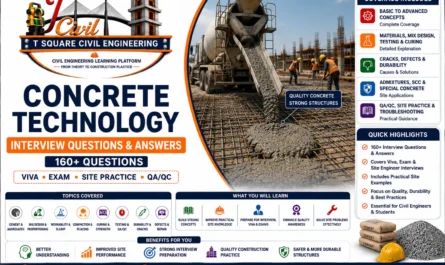
by Preparing for a civil engineering interview requires more than memorising definitions. Candidates should understand fundamental engineering concepts and be able to explain how those concepts are applied in design, testing, estimation, quality control and construction-site execution.
This guide contains 100 civil engineering interview questions and answers covering civil engineering fundamentals, concrete technology, RCC, reinforcement, foundations, soil, brick masonry, quantity estimation, surveying, highway engineering, QA/QC, construction safety, site execution and common HR questions.
The answers are written in simple language for freshers, diploma and degree students, site engineers and experienced construction professionals. Relevant Indian Standards and accepted engineering practices are mentioned where applicable; however, project-specific values must always be verified using approved drawings, specifications and the currently applicable standards.
Use this guide for:
- Civil engineering interview preparation
- Civil site engineer and QA/QC interviews
- Quantity surveying and estimation interviews
- Campus placements and technical viva preparation
- SSC JE, State JE/AE and similar technical interview revision
- Quick review of practical construction terminology
Do not memorise every answer word for word. Understand the concept and explain it naturally using examples from your academic projects, internships, training or construction-site experience.
For specialised preparation, explore the complete Civil Engineering Interview Questions and Answers collection.
Use this as a question bank, quick revision sheet, and reference before interviews or exams.

Page Contents
Interview Questions and Answers:
1. What is Civil Engineering?
Answer:
Civil engineering is a major branch of engineering that focuses on the planning, analysis, design, construction, operation, and maintenance of the infrastructure we use every day. Civil engineers are responsible for creating safe, durable, and sustainable structures that support modern life.
Typical examples of civil engineering works include:
• Residential and commercial buildings
• Highways, expressways, and rural roads
• Bridges and flyovers
• Railway lines and metro systems
• Dams, canals, and other hydraulic structures
• Tunnels, subways, and culverts
• Water supply, drainage, and sewage treatment systems
A good line to use in interviews:
“Civil engineering shapes society by providing the essential, safe, and sustainable infrastructure that people depend on every day.”
2. Why did you choose Civil Engineering?
Answer (sample):
“I chose civil engineering because it allows me to work on real structures that people use every day—roads, railways, buildings, bridges, dams, airports, and water supply systems. It combines technical design with practical site execution, so I can work both in the office as well as on-site. I enjoy solving real-world problems, coordinating with different teams, and feeling proud when my work becomes part of my country’s infrastructure and development.”
You can personalise this by adding:
• A college project you enjoyed
• An internship or site experience that inspired you
• A specific structure or project that motivated you to become a civil engineer
3. What is PCC?
Answer:
PCC (Plain Cement Concrete) is concrete in which no steel reinforcement is provided to resist structural tensile forces. It is mainly used where compressive action predominates and significant tensile or flexural resistance is not required.
Typical uses of PCC in civil engineering works include:
- Levelling or blinding courses below RCC footings and foundations
- Bed concrete for foundations
- Plain or mass-concrete foundations and gravity components
- Base concrete below floors and pavements
- Walkways and non-reinforced pavement works
- Bedding and support for underground pipes
- Plain-concrete components in bridge, road and hydraulic works, where specified in the approved drawings
Lower grades such as M7.5, M10 and M15 are commonly encountered in blinding, levelling and other plain-concrete works, depending on the purpose and project specifications.
However, PCC is not always limited to these lower grades. IS 456 durability provisions relate the minimum concrete grade, minimum cement content and maximum free water–cement ratio to the environmental exposure condition. For plain concrete, the minimum grade specified in Table 5 is M15 for mild and moderate exposure, M20 for severe and very severe exposure, and M25 for extreme exposure.
Therefore, M20 or M25 PCC may be specified in bridge works, hydraulic structures, marine environments and other exposed construction where required by durability, exposure, design and project-specific specifications.
The grade must not be selected merely because the structure is considered important. It should be selected according to:
- Applicable exposure classification
- Approved structural and construction drawings
- Relevant IS, IRC, IRS or other governing standards
- Project and authority specifications
- Durability and service-life requirements
- Site and environmental conditions
Example for interviews:
“In ordinary building construction, a PCC levelling course such as M7.5 or M10 may be specified below an RCC footing to provide a clean and level working surface and separate the structural concrete from the soil. In bridge or hydraulic works exposed to severe, very severe or extreme environmental conditions, M20 or M25 plain concrete may be specified to satisfy durability and project requirements.”
Important: Nominal proportions such as 1:4:8 or 1:3:6 should be mentioned only when they are specifically permitted by the applicable standard and project specification. The approved concrete grade and mix requirements take priority.
4. What is RCC?
Answer:
RCC (Reinforced Cement Concrete) is the concrete in which steel reinforcement (bars, mesh, or wires) is embedded so that the member can safely resist both compressive and tensile forces. The concrete mainly takes compression, while the steel reinforcement carries tension and improves ductility.
Common applications of RCC in civil engineering:
• Beams and columns in framed structures
• Slabs and staircases in buildings
• Footings, pile caps, and raft foundations
• Bridges, Water tanks, overhead reservoirs, retaining walls, silos, and chimneys
Example to mention in interviews:
“In a simply supported RCC beam, the concrete at the top zone resists compressive stress/force, while the steel reinforcement provided at the bottom of beam resists the tensile force/stresses developed due to bending.”
5. Difference between PCC and RCC
Answer:
PCC stands for Plain Cement Concrete and RCC stands for Reinforced Cement Concrete and both are widely used in civil engineering, and the difference between them are given below:
| Aspect | PCC (Plain Cement Concrete) | RCC (Reinforced Cement Concrete) |
| Reinforcement | No steel reinforcement is provided | Contains steel bars or mesh as reinforcement |
| Stresses | Designed mainly to resist compression | Designed to resist both compression and tension |
| Cost | Lower cost | Higher cost |
| Typical Use | Levelling course, bedding, non-structural base layers | Structural members like beams, slabs, columns, and load-bearing structures |
In simple words, PCC is used as a non-structural, compressive base layer, while RCC is used as a structural material where both tension and compression must be safely resisted.
6. What is Concrete?
Answer:
Concrete is a composite construction material produced by mixing cement, fine aggregate, coarse aggregate and water in suitable proportions. Chemical admixtures and supplementary cementitious materials may also be incorporated to obtain the required workability, strength, durability, setting characteristics or other performance requirements.
When water is added, the cementitious materials undergo hydration and form a hardened paste that binds the aggregates together into a solid mass.
The principal ingredients of concrete are:
- Cement
- Fine aggregate
- Coarse aggregate
- Water
- Chemical admixtures, when required (Optional – to improve the workability, strength, and durability)
- Supplementary cementitious materials, when required
Concrete is strong in compression but relatively weak in tension. Therefore, steel reinforcement is normally provided when concrete must resist significant tensile, flexural or shear stresses.
Selection of Concrete Grade
Concrete grade must not be selected only according to the type of structural member, such as a slab, beam, column or footing. The required grade should be determined from:
- Approved structural design and drawings
- Design strength requirements
- Environmental exposure conditions
- Durability and intended service-life requirements
- Applicable codes and project specifications
- Construction and quality-control requirements
The concrete mix design is then developed and approved to achieve the specified grade, workability, durability and other performance requirements.
Under IS 456, M20 is the minimum grade specified for reinforced concrete exposed to mild conditions. Higher grades may be required for more severe exposure, higher structural demands or project-specific requirements.
Interview example:
“The concrete grade for a residential slab should not be assumed as M20 or M25 merely from general site practice. It must be confirmed from the approved structural drawings. The concrete mix design should then be developed to meet the specified grade, workability, durability and exposure requirements.”
7. What are the ingredients of concrete?
Answer:
Concrete is made from a combination of basic materials and optional admixtures that control its performance.
Main ingredients of concrete are:
• Cement – the binding material that hardens and holds everything together.
• Fine aggregate (sand) – fills the gaps between coarse particles and helps achieve a dense mix.
• Coarse aggregate – provides bulk, strength, and stability to the concrete.
• Water – reacts with cement (hydration) and makes the mix workable.
Additional materials often used:
• Chemical admixtures – such as plasticizers, superplasticizers, retarders, and accelerators to modify workability, setting time, or early strength.
• Mineral admixtures – like fly ash, GGBS (Ground Granulated Blast Furnace Slag), and silica fume to improve durability, reduce permeability, and enhance long-term strength.
This combination of ingredients allows civil engineers to design concrete mixes with the required strength, workability, and durability for different structures.
8. What is Cement?
Answer:
Cement is a finely ground hydraulic binding material that reacts with water, sets and hardens through hydration. The hardened cement paste binds fine and coarse aggregates together in concrete and binds masonry units through mortar.
Hydraulic cement can set and harden in the presence of water and retain its strength and stability after hardening.
Cement contributes to the strength, cohesion and performance of concrete and mortar. However, the durability of concrete does not depend on cement alone. It is also affected by the water–cement ratio, concrete mix proportions, compaction, curing, cover to reinforcement, workmanship and environmental exposure.
Common Types of Cement
- OPC—Ordinary Portland Cement: OPC is available in 33, 43 and 53 grades under IS 269. These grades relate to the specified compressive strength of standard cement–sand mortar cubes at 28 days and must not be confused with concrete grades such as M20 or M25. The appropriate OPC grade should be selected according to the required strength development, construction method, exposure and project specifications.
- PPC—Portland Pozzolana Cement: PPC contains Portland cement clinker, gypsum and a pozzolanic material such as fly ash or calcined clay. Depending on its composition and application, PPC may provide good workability, lower heat evolution and improved resistance to certain exposure conditions. Its early-strength development may be slower than that of some OPCs.
- PSC—Portland Slag Cement: PSC contains Portland cement clinker, gypsum and granulated blast-furnace slag. When properly selected, proportioned and cured, it may provide lower heat evolution, reduced permeability and improved resistance in certain marine, sulphate-bearing or chloride-exposed environments.
Selection of Cement
The type and grade of cement should be selected according to:
- Structural and durability requirements
- Environmental exposure
- Required early- and later-age strength
- Heat-of-hydration considerations
- Applicable standards and project specifications
- Compatibility with admixtures and other concrete materials
- Construction and curing conditions
No cement type should be assumed to be universally superior for every application.
Interview example:
“PPC is commonly used in masonry, general concrete and some mass-concrete applications where good workability and controlled heat development are beneficial. However, it should not be stated that PPC always develops better long-term strength than OPC. Actual performance depends on cement composition, concrete mix design, water–cement ratio, curing, exposure conditions and workmanship.”
Relevant Indian Standards
- OPC: IS 269:2015
- Fly ash-based PPC: IS 1489 (Part 1):2015
- PSC: IS 455:2015
9. What is Hydration?
Answer:
Hydration is the chemical reaction that takes place when water is added to cement. During this process, new compounds such as C–S–H gel (Calcium–Silicate–Hydrate) and calcium hydroxide are formed. These products are mainly responsible for the setting, hardening, and strength development of concrete.
The hydration process also generates heat of hydration. In mass concrete works—such as dams, large foundations, and thick raft slabs—this heat must be carefully controlled to avoid excessive temperature rise and cracking.
In simple words, hydration is the reaction that converts fresh cement paste into a hard, load-bearing concrete.
10. What is Water-Cement Ratio?
Answer:
The water–cement ratio, or w/c ratio, is the ratio of the mass of free water to the mass of cement used in a concrete mix.
It is a dimensionless value and is one of the most important factors influencing the strength, permeability, durability and workability of concrete.
Formula
Water–Cement Ratio = Mass of Free Water ÷ Mass of Cement
Example
If:
- Water = 20 kg
- Cement = 50 kg
Then:
Water–cement ratio = 20 ÷ 50 = 0.40
This means that 0.40 kg of water is used for every 1 kg of cement.
Effect of Water–Cement Ratio
For the same materials, mix conditions and curing, reducing the water–cement ratio generally increases concrete strength and reduces permeability, provided that adequate workability, placement and compaction are achieved.
An excessively high water–cement ratio can:
- Increase bleeding and segregation
- Create more capillary pores after hardening
- Reduce compressive strength
- Increase permeability
- Reduce durability
- Increase the risk of shrinkage and surface defects
However, an excessively low water–cement ratio can make concrete difficult to place and compact. Poor compaction may create voids and reduce the strength and durability of the finished concrete.
Therefore, water should not be reduced without considering workability, compaction and curing. Where necessary, an approved water-reducing admixture or superplasticizer may be used to obtain the required workability without adding excessive water.
Selection of Water–Cement Ratio
There is no universal recommended water–cement ratio such as 0.40–0.50 for all concrete.
The adopted water–cement ratio should satisfy:
- Strength requirements established through concrete mix design
- Maximum durability limit for the applicable exposure condition
- Workability and placing requirements
- Cement and aggregate characteristics
- Admixture compatibility
- Approved drawings and project specifications
The selected ratio should not exceed the maximum value permitted for the applicable environmental exposure. Under IS 456, different maximum water–cement ratios are specified for different exposure conditions and for plain and reinforced concrete.
The final adopted ratio is normally the more restrictive value obtained from strength and durability considerations.
Important Site Note
The calculation should use the effective free water in the concrete. Moisture contributed by wet aggregates and, where applicable, liquid admixtures should be considered, while water absorbed by aggregates should be accounted for according to the approved batching procedure.
When supplementary cementitious materials are included, the project specification may define a water–binder or water–cementitious-material ratio. Materials must not be included in the denominator unless permitted by the applicable standard and approved mix design.
Interview example:
“A water–cement ratio of 0.40 means that, for example, 20 kg of free water is used with 50 kg of cement. The ratio should not be selected from a universal range. It must satisfy both the strength requirement established by mix design and the maximum durability limit specified for the applicable exposure condition.”
11. What is Workability?
Answer:
Workability is the ease with which fresh concrete can be mixed, transported, placed, compacted, and finished without segregation or bleeding.
Factors affecting workability:
• Water content
• Size, shape, and grading of aggregates
• Cement content
• Use of admixtures (plasticizers/superplasticizers)
• Temperature and time
Example: Pumped concrete for high-rise buildings requires high workability (higher slump) to flow easily through pipelines.
12. What is Slump Test?
Answer:
The slump test is used to determine the consistency of fresh concrete and to provide an indication of its workability under specified test conditions.
The test is commonly performed at the batching plant, laboratory or construction site using a standard slump cone. After the cone is filled and compacted according to the prescribed procedure, it is lifted vertically. The resulting subsidence of the concrete is measured in millimetres and reported as the slump.
The slump test is conducted in accordance with IS 1199 (Part 2):2018—Fresh Concrete: Methods of Sampling, Testing and Analysis, Part 2: Determination of Consistency of Fresh Concrete.
Factors Affecting the Specified Slump
The required slump depends on:
- Concrete mix proportions
- Method of placing and compaction
- Pumping requirements
- Size and geometry of the member
- Congestion of reinforcement
- Aggregate grading and maximum aggregate size
- Use of chemical admixtures
- Transportation time and ambient conditions
- Approved mix design and project specifications
There is no universal slump range for all slabs, beams, columns, footings or road works. The acceptance range and permitted tolerance must follow the approved concrete mix design, construction method and project specifications.
Interpretation of Slump
- True slump: The concrete subsides approximately uniformly and generally provides a valid test result.
- Shear slump: Part of the concrete shears and slips sideways. The test should be repeated and interpreted according to the applicable test standard.
- Collapse slump: The concrete collapses substantially, indicating that the slump test may not be suitable for determining the consistency of that concrete.
A slump result alone does not establish concrete strength or durability. A high slump may result from excessive water, but it may also be produced using an approved water-reducing admixture or superplasticiser. Therefore, water should not be added at the site merely to increase slump unless the addition is permitted, controlled and documented under the approved procedure.
Interview example:
“The slump test checks the consistency of fresh concrete at the time of placement. The measured slump is compared with the range specified in the approved mix design or project specification—not with a universal value based only on whether the concrete is used in a slab, beam or footing.”
13. What is Segregation?
Answer:
Segregation is the separation of coarse aggregate from the cement mortar in concrete.
Causes:
• Dropping concrete from excessive height
• Over-vibration
• Too much water (very wet mix)
• Poor grading of aggregates
Effects:
• Honeycombing
• Loss of strength
• Poor surface finish
• Reduced durability
14. What is Bleeding?
Answer:
Bleeding is the upward movement of water in freshly placed concrete as solid particles settle downward.
Prevention:
• Use proper water-cement ratio
• Proper mix design and grading of aggregates
• Use of suitable admixtures
• Avoid over-vibration and excessive compaction
15. What is Honeycombing?
Answer:
Honeycombing refers to voids or cavities in hardened concrete that resemble a honeycomb.
Causes:
• Inadequate vibration
• Congested reinforcement
• Leaky or poorly fixed formwork
• Harsh concrete mix with insufficient fines
Honeycombing reduces strength and durability and often requires repair.
16. What is Curing?
Answer:
Curing is the process of maintaining adequate moisture and temperature in concrete so that hydration continues and the concrete gains the desired strength and durability.
Benefits:
• Higher compressive strength
• Improved durability and water-tightness
• Reduced shrinkage cracks
• Better surface hardness
17. Methods of Curing
Answer:
• Water ponding (on slabs)
• Sprinkling or spraying water
• Covering with wet hessian/gunny bags
• Covering with plastic sheets
• Membrane-forming curing compounds
• Steam curing (for precast elements)
18. What Is the Minimum Curing Period for Concrete?
Answer:
Curing is the process of maintaining adequate moisture and suitable temperature conditions in concrete so that cement hydration can continue and the concrete can develop the required strength and durability.
According to IS 456:2000, the general minimum moist-curing periods are:
- Concrete made with Ordinary Portland Cement: Moist curing should continue for at least seven days from the date of placing.
- Concrete containing mineral admixtures or made with blended cement: Moist curing should continue for at least 10 days.
- Concrete exposed to dry and hot weather: The curing period should not be less than 10 days.
- Concrete containing mineral admixtures or made with blended cement: IS 456 recommends extending the applicable minimum curing period to 14 days, particularly under dry and hot conditions.
These are minimum general requirements. A longer curing period may be specified depending on:
- Cement and supplementary cementitious materials
- Concrete mix and water–cement ratio
- Environmental exposure
- Ambient temperature and humidity
- Size and type of concrete member
- Required strength development
- Project specifications
During moist curing, exposed concrete surfaces should remain continuously damp. This may be achieved through ponding, wet coverings, sprinkling or another approved curing method.
Occasional wetting followed by complete drying does not provide effective moist curing.
Interview example:
“Concrete made with OPC generally requires a minimum of seven days of moist curing under normal conditions. Concrete containing mineral admixtures or blended cement generally requires at least 10 days, and longer curing may be required under hot and dry conditions or by the project specifications.”
19. What is M20 Concrete?
Answer:
M20 concrete has a characteristic compressive strength of 20 MPa (20 N/mm²) at 28 days.
Where nominal mixes are permitted, a common proportion is:
1 : 1.5 : 3 (Cement : Sand : Coarse Aggregate)
For important structural work, a design mix is preferred.
20. What is Characteristic Strength?
Answer:
Characteristic strength is the compressive strength value below which not more than 5% of test results are expected to fall.
Example: For M25 concrete, characteristic strength = 25 MPa at 28 days.
21. What is Nominal Mix?
Answer:
Nominal mix uses fixed proportions of cement, sand, and aggregate based on past experience.
Example: Where permitted – M20 = 1:1.5:3.
It is simple but has limited quality control.
22. What is Design Mix?
Answer:
Design mix is proportioned through laboratory trials to achieve required strength, workability, and durability considering actual material properties.
Advantages:
• Better quality control
• More economical use of cement
• Consistent performance
• Suitable for major structural projects
23. Difference between Nominal Mix and Design Mix
| Aspect | Nominal Mix | Design Mix |
| Proportions | Fixed (e.g., 1:1.5:3) | Based on lab trials and target strength |
| Basis | Experience/past practice | Material tests, workability, durability requirements |
| Quality control | Limited | Better and more reliable |
| Typical use | Lower grades, small works (where allowed) | Structural concrete for major works |
24. What is Compressive Strength?
Answer:
Compressive strength is the maximum compressive load a material can withstand per unit area before failure.
For concrete, it is measured using standard cubes or cylinders after curing (usually 28 days) and expressed in MPa (N/mm²).
25. Why are cubes tested after 7 days and 28 days?
Answer:
Concrete gains strength gradually as cement hydration continues. Concrete cube specimens may therefore be tested at different ages to evaluate strength development.
Seven-Day Test
The seven-day compressive-strength test provides an early indication of concrete strength development. It can help identify abnormal batching, material, curing or testing conditions before the 28-day result becomes available.
The seven-day result is useful for:
- Monitoring early-strength development
- Comparing results with approved mix-design trial data
- Detecting possible batching or material variations
- Reviewing curing and testing practices
- Supporting construction decisions when permitted by the project specification
A statement that every concrete mix must achieve a fixed percentage, such as 60% to 70% of its 28-day strength at seven days, is only a general approximation. It is not a universal acceptance criterion.
Actual early-strength development depends on:
- Cement type
- Water–cement or water–binder ratio
- Supplementary cementitious materials
- Chemical admixtures
- Concrete grade
- Curing temperature and method
- Aggregate and other material properties
Seven-day expectations should therefore be established from approved mix-design trials, previous performance data or project requirements.
Twenty-Eight-Day Test
For normal concrete assessed under IS 456, the 28-day compressive strength is the principal age used for strength compliance and acceptance unless another test age has been specified.
Acceptance must be evaluated using the applicable sampling and statistical criteria. Concrete should not be accepted or rejected merely by comparing one individual cube result with the characteristic compressive strength.
Additional test ages may be specified for:
- Precast concrete
- Formwork-removal decisions
- Prestressing or post-tensioning operations
- Concrete containing supplementary cementitious materials
- Mass concrete
- Special curing systems
- Other project-specific requirements
Interview example:
“The seven-day cube test provides an early indication of concrete strength development, while the 28-day result is normally used for compliance and acceptance. A fixed seven-day percentage is not universally applicable because strength development depends on the cement, concrete mix, admixtures and curing conditions.”
26. Difference between Cement and Concrete
Answer:
| Particulars | Cement | Concrete |
| Nature | Binding material (powder) | Composite construction material |
| Composition | Clinker + gypsum, etc. | Cement + sand + coarse aggregate + water (+ admixtures) |
| Use | In mortar, concrete, grout | Structural members, pavements, foundations |
| Form | Manufactured product | Prepared on site or in batching plant |
27. What is Mortar?
Answer:
Mortar is a mixture of cement, sand, and water (sometimes with lime or admixtures) used to bind masonry units and provide a smooth surface.
Uses:
• Brick and stone masonry
• Plastering walls and ceilings
• Tile fixing
• Pointing and joint filling
Unlike concrete, mortar does not contain coarse aggregate.
28. Difference between Mortar and Concrete
Answer:
| Particulars | Mortar | Concrete |
| Composition | Cement + sand + water | Cement + sand + coarse aggregate + water |
| Coarse aggregate | Not used | Used |
| Typical use | Masonry, plaster, tile bedding | Structural elements (slabs, beams, footings, columns) |
| Strength | Lower | Higher |
29. What is Fine Aggregate?
Answer:
Fine aggregate is aggregate, most of which passes through the 4.75 mm IS sieve, and which satisfies the applicable grading and quality requirements of IS 383.
Fine aggregate may include:
- Natural river sand
- Manufactured sand
- Crushed stone sand
- Crushed gravel sand
- Mixed sand
- Other fine aggregate permitted by the applicable specification
Fine aggregate is classified into grading zones according to its particle-size distribution.
Material finer than the 75-micron IS sieve may be present only within the limits permitted for the particular type of fine aggregate. Therefore, fine aggregate should not be defined simply as material passing through the 4.75 mm sieve and retained on the 75-micron sieve.
Functions of Fine Aggregate
Fine aggregate performs several functions in concrete and mortar:
- Fills spaces between coarse aggregate particles
- Improves cohesiveness and workability
- Contributes to proper aggregate grading
- Helps produce a dense concrete mass
- Supports the required surface finish
- Reduces excessive voids in the concrete
- Influences water demand and pumpability
Fine aggregate must satisfy the specified requirements for:
- Grading
- Deleterious materials
- Particle shape and texture
- Moisture condition
- Water absorption
- Durability
- Other project-specific properties
Interview example:
“Fine aggregate is aggregate, most of which passes through the 4.75 mm IS sieve. Its suitability cannot be decided by sieve size alone; it must also meet the grading, deleterious-material and quality requirements of IS 383 and the project specification.”
30. What is Coarse Aggregate?
Answer:
Coarse aggregate consists of particles retained on the 4.75 mm IS sieve.
Common sizes: 10 mm, 20 mm, 40 mm.
Functions:
• Provides bulk and strength
• Reduces shrinkage
• Improves durability
• Forms the skeleton of concrete
31. What Is Aggregate Crushing Value (ACV)?
Answer:
Aggregate Crushing Value, or ACV, indicates the resistance of coarse aggregate to crushing under a gradually applied compressive load. The test is conducted according to IS 2386 (Part 4).
A lower ACV generally indicates stronger aggregate with greater resistance to crushing.
Formula
ACV (%) = (B ÷ A) × 100
Where:
- A = mass of the surface-dry test sample
- B = mass of fines passing the appropriate IS sieve—2.36 mm for the standard test
According to IS 383:2016:
- For aggregates used in concrete wearing surfaces, such as roads, runways, pavements, spillways and water-carrying tunnel linings, the ACV should not exceed 30%.
- For aggregates used in concrete other than wearing surfaces, when the ACV exceeds 30%, the 10% fines value test should be conducted. The minimum load required to produce 10% fines should be 50 kN.
- For concrete grades M65 and above, the ACV should not exceed 22%.
For granular sub-base, road base and other pavement layers, the applicable MoRTH, IRC and project specifications should be followed.
Interview example:
“Aggregate Crushing Value measures the resistance of coarse aggregate to gradual crushing. A lower value generally indicates stronger aggregate.”
32. What Is Aggregate Impact Value (AIV)?
Answer:
Aggregate Impact Value, or AIV, indicates the resistance of coarse aggregate to sudden impact or shock. It is a measure of aggregate toughness and is determined according to IS 2386 (Part 4).
A lower AIV generally indicates tougher aggregate with greater resistance to impact.
Formula
AIV (%) = (B ÷ A) × 100
Where:
- A = mass of the oven-dried test sample
- B = mass of fines passing the 2.36 mm IS sieve after the impact test
According to IS 383:2016:
- For aggregates used in concrete wearing surfaces, such as roads, runways, pavements, spillways and water-carrying tunnel linings, the AIV should not exceed 30%.
- For aggregates used in concrete other than wearing surfaces, the AIV should not exceed 45%.
- For concrete grades M65 and above, the AIV should not exceed 22%.
For road bases and other pavement layers, the applicable MoRTH, IRC and project specifications should be followed.
Interview example:
“ACV measures resistance to gradual crushing, whereas AIV measures resistance to sudden impact or shock.”
33. Specific Gravity of Cement
Answer:
The specific gravity of OPC is usually around 3.15.
For PPC and blended cements, it may be slightly lower (approximately 2.9–3.1) depending on composition.
34. What Is the Initial Setting Time of Cement?
Answer:
Initial setting time is the period from the addition of water to cement until the cement paste reaches the specified initial-setting condition in the Vicat apparatus.
Under IS 4031 (Part 5), initial setting occurs when the specified needle no longer penetrates the paste beyond the prescribed distance from the bottom of the mould.
IS 4031 provides the test method, while the applicable cement product standard gives the acceptance requirement.
For OPC complying with IS 269, the initial setting time should not be less than 30 minutes.
35. What Is the Final Setting Time of Cement?
Answer:
Final setting time is the period from the addition of water to cement until the paste reaches the specified final-setting condition in the Vicat apparatus.
In the final-setting test, the needle may make an impression on the paste, but the annular attachment should no longer leave an impression.
For OPC complying with IS 269, the final setting time should not exceed 600 minutes, or 10 hours.
Final setting does not mean that the cement or concrete has developed its design strength. Strength development continues through hydration.
36. What is Fineness of Cement?
Answer:
Fineness indicates the particle size of cement, often measured by sieve test or Blaine’s specific surface.
Effects of finer cement:
• Faster hydration
• Higher early strength
• More heat of hydration
• Needs careful curing to control shrinkage and cracking
37. Why is a Vibrator Used in Concrete?
Answer:
Concrete vibrators are used to remove entrapped air and properly compact concrete.
Benefits:
• Higher strength and density
• Better bond with reinforcement
• Reduced honeycombing and voids
• Improved durability and surface finish
38. What Happens if Concrete is Not Vibrated Properly?
Answer:
• Honeycombing and voids
• Entrapped air pockets
• Lower strength and stiffness
• Water leakage and higher permeability
• Exposed reinforcement and poor bond
39. What is Cover to Reinforcement?
Answer:
Concrete cover is the distance between the outer concrete surface and the nearest surface of reinforcement steel.
Purpose:
• Protects steel from corrosion
• Provides fire resistance
• Ensures proper bond
• Enhances durability and service life
Cover requirements depend on member type, exposure, and code provisions.
40. Why is Concrete Cover Important?
Answer:
• Prevents or delays corrosion of reinforcement
• Provides required fire resistance
• Protects steel from weather, chemicals, and carbonation
• Helps the structure achieve its design life
Insufficient cover often leads to cracking, rust stains, and spalling.
41. What is Development Length?
Answer:
Development length is the minimum embedment length of reinforcement necessary to develop its full tensile strength through bond between steel and concrete.
Depends on:
• Bar diameter
• Grade of steel
• Grade of concrete
• Bond conditions (good/poor)
Formulae are given in design codes (e.g., IS 456).
42. What is Lap Length?
Answer:
Lap length is the overlap length provided when two bars are joined to transfer stresses from one bar to another.
Used when bar length is insufficient or for construction convenience.
Depends on:
• Bar diameter
• Bar type (plain/deformed)
• Position (tension/compression)
• Code provisions and drawings
43. What is Anchorage Length?
Answer:
Anchorage length is the length of reinforcement embedded or bent into concrete (including hooks/bends) to develop adequate bond and prevent bar pull-out.
Commonly used at beam-column joints, hooks at bar ends, and foundation reinforcements.
44. What is Reinforcement?
Answer:
Reinforcement is steel provided inside concrete to resist tensile, shear, and sometimes compressive forces.
Types:
• Main (longitudinal) bars
• Distribution bars
• Stirrups
• Ties
• Dowel bars
• Temperature and shrinkage reinforcement
45. What Are Stirrups?
Answer:
Stirrups are transverse reinforcement provided mainly in reinforced-concrete beams.
Their principal functions are to:
- Resist shear and diagonal-tension forces
- Contribute to torsional resistance where required
- Hold longitudinal reinforcement in position
- Control diagonal cracking
- Improve confinement and ductility
In columns, transverse reinforcement is normally called lateral ties, hoops, spirals or helical reinforcement rather than stirrups.
The diameter, spacing, number of legs, anchorage and configuration must follow the approved structural drawings.
46. What are Main Bars?
Answer:
Main bars are primary longitudinal reinforcement that resists major tensile stresses.
Examples:
• Bottom bars in simply supported beams
• Top bars in cantilever beams
• Main reinforcement in slabs
• Longitudinal bars in columns
47. What are Distribution Bars?
Answer:
Distribution bars are secondary reinforcement placed at right angles to main bars in slabs.
Functions:
• Distribute loads
• Control shrinkage and temperature cracks
• Maintain spacing and position of main bars
48. What is a Beam?
Answer:
A beam is a horizontal or slightly inclined structural member designed to carry loads primarily by bending and transfer them to columns, walls, or foundations.
Types:
• Simply supported
• Cantilever
• Continuous
• Fixed
• Overhanging
49. What is a Column?
Answer:
A column is a vertical structural member that primarily carries axial compressive loads and transfers them from beams and slabs to foundations.
Common shapes: square, rectangular, circular, L-shaped, etc.
50. What is a Slab?
Answer:
A slab is a flat horizontal structural element that forms floors and roofs, transferring loads to beams, walls, or columns.
Types:
- One-way slab
- Two-way slab
- Flat slab
- Waffle slab
- Ribbed slab
51. What is a Foundation?
Answer:
A foundation is the lowest part of a structure that safely transfers building loads to the supporting soil or rock.
Functions:
• Transfers loads safely to the ground
• Prevents excessive and differential settlement
• Increases overall stability
• Resists sliding and overturning
• Distributes loads over a larger area
52. Types of Foundations
Answer:
A. Shallow Foundations
• Isolated footing
• Combined footing
• Strap footing
• Raft (mat) foundation
B. Deep Foundations
• Pile foundation
• Pier foundation
• Caisson foundation
Choice depends on soil conditions, loading, water table, and economy.
53. What is an Isolated Footing?
Answer:
An isolated footing supports a single column. It is used when soil has adequate bearing capacity and columns are spaced sufficiently.
Advantages:
• Economical for low/medium-rise buildings
• Easy to design and construct
• Simple formwork arrangement
54. What is a Combined Footing?
Answer:
A combined footing supports two or more columns on a single base.
Used when:
• Columns are close together
• Property boundary limits footing size
• Individual footings would overlap
55. What is a Raft Foundation?
Answer:
A raft (mat) foundation is a large RCC slab supporting multiple columns and/or walls.
Used when:
• Soil bearing capacity is low
• Columns are closely spaced
• Differential settlement must be minimized
• Basements or large podium slabs are provided
56. What is a Pile Foundation?
Answer:
Pile foundations are long, slender members (concrete/steel/timber) driven or cast into the ground to transfer loads to deeper, stronger strata.
Applications:
• Weak or compressible surface soils
• High-rise buildings
• Bridges and marine structures
• Structures needing uplift and lateral load resistance
57. What is Safe Bearing Capacity (SBC)?
Answer:
SBC is the maximum pressure that soil can safely support without shear failure or excessive settlement.
Measured in kN/m² or kPa and obtained from soil investigation reports.
58. What is Differential Settlement?
Answer:
Differential settlement occurs when different parts of a structure settle unevenly.
Effects:
• Cracks in walls and finishes
• Uneven floors
• Door/window misalignment
• Structural distress
59. What is Soil Compaction?
Answer:
Compaction increases soil density by reducing air voids using mechanical equipment.
Benefits:
• Higher bearing capacity
• Reduced settlement
• Improved slope stability
• Lower permeability and less seepage
60. What is Earthwork?
Answer:
Earthwork includes excavation, filling, backfilling, levelling, and compaction of soil.
Examples:
• Foundation excavation
• Road embankments
• Canal and drain excavation
• Backfilling around foundations and retaining walls
61. What is Brick Masonry?
Answer:
Brick masonry is construction using bricks bonded with mortar to form walls and other elements.
Advantages:
• Economical and locally available
• Durable and fire-resistant
• Easy to maintain
• Suitable for load-bearing and partition walls
62. Standard Dimensions of a Brick (India)
Answer:
• Actual size: 190 × 90 × 90 mm
• Nominal size (with 10 mm mortar joint): 200 × 100 × 100 mm
63. Qualities of a Good Brick
Answer:
• Uniform size, shape, and colour
• Well burnt, free from cracks and defects
• Produces a clear ringing sound when struck
• Sharp edges and corners
• Limited water absorption
• Adequate compressive strength as per standards
64. What Is Water Absorption of Bricks?
Answer:
Brick water absorption is the increase in mass after immersion in water, expressed as a percentage of the dry mass.
Formula:
Water absorption (%) = [(Wet mass − Dry mass) ÷ Dry mass] × 100
Under IS 1077:2025, common burnt-clay bricks are classified according to their minimum average compressive strength. For example, Class 12.5 means that the bricks have a minimum average compressive strength of 12.5 N/mm².
After 24-hour water immersion, the average water absorption should not exceed:
- 20% by dry mass for bricks up to and including Class 12.5
- 15% by dry mass for bricks above Class 12.5
Class 12.5 is therefore a compressive-strength classification—not a water-absorption percentage or an informal brick-quality category.
65. What is Efflorescence?
Answer:
Efflorescence is the appearance of white, powdery salt deposits on the surface of bricks or concrete due to movement of soluble salts with moisture.
Causes:
• Salts in bricks, sand, water, or mortar
• Water ingress and evaporation
• Poor drainage or lack of damp-proofing
66. What is Plastering?
Answer:
Plastering is the application of a mortar layer on walls/ceilings to provide a smooth, protective, and decorative finish.
Advantages:
• Improves appearance
• Protects against weather and moisture
• Increases durability
• Provides a good base for painting
67. What is Curing of Brick Masonry?
Answer:
Curing of brick masonry means keeping the masonry moist to ensure proper hydration and strength gain of the mortar.
Typically cured for at least 7 days, or longer as per specifications and climate.
68. What is Center Line Method in Estimation?
Answer:
In the center line method, the total center line length of walls is calculated and multiplied by cross-sectional area to get quantities.
Advantages:
• Faster calculations
• Less repetitive measurement
• Suitable for symmetrical buildings
69. What is Long Wall–Short Wall Method?
Answer:
In this method:
• Long walls are measured out-to-out.
• Short walls are measured in-to-in.
Commonly used where wall thickness varies or building is irregular.
70. What is an Estimate?
Answer:
An estimate is a calculation of quantities and probable cost of materials, labour, equipment, and other resources needed for a construction project.
Used for budgeting, tendering, and cost control.
71. What is BOQ?
Answer:
BOQ (Bill of Quantities) is a document listing work items with their detailed descriptions and quantities.
Used for:
• Tendering and bid comparison
• Cost estimation
• Interim and final payments
72. What is Rate Analysis?
Answer:
Rate analysis determines the unit cost of an item of work.
It considers:
• Material cost
• Labour cost
• Equipment and tools
• Transportation
• Overheads and contractor’s profit
73. What is Bar Bending Schedule (BBS)?
Answer:
BBS is a detailed list of reinforcement bars used in a structure.
Includes:
• Bar mark
• Diameter
• Shape and bending details
• Cutting length
• Number of bars
• Total length and weight
Benefits:
• Accurate steel estimation
• Reduced wastage
• Easier cutting, bending, and placing
• Better inventory and cost control
74. What is Quantity Surveying?
Answer:
Quantity surveying involves measuring quantities, estimating costs, and managing contracts for construction projects.
Responsibilities:
• Preparing estimates and BOQs
• Cost planning and budgeting
• Valuation of work and billing
• Contract administration and variation claims
• Monitoring project costs
75. What is QA/QC in Construction?
Answer:
QA (Quality Assurance): Systems and procedures to prevent defects by planning and process control.
QC (Quality Control): Inspection and testing to check if work meets specifications.
Examples of QC:
• Slump test
• Cube strength test
• Reinforcement inspection
• Material quality tests
• Dimensional checks
76. What is Surveying?
Answer:
Surveying is the science and art of determining relative positions of points on, above, or below the earth’s surface and representing them on maps, plans, or digital models.
Applications:
• Building and road layout
• Bridge and canal alignment
• Land measurement and property boundaries
• Topographic mapping
77. Types of Surveying
Answer:
• Chain survey
• Compass survey
• Plane table survey
• Theodolite survey
• Levelling
• Total station survey
• GPS/GNSS survey
• Drone (UAV) survey
78. What is Levelling?
Answer:
Levelling determines the difference in elevation between points.
Purpose:
• Establish reduced levels (RL)
• Set formation levels of roads and railways
• Fix plinth and floor levels
• Check settlement/heave of structures
79. What is a Benchmark (BM)?
Answer:
A benchmark is a fixed reference point of known elevation used during levelling.
Types:
• GTS benchmark (national survey agencies)
• Permanent benchmark
• Temporary benchmark
• Arbitrary benchmark (assumed RL)
80. What is a Total Station?
Answer:
A Total Station combines:
• Electronic theodolite (angles)
• EDM (distance measurement)
• Microprocessor (data storage and processing)
Uses:
• Measuring angles, distances, and coordinates
• Setting out buildings and roads
• Topographic and as-built surveys
• Quantity calculations
81. Difference between Dumpy Level and Total Station
Answer:
| Aspect | Dumpy Level | Total Station |
| Function | Measures levels (RLs) | Measures angles, distances, coordinates |
| Readings | Manual staff readings | Electronic readings |
| Accuracy/scope | Good for basic levelling only | High accuracy, multiple functions |
| Speed | Slower | Faster data collection and processing |
| Data handling | Manual records | Electronic storage and transfer |
82. What is Camber in Roads?
Answer:
Camber is the transverse slope of the road surface that drains rainwater quickly.
Benefits:
• Prevents water stagnation
• Reduces skidding and hydroplaning
• Increases pavement life by limiting water infiltration
83. What is Super Elevation?
Answer:
Super elevation is the raising of the outer edge of the pavement on horizontal curves.
Purpose:
• Counteracts centrifugal force
• Reduces risk of skidding and overturning
• Improves stability and comfort at curves
84. What is CBR?
Answer:
CBR (California Bearing Ratio) is a test to evaluate subgrade strength for pavement design.
• Higher CBR → stronger soil → thinner pavement layers possible.
85. What is WMM?
Answer:
WMM (Wet Mix Macadam) is a well-graded aggregate mix prepared with water in a plant and laid and compacted as a base/sub-base layer in pavements.
Advantages:
• Better strength and density
• Uniform compaction
• Faster construction with machinery
• Improved durability
86. What is Bitumen?
Answer:
Bitumen is a black, viscous, petroleum-based binding material used in flexible pavements.
Properties:
• Waterproof
• Good adhesion to aggregates
• Flexible and durable under traffic loads
• Provides a smooth riding surface
87. What is a Construction Joint?
Answer:
A construction joint is a joint where concreting is intentionally stopped and later resumed.
Purpose:
• Allows staged construction
• Ensures proper bonding between old and new concrete when treated correctly (roughening, cleaning, bonding agents)
88. What is an Expansion Joint?
Answer:
An expansion joint is a gap provided in structures to allow expansion and contraction due to temperature or other movements.
Purpose:
• Prevent uncontrolled cracking
• Reduce stresses from thermal movements
• Maintain long-term serviceability
89. What is Formwork (Shuttering)?
Answer:
Formwork is a temporary or permanent mould used to support fresh concrete until it has gained sufficient strength.
Requirements:
• Strong and rigid
• Leak-proof
• Accurate alignment and dimensions
• Safe and stable
• Easy to fix and remove
90. Common Causes of Cracks in Concrete
Answer:
• Plastic shrinkage
• Drying shrinkage
• Thermal movement
• Overloading or impact
• Poor or inadequate curing
• Differential settlement
• Corrosion of reinforcement
• Improper detailing or workmanship
91. What Is Concrete Cube Testing?
Answer:
Concrete cube testing determines the compressive strength of hardened concrete.
For routine assessment under IS 456:
- Three specimens are prepared from each sample for 28-day testing
- One sample result is the average strength of three specimens
- Individual specimen variation should not exceed ±15% of the sample average
- If this variation is exceeded, the sample result is considered invalid
Concrete should not be accepted or rejected by comparing one cube result directly with the characteristic strength. Acceptance must satisfy both the applicable group-mean and individual test-result criteria given in IS 456 and the project specifications.
Common test ages: 7 days and 28 days.
92. Safety Precautions on Construction Site
Answer:
• Wear PPE: helmet, safety shoes, gloves, reflective jacket, goggles, ear protection
• Use safety harnesses for work at height
• Follow permit-to-work systems for high-risk jobs
• Keep work areas clean and organized
• Use barricades, signage, and warning tapes
• Inspect scaffolds, ladders, lifting tools, and equipment regularly
• Follow emergency and evacuation procedures
• Attend safety inductions and toolbox talks
93. Duties of a Site Engineer
Answer:
• Supervise day-to-day construction activities
• Check drawings and specifications
• Plan daily work and allocate resources
• Coordinate with contractors, consultants, and clients
• Ensure quality and adherence to specifications
• Maintain measurements and documentation
• Ensure safety compliance and housekeeping
• Prepare daily progress reports
94. What if the Concrete Slump is Outside the Specified Range?
Answer:
• Do not ignore the result or randomly add water.
• Recheck the slump test procedure and sample.
• Verify approved mix design and target slump.
• Inform the site engineer/QA-QC engineer immediately.
• Decide to accept, reject, or adjust mix as per specifications and the engineer’s instructions.
• Any water or admixture addition must follow written project procedures.
95. Documents a Site Engineer Should Maintain
Answer:
• Site diary/log book
• Inspection Requests (IRs) and approvals
• Material inspection reports (MIR)
• Concrete pour cards and logs
• Cube test records
• Reinforcement and formwork inspection checklists
• Measurement Book (MB)
• Daily Progress Reports (DPRs)
• Safety records and toolbox talk registers
96. What if There is a Difference Between Drawing and Site Conditions?
Answer:
• Stop or hold work in the affected area if necessary.
• Verify the discrepancy carefully (check the latest drawing revision).
• Inform senior/site in-charge or project manager.
• Raise an RFI (Request for Information) or follow document-control procedure.
• Resume work only after receiving clarified/approved instructions or revised drawings.
97. How Do You Ensure Quality During Concrete Work?
Answer:
• Check formwork alignment, levels, and cleanliness
• Inspect reinforcement size, spacing, cover, and tying
• Confirm approved mix design and batching
• Perform slump tests and, if needed, temperature checks
• Ensure proper placing and vibration (no segregation)
• Provide correct construction joints and finishing
• Ensure adequate curing and protection
• Take cubes and maintain all QA/QC records
98. “Why Should We Hire You?” – Sample Answer
Sample Answer:
“I have a strong foundation in civil engineering fundamentals and a genuine interest in practical site execution. I am eager to learn your systems, follow safety and quality standards, and contribute to timely project completion. I’m comfortable reading drawings, coordinating with teams, and maintaining site records. I adapt quickly, communicate well, and I’m committed to continuous improvement.”
99. “What Are Your Strengths?” – Sample Answer
Sample Answer:
“My strengths include quick learning, problem-solving, and teamwork. I communicate clearly with supervisors, workers, and consultants. I manage my time well, pay attention to quality and safety, and keep proper documentation. I also stay updated with basic codes and common site practices, which helps me make practical decisions.”
100. “Where Do You See Yourself in Five Years?” – Sample Answer
Sample Answer:
“In the next five years, I see myself as a competent civil engineer handling responsibilities in project execution, quality control, and planning. I want to grow into a role where I can manage teams, coordinate with clients and consultants, and help improve project processes. I also plan to enhance my technical knowledge through certifications and on-site experience.”
How to Use This 100-Question Guide for Interview Preparation
• Revise theory first: Go through each question and ensure you understand the concept, not just the definition.
• Add your own examples: In interviews, relate answers to your internship, academic projects, or training.
• Focus on site practicality: For site engineer roles, emphasise quality, safety, documentation, and coordination.
• Practice HR answers: Questions 98–100 are almost always asked; prepare your own honest versions.