
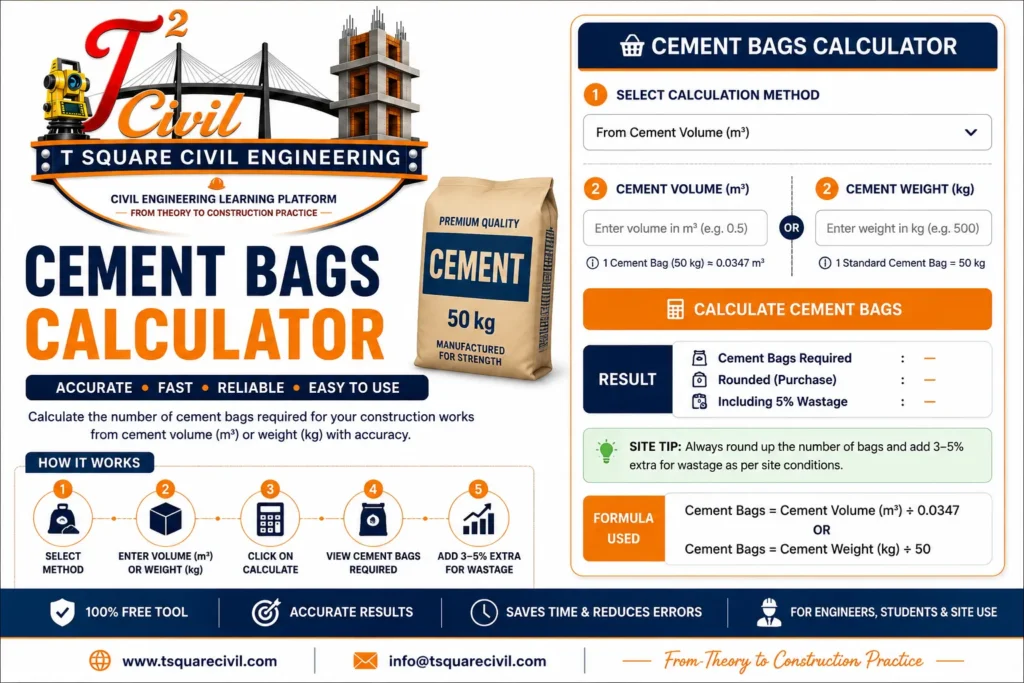
Use this cement bags calculator to estimate cement requirements from known cement weight or volume, nominal concrete proportions, approved design-mix cement content, or plaster area and thickness.
Select a calculation method, enter your project details, and choose the cement bag weight. The calculator shows the theoretical cement requirement and the whole bags to arrange, including any handling allowance you select.
For design-mix concrete, enter the cement content from the approved mix design. Nominal-proportion calculations provide preliminary estimates using the stated assumptions.

View Calculation Details & Formula
Civil Engineering Learning Platform: From Theory to Construction Practice
Page Contents
How to Use the Cement Bags Calculator
Choose the calculation method that matches the information available for your project.
| Calculation method | Information to enter |
|---|---|
| Cement weight | Total cement requirement in kilograms |
| Cement volume | Approximate bulk cement volume and assumed bulk density |
| Nominal concrete proportion | Finished concrete volume, cement–sand–aggregate proportions and dry-volume factor |
| Approved design mix | Concrete volume and approved cement content in kg/m³ |
| Plaster | Plaster area, thickness, cement–sand proportion and mortar dry-volume factor |
Then enter the bag weight and any project-specific handling allowance. Select Calculate Cement Bags to view the result.
Cement volume and concrete volume are different inputs. Use the cement-volume method only when the bulk cement volume is known. Use the concrete methods when estimating cement for a finished quantity of concrete.
The theoretical result may include part of a bag. Where procurement requires whole bags, use the rounded-up quantity shown by the calculator.
If you need to calculate the finished concrete volume first, use the Concrete Volume Calculator.
Did You Know?
- Cement is one of the most consumed construction materials in the world after water.
- A standard cement bag weighs 50 kg in India.
- Using an assumed bulk density of 1440 kg/m³, 1 m³ of bulk cement corresponds to approximately 28.8 standard 50 kg bags for estimation.
- Even a 5% error in cement estimation can significantly increase the cost of large projects.
- Proper cement storage can preserve its quality for several months, while poor storage can reduce strength.
- Cement begins reacting with water as soon as mixing starts, which is why timely placement is important.
- A damaged or moisture-affected cement bag can reduce concrete quality even if the quantity is correct.
What is a Cement Bags Calculator?
A cement bags calculator converts a calculated cement requirement into the number of bags needed. Depending on the available information, it can use cement weight, approximate bulk cement volume, nominal concrete proportions, approved cement content, or plaster dimensions.
Its main purpose is to support material estimation and procurement planning. Check the final quantity against the drawings, BOQ, approved mix design and project specifications.
Quick Facts About Cement Bags
✔ Standard cement bag weight = 50 kg
✔ Approximate bulk volume of one 50 kg cement bag ≈ 0.0347 m³, when a bulk density of 1440 kg/m³ is assumed for estimation.
✔ Volume = 1.23 CFT
✔ Volume = 34.7 litres
✔ Assumed bulk density of cement for this volume estimation ≈ 1440 kg/m³
✔ A handling/wastage allowance may be included where appropriate based on project conditions, procurement practice and site controls.
Why Use a Cement Bag Calculator?
A cement bag calculator helps you turn a calculated cement requirement into a practical procurement quantity. It reduces arithmetic errors and makes the assumptions behind your estimate easier to check.
The required quantity depends on the work volume, specified proportion or approved cement content, bag weight and any project-specific handling allowance. Guessing can lead to shortages during construction or excess material that needs additional storage.
For example, if the approved cement requirement is 1,000 kg and each bag contains 50 kg:
Theoretical requirement = 1,000 ÷ 50 = 20 bags
If a 5% handling allowance is appropriate:
Procurement quantity = 20 × 1.05 = 21 bags
The allowance supports procurement planning; it does not change the approved concrete mix proportions.
Use the calculator to:
- Convert known cement weight or approximate bulk volume into bags.
- Estimate cement for a specified nominal concrete proportion.
- Calculate bags from approved design-mix cement content.
- Estimate cement for plaster using its area, thickness and mortar proportion.
- Separate theoretical consumption from whole-bag procurement.
Before ordering, check the inputs against the drawings, BOQ and project specifications. For ready-mixed concrete, cement procurement is normally handled by the supplier; use the calculation only where it is relevant to your scope.
Volume of One Cement Bag
The approximate bulk volume represented by a cement bag can be estimated from its weight and an assumed bulk density.
Bulk cement volume = Cement weight ÷ Assumed bulk density
For a 50 kg bag and an assumed bulk density of 1,440 kg/m³:
Volume = 50 ÷ 1,440 = 0.03472 m³
| Quantity | Approximate value |
|---|---|
| Bag weight | 50 kg |
| Assumed bulk density | 1,440 kg/m³ |
| Bulk volume | 0.03472 m³ |
| Bulk volume in litres | 34.72 litres |
| Bulk volume in cubic feet | 1.23 ft³ |
These volume values are estimating assumptions. Actual bulk density varies with packing and handling. They do not represent the absolute volume of cement particles used in concrete mix-design calculations.
When cement weight is already known, calculate bags directly from weight; a bulk-density assumption is unnecessary.
This is an approximate bulk volume, including spaces between particles. It is different from the absolute volume of cement particles used in concrete mix design.
For that calculation method, see Absolute Volume Method in Concrete Mix Design.
Engineering note: The value 0.0347 m³ is an approximate bulk volume obtained by assuming a bulk density of 1440 kg/m³. It should be used for material estimation rather than interpreted as the absolute physical volume of every 50 kg cement bag.
Cement Bags Calculation – Basic Formulas
From Cement Weight
Number of bags = Cement weight in kg ÷ Bag weight in kg
For 500 kg of cement supplied in 50 kg bags:
Number of bags = 500 ÷ 50 = 10 bags
From Bulk Cement Volume
Number of bags = Bulk cement volume × Assumed bulk density ÷ Bag weight
For 0.5 m³ of bulk cement, an assumed density of 1,440 kg/m³ and 50 kg bags:
Number of bags = 0.5 × 1,440 ÷ 50 = 14.4 bags
For whole-bag procurement, arrange 15 bags before adding any separate handling allowance.
From Approved Design Mix Cement Content
Number of bags = Concrete volume × Approved cement content ÷ Bag weight
For 10 m³ of concrete with an approved cement content of 350 kg/m³:
Number of bags = 10 × 350 ÷ 50 = 70 bags
Use the approved cement content for this calculation. If the mix also contains fly ash, GGBS or other cementitious materials, total cementitious content is not automatically the same as cement content.
Including a Handling Allowance
Bags including allowance = Theoretical bags × (1 + Allowance percentage ÷ 100)
For 20 theoretical bags and a 5% handling allowance:
Bags including allowance = 20 × 1.05 = 21 bags
Apply the allowance before rounding up to whole bags. Treat it as a procurement allowance; do not change the approved concrete mix proportions.
Approximate Cement Bags for Selected Nominal Mix Proportions for 1 m³ Concrete
Step 1: Convert Wet Volume to Dry Volume
For concrete calculations:
Dry Volume = Wet Volume × 1.54
For 1 m³ concrete:
Dry Volume = 1 × 1.54 = 1.54 m³
Why Is Dry Volume Greater Than Wet Concrete Volume?
The combined loose volume of dry cement, sand and coarse aggregate is greater than the final compacted volume of concrete. During mixing and compaction, the smaller particles fill voids between larger particles and the ingredients form a dense concrete mass.
For preliminary nominal-mix quantity estimation, a dry-volume factor such as 1.54 is commonly used as an approximate estimating assumption.
Therefore, for 1 m³ of finished concrete:
Approximate dry ingredient volume = 1 × 1.54 = 1.54 m³
Important: The factor is an estimating assumption, not a universal mix-design constant. For design-mix concrete, material quantities should be obtained from the approved mix design.
Step 2: Calculate Cement Volume
Cement Volume = (Dry Volume × Cement Ratio) ÷ Total Ratio
Step 3: Convert Cement Volume to Bags
Since:
1 Cement Bag (50 kg) = 0.0347 m³
Therefore:
Number of Bags = Cement Volume ÷ 0.0347
Example:1 Concrete Mix Ratio- 1: 1: 2
Total Ratio
1 + 1 + 2 = 4
Cement Volume
= (1.54 × 1) ÷ 4
= 0.385 m³
Cement Bags
= 0.385 ÷ 0.0347
= 11.09 Bags
≈ 11.1 Bags
Example:2 Concrete Mix Ratio-1 : 1.5 : 3
Total Ratio
1 + 1.5 + 3 = 5.5
Cement Volume
= (1.54 × 1) ÷ 5.5
= 0.28 m³
Cement Bags
= 0.28 ÷ 0.0347
= 8.07 Bags
≈ 8.1 Bags
Example:3 Concrete Mix Ratio-1 : 2 : 4
Total Ratio
1 + 2 + 4 = 7
Cement Volume
= (1.54 × 1) ÷ 7
= 0.22 m³
Cement Bags
= 0.22 ÷ 0.0347
= 6.34 Bags
≈ 6.3 Bags
Example:4 Concrete Mix Ratio-1 : 3 : 6
Total Ratio
1 + 3 + 6 = 10
Cement Volume
= (1.54 × 1) ÷ 10
= 0.154 m³
Cement Bags
= 0.154 ÷ 0.0347
= 4.44 Bags
≈ 4.4 Bags
Example:5 Concrete Mix Ratio–1 : 4 : 8
Total Ratio
1 + 4 + 8 = 13
Cement Volume
= (1.54 × 1) ÷ 13
= 0.118 m³
Cement Bags
= 0.118 ÷ 0.0347
= 3.40 Bags
≈ 3.4 Bags
Summary Table
| Nominal Mix Ratio | Total Parts | Cement Volume for 1 m³ Concrete | Approx. Cement Bags* |
|---|---|---|---|
| 1:1:2 | 4 | 0.385 m³ | 11.1 |
| 1:1.5:3 | 5.5 | 0.280 m³ | 8.1 |
| 1:2:4 | 7 | 0.220 m³ | 6.3 |
| 1:3:6 | 10 | 0.154 m³ | 4.4 |
| 1:4:8 | 13 | 0.118 m³ | 3.4 |
Note: These are approximate theoretical quantities calculated using a dry-volume factor of 1.54 and an assumed cement bulk density of 1440 kg/m³. Actual cement content for structural/design-mix concrete must be taken from the approved concrete mix design or project specification rather than inferred from these nominal ratios.
Formula Used
Number of Cement Bags = (1.54 × Cement Ratio ÷ Total Ratio) ÷ 0.0347
Where:
- 1.54 = Dry Volume Factor
- 0.0347 m³ = Volume of One 50 kg Cement Bag
- Total Ratio = Sum of Cement + Sand + Aggregate Parts
For 1 cubic meter of concrete, approximate cement bag requirements are:
• 1 : 1 : 2 → 11.1 bags
• 1 : 1.5 : 3 → 8.1 bags
• 1 : 2 : 4 → 6.3 bags
• 1 : 3 : 6 → 4.4 bags
• 1 : 4 : 8 → 3.4 bags
Note: These figures represent theoretical quantities for the stated nominal proportions using the assumptions above. Concrete grade and cement content for design-mix concrete should be established from the approved mix design and applicable project requirements.
Actual material requirements and procurement quantities may differ because of:
• Approved mix design or specified mix proportion
• Material characteristics and batching method
• Measurement and handling losses
• Construction tolerances and site conditions
• Project-specific procurement/wastage allowance
If you also need preliminary sand and aggregate quantities, use the Cement, Sand and Aggregate Calculator.
Think Like a Site Engineer
Whenever a site engineer receives a drawing, the first question is not “How many bags of cement should I order?” Instead, the engineer asks:
- What is the concrete volume?
- Which concrete grade and approved mix design or specified proportion will be used?
- Is it a nominal mix or a design mix?
- How much cement is required per cubic metre?
- What procurement or handling allowance is appropriate for the project?
Answering these questions systematically leads to accurate material estimation and better project planning. The calculator on this page follows the same logical process used by professional engineers.
Worked Examples – Cement Bag Calculations
Example 1: Cement Bags for 5 m³ of 1:1.5:3 Nominal Concrete
Problem
Estimate the theoretical cement requirement for 5 m³ of finished concrete using a nominal proportion of 1:1.5:3, a dry-volume factor of 1.54, an assumed cement bulk density of 1440 kg/m³, and 50 kg cement bags.
For 1 m³:
Dry volume = 1 × 1.54 = 1.54 m³
Total parts = 1 + 1.5 + 3 = 5.5
Cement volume = 1.54 × (1 ÷ 5.5) = 0.28 m³
Cement weight ≈ 0.28 × 1440 = 403.2 kg
Cement bags ≈ 403.2 ÷ 50 = 8.06 bags/m³
For 5 m³:
Cement bags ≈ 8.06 × 5 = 40.3 bags
Theoretical requirement ≈ 40.3 bags.
For procurement, whole bags and any project-specific handling allowance should be considered separately.
Important: Do not use this nominal proportion as a substitute for the approved mix design of structural/design-mix concrete.
Example 2: Cement Bags from Cement Weight
Problem
Total cement required = 500 kg. How many bags?
Solution
• Number of bags = 500 ÷ 50 = 10 bags
Answer: 10 cement bags.
Example 3: Cement Bags from Cement Volume
Problem
Cement volume required = 0.5 m³. How many bags?
Solution
Cement weight = 0.5 × 1,440 = 720 kg.
Theoretical cement bags = 720 ÷ 50 = 14.4 bags.
For procurement in whole 50 kg bags, arrange 15 bags before adding any project-specific handling allowance.
Example 4: Cement for 10 m³ of 1:2:4 Concrete
For 1 m³ of 1:2:4 nominal concrete:
Cement bags ≈ 6.34 bags
For 10 m³:
10 × 6.34 = 63.4 bags
Theoretical cement requirement = 63.4 bags.
For procurement in whole bags, round upward to 64 bags before applying any project-specific allowance.
Example 5: Cement for Brick Masonry
For brick masonry, first determine the net masonry volume from wall length, height and thickness after deducting applicable openings. Then estimate the mortar quantity based on the masonry unit dimensions and joint thickness. The cement quantity is subsequently calculated from the specified mortar proportion.
Do not estimate cement for brick masonry from wall area alone unless the wall thickness and the basis of the consumption rate are clearly specified.
Example 6: Cement for 100 sq ft (9.29 m²) Plaster, 12 mm Thick, 1:4 Mortar
100 sq ft ≈ 9.29 m²
Wet plaster volume:
9.29 × 0.012 = 0.1115 m³
Using an assumed mortar dry-volume factor of 1.33:
Dry mortar volume:
0.1115 × 1.33 = 0.1483 m³
For 1:4 mortar:
Total parts = 1 + 4 = 5
Cement volume:
0.1483 × 1/5 = 0.0297 m³
Using 1440 kg/m³ assumed bulk density:
Cement weight:
0.0297 × 1440 ≈ 42.7 kg
Cement bags:
42.7 ÷ 50 ≈ 0.85 bag
Theoretical cement requirement ≈ 0.85 bag.
For procurement, whole bags and any applicable project allowance should be considered separately.
Real Site Example: Estimating Cement for a House Slab

Suppose a residential roof slab requires 12 m³ of design-mix concrete. The approved mix design specifies a cement content of 360 kg/m³.
Cement = 12 × 360 = 4320 kg
Number of 50 kg bags = 4320 ÷ 50 = 86.4 bags
The theoretical cement requirement is therefore 86.4 bags.
If cement is procured in whole bags, at least 87 bags would represent the theoretical quantity before considering any project-specific procurement or handling allowance.
The final quantity ordered should be coordinated with the approved mix design, batching method, BOQ, supply arrangement and site requirements.
A Small Calculation Can Save Thousands of Rupees
Many people believe that a few extra cement bags do not make much difference. However, on large projects the impact can be significant.
For example:
If the cost of one cement bag is ₹420 and you overestimate the requirement by just 30 bags, the additional expense becomes:
30 × ₹420 = ₹12,600
If multiple materials are estimated inaccurately, the total financial loss can become much higher.
Similarly, underestimating cement requirements can delay concrete pouring, increase labour costs, and affect construction quality.
This is why accurate material estimation is an essential part of professional construction management.
Applications of a Cement Bag Calculator
You can use the cement calculator for almost all RCC, PCC, and masonry works, including:
RCC (Reinforced Cement Concrete)
• Footings
• Columns
• Beams
• Slabs
• Staircases
PCC (Plain Cement Concrete)
• Foundation PCC
• Flooring PCC
• Road sub-base and levelling courses
Masonry Works
• Brick masonry
• Block masonry
• Stone masonry
Finishing Works
• Wall plaster (internal and external)
• Ceiling plaster
• Floor screed
• Tile bedding and underlayment
Where Is This Cement Bags Calculator Used?
This calculator is widely used in residential, commercial and infrastructure projects for estimating cement requirements before construction begins. It is suitable for:
- House construction
- RCC foundations
- Footings
- Columns
- Beams
- Slabs
- Brick masonry
- Block masonry
- Plastering
- Floor screeds
- Tile bedding
- Compound walls
- Road works
- Quantity surveying
- BOQ preparation
- Construction cost estimation
Factors Affecting Cement Requirement
Several factors influence the actual cement consumption on site:
1. Mix Proportion / Approved Mix Design
Cement content depends on the specified concrete requirements and the adopted mix design or nominal proportion. Concrete performance is not determined by cement quantity alone; water–cement ratio, constituent materials, workability, compaction, curing and quality control are also important.
2. Handling and Procurement Allowance
Any additional quantity allowed for handling, losses or procurement should be selected according to the project, batching system, site controls, storage conditions and contractual/BOQ requirements rather than applying one universal percentage.
3. Aggregate Moisture
• Aggregate moisture contributes free water to the concrete mix and therefore requires appropriate correction of batch water and aggregate quantities.
• Proper moisture correction helps maintain the intended water–cement ratio and improves batching accuracy.
4. Workmanship
• Poor batching and mixing practices can increase cement consumption.
• Accurate weighing and machine mixing reduce errors.
5. Construction Method
• Machine mixing usually results in lower wastage and better uniformity.
• Manual mixing often leads to higher wastage and non-uniform mixes.
Professional Estimation Workflow
- Study the drawings and specifications.
- Calculate the required concrete, mortar or plaster quantity.
- Identify whether the concrete is nominal mix or design mix.
- For design mix, obtain the approved cement content in kg/m³.
- For nominal proportion estimation, apply the stated estimating assumptions.
- Calculate the theoretical cement requirement.
- Convert the quantity to the applicable bag size.
- Apply only the appropriate project-specific procurement/handling allowance.
- Compare the result with the BOQ and construction programme before ordering.
Following this sequence helps reduce mistakes and improves construction planning.
Advantages of Accurate Cement Estimation
Accurate estimation using a cement bag calculator offers multiple benefits:
• Cost Control: Prevents over-ordering and reduces unnecessary purchases of cement.
• Reduced Wastage: Minimises unused or expired cement on site.
• Better Procurement: Helps plan material delivery in stages as per work progress.
• Improved Planning: Ensures continuous work without stoppages due to material shortages.
• Accurate Budgeting: Provides reliable figures for BOQ, estimates, and client proposals.
Cement Bags Calculator Formula Used by T Square Civil Engineering
The T Square Civil Engineering Cement Bags Calculator uses different calculation paths depending on the information available. Cement bags may be calculated directly from cement weight or approximate bulk volume, estimated from a specified nominal proportion, calculated from approved design-mix cement content, or estimated for plaster/mortar work.
Volume of One Cement Bag
• Volume = 50 ÷ 1440 = 0.0347 m³
Cement Bags from Volume
• Cement Bags Required = Cement Volume (m³) ÷ 0.0347
Cement Bags from Weight
• Cement Bags Required = Cement Weight (kg) ÷ 50
For design-mix concrete:
Cement Weight (kg) = Concrete Volume (m³) × Approved Cement Content (kg/m³)
Cement Bags = Cement Weight ÷ Bag Weight
This method is commonly used in quantity surveying, estimation, and construction planning.
Related Civil Engineering Calculators
Steel Bar Weight Calculator
Calculate the weight of TMT bars, reinforcement steel, and rebars using the standard D²/162 formula for accurate quantity estimation.
Cement, Sand & Aggregate Calculator for Concrete (M5 to M20)
Estimate the quantities of cement, sand, and aggregate required for nominal concrete mixes ranging from M5 to M20 grades.
Concrete Volume Calculator for Slabs, Beams, Columns, and Footings
Calculate the volume of concrete required for various RCC structural elements quickly and accurately.
Brick Quantity Calculator
Determine the number of bricks required for walls, partitions, and masonry construction works.
Bar Bending Schedule (BBS) Calculator for Construction Sites
Prepare accurate bar-bending schedules and calculate steel reinforcement quantities for RCC structures.
Plaster Quantity Calculator
Estimate cement, sand, and water requirements for internal and external plastering works.
House Construction Cost Calculator
Calculate the approximate cost of residential building construction based on area, specifications, and construction standards.
Tile Quantity Calculator
Estimate the number of floor and wall tiles required for rooms, kitchens, bathrooms, and other spaces.
Paint Quantity Calculator
Calculate paint requirements for walls, ceilings, and exterior surfaces while minimising wastage and cost.
Lap Length Calculator for Reinforcement Steel Bars
Determine the required lap splice length for steel reinforcement bars in accordance with standard engineering practices and design requirements.
Common Myths About Cement Estimation
Myth 1: More cement always produces stronger concrete.
Fact: Excess cement can increase shrinkage and cracking. Strength depends on the approved mix design and water-cement ratio.
Myth 2: Every construction project uses the same amount of cement.
Fact: Cement consumption depends on the concrete grade, mix proportion, member size, and project specifications.
Myth 3: Cement Estimation Is Only Important for Large Projects
Fact: Even small residential projects benefit from accurate material estimation because it reduces cost and wastage.
Common Mistakes While Estimating Cement Bags
- Treating the 1.54 dry-volume factor as an exact or universal constant
- Using the wrong nominal mix proportion
- Using nominal-mix values for design-mix concrete
- Assuming a fixed cement-bag requirement solely from the concrete grade
- Applying an arbitrary wastage allowance without considering project conditions
- Rounding down when whole-bag procurement requires rounding upward
Site Engineer Tips
- Consider an appropriate procurement and handling allowance based on the project, batching system, storage arrangement, BOQ and actual site controls. As a practical site-estimation allowance, around 3–5% additional quantity may be considered where appropriate, subject to actual project conditions and established site practice.
- Store cement bags on raised wooden pallets in a dry, weather-protected area.
- Protect cement from moisture and dampness.
- Use cement of suitable quality and condition for structural concrete.
- Follow the approved mix design or specified mix proportions.
- Measure and batch materials accurately using the specified batching method.
What Happens If You Order Too Much Cement?
Unused cement does not always save money.
If cement is stored in damp conditions, it absorbs moisture from the air and gradually loses strength. Bags may develop hard lumps, making them unsuitable for structural concrete.
Accurate estimation not only reduces project cost but also ensures that fresh cement is available when construction begins.
Mistakes I Have Seen on Construction Sites
One common mistake is ordering cement before calculating the actual quantity required.
Another frequent error is incorrectly applying—or treating as universal—a dry-volume conversion factor when estimating nominal concrete or mortar quantities.
Another common error is assuming that a concrete grade automatically corresponds to one fixed volumetric proportion or one fixed number of cement bags per cubic metre.
Another common mistake is applying a standard wastage percentage without considering the actual batching method, handling system, storage conditions, procurement arrangement and project requirements.
Some people use nominal mix calculations for design mix concrete, which can result in incorrect estimates.
Professional engineers avoid these mistakes by carefully checking calculations, verifying drawings, and comparing estimates with the Bill of Quantities (BOQ) before ordering materials.
Estimate Cement Requirements with Confidence
Use the T Square Civil Cement Bags Calculator to estimate cement quantities quickly and accurately for concrete, masonry, plastering and flooring works. Combine it with our other civil engineering calculators and practical guides to improve planning, reduce material wastage and simplify construction estimation.
Final Advice for Students and Engineers
Learning how to calculate cement quantity is more than an examination topic—it is a practical skill used every day in construction projects.
Whether you are preparing for interviews, supervising site work, estimating materials, or constructing your own house, understanding cement calculations helps you make informed decisions and avoid costly mistakes.
Instead of memorising formulas, try to understand the reasoning behind each calculation. Once you understand the concepts, estimating cement requirements for any project becomes much easier.
Key Takeaways
✔ A standard cement bag commonly used in India contains 50 kg of cement.
✔ At an assumed bulk density of 1440 kg/m³, 50 kg corresponds to an approximate bulk volume of 0.0347 m³.
✔ For nominal proportion estimation, clearly state the dry-volume factor and other assumptions used.
✔ For design-mix concrete, calculate cement from the approved cement content in kg/m³.
✔ Do not assume a fixed number of cement bags solely from the concrete grade.
✔ Apply procurement/handling allowances according to actual project requirements.
✔ Verify quantities against drawings, specifications, approved mix design and BOQ before procurement.
Frequently Asked Questions (FAQs) – Cement Bags Calculator
Q1. How many 50 kg cement bags correspond to 1 m³ of bulk cement for estimation?
Using an assumed bulk density of 1440 kg/m³, one 50 kg cement bag represents an approximate bulk volume of 0.0347 m³.
Number of bags = 1 ÷ 0.0347 ≈ 28.8 bags
Therefore, approximately 28.8 bags correspond to 1 m³ of bulk cement under this estimating assumption.
Q2. What is the volume of a 50 kg cement bag?
Using an assumed bulk density of 1440 kg/m³, the approximate bulk volume represented by a 50 kg cement bag is:
• 0.0347 m³
• 1.23 CFT (cubic feet)
• 34.7 litres
Q3. How many bags of cement are required for 1 m³ of M20 concrete?
There is no single universal number of cement bags for every M20 concrete mix. For design-mix concrete, the cement requirement should be taken from the approved mix design in kg/m³ and divided by the cement bag weight.
For example, if an approved mix contains 350 kg of cement per m³:
Cement bags = 350 ÷ 50 = 7 bags/m³.
A nominal proportion such as 1:1.5:3 may be used only as an illustrative quantity-estimation example where appropriate; it should not be treated as the universal composition of M20 concrete.
Q4. How many cement bags are needed for 100 sq ft of plastering?
Cement requirement for 100 sq ft of plaster depends on plaster thickness, mortar proportion, the adopted dry-volume allowance and any site/procurement allowance. For example, using 12 mm thickness, 1:4 mortar, a dry-volume factor of 1.33 and an assumed cement bulk density of 1440 kg/m³ gives a theoretical requirement of approximately 0.85 of a 50 kg bag before project-specific allowances.
Q5. How many cement bags are required for 1 m³ of 1:2:4 concrete?
Approximately 6.3 bags per m³ under the stated assumptions of a 1.54 dry-volume factor, 1440 kg/m³ assumed cement bulk density and 50 kg bags.
Q6. How do I calculate cement for brickwork?
Calculate the net volume of brick masonry from the wall dimensions, determine the mortar requirement based on brick dimensions and joint thickness, and then calculate the cement fraction from the specified mortar proportion. Wall area alone is insufficient unless wall thickness and the basis of the adopted consumption rate are also known.
Q7. Does the cement bag requirement change with brand?
Standard cement packaging used for the project determines the bag weight. Cement properties may vary between products and types, but structural concrete quantities should always follow the approved mix design, specifications and applicable quality requirements rather than a brand-based thumb rule.
Q8. Should I include the wastage percentage in my cement estimate?
A procurement or handling allowance may be appropriate, but the percentage should be selected according to the actual project conditions, batching method, material handling, storage arrangements, BOQ and contractual requirements.
The T Square Civil Engineering Cement Bags Calculator therefore allows the user to enter an appropriate allowance rather than imposing one universal wastage percentage.
If the theoretical requirement is 40 bags and the project has an approved 5% allowance:
40 × 1.05 = 42 bags
Q9. Can I use a cement bag calculator for small home projects?
Absolutely. Homeowners can use a cement bag calculator for:
• Small slabs and PCC
• House flooring
• Driveways and pathways
• Compound walls
• Interior and exterior plastering
It helps avoid both shortage and unnecessary excess cement.
Q10. Why should I use the TSquareCivil Cement Bags Calculator instead of manual calculation?
• Fast and consistent: Performs repetitive calculations quickly using the selected inputs.
• Transparent assumptions: Clearly identifies factors such as bag weight, assumed bulk density, dry-volume factor and handling allowance.
• Multiple calculation methods: Supports cement volume, cement weight, nominal concrete proportions, approved design-mix cement content and plaster estimation.
• User-friendly: Suitable for engineers, students, contractors and homeowners.
• Calculation details: Helps users understand the calculation rather than providing only a final number.
Always verify final construction quantities against the approved mix design, drawings, BOQ and project specifications.
Q11. Is this calculator suitable for different grades of concrete?
Yes, provided the correct calculation method is selected. For nominal proportion estimation, enter the specified cement:sand:aggregate proportion and the relevant estimating assumptions. For design-mix concrete such as structural M20, M25 and higher grades, enter the approved cement content in kg/m³ from the project mix design. Do not infer the cement content solely from the grade designation.
Q12. How do I convert cubic feet to cubic meters for cement calculations?
Use the conversion:
• 1 m³ = 35.3147 CFT
So, Volume (m³) = Volume (CFT) ÷ 35.3147.
Once you get the volume in m³,
When using the calculator’s assumed bulk density of 1440 kg/m³:
Cement bags = Cement bulk volume (m³) ÷ 0.0347
Q13. How Many Cement Bags Are in One Metric Tonne?
One metric tonne equals 1,000 kg. For cement supplied in 50 kg bags:
Number of bags = 1,000 ÷ 50 = 20 bags
| Cement quantity | Number of 50 kg bags |
|---|---|
| 50 kg | 1 |
| 500 kg | 10 |
| 1 metric tonne | 20 |
| 5 metric tonnes | 100 |
| 10 metric tonnes | 200 |
For another bag size, divide the total cement weight by the actual bag weight. These are weight conversions and do not require a bulk-density assumption.
Q14. Can I use this method for 25 kg or 40 kg cement bags?
Yes, just replace 50 kg with the bag weight you are using:
• For 25 kg bags: Bags = Cement (kg) ÷ 25
• For 40 kg bags: Bags = Cement (kg) ÷ 40
Volume per bag will also change accordingly.
Q15. Can I Calculate Cement Bags from Area Alone?
Area alone is insufficient for a reliable cement estimate. For a concrete slab, you also need its thickness and the approved cement content or specified nominal proportion. For plaster, you need plaster thickness and the cement–sand proportion.
Calculate the work volume first, then determine the cement requirement using the appropriate method.
Q16. Is a Cement Bag the Same as a Premixed Concrete Bag?
No. A cement bag contains the binder used to make concrete or mortar. A premixed concrete bag contains a blend of ingredients, typically including cement, sand and aggregate.
For premixed concrete, use the manufacturer’s stated yield per bag. Do not apply the bulk volume of a cement bag as the yield of a premixed concrete bag.
Conclusion
The Cement Bags Calculator is a practical construction estimation tool for determining cement requirements for concrete, plastering, masonry, flooring and other cement-based works. By systematically estimating the theoretical cement quantity and converting it into the appropriate number of bags, engineers, contractors, students and homeowners can improve material planning and procurement.
• Reduce cement wastage
• Optimise project costs
• Plan procurement effectively
• Improve overall construction efficiency
Use the T Square Civil Engineering Cement Bags Calculator to obtain fast and transparent cement estimates based on the inputs and assumptions selected, while verifying final construction quantities against the approved project requirements.
About T Square Civil Engineering
T Square Civil Engineering is a civil engineering learning platform created to support students, site engineers, and construction professionals with practical and easy-to-understand educational resources. Our content includes guides, worked examples, calculators, and industry-focused learning materials designed to connect engineering theory with real-world construction practice.
Continue Your Learning
If you found this guide helpful, explore our other civil engineering resources:
- Ultrasonic Pulse Velocity Test of Concrete
- Rebound Hammer Test of Concrete
- Concrete Cube Compressive Strength Test
- Concrete Cube Casting Procedure
- Concrete Curing Methods
- Flexural Strength Test of Concrete
- Split Tensile Strength Test of Concrete
- Concrete Volume Calculator
- Cement, Sand & Aggregate Calculator
- Steel Weight Calculator
- Slump Test of Concrete
- Standard Consistency Test of Cement
- Initial & Final Setting Time Test
- Concrete Mix Design-M60
- Concrete Technology Interview Questions and Answers
These resources are designed to help students and professionals understand civil engineering concepts through practical examples, calculators, and step-by-step guides.
Disclaimer: The information provided on T Square Civil Engineering is intended for educational and general reference purposes only. The content is prepared with care; however, errors, omissions, interpretation differences, or outdated information may occur. Readers should independently verify applicable and current Indian Standards (IS Codes), project drawings, approved mix designs, specifications, contractual requirements, manufacturer information, and relevant regulations before using any information for design, construction, testing, estimation, procurement, or quality control. Calculators and worked examples provide indicative or theoretical results based on the inputs and assumptions stated and should not be treated as professional design approval, construction instructions, quotations, or project-specific engineering advice. Site-specific engineering decisions should be made by appropriately qualified professionals. T Square Civil Engineering does not accept responsibility for loss, damage, or consequences arising from reliance on or use of the information provided.