 by
Page Contents
Introduction
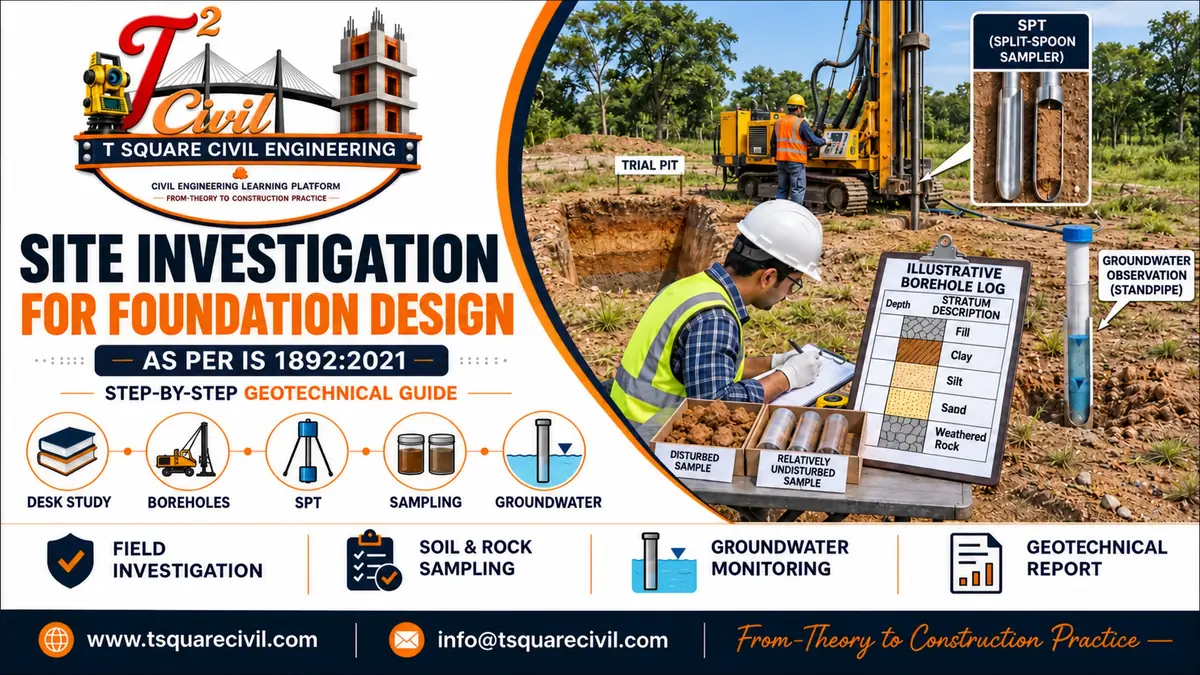
Site investigation is the systematic process of studying the ground conditions at a construction site before finalising the foundation design.
It provides information about:
- Soil and rock layers
- Soil strength and compressibility
- Groundwater conditions
- Fill, organic, expansive or weak soil
- Excavation conditions
- Settlement risks
- Suitable foundation alternatives
- Construction-related ground risks
A foundation should not be selected only from the number of floors, a standard foundation depth or one assumed bearing-capacity value. The correct decision requires reliable information about the actual site and the proposed structure.
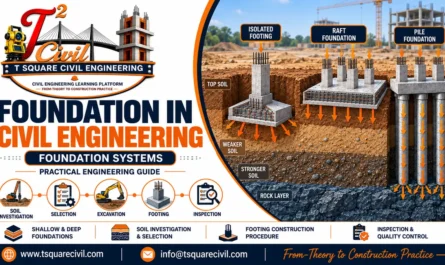
For a general overview of foundation types and selection, read Foundation in Civil Engineering: Types, Selection, Construction and Common Problems.
This article focuses specifically on how site investigation is planned, performed, interpreted and documented for foundation design.
Quick Information Table
| Item | Explanation |
|---|---|
| Main purpose | To understand the soil, rock and groundwater conditions affecting the proposed structure |
| Common field methods | Trial pits, boreholes, SPT, CPT, plate load tests, vane shear tests, rock coring and geophysical surveys |
| Common laboratory tests | Grain-size analysis, Atterberg limits, shear strength, consolidation, permeability, compaction and chemical tests |
| Main design uses | Foundation type, founding level, bearing resistance, settlement, groundwater control and excavation planning |
| Main output | Geotechnical investigation report with interpreted ground conditions and design recommendations |
| Important limitation | No fixed number of boreholes, test depth or test type is suitable for every site |
| Final responsibility | Foundation design must be completed or verified by qualified geotechnical and structural engineers |
What Is Site Investigation for Foundation Design?
Site investigation is the process of collecting and evaluating information about the ground that will support a structure.
The investigation normally includes:
- Review of existing information.
- Inspection of the site.
- Subsurface exploration.
- Field testing.
- Soil and rock sampling.
- Groundwater observations.
- Laboratory testing.
- Engineering interpretation.
- Preparation of a geotechnical report.
The objective is not merely to collect soil samples. The objective is to develop a reliable ground model that can be used for safe and economical foundation design.
The ground model should explain:
- What soil and rock layers are present.
- How these layers vary across the site.
- Which layers may support a foundation.
- Which layers may compress or move.
- How groundwater may affect construction.
- What risks may arise during excavation or foundation installation.
Why Is Site Investigation Important?
A proper site investigation helps engineers answer important foundation-related questions.
1. Which Foundation Type May Be Suitable?
The investigation helps compare:
- Isolated footings
- Combined footings
- Strip footings
- Raft foundations
- Pile foundations
- Ground-improvement options
The investigation does not automatically select the foundation. It provides the information required for comparison and design.
For a direct comparison of shallow and deep systems, read Shallow vs Deep Foundation: Differences, Types, Selection Criteria and Applications.
2. Can the Near-Surface Soil Support the Structure?
The soil near the proposed foundation level must be checked for:
- Shear strength
- Compressibility
- Density
- Layer thickness
- Uniformity
- Groundwater influence
- Long-term settlement behaviour
A soil may have adequate resistance against shear failure but still produce excessive settlement. Bearing resistance and settlement must therefore be evaluated separately.
3. Are Weak or Problematic Layers Present?
Investigation may identify:
- Uncontrolled fill
- Organic soil
- Loose sand
- Soft clay
- Expansive soil
- Collapsible soil
- Buried waste
- Voids or cavities
- Weathered rock
- Variable strata
- Old foundation remains
These conditions may require a change in foundation type, ground improvement, excavation treatment or construction method.
4. What Groundwater Problems May Occur?
Groundwater information may be required for:
- Excavation planning
- Dewatering
- Basement construction
- Borehole stability
- Pile installation
- Concrete placement
- Waterproofing
- Corrosion or durability assessment
- Protection of adjacent structures
A groundwater level observed during drilling should not automatically be treated as the permanent design groundwater level.
5. What Settlement Can Be Expected?
Site investigation provides information required to evaluate:
- Immediate settlement
- Consolidation settlement
- Long-term settlement
- Differential settlement
- Settlement caused by fill or loose soil
- Settlement of pile groups
- Settlement due to groundwater changes
Stages of Site Investigation
Every project does not require the same level of investigation. The scope should be proportionate to the structure, ground conditions, risk and design requirements.
| Stage | Main purpose | Typical output |
|---|---|---|
| Desk study | Review available records and previous information | Preliminary ground model and risk list |
| Site reconnaissance | Observe actual surface conditions | Site observations and investigation priorities |
| Preliminary investigation | Identify general subsurface conditions | Initial soil profile and areas requiring more study |
| Detailed investigation | Obtain design-level soil, rock and groundwater data | Parameters and recommendations for design |
| Supplementary investigation | Resolve uncertainties or unexpected conditions | Revised ground model and additional design information |
Desk Study
A desk study may review:
- Previous site investigation reports
- Geological maps
- Topographic information
- Previous site use
- Historical filling or excavation
- Flooding and drainage records
- Nearby construction experience
- Existing utility records
- Adjacent building foundations
- Previous settlement or cracking
- Available groundwater information
A desk study provides background information, but it cannot replace site-specific field investigation.
Site Reconnaissance
A site visit may identify:
- Sloping or uneven ground
- Waterlogging
- Surface cracks
- Existing settlement
- Loose or filled areas
- Exposed soil or rock
- Drainage channels
- Nearby excavations
- Existing retaining walls
- Adjacent structures
- Access restrictions
- Overhead and underground services
The site visit should also record features that may not appear in drawings or historical records.
Planning the Investigation
A good investigation begins with a written plan.
Step 1: Collect Project Information
The investigation team should understand:
- Site boundary
- Proposed building footprint
- Number and arrangement of structural levels
- Column and wall layout
- Basement requirements
- Approximate structural loads
- Retaining-wall requirements
- Proposed foundation alternatives
- Construction sequence
- Adjacent structures
- Site access and equipment restrictions
The number of floors alone is not sufficient to define the investigation scope.
Step 2: Prepare a Preliminary Ground Model
Available geological, historical and site information should be used to develop an initial understanding of:
- Expected soil layers
- Possible rock levels
- Fill thickness
- Groundwater conditions
- Geological hazards
- Areas of likely variability
This preliminary model should be tested and updated using field data.
Step 3: Identify Site Risks
The investigation plan should consider possible risks such as:
- Weak or compressible soil
- Expansive soil
- High groundwater
- Buried obstructions
- Variable fill
- Contaminated ground
- Rock excavation
- Ground movement
- Adjacent foundations
- Difficult access
- Vibration restrictions
Step 4: Select Investigation Locations
Investigation points should be planned to represent:
- The proposed building footprint
- Heavily loaded areas
- Column and wall zones
- Basement or retaining-wall areas
- Changes in ground level
- Suspected fill or weak zones
- Transitions between different soil conditions
- Areas near existing structures
There is no universal rule that investigation points must be placed only at corners or at a fixed spacing.
Step 5: Select Investigation Depths
Investigation depth should be based on:
- Proposed foundation level
- Expected stress influence zone
- Structural loading
- Soil and rock variability
- Compressible or weak-layer thickness
- Expected pile length
- Groundwater conditions
- Possible excavation depth
A borehole should not be stopped simply because a hard layer is encountered. The thickness, continuity and engineering significance of the layer may need to be confirmed.
Step 6: Select Field and Laboratory Tests
Testing should be selected according to:
- Soil type
- Rock type
- Foundation alternative
- Design question
- Settlement risk
- Groundwater conditions
- Construction requirements
Testing should not be added only to increase the number of results. Each test should answer a specific engineering question.
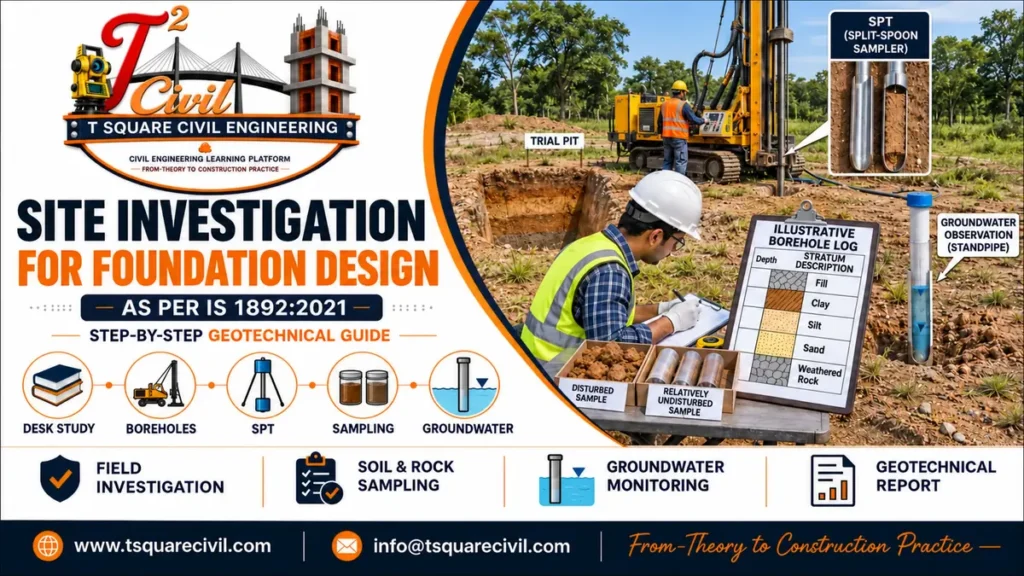
Common Field Investigation Methods
| Method | Main use | Important limitation |
|---|---|---|
| Trial pit | Direct visual examination of shallow soil and existing conditions | Usually limited by depth, groundwater, safety and access |
| Borehole | Investigation of deeper soil and rock layers | A borehole represents a limited location and may not show all lateral variation |
| Standard Penetration Test | In-situ penetration resistance and soil-profile support information | Results require proper procedure and engineering interpretation |
| Cone Penetration Test | Continuous measurement of penetration resistance and soil response | Does not normally provide conventional soil samples |
| Plate load test | Localised assessment of load-deformation behaviour | Results may be affected by plate size, test depth and scale effects |
| Vane shear test | In-situ strength assessment of suitable soft cohesive soil | Not generally suitable for all soil types |
| Rock coring | Recovery and description of rock material | Core recovery and quality depend on drilling method and rock condition |
| Geophysical survey | Identifying changes, anomalies and possible continuity between investigation points | Usually requires confirmation using intrusive investigation |
Trial Pits
Trial pits are useful when shallow ground conditions must be inspected directly.
They may help identify:
- Shallow fill
- Existing foundations
- Pavement layers
- Organic material
- Shallow groundwater
- Visible soil changes
- Near-surface obstructions
Trial pits do not normally replace deeper investigation where the structure has significant loads, deep foundations, basement levels or deep compressible soil.
Boreholes
Boreholes are commonly used to investigate deeper soil and rock conditions.
They may provide:
- Soil-layer information
- Soil samples
- Rock cores
- Groundwater observations
- Field-test locations
- Evidence of fill, weathered rock or hard strata
Borehole records should include accurate depth references, sample depths, test results, groundwater observations and descriptions of recovered materials.
Standard Penetration Test
The Standard Penetration Test, commonly called SPT, provides a field penetration-resistance value that can assist in evaluating soil conditions.
SPT results may be used with other information to help assess:
- Relative density of granular soil
- Approximate consistency of cohesive soil, interpreted cautiously using suitable correlations
- Changes between soil layers
- Preliminary foundation parameters
- Variability across the site
An SPT value is not the same as bearing capacity. Raw results should not be used blindly in foundation calculations.
The result may require consideration of:
- Equipment
- Energy delivery
- Borehole condition
- Rod length
- Sampler arrangement
- Overburden effects
- Ground conditions
- Applicable correction or normalisation procedures
SPT results should be obtained and interpreted in accordance with the applicable current standard and project requirements.
Cone Penetration Testing
Cone penetration testing may provide near-continuous information about soil resistance with depth.
It can be useful for identifying:
- Changes in soil layers
- Relative soil behaviour
- Weak zones
- Soft or loose deposits
- Possible liquefaction-related parameters where applicable
- Variability between investigation locations
CPT does not normally recover conventional soil samples. Boreholes or other sampling methods may therefore still be required for soil identification, laboratory testing and chemical assessment.
Plate Load Testing
A plate load test measures the response of a limited area of soil under applied loading.
The result may be influenced by:
- Plate size
- Test depth
- Soil layering
- Groundwater
- Loading sequence
- Local soil variability
- Stress influence below the test plate
A plate load test should not automatically be treated as a complete representation of full-scale foundation performance, particularly where deeper compressible layers are present.
Soil and Rock Sampling
Sampling quality is essential because laboratory results are only as reliable as the samples tested.
Disturbed Samples
Disturbed samples may be suitable for:
- Soil classification
- Grain-size analysis
- Moisture content
- Atterberg limits
- Some chemical tests
- General identification
They do not preserve the original in-situ structure of the soil.
Relatively Undisturbed Samples
Relatively undisturbed samples may be required for evaluating:
- Compressibility
- Consolidation
- Shear strength
- Stress history
- Deformation characteristics
Sampling disturbance should be considered when interpreting the laboratory results.
Rock Cores
Rock cores may be examined for:
- Rock type
- Weathering
- Fracturing
- Discontinuities
- Core recovery
- Rock quality
- Possible founding level
Rock descriptions and drilling records should be prepared in a consistent format.
All samples should be properly:
- Labelled
- Sealed where necessary
- Protected from moisture loss
- Transported safely
- Recorded with depth and location
- Matched with the correct borehole or trial-pit record
Groundwater Investigation
Groundwater conditions may change with:
- Season
- Rainfall
- Tidal effects
- Nearby pumping
- Irrigation
- Excavation
- Drainage changes
- Perched water layers
Groundwater investigation may include:
- Observations during drilling
- Measurements after borehole stabilisation
- Standpipe or piezometer monitoring
- Seasonal readings
- Water-quality testing
- Assessment of seepage into excavations
A single reading taken during drilling may represent temporary water, drilling fluid, perched water or a non-stabilised condition.
The report should clearly distinguish between:
- Water encountered during drilling
- Water level after stabilisation
- Long-term monitored level
- Assumed design groundwater level
Laboratory Tests for Foundation Investigation
Laboratory tests should be selected according to the design requirements.
| Test category | Typical tests | Main use |
|---|---|---|
| Classification | Moisture content, grain-size distribution, Atterberg limits and specific gravity | Identify and classify soil |
| Shear strength | Direct shear, triaxial or unconfined compression tests | Assess resistance against shearing |
| Compressibility | Consolidation or oedometer testing | Evaluate settlement and rate of consolidation |
| Compaction | Laboratory compaction testing | Establish requirements for engineered fill |
| Hydraulic properties | Permeability testing | Assess drainage, seepage and dewatering behaviour |
| Soil and groundwater chemical tests such as sulphate, chloride and pH | Sulphate, chloride, pH and other project-specific tests | Assess durability and corrosion-related risks |
| Rock properties | Point-load or compressive-strength testing where applicable | Support rock-strength assessment and design interpretation |
Not every test is required for every project. Testing should be linked to the foundation system, soil conditions and design questions.
For related material-testing resources, visit the Civil Engineering Lab Test hub.
How Investigation Data Influences Foundation Design
| Investigation information | Foundation-design question |
|---|---|
| Soil profile and layer thickness | Which layer may support the foundation? |
| Shear strength | Can the soil resist the applied pressure and actions? |
| Compressibility | Will total or differential settlement be excessive? |
| Groundwater | Will excavation, dewatering or concrete placement be affected? |
| Fill and organic soil | Is removal, replacement, improvement or deep support required? |
| Expansive soil | Could swelling and shrinkage damage the foundation? |
| Rock condition | Can the foundation bear on or be socketed into rock? |
| Lateral variation | Could different parts of the structure settle differently? |
| Adjacent structures | Could excavation or foundation installation cause movement? |
| Chemical results | Are special durability or protection measures required? |
A geotechnical recommendation should state the basis of the parameters used. Important details may include:
- Foundation level
- Net or gross pressure
- Short-term or long-term condition
- Drained or undrained behaviour
- Total-stress or effective-stress parameters
- Settlement criterion
- Groundwater assumption
- Factor of safety or design approach
- Limitations of the investigation
An allowable bearing pressure should not be quoted without explaining the relevant foundation level, soil condition and settlement basis.
What Should a Geotechnical Investigation Report Contain?
A useful report normally contains:
1. Project Information
- Project name and location
- Site boundaries
- Proposed construction
- Investigation objectives
- Drawings and information reviewed
2. Investigation Scope
- Number and location of boreholes or trial pits
- Investigation depths
- Field tests
- Sampling methods
- Laboratory tests
- Groundwater monitoring
- Investigation dates
3. Site and Geological Description
- Site topography
- Surface conditions
- Regional geology
- Previous land use
- Drainage and water conditions
- Adjacent development
4. Field Records
- Borehole logs
- Trial-pit logs
- SPT results
- Sample details
- Rock-core records
- Groundwater observations
- Investigation-location plan
5. Laboratory Results
- Test methods
- Sample depths
- Test values
- Soil classification
- Strength results
- Consolidation results
- Chemical results
6. Engineering Interpretation
- Ground model
- Soil and rock parameters
- Groundwater design condition
- Bearing resistance
- Settlement assessment
- Slope or excavation concerns
- Ground-improvement requirements
7. Foundation Recommendations
The report may compare:
- Shallow foundations
- Raft foundations
- Deep foundations
- Ground improvement
- Excavation and replacement
- Special foundation systems
Each recommendation should include its assumptions, limitations and construction requirements.
8. Construction Guidance
The report may address:
- Excavation stability
- Temporary support
- Dewatering
- Working platforms
- Backfilling
- Compaction
- Pile installation
- Verification testing
- Inspection requirements
Practical Site Investigation Workflow
Step 1: Understand the Proposed Structure
Collect the latest drawings, structural loads, column layout, wall layout, basement information and construction requirements.
Step 2: Review Existing Information
Complete the desk study and identify geological, historical, groundwater and neighbouring-structure risks.
Step 3: Inspect the Site
Record the ground profile, drainage, access, existing structures, visible defects, fill and possible obstructions.
Step 4: Prepare the Investigation Plan
Select investigation points, depths, field tests, sampling methods, laboratory tests and groundwater-monitoring requirements.
Step 5: Perform Field Investigation
Complete the approved boreholes, trial pits, field tests and sampling under proper supervision and record control.
Step 6: Complete Laboratory Testing
Test representative samples using methods suitable for the soil, rock and foundation-design questions.
Step 7: Develop the Ground Model
Combine desk-study, field, groundwater and laboratory information. Identify variations and uncertainties.
Step 8: Review Investigation Adequacy
Additional investigation may be required when:
- Soil layers vary significantly.
- Unexpected fill or weak soil is found.
- Groundwater conditions are unclear.
- The structural layout changes.
- A basement or deep foundation is added.
- Test results are inconsistent.
- Existing structures are at risk.
Step 9: Prepare the Geotechnical Report
Document the observed conditions, interpreted parameters, recommendations, assumptions and limitations.
Step 10: Verify Conditions During Construction
Foundation excavation and pile installation should be checked against the investigation assumptions. Unexpected ground conditions should be reported and reviewed by the responsible engineer.
Practical Examples
Example 1: Low-Rise Building on Uniform Soil
A low-rise building may have relatively simple foundation requirements if the site investigation shows uniform and competent near-surface soil.
Even in this situation, the investigation should verify:
- Soil continuity
- Presence of fill
- Groundwater
- Settlement behaviour
- Variation across the building footprint
The investigation scope should be proportionate to the project risk, not selected only by building height.
Example 2: Heavy Structure on Soft Compressible Soil
If a heavily loaded structure is located over soft or compressible soil, the investigation may require:
- Deeper boreholes
- More detailed sampling
- Consolidation testing
- Groundwater monitoring
- Settlement assessment
- Evaluation of ground improvement
- Evaluation of pile foundations
The thickness and depth of the compressible layer are important for selecting a suitable solution.
Example 3: New Construction Near an Existing Building
A site beside an existing building may require additional investigation of:
- Existing foundation depth
- Soil between the two structures
- Groundwater
- Excavation movement
- Vibration
- Temporary support
- Underground utilities
The investigation and foundation design should be coordinated with the proposed construction method.
Common Site Investigation Mistakes
Avoid the following mistakes:
- Using one soil test as the complete basis for foundation design.
- Fixing borehole depth without considering the stress influence zone.
- Using the same investigation spacing for every project.
- Ignoring filled, organic or disturbed soil.
- Treating raw SPT values as direct bearing capacity.
- Assuming the first hard layer is competent rock.
- Treating a drilling-time water level as the permanent groundwater level.
- Selecting laboratory tests without considering the design question.
- Using disturbed samples for tests that require reliable structure and stress information.
- Ignoring lateral variation between investigation points.
- Reusing an old investigation report without checking current site conditions.
- Failing to investigate changes in building layout or foundation loads.
- Providing an allowable bearing pressure without stating its basis.
- Ignoring adjacent buildings, basements and excavation risks.
- Proceeding with construction when actual ground conditions differ from the report.
Frequently Asked Questions
Is a soil test the same as a site investigation?
No. A soil test is one part of site investigation. A complete investigation may include desk study, site reconnaissance, boreholes, field tests, sampling, groundwater monitoring, laboratory testing and engineering interpretation.
How many boreholes are required for a building?
There is no universal number. The requirement depends on the building footprint, structural loads, geology, ground variability, foundation type, investigation standard and project risk.
How deep should a foundation borehole be?
There is no single fixed depth. The investigation should extend sufficiently to characterise the soil and rock conditions that may influence foundation bearing, settlement, groundwater and construction.
Is SPT sufficient for foundation design?
SPT may provide useful information, but it is not automatically sufficient for every project. Soil samples, laboratory testing, groundwater information and other field tests may be required.
Can a trial pit replace a borehole?
A trial pit may be suitable for shallow investigations in accessible ground. It cannot generally replace deeper investigation where deep soil, groundwater, heavy loads, piles or significant settlement risks are involved.
Does a borehole provide information about the entire site?
No. A borehole represents a limited location. Multiple investigation points and engineering interpretation may be needed where soil conditions vary across the site.
Can an old soil investigation report be reused?
Only after review by a qualified engineer. The review should consider changes in site use, building layout, loads, groundwater, adjacent construction, ground conditions and applicable standards.
What should be done if unexpected soil is found during excavation?
Construction should be paused or controlled as required, and the unexpected condition should be documented and reviewed by the responsible geotechnical or structural engineer. Unsuitable soil should not simply be covered with concrete without approved instruction.
Can site investigation alone determine the footing size?
No. Site investigation provides ground information and design parameters. Footing size, reinforcement and structural details require project-specific structural and geotechnical design.
Applicable Indian Standards
The following standards may be relevant depending on the project and investigation requirements:
- IS 1892:2021 — Subsurface investigation for foundations — Code of practice.
- IS 2131:2025 — Standard Penetration Test of Soil — Method of Test.
- IS 4464:2024 — Presentation of Drilling Information and Core Description in Geotechnical Investigation — Code of Practice.
- IS 1904:2021 — General requirements for design and construction of foundations in soils — Code of practice.
- IS 6403:1981 — Determination of bearing capacity of shallow foundations, where applicable.
- IS 2911 series — Design, construction and testing requirements for pile foundations, where deep foundations are considered.
Always verify the latest applicable edition, amendments, project specifications and authority requirements before using any standard for design or construction.
This article does not reproduce copyrighted Indian Standard text.
Related Civil Engineering Guides
- Foundation in Civil Engineering: Types, Selection, Construction and Common Problems
- Shallow vs Deep Foundation: Differences, Types, Selection Criteria and Applications
- Civil Engineering Lab Test
- Civil Engineering Articles
Conclusion
Site investigation is the foundation of reliable geotechnical design.
A proper investigation helps engineers understand:
- Soil and rock layering
- Bearing and settlement behaviour
- Groundwater conditions
- Problematic ground
- Excavation risks
- Foundation alternatives
- Construction requirements
There is no universal number of boreholes, investigation depth or laboratory tests suitable for every project. The investigation must be planned according to the structure, ground conditions, foundation system and project risks.
The final foundation design should be based on a properly interpreted geotechnical investigation, approved structural information and professional engineering judgement.
About T Square Civil Engineering
T Square Civil Engineering is an educational platform that explains civil engineering concepts, construction practices, material testing, concrete technology, mix design, quantity estimation and site quality control in simple and practical language.
Our aim is to connect engineering theory with construction practice through original articles, formulas, examples, calculators, checklists and visual explanations.
To learn more about our purpose and approach, visit the About T Square Civil Engineering page.
Disclaimer
The information on this website is provided for educational purposes only.
This article is not a substitute for professional engineering advice, site-specific soil investigation, structural design, approved drawings, project specifications or supervision by qualified professionals.
Foundation type, size, depth, reinforcement, concrete grade, bearing capacity, settlement limits and construction methods must be determined or verified by a qualified civil, structural or geotechnical engineer for the specific project.
Do not use the information, formulas, examples or calculators on this website as the sole basis for construction, estimation, design or decision-making.
T Square Civil Engineering does not accept responsibility for any loss, damage, defect, delay or other consequence resulting from reliance on the information without proper professional verification.
For the complete website disclaimer, visit the T Square Civil Engineering Disclaimer page.