 by
Choosing between a shallow and deep foundation is an important geotechnical and structural decision. The correct choice depends on how the structural loads interact with the soil profile, settlement behaviour, groundwater, construction conditions and project requirements.
A shallow foundation is generally considered when the soil near the ground surface can safely support the structure with acceptable settlement. A deep foundation is generally evaluated when the near-surface soil is weak, compressible, expansive, highly variable or unsuitable for the expected loads.
There is no single foundation type that is best for every project. The selection should be based on site investigation, structural loading, settlement assessment, construction feasibility and professional design.
This article focuses specifically on the difference between shallow and deep foundations and the practical factors used for preliminary foundation selection. For the broader foundation overview, read Foundation in Civil Engineering: Types, Selection, Construction and Common Problems.
Page Contents
Quick Information Table
| Item | Shallow Foundation | Deep Foundation |
|---|---|---|
| Main support zone | Soil close to the ground surface | Deeper soil or rock layers |
| Main load-transfer mechanism | Base pressure below the foundation | End bearing, shaft resistance or both |
| Common systems | Isolated footing, combined footing, strip footing, strap footing and raft | Pile, under-reamed pile, drilled shaft and caisson |
| First condition to evaluate | Whether near-surface soil is suitable | Whether deep support is required or beneficial |
| Main settlement concern | Settlement of the shallow supporting soil | Settlement of the pile or deep foundation system and surrounding soil |
| Construction method | Usually open excavation | Boring, drilling, driving or specialist installation |
| Equipment | Generally simpler equipment | Often requires specialist equipment |
| Cost | Often economical when soil is suitable | Often higher, but site-dependent |
| Main risk | Inadequate near-surface support or excessive settlement | Installation defects, group effects or unsuitable deep-soil assumptions |
| Final decision | Requires structural and geotechnical design | Requires structural and geotechnical design |
Shallow vs Deep Foundation: Main Difference
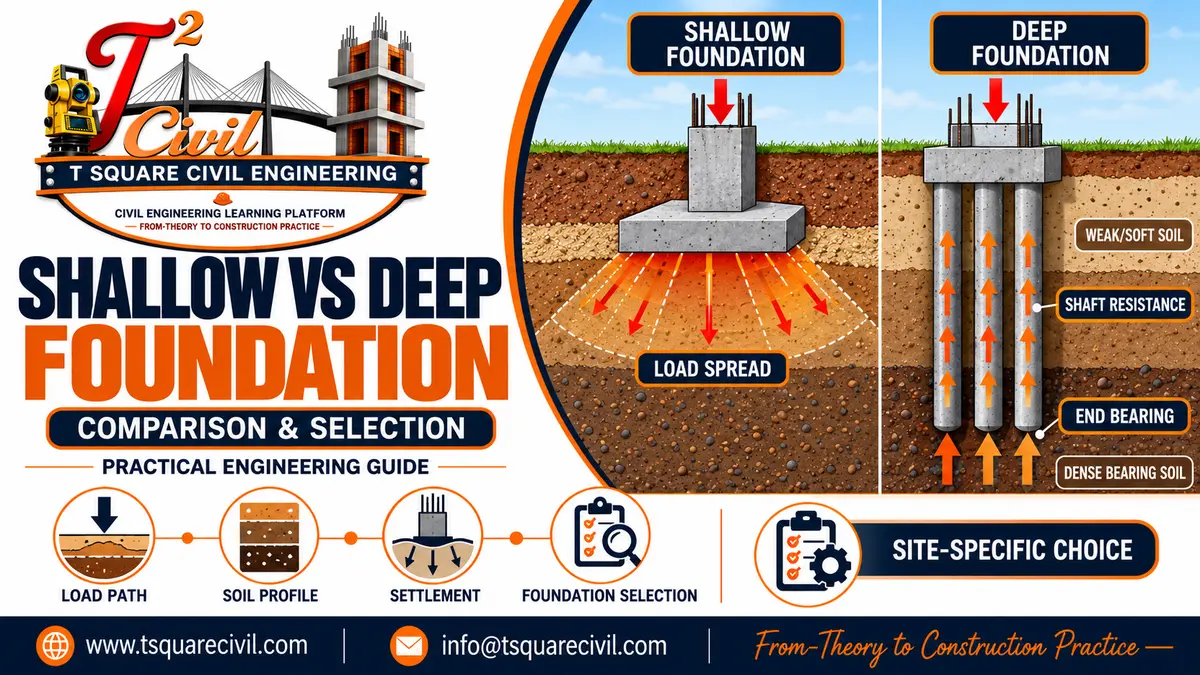
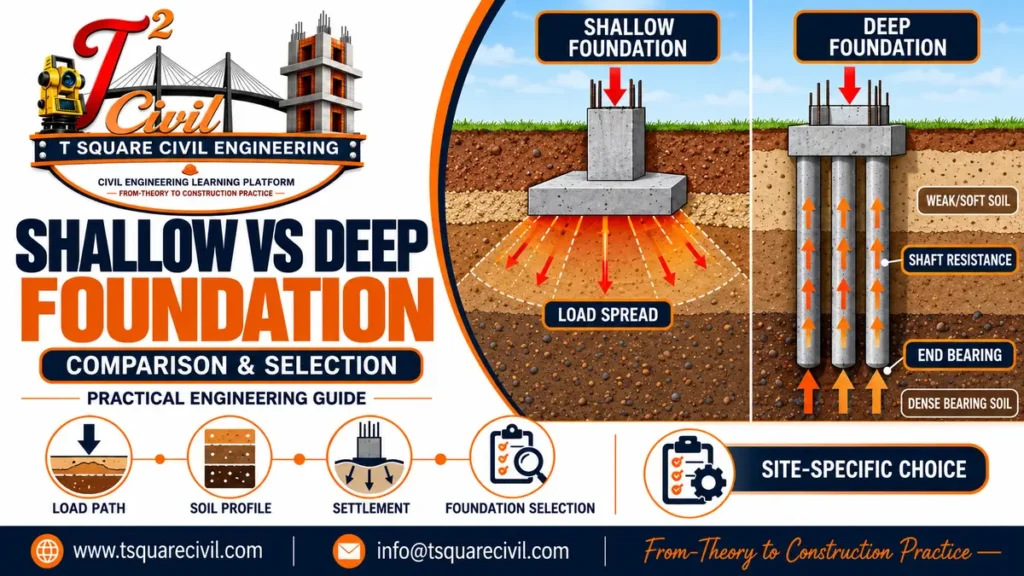
The main difference is the zone and mechanism through which the structural load is transferred.
A shallow foundation transfers most of its load to the soil close to the foundation base. Its performance is therefore strongly influenced by the strength, compressibility and uniformity of the near-surface soil.
A deep foundation transfers load to deeper soil or rock through:
- End bearing at the base
- Shaft resistance along the embedded surface
- A combination of end bearing and shaft resistance
The classification should not be based on one universal depth-to-width ratio. Numerical limits may vary between textbooks and design practices. Actual foundation behaviour depends on the soil influence zone, foundation geometry, loads and settlement response.
Common Foundation Systems Included in Each Group
| Foundation group | Common systems | General purpose |
|---|---|---|
| Shallow foundation | Isolated, combined, strip and strap footing | Distribute column or wall loads near the ground surface |
| Shallow foundation | Raft or mat foundation | Distribute several column and wall loads over a large base area |
| Deep foundation | Bored or driven piles | Transfer loads through shaft resistance, end bearing or both |
| Deep foundation | Under-reamed piles | Provide deep support with enlarged bulbs in suitable ground conditions |
| Deep foundation | Drilled shafts or caissons | Transfer large loads through a large deep foundation element |
This table is only a classification summary. Detailed footing, raft and pile design should be treated in separate focused articles.
How Load Transfer Differs
Load Transfer in a Shallow Foundation
In a shallow foundation, the structural load reaches the foundation base through columns, walls or other structural elements. The foundation then distributes the load over the supporting soil area.
The design must consider:
- Contact pressure below the base
- Shear failure of the soil
- Total settlement
- Differential settlement
- Sliding
- Overturning
- Uplift
- Structural bending and shear
The soil below and around the shallow foundation must perform satisfactorily under the applied load and environmental conditions.
Load Transfer in a Deep Foundation
In a deep foundation, the load is transferred through a longer embedded element.
Depending on the soil profile and design, resistance may develop from:
- End bearing at the pile or shaft base
- Shaft resistance along the embedded length
- Resistance from both mechanisms
A pile does not always need to reach rock. It may safely transfer load through suitable soil layers when the geotechnical and structural design supports that behaviour.
Foundation Selection Decision Matrix
The following matrix provides preliminary selection guidance. It does not replace a geotechnical report or structural design.
| Site or project condition | Foundation system that may be studied first | Important checks |
|---|---|---|
| Competent and reasonably uniform near-surface soil | Shallow footing or raft | Bearing pressure, total settlement and differential settlement |
| Weak or highly compressible upper soil | Deep foundation or ground improvement | Consolidation, long-term settlement and group behaviour |
| Closely spaced columns or overlapping footings | Combined footing or raft | Soil pressure distribution, bending, shear and settlement |
| Heavy structural loads | Shallow or deep system depending on soil | Load combinations, bearing, settlement and construction feasibility |
| Expansive soil | Special shallow system, improvement or under-reamed pile | Swelling, shrinkage, moisture variation and uplift |
| High groundwater | Method-specific shallow or deep solution | Dewatering, excavation stability, bore stability and concrete placement |
| Restricted excavation near an existing building | Carefully selected shallow or deep system | Ground movement, vibration, temporary support and adjacent foundations |
| High lateral load or uplift | Shallow or deep system based on design | Sliding, overturning, uplift, lateral resistance and structural stiffness |
| Large number of closely spaced footings | Raft or alternative deep system | Soil-structure interaction, settlement and economic comparison |
| Unsuitable filled or organic soil | Ground improvement, removal or deep foundation | Thickness, variability, compressibility and long-term performance |
Factors That Influence the Selection
Structural Load and Building Layout
Foundation selection must begin with the actual structural loads and layout.
Important information includes:
- Column loads
- Wall loads
- Dead loads
- Live loads
- Wind effects
- Earthquake effects
- Lateral loads
- Uplift
- Bending moments
- Column spacing
- Property-boundary restrictions
- Basement requirements
The number of floors alone cannot determine whether a shallow or deep foundation is required.
Near-Surface Soil Behaviour
A shallow foundation may be considered when the near-surface soil has suitable:
- Shear strength
- Density
- Compressibility
- Thickness
- Uniformity
- Drainage characteristics
Weak pockets, loose layers, uncontrolled fill and organic soil can make a shallow foundation unsuitable or require ground improvement.
Bearing Capacity and Settlement
Bearing capacity and settlement are related but different design considerations.
A soil may have adequate resistance against shear failure but still produce excessive settlement. Differential settlement can be especially harmful when different parts of a building are supported by different soil conditions.
Both shallow and deep foundation alternatives must therefore be evaluated for:
- Ultimate resistance
- Allowable bearing pressure
- Total settlement
- Differential settlement
- Long-term soil movement
- Load redistribution
Groundwater
Groundwater is not by itself a reason to select a deep foundation. It is a factor that affects construction and long-term performance.
For shallow foundations, groundwater may affect:
- Open excavation
- Dewatering
- Soil erosion
- Bottom stability
- Concrete placement
- Waterproofing
For deep foundations, groundwater may affect:
- Bore stability
- Temporary casing or slurry
- Drilling conditions
- Concrete continuity
- Soil contamination
- Installation quality
Expansive and Problematic Soils
Expansive soils may swell when wet and shrink when dry. This repeated movement can damage a foundation if the soil and moisture conditions are not properly addressed.
Possible solutions may include:
- Moisture-control measures
- Soil replacement
- Ground improvement
- Special shallow foundation design
- Under-reamed piles
- Other deep foundation systems
The final solution must be based on project-specific investigation and design.
Adjacent Structures
A foundation constructed close to an existing building may create additional risks.
The selection should consider:
- Loss of ground support
- Excavation movement
- Vibration
- Ground displacement
- Property boundaries
- Existing foundation depth
- Underground utilities
- Temporary support requirements
A deep foundation method can also affect nearby structures. Driven piles may produce vibration, while bored systems may create spoil and require careful bore control.
Construction Feasibility
A technically suitable foundation may still be impractical if the construction method cannot be safely executed on the site.
Consider:
- Available working space
- Access for equipment
- Crane and piling-rig movement
- Concrete supply
- Reinforcement handling
- Dewatering arrangements
- Spoil disposal
- Noise and vibration restrictions
- Weather and groundwater conditions
- Inspection and testing facilities
Cost and Construction Time
Cost comparison should include the complete foundation system rather than only the concrete or steel quantity.
The comparison may include:
- Site investigation
- Design
- Excavation
- Dewatering
- Ground improvement
- Equipment
- Temporary works
- Concrete and reinforcement
- Pile installation
- Testing
- Spoil disposal
- Construction time
- Long-term performance risk
A shallow foundation is often economical when the soil is suitable. A deep foundation may become more practical when a shallow system would require extensive ground improvement or experience unacceptable settlement.
Practical Foundation Selection Workflow
Step 1: Confirm the Structural Requirements
Collect the approved structural information, including loads, column layout, wall arrangement, lateral forces, uplift and settlement criteria.
Step 2: Review the Ground Information
Review the available:
- Desk study
- Site reconnaissance
- Boreholes
- Trial pits
- Field tests
- Laboratory tests
- Groundwater observations
- Soil and rock profile
For related testing and laboratory resources, visit the Civil Engineering Lab Test hub.
Step 3: Test the Shallow Foundation Feasibility
Evaluate whether a shallow system can satisfy:
- Bearing requirements
- Total settlement limits
- Differential settlement limits
- Sliding resistance
- Overturning resistance
- Uplift requirements
- Construction restrictions
If the shallow option is satisfactory, it may remain the preferred solution because of its simplicity and accessibility.
Step 4: Compare Raft and Ground-Improvement Options
If individual footings become too large or overlap, compare:
- Combined footings
- Strap footings
- Raft foundations
- Soil replacement
- Ground improvement
A pile foundation should not automatically be selected before these alternatives are examined.
Step 5: Evaluate Deep Foundation Alternatives
If shallow options are unsuitable, evaluate deep foundation systems based on:
- Deep soil or rock profile
- End-bearing resistance
- Shaft resistance
- Pile-group behaviour
- Installation method
- Lateral resistance
- Uplift resistance
- Settlement
- Testing requirements
- Adjacent-structure effects
Step 6: Select and Document the Final System
The final decision should be documented through approved structural and geotechnical design.
The design documents should clearly identify:
- Foundation type
- Foundation levels
- Design loads
- Soil parameters
- Settlement criteria
- Reinforcement requirements
- Concrete requirements
- Construction method
- Inspection and testing requirements
Practical Selection Examples
Example 1: Competent Near-Surface Soil
Suppose a building has moderate structural loads and the site investigation indicates a reasonably uniform, competent soil layer near the surface.
In this situation, isolated, combined or strip footings may be studied first. A raft may also be considered if the column arrangement or footing area makes it practical.
The final choice still requires bearing and settlement checks.
Example 2: Heavy Structure on Soft Compressible Soil
Suppose a heavily loaded structure is located over a thick soft or compressible soil layer.
A shallow foundation may experience excessive settlement. Deep foundations or ground improvement may therefore be evaluated.
The design should assess:
- Compressible-layer thickness
- Long-term settlement
- Pile-group behaviour
- Load-transfer mechanism
- Construction method
- Testing requirements
Example 3: Closely Spaced Columns
Suppose several columns are closely spaced and individual footings would overlap.
A combined footing or raft may be considered before selecting piles. The decision should examine:
- Column loads
- Footing overlap
- Soil pressure distribution
- Raft stiffness
- Settlement compatibility
- Construction practicality
Example 4: Restricted Site Near an Existing Building
Suppose the new foundation is close to an existing building and open excavation may disturb the neighbouring foundation.
The selection should compare construction methods and ground-movement risks. A shallow system with suitable temporary support, a raft, or a carefully selected deep foundation may be considered depending on the site.
Advantages and Limitations
| Foundation type | Main advantages | Main limitations |
|---|---|---|
| Shallow foundation | Simple construction, easier inspection, generally lower equipment requirement and often economical | Depends on near-surface soil and may be affected by settlement, groundwater, expansive soil or excavation restrictions |
| Deep foundation | Can transfer load through or beyond weak upper soil and can support large loads in suitable conditions | Requires specialist equipment, detailed installation control and testing; may involve higher cost, vibration or spoil |
| Raft foundation | Distributes loads over a large area and may reduce contact pressure | Requires soil-structure and settlement evaluation; not automatically suitable for every weak-soil condition |
| Pile foundation | May provide end-bearing and shaft resistance and can be designed for lateral or uplift actions | Group effects, installation defects, groundwater, construction access and testing must be considered |
Selection-Specific Mistakes to Avoid
Avoid these foundation-selection mistakes:
- Selecting a foundation only from the number of floors.
- Adopting a fixed foundation depth for every site.
- Treating bearing capacity as the only design check.
- Ignoring differential settlement.
- Assuming deep foundations are always safer than shallow foundations.
- Assuming every pile must reach rock.
- Selecting piles without comparing raft or ground-improvement alternatives.
- Ignoring groundwater and adjacent structures.
- Comparing only initial construction cost.
- Using one isolated soil test as the complete basis for foundation selection.
- Copying a foundation system from another project.
- Ignoring the effect of the installation method on nearby structures.
Frequently Asked Questions
Which foundation is better: shallow or deep?
Neither is universally better. A shallow foundation may be suitable when near-surface soil can safely support the structure with acceptable settlement. A deep foundation may be required when shallow soil is weak, compressible, expansive or unsuitable for the project loads.
Is there a fixed depth that separates shallow and deep foundations?
There is no single universal depth-to-width limit that should be applied to every project. Classification and design depend on the foundation geometry, soil influence zone, structural loads and project conditions.
Can ground improvement make a shallow foundation possible?
Yes, ground improvement may improve the strength or settlement behaviour of the supporting soil. Whether it is suitable depends on the soil type, improvement method, depth of treatment, performance requirements and project economics.
Does a deep foundation eliminate settlement?
No. Deep foundations can also settle because of compression of the foundation element, deformation of the supporting soil, shaft movement and group effects.
Do piles always reach rock?
No. Piles may transfer load through end bearing in suitable soil, shaft resistance, or a combination of both. Rock is only one possible bearing layer.
Can one project use both shallow and deep foundations?
It is possible in some projects, but using different foundation systems can create differential-settlement and load-compatibility concerns. Such arrangements require careful structural and geotechnical design.
Does a raft foundation automatically solve weak-soil problems?
No. A raft may be suitable in some conditions, but its performance depends on soil compressibility, settlement, structural stiffness, groundwater and load distribution.
Can this article be used to select a foundation for construction?
No. This article provides educational information only. Actual foundation selection requires project-specific site investigation, structural loads, calculations and approval by qualified professionals.
Applicable Indian Standards
The following standards may be relevant depending on the project:
- IS 1904:2021 — General requirements for design and construction of foundations in soils.
- IS 1892:2021 — Subsurface investigation for foundations.
- IS 6403:1981 — Determination of bearing capacity of shallow foundations.
- IS 2911 series — Design and construction of pile foundations.
- IS 2131:2025 — Standard Penetration Test of Soil, where SPT is used.
- IS 456:2000 — Plain and reinforced concrete, where applicable to reinforced concrete foundation elements.
Always verify the latest applicable edition, amendments, project specifications and authority requirements before using any standard for design or construction.
This article does not reproduce copyrighted Indian Standard text.
Related Civil Engineering Guides
- Foundation in Civil Engineering: Types, Selection, Construction and Common Problems
- Civil Engineering Articles
- Civil Engineering Lab Test
- Concrete Volume Calculator
- Building Quantity Estimation Guide
Quantity calculators and estimation guides provide preliminary material or geometric estimates only. They do not replace structural or geotechnical design.
Conclusion
The choice between a shallow and deep foundation should be based on soil behaviour, structural loading and construction conditions rather than on building height or a fixed foundation depth.
A shallow foundation may be evaluated first when the near-surface soil is competent and settlement is acceptable. A deep foundation may be considered when the upper soil is weak, compressible, expansive or unable to provide satisfactory support.
The final selection should compare:
- Structural loads
- Near-surface soil
- Bearing pressure
- Total and differential settlement
- Groundwater
- Expansive or filled soil
- Lateral loads and uplift
- Adjacent structures
- Construction method
- Equipment availability
- Cost and construction time
The safest and most economical foundation is the one that satisfies the project-specific structural, geotechnical and construction requirements after proper investigation and professional design.
About T Square Civil Engineering
T Square Civil Engineering is an educational platform that explains civil engineering concepts, construction practices, material testing, concrete technology, mix design, quantity estimation and site quality control in simple and practical language.
Our aim is to connect engineering theory with construction practice through original articles, formulas, examples, calculators, checklists and visual explanations.
To learn more about our purpose and approach, visit the About T Square Civil Engineering page.
Disclaimer
The information on this website is provided for educational purposes only.
This article is not a substitute for professional engineering advice, site-specific soil investigation, structural design, approved drawings, project specifications or supervision by qualified professionals.
Foundation type, size, depth, reinforcement, concrete grade, bearing capacity, settlement limits and construction methods must be determined or verified by a qualified civil, structural or geotechnical engineer for the specific project.
Do not use the information, formulas, examples or calculators on this website as the sole basis for construction, estimation, design or decision-making.
T Square Civil Engineering does not accept responsibility for any loss, damage, defect, delay or other consequence resulting from reliance on the information without proper professional verification.
For the complete website disclaimer, visit the T Square Civil Engineering Disclaimer page.