Ultrasonic Pulse Velocity Test of Concrete: Procedure, Formula, Results & IS Code
 by
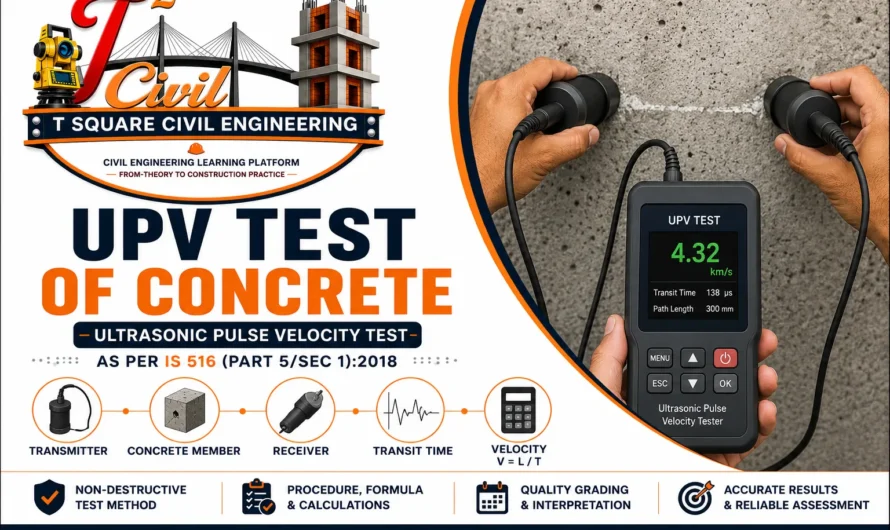
Ultrasonic Pulse Velocity (UPV) Test of Concrete The Ultrasonic Pulse Velocity (UPV) Test is a non-destructive test used to assess the quality and uniformity of …

Civil Engineering Learning Platform: From Theory to Construction Practice
Civil engineering laboratory tests are used to assess the quality, strength, durability, and suitability of construction materials and concrete used in building and infrastructure projects.
This category provides clear, step-by-step guides for cement, concrete, aggregates, and other construction-material tests, including equipment, test procedures, formulas, calculations, result interpretation, and relevant IS Code references. These resources are useful for civil engineering students, site engineers, QA/QC engineers, laboratory technicians, contractors, and construction professionals.
Ultrasonic Pulse Velocity (UPV) Test of Concrete The Ultrasonic Pulse Velocity (UPV) Test is a non-destructive test used to assess the quality and uniformity of …
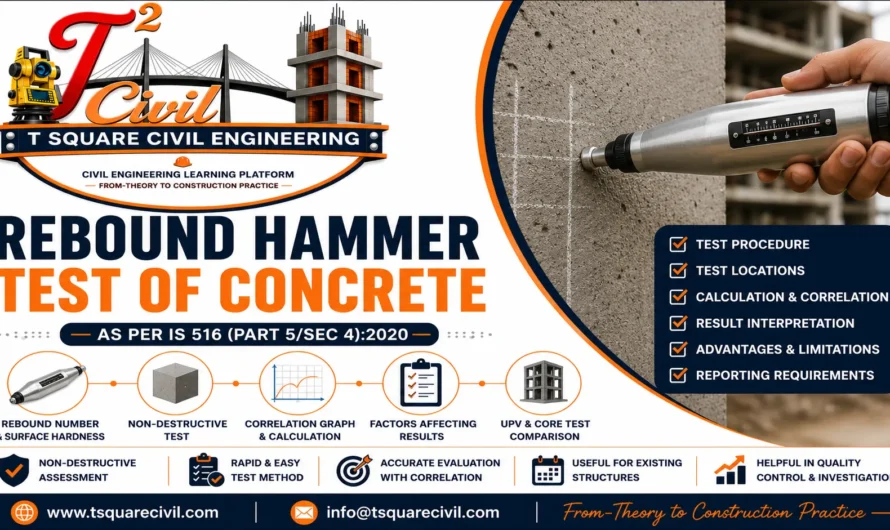
Introduction The Rebound Hammer Test of Concrete is a widely used non-destructive test for assessing the surface hardness and uniformity of hardened concrete. It is …
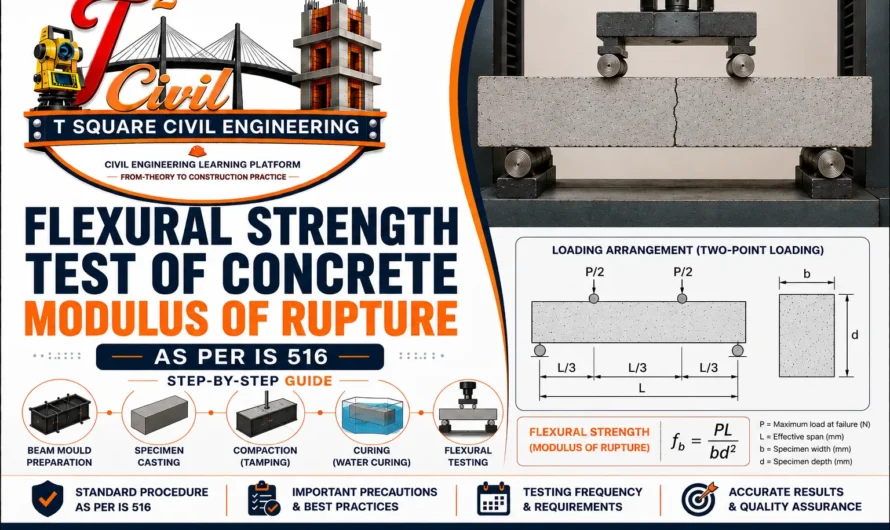
Introduction Concrete is strong in compression but comparatively weak in tension. In many structural and pavement applications, concrete is also subjected to bending or flexural …
Concrete has high compressive strength but comparatively low tensile strength. The split tensile strength test is an indirect method used to determine the tensile strength …
Concrete Cube Casting Procedure involves preparing representative concrete specimens for compressive-strength testing. Reliable results depend on correct sampling, mould preparation, compaction, identification, initial storage and …
Introduction The soundness test of cement determines whether hardened cement paste is likely to undergo excessive delayed expansion after setting. Cement should retain its volume …
Introduction to the Compressive Strength Test What is the Compressive Strength Test? The Compressive Strength Test is one of the most important quality control tests …
Introduction The initial and final setting time of cement are important physical properties used to understand how cement paste changes from a plastic condition to …
Fineness of cement is an important physical property that indicates the degree of subdivision or particle size of cement. It influences the rate of hydration, …
Introduction Standard consistency of cement is the water content required to prepare a cement paste that satisfies the specified penetration condition when tested with a …