 by
by Page Contents
Introduction
The soundness test of cement determines whether hardened cement paste is likely to undergo excessive delayed expansion after setting.
Cement should retain its volume after it has set and hardened. If significant expansion occurs later, it may cause cracking, loss of durability and disruption of mortar or concrete.
Soundness is therefore an important physical property of cement and forms part of cement quality-control testing.
In India, soundness of hydraulic cement is determined according to IS 4031 (Part 3):1988 using two methods:
- Le-Chatelier method
- Autoclave method
The Le-Chatelier method is widely used in civil engineering laboratories and is particularly useful for assessing expansion associated mainly with free lime. The autoclave method subjects cement paste to high-pressure steam and provides a more severe accelerated assessment of potentially expansive constituents.
What Is Soundness of Cement?
Soundness of cement is the ability of hardened cement paste to retain its volume after setting without undergoing excessive delayed expansion.
A sound cement remains dimensionally stable after hardening.
An unsound cement may expand after setting and can cause:
- cracking;
- distortion;
- loss of bond;
- surface deterioration; and
- reduced durability of concrete or mortar.
The soundness test is therefore intended to identify potentially harmful expansion before cement is accepted for use.
Why Does Cement Become Unsound?
Unsoundness may result when certain expansive constituents remain in cement and hydrate only after the cement has already begun to harden.
Important causes include:
Free Lime
Excess uncombined calcium oxide, commonly referred to as free lime, can hydrate slowly after setting.
Its delayed hydration may produce expansion.
Magnesia
Excess free magnesium oxide may hydrate slowly and can contribute to delayed expansion.
Calcium Sulphate
Improper or excessive sulphate content may also contribute to undesirable expansion under certain conditions.
The exact behaviour depends on cement composition and manufacturing conditions, so soundness should be established by standardized testing rather than predicted from one constituent alone.
Why Is the Soundness Test Important?
The soundness test is important because excessive expansion of hardened cement paste can damage concrete even when other properties initially appear satisfactory.
Soundness testing helps:
- check dimensional stability of cement;
- identify excessive delayed expansion;
- support cement quality control;
- verify compliance with the applicable cement specification; and
- reduce the risk of cracking associated with unsound cement.
IS Code for Soundness Test of Cement
The principal Indian Standard is:
IS 4031 (Part 3):1988 – Methods of Physical Tests for Hydraulic Cement: Determination of Soundness
The standard covers both:
- Le-Chatelier method, and
- Autoclave method.
For Ordinary Portland Cement, the applicable product specification is:
IS 269:2015 – Ordinary Portland Cement – Specification
The test method and cement specification should not be confused.
IS 4031 Part 3 explains how the test is performed, whereas IS 269 specifies the soundness limits applicable to OPC grades.
Methods of Determining Soundness of Cement
Soundness may be determined by:
1. Le-Chatelier Method
This method measures expansion of cement paste using a split brass mould fitted with indicator arms.
The result is expressed in:
millimetres (mm)
2. Autoclave Method
This method exposes cement-paste bars to high-pressure saturated steam.
The change in length is determined and expressed as:
percentage expansion
The autoclave test is more severe than the Le-Chatelier procedure and should not be treated as simply another way of obtaining the same numerical result.
Principle of the Le-Chatelier Soundness Test
A cement paste is prepared using water equal to 0.78 times the water required for standard consistency.
The paste is filled into a Le-Chatelier mould and kept in water at 27 ± 2°C for 24 hours.
The distance between the indicator points is measured.
The mould is then submerged again, the water is brought to boiling in approximately 25–30 minutes, and boiling is continued for 3 hours.
After cooling, the distance between the indicator points is measured again.
The difference between the two measurements represents the expansion of the cement.
Apparatus Required for Le-Chatelier Test
The apparatus generally includes:
- Le-Chatelier mould
- Two glass plates
- Small weight for the cover glass
- Water bath
- Balance
- Standard weights
- Measuring scale or suitable measuring device
- Mixing equipment
- Gauging trowel
- Clean water
The Le-Chatelier apparatus should conform to the applicable equipment standard.
The water bath should be capable of immersing the specimens and raising the temperature from approximately 27°C to boiling within the specified period.
Le-Chatelier Mould
The Le-Chatelier mould is a small split cylindrical mould manufactured from spring brass or other suitable material.
Two indicator arms are attached on opposite sides of the split.
When cement paste expands, the split mould opens and causes the indicator points to move apart.
The difference in indicator distance before and after boiling provides a measure of expansion.
Water Required for Soundness Test
The cement paste is prepared using:
Water for soundness test = 0.78 × P
where:
P = percentage of water required to produce cement paste of standard consistency
The standard-consistency value should first be determined according to the applicable standard-consistency test.
For example, if:
P = 30%
then:
Water for soundness paste = 0.78 × 30
= 23.4% of the mass of cement used
Therefore, if a laboratory prepares the paste using 100 g of cement:
Water = 23.4 g approximately
when P = 30%.
The 0.78P requirement is specified in IS 4031 Part 3.
How Much Cement Is Required?
Many teaching and routine laboratories prepare a convenient quantity of cement paste, such as 100 g or 400 g, depending on their laboratory SOP and the number of moulds being prepared.
However, the Le-Chatelier procedure in IS 4031 Part 3 is fundamentally specified in terms of preparing sufficient cement paste using 0.78P water and filling the moulds; the key requirement is not a universal fixed 400 g test portion.
Therefore, your article should not state that 400 g is mandatory under IS 4031 Part 3.
The quantity of paste prepared should be sufficient to fill the required specimens while maintaining the prescribed cement-to-water proportion.
Procedure for Soundness Test of Cement by Le-Chatelier Method
Step 1: Determine Standard Consistency
First determine the standard consistency of cement.
Let the standard-consistency water requirement be:
P%
Step 2: Calculate Water for the Soundness Test
Calculate the water required as:
Water = 0.78P
Prepare cement paste using this calculated amount.
Step 3: Prepare the Mould
Lightly oil the Le-Chatelier mould.
Place it on a lightly oiled glass plate.
The mould should be clean and in proper working condition.
Step 4: Fill the Mould
Fill the mould completely with the prepared cement paste.
During filling, take care to keep the split edges of the mould gently together.
Avoid unnecessary vibration or loss of paste.
Step 5: Cover the Mould
Cover the filled mould with another lightly oiled glass plate.
Place the specified small weight on the upper glass plate.
Step 6: Immerse in Water
Immediately submerge the complete assembly in water maintained at:
27 ± 2°C
Keep the assembly submerged for:
24 hours
IS 4031 Part 3 specifies this 24-hour conditioning period.
Step 7: Take Initial Reading
After 24 hours, measure the distance between the two indicator points.
Measure to the nearest:
0.5 mm
Let the initial distance be:
L₁
Step 8: Re-Immerse the Mould
Submerge the mould again in water maintained initially at approximately:
27 ± 2°C
Step 9: Raise Water to Boiling
Heat the water and bring it to boiling while the mould remains submerged.
The water should reach boiling in approximately:
25 to 30 minutes
Step 10: Continue Boiling
Maintain boiling for:
3 hours
Step 11: Cool the Specimen
After completing the boiling period, remove the heat and allow the mould to cool appropriately.
Step 12: Take Final Reading
Measure the distance between the indicator points again.
Let this value be:
L₂
Step 13: Calculate Expansion
The expansion of the specimen is:
Expansion = L₂ − L₁
The result is expressed in:
mm
The IS procedure requires the mean of two values, reported to the nearest 0.5 mm, to represent the cement expansion.
Formula for Soundness of Cement
For each Le-Chatelier specimen:
Expansion, E = L₂ − L₁
where:
E = expansion of cement, mm
L₁ = distance between indicator points after 24-hour immersion, mm
L₂ = distance between indicator points after boiling and cooling, mm
For two specimens:
Mean expansion = (E₁ + E₂) / 2
The mean value is reported to the nearest 0.5 mm.
Example Calculation
Assume two Le-Chatelier specimens are tested.
Specimen 1
Initial indicator distance:
L₁ = 12.0 mm
Final indicator distance:
L₂ = 15.0 mm
Expansion:
E₁ = 15.0 − 12.0
E₁ = 3.0 mm
Specimen 2
Initial indicator distance:
L₁ = 11.5 mm
Final indicator distance:
L₂ = 14.0 mm
Expansion:
E₂ = 14.0 − 11.5
E₂ = 2.5 mm
Mean Expansion
Mean = (3.0 + 2.5) / 2
Mean = 2.75 mm
Report in accordance with the specified rounding requirement.
The calculated result should then be compared with the limit applicable to the particular cement type and grade.
Observation Table
| Particular | Specimen 1 | Specimen 2 |
|---|---|---|
| Standard consistency, P | 30% | 30% |
| Water for soundness paste | 0.78P | 0.78P |
| Initial indicator distance, L₁ | 12.0 mm | 11.5 mm |
| Final indicator distance, L₂ | 15.0 mm | 14.0 mm |
| Expansion, L₂ − L₁ | 3.0 mm | 2.5 mm |
Mean expansion = 2.75 mm
Soundness Limits for Ordinary Portland Cement
Under IS 269:2015, the soundness requirements for OPC include both Le-Chatelier and autoclave limits.
| OPC Grade | Le-Chatelier Expansion, Max | Autoclave Expansion, Max |
|---|---|---|
| OPC 33 | 10 mm | 0.8% |
| OPC 43 | 10 mm | 0.8% |
| OPC 43S | 5 mm | 0.8% |
| OPC 53 | 10 mm | 0.8% |
| OPC 53S | 5 mm | 0.8% |
These requirements are given in the OPC physical-requirements table under IS 269:2015.
Important
Do not write simply:
“The soundness limit of cement is 10 mm.”
That is not universally correct for every cement grade or every cement type.
For example, OPC 43S and OPC 53S have a lower Le-Chatelier limit of 5 mm under IS 269:2015.
Always verify the:
- cement type;
- cement grade;
- applicable product standard;
- approved project specification; and
- latest amendments.
What Happens If Cement Fails the Soundness Test?
IS 4031 Part 3 provides for retesting after aeration.
For the Le-Chatelier retest, the cement is spread in a layer approximately:
75 mm thick
and stored for:
7 days
at approximately:
27 ± 2°C
and:
50–80% relative humidity
before retesting.
For OPC under IS 269, additional requirements apply to the soundness result after aeration. The applicable cement specification should therefore be consulted before making a final acceptance or rejection decision.
Autoclave Soundness Test of Cement
IS 4031 Part 3 also specifies an autoclave method.
In this method, cement-paste bars are subjected to high-pressure saturated steam.
The method uses test bars prepared in moulds of approximately:
25 × 25 mm cross-section and 282 mm internal length
with an effective gauge length of:
250 mm.
A standard paste batch contains:
500 g of cement
with sufficient water to produce paste of standard consistency.
The specimens are stored in a moist environment before being subjected to autoclave treatment.
Principle of the Autoclave Test
The initial length of a cement-paste bar is measured.
The specimen is exposed to saturated steam under high pressure.
After autoclaving and controlled cooling, the bar length is measured again.
The percentage change in length represents the:
autoclave expansion of cement
Autoclave Test Conditions
Under IS 4031 Part 3, the autoclave pressure is raised to approximately:
2.1 MPa gauge pressure
The pressure is brought to this level in approximately:
1 to 1¼ hours
and maintained at:
2.1 ± 0.1 MPa
for:
3 hours.
This corresponds to a saturated-steam temperature of approximately:
215.7 ± 1.7°C.
Because the procedure involves high-pressure steam, autoclave testing requires proper equipment, trained personnel and strict safety controls.
Formula for Autoclave Expansion
Autoclave expansion is calculated from the change in specimen length relative to its effective gauge length.
In general:
Autoclave expansion (%) = [(Final length − Initial length) / Effective gauge length] × 100
The result is reported to the nearest:
0.01%
IS 4031 Part 3 specifies that any contraction is reported as a negative expansion.
Le-Chatelier Test vs Autoclave Test
| Parameter | Le-Chatelier Method | Autoclave Method |
|---|---|---|
| Main result | Linear expansion | Percentage length change |
| Unit | mm | % |
| Apparatus | Le-Chatelier mould | High-pressure autoclave |
| Conditioning | Water and boiling | High-pressure saturated steam |
| Test severity | Moderate accelerated test | More severe accelerated test |
| IS code | IS 4031 Part 3 | IS 4031 Part 3 |
| OPC limit | Depends on grade | Generally 0.8% max |
The two methods are complementary and should not be numerically compared with each other.
Why Is 0.78P Water Used?
The soundness specimen needs a paste with controlled consistency so that different cement samples can be compared under standardized conditions.
Using:
0.78 × standard-consistency water
provides a defined paste condition for the Le-Chatelier test.
For example:
If:
P = 32%
then:
Water = 0.78 × 32
= 24.96%
If 100 g cement is used to prepare the paste:
Water ≈ 24.96 g
Relationship Between Soundness and Standard Consistency
The Le-Chatelier procedure directly depends on standard consistency because the water used to prepare the paste is based on:
0.78P
Therefore, standard consistency must be determined correctly before carrying out the soundness test.
Internal link: Standard Consistency Test of Cement using Vicat Apparatus
Is Soundness the Same as Setting Time?
No.
Soundness measures the tendency of hardened cement paste to undergo excessive delayed expansion.
Setting time measures the time required for cement paste to lose plasticity and develop a specified degree of rigidity.
These are separate physical properties.
A cement may satisfy setting-time requirements but still need to be checked independently for soundness.
Internal link: Initial and Final Setting Time Test of Cement
Is Soundness the Same as Compressive Strength?
No.
Compressive strength measures the ability of cement mortar to resist compressive stress.
Soundness measures dimensional stability.
A cement can develop adequate compressive strength and yet fail a soundness requirement.
Therefore, both tests are independently important.
Internal link: Compressive Strength Test of Cement
Precautions During Le-Chatelier Test
Follow these precautions for reliable results:
- Use a representative cement sample.
- Determine standard consistency accurately.
- Use the correct water quantity of 0.78P.
- Keep the mould clean and lightly oiled.
- Oil the glass plates lightly.
- Avoid excessive oil that may contaminate the paste.
- Keep the mould edges gently together during filling.
- Fill the mould completely.
- Prevent loss of cement paste.
- Immediately immerse the assembly after preparation.
- Maintain water at 27 ± 2°C during the initial conditioning period.
- Keep the specimen submerged for the required 24 hours.
- Measure indicator spacing accurately to the nearest 0.5 mm.
- Bring the water to boiling gradually within the specified period.
- Maintain boiling for the full 3 hours.
- Allow the specimen to cool before taking the final measurement.
- Use two determinations and report the mean.
- Check the applicable cement specification before declaring the sample acceptable.
Common Errors in Soundness Testing
Using P Instead of 0.78P
For the Le-Chatelier soundness test, the paste is not prepared using the full standard-consistency water quantity.
Use:
0.78P
Reporting Only One Specimen
IS 4031 Part 3 requires the mean of two expansion values.
Measuring Before the 24-Hour Conditioning Period
The first indicator reading should be taken after the specified immersion period.
Heating the Water Too Rapidly
The water should be brought from the initial test temperature to boiling over the specified controlled period rather than immediately placing the specimen into boiling water.
Not Cooling Before Final Measurement
The mould should be allowed to cool appropriately before the final indicator reading.
Applying a Universal 10 mm Limit
The permitted expansion depends on the applicable cement specification and grade.
Practical Interpretation for Site and QA/QC Engineers
A soundness result should never be interpreted in isolation.
For cement acceptance, the engineer should normally review:
- manufacturer and cement grade;
- batch or lot number;
- manufacturer’s test certificate;
- fineness;
- standard consistency;
- setting time;
- soundness;
- compressive strength;
- relevant chemical requirements; and
- project specification.
If a cement fails soundness requirements, it should not simply be accepted because another physical property, such as compressive strength, is satisfactory.
The failure and retest requirements of the applicable standard should be followed.
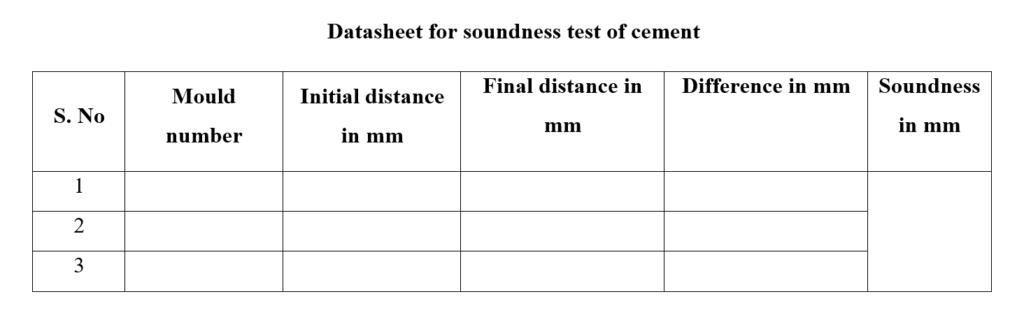
Sample Laboratory Report
| Item | Observation |
|---|---|
| Project | __________ |
| Cement type | __________ |
| Cement grade | __________ |
| Manufacturer | __________ |
| Batch/Lot No. | __________ |
| Date of test | __________ |
| Standard consistency, P | __________ % |
| Water used, 0.78P | __________ % |
| Test method | IS 4031 Part 3 |
| Initial distance, specimen 1 | __________ mm |
| Final distance, specimen 1 | __________ mm |
| Expansion, specimen 1 | __________ mm |
| Initial distance, specimen 2 | __________ mm |
| Final distance, specimen 2 | __________ mm |
| Expansion, specimen 2 | __________ mm |
| Mean expansion | __________ mm |
| Applicable limit | __________ mm |
| Result | Pass / Fail as applicable |
| Tested by | __________ |
| Checked by | __________ |
Frequently Asked Questions
What is soundness of cement?
Soundness is the ability of hardened cement paste to retain its volume without undergoing excessive delayed expansion after setting.
Which IS code is used for the soundness test of cement?
IS 4031 (Part 3):1988 covers determination of cement soundness by the Le-Chatelier and autoclave methods.
Which apparatus is used for the soundness test of cement?
The Le-Chatelier apparatus is commonly used for the routine soundness test. An autoclave is used for the separate autoclave-expansion method.
How much water is used in the Le-Chatelier test?
The paste is prepared using water equal to:
0.78 × P
where P is the water required for standard consistency.
How long is the Le-Chatelier mould kept in water?
The mould assembly is initially kept submerged in water at 27 ± 2°C for 24 hours.
How long is the specimen boiled?
After the initial reading, the specimen is kept submerged while the water is brought to boiling and is then boiled for 3 hours.
What is the formula for soundness by the Le-Chatelier method?
Expansion = Final indicator distance − Initial indicator distance
The mean of two specimen results represents the expansion.
What is the maximum Le-Chatelier expansion for OPC?
Under IS 269:2015, OPC 33, OPC 43 and OPC 53 generally have a maximum Le-Chatelier expansion of 10 mm, while OPC 43S and OPC 53S have a maximum of 5 mm.
What is the maximum autoclave expansion for OPC?
IS 269:2015 specifies a maximum autoclave expansion of 0.8% for the listed OPC grades.
What causes unsoundness of cement?
Unsoundness may be associated with slowly hydrating expansive constituents such as free lime or magnesia and, depending on cement composition, sulphate-related effects.
Why is the soundness test necessary?
The test helps identify cement that may undergo damaging delayed expansion after setting and therefore supports durability and quality control.
What is the difference between soundness and setting time?
Soundness measures dimensional stability after setting, while setting time measures how rapidly fresh cement paste changes from a plastic condition toward rigidity.
What happens if cement fails the soundness test?
The applicable cement specification and IS 4031 Part 3 retest procedure should be followed. The standard provides for retesting after controlled aeration of the sample.
Key Points to Remember
- Sound cement should remain dimensionally stable after hardening.
- IS 4031 Part 3:1988 covers the soundness test.
- Two methods are included: Le-Chatelier and autoclave.
- Le-Chatelier paste is prepared using 0.78P water.
- Initial conditioning is 24 hours at 27 ± 2°C.
- Water is brought to boiling in about 25–30 minutes.
- Boiling continues for 3 hours.
- Le-Chatelier expansion is L₂ − L₁.
- The mean of two determinations is reported.
- OPC Le-Chatelier limits are not universally 10 mm; grade matters.
- Autoclave expansion is expressed as a percentage, not millimetres.
- Material acceptance should always follow the applicable cement specification.
Conclusion
The soundness test of cement is an important quality-control test used to assess the dimensional stability of hardened cement paste.
The Le-Chatelier method under IS 4031 Part 3 measures the expansion of a cement-paste specimen after controlled water conditioning and boiling. The paste is prepared using 0.78 times the water required for standard consistency, and the final result is obtained from the change in indicator spacing.
IS 4031 Part 3 also includes the autoclave method, which exposes cement-paste specimens to high-pressure saturated steam and reports the resulting length change as percentage expansion.
Engineers should not apply a single soundness limit to every cement. The test result must be compared with the requirement for the actual cement type and grade under the applicable product standard and project specification.
References
- IS 4031 (Part 3):1988 – Methods of Physical Tests for Hydraulic Cement: Determination of Soundness.
- IS 4031 (Part 4):1988 – Determination of Consistency of Standard Cement Paste.
- IS 269:2015 – Ordinary Portland Cement – Specification.
- Applicable project specifications and latest amendments to relevant Indian Standards.
Datasheet for soundness test of cement