 by
by The Aggregate Impact Value (AIV) test is used to determine the resistance of coarse aggregate to sudden shock or impact.
Aggregates used in concrete, pavements and other construction works may be subjected not only to gradually applied loads but also to impact, vibration and repeated dynamic effects. An aggregate may behave differently under sudden impact than under slowly applied compression.
The Aggregate Impact Value test therefore provides a relative measure of the toughness of coarse aggregate, or its ability to resist fracture under sudden impact.
A lower Aggregate Impact Value generally indicates greater resistance to impact, whereas a higher value indicates that a larger proportion of the aggregate has broken down into fines under the specified test conditions.
In India, the test procedure is specified in IS 2386 (Part 4):1963 — Methods of Test for Aggregates for Concrete: Mechanical Properties. Requirements for aggregates used in concrete are specified in IS 383:2016.
Disclaimer: This article provides educational and practical laboratory guidance. Always verify the latest applicable Indian Standards, amendments, approved project specifications and laboratory quality procedures before using test results for acceptance or rejection of construction materials.
Page Contents
What Is Aggregate Impact Value?
Aggregate Impact Value is the percentage by mass of fines produced when a standard-sized coarse aggregate sample is subjected to a specified number of impacts in a standard impact-testing machine.
The test measures the aggregate’s resistance to sudden shock or impact.
This differs from the Aggregate Crushing Value test, which assesses resistance to crushing under a gradually applied compressive load.
Therefore:
AIV → resistance to sudden impact
ACV → resistance to gradual crushing
Both tests evaluate mechanical properties of coarse aggregate, but they represent different modes of loading.
What Does Aggregate Impact Value Indicate?
Aggregate Impact Value primarily indicates the toughness or impact resistance of coarse aggregate.
When the test sample is repeatedly struck by the standard hammer, weaker particles break into smaller fragments.
These fragments are then sieved through the 2.36 mm sieve.
The greater the mass of material passing the 2.36 mm sieve, the greater the breakdown of the aggregate and therefore the higher the AIV.
Thus:
Lower AIV = greater resistance to impact
Higher AIV = lower resistance to impact
AIV should not, however, be used as the only indicator of aggregate suitability.
Aggregate grading, particle shape, water absorption, specific gravity, crushing resistance, abrasion resistance, durability and deleterious materials may also need to be considered.
Why Is the Aggregate Impact Value Test Important?
Coarse aggregate constitutes a large proportion of concrete and other construction materials.
Its ability to resist impact can influence performance where the aggregate is subjected to dynamic or repeated loads.
The test is useful for:
- comparing different aggregate sources;
- checking the consistency of aggregate quality;
- evaluating resistance to sudden impact;
- supporting material approval;
- quality control in aggregate production;
- concrete aggregate assessment; and
- pavement and other construction-material evaluation where applicable.
The test should always be interpreted together with the requirements of the relevant material specification.
Applicable Indian Standards
The principal Indian Standards relevant to Aggregate Impact Value testing are:
| Standard | Purpose |
|---|---|
| IS 2386 (Part 4):1963 | Methods of test for mechanical properties of aggregates, including Aggregate Impact Value |
| IS 383:2016 | Specification for coarse and fine aggregate for concrete |
| IS 2430:1986 | Sampling of aggregates for concrete |
| IS 9377:1979 | Specification for apparatus for Aggregate Impact Value |
IS 2386 (Part 4) specifies the AIV test procedure, while IS 383 specifies mechanical-property requirements for aggregates used in concrete.
Indian Standards may be amended, revised or superseded. The latest BIS status should therefore be checked for project use.
Principle of the Aggregate Impact Value Test
A prepared coarse aggregate sample of standard particle size is placed in the cup of the Aggregate Impact Value testing machine.
The aggregate is compacted and subjected to 15 blows from a standard hammer falling freely from the specified height.
After impact, the entire crushed material is removed and sieved through the 2.36 mm IS sieve.
The percentage of the original sample mass that passes the 2.36 mm sieve is calculated.
This percentage is the Aggregate Impact Value.
Standard Aggregate Size Used for the Test
For the standard Aggregate Impact Value test, the test sample consists entirely of aggregate:
Passing the 12.5 mm IS sieve
and
Retained on the 10 mm IS sieve
This size fraction should be properly separated before preparing the test specimen.
Using the correct size fraction is important because impact-test results can be influenced by particle size.
Apparatus Required
The main equipment required for the test includes:
- Aggregate Impact Value testing machine;
- 12.5 mm IS sieve;
- 10 mm IS sieve;
- 2.36 mm IS sieve;
- cylindrical measuring cup;
- tamping rod;
- weighing balance;
- drying oven; and
- suitable trays or containers.
Important Apparatus Dimensions
For the standard test, IS 2386 (Part 4) specifies key apparatus characteristics including:
| Component | Requirement |
|---|---|
| Impact hammer mass | 13.5 to 14.0 kg |
| Hammer fall | 380 ± 5 mm |
| Test cup internal diameter | 102 mm |
| Test cup internal depth | 50 mm |
| Cylindrical measuring cup diameter | 75 mm |
| Measuring cup depth | 50 mm |
| Tamping rod diameter | 10 mm |
| Tamping rod length | 230 mm |
| Balance | Capacity at least 500 g, readable to 0.1 g |
| Oven temperature | 100°C to 110°C |
The impact machine should rest rigidly on a suitable level concrete, stone or equivalent rigid support so that rocking does not occur during testing.
Preparation of the Test Sample
Obtain a representative coarse aggregate sample.
Separate the required material using the 12.5 mm and 10 mm IS sieves.
The test fraction should consist entirely of aggregate passing 12.5 mm and retained on 10 mm.
Dry the test material in an oven for four hours at 100°C to 110°C.
After drying, allow the aggregate to cool before preparing the test specimen.
Determination of the Test Sample Mass
The standard cylindrical measure is used to establish the required amount of aggregate.
Fill the measure approximately one-third full with the prepared aggregate.
Compact it with 25 strokes of the rounded end of the tamping rod.
Add another approximately equal layer and again apply 25 strokes.
Fill the measure to overflowing with the third layer and apply another 25 strokes.
Strike off the excess aggregate using the tamping rod as a straightedge.
Determine the net mass of aggregate in the measure to the nearest gram.
Let this mass be:
A = mass of oven-dried test sample
The same mass of material should be used for the duplicate test on the same aggregate.
Aggregate Impact Value Test Procedure
Ensure that the impact-testing machine is resting rigidly on a level and stable base and that the hammer guide columns are vertical.
Fix the test cup firmly in position on the base of the impact-testing machine.
Place the entire prepared test sample into the cup.
Compact the sample in the impact cup using one set of 25 strokes of the tamping rod.
This point is important:
The measuring cylinder is filled in three layers with 25 strokes per layer to establish the sample quantity, but after the measured sample is placed in the impact-machine cup, it receives a single tamping of 25 strokes.
Raise the hammer until its lower face is approximately 380 mm above the upper surface of the aggregate.
Allow the hammer to fall freely onto the test sample.
Apply a total of 15 blows.
The blows should be delivered at intervals of not less than one second.
After completing the 15 impacts, remove the entire crushed sample carefully from the cup.
Sieving After Impact
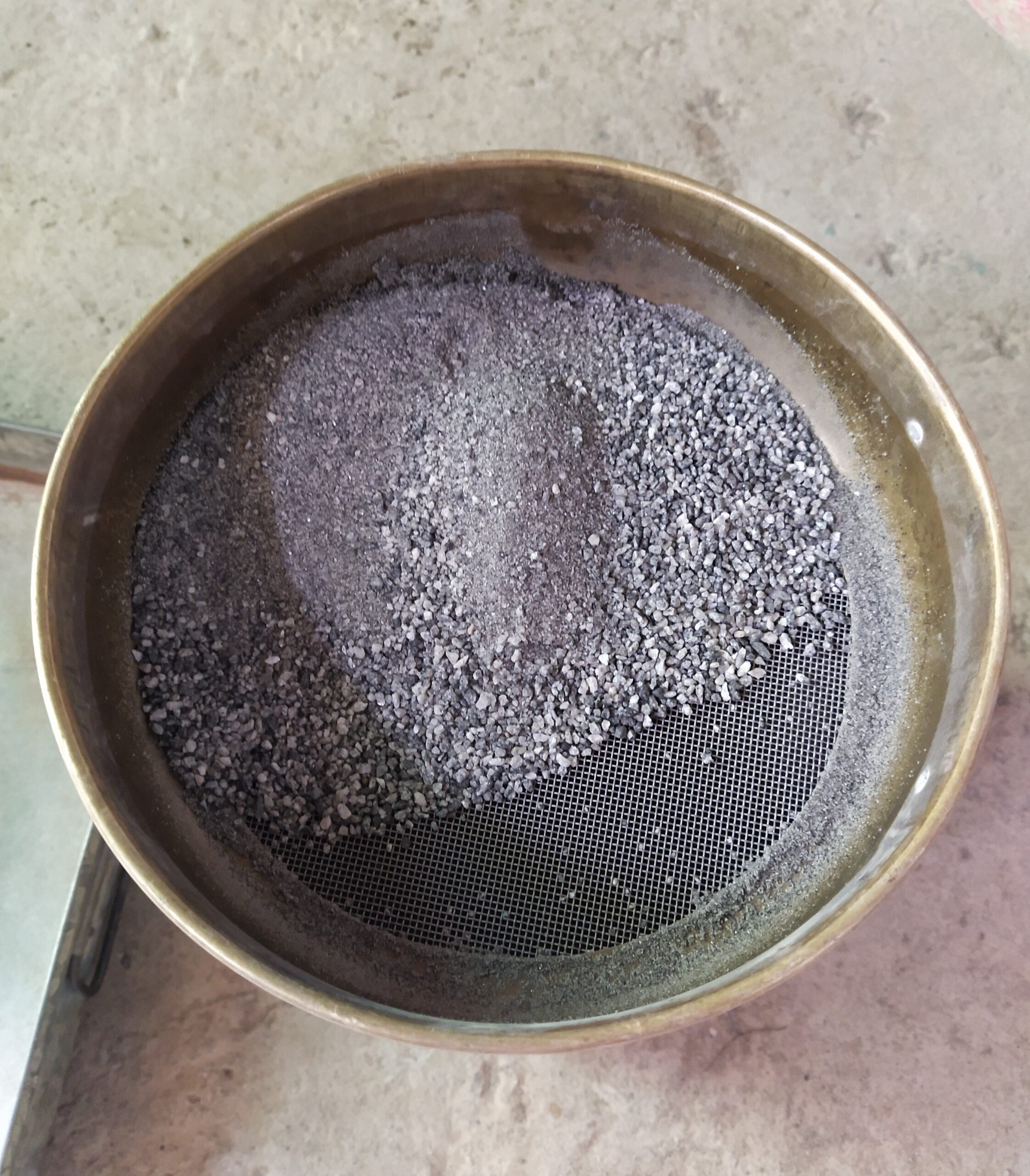
Sieve the entire impacted sample through the 2.36 mm IS sieve.
Continue sieving until no further significant quantity passes through the sieve during one minute of sieving.
Determine:
B = mass passing the 2.36 mm sieve
and
C = mass retained on the 2.36 mm sieve
The combined recovered mass should be checked against the original test mass.
According to IS 2386 (Part 4), if:
B + C
is more than 1 g less than the original mass A, the result should be discarded and a fresh test carried out.
This mass-balance check is important because excessive loss of material during transfer or sieving can produce an incorrect AIV.
Aggregate Impact Value Formula
The Aggregate Impact Value is calculated as:
AIV (%) = (B ÷ A) × 100
Where:
A = original oven-dried test-sample mass
B = mass of material passing the 2.36 mm sieve after impact
The result for each test is calculated to one decimal place.
Two tests are carried out, and the mean of the two results is reported as the Aggregate Impact Value, rounded as required by the test method.
Worked Example of Aggregate Impact Value
Suppose:
Original oven-dried test sample, A = 350.0 g
After 15 impacts:
Mass passing 2.36 mm sieve, B = 63.0 g
Then:
AIV = (63.0 ÷ 350.0) × 100
AIV = 18.0%
Suppose the duplicate test gives:
AIV = 18.4%
Then the mean is:
Mean AIV = (18.0 + 18.4) ÷ 2
= 18.2%
The final reported result should be rounded according to the reporting requirements of the applicable test method.
For practical interpretation, the value should then be compared with the applicable project specification and IS 383 requirement.
Sample Observation and Calculation Table
| Particular | Test 1 | Test 2 |
|---|---|---|
| Original sample mass, A (g) | 350.0 | 350.0 |
| Mass passing 2.36 mm, B (g) | 63.0 | 64.4 |
| Mass retained 2.36 mm, C (g) | 286.7 | 285.3 |
| Recovered mass B + C (g) | 349.7 | 349.7 |
| AIV (%) | 18.0 | 18.4 |
Average AIV = 18.2%
The values above are an illustrative laboratory example.
Aggregate Impact Value Limits as per IS 383:2016
For aggregates used in concrete, IS 383:2016 gives the following Aggregate Impact Value requirements:
| Application | Maximum AIV |
|---|---|
| Aggregate used in concrete for wearing surfaces | 30% |
| Aggregate used in concrete for other than wearing surfaces | 45% |
| Concrete of grade M65 and above | 22% |
Examples of wearing-surface applications identified in IS 383 include roads, pavements, runways, tunnel linings carrying water, spillways and stilling basins.
Therefore, when evaluating a result, the engineer must consider the actual application of the aggregate rather than applying one limit universally.
Example
If:
Measured AIV = 18%
then the value is below:
- 30% for wearing-surface concrete;
- 45% for other concrete; and
- 22% for M65-and-above concrete.
From the AIV criterion alone, this example result is therefore within all three of those specified maximum values.
Final material acceptance should still consider all other applicable project and aggregate requirements.
Why Lower AIV Is Generally Better
The AIV represents the proportion of aggregate converted into fines by standard impact loading.
A smaller percentage means less aggregate breakdown.
Therefore:
Lower AIV → higher resistance to impact
Higher AIV → greater breakdown under impact
However, it is not appropriate to assign arbitrary labels such as “excellent,” “good” or “poor” solely from AIV unless such classifications are explicitly supported by the applicable specification.
The technically correct approach is to compare the measured value against the requirement for the intended construction application.
AIV and High-Strength Concrete
IS 383:2016 includes a specific note for concrete grades M65 and above, requiring stronger aggregate and specifying a maximum Aggregate Impact Value and Aggregate Crushing Value of 22%.
This is important because aggregate mechanical properties can become increasingly significant as concrete strength increases.
A coarse aggregate acceptable for ordinary concrete should not automatically be assumed suitable for higher-strength applications.
Aggregate Impact Value vs Aggregate Crushing Value
AIV and ACV are related mechanical-property tests but measure different resistance characteristics.
| Aggregate Impact Value | Aggregate Crushing Value |
|---|---|
| Measures resistance to sudden impact | Measures resistance to gradual compressive loading |
| Uses impact-testing machine | Uses compression-testing machine |
| Test sample receives 15 hammer blows | Aggregate is subjected to progressively applied compression |
| Fines passing 2.36 mm are measured | Fines passing 2.36 mm are measured |
| Represents impact resistance/toughness | Represents crushing resistance |
IS 383 allows Aggregate Impact Value to be determined as an alternative mechanical-property assessment to the crushing-value provision under its mechanical-properties requirements.
For a full understanding of aggregate strength, engineers should consider the relevant test required by the project specification rather than assuming that one test replaces every other mechanical-property assessment.
AIV vs Los Angeles Abrasion Value
Aggregate Impact Value should also not be confused with the Los Angeles Abrasion Value.
AIV primarily evaluates breakdown caused by sudden impact.
Los Angeles Abrasion Value evaluates resistance to a combination of abrasion, impact and attrition in the Los Angeles machine.
Both tests are covered under mechanical-property assessment of aggregate, but they use different apparatus and provide different information.
Importance of Representative Sampling
Accurate laboratory testing begins with representative sampling.
A stockpile may contain:
- particle-size segregation;
- material from different production batches;
- varying particle shapes;
- contamination; or
- different moisture conditions.
A sample taken only from one convenient point may therefore not represent the entire stockpile.
Sampling should be carried out using an approved method, with reference to IS 2430 where applicable.
The sample should then be reduced carefully without selectively removing weaker, flatter or differently shaped particles.
Common Errors During the AIV Test
Typical errors include:
- using the wrong aggregate size fraction;
- failing to dry the aggregate properly;
- testing hot aggregate directly from the oven;
- incorrect filling of the measuring cylinder;
- applying fewer or more than 25 tamping strokes;
- incorrect tamping of the impact cup;
- incorrect hammer height;
- applying fewer or more than 15 blows;
- allowing the impact machine to rock;
- delivering blows too rapidly;
- losing fines while transferring the sample;
- incomplete sieving through the 2.36 mm sieve;
- using damaged sieves;
- incorrect weighing;
- ignoring the mass-balance check;
- testing only once rather than carrying out duplicate tests; and
- applying the wrong acceptance criterion.
Important Precautions
Ensure that the aggregate sample is representative.
Use only the required 12.5 mm passing and 10 mm retained fraction for the standard test.
Dry the aggregate for the specified duration and temperature.
Allow the dried sample to cool before testing.
Keep the impact machine on a rigid, level foundation.
Ensure the hammer falls freely without obstruction.
Confirm the specified fall height.
Compact the material uniformly.
Apply exactly 15 impacts.
Maintain at least the required interval between blows.
Recover the complete sample carefully after impact.
Prevent loss of fines during transfer.
Sieve thoroughly through 2.36 mm.
Check the recovered mass against the original mass.
Carry out two tests.
Use the mean result for reporting.
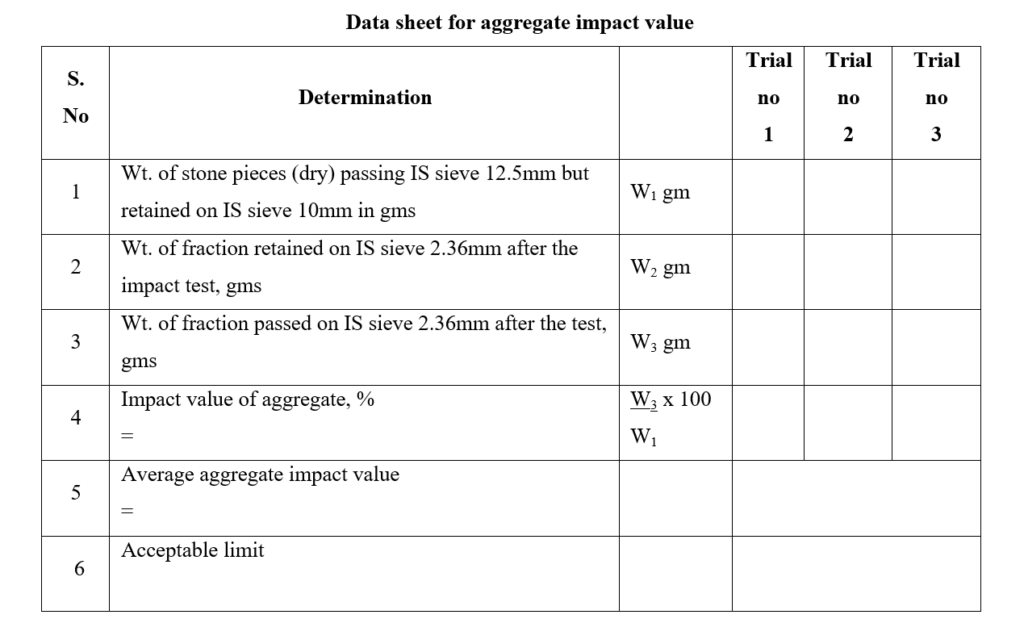
Suggested Laboratory Datasheet
A practical AIV test record may include:
Project:
Client:
Location:
Aggregate source:
Sample identification:
Date sampled:
Date tested:
Test method: IS 2386 (Part 4)
Specification: IS 383 / approved project specification
Sample fraction: Passing 12.5 mm and retained on 10 mm
Oven temperature:
Drying duration:
Original sample mass A:
Mass passing 2.36 mm B:
Mass retained 2.36 mm C:
Recovered mass B + C:
AIV Test 1:
AIV Test 2:
Mean AIV:
Specified maximum:
Result / remarks:
Tested by:
Checked by:
This format helps provide traceability during laboratory and QA/QC review.
Practical Site Example
Suppose a project receives coarse aggregate from a new quarry source.
The aggregate grading appears acceptable, but before approving the source the QA/QC team is required to verify mechanical properties.
An AIV test is performed.
The mean Aggregate Impact Value is found to be:
27%
For ordinary concrete that is not a wearing surface, this is below the 45% maximum AIV specified by IS 383 for that category.
For wearing-surface concrete, the same 27% value is also below the 30% maximum.
However, for M65-and-above concrete, the value would exceed the 22% maximum indicated in IS 383.
This example demonstrates why the same aggregate result can have different acceptability depending on its intended application.
Relationship Between AIV and Aggregate Quality Control
Aggregate Impact Value should not be reviewed in isolation.
A complete aggregate-quality assessment may also involve:
- sieve analysis and grading;
- flakiness and elongation;
- specific gravity;
- water absorption;
- Aggregate Crushing Value or ten-percent fines value where applicable;
- abrasion resistance;
- soundness;
- deleterious materials;
- alkali-aggregate reactivity where applicable; and
- petrographic assessment when necessary.
The required test programme depends on the project, concrete grade, aggregate source and specification.
Frequently Asked Questions
What is Aggregate Impact Value?
Aggregate Impact Value is the percentage by mass of fines produced when a standard-sized coarse aggregate sample is subjected to specified impact loading in an Aggregate Impact Value testing machine.
What does AIV measure?
AIV provides a relative measure of the resistance of coarse aggregate to sudden shock or impact.
What is the IS code for Aggregate Impact Value?
The Aggregate Impact Value test is covered by IS 2386 (Part 4):1963.
Aggregate requirements for concrete are specified in IS 383:2016.
What aggregate size is used for the AIV test?
For the standard test, aggregate passing the 12.5 mm sieve and retained on the 10 mm sieve is used.
How many blows are applied in the Aggregate Impact Value test?
The standard test sample is subjected to 15 blows from the impact hammer.
What is the height of fall of the AIV hammer?
The hammer falls freely from approximately 380 ± 5 mm above the aggregate surface.
What is the weight of the Aggregate Impact Value hammer?
The standard hammer has a mass of approximately 13.5 to 14.0 kg.
Which sieve is used to determine the fines after impact?
The impacted material is sieved through a 2.36 mm IS sieve.
The material passing this sieve is used in the AIV calculation.
What is the formula for Aggregate Impact Value?
AIV (%) = Mass passing 2.36 mm sieve ÷ Original oven-dried sample mass × 100
Is a lower Aggregate Impact Value better?
Generally, yes.
A lower AIV means that less material broke down into fines under the specified impacts and therefore indicates greater resistance to sudden impact.
What is the maximum AIV for wearing-surface concrete?
IS 383:2016 specifies a maximum 30% for aggregates used in concrete wearing surfaces.
What is the maximum AIV for concrete other than wearing surfaces?
IS 383:2016 specifies a maximum 45% for aggregate used in concrete other than wearing surfaces.
What is the AIV limit for M65 and higher concrete?
For concrete grades M65 and above, IS 383:2016 notes that the Aggregate Impact Value and Aggregate Crushing Value should not exceed 22%.
What is the difference between AIV and ACV?
AIV measures resistance to sudden impact, whereas ACV measures resistance to gradually applied compressive loading.
Why are two AIV tests performed?
Duplicate tests improve reliability. The mean of the two results is reported as the Aggregate Impact Value according to the test method.
Conclusion
The Aggregate Impact Value test is an important mechanical-property test used to evaluate the resistance of coarse aggregate to sudden shock or impact.
For the standard test, aggregate passing the 12.5 mm sieve and retained on the 10 mm sieve is dried and prepared in a standard measuring container.
The prepared sample is placed in the impact cup, compacted and subjected to 15 blows from a 13.5–14.0 kg hammer falling through approximately 380 mm.
The impacted aggregate is then sieved through the 2.36 mm sieve.
The Aggregate Impact Value is calculated from:
AIV (%) = (Mass passing 2.36 mm sieve ÷ Original oven-dried sample mass) × 100
A lower AIV generally indicates stronger resistance to impact.
For concrete aggregate, the measured value should be compared with the appropriate IS 383 requirement for the intended use rather than applying one universal acceptance limit.
A technically sound evaluation should also consider aggregate grading, shape, absorption, crushing resistance, abrasion resistance and other project-specified properties.
About T Square Civil Engineering
T Square Civil Engineering is a civil engineering learning platform created to support students, site engineers, QA/QC engineers, laboratory technicians, quantity surveyors, contractors and construction professionals with practical learning resources, worked examples and calculators that connect engineering theory with construction practice.
From Theory to Construction Practice.
Datasheet for aggregate impact value