 by
by Page Contents
Introduction
Standard consistency of cement is the water content required to prepare a cement paste that satisfies the specified penetration condition when tested with a Vicat apparatus.
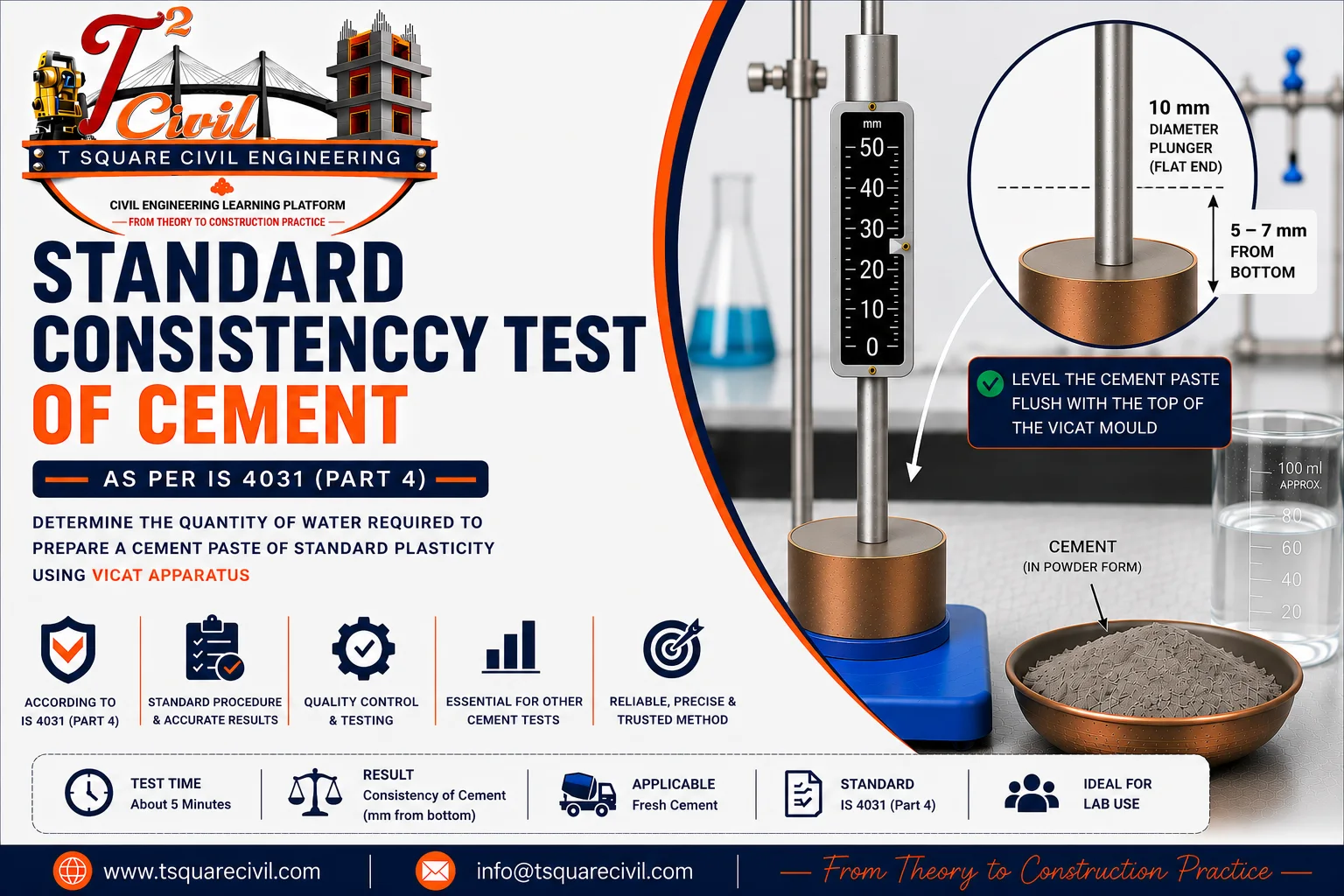
As per IS 4031 (Part 4), standard consistency is reached when the Vicat plunger penetrates the cement paste to a point 5–7 mm from the bottom of the Vicat mould. The water used is expressed as a percentage by mass of dry cement.
Standard consistency is also commonly referred to as normal consistency of cement in laboratory and educational discussions.
Formula:
Standard Consistency, P (%) = (Mass of Water ÷ Mass of Dry Cement) × 100
The value of P provides a reference water content for subsequent cement tests. It should not be confused with the water–cement ratio used for concrete mix design.
This guide explains the definition, Vicat apparatus, IS Code, test procedure, formula, observation, calculation, test endpoint, precautions and practical interpretation of the standard consistency test of cement.
Quick Information
| Parameter | Details |
|---|---|
| Test | Standard Consistency Test of Cement |
| Also Called | Normal Consistency of Cement |
| Test Method | IS 4031 (Part 4):1988 |
| Apparatus | Vicat Apparatus conforming to applicable IS 5513 requirements |
| Plunger | 10 mm diameter Vicat plunger |
| Standard Consistency Criterion | Plunger reaches a point 5–7 mm from the bottom of the Vicat mould |
| Gauging Time | Not less than 3 minutes and not more than 5 minutes |
| Temperature | 27 ± 2°C |
| Laboratory Relative Humidity | Not less than 65% |
| Cement Quantity | Accurately weighed quantity; this article may use 400 g for the worked laboratory example |
| Formula | P (%) = (Mass of Water ÷ Mass of Dry Cement) × 100 |
| Result Reporting | Water content expressed as percentage by mass of dry cement |
| Purpose | To determine the water required to produce cement paste of standard consistency for subsequent cement testing |
Important: IS 4031 (Part 4) determines standard consistency from the specified Vicat penetration condition. It does not prescribe one universal standard-consistency percentage that applies to every cement sample.
Why Should You Read This Guide?
This guide has been prepared to provide a complete understanding of the Standard Consistency Test of Cement in accordance with IS 4031 (Part 4). Whether you are a civil engineering student, diploma student, GATE or SSC JE aspirant, laboratory technician, QA/QC engineer, site engineer, or construction professional, this article explains both the theoretical concepts and practical laboratory procedures in a simple and systematic manner. By the end of this guide, you will be able to understand the purpose of the test, perform the procedure correctly, interpret the results, and avoid common mistakes during laboratory testing.

What is the Standard Consistency of Cement?
Standard Consistency of Cement is the minimum quantity of water required to prepare a cement paste having a standard degree of plasticity, such that the Vicat plunger penetrates the paste to a specified depth under standard laboratory conditions.
In simple words, it is the amount of water needed to prepare a cement paste that is neither too dry nor too wet.
The consistency of cement is expressed as the percentage of water by weight of dry cement.
Define Consistency of Cement
Consistency of cement describes the water requirement of a cement paste under specified test conditions. For the standard consistency test, the required water percentage is determined using the Vicat apparatus.
According to IS 4031 (Part 4), the cement paste has standard consistency when the Vicat plunger penetrates to a point 5–7 mm from the bottom of the Vicat mould.
The result is expressed as:
P (%) = (Mass of Water ÷ Mass of Dry Cement) × 100
where P is the standard consistency of the cement sample.
For example, if a 400 g cement sample requires 112 g of water to satisfy the specified penetration condition:
P = (112 ÷ 400) × 100 = 28.0%
Therefore, the standard consistency of that tested cement sample is 28.0%.
Note: Standard consistency is a laboratory test parameter. It is not the water–cement ratio adopted for a concrete mix.
Typical Practical Range
In routine laboratory testing, the standard consistency of many Ordinary Portland Cement samples is commonly observed in the range of about 26% to 33% by mass of cement.
This range is useful as a practical laboratory reference, but it should not be treated as a universal acceptance limit or fixed IS requirement. The actual standard consistency of the cement sample is the water percentage corresponding to the specified Vicat plunger penetration condition.
The measured value may vary depending on cement composition, fineness, storage condition and other material characteristics.
Why is Standard Consistency Determined?
Objective of Standard Consistency Test
The Standard Consistency Test is one of the fundamental laboratory tests carried out on cement to determine the percentage of water required to prepare a cement paste of standard plasticity. The value obtained from this test serves as the reference for conducting several other physical tests on cement under standardized laboratory conditions. By determining the correct standard consistency, engineers and laboratory technicians can ensure accurate, repeatable, and reliable test results while maintaining compliance with the requirements of IS 4031 (Part 4).
Primary Objectives of the Test
- To determine the percentage of water required to prepare a cement paste of standard consistency.
- To establish a uniform reference condition for conducting cement laboratory tests.
- To determine the correct water content required for the Initial Setting Time Test.
- To determine the correct water content required for the Final Setting Time Test.
- To determine the correct water content required for the Soundness Test.
- To evaluate the water demand of different types and grades of cement.
- To ensure accurate, repeatable, and reliable laboratory test results.
- To support quality control during cement manufacturing and construction.
Why Are These Objectives Important?
Each objective of the Standard Consistency Test contributes to maintaining the accuracy and reliability of cement quality assessment. The percentage of water determined during this test becomes the standard reference for several subsequent laboratory tests. If the cement paste is prepared with insufficient or excessive water, the results of tests such as the Initial Setting Time Test, Final Setting Time Test, and Soundness Test may become inaccurate. Therefore, determining the standard consistency ensures that all physical tests are performed under uniform conditions and produce dependable results.
Practical Importance for Engineers
For civil engineers, laboratory technicians, and QA/QC professionals, the Standard Consistency Test is an essential quality control procedure. It helps verify the water requirement of cement before further laboratory testing and ensures that cement complies with the relevant Indian Standards. A clear understanding of this test also enables site engineers to interpret laboratory reports correctly and coordinate effectively with quality control teams during construction projects.
🎯 Examination Tip: For GATE, SSC JE, RRB JE, diploma, and university examinations, remember that the objective of the Standard Consistency Test is not to determine the water–cement ratio for concrete. Its purpose is to determine the percentage of water required to prepare a cement paste of standard consistency for conducting other cement laboratory tests under standardized conditions.
Importance of Standard Consistency Test
The Standard Consistency Test is one of the most important quality control tests performed on cement because it establishes the standard water content required for preparing a cement paste of standard plasticity. The value obtained from this test serves as the foundation for several other physical tests of cement. Accurate determination of standard consistency ensures that all subsequent laboratory tests are conducted under uniform conditions, producing reliable, repeatable, and comparable results.
Why is the Standard Consistency Test Important?
The Standard Consistency Test plays an important role in cement quality evaluation because it determines the quantity of water required to prepare a cement paste satisfying the specified standard-consistency penetration condition.
Different cement samples can have different water requirements because of variations in fineness, composition, manufacturing process, storage condition and other material characteristics.
Determining the correct standard consistency establishes a uniform reference condition for subsequent cement laboratory tests and improves the reliability and repeatability of test results.
Importance in Cement Quality Control
Quality control laboratories perform the Standard Consistency Test before conducting other physical tests on cement. The water content determined during this test is used as the reference for subsequent laboratory procedures, helping engineers and technicians evaluate cement properties under standardised conditions. This minimises variations in test results and improves the reliability of quality assessment during cement manufacturing and construction.
Major Benefits of the Standard Consistency Test
- Determines the correct water content required for preparing standard cement paste.
- Provides the reference value for the Initial Setting Time Test.
- Provides the reference value for the Final Setting Time Test.
- Provides the reference value for the Soundness Test.
- Ensures uniform laboratory testing conditions.
- Improves the accuracy and repeatability of test results.
- Supports quality assurance during cement manufacturing.
- Helps laboratory technicians and engineers maintain standardised testing procedures.
- Assists in comparing the properties of different cement samples.
- Contributes to the production of durable and reliable concrete structures.
Importance for Different Professionals
| Professional | Importance |
|---|---|
| Civil Engineers | Helps interpret laboratory reports and assess cement quality before construction. |
| Site Engineers | Enables better coordination with QA/QC teams and understanding of test reports. |
| QA/QC Engineers | Ensures compliance with quality standards and improves the reliability of laboratory testing. |
| Laboratory Technicians | Provides the correct reference water content for conducting physical tests on cement. |
| Students | Builds a strong understanding of cement testing concepts for academic and competitive examinations. |
Consequences of Incorrect Standard Consistency
If the standard consistency is determined incorrectly, all subsequent cement tests may produce unreliable results. Insufficient water results in a stiff cement paste that prevents proper penetration of the Vicat plunger, while excessive water produces an overly fluid paste that affects penetration readings. Consequently, tests such as the Initial Setting Time Test, Final Setting Time Test, and Soundness Test may not accurately represent the true properties of the cement. Therefore, accurate determination of standard consistency is essential for obtaining dependable laboratory results.
💡 Engineering Insight: The Standard Consistency Test is not performed to evaluate the strength of cement directly. Instead, it establishes a standardized water content that enables other cement quality tests to be carried out accurately and consistently.
Key Benefits of the Standard Consistency Test
| Benefit | Explanation |
|---|---|
| Basis for Other Cement Tests | The standard consistency value is used for the Initial Setting Time, Final Setting Time, and Soundness Tests. |
| Uniform Testing | Ensures that cement tests are conducted under identical laboratory conditions. |
| Cement Quality Control | Helps monitor the physical properties and quality of cement. |
| Quality Assurance | Confirms compliance with Indian Standards before cement is used in construction. |
| Reliable Construction | Improves the accuracy of cement testing, contributing to durable concrete structures. |
Theory of the Standard Consistency Test
When water is added to cement, hydration begins and the cement particles gradually form a workable paste.
If insufficient water is added, the paste remains too stiff and the Vicat plunger does not penetrate sufficiently. If excessive water is added, the paste becomes too fluid and the plunger penetrates too far.
Therefore, trial pastes are prepared with different water contents until the 10 mm Vicat plunger reaches a point 5–7 mm from the bottom of the mould.
The percentage of water corresponding to this specified penetration condition is reported as the standard consistency of the cement sample.
The Vicat apparatus provides a standardized method for determining this water requirement.
Scientific Principle of the Standard Consistency Test
The Standard Consistency Test is based on the principle that the plasticity of cement paste depends on the amount of water added during mixing. When water is added, cement particles begin to hydrate immediately, forming hydration products that gradually change the consistency of the paste. By adjusting the water content through successive trials and measuring the penetration of the standard Vicat plunger, the quantity of water that produces a cement paste of standard plasticity is determined. This standardised condition serves as the reference for conducting other physical tests on cement.
IS Code for Standard Consistency Test of Cement
The standard consistency test of cement is covered by:
IS 4031 (Part 4):1988 – Methods of Physical Tests for Hydraulic Cement: Determination of Consistency of Standard Cement Paste.
BIS lists IS 4031 (Part 4):1988 as reviewed in 2024. The standard defines the procedure for determining the water required to produce cement paste of standard consistency.
The Vicat apparatus used for consistency and setting-time testing is covered by:
IS 5513:1996 – Vicat Apparatus — Specification.
BIS lists IS 5513:1996 as reviewed in 2026.
For Ordinary Portland Cement, use the applicable current cement specification. IS 269:2015 covers OPC grades including OPC 33, OPC 43 and OPC 53.
Relevant Indian Standards
| IS Code | Description |
|---|---|
| IS 4031 (Part 4):1988 | Determination of Consistency of Standard Cement Paste |
| IS 4031 (Part 5) | Determination of Initial and Final Setting Time of Cement |
| IS 5513:1996 | Vicat Apparatus — Specification |
| IS 269:2015 | Ordinary Portland Cement — covers OPC 33, OPC 43, OPC 53, OPC 43S and OPC 53S |
| IS 1489 (Part 1 & Part 2):2015 | Portland Pozzolana Cement |
| IS 455:2015 | Portland Slag Cement |
For formal laboratory testing, always verify the latest applicable revision, amendments and project or laboratory requirements.
Applications of the Standard Consistency Test
The Standard Consistency Test is widely used in:
- Cement manufacturing plants
- Civil engineering laboratories
- Government quality control laboratories
- Ready-mix concrete plants
- Construction companies
- Research laboratories
- Educational institutions
- Highway projects
- Metro projects
- Railway projects
- Bridge projects
- Dam construction
- Building construction
- Industrial construction
- Infrastructure projects
Vicat Apparatus
What is a Vicat Apparatus?
The Vicat Apparatus is a standard laboratory instrument used to determine the standard consistency, initial setting time, and final setting time of cement paste. It is one of the most important testing instruments in cement laboratories because it provides accurate, repeatable, and standardized measurements in accordance with IS 4031. During the Standard Consistency Test, the apparatus measures the penetration of a 10 mm diameter plunger into freshly prepared cement paste to determine the percentage of water required to achieve standard consistency.
- Standard Consistency of Cement
- Initial Setting Time
- Final Setting Time
It is one of the most important instruments used in cement testing laboratories because it provides accurate and repeatable measurements of cement paste penetration under controlled conditions.
The apparatus measures the penetration of a standard plunger into freshly prepared cement paste. The percentage of water that allows the plunger to penetrate to the specified depth represents the standard consistency of the cement.
The apparatus is manufactured according to the relevant standards and should be calibrated regularly to ensure accurate test results.
Why is the Vicat Apparatus Used?
The Vicat Apparatus is used because it provides:
- Uniform testing conditions.
- Accurate penetration measurements.
- Repeatable laboratory results.
- Reliable quality control of cement.
- Standardized procedures accepted internationally.
Without the Vicat Apparatus, it would be difficult to determine the correct water content required for preparing standard cement paste.
Specifications of the Vicat Apparatus
| Parameter | Specification |
|---|---|
| Apparatus Standard | IS 5513 |
| Test Method | IS 4031 (Part 4) |
| Plunger Diameter | 10 mm |
| Plunger | Cylindrical, flat-ended plunger |
| Penetration Criterion for Standard Consistency | Plunger reaches a point 5–7 mm from the bottom of the Vicat mould |
| Base Plate | Non-porous plate |
| Purpose | Determination of standard consistency of cement paste |
Note: Cement quantity is a test-procedure parameter, not a specification of the Vicat apparatus. A 400 g cement sample may be used in laboratory examples, but the cement sample should be accurately weighed and the applicable test procedure followed.
Components of the Vicat Apparatus
A standard Vicat Apparatus consists of the following components:
1. Vicat Frame
The Vicat Frame is the main supporting structure of the apparatus.
Functions:
- Supports all moving parts.
- Maintains vertical movement of the plunger.
- Ensures accurate penetration.
- Provides stability during testing.
The frame should always be placed on a firm and vibration-free laboratory table.
2. Movable Rod
The movable rod carries the plunger or needle.
Functions:
- Moves vertically without friction.
- Allows smooth penetration.
- Can be locked at the required position.
- Ensures accurate readings.
The rod should always move freely.
3. Plunger
The plunger is used specifically for determining Standard Consistency.
Specifications:
- Diameter: 10 mm
- Length: approximately 50 mm
- Material: Stainless Steel
Functions:
- Penetrates the cement paste.
- Determines the required water percentage.
- Produces repeatable penetration depth.
4. Vicat Mould
The mould is used to hold freshly prepared cement paste.
Characteristics:
- Frustum-shaped.
- Non-corrosive material.
- Placed on a non-porous base plate.
The mould should always be clean before testing.
5. Non-Porous Base Plate
Purpose:
- Supports the mould.
- Prevents water absorption.
- Provides a level surface.
- Ensures accurate penetration.
Glass plates are commonly used.
6. Graduated Scale
The scale measures the penetration depth.
Functions:
- Indicates plunger movement.
- Helps determine standard consistency.
- Provides millimetre readings.
The scale should be clearly visible.
7. Locking Device
The locking screw allows:
- Position adjustment.
- Release of the plunger.
- Accurate control during testing.
Functions of Each Component
| Component | Function |
|---|---|
| Vicat Frame | Supports the entire apparatus and ensures stability during testing. |
| Movable Rod | Allows smooth vertical movement of the plunger or needle. |
| Plunger (10 mm) | Determines the standard consistency by measuring penetration into the cement paste. |
| Vicat Mould | Holds the freshly prepared cement paste during the test. |
| Base Plate | Provides a smooth, non-absorbent surface for the mould. |
| Graduated Scale | Measures the penetration depth of the plunger. |
| Locking Device | Holds and releases the plunger accurately during testing. |
Maintenance and Care of the Vicat Apparatus
- Clean the plunger and mould immediately after each test.
- Ensure the movable rod slides freely without friction.
- Keep the graduated scale clean and easy to read.
- Check calibration periodically for accurate results.
- Store the apparatus in a clean, dry laboratory environment.
- Replace worn or damaged components before testing.
Precautions While Using the Vicat Apparatus
- Ensure the apparatus is placed on a level,vibration-free table.
- Verify that the plunger moves freely without friction.
- Clean the mould and plunger before every trial.
- Use only fresh cement and clean water.
- Release the plunger gently without applying extra force.
- Read the penetration carefully at eye level to avoid parallax error.
Common Mistakes While Using the Vicat Apparatus
- Using a dirty plunger or mould.
- Releasing the plunger with additional force instead of allowing it to fall under its own weight.
- Reading the penetration scale incorrectly.
- Testing on an uneven or vibrating surface.
- Using a damaged or uncalibrated apparatus.
- Delaying the test after preparing the cement paste.
💡 Engineering Tip: The accuracy of the Standard Consistency Test depends not only on the quality of the cement paste but also on the proper handling and calibration of the Vicat Apparatus. Even a small error in plunger movement or penetration reading can affect the final consistency value.
Difference Between Vicat Apparatus and Le Chatelier Apparatus
| Feature | Vicat Apparatus | Le Chatelier Apparatus |
|---|---|---|
| Purpose | Determines standard consistency and setting time | Determines the soundness of cement |
| Test Performed | Standard Consistency, Initial Setting Time, Final Setting Time | Soundness Test |
| Main Component | Plunger/Needle | Split Brass Mould |
| IS Code | IS 4031 | IS 4031 (Part 3) |
| Measurement | Penetration | Expansion |
| Laboratory Use | Cement paste testing | Cement expansion testing |
Materials Required
The following materials are required:
Cement Sample
Use fresh cement.
Avoid:
- Lumpy cement.
- Moist cement.
- Expired cement.
Fresh cement produces more reliable results.
Water
Use:
- Clean potable water.
- Distilled water (preferred in laboratories).
Avoid:
- Salty water.
- Contaminated water.
- Dirty containers.
Water quality influences the hydration process.
Weighing Balance
Accuracy:
At least 1 g.
Purpose:
- Measure cement.
- Measure water.
Measuring Cylinder
Purpose:
- Measure water accurately.
Capacity:
Typically 100–250 mL.
Mixing Tray
Used for:
- Mixing cement paste.
- Uniform gauging.
Trowel
Used for:
- Mixing.
- Filling mould.
- Levelling surface.
Stopwatch
Purpose:
Hydration starts immediately after water is added.
Accurate timing is therefore essential.
Cloth
Used for:
- Cleaning apparatus.
- Wiping mould.
- Maintaining cleanliness.
Laboratory Conditions
The standard consistency test should be performed under controlled laboratory conditions.
Temperature
The temperature of the moulding room, dry materials and water should be maintained at:
27 ± 2°C
Relative Humidity
The relative humidity of the laboratory should be:
Not less than 65%
Standards Note: Amendment No. 2 to IS 4031 (Part 4) revised the relative-humidity requirement from the earlier 65 ± 5% wording to not less than 65%.
The Vicat apparatus should be placed on a stable surface and the apparatus, mould, plunger and non-porous plate should be clean before testing.
Safety Precautions in the Laboratory
Handling cement requires appropriate laboratory safety measures because cement contains alkaline compounds that may irritate the skin, eyes, and respiratory system. Maintaining a clean and safe laboratory environment not only protects personnel but also improves the accuracy and reliability of test results.
Personal Safety Measures
Laboratory personnel should follow these precautions while performing the Standard Consistency Test:
- Wear safety goggles to protect the eyes from cement dust.
- Use protective gloves while handling cement paste.
- Wear a dust mask when working with dry cement.
- Avoid direct contact of cement paste with the skin.
- Wash hands thoroughly after completing the test.
Laboratory Safety Practices
- Keep the laboratory clean and well ventilated.
- Ensure that the Vicat Apparatus is placed on a stable, vibration-free table.
- Clean all apparatus immediately after use.
- Store cement samples in a dry location to prevent moisture absorption.
- Dispose of waste cement in accordance with laboratory procedures.
- Avoid eating, drinking, or smoking inside the laboratory.
Why Laboratory Safety is Important
Following laboratory safety practices reduces the risk of injury, prevents contamination of cement samples, and improves the reliability and repeatability of laboratory test results. A clean and well-maintained testing environment also extends the service life of laboratory equipment.
Preparation Before Testing
Proper preparation improves test accuracy.
The following steps should always be followed.
Step 1
Inspect the Vicat Apparatus.
Check:
- Rod movement.
- Plunger.
- Scale.
- Base plate.
- Locking screw.
Step 2
Clean all components.
Remove:
- Old cement paste.
- Dust.
- Dirt.
Step 3
Check calibration.
The rod should move freely.
No sticking should occur.
Step 4
Accurately weigh the cement sample.
A 400 g sample is commonly used for laboratory demonstrations and is used in the worked example in this article. The applicable test procedure should always be followed for formal testing.
Use a calibrated weighing balance.
Step 5
Measure water accurately.
Initially select a trial water percentage.
Practical starting range: About 26–33% may be used as an initial laboratory reference for many OPC samples; adjust the water content through fresh trials until the specified penetration is achieved.
Step 6
Arrange all materials.
Keep ready:
- Cement.
- Water.
- Stopwatch.
- Trowel.
- Vicat Apparatus.
Selection of Trial Water Percentage
The standard consistency is not known initially.
Therefore, several trials are carried out by taking the following % of water.
Example:
Trial 1
26%
Trial 2
28%
Trial 3
30%
Trial 4
32%
Continue until the required penetration is obtained.
Why Multiple Trials Are Required
Every cement behaves differently because of:
- Cement fineness.
- Manufacturing process.
- Storage conditions.
- Chemical composition.
- Moisture absorption.
Therefore, the exact water percentage cannot be assumed.
Importance of Proper Mixing
Mixing is one of the most important steps.
Poor mixing results in:
- Air pockets.
- Non-uniform hydration.
- Incorrect penetration.
- Inaccurate consistency.
Always ensure:
- Uniform mixing.
- No dry particles.
- Smooth paste.
Precautions Before Conducting the Test
Always follow these precautions:
- Use fresh cement.
- Use clean potable water.
- Measure accurately.
- Start timing immediately.
- Fill mould without delay.
- Avoid vibration.
- Clean apparatus after every trial.
- Perform test under standard laboratory conditions.
Common Mistakes Before Testing
Many students make the following mistakes:
❌ Using old cement.
❌ Incorrect weighing.
❌ Delayed mixing.
❌ Dirty mould.
❌ Improper levelling.
❌ Incorrect water measurement.
❌ Using contaminated water.
❌ Placing apparatus on an uneven surface.
Avoiding these mistakes greatly improves the reliability of the test.
Practical Tips for Site Engineers
Although this is primarily a laboratory test, understanding it helps site engineers:
- Interpret laboratory reports.
- Assess cement quality.
- Coordinate with QA/QC teams.
- Understand setting time results.
- Identify potential quality issues.
A site engineer should know that standard consistency is not the water used for concrete mixing. It is a laboratory parameter used to establish a standard condition for subsequent cement tests.
Consistency Test of Cement Using Vicat Apparatus – Procedure
Objective of the Test
The objective of this test is to determine the percentage of water required to prepare a cement paste of standard consistency, such that the 10 mm diameter Vicat plunger penetrates to a point 5–7 mm from the bottom of the Vicat mould, in accordance with IS 4031 (Part 4).
Principle of the Test
When water is added to cement, hydration begins immediately. The amount of water influences the plasticity of the cement paste.
- If the water content is too low, the paste becomes stiff and the plunger cannot penetrate sufficiently.
- If the water content is too high, the paste becomes excessively fluid and the plunger penetrates too deeply.
By carrying out repeated trials with different water contents, the percentage of water producing the specified penetration is determined as the Standard Consistency.
Step-by-Step Test Procedure
Step 1 – Preparation of Cement Sample
Take 400 g of fresh cement and place it on a clean, non-absorbent mixing tray.
Step 2 – Measure the Water
Measure a trial quantity of clean water.
For the first trial, use approximately 26–28% water by weight of cement.
Example:
| Cement | Water |
|---|---|
| 400 g | 104–112 mL |
Important Points
- Use freshly opened cement.
- Break all lumps before testing.
- Protect the sample from moisture.
Step 3 – Mixing of Cement Paste
Pour the measured water into the cement.
Mix thoroughly using a trowel.
Mixing Time
- Minimum: 3 minutes
- Maximum: 5 minutes
The mixing should produce a smooth, homogeneous paste without dry particles.
Common Mistakes
❌ Inadequate mixing
❌ Delayed mixing
❌ Uneven mixing
Step 4 – Filling the Vicat Mould
Immediately after mixing:
- Place the Vicat mould on the non-porous base plate.
- Fill the mould completely with the cement paste.
- Avoid trapping air bubbles.
Lightly tap the mould if necessary.
Step 5 – Level the Surface
Remove excess paste using a trowel.
Level the surface carefully.
The top should be smooth and flush with the mould.
Do not compact excessively.
Step 6 – Position the Mould
Place the mould under the Vicat plunger.
Ensure that:
- The mould is centred.
- The apparatus is vertical.
- The base plate is clean.
Step 7 – Lower the Plunger
Lower the 10 mm diameter plunger gently until it just touches the surface of the cement paste.
Avoid applying additional force.
Step 8 – Release the Plunger
Release the plunger quickly.
Allow it to penetrate under its own weight.
Do not disturb the apparatus during penetration.
Step 9 – Observe the Penetration
Read the penetration on the graduated scale.
The correct standard consistency is obtained when the plunger penetrates to 5–7 mm above the bottom of the mould.
If the penetration is outside this range, repeat the test using a different percentage of water content.
Step 10 – Repeat the Trial
Carry out additional trials with different percentages of water until the required penetration of 5-7mm is achieved.
Flow Chart of the Test Procedure
Take Accurately Weighed Cement Sample (e.g., 400 g for the worked example)
        ↓
Measure Trial Water
        ↓
Mix for 3–5 Minutes
        ↓
Fill Vicat Mould
        ↓
Level Surface
        ↓
Place Under Plunger
        ↓
Release Plunger
        ↓
Measure Penetration
        ↓
Penetration 5–7 mm from Bottom?
        ↓
Yes → Standard Consistency Obtained
No → Repeat with Different Water Content
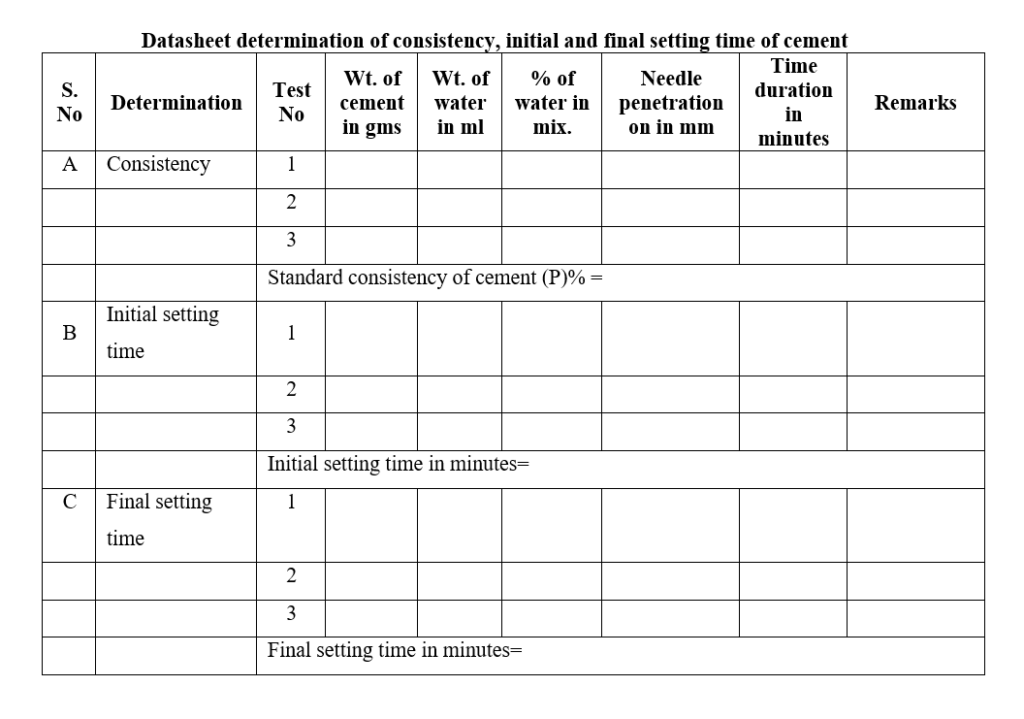
Observation Table
| Trial No. | Cement (g) | Water (mL) | Water (%) | Penetration from Bottom (mm) | Remarks |
|---|---|---|---|---|---|
| 1 | 400 | 104 | 26 | 12 | Too Dry |
| 2 | 400 | 108 | 27 | 9 | Slightly Dry |
| 3 | 400 | 112 | 28 | 6 | Accepted |
| 4 | 400 | 116 | 29 | 4 | Too Wet |
How to Record Observations
During the Standard Consistency Test, observations should be recorded carefully for every trial. For each trial, note the quantity of cement, the volume of water added, the percentage of water by weight of cement, and the penetration of the Vicat plunger. Continue conducting trials until the plunger penetrates to a point 5–7 mm from the bottom of the Vicat mould.
The trial that satisfies this requirement is considered the Standard Consistency of Cement. Accurate observation recording improves the reliability of laboratory results and minimizes human error.
Sample Calculation
Given
Weight of Cement = 400 g
Water Added = 112 mL
Since:
1 mL water ≈ 1 g
Weight of Water = 112 g
Formula
Calculation
Result
Standard Consistency of Cement = 28%
Engineering Interpretation
The calculated Standard Consistency value represents the water percentage required for the tested cement sample to satisfy the specified Vicat penetration condition.
This value should not be used directly as the water–cement ratio for concrete mix design. It serves as a reference water content for applicable cement laboratory tests such as setting-time and soundness tests.
Standard Penetration Criterion
The standard consistency of cement paste is obtained when the Vicat plunger penetrates to a point 5–7 mm from the bottom of the Vicat mould.
If the required penetration is not obtained, prepare a fresh paste using a different water percentage and repeat the test.
If the plunger remains more than 7 mm from the bottom, the paste requires adjustment toward a higher water content in the next fresh trial.
If the plunger approaches closer than 5 mm to the bottom, use a lower water content in the next fresh trial.
The percentage of water corresponding to the specified 5–7 mm endpoint is reported as the standard consistency of the cement sample.
Standard consistency is a test endpoint, not a separate pass/fail percentage limit for cement.
Interpretation of Results
Low Consistency Value
A relatively low water requirement may indicate:
- Lower fineness.
- Reduced surface area.
- Different cement composition.
High Consistency Value
A relatively high water requirement may indicate:
- Finer cement particles.
- Greater surface area.
- Higher water demand.
The exact reason depends on the cement type and manufacturing process, so consistency results should always be interpreted alongside other quality tests.
Practical Applications in Construction
The Standard Consistency Test is not merely a laboratory exercise; it has significant practical applications in the construction industry. The value obtained from this test enables engineers to evaluate the water requirement of cement before performing other physical tests. By ensuring that cement paste is prepared under standardized conditions, the test contributes to reliable quality control and consistent laboratory results.
Major Applications of the Standard Consistency Test
The Standard Consistency Test is widely used in the following areas:
- Infrastructure projects such as highways, bridges, tunnels, dams, airports, and metro rail systems.
- Quality control in cement manufacturing plants.
- Testing cement received at construction sites.
- Determination of water content before Initial Setting Time and Final Setting Time tests.
- Soundness testing of cement.
- Ready-Mix Concrete (RMC) quality control laboratories.
- Government material testing laboratories.
- Engineering colleges and universities for practical training.
- Research and development of new cement products.
Importance for Civil Engineers
Although the Standard Consistency Test is performed in laboratories, every civil engineer should understand its significance. Site engineers frequently review laboratory reports before approving cement for construction works. A proper understanding of this test helps engineers interpret laboratory results, coordinate effectively with QA/QC teams, and ensure compliance with Indian Standards.
Industrial Applications
Industries involved in cement manufacturing and quality assurance use the Standard Consistency Test as part of their routine inspection procedures. The results help maintain consistency between production batches and ensure that cement supplied to construction projects meets the required quality standards.
Engineering Insight: Reliable laboratory testing begins with determining the correct standard consistency. Errors in this initial test may affect the accuracy of all subsequent physical tests performed on cement.
Does Standard Consistency of Cement Have a Fixed Value?
No single standard-consistency percentage should be assumed for every cement sample.
The standard consistency is determined experimentally by preparing trial cement pastes with different water contents and testing each fresh paste with the Vicat apparatus. The water percentage that produces the specified penetration is reported as the standard consistency, P, of that particular cement sample.
The required water may vary because of differences in cement composition, fineness, manufacturing process, storage condition and other material characteristics.
Therefore, a value such as 28% should be treated as the measured result of a particular test or as a worked example—not as a universal acceptance limit for all cement.
Why Multiple Trials Are Necessary
Every cement sample behaves differently because of variations in:
- Fineness
- Mineral composition
- Storage conditions
- Moisture absorption
- Manufacturing process
Therefore, several trials are required to identify the water percentage that satisfies the penetration requirement.
Practical Example
Suppose a laboratory engineer performs four trials:
| Water (%) | Penetration |
|---|---|
| 26 | Too Low |
| 27 | Slightly Low |
| 28 | Correct |
| 29 | Too High |
The correct standard consistency is 28% because the plunger penetrates to the specified depth of 5-7mm.
Practical Tips for Laboratory Engineers
- Start the stopwatch immediately after adding water.
- Mix quickly and uniformly.
- Clean the apparatus after each trial.
- Use fresh cement for every new determination.
- Perform the test in a controlled environment.
- Record observations immediately.
- Repeat the test if there is any doubt about the reading.
Common Errors During Testing
Avoid these common mistakes:
- Using inaccurate water measurements.
- Delaying mould filling after mixing.
- Trapping air bubbles in the paste.
- Tilting the Vicat mould.
- Reusing partially set cement paste.
- Reading the penetration scale incorrectly.
- Testing on an uneven surface.
- Using contaminated or dirty equipment.
Troubleshooting Guide
Even experienced laboratory technicians may encounter difficulties while performing the Standard Consistency Test. The following troubleshooting guide helps identify common problems, their possible causes, and the recommended corrective actions.
| Problem | Possible Cause | Recommended Solution |
|---|---|---|
| Plunger penetration is less than the specified limit | Insufficient water content | Increase the water percentage and repeat the test using fresh cement paste. |
| Plunger penetration exceeds the specified limit | Excess water content | Reduce the quantity of water and prepare a new cement paste. |
| Uneven penetration | Non-uniform mixing | Mix the cement paste thoroughly for the recommended duration. |
| Air voids in the paste | Improper filling of the mould | Fill the Vicat mould carefully and eliminate trapped air. |
| Different readings for repeated trials | Dirty or uncalibrated apparatus | Clean and calibrate the Vicat Apparatus before testing. |
| Cement paste sets rapidly | Delay between mixing and testing | Complete the test immediately after preparing the paste. |
| Plunger movement is not smooth | Dust or hardened cement on the rod | Clean the movable rod and ensure free vertical movement. |
Engineering Recommendation
Whenever an abnormal penetration value is observed, prepare a fresh cement paste instead of modifying the existing sample. This practice improves the accuracy and repeatability of laboratory results.
Factors Affecting Standard Consistency of Cement
The amount of water required to obtain standard consistency is not fixed. It varies depending on several physical, chemical, and environmental factors. Understanding these factors helps laboratory engineers interpret test results correctly.
1. Fineness of Cement
Fineness is one of the most important factors affecting standard consistency.
Explanation
Finely ground cement has a much larger surface area than coarse cement. Since more particles are exposed to water, additional water is required for hydration.
Effect
- Very fine cement → Higher water requirement → Higher standard consistency.
- Coarser cement → Lower water requirement.
Practical Example
A finer cement sample generally has a larger total surface area and may require more water to reach standard consistency than a relatively coarser sample, when other relevant factors are comparable.
Frequently Asked Questions (FAQs)
1. What is the Standard Consistency of Cement?
The Standard Consistency of Cement is the percentage of water required to prepare a cement paste of standard plasticity so that the 10 mm diameter Vicat plunger penetrates to a point 5–7 mm from the bottom of the Vicat mould under standard laboratory conditions. It is determined in accordance with IS 4031 (Part 4).
2. Which apparatus is used to determine the Standard Consistency of Cement?
The Standard Consistency Test is carried out using the Vicat Apparatus. It consists of a frame, movable rod, plunger, Vicat mould, base plate and graduated scale for measuring penetration.
3. What is the standard penetration during the consistency test?
The cement paste is said to have standard consistency when the 10 mm diameter Vicat plunger penetrates to a point 5–7 mm from the bottom of the Vicat mould.
4. Why is the Standard Consistency Test important?
The test determines the correct quantity of water required for preparing standard cement paste. The result is used as the basis for conducting the Initial Setting Time Test, Final Setting Time Test and Soundness Test under uniform laboratory conditions.
5. Which IS Code is used for the Standard Consistency Test?
The test is conducted according to IS 4031 (Part 4): Methods of Physical Tests for Hydraulic Cement – Determination of Standard Consistency of Cement Paste.
6. What is Normal Consistency of Cement?
Normal consistency of cement is a term commonly used for the standard consistency of cement. It is the water percentage by mass of dry cement that enables the Vicat plunger to reach the specified standard-consistency penetration condition. The result is determined experimentally rather than assumed from a fixed percentage.
7. Why are multiple trials required?
The exact water requirement of cement cannot be predicted in advance because different cement samples have different fineness and chemical composition. Therefore, several trials are carried out until the required penetration is achieved.
8. Can Standard Consistency be used as the water-cement ratio?
No. Standard Consistency is a laboratory parameter used only for cement testing, whereas the water-cement ratio is a design parameter used in concrete mix design. Both serve different purposes.
9. Is 26–33% the Standard Consistency Limit of Cement?
No. A range such as 26–33% may be encountered in laboratory practice for some cement samples, but it is not a universal pass/fail limit prescribed for every cement. Standard consistency is determined from the specified Vicat plunger penetration. The water percentage producing that condition is reported as the standard consistency of the tested cement sample.
Viva Questions and Answers
The following viva questions are frequently asked during diploma, B.Tech., laboratory practical examinations, GATE, SSC JE, RRB JE, and other civil engineering interviews.
1. What is the Standard Consistency of Cement?
Answer: It is the percentage of water required to prepare a cement paste of standard plasticity so that the 10 mm Vicat plunger penetrates to a point 5–7 mm from the bottom of the Vicat mould.
2. Which apparatus is used for the Standard Consistency Test?
Answer: Vicat Apparatus.
3. Which IS Code is followed?
Answer: IS 4031 (Part 4).
4. How much cement is used for the Standard Consistency Test?
Answer: Use an accurately weighed quantity of cement in accordance with the applicable test procedure. A 400 g sample is commonly used in laboratory practice and worked examples, but it should not be stated as a universal mandatory quantity prescribed by IS 4031 (Part 4).
5. What is the diameter of the plunger?
Answer: 10 mm.
6. Why is Standard Consistency determined?
Answer: To determine the percentage of water required for preparing cement paste of standard consistency before conducting other physical tests.
7. Which tests use the Standard Consistency value?
Answer: Initial Setting Time Test, Final Setting Time Test, and Soundness Test.
8. Why are multiple trials required?
Answer: Different cement samples require different quantities of water because of variations in fineness, composition, and manufacturing process.
9. Is Standard Consistency the same as the water-cement ratio?
Answer: No. Standard Consistency is used for laboratory testing, whereas the water-cement ratio is used in concrete mix design.
10. What happens if excess water is added?
Answer: The cement paste becomes overly fluid, resulting in excessive penetration of the Vicat plunger and inaccurate test results.
Standard Consistency Test of Cement Interview Questions and Answers
The following interview questions are commonly asked during interviews for Site Engineer, QA/QC Engineer, Laboratory Engineer, Graduate Engineer Trainee (GET), Junior Engineer (JE), Assistant Engineer (AE), and Quality Control Engineer positions. Understanding these questions will help candidates explain both the theory and practical aspects of the Standard Consistency Test of Cement.
1. Explain the Standard Consistency Test of Cement.
Answer:
The Standard Consistency Test of Cement is a laboratory test conducted to determine the percentage of water required to prepare a cement paste of standard plasticity. The test is performed using the Vicat Apparatus in accordance with IS 4031 (Part 4). The correct standard consistency is achieved when the 10 mm diameter Vicat plunger penetrates to a point 5–7 mm from the bottom of the Vicat mould. The value obtained is used as the reference water content for conducting the Initial Setting Time Test, Final Setting Time Test, and Soundness Test of Cement.
2. Why is the Vicat Apparatus used for this test?
Answer:
The Vicat Apparatus provides a standardised and accurate method for measuring the penetration of a plunger into freshly prepared cement paste. It ensures uniform testing conditions and repeatable results. The apparatus is specifically designed to determine the standard consistency, initial setting time, and final setting time of cement in accordance with Indian Standards.
3. What is the significance of the 5–7 mm penetration?
Answer:
Standard consistency is obtained when the 10 mm Vicat plunger reaches a point 5–7 mm from the bottom of the Vicat mould.
If the plunger remains more than 7 mm above the bottom, the paste is comparatively too stiff, and the next fresh trial generally requires a higher water content.
If the plunger reaches closer than 5 mm to the bottom, the paste is comparatively too fluid, and the next fresh trial generally requires a lower water content.
The water percentage corresponding to the 5–7 mm condition is reported as the standard consistency of the cement sample.
4. Is 400 g of cement compulsory for the Standard Consistency Test?
Answer: IS 4031 (Part 4) describes preparation of the paste using a weighed quantity of cement. A 400 g sample is commonly used in laboratory practice and educational procedures, but it should not be described as a universal acceptance requirement of the standard. For formal testing, follow the applicable standard and laboratory procedure.
5. How does cement fineness affect standard consistency?
Answer:
Finer cement particles have a larger surface area and therefore require more water for hydration. As the fineness of cement increases, the standard consistency generally increases because additional water is needed to wet the larger surface area of the cement particles. Coarser cement usually requires less water.
6. What precautions should be followed while conducting the test?
Answer:
The following precautions should always be observed:
- Use fresh and lump-free cement.
- Use clean potable or distilled water.
- Weigh cement and water accurately.
- Mix the cement paste uniformly within the recommended time.
- Fill the Vicat mould immediately after mixing.
- Ensure the apparatus is clean and properly calibrated.
- Release the plunger gently without applying external force.
- Record the penetration reading carefully at eye level.
Following these precautions improves the accuracy and reliability of the test.
7. Why should the plunger be allowed to fall under its own weight?
Answer:
The plunger must fall under its own weight to ensure that the penetration is produced only by the standard load specified in the test method. Applying additional force manually results in excessive penetration and inaccurate determination of the standard consistency.
8. What are the consequences of using old or moisture-affected cement?
Answer:
Old or moisture-affected cement may undergo partial hydration before testing, which alters its physical properties. As a result, the measured standard consistency may not represent the actual quality of the cement. This can lead to inaccurate results in the Initial Setting Time Test, Final Setting Time Test, and Soundness Test. Therefore, only fresh cement should be used for testing.
9. How is the Standard Consistency Test different from the water-cement ratio used in concrete?
Answer:
The Standard Consistency Test determines the percentage of water required to prepare a cement paste of standard plasticity for laboratory testing. It is expressed as a percentage of the weight of cement and is used only for cement quality tests.
The water-cement ratio, on the other hand, is the ratio of the weight of water to the weight of cement used in concrete mix design. It directly influences the strength, durability, and workability of concrete. Therefore, the two concepts serve entirely different purposes.
10. Which Indian Standard governs the Standard Consistency Test?
Answer:
The Standard Consistency Test is conducted according to IS 4031 (Part 4): Methods of Physical Tests for Hydraulic Cement – Determination of Standard Consistency of Cement Paste. This standard specifies the apparatus, procedure, penetration criteria, and calculation method for determining the standard consistency of cement.
11. Why are multiple trials performed during the Standard Consistency Test?
Answer:
The exact water requirement of cement is not known beforehand because it varies with the type, fineness, age, and chemical composition of the cement. Therefore, several trials with different water percentages are conducted until the required penetration of 5–7 mm from the bottom of the Vicat mould is obtained. This ensures accurate determination of the standard consistency.
12. What happens if too much water is added during the test?
Answer:
If excessive water is added, the cement paste becomes too fluid. The Vicat plunger penetrates deeper than the specified limit, indicating that the paste has exceeded the standard consistency. In such cases, the test must be repeated with a lower water percentage using a fresh cement paste.
13. What happens if insufficient water is added?
Answer:
When insufficient water is added, the cement paste becomes stiff and lacks the required plasticity. The Vicat plunger fails to penetrate to the specified depth, indicating that the water content is below the standard consistency. A fresh trial with a higher water percentage is then required.
14. Why is the Standard Consistency Test performed before the Initial Setting Time Test?
Answer:
The Initial Setting Time Test requires a cement paste prepared with the correct standard consistency. Determining the standard consistency first ensures that the setting time test is performed under uniform conditions, resulting in accurate and comparable measurements. Without establishing the standard consistency, the setting time results may be unreliable.
15. Why is the Standard Consistency Test important in quality control?
Answer:
The Standard Consistency Test is one of the first quality-control tests conducted on cement because it establishes the standard water content required to prepare cement paste. The value obtained serves as the basis for other important physical tests, ensuring that all tests are performed under standardised conditions. This improves the accuracy of laboratory results, supports compliance with Indian Standards, and helps engineers assess the suitability of cement for construction projects.
Want to prepare for civil engineering interviews? Read our complete guide on 100 Civil Engineering Interview Questions and Answers
💡 Interview Tip
Interviewers may ask both the test values and their practical meaning. Remember these key points:
- IS Code: IS 4031 (Part 4)
- Apparatus: Vicat Apparatus
- Plunger Diameter: 10 mm
- Standard Penetration Criterion: 5–7 mm from the bottom of the Vicat mould
- Typical Practical Range: About 26–33% for many OPC samples; indicative laboratory range only, not a universal IS acceptance limit
- Cement Quantity: Use an accurately weighed quantity; 400 g is commonly used in laboratory examples
- Gauging Time: 3–5 minutes
- Laboratory Temperature: 27 ± 2°C
- Relative Humidity: Not less than 65%
Understanding why these values are used is more important than memorizing them without understanding the test procedure.
Quick Revision Notes
- IS Code: IS 4031 (Part 4)
- Apparatus: Vicat Apparatus
- Plunger Diameter: 10 mm
- Standard Penetration Criterion: 5–7 mm from the bottom of the Vicat mould
- Typical Practical Range: About 26–33% for many OPC samples (indicative laboratory range only; not a universal IS acceptance limit)
- Gauging Time: 3–5 minutes
- Laboratory Temperature: 27 ± 2°C
- Relative Humidity: Not less than 65%
- Cement Quantity: Accurately weighed quantity; 400 g may be used for laboratory examples
- Formula: P (%) = (Mass of Water ÷ Mass of Dry Cement) × 100
- Standard Consistency: Determined experimentally from the specified Vicat penetration condition; no single universal percentage applies to every cement sample
- Used as a reference for: Setting-time and other applicable cement laboratory tests
You Can Also Read Our Related Posts
For further understanding of cement testing and concrete quality control, you can also read the following related articles:
- Concrete Cube Casting Procedure
- Initial and Final Setting Time Test of Cement
- Soundness Test of Cement
- Fineness Test of Cement
- Compressive Strength Test of Cement
Conclusion
The Standard Consistency Test of Cement is one of the most fundamental laboratory tests performed before conducting other physical tests on cement. It determines the percentage of water required to prepare a cement paste of standard plasticity under standardized laboratory conditions using the Vicat Apparatus in accordance with IS 4031 (Part 4).
Accurate determination of standard consistency is essential because the value obtained serves as the reference for the Initial Setting Time Test, Final Setting Time Test and Soundness Test. Incorrect consistency may lead to unreliable laboratory results and inaccurate assessment of cement quality.
For civil engineering students, laboratory technicians, QA/QC engineers and construction professionals, a clear understanding of the Standard Consistency Test helps in maintaining quality control and ensuring compliance with Indian Standards. By following the correct procedure, observing laboratory precautions and interpreting the results properly, reliable and repeatable test results can be obtained.
To understand cement testing completely, also read our guides on the Initial Setting Time Test, Final Setting Time Test, Soundness Test, Fineness Test, Concrete Cube Casting Procedure, and Water-Cement Ratio.
Datasheet determination of consistency, initial and final setting time of cement