
 by
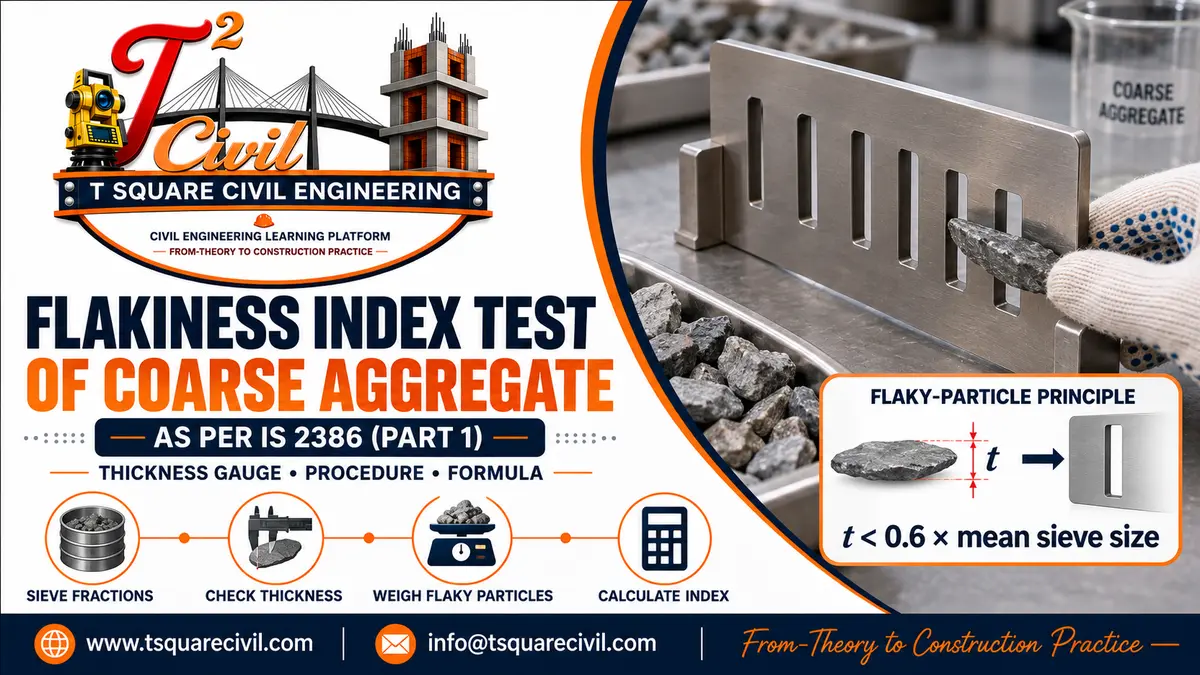
by The flakiness index test determines the percentage of thin or flaky particles present in coarse aggregate. Particle shape is important because unusually thin particles can affect aggregate packing, concrete workability, compaction and resistance to breakage.
Under IS 2386 (Part 1), a coarse aggregate particle is classified as flaky when its least dimension, or thickness, is less than three-fifths of the mean size of its sieve fraction. The test is not applicable to aggregate particles smaller than 6.3 mm.
This guide explains the flakiness index definition, IS code, thickness gauge, test procedure, formula, calculation, worked example, result interpretation and relationship with the elongation index.
Quick Answer
- Test: Flakiness Index of Coarse Aggregate
- Primary test standard: IS 2386 (Part 1):1963, with applicable amendments
- Main apparatus: Thickness gauge, IS sieves and weighing balance
- Dimensional criterion: Least dimension less than 0.6 times the mean sieve size
- Applicable particle size: Coarse aggregate retained on the 6.3 mm sieve
- Result: Reported as a percentage by mass
- Important limit: Do not treat 40% as a universal standalone Flakiness Index limit; IS 383:2016 addresses the combined flakiness and elongation index.
Page Contents
What Is the Flakiness Index?
The flakiness index of aggregate represents the percentage by mass of particles whose least dimension is less than 0.6 times the mean size of the sieve fraction in which they occur.
In simple terms, a particle is considered flaky when it is relatively thin compared with its length and width.
For a particle belonging to a particular sieve fraction:
Mean sieve size:
Thickness-gauge slot:
Where:
- = larger sieve size in millimetres
- = smaller sieve size in millimetres
- = mean sieve size in millimetres
- = applicable thickness-gauge slot width in millimetres
If the particle passes through the applicable thickness-gauge slot when presented in its least dimension, it is classified as flaky.
Example of the dimensional criterion
For aggregate passing the 20 mm sieve and retained on the 16 mm sieve:
Therefore:
A particle in this size fraction is classified as flaky when its least dimension allows it to pass through the 10.8 mm thickness-gauge slot.
Why Is the Flakiness Index Test Conducted?
The test is conducted to evaluate the shape characteristics of coarse aggregate used in concrete, pavement layers and other civil engineering works.
The results can help engineers:
- Compare aggregates obtained from different sources.
- Evaluate the effectiveness of aggregate crushing and shaping.
- Identify an excessive proportion of thin particles.
- Assess aggregate suitability against project specifications.
- Support concrete mix-design and aggregate-source approval.
- Monitor changes in quarry production or crusher settings.
- Investigate problems related to aggregate packing or compaction.
Flakiness Index does not independently establish the complete quality of aggregate. Strength, grading, impact resistance, crushing resistance, abrasion resistance, water absorption, durability and deleterious materials must also be evaluated where relevant.
Applicable IS Codes and Standards
IS 2386 (Part 1):1963
IS 2386 (Part 1) — Methods of Test for Aggregates for Concrete: Particle Size and Shape specifies the method for determining the Flakiness Index of coarse aggregate.
The standard should be read with all applicable amendments, and users should verify its current status in the BIS catalogue. The amendments are important because they revise certain gauge dimensions, sieve fractions and calculation provisions.
IS 383:2016
IS 383:2016 — Coarse and Fine Aggregate for Concrete: Specification provides requirements for aggregates used in concrete.
Where IS 383:2016 applies, the specified requirement relates to the combined flakiness and elongation index, which should not exceed 40%.
This must not be misunderstood as a universal maximum limit of 40% for the Flakiness Index alone. Project specifications, pavement specifications and other governing documents may prescribe different requirements.
Important: IS 2386 (Part 1) provides the test method. The acceptance requirement must be taken from IS 383, the approved project specification or another governing standard applicable to the work.
Principle of the Flakiness Index Test
The aggregate sample is separated into specified size fractions by sieving. Every particle in a fraction is checked using the corresponding opening of a standard thickness gauge.
Particles passing through the applicable slot are classified as flaky.
The mass of flaky particles in each fraction is related to:
- The total mass of that particular fraction; and
- The contribution of that fraction to the complete aggregate sample.
The fraction-wise weighted values are then added to determine the overall Flakiness Index.
Apparatus Required
The following apparatus is required:
- Thickness gauge: A metal gauge having standard elongated slots corresponding to the specified aggregate size fractions.
- IS sieves: 63 mm, 50 mm, 40 mm, 31.5 mm, 25 mm, 20 mm, 16 mm, 12.5 mm, 10 mm and 6.3 mm, as required for the sample.
- Weighing balance: Of sufficient capacity and accurate to 0.1% of the mass of the test sample.
- Sample divider or quartering equipment: For obtaining a representative test sample.
- Clean trays or containers: For keeping individual sieve fractions and separated flaky particles.
- Brush: For cleaning the sieves without damaging their apertures.
Flakiness Gauge and Slot Dimensions
The thickness-gauge opening for each aggregate fraction is approximately 0.6 times the mean of the two sieve sizes defining that fraction.
| Passing through IS sieve | Retained on IS sieve | Thickness-gauge slot |
|---|---|---|
| 63 mm | 50 mm | 33.90 mm |
| 50 mm | 40 mm | 27.00 mm |
| 40 mm | 31.5 mm | 21.50 mm |
| 31.5 mm | 25 mm | 16.95 mm |
| 25 mm | 20 mm | 13.50 mm |
| 20 mm | 16 mm | 10.80 mm |
| 16 mm | 12.5 mm | 8.55 mm |
| 12.5 mm | 10 mm | 6.75 mm |
| 10 mm | 6.3 mm | 4.89 mm |
The older 40–25 mm fraction should not be used in the observation sheet. Applicable amendments divide it into:
- 40–31.5 mm
- 31.5–25 mm
When purchasing or verifying a gauge, confirm that its slot markings and dimensions agree with the applicable amended requirements.
Sample Preparation
Correct sampling is essential because an unrepresentative sample can produce a misleading Flakiness Index.
Follow these precautions during preparation:
- Obtain a representative bulk sample from the aggregate source.
- Mix the bulk sample thoroughly.
- Reduce it by an approved sample-divider or quartering method.
- Ensure that the aggregate is sufficiently dry and free from adhering material.
- Separate the sample into the specified sieve fractions.
- Provide at least 200 particles in every size fraction to be tested.
- Keep each fraction in a separate, clearly labelled tray.
- Exclude material smaller than 6.3 mm from the Flakiness Index test.
Do not selectively remove particles based on their appearance before testing.
Flakiness Index Test Procedure
Step 1: Check the apparatus
Ensure that:
- The weighing balance is functioning correctly.
- The sieves are clean and undamaged.
- The thickness-gauge slots are clean and correctly marked.
- Separate trays are available for every sieve fraction.
Step 2: Obtain a representative sample
Reduce the bulk aggregate to a suitable test quantity using a sample divider or quartering method. Avoid segregation of coarse and relatively smaller particles.
Step 3: Sieve the sample
Arrange the required sieves in descending order and sieve the aggregate into the fractions listed in the thickness-gauge table.
For example, aggregate passing the 20 mm sieve and retained on the 16 mm sieve forms the 20–16 mm fraction.
Step 4: Check the number of particles
Confirm that each fraction being tested contains at least 200 particles. If a fraction does not contain the required number, obtain a larger representative sample.
Step 5: Weigh each fraction
Weigh the complete mass of each size fraction separately and record it as .
Step 6: Gauge the particles
Take every particle from one fraction and attempt to pass it through the corresponding thickness-gauge slot using its least dimension.
- Do not force, press or deform a particle through the opening.
- Use only the slot assigned to that sieve fraction.
- Keep the particles passing the gauge separate from those retained.
Step 7: Weigh the flaky particles
Weigh the particles passing the applicable thickness-gauge slot and record their mass as .
Step 8: Repeat for every fraction
Repeat the gauging and weighing process for all applicable fractions retained above the 6.3 mm sieve.
Step 9: Calculate the result
Calculate the fraction percentage, mass contribution and weighted percentage for every fraction. Add the weighted percentages to obtain the overall Flakiness Index.
Flakiness Index Formula
For each sieve fraction:
Where:
- = percentage of flaky particles in fraction
- = mass of particles passing the appropriate thickness gauge
- = total mass of that sieve fraction
The mass contribution of the fraction to the complete sample is:
Where:
- = percentage by mass of fraction in the complete sample
- = total mass of all applicable fractions in the sample retained on the 6.3 mm sieve
The weighted percentage for the fraction is:
Therefore:
Equivalent total-mass check
The weighted calculation is mathematically equivalent to:
However, the fraction-wise method should be retained in the laboratory observation sheet because it:
- Follows the amended calculation structure.
- Shows which aggregate size contributes most to the result.
- Helps identify testing or recording errors.
- Provides better traceability for quality-control purposes.
Simple Flakiness Index Calculation
Consider aggregate passing the 20 mm sieve and retained on the 16 mm sieve.
Given:
- Thickness-gauge slot = 10.80 mm
- Total mass of fraction, = 1,560 g
- Mass passing the thickness gauge, = 202.8 g
Therefore:
Therefore, 13% by mass of this individual size fraction is flaky.
This is the result for that fraction only. For a graded sample containing several fractions, it must be weighted according to the mass contribution of the fraction.
Worked Example for Graded Coarse Aggregate
The following example demonstrates the complete fraction-wise calculation.
| Sieve fraction | Gauge slot | No. of particles | Total mass | Flaky mass | Weighted value | ||
|---|---|---|---|---|---|---|---|
| 25–20 mm | 13.50 mm | 240 | 2,400 g | 240.0 g | 10.00% | 44.40% | 4.44% |
| 20–16 mm | 10.80 mm | 260 | 1,560 g | 202.8 g | 13.00% | 28.86% | 3.75% |
| 16–12.5 mm | 8.55 mm | 300 | 900 g | 135.0 g | 15.00% | 16.65% | 2.50% |
| 12.5–10 mm | 6.75 mm | 280 | 420 g | 75.6 g | 18.00% | 7.77% | 1.40% |
| 10–6.3 mm | 4.89 mm | 250 | 125 g | 25.0 g | 20.00% | 2.31% | 0.46% |
| Total | — | 1,330 | 5,405 g | 678.4 g | — | 100% | 12.55% |
Calculation for the 20–16 mm fraction
Overall Flakiness Index
The result can be checked using the equivalent total-mass formula:
The final rounding and number of decimal places should follow the laboratory quality plan or governing project specification.
Flakiness Index Observation Sheet
| Passing sieve | Retained sieve | Gauge slot | Number of particles | Total fraction mass | Mass passing gauge | Weighted value | ||
|---|---|---|---|---|---|---|---|---|
| 63 mm | 50 mm | 33.90 mm | ||||||
| 50 mm | 40 mm | 27.00 mm | ||||||
| 40 mm | 31.5 mm | 21.50 mm | ||||||
| 31.5 mm | 25 mm | 16.95 mm | ||||||
| 25 mm | 20 mm | 13.50 mm | ||||||
| 20 mm | 16 mm | 10.80 mm | ||||||
| 16 mm | 12.5 mm | 8.55 mm | ||||||
| 12.5 mm | 10 mm | 6.75 mm | ||||||
| 10 mm | 6.3 mm | 4.89 mm | ||||||
| Total | — | — | — | 100% |
Reporting the Test Result
A complete laboratory report should include:
- Name and identification of the aggregate sample.
- Aggregate source and sampling location.
- Date of sampling and testing.
- Applicable test standard.
- Sieve fractions tested.
- Mass of each fraction.
- Mass passing the corresponding gauge.
- Fraction-wise percentages.
- Weighted calculation.
- Overall Flakiness Index.
- Applicable acceptance requirement.
- Name or identification of the person performing and checking the test.
- Any deviation from the specified method.
A suitable result statement is:
The Flakiness Index of the submitted coarse aggregate sample, determined in accordance with IS 2386 (Part 1) using the applicable amended gauge fractions, is ______%.
Acceptance or rejection should be stated separately after comparison with the governing specification.
Flakiness Index Limit as per IS Code
IS 2386 (Part 1) defines the test procedure but does not establish one universal acceptance limit for every construction application.
For coarse aggregate used in concrete under IS 383:2016, the specified requirement is:
Combined flakiness and elongation index: maximum 40%.
This does not mean that the standalone Flakiness Index can automatically be accepted up to 40%.
The applicable limit should be selected from:
- IS 383 for aggregate used in concrete.
- The approved project specification.
- Relevant highway or pavement specifications.
- Contract requirements.
- The approved mix design and quality-assurance plan.
Highway specifications may apply different limits depending on whether the aggregate is intended for granular sub-base, wet-mix macadam, bituminous layers or other pavement works.
Interpretation of the Flakiness Index
A lower Flakiness Index generally indicates a smaller proportion of thin particles. However, Flakiness Index alone should not be used to declare an aggregate suitable or unsuitable.
The result must be interpreted together with:
- Particle-size distribution.
- Elongation Index.
- Aggregate Crushing Value or Ten Percent Fines Value.
- Aggregate Impact Value.
- Los Angeles abrasion value, where applicable.
- Specific gravity and water absorption.
- Soundness.
- Petrographic characteristics.
- Intended construction application.
An aggregate with a low Flakiness Index may still be unsuitable if it is weak, absorptive, poorly graded or contaminated.
Effect of Flaky Aggregate on Concrete
An excessive proportion of flaky particles can influence concrete in several ways.
| Concrete property | Possible influence of flaky particles |
|---|---|
| Packing | Thin particles may orient themselves and create less efficient packing arrangements. |
| Voids | Poor particle arrangement can increase voids that must be filled by mortar or paste. |
| Workability | Greater surface area and irregular particle orientation may increase paste demand or reduce ease of placement. |
| Compaction | Flaky particles can make uniform compaction more difficult, particularly in congested reinforcement. |
| Pumpability | Unfavourable particle shape may contribute to greater resistance or blockage risk when combined with poor grading. |
| Strength | Thin particles may be more susceptible to breakage, although concrete strength depends on the complete mix and aggregate quality. |
| Finishability | Particle orientation near the surface may affect finishing under some conditions. |
These effects are tendencies rather than fixed outcomes. Actual concrete performance also depends on grading, maximum aggregate size, paste volume, water–binder ratio, admixtures, mixing, placement and compaction.
Effect of Flaky Aggregate on Pavement Materials
In pavement layers, excessive flaky particles may:
- Break under compaction or repeated traffic loading.
- Change aggregate grading after breakage.
- Orient into less stable arrangements.
- Reduce inter-particle contact.
- Affect the stability and durability of the compacted layer.
Pavement acceptance must be based on the applicable project or highway specification rather than a general concrete-aggregate limit.
Flakiness Index vs Elongation Index
| Property | Flakiness Index | Elongation Index |
|---|---|---|
| Dimension evaluated | Least dimension or thickness | Greatest dimension or length |
| Particle criterion | Less than 0.6 times mean sieve size | Greater than 1.8 times mean sieve size |
| Apparatus | Thickness gauge | Length gauge |
| Classified particles | Particles passing the prescribed thickness slot | Particles retained by the prescribed length gauge |
| Report basis | Percentage by mass | Percentage by mass |
| Minimum applicable size | Not applicable below 6.3 mm | Not applicable below 6.3 mm |
| Main purpose | Evaluates thin or flat particles | Evaluates unusually long particles |
A particle can have unfavourable proportions in more than one direction. Where a combined result is required, follow the procedure and calculation prescribed by the governing specification.
Common Errors in the Flakiness Index Test
Common testing and calculation errors include:
- Using an outdated 40–25 mm fraction instead of the amended fractions.
- Selecting the wrong thickness-gauge slot.
- Testing material smaller than 6.3 mm.
- Using fewer than 200 particles in a tested fraction.
- Forcing particles through the gauge.
- Gauging particles in an arbitrary orientation instead of their least dimension.
- Mixing separate sieve fractions during testing.
- Losing particles during sieving or transfer.
- Using a damaged or incorrectly manufactured gauge.
- Calculating a simple average of the individual fraction percentages.
- Ignoring the mass contribution of each sieve fraction.
- Treating 40% as a universal standalone Flakiness Index limit.
- Recording the mass retained by the thickness gauge as flaky instead of the mass passing the gauge.
- Applying an ASTM or European classification procedure to results obtained using the IS gauge.
Laboratory Precautions
- Obtain a representative sample by proper reduction.
- Keep the sample clean and sufficiently dry for accurate sieving and weighing.
- Verify the balance before testing.
- Inspect the gauge for damage, deformation and blocked slots.
- Label every fraction clearly.
- Use the correct slot for each sieve fraction.
- Pass particles through the gauge individually without force.
- Prevent loss of particles while transferring between trays.
- Record masses immediately.
- Confirm that the total fraction mass agrees with the sample mass used in the calculation.
- Recheck unusually high or low results before issuing the report.
- Follow the laboratory quality system and approved test format.
Practical QA/QC Applications
The Flakiness Index test may be used during:
- Initial approval of a quarry or aggregate source.
- Concrete mix-design investigations.
- Routine aggregate quality-control testing.
- Changes in crusher type or crusher settings.
- Investigation of inconsistent concrete workability.
- Approval of pavement aggregates.
- Comparison of natural and crushed aggregate sources.
- Verification following changes in rock strata or production conditions.
Testing frequency should follow the approved inspection and test plan, project specification or relevant contractual requirement. A universal testing frequency should not be assumed.
Quick Viva and Interview Questions
1. What does the Flakiness Index measure?
It measures the proportion by mass of thin or flaky particles in coarse aggregate.
2. Which apparatus is used?
A standard thickness gauge is used with the required IS sieves and weighing balance.
3. What is the dimensional criterion for a flaky particle?
Its least dimension is less than 0.6 times the mean size of its sieve fraction.
4. Which particles pass the thickness gauge?
Particles classified as flaky pass through the applicable thickness-gauge slot.
5. Is the test applicable below 6.3 mm?
No. The IS Flakiness Index test is not applicable to aggregate sizes smaller than 6.3 mm.
6. Is Flakiness Index determined by number or mass?
The sample requirement refers to the number of particles, but the amended result calculation is based on mass.
7. What is the main difference between flaky and elongated particles?
A flaky particle has an unusually small thickness, while an elongated particle has an unusually large length relative to its mean sieve size.
8. Is 40% the maximum standalone Flakiness Index?
No. Under IS 383:2016, 40% applies to the combined flakiness and elongation index for coarse aggregate used in concrete.
Frequently Asked Questions
What is the Flakiness Index of aggregate?
The Flakiness Index is the percentage by mass of coarse aggregate particles whose least dimension is less than 0.6 times the mean size of their sieve fraction.
What is the IS code for the Flakiness Index test?
The test is conducted according to IS 2386 (Part 1):1963, read with all applicable amendments and current references.
What is the Flakiness Index formula?
The fraction-wise result is calculated as:
The overall Flakiness Index is the sum of the weighted fraction percentages. It can be cross-checked as total flaky mass divided by total applicable sample mass, multiplied by 100.
What is a flakiness gauge?
A flakiness gauge, also called a thickness gauge, is a metal plate containing elongated slots. Each slot corresponds to 0.6 times the mean size of a specified aggregate fraction.
Which material is considered flaky?
A particle that passes through the thickness-gauge slot assigned to its sieve fraction is considered flaky.
Why are 200 particles required?
A sufficient sample size reduces the influence of a small number of unusual particles and makes the tested fraction more representative.
Is the same gauge used for 10 mm and 20 mm aggregate?
The same standard thickness-gauge plate may contain the required slots, but different sieve fractions use different openings. For example, the 20–16 mm fraction uses the 10.80 mm slot, while the 10–6.3 mm fraction uses the 4.89 mm slot.
Can Flakiness Index be calculated as flaky mass divided by total mass?
Yes, this gives an equivalent overall result when all applicable size fractions belong to the same sample. However, the fraction-wise weighted calculation should be retained in the observation sheet for conformity and traceability.
Does a lower Flakiness Index always guarantee good aggregate?
No. A lower value indicates fewer flaky particles, but aggregate strength, grading, abrasion resistance, absorption, soundness and other properties must also satisfy the applicable requirements.
What is an acceptable Flakiness Index?
There is no single standalone value applicable to every project. Use the governing aggregate specification. For concrete aggregate under IS 383:2016, the combined flakiness and elongation index should not exceed 40%.
Conclusion
The Flakiness Index test is an important particle-shape assessment for coarse aggregate. Accurate results depend on representative sampling, correct sieve separation, the applicable amended thickness-gauge dimensions and proper fraction-wise calculation.
The result should not be interpreted independently or compared with an arbitrary universal limit. It must be considered together with the Elongation Index, grading, strength, durability and the specification applicable to the intended construction work.
Continue Your Learning
Explore these related T Square Civil Engineering resources to understand aggregate shape, grading, strength and physical-property testing:
- Elongation Index of Aggregate — Learn how elongated particles are identified using the standard length gauge.
- Sieve Analysis and Particle Size Distribution — Understand aggregate grading, sieve fractions, percentage retained and percentage passing.
- Aggregate Crushing Value — Evaluate aggregate resistance to gradually applied compressive loading.
- Aggregate Impact Value Test — Determine aggregate resistance to sudden impact or shock.
- Specific Gravity and Water Absorption of Aggregate — Understand important physical properties used in aggregate quality control and concrete mix design.
About T Square Civil Engineering
T Square Civil Engineering is a civil engineering learning platform created to support students, site engineers, quantity surveyors, contractors and construction professionals with practical, technically reviewed learning resources, worked examples and calculators that connect engineering theory with construction practice.
Disclaimer: The information provided in this article is intended for general educational and general-reference purposes only. Engineering requirements, terminology, material properties, construction methods, product performance, costs, standards, regulations and site practices may vary according to the country, governing authority, manufacturer, project specifications and actual site conditions. Verify the latest applicable standards and amendments, regulations, manufacturer’s technical data, approved drawings, project specifications and site conditions before design, procurement, testing or construction. Worked examples, quantities, rates, cost estimates and calculator results are illustrative and must not be treated as project-specific design, professional certification, material test reports, quotations or tender documents. Obtain advice from appropriately qualified professionals for structural, geotechnical, safety-critical, contractual and project-specific decisions. T Square Civil Engineering is not responsible for loss or damage arising from reliance on this general information.