
 by
by Page Contents
Introduction to the Compressive Strength Test
What is the Compressive Strength Test?
The Compressive Strength Test is one of the most important quality control tests in civil engineering. The Compressive Strength Test of Concrete Cubes is performed to determine whether hardened concrete has achieved the required design strength in accordance with the applicable Indian Standards. It plays a vital role in ensuring the strength, safety, durability, and long-term performance of buildings, bridges, dams, highways, industrial structures, and other concrete construction projects.
Among all laboratory tests conducted on concrete, the Compressive Strength Test of Concrete Cubes is the most widely accepted method for evaluating concrete quality. It measures the maximum compressive load that a standard concrete cube can withstand before failure. Therefore, the test provides a reliable indication of whether the concrete has achieved the specified compressive strength required for structural applications.
Why is the Compressive Strength Test Important?
During construction, concrete cubes are prepared from freshly mixed concrete, cured under controlled conditions, and tested using a Compression Testing Machine (CTM) after the specified curing periods, typically 7 days and 28 days. Consequently, the test results enable engineers to verify compliance with design requirements, project specifications, and applicable Indian Standards while maintaining effective quality control.
In India, the Compressive Strength Test is primarily carried out in accordance with IS 516 (Methods of Tests for Strength of Concrete). Furthermore, the acceptance of concrete strength is generally assessed with reference to IS 456: Plain and Reinforced Concrete – Code of Practice, along with the project specifications.
Factors Affecting the Compressive Strength of Concrete
The compressive strength of concrete is influenced by several factors, including:
- Water-cement ratio
- Cement quality
- Aggregate properties
- Mixing process
- Compaction
- Curing conditions
- Age of concrete
- Testing procedure
Even small variations in these factors can significantly affect the final strength of concrete. Therefore, following the standard testing procedure is essential for obtaining accurate, reliable, and repeatable results.
Applications of the Compressive Strength Test
The Compressive Strength Test is routinely performed in:
- Construction laboratories
- Ready-mix concrete plants
- Government quality control laboratories
- Third-party testing laboratories
- Educational institutions
- Infrastructure projects
- Residential and commercial construction projects
The test results are used by:
- Structural engineers
- Site engineers
- QA/QC engineers
- Consultants
- Contractors
- Government authorities
- Material testing laboratories
Overall, the Compressive Strength Test of Concrete Cubes helps verify that the concrete used in construction satisfies the required strength, safety, durability, and quality standards before structural elements are put into service.
Quick Facts
| Particular | Details |
|---|---|
| Test Name | Compressive Strength Test of Concrete Cubes |
| Standard | IS 516 (Latest Applicable Edition) |
| Acceptance Reference | IS 456 |
| Purpose | Determine compressive strength of hardened concrete |
| Specimen Shape | Cube |
| Standard Cube Size | 150 mm × 150 mm × 150 mm |
| Alternative Cube Size | 100 mm cube (for smaller aggregate sizes where applicable) |
| Testing Ages | 7 Days & 28 Days |
| Testing Machine | Compression Testing Machine (CTM) |
| Unit of Strength | MPa (N/mm²) |
| Failure Type | Compression Failure |
| Common Applications | Buildings, Bridges, Roads, Dams, Industrial Structures |
Why is the Compressive Strength Test Important?
The compressive strength of concrete is one of the most critical parameters for evaluating its quality and structural performance. Since concrete is primarily designed to resist compressive loads, this test provides a reliable measure of whether the concrete can safely withstand the loads expected during its service life.
The test is important because it:
- Verifies that the concrete meets the specified design strength.
- Ensures structural safety and durability.
- Helps identify poor-quality materials or improper construction practices.
- Assesses the effectiveness of mixing, compaction, and curing.
- Supports quality control during construction.
- Detects potential problems before structural elements are put into service.
- Provides documented evidence of compliance with project specifications.
Regular testing helps engineers make informed decisions regarding the acceptance or rejection of concrete used in construction projects.
Objectives of the Compressive Strength Test
The primary objectives of conducting the compressive strength test are:
- To determine the compressive strength of hardened concrete.
- To verify whether the concrete has achieved the required characteristic strength.
- To evaluate the quality of concrete used in construction.
- To assess the effectiveness of materials, mix proportions, compaction, and curing.
- To ensure compliance with relevant Indian Standards and project specifications.
- To support quality assurance and quality control during construction.
- To compare the performance of different concrete mixes.
- To provide data for structural evaluation and acceptance of concrete.
Principle of the Test
The compressive strength test is based on the principle that hardened concrete can resist compressive forces up to a certain limit. When a gradually increasing compressive load is applied to a standard concrete cube using a Compression Testing Machine (CTM), the cube initially undergoes elastic deformation. As the load continues to increase, internal micro-cracks develop and propagate through the concrete. Eventually, the cube reaches its maximum load-carrying capacity and fails by crushing.
The maximum load recorded at the time of failure is divided by the loaded cross-sectional area of the specimen to determine its compressive strength, which is expressed in megapascals (MPa) or N/mm².
The test assumes that the load is applied uniformly over the entire bearing surface and that the specimen has been properly cast, cured, and tested according to the relevant standard procedures.
Relevant Indian Standards (IS Codes)
The following Indian Standards are commonly associated with the Compressive Strength Test of Concrete Cubes:
| IS Code | Description | Purpose |
|---|---|---|
| IS 516 (Latest Edition) | Methods of Tests for Strength of Concrete | Specifies the procedure for testing compressive strength of concrete specimens. |
| IS 456:2000 | Plain and Reinforced Concrete – Code of Practice | Provides acceptance criteria and requirements for concrete used in construction. |
| IS 10262 | Concrete Mix Proportioning Guidelines | Assists in designing concrete mixes that achieve the required compressive strength. |
| IS 1199 | Sampling and Analysis of Concrete | Covers methods for sampling and preparing fresh concrete specimens. |
Note: Always refer to the latest applicable editions of Indian Standards for project-specific requirements.
Apparatus for the Compressive Strength Test
The following equipment is required to perform the Compressive Strength Test of Concrete Cubes accurately:
| Apparatus | Purpose |
|---|---|
| Cube Mould (150 mm × 150 mm × 150 mm) | Used to cast standard concrete cube specimens. |
| Compression Testing Machine (CTM) | Applies compressive load until the cube fails and records the maximum load. |
| Tamping Rod | Compacts concrete manually by removing entrapped air. |
| Vibrating Table or Needle Vibrator | Provides proper compaction for workable concrete mixes. |
| Steel Trowel | Finishes and levels the top surface of the specimen. |
| Weighing Balance | Measures material quantities accurately where required. |
| Measuring Scale | Verifies specimen dimensions before testing. |
| Curing Tank | Stores concrete cubes under controlled water-curing conditions. |
| Marker or Identification Tags | Used for specimen identification and traceability. |
| Personal Protective Equipment (PPE) | Ensures operator safety during casting and testing. |
Materials for the Compressive Strength Test
The following materials are required for preparing concrete cube specimens:
- Ordinary Portland Cement (OPC) or other specified cement
- Fine Aggregate (Sand)
- Coarse Aggregate
- Clean Potable Water
- Concrete Admixtures (if specified in the mix design)
- Mould Release Oil
- Identification Labels
All materials should comply with the relevant Indian Standards and project specifications to ensure accurate and reliable test results.
Concrete Sampling
Proper sampling is the first and one of the most important steps in obtaining reliable compressive strength results. A concrete cube represents the quality of the concrete from which it is taken. Therefore, the sample should accurately represent the concrete being placed in the structure.
Concrete samples may be collected from:
- Freshly mixed concrete at the batching plant
- Transit mixer discharge
- Concrete pump outlet
- Wheelbarrows or buckets during placement
- Concrete placed directly into structural members
The sample should be taken from the middle portion of the concrete discharge rather than from the beginning or the end, as these portions may not represent the actual mix.
Before casting the cubes:
- Remix the collected concrete gently using a shovel.
- Do not add extra cement or water.
- Remove segregation, if any.
- Ensure uniform consistency throughout the sample.
Site Tip: Never prepare cubes from leftover concrete after completing the pour. Always collect the sample during actual concrete placement.
Frequency of Sampling
The frequency of cube preparation depends on the project specifications and applicable standards.
Generally, concrete cubes are prepared:
- For each grade of concrete
- For each day’s concreting
- Whenever there is a change in source of materials
- Whenever there is a change in mix design
- Whenever quality verification is required
Large infrastructure projects often prepare several sets of cubes during a single concrete pour to monitor consistency throughout the work.
Preparation of Cube Mould
Before casting the concrete cubes, the moulds should be inspected carefully.
Step 1 – Cleaning
Ensure that:
- The mould is free from hardened concrete.
- No dust or rust is present.
- The inner surfaces are clean.
Step 2 – Assembly
- Assemble the mould properly.
- Tighten all bolts.
- Ensure there is no leakage through joints.
Loose bolts may cause slurry leakage, leading to inaccurate cube dimensions.
Step 3 – Apply Mould Oil
Apply a thin layer of mould release oil to the inner surfaces.
Purpose:
- Prevents concrete from sticking.
- Makes demoulding easier.
- Prevents damage to cube edges.
Avoid applying excessive oil because it may affect the surface quality of the specimen.
Step 4 – Place on Level Surface
Keep the mould on:
- Rigid platform
- Vibrating table (if vibration is used)
The mould must remain stable during casting.
Standard Cube Dimensions
| Specimen | Dimensions |
|---|---|
| Standard Cube | 150 × 150 × 150 mm |
| Alternative Cube | 100 × 100 × 100 mm (where applicable) |
The standard cube size used in India for most structural concrete is 150 mm × 150 mm × 150 mm.
Concrete Cube Casting Procedure
Step 1 – Fill the First Layer
Place approximately one-third of the concrete into the mould.
Avoid dropping concrete from excessive height to minimize segregation.
Step 2 – Compact the Layer
Compaction may be done using:
- Tamping rod
- Needle vibrator
- Vibrating table
Proper compaction removes entrapped air and improves the density of the concrete.
Step 3 – Fill the Second Layer
Add another one-third of the concrete.
Compact thoroughly.
Step 4 – Fill the Final Layer
Fill the remaining portion of the mould slightly above the top.
Compact again.
Step 5 – Strike Off the Surface
Remove excess concrete using:
- Steel trowel
- Float
Finish the surface smoothly and level with the top edge of the mould.
Compaction Methods
Proper compaction is essential because trapped air reduces the compressive strength of concrete.
1. Hand Compaction
Hand compaction is generally used for:
- Low-workability concrete
- Small laboratory work
- Educational demonstrations
Procedure:
- Compact each layer using a tamping rod.
- Distribute strokes uniformly.
- Ensure complete compaction without overworking the mix.
2. Mechanical Vibration
Mechanical vibration is commonly used on construction sites.
Equipment:
- Needle vibrator
- Vibrating table
Advantages:
- Better compaction
- Reduced air voids
- Higher density
- Improved strength
- Uniform specimens
However, excessive vibration may lead to segregation and bleeding.
Comparison of Compaction Methods
| Parameter | Hand Compaction | Mechanical Vibration |
|---|---|---|
| Equipment Required | Tamping Rod | Vibrator |
| Speed | Slow | Fast |
| Quality | Depends on operator | More uniform |
| Air Removal | Moderate | Excellent |
| Suitable For | Small works | Large construction projects |
Identification and Marking
Every cube must be clearly identified.
Typical markings include:
- Cube number
- Grade of concrete
- Date of casting
- Location of concrete
- Mix identification
- Age for testing (7 or 28 days)
Example:
Project: XYZ Tower

Grade: M30

Cube No.: C-15

Date: 29-07-2026

Test Age: 28 Days
Proper identification helps maintain traceability throughout the testing process.
Initial Storage
Immediately after casting:
- Cover the mould using a damp cloth or plastic sheet.
- Protect from direct sunlight.
- Protect from rain.
- Protect from vibration.
The specimen should remain undisturbed for approximately 24 ± ½ hours after casting.
Demoulding
After approximately 24 hours:
- Carefully remove the cube from the mould.
- Avoid damaging corners or edges.
- Inspect for defects.
Reject specimens having:
- Broken edges
- Honeycombing
- Large voids
- Severe segregation
Curing Procedure
Immediately after demoulding:
Immerse the cubes in clean water inside a curing tank.
Maintain:
- Continuous immersion
- Clean water
- Appropriate temperature as specified by the applicable standard
The curing period generally adopted is:
- 7 Days
- 28 Days
Proper curing allows cement hydration to continue and helps concrete achieve its intended strength.
Importance of Proper Curing
Proper curing:
- Increases compressive strength.
- Reduces shrinkage cracks.
- Improves durability.
- Reduces permeability.
- Enhances long-term performance.
Poor curing may reduce the concrete strength significantly.
Testing Procedure Using Compression Testing Machine (CTM)
After the required curing period, remove the specimen from the curing tank.
Step 1
Clean the cube surface.
Remove excess water using a damp cloth.
Step 2
Measure the cube dimensions if required.
Step 3
Place the cube centrally on the lower platen of the Compression Testing Machine.
Proper alignment is essential.
Step 4
Ensure that the load will be applied uniformly over the specimen.
Misalignment causes inaccurate results.
Step 5
Start the Compression Testing Machine.
Apply the compressive load continuously and without shock at the loading rate specified in the applicable standard until the specimen fails.
Do not apply the load suddenly.
Step 6
Observe the specimen.
Continue loading until complete failure occurs.
Record:
- Maximum load at failure
- Failure pattern
- Any unusual observations
Step 7
Repeat the procedure for the remaining specimens.
Normally, the average compressive strength of three specimens is considered for reporting, unless project specifications require otherwise.
Failure Patterns
Typical failure modes observed during testing include:
- Vertical cracking
- Diagonal cracking
- Corner failure
- Shear failure
- Cone-type failure
- Splitting failure
Studying the failure pattern helps engineers identify improper casting, poor compaction, or testing errors.
Flowchart of Complete Cube Testing Procedure
Concrete Sampling
        │
        ▼
Preparation of Cube Mould
        │
        ▼
Casting of Concrete Cubes
        │
        ▼
Compaction
        │
        ▼
Surface Finishing
        │
        ▼
Identification & Marking
        │
        ▼
Initial Storage (≈24 Hours)
        │
        ▼
Demoulding
        │
        ▼
Water Curing
        │
        ▼
7-Day / 28-Day Testing
        │
        ▼
Compression Testing Machine
        │
        ▼
Record Maximum Load
        │
        ▼
Calculate Compressive Strength
        │
        ▼
Interpret Results
Observation Table
After testing the concrete cube in the Compression Testing Machine (CTM), the following observations should be recorded carefully.
Standard Observation Table
| Cube No. | Grade of Concrete | Age (Days) | Length (mm) | Width (mm) | Loaded Area (mm²) | Maximum Load (kN) | Compressive Strength (MPa) | Remarks |
|---|---|---|---|---|---|---|---|---|
| 1 | M25 | 28 | 150 | 150 | 22500 | 690 | 30.67 | Pass |
| 2 | M25 | 28 | 150 | 150 | 22500 | 675 | 30.00 | Pass |
| 3 | M25 | 28 | 150 | 150 | 22500 | 700 | 31.11 | Pass |
Average Compressive Strength
Average Strength
= (30.67 + 30.00 + 31.11) ÷ 3
= 30.59 MPa
The average strength of the specimens is generally used for evaluation, subject to the applicable project specifications and standards.
Formula for Compressive Strength
The compressive strength of a concrete cube is calculated by dividing the maximum load at failure by the loaded cross-sectional area of the specimen.
Formula
Compressive Strength (MPa or N/mm²) = Maximum Load at Failure (N) ÷ Loaded Area (mm²)
Where:
- Maximum Load = Load recorded by the Compression Testing Machine at failure.
- Loaded Area = Area of the face on which the load is applied.
For a standard 150 mm × 150 mm cube:
Loaded Area
= 150 × 150
= 22,500 mm²
Unit Conversion
| Quantity | Conversion |
|---|---|
| 1 kN | 1000 N |
| 1 MPa | 1 N/mm² |
| Standard Cube Area | 22,500 mm² |
Always convert the CTM reading from kN to N before using the formula.
Numerical Example 1
Given
Cube Size = 150 mm × 150 mm
Maximum Load = 720 kN
Step 1
Convert Load
720 × 1000
= 720,000 N
Step 2
Calculate Area
150 × 150
= 22,500 mm²
Step 3
Apply Formula
Strength
= 720,000 ÷ 22,500
= 32.00 MPa
Answer: The compressive strength of the concrete cube is 32 MPa.
Numerical Example 2
Given
Maximum Load = 650 kN
Calculation
650 × 1000
= 650,000 N
Strength
= 650,000 ÷ 22,500
= 28.89 MPa
Numerical Example 3
Maximum Load = 580 kN
Strength
= 580,000 ÷ 22,500
= 25.78 MPa
Typical Compressive Strength Values
| Grade of Concrete | Characteristic Strength at 28 Days (MPa) | Typical Laboratory Strength Range (MPa)* |
|---|---|---|
| M10 | 10 | 12–16 |
| M15 | 15 | 17–21 |
| M20 | 20 | 23–28 |
| M25 | 25 | 28–33 |
| M30 | 30 | 33–38 |
| M35 | 35 | 38–43 |
| M40 | 40 | 43–48 |
| M45 | 45 | 48–54 |
| M50 | 50 | 53–60 |
*Actual strengths vary depending on mix design, materials, workmanship, curing, and testing conditions.
Strength Development of Concrete
Concrete gains strength gradually as cement hydrates.
Typical strength gain under proper curing conditions:
| Age | Approximate Strength Gain* |
|---|---|
| 1 Day | 15–20% |
| 3 Days | 35–45% |
| 7 Days | 60–70% |
| 14 Days | 80–90% |
| 28 Days | Approximately 100% (reference strength) |
*Values are approximate and depend on cement type, temperature, curing, and mix proportions.
Interpretation of Results
The compressive strength result should not be viewed in isolation. Engineers typically evaluate:
- Average strength of the test specimens.
- Uniformity of the results.
- Concrete grade specified for the project.
- Age of testing.
- Site conditions.
- Compliance with the acceptance provisions of the applicable project specifications and standards.
One low result does not automatically indicate poor-quality concrete; the complete set of test results and the acceptance criteria should be reviewed before making a decision.
Acceptance of Test Results
Acceptance of concrete strength is generally assessed in accordance with the applicable project specifications and the relevant Indian Standard (commonly IS 456).
During evaluation, engineers consider:
- Average compressive strength.
- Variation between specimens.
- Characteristic strength specified in the design.
- Overall quality control history.
- Frequency of testing.
If results do not satisfy the acceptance requirements, additional investigations such as core testing, structural assessment, or other engineering evaluations may be necessary before deciding on corrective action.
Factors Affecting Compressive Strength
Several factors influence the final compressive strength of concrete.
1. Water-Cement Ratio
This is one of the most important factors.
- Lower water-cement ratio generally increases strength when adequate workability and compaction are maintained.
- Excess water increases porosity and reduces strength.
2. Cement Quality
Strength depends on:
- Cement type
- Freshness
- Proper storage
- Manufacturing quality
3. Aggregate Quality
Strength is affected by:
- Size
- Shape
- Grading
- Cleanliness
- Strength of aggregate
Poor-quality aggregates reduce concrete performance.
4. Mix Proportion
Incorrect batching can result in:
- Lower strength
- Segregation
- Honeycombing
- Bleeding
5. Mixing
Improper mixing causes:
- Non-uniform concrete
- Weak zones
- Reduced strength
6. Compaction
Poor compaction leaves air voids.
Air voids significantly reduce compressive strength.
7. Curing
Proper curing promotes cement hydration.
Poor curing may lead to:
- Lower strength
- Surface cracking
- Reduced durability
8. Age of Concrete
Concrete strength increases with age.
The standard reference age for compressive strength is 28 days, although strength development continues beyond this period under suitable conditions.
9. Testing Procedure
Errors in:
- Specimen preparation
- Alignment in CTM
- Loading rate
- Measurement
can lead to inaccurate results.
Common Testing Errors
Avoid the following mistakes:
- Using dirty cube moulds
- Improper mould assembly
- Excess mould oil
- Incorrect batching
- Inadequate mixing
- Poor compaction
- Honeycombing
- Improper curing
- Testing before the specified age
- Misalignment of the cube in the CTM
- Applying load too quickly or unevenly
- Incorrect recording of the maximum load
Following standard procedures helps improve the reliability of the test.
Practical Site Engineer Tips
- Always cast cubes from representative concrete, not leftover material.
- Label each specimen immediately after casting.
- Maintain a cube register with casting and testing details.
- Ensure continuous water curing until the test date.
- Calibrate the Compression Testing Machine periodically.
- Record unusual observations such as visible cracks or honeycombing.
- Review cube test results along with slump test results and site records for a complete assessment of concrete quality.
Common Mistakes During the Compressive Strength Test
Examples:
- Using dirty cube moulds
- Incorrect water-cement ratio
- Poor compaction
- Inadequate curing
- Early testing
- Misalignment in the CTM
- Incorrect load application
- Improper specimen identification
QA/QC Inspection Checklist
| Item | Check |
|---|---|
| Cube mould cleaned | ✔ |
| Mould properly assembled | ✔ |
| Release oil applied correctly | ✔ |
| Representative concrete sample collected | ✔ |
| Correct cube size used | ✔ |
| Proper compaction carried out | ✔ |
| Surface finished level | ✔ |
| Cube labelled correctly | ✔ |
| Initial storage completed | ✔ |
| Demoulded after about 24 hours | ✔ |
| Water curing maintained | ✔ |
| Test conducted at specified age | ✔ |
| CTM calibrated | ✔ |
| Maximum load recorded | ✔ |
| Strength calculated correctly | ✔ |
| Results reviewed and documented | ✔ |
Advantages of the Compressive Strength Test
The Compressive Strength Test of Concrete Cubes offers several benefits for quality control and structural assessment.
Advantages
- It is the most widely accepted method for evaluating concrete strength.
- Provides a direct measure of the load-carrying capacity of concrete in compression.
- Helps verify whether the concrete meets the specified design strength.
- Supports quality assurance during construction.
- Assists in identifying problems related to materials, batching, compaction, or curing.
- Enables comparison of different concrete mixes.
- Simple and standardized testing procedure.
- Widely used in laboratories, educational institutions, and construction projects.
- Produces reliable results when conducted according to standard procedures.
- Helps engineers make informed decisions regarding acceptance of concrete.
Limitations
Although the cube test is highly reliable, it has certain limitations.
Limitations
- The cube does not exactly represent the conditions within an actual structural member.
- Test results are affected by workmanship during casting and curing.
- Improper compaction or curing can significantly reduce measured strength.
- The test is destructive; the specimen cannot be reused.
- Results are influenced by the calibration and condition of the Compression Testing Machine (CTM).
- Only compressive strength is measured; other properties such as tensile strength, flexural strength, permeability, and durability require separate tests.
- A satisfactory cube result alone does not guarantee the overall quality of the finished structure.
Safety Precautions
Follow these safety measures during casting, curing, and testing:
- Wear appropriate Personal Protective Equipment (PPE), including safety shoes, gloves, and eye protection.
- Handle cement carefully to avoid skin and eye irritation.
- Ensure the CTM is operated only by trained personnel.
- Keep hands away from the loading platens during testing.
- Inspect the machine and specimen before applying load.
- Do not exceed the machine’s rated capacity.
- Remove broken concrete pieces carefully after testing.
- Maintain a clean and dry laboratory to prevent slips and trips.
- Follow the laboratory’s safety procedures at all times.
Frequently Asked Questions (FAQs)
1. What is the Compressive Strength Test of Concrete Cubes?
It is a laboratory test used to determine the compressive strength of hardened concrete by applying a compressive load until the cube fails.
2. Why is the test conducted?
To verify that the concrete has achieved the required strength and meets project specifications.
3. Which Indian Standard covers this test?
The testing procedure is specified in IS 516, while acceptance of concrete strength is generally evaluated with reference to IS 456, as applicable.
4. What is the standard size of a concrete cube?
The standard cube size commonly used in India is 150 mm × 150 mm × 150 mm.
5. Why are cubes tested at 7 and 28 days?
The 7-day test provides an indication of early strength development, while the 28-day test is the standard reference age for assessing the characteristic compressive strength of concrete.
6. Which machine is used for the test?
A Compression Testing Machine (CTM).
7. What is the unit of compressive strength?
The result is expressed in MPa (N/mm²).
8. What is the formula for compressive strength?
Compressive Strength = Maximum Load ÷ Loaded Area
9. What factors affect compressive strength?
Water-cement ratio, cement quality, aggregate quality, compaction, curing, age of concrete, and testing procedure.
10. Why is curing important?
Proper curing promotes cement hydration, improving strength, durability, and long-term performance.
11. Can one failed cube mean the concrete is unacceptable?
Not necessarily. Engineers evaluate the complete set of test results and the applicable acceptance criteria before drawing conclusions.
12. What happens if cube strength is low?
The engineer may review construction records, conduct additional investigations (such as core testing where appropriate), and assess the structure before deciding on corrective measures.
13. What is the loaded area of a standard 150 mm cube?
150 mm × 150 mm = 22,500 mm².
14. Can concrete continue to gain strength after 28 days?
Yes. Under suitable curing and environmental conditions, concrete generally continues to gain strength beyond 28 days, although 28 days is the standard reference age for design and quality control.
15. Is cube testing mandatory for all projects?
Testing requirements depend on project specifications, applicable standards, and quality control plans.
Civil Engineering Interview Questions
1. What is the purpose of the Compressive Strength Test?
Answer: To determine the compressive strength of hardened concrete and verify compliance with the specified concrete grade.
2. Why is compressive strength important?
Answer: Concrete is primarily designed to resist compressive loads; therefore, compressive strength is a key indicator of structural performance.
3. Which IS Code specifies the testing procedure?
Answer: IS 516.
4. Which IS Code is commonly referred to for acceptance of concrete strength?
Answer: IS 456.
5. What is the standard size of a concrete cube?
Answer: 150 mm × 150 mm × 150 mm.
6. Which machine is used for testing?
Answer: Compression Testing Machine (CTM).
7. At what ages are cubes commonly tested?
Answer: 7 days and 28 days.
8. Why are three cubes generally tested?
Answer: To obtain representative results and reduce the influence of random variations between individual specimens.
9. What is honeycombing?
Answer: Honeycombing is the presence of voids in hardened concrete due to inadequate compaction or improper placement.
10. What happens if excessive water is added to concrete?
Answer: It increases the water-cement ratio, which can reduce strength and durability.
11. Why should the cube be placed centrally in the CTM?
Answer: To ensure uniform load distribution and accurate test results.
12. What is the significance of the 28-day strength?
Answer: It is the standard reference age used to evaluate the characteristic compressive strength of concrete.
13. Name three factors affecting compressive strength.
Answer: Water-cement ratio, curing, and compaction.
14. What is segregation?
Answer: Separation of coarse aggregate from the cement mortar, leading to non-uniform concrete.
15. Why is proper curing necessary?
Answer: It promotes cement hydration and helps concrete achieve the desired strength and durability.
Viva Voce Questions with Answers
1. What is compressive strength?
Answer: It is the maximum compressive stress that concrete can withstand before failure.
2. Why is the cube test performed?
Answer: To determine the compressive strength of hardened concrete.
3. Which IS Code specifies the cube test procedure?
Answer: IS 516.
4. Which IS Code is commonly used for evaluating the acceptance of concrete strength?
Answer: IS 456.
5. What is the standard size of a concrete cube?
Answer: 150 mm × 150 mm × 150 mm.
6. Which machine is used for testing?
Answer: Compression Testing Machine (CTM).
7. At what ages are cubes commonly tested?
Answer: 7 days and 28 days.
8. Why is 28-day strength considered the standard?
Answer: Because it is the standard reference age used for evaluating the characteristic compressive strength of concrete.
9. What is the loaded area of a 150 mm cube?
Answer: 22,500 mm².
10. What is the unit of compressive strength?
Answer: MPa or N/mm².
11. Why is proper compaction important?
Answer: It removes entrapped air and increases the density and strength of concrete.
12. What is honeycombing?
Answer: Honeycombing is the presence of voids in concrete due to inadequate compaction or poor placement.
13. Why is curing necessary?
Answer: Curing ensures proper cement hydration, which improves strength and durability.
14. What happens if excess water is added to concrete?
Answer: It increases the water-cement ratio, resulting in lower strength and durability.
15. What is segregation?
Answer: Separation of coarse aggregate from the mortar, leading to non-uniform concrete.
16. What is bleeding?
Answer: Bleeding is the upward movement of water to the surface of freshly placed concrete.
17. Why should the cube be centered in the CTM?
Answer: To ensure uniform load distribution and obtain accurate test results.
18. Why is mould oil applied?
Answer: To prevent concrete from sticking to the mould and to facilitate easy demoulding.
19. Why are three cubes generally tested?
Answer: To obtain representative results and minimize the effect of random variations.
20. What is characteristic compressive strength?
Answer: It is the specified strength that concrete is expected to achieve at 28 days, with only a small proportion of results permitted to fall below this value under standard acceptance criteria.
21. Name three factors affecting compressive strength.
Answer: Water-cement ratio, curing, and compaction.
22. Why should cube moulds be cleaned before casting?
Answer: To ensure proper specimen shape and prevent contamination of the concrete.
23. Why should specimens be labelled?
Answer: For correct identification, traceability, and accurate recording of test results.
24. What is the purpose of the Compression Testing Machine?
Answer: To apply a controlled compressive load until the concrete specimen fails.
25. What may happen if the cube is not cured properly?
Answer: The concrete may develop lower strength, increased cracking, and reduced durability.
26. Can concrete continue to gain strength after 28 days?
Answer: Yes, under suitable curing and environmental conditions, strength generally continues to increase beyond 28 days.
27. What information should be recorded during the test?
Answer: Cube identification, age, dimensions (if measured), maximum load, calculated compressive strength, failure pattern, and remarks.
28. What is the role of QA/QC engineers in cube testing?
Answer: They supervise sampling, casting, curing, testing, documentation, and review the results to ensure compliance with project requirements.
29. What should be done if compressive strength is below the required value?
Answer: Investigate possible causes, review quality control records, and carry out further engineering assessment or additional testing if required.
30. Why is the Compressive Strength Test considered one of the most important concrete tests?
Answer: Because it provides a direct measure of the concrete’s ability to resist compressive loads and is a key quality control test used to assess whether the concrete is suitable for its intended structural application.
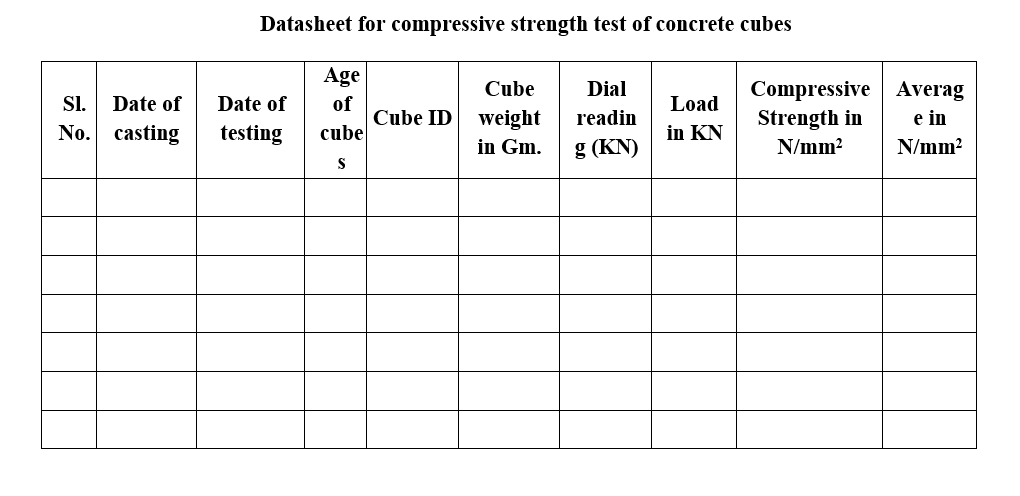
Datasheet for compressive strength test of concrete cubes
Related Articles
To provide a better learning experience, include internal links to:
- Concrete Cube Casting Procedure
- Slump Test of Concrete
- Workability of Concrete
- Standard Consistency Test of Cement
- Cement Mortar Cube Test
- Flakiness Index of Aggregate
- Nominal Mix Proportions of Concrete
- M10 to M60 Mix Design Series
- Concrete Technology Hub (future cornerstone page)
Related Calculators
Link to the following tools:
- Concrete Volume Calculator
- Cement Bags Calculator
- Cement, Sand & Aggregate Calculator
- Steel Weight Calculator
- Brick Quantity Calculator
- Construction Cost Calculator
Conclusion
The Compressive Strength Test of Concrete Cubes is one of the most important quality control tests performed in civil engineering. By measuring the maximum compressive load that a concrete specimen can withstand, engineers can assess whether the concrete is suitable for its intended structural application.
When carried out according to IS 516 using properly cast, cured, and tested specimens, the test provides dependable information for quality assurance and helps ensure that concrete meets the required design strength. Careful attention to sampling, mould preparation, compaction, curing, testing, and documentation improves the reliability of the results.
This test is routinely used in construction projects, ready-mix concrete plants, educational laboratories, and infrastructure works, making it an essential skill for civil engineering students, site engineers, QA/QC professionals, and laboratory technicians.
Understanding not only the testing procedure but also the factors affecting strength, common sources of error, and the interpretation of results enables engineers to make informed decisions that contribute to safe, durable, and high-quality concrete structures.
References
This article has been prepared using recognized engineering references and commonly accepted construction practices, including:
| Reference | Purpose |
|---|---|
| IS 516 | Compressive Strength Test Procedure |
| IS 456 | Acceptance of Concrete |
| IS 10262 | Mix Proportioning |
| IS 1199 | Sampling of Concrete |
| Concrete Technology Textbooks | Background Theory |
Note: Always refer to the latest editions of applicable Indian Standards (IS Codes), project specifications, and official publications for detailed technical requirements.
About T Square Civil Engineering
T Square Civil Engineering is a learning platform dedicated to providing accurate, practical, and easy-to-understand civil engineering knowledge. Our mission is to help students, site engineers, and construction professionals bridge the gap between engineering theory and real-world construction practice through detailed guides, calculators, technical articles, and industry-focused resources.
Our content is carefully researched and prepared to support academic learning, competitive examinations, and practical site applications while promoting engineering best practices and continuous professional development.
Visit www.tsquarecivil.com to explore more civil engineering articles, calculators, interview questions, and practical construction resources.
Disclaimer
The information provided on T Square Civil Engineering is intended for educational and informational purposes only. While every effort has been made to ensure the technical accuracy and reliability of the content, readers are advised to consult the latest applicable Indian Standards (IS Codes), project specifications, manufacturer guidelines, and local regulations before applying any information to the design, construction, testing, quality control, or execution of engineering works.
The content published on this website should not be considered a substitute for professional engineering judgment or project-specific technical advice. T Square Civil Engineering shall not be held responsible for any loss, damage, or consequences arising from the use or interpretation of the information provided on this website.