 by
by The elongation index of aggregate is an important particle-shape test used to determine the proportion of excessively elongated particles present in coarse aggregate.
Particle shape influences the packing, workability, compaction and performance of aggregate in concrete and other construction applications. An aggregate containing a high proportion of elongated particles may produce less satisfactory packing and may require greater care during handling, proportioning and compaction.
In India, the elongation index test for coarse aggregate is carried out in accordance with IS 2386 (Part 1):1963 – Methods of Test for Aggregates for Concrete, Part 1: Particle Size and Shape.
This article explains the definition, principle, apparatus, length-gauge dimensions, procedure, formula, calculation, reporting and relationship between elongation index and flakiness index.
Important: Project specifications, contract requirements and the latest applicable standards and amendments should always be checked before accepting or rejecting aggregate.
Page Contents
What Is Elongation Index of Aggregate?
The elongation index is the percentage by mass of elongated particles present in a coarse aggregate sample.
For the purpose of the test, a particle is considered elongated when its greatest dimension is greater than the specified length corresponding to its size fraction.
Under IS 2386 (Part 1), the specified length is:
1.8 × mean size of the aggregate fraction
where the mean size is based on the sieve sizes defining that fraction.
For example, aggregate passing the 20 mm sieve and retained on the 16 mm sieve has:
Mean size
= (20 + 16) ÷ 2
= 18 mm
Specified length
= 1.8 × 18
= 32.4 mm
Therefore, for this size fraction, a particle that cannot pass through the corresponding 32.4 mm length-gauge opening is classified as elongated.
The elongation test is not applicable to aggregate fractions smaller than 6.3 mm.
Why Is the Elongation Index Test Important?
Aggregate particles are not always cubical. Crushing and natural geological processes can produce particles that are elongated, flaky, angular, rounded or irregular.
A high proportion of elongated particles can influence:
- particle packing;
- void content;
- workability;
- compaction;
- orientation of aggregate particles;
- stability of aggregate skeleton; and
- overall consistency of the aggregate used in construction.
The elongation index therefore provides a simple quantitative measure of one aspect of aggregate particle shape.
It should not, however, be treated as an independent measure of aggregate strength. Mechanical properties such as crushing resistance, impact resistance and abrasion resistance are evaluated using separate tests.
IS Code for Elongation Index Test
The principal Indian Standard used for the test is:
IS 2386 (Part 1):1963 – Methods of Test for Aggregates for Concrete: Part 1 – Particle Size and Shape
IS 2386 (Part 1) covers particle-size and shape tests including sieve analysis, flakiness index and elongation index.
For aggregates intended for concrete, IS 383:2016 – Coarse and Fine Aggregate for Concrete – Specification should also be considered because it specifies requirements related to the combined flakiness and elongation index.
Principle of the Elongation Index Test
The coarse aggregate is first separated into specified size fractions using standard IS sieves.
Particles belonging to each fraction are then checked individually using the corresponding opening of a length gauge.
A particle that does not pass through the specified length-gauge opening is considered elongated.
The masses of elongated particles from the tested fractions are combined and expressed as a percentage of the total mass of aggregate used for the elongation test.
Apparatus Required
The main equipment required for the elongation index test consists of:
- Length gauge conforming to the required dimensions.
- IS sieves appropriate to the coarse aggregate fractions being tested.
- Weighing balance of sufficient capacity and having an accuracy of 0.1% of the weight of the test sample.
- Clean trays or containers for separating aggregate fractions.
- Sample divider or quartering arrangement where required for preparing a representative test sample.
The balance should be capable of determining the required masses with adequate accuracy for the test.
Length Gauge Dimensions
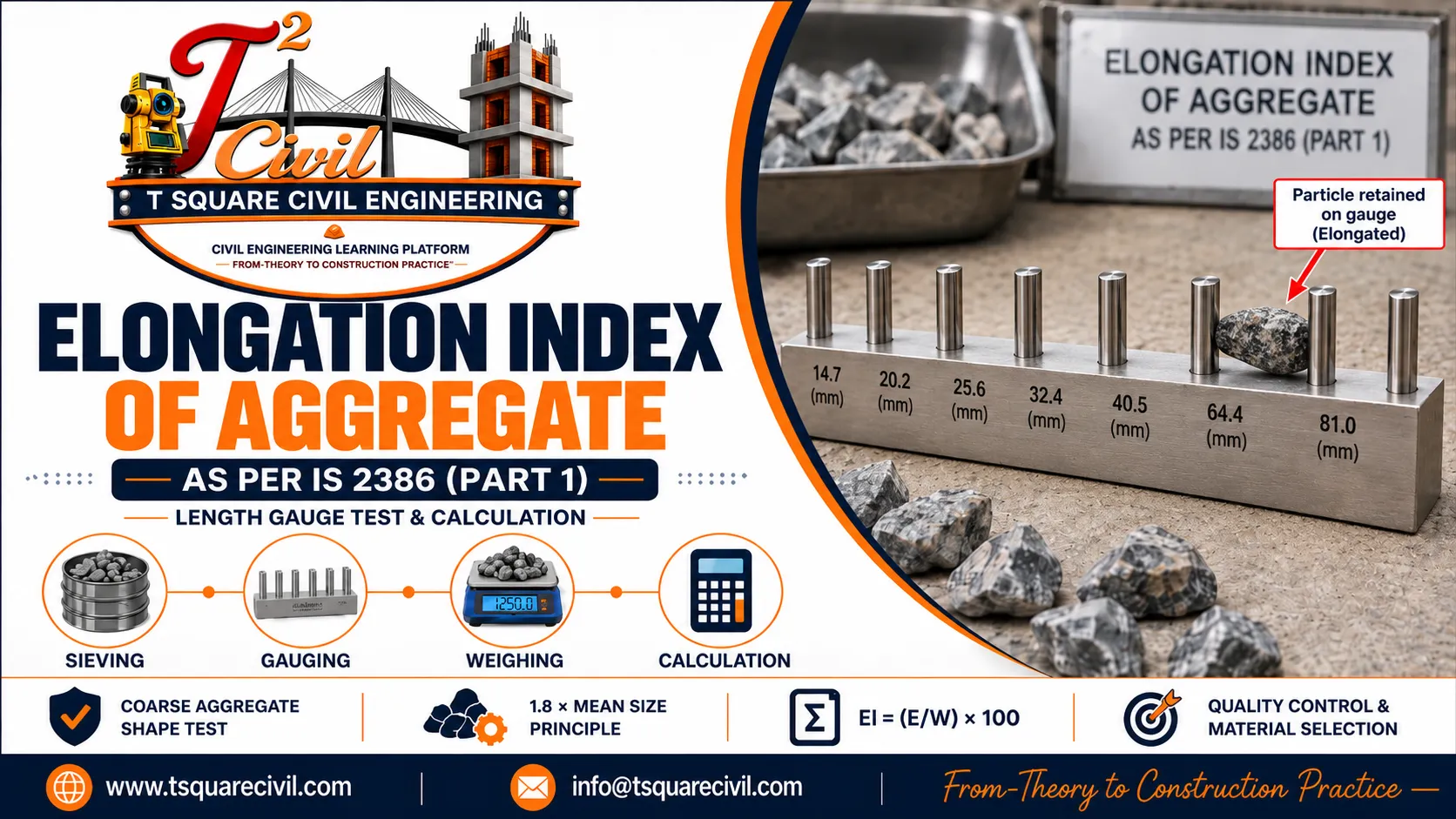
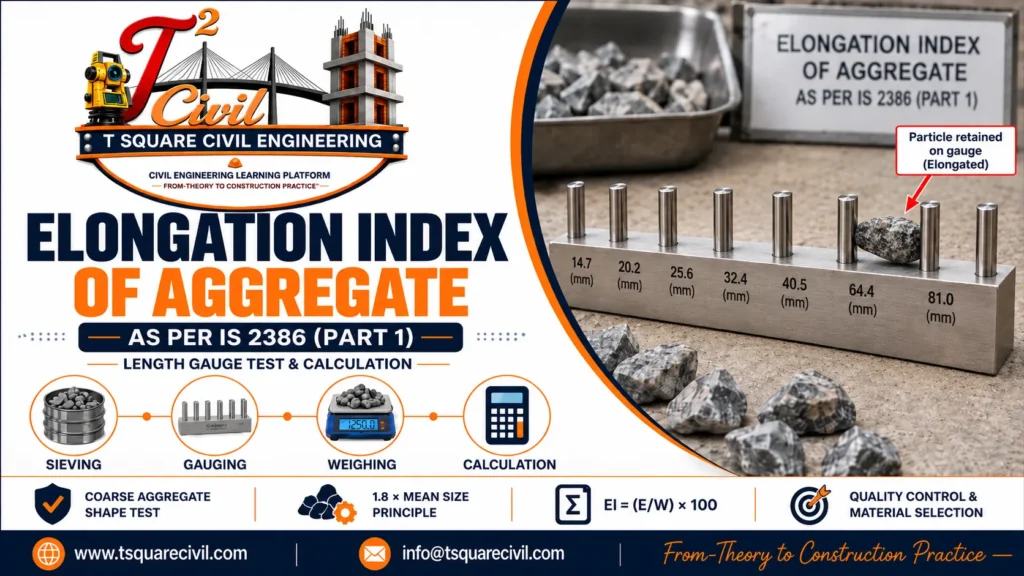
The length-gauge dimension for a particular size fraction is approximately 1.8 times the mean sieve size of that fraction.
| Aggregate passing sieve | Aggregate retained on IS sieve | Length-gauge opening |
|---|---|---|
| 63 mm | 50 mm | — |
| 50 mm | 40 mm | 81.0 mm |
| 40 mm | 31.5 mm | 64.4 mm |
| 31.5 mm | 25 mm | — |
| 25 mm | 20 mm | 40.5 mm |
| 20 mm | 16 mm | 32.4 mm |
| 16 mm | 12.5 mm | 25.6 mm |
| 12.5 mm | 10 mm | 20.2 mm |
| 10 mm | 6.3 mm | 14.7 mm |
Where a length-gauge opening is specified in the table, that opening is used to classify elongated particles in the corresponding aggregate size fraction.
Example
For aggregate passing 16 mm and retained on 12.5 mm sieve:
Mean size
= (16 + 12.5) ÷ 2
= 14.25 mm
Length-gauge dimension
= 1.8 × 14.25
= 25.65 mm
The specified gauge dimension is approximately 25.6 mm.
Sample Preparation
Obtain a representative coarse-aggregate sample and separate it into the applicable size fractions using the specified IS sieves. A sufficient quantity of aggregate shall be taken to provide a minimum of 200 particles of any fraction to be tested. The elongation-index method is not applicable to aggregate sizes smaller than 6.3 mm.
Elongation Index Test Procedure
Step 1: Obtain a Representative Sample
Reduce the bulk aggregate sample to a suitable representative laboratory sample using an appropriate sample divider or quartering method.
Step 2: Bring the Sample to Air-Dry Condition
Prepare the aggregate in a suitable air-dry condition before weighing and sieving.
Step 3: Sieve the Aggregate
Sieve the sample through the appropriate IS sieves and separate it into individual size fractions.
For example:
20–16 mm
16–12.5 mm
12.5–10 mm
10–6.3 mm
The actual fractions tested will depend on the grading of the aggregate sample.
Step 4: Weigh Each Fraction
Determine the mass of each fraction being used for the test.
Let:
W₁, W₂, W₃ … = masses of individual aggregate fractions
Then:
W = W₁ + W₂ + W₃ + …
where:
W = total mass of aggregate subjected to the elongation-index test
Step 5: Check the Particles on the Length Gauge
Take one size fraction at a time.
Check each particle using the appropriate opening of the length gauge.
The particle should be presented to the appropriate gauge opening in relation to its greatest dimension.
A particle that does not pass through the specified opening is classified as an elongated particle.
Step 6: Collect the Elongated Particles
Collect all elongated particles separately for each aggregate size fraction.
Step 7: Weigh the Elongated Particles
Determine the mass of elongated particles from every tested fraction.
Let:
E₁, E₂, E₃ … = masses of elongated particles from individual fractions
Then:
E = E₁ + E₂ + E₃ + …
where:
E = total mass of elongated particles
Step 8: Calculate the Elongation Index
Calculate the elongation index using:
Elongation Index (%) = (E ÷ W) × 100
where:
E = total mass of elongated particles retained by the appropriate length-gauge openings
and
W = total mass of aggregate fractions subjected to the elongation test
Elongation Index Formula
The general formula is:
EI (%) = (Mass of elongated particles ÷ Total mass of aggregate tested) × 100
or:
EI (%) = (E ÷ W) × 100
where:
EI = Elongation Index, %
E = total mass of elongated particles
W = total mass of aggregate tested
Worked Example
Assume the total mass of coarse aggregate fractions subjected to the elongation test is:
W = 2,000 g
After checking all particles using the appropriate length-gauge openings, the total mass of particles classified as elongated is:
E = 360 g
Therefore:
EI = (360 ÷ 2,000) × 100
EI = 18%
Hence:
Elongation Index = 18%
This means that 18% of the mass of the aggregate tested consists of particles classified as elongated according to the specified test criterion.
Example Observation Sheet
| Size fraction | Mass of fraction, W (g) | Length-gauge opening (mm) | Mass of elongated particles, E (g) |
|---|---|---|---|
| 25–20 mm | 500 | 40.5 | 70 |
| 20–16 mm | 600 | 32.4 | 95 |
| 16–12.5 mm | 500 | 25.6 | 100 |
| 12.5–10 mm | 250 | 20.2 | 55 |
| 10–6.3 mm | 150 | 14.7 | 40 |
| Total | 2,000 | — | 360 |
Therefore:
Elongation Index
= (360 ÷ 2,000) × 100
= 18%
How to Interpret the Elongation Index
A lower elongation index indicates that a smaller proportion of the aggregate sample consists of excessively elongated particles.
A higher elongation index indicates a greater proportion of elongated particles.
However, the elongation index should not be interpreted alone as a complete measure of aggregate quality.
Aggregate suitability also depends on properties such as:
- grading;
- flakiness;
- crushing resistance;
- impact resistance;
- abrasion resistance;
- water absorption;
- specific gravity;
- durability; and
- the requirements of the particular concrete or construction specification.
Elongation Index Limit as per IS 383
An important distinction must be made between:
individual elongation index
and
combined flakiness and elongation index.
IS 383:2016 specifies the combined flakiness and elongation index for concrete aggregate.
Under this procedure, flakiness and elongation are determined on the same sample. The flaky particles are first identified and removed, and the remaining material is then used for the elongation determination.
The resulting flakiness and elongation indices are combined.
For crushed or uncrushed aggregate, IS 383:2016 specifies that the combined flakiness and elongation index should not exceed 40%, subject to the provisions and discretion stated in the standard.
Therefore, it is technically preferable not to state simply:
“Elongation index must be less than 40%.”
That statement can be misleading.
The 40% requirement relates to the combined flakiness and elongation index, not automatically to the stand-alone elongation index result.
Combined Flakiness and Elongation Index
For concrete aggregate evaluated according to IS 383, the procedure differs from performing two completely independent tests on separate samples.
First determine the flaky particles.
Remove those flaky particles from the original test portion.
The remaining non-flaky aggregate is then examined for elongated particles.
The flakiness and elongation indices determined according to the specified procedure are then added numerically to obtain the:
Combined Flakiness and Elongation Index
This prevents the same particle from being unnecessarily counted in an inappropriate manner in the combined assessment.
Elongation Index vs Flakiness Index
| Property | Flakiness Index | Elongation Index |
|---|---|---|
| Shape characteristic | Excessively thin particle | Excessively long particle |
| Governing dimension | Least dimension | Greatest dimension |
| Gauge | Thickness gauge | Length gauge |
| Criterion | Thickness related to 0.6 × mean size | Length related to 1.8 × mean size |
| Applicable standard | IS 2386 Part 1 | IS 2386 Part 1 |
| Aggregate size | Coarse aggregate fractions covered by the method | Fractions above 6.3 mm |
| Result | Percentage by mass | Percentage by mass |
A particle can have an irregular shape, so flakiness and elongation describe different geometrical characteristics.
For concrete aggregate evaluated under IS 383, they are considered together through the combined flakiness and elongation index requirement.
Why Elongated Aggregate Can Be Undesirable
A very high proportion of elongated particles may adversely influence aggregate packing and handling.
Elongated particles can tend to orient themselves during placing and compaction and may contribute to higher voids compared with a suitably shaped aggregate skeleton.
However, elongation index alone should not be used to predict concrete compressive strength or structural performance. Concrete performance depends on the complete combination of aggregate grading and shape, paste content, water-cement ratio, compaction, curing, material quality and mix design.
Common Errors During the Test
Common testing errors include using the wrong gauge opening for a sieve fraction, mixing different fractions before gauging, classifying particles visually instead of using the gauge, forcing particles through the gauge, including aggregate smaller than the applicable test size, inaccurate weighing and failing to use a representative sample.
Correct size separation and use of the corresponding gauge opening are particularly important because the permitted particle length changes with aggregate size.
Precautions
Use clean and undamaged sieves and a correctly manufactured length gauge.
Ensure that the aggregate fractions are clearly separated before testing.
Use the correct gauge opening for each size fraction.
Do not force a particle through the gauge.
Weigh the test fractions and elongated particles carefully.
Keep individual fractions in separate trays to prevent mixing.
Use a representative sample rather than hand-selecting particles based on appearance.
Record all observations immediately during testing.
Reporting the Result
A laboratory report should normally identify:
- sample identification;
- source and nominal size of aggregate;
- relevant test standard;
- size fractions tested;
- mass of each fraction;
- mass of elongated particles;
- calculated elongation index;
- combined flakiness and elongation index where required;
- date of testing; and
- observations affecting the result.
The final result should be reported according to the requirements of the applicable test method, specification and laboratory quality system.
Practical Site and Laboratory Example
Suppose a construction project receives 20 mm nominal-size crushed coarse aggregate.
A representative sample is collected and separated into relevant fractions such as:
20–16 mm,
16–12.5 mm,
12.5–10 mm, and
10–6.3 mm.
Each fraction is checked using the corresponding length-gauge opening.
If a large number of particles fail to pass through their specified length-gauge openings, the material contains a comparatively high proportion of elongated particles.
For acceptance of aggregate for concrete, the engineer should then consider the applicable project specification and, where IS 383 applies, the combined flakiness and elongation index, rather than relying only on the elongation index measured separately.
Frequently Asked Questions
What is the elongation index of aggregate?
The elongation index is the percentage by mass of aggregate particles classified as elongated according to the specified length criterion for their size fraction.
What is an elongated aggregate particle?
For the IS 2386 Part 1 test, an elongated particle has a greatest dimension exceeding the specified length associated with its aggregate size fraction, based on approximately 1.8 times the mean sieve size.
What is the IS code for elongation index?
The elongation index test is covered by IS 2386 (Part 1):1963 – Methods of Test for Aggregates for Concrete: Part 1 – Particle Size and Shape.
What is the formula for elongation index?
Elongation Index (%) = (Mass of elongated particles ÷ Total mass of aggregate tested) × 100
Which gauge is used for the elongation index test?
A length gauge is used.
Which particles are considered elongated during the test?
Particles that do not pass through the appropriate length-gauge opening for their size fraction are treated as elongated particles.
Is elongation index applicable below 6.3 mm?
No. The elongation-index method is not applicable to aggregate sizes smaller than 6.3 mm.
What is the maximum elongation index allowed as per IS 383?
IS 383:2016 specifies a limit for the combined flakiness and elongation index, not simply a universal stand-alone elongation-index limit. The combined value for crushed or uncrushed aggregate should not exceed 40%, subject to the provisions of the standard and applicable project requirements.
What is the difference between flakiness index and elongation index?
Flakiness index evaluates particles with an excessively small least dimension, whereas elongation index evaluates particles with an excessively large greatest dimension. Flakiness is checked using a thickness gauge and elongation using a length gauge.
Why is the elongation index important?
It helps assess the particle shape of coarse aggregate. Excessively elongated particles may affect packing, workability, compaction and aggregate arrangement in concrete and other construction materials.
Conclusion
The elongation index test of coarse aggregate provides a quantitative assessment of the proportion of excessively elongated particles in an aggregate sample.
According to IS 2386 (Part 1), aggregate is separated into specified size fractions and each particle is checked using the appropriate length gauge. Particles that do not pass through the corresponding gauge opening are classified as elongated.
The elongation index is then calculated as:
Elongation Index (%) = (Mass of elongated particles ÷ Total mass of aggregate tested) × 100
For concrete aggregates evaluated under IS 383:2016, the individual elongation-index result should also be understood in the context of the combined flakiness and elongation index requirement.
Together with sieve analysis, flakiness index, impact value, crushing value, specific gravity and water absorption, the elongation index forms an important part of systematic aggregate quality assessment.