 by
by Fineness of cement is an important physical property that indicates the degree of subdivision or particle size of cement. It influences the rate of hydration, early strength development, heat generation, water requirement and several other properties of cement paste, mortar and concrete.
In civil engineering laboratories, the fineness of cement is commonly demonstrated by sieving a cement sample through a 90 µm sieve and determining the percentage of material retained on the sieve.
A 100 g cement sample is commonly used in many teaching laboratories and routine laboratory demonstrations because it makes the calculation simple. However, when the dry-sieving test is performed strictly according to IS 4031 (Part 1):1996, approximately 10 g of cement is used for each determination.
This article explains both approaches so that students, site engineers, laboratory technicians and QA/QC engineers can clearly understand the difference between common laboratory practice and the standardised IS test procedure.
Page Contents
What Is Fineness of Cement?
Fineness of cement refers to how finely the cement clinker and other permitted constituents have been ground during cement manufacture.
In simple terms, cement containing a greater proportion of smaller particles is considered finer than cement containing a greater proportion of coarse particles.
Cement fineness may be assessed mainly by:
- Dry sieving through a 90 µm sieve, where the percentage of coarse material retained on the sieve is determined.
- Blaine air-permeability testing, where the specific surface area of cement is determined.
These two tests measure fineness in different ways and their results should not be treated as identical.
Why Is Fineness of Cement Important?
Cement reacts with water primarily through the exposed surfaces of its particles. Therefore, particle size and total surface area affect the rate at which hydration occurs.
Proper cement fineness is important for several reasons.
1. Rate of Hydration
Finer cement provides a larger surface area for contact with water.
As a result, finer particles generally hydrate more rapidly than coarse particles.
2. Early Strength Development
Because finer particles generally react faster with water, increased fineness can contribute to faster early-age strength development.
However, cement fineness is only one factor affecting strength. Cement composition, water-cement ratio, curing, temperature and other factors are also important.
3. Heat of Hydration
Faster hydration can result in faster heat generation.
This may be advantageous in some situations but may require consideration in mass concrete or other situations where temperature rise needs to be controlled.
4. Water Demand
Very fine cement has a greater total surface area that must be wetted.
Therefore, increased fineness can sometimes increase the water required to achieve a particular paste consistency.
5. Bleeding
Finer cement generally helps reduce bleeding because fine particles provide greater surface area and improve the ability of the cement paste to retain water.
6. Workability and Cohesion
Suitable cement fineness can improve the cohesion of cement paste and concrete.
However, excessive fineness can increase water demand, so finer cement should not automatically be considered better.
Principle of Fineness Test of Cement
In the dry-sieving method, a known mass of cement is placed on a 90 µm sieve.
The cement is sieved carefully so that fine particles pass through the openings while particles larger than the effective sieve opening remain on the sieve.
The retained material is weighed and expressed as a percentage of the original cement sample.
The percentage retained is known as the sieve residue.
A lower residue generally indicates that a smaller proportion of coarse particles is present.
IS Code for Fineness of Cement
The main Indian Standards associated with the determination of cement fineness are:
IS 4031 (Part 1):1996
Methods of Physical Tests for Hydraulic Cement – Determination of Fineness by Dry Sieving.
IS 4031 (Part 2):1999
Methods of Physical Tests for Hydraulic Cement – Determination of Fineness by Specific Surface by Blaine Air-Permeability Method.
For Ordinary Portland Cement, the relevant product specification is:
IS 269:2015 – Ordinary Portland Cement – Specification
It is important to understand the difference between a test method standard and a cement product specification.
IS 4031 describes how a particular physical test is performed, whereas the applicable cement specification defines the requirements that a particular type and grade of cement must satisfy.
Which Sieve Is Used for Fineness Test of Cement?
A 90 µm IS sieve is used for determining cement fineness by the dry-sieving method.
The sieve should be:
- clean;
- dry;
- free from visible damage;
- free from blocked openings; and
- properly checked before use.
The condition of the sieve is important because worn, damaged or blocked openings can significantly affect the test result.
How Much Cement Is Taken for the Fineness Test?
This is one of the most commonly asked questions about this test because two different quantities are frequently encountered.
Common Laboratory Practice – 100 g
In many civil engineering colleges, teaching laboratories and routine site-laboratory demonstrations, 100 g of cement is commonly taken.
The main advantage is that the calculation becomes very simple.
If the initial cement sample is exactly 100 g:
Residue (%) = Weight of cement retained on the 90 µm sieve in grams
For example, if 7 g remains on the sieve:
Residue = 7%
This procedure is useful for demonstrating the principle of the test and is widely encountered by civil engineering students.
IS 4031 Part 1 Reference Procedure – Approximately 10 g
When the test is carried out and reported strictly according to IS 4031 (Part 1):1996, approximately 10 g of cement is used for each determination.
The test is repeated using another fresh approximately 10 g test portion.
Therefore:
100 g should not be described as the IS 4031 Part 1 specified sample quantity.
Both methods may be encountered in laboratories, but the laboratory should clearly state which test procedure or SOP is being followed.
Apparatus Required for Fineness Test of Cement
The following equipment is generally required:
- 90 µm IS sieve
- Sieve lid
- Receiving pan or tray
- Suitable weighing balance
- Clean and dry container
- Clean, dry rod
- Nylon or suitable bristle brush for cleaning the sieve
For testing according to IS 4031 Part 1, the weighing equipment should have sufficient accuracy for the approximately 10 g test quantity.
Preparation of Cement Sample
Proper preparation is necessary to obtain a representative result.
Before the test:
- Take a representative sample of cement.
- Mix the bulk cement sample thoroughly.
- Ensure that the cement and testing apparatus are dry.
- Remove only loose agglomerations without crushing individual cement particles.
- Prevent contamination of the sample by moisture, dust or foreign material.
- Ensure that the test sieve is clean before starting.
For the IS procedure, the representative cement sample is agitated in a stoppered jar to disperse agglomerates and then carefully mixed so that fine material is uniformly distributed before the test portion is taken.
Fineness Test of Cement Using 100 g Sample – Common Laboratory Method
The following procedure represents the commonly encountered 100 g laboratory or educational method.
Step 1: Clean the Sieve
Clean and dry the 90 µm sieve thoroughly.
Check that the mesh is not damaged or blocked.
Step 2: Weigh the Cement
Take:
Weight of cement sample, W = 100 g
Record the exact weight if it differs slightly from 100 g.
Step 3: Place Cement on the Sieve
Transfer the cement carefully onto the 90 µm sieve.
Ensure that no cement is lost during transfer.
Fit the pan below and the lid above the sieve.
Step 4: Sieve the Cement
Sieve the cement using gentle and controlled movements.
Loose agglomerations may be dispersed carefully, but cement particles should never be deliberately forced through the sieve openings.
Many teaching laboratories specify a particular manual sieving duration, commonly around 15 minutes. Where a laboratory has an approved SOP or laboratory manual, the duration and technique specified in that procedure should be followed.
Step 5: Weigh the Residue
After completing the sieving operation, carefully weigh the cement retained on the 90 µm sieve.
Let:
Wr = Weight of residue retained on the sieve
Step 6: Calculate the Residue
Use:
Residue (%) = (Wr / W) × 100
For an exactly 100 g sample:
Residue (%) = Weight retained in grams
Example Calculation Using 100 g Cement
Suppose:
Initial cement sample:
W = 100 g
Cement retained on 90 µm sieve:
Wr = 6.5 g
Therefore:
Residue (%) = (6.5 / 100) × 100
Residue = 6.5%
Percentage passing through the sieve:
Percentage passing = 100 − 6.5
Percentage passing = 93.5%
Therefore, the cement sample has:
90 µm sieve residue = 6.5%
and
Material passing the 90 µm sieve = 93.5%
Fineness Test of Cement as per IS 4031 Part 1
When the fineness test is performed specifically according to IS 4031 (Part 1):1996, the standardized procedure should be followed.
Step 1: Prepare the Sample
Take a representative cement sample.
The sample is first agitated in a stoppered jar to disperse agglomerations.
After allowing it to stand briefly, gently mix the cement using a clean, dry rod so that the finer particles are properly distributed.
Step 2: Prepare the 90 µm Sieve
Fit the receiving tray below the sieve.
Ensure that the sieve is clean and dry.
Step 3: Take the Test Portion
Weigh approximately:
10 g of cement
Record the actual mass accurately.
Let:
W = Initial mass of cement
Step 4: Transfer the Cement
Place the weighed cement carefully on the 90 µm sieve without losing any material.
Disperse loose agglomerations and fit the sieve lid.
Step 5: Carry Out Sieving
Agitate the sieve using suitable:
- swirling movements;
- planetary movements; and
- linear movements.
Continue the sieving process until no more appreciable fine material passes through the sieve.
A fixed 15-minute duration should therefore not be presented as a requirement of IS 4031 Part 1.
Step 6: Weigh the Residue
Remove the cement retained on the sieve carefully and determine its mass.
Let:
Wr = Mass of residue retained on 90 µm sieve
Step 7: Calculate Percentage Residue
Calculate:
R = (Wr / W) × 100
Where:
R = residue on 90 µm sieve, %
Wr = mass retained on 90 µm sieve, g
W = original mass of cement sample, g
Step 8: Repeat the Test
Carry out another determination using a fresh approximately 10 g cement sample.
Step 9: Compare the Results
If the difference between the two results is not more than 1 percentage point absolute, calculate and report their mean.
If the difference is more than 1 percentage point absolute, carry out a third determination using another fresh sample and calculate the mean of the three results.
Example Calculation as per IS 4031 Part 1
Assume the first test gives:
Initial mass of cement:
W₁ = 10.00 g
Residue:
Wr₁ = 0.64 g
Therefore:
R₁ = (0.64 / 10.00) × 100
R₁ = 6.4%
For the second determination:
Initial mass:
W₂ = 10.02 g
Residue:
Wr₂ = 0.66 g
Therefore:
R₂ = (0.66 / 10.02) × 100
R₂ ≈ 6.6%
Difference between the two results:
6.6 − 6.4 = 0.2 percentage point
Since the difference is not more than 1 percentage point, a third determination is not required.
Mean residue:
Mean residue = (6.4 + 6.6) / 2
Mean residue = 6.5%
Test Result
Fineness by dry sieving: residue on 90 µm sieve = 6.5%
Fineness of Cement Formula
The general formula is:
Residue on 90 µm sieve (%) = (Weight retained on 90 µm sieve / Initial weight of cement) × 100
or:
R = (Wr / W) × 100
Where:
R = percentage residue
Wr = mass retained on sieve
W = original mass of cement
If percentage passing is required:
Percentage passing = 100 − Percentage residue
Is Percentage Residue the Same as Percentage Fineness?
The terminology can sometimes cause confusion.
For the dry-sieving test, the directly measured result is:
Percentage residue retained on the 90 µm sieve
A lower residue normally indicates that a smaller proportion of coarse cement particles is present.
Therefore, instead of writing:
“Fineness of cement = 6%”
a clearer laboratory result is:
“Residue retained on 90 µm sieve = 6%.”
If required for explanation:
Percentage passing = 94%
This avoids confusion between sieve residue and specific surface fineness.
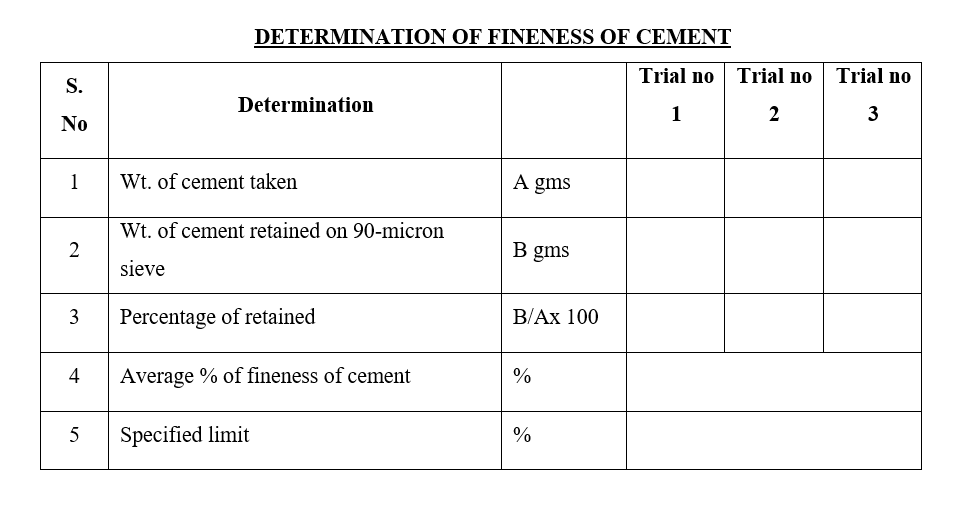
Observation Table – 100 g Laboratory Method
| Particular | Observation |
|---|---|
| Initial mass of cement, W | 100 g |
| Sieve size | 90 µm |
| Mass retained, Wr | 6.5 g |
| Residue | 6.5% |
| Percentage passing | 93.5% |
Observation Table – IS Reference Method
| Particular | Trial 1 | Trial 2 | Trial 3, if required |
|---|---|---|---|
| Initial cement mass | 10.00 g | 10.02 g | — |
| Residue retained | 0.64 g | 0.66 g | — |
| Residue | 6.4% | 6.6% | — |
Mean residue:
6.5%
100 g Method vs IS 4031 Part 1 Method
| Parameter | Common Laboratory Method | IS 4031 Part 1 Method |
|---|---|---|
| Cement sample | Commonly 100 g | Approximately 10 g |
| Sieve | 90 µm | 90 µm |
| Main purpose | Teaching/routine demonstration | Standardized dry-sieve determination |
| Sieving duration | Often specified by laboratory SOP | Until no more appreciable fine material passes |
| Number of tests | As specified by laboratory procedure | Two determinations normally required |
| Third test | Depends on SOP | Required if difference exceeds 1 percentage point |
| Result | Percentage residue | Percentage residue |
Practical Note
For a college practical, examination or routine laboratory exercise, follow the procedure prescribed in the approved laboratory manual.
For contractual testing, quality-control acceptance or a result specifically reported “as per IS 4031 Part 1,” follow the standardized IS procedure and the applicable project specification.
Fineness of Cement by Blaine Air-Permeability Method
The second important method of evaluating cement fineness is the Blaine air-permeability method.
This method is covered by:
IS 4031 (Part 2):1999
Unlike the sieve test, the Blaine method does not simply determine the percentage of cement particles coarser than a particular sieve opening.
Instead, it determines the specific surface area of cement.
Specific surface is commonly expressed as:
m²/kg
or:
cm²/g
The method is based on the resistance offered by a prepared bed of cement to the passage of air under specified conditions.
Greater specific surface generally represents finer cement.
90 µm Sieve Test vs Blaine Test
| Parameter | 90 µm Sieve Test | Blaine Air-Permeability Test |
|---|---|---|
| Property measured | Coarse residue | Specific surface |
| Result | Percentage retained | m²/kg or cm²/g |
| Standard | IS 4031 Part 1 | IS 4031 Part 2 |
| Main equipment | 90 µm sieve | Blaine apparatus |
| Interpretation | Lower residue generally indicates less coarse material | Higher specific surface generally indicates finer cement |
| Test principle | Particle-size cut-off | Air permeability through cement bed |
The two tests should not be considered interchangeable because they evaluate different aspects of cement particle characteristics.
Fineness Requirement of Ordinary Portland Cement
For Ordinary Portland Cement, acceptance should be checked against the applicable cement specification rather than using a generic sieve-residue value for every cement.
Under IS 269:2015, fineness of OPC is specified in terms of specific surface determined by the Blaine air-permeability method.
The minimum specific surface for normal OPC 33, OPC 43 and OPC 53 is commonly specified as:
225 m²/kg minimum
Special OPC 43S and OPC 53S have higher specified specific-surface requirements.
Important
Do not assume that:
“Cement must have less than 10% residue on the 90 µm sieve as per IS 269”
is a universal current acceptance requirement for every cement.
Different cement types are covered by different product standards, and the relevant cement specification should always be checked.
For project acceptance, verify:
- cement type;
- cement grade;
- applicable Indian Standard;
- latest amendments;
- approved project specification;
- manufacturer’s test certificate; and
- contractual quality requirements.
Effect of Fineness on Strength of Cement
Finer cement generally hydrates faster because more surface area is exposed to water.
This can contribute to faster early-age strength development.
However, it is technically incorrect to state that finer cement always produces higher strength.
Strength also depends on:
- cement mineral composition;
- water-cement ratio;
- quality of mixing;
- curing;
- temperature;
- age of testing; and
- other material properties.
The compressive strength of cement must therefore be determined independently using the specified mortar-cube test.
Effect of Fineness on Setting Time
Finer cement particles generally hydrate faster.
Therefore, fineness can influence the rate of stiffening and setting.
However, setting time is also affected by:
- cement composition;
- gypsum content;
- water content;
- temperature; and
- other chemical and physical characteristics.
Fineness alone should not be used to predict setting time.
Effect of Fineness on Standard Consistency
A finer cement has a larger surface area that must be wetted by water.
Therefore, an increase in fineness may contribute to a higher water requirement for standard consistency.
The actual standard consistency of cement should be determined independently using the Vicat apparatus.
Why Extremely Fine Cement Is Not Always Better
It is incorrect to assume that cement should simply be ground as finely as possible.
Very high fineness may:
- increase water demand;
- accelerate heat evolution;
- alter early hydration behaviour;
- increase sensitivity to moisture during storage; and
- influence shrinkage and other properties depending on the cement and concrete system.
A suitable cement requires an appropriate particle-size distribution and chemical composition for its intended application.
Factors Affecting Cement Fineness
Several factors can affect cement fineness.
1. Grinding Process
The type, efficiency and operating condition of the grinding equipment strongly affect cement particle size.
2. Grinding Duration
Increased grinding generally results in smaller particles and greater specific surface.
3. Clinker Characteristics
The hardness and mineralogical characteristics of clinker influence grinding behaviour.
4. Added Constituents
Gypsum and other permitted cement constituents can influence the overall particle-size distribution.
5. Storage Conditions
Moisture exposure can cause cement particles to form agglomerations.
6. Condition of the Test Sieve
Blocked, worn, distorted or damaged sieve openings can affect the measured residue.
7. Testing Technique
Improper sample transfer, loss of cement, insufficient sieving or forcing particles through the mesh can produce incorrect results.
Precautions During Fineness Test of Cement
The following precautions should be followed:
- Use a representative cement sample.
- Keep the cement sample dry.
- Ensure that the sieve is clean and dry.
- Check the sieve for damage before testing.
- Prevent loss of cement during weighing and transfer.
- Do not force cement particles through the sieve.
- Break only loose agglomerations carefully.
- Use controlled sieve movements.
- Weigh the residue accurately.
- Follow the approved test method or laboratory SOP.
- When reporting the test as per IS 4031 Part 1, use the required approximately 10 g test portions.
- Carry out repeat determinations as required by the standard.
- Keep the weighing balance properly calibrated.
- Maintain sieve-checking and calibration records where required.
- Avoid inhalation of cement dust and use appropriate laboratory PPE.
Common Mistakes in Fineness Test of Cement
Mistake 1: Calling the 100 g Test the IS 4031 Procedure
A 100 g sample is commonly encountered in teaching and routine laboratory practice, but IS 4031 Part 1 specifies an approximately 10 g test portion.
Clearly identify which procedure is being followed.
Mistake 2: Forcing Cement Through the Sieve
Particles should not be rubbed or forced through the sieve mesh.
Doing so can produce an artificially low residue.
Mistake 3: Losing Cement During Transfer
Any loss of cement changes the mass balance and affects the result.
Mistake 4: Using a Dirty or Blocked Sieve
Blocked sieve openings can produce an artificially high residue.
Mistake 5: Reporting Only “Percentage Fineness”
Report the result clearly as:
Residue retained on 90 µm sieve = ___ %
Mistake 6: Applying One Acceptance Limit to Every Cement
Different cement types and grades may have different requirements.
Always check the applicable cement specification.
Mistake 7: Ignoring Repeatability
Where the IS 4031 Part 1 procedure is followed, repeat determinations are part of the standardized method.
Practical Importance for Site Engineers and QA/QC Engineers
Fineness is one part of cement quality assessment.
It should not be used alone to decide whether a cement consignment is suitable for structural concrete.
Depending on the cement type and project specification, laboratory evaluation may include:
- fineness;
- standard consistency;
- initial setting time;
- final setting time;
- soundness;
- compressive strength; and
- specified chemical requirements.
The engineer should compare laboratory results with:
- the approved material specification;
- applicable Indian Standards;
- manufacturer’s test certificate;
- project quality plan; and
- contractual acceptance requirements.
Laboratory Test Report Format
A typical fineness test report may include:
Project: __________
Laboratory: __________
Cement manufacturer: __________
Cement type: __________
Cement grade: __________
Batch/Lot number: __________
Date received: __________
Date tested: __________
Test method: __________
Sieve size: 90 µm
Initial sample mass: __________ g
Residue retained: __________ g
Residue: __________ %
Second determination: __________ %
Third determination, if required: __________ %
Mean result: __________ %
Applicable specification: __________
Remarks: __________
Tested by: __________
Checked by: __________
Frequently Asked Questions
What is fineness of cement?
Fineness of cement indicates the degree of subdivision or particle size of cement. It can be evaluated by determining the residue retained on a specified sieve or by measuring the specific surface area.
Which sieve is used for the fineness test of cement?
A 90 µm IS sieve is used for the dry-sieving fineness test.
What is the IS code for fineness of cement?
IS 4031 (Part 1):1996 covers determination of fineness by dry sieving.
IS 4031 (Part 2):1999 covers determination of fineness by the Blaine air-permeability method.
Is 100 g of cement used for the fineness test?
A 100 g sample is commonly used in many educational and routine laboratory procedures.
However, when testing strictly according to IS 4031 Part 1, approximately 10 g of cement is used for each determination.
Why do laboratories commonly use 100 g of cement?
Using exactly 100 g makes the calculation easy because the mass retained on the sieve in grams becomes numerically equal to the percentage residue.
For example:
6 g retained from 100 g cement = 6% residue.
How much cement is used as per IS 4031 Part 1?
Approximately 10 g of cement is taken for each determination.
What is the formula for fineness of cement?
For the dry-sieve test:
Residue (%) = (Mass retained on 90 µm sieve / Initial cement mass) × 100
What does 6% residue mean?
It means that 6% of the original cement sample by mass remained on the 90 µm sieve under the test conditions.
Is lower sieve residue better?
A lower residue generally means that a smaller proportion of relatively coarse particles is present.
However, cement quality cannot be assessed from sieve residue alone.
Is cement sieved for exactly 15 minutes?
A fixed period such as 15 minutes is commonly specified in some educational laboratory procedures.
However, IS 4031 Part 1 specifies sieving until no more appreciable fine material passes through the sieve, rather than defining the test simply by a fixed 15-minute duration.
What is Blaine fineness?
Blaine fineness represents the specific surface area of cement determined using an air-permeability apparatus.
The result is generally expressed in m²/kg or cm²/g.
What is the difference between sieve fineness and Blaine fineness?
The 90 µm sieve test measures the percentage of relatively coarse material retained on a particular sieve.
The Blaine method evaluates the specific surface area of cement.
Therefore, they represent different measures of cement fineness.
What is the minimum Blaine fineness of ordinary OPC?
For OPC 33, OPC 43 and OPC 53 under IS 269:2015, the minimum specific surface is generally 225 m²/kg.
The latest applicable standard and amendments should always be checked before using this value for acceptance.
Does finer cement gain strength faster?
Generally, finer cement can hydrate more rapidly and contribute to faster early-age strength development.
However, compressive strength depends on several other physical, chemical and construction-related factors.
Why is cement fineness tested?
The test helps assess cement particle characteristics and provides an important quality-control parameter affecting hydration and cement performance.
Key Points to Remember
- Fineness represents the degree of subdivision of cement particles.
- A 90 µm sieve is used for dry-sieve testing.
- 100 g is commonly used in educational and routine laboratory demonstrations.
- Approximately 10 g is used for each determination under IS 4031 Part 1.
- Do not describe the 100 g method as the specified IS 4031 Part 1 procedure.
- The dry-sieve result should preferably be reported as percentage residue retained on the 90 µm sieve.
- Lower residue generally indicates a lower proportion of coarse particles.
- Blaine fineness represents specific surface area rather than sieve residue.
- Fineness affects hydration and early strength development but does not alone determine cement quality.
- Acceptance should always be based on the applicable cement specification and project requirements.
Conclusion
Fineness of cement is an important physical characteristic that influences hydration, early strength development, heat evolution, water demand and the behaviour of cement in mortar and concrete.
The fineness of cement can be evaluated using a 90 µm sieve or by determining its specific surface using the Blaine air-permeability method.
A 100 g cement sample is widely encountered in civil engineering teaching laboratories and routine laboratory demonstrations because it provides a simple and convenient calculation. However, when the dry-sieving test is carried out specifically according to IS 4031 (Part 1):1996, approximately 10 g of cement is used for each determination, and repeat testing requirements apply.
This distinction is important for students as well as practicing engineers. Educational laboratory methods should not be incorrectly presented as standardized acceptance procedures.
For actual project quality control, cement test results should always be assessed against the applicable cement specification, approved project requirements, manufacturer’s test certificate and latest amendments to the relevant standards.
References
- IS 4031 (Part 1):1996 – Methods of Physical Tests for Hydraulic Cement: Determination of Fineness by Dry Sieving.
- IS 4031 (Part 2):1999 – Methods of Physical Tests for Hydraulic Cement: Determination of Fineness by Specific Surface by Blaine Air-Permeability Method.
- IS 269:2015 – Ordinary Portland Cement – Specification.
- Relevant approved project specifications, laboratory SOPs and latest applicable amendments should be referred to for acceptance testing.
Datasheet for determination of fineness of cement