
 by
by Page Contents
Introduction
The initial and final setting time of cement are important physical properties used to understand how cement paste changes from a plastic condition to a rigid state after water is added.
The initial setting time indicates the stage at which cement paste reaches the specified initial-setting condition and begins losing its plastic character. The final setting time indicates the stage at which the paste reaches the specified final-setting condition under the Vicat test.
These properties are important for cement quality control because the cement should provide sufficient time for mixing, transportation, placing and finishing while also setting within the limits specified for the particular cement type.
In India, the initial and final setting times of hydraulic cement are determined according to:
IS 4031 (Part 5):1988 – Methods of Physical Tests for Hydraulic Cement: Determination of Initial and Final Setting Times
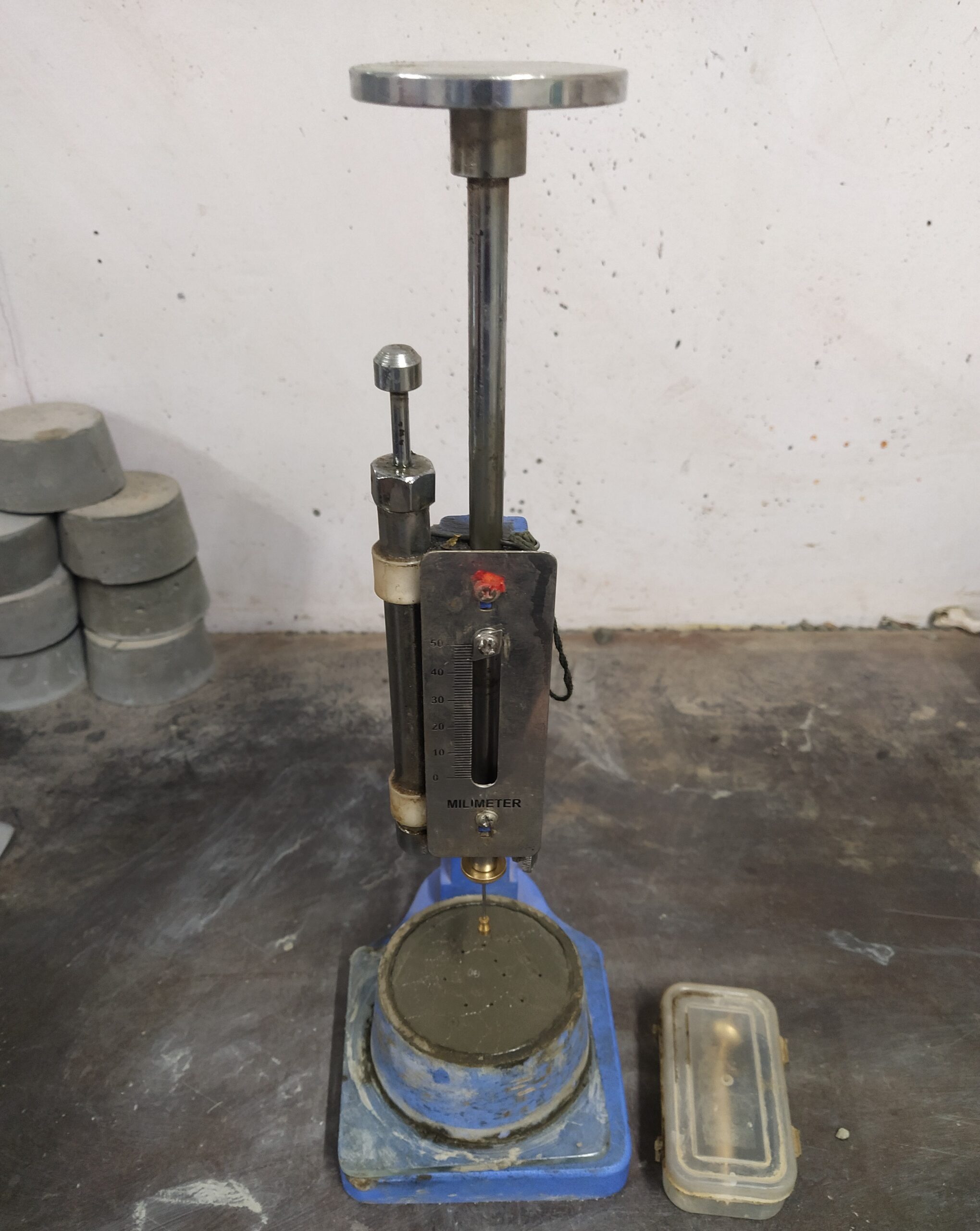
The test is carried out using a Vicat apparatus.
IS 4031 Part 5 remains the BIS test method for determining these setting times.
Quick Information
| Parameter | Requirement / Test Information |
|---|---|
| Test | Initial and Final Setting Time of Cement |
| Test method | IS 4031 (Part 5):1988 |
| Apparatus | Vicat apparatus |
| Current apparatus specification | IS 5513:1996 |
| Paste water | 0.85 × standard-consistency water |
| Initial set criterion | Needle fails to penetrate beyond 5.0 ± 0.5 mm from bottom |
| Final set criterion | Needle makes impression but annular attachment does not |
| Result | Time from addition of water |
| Reporting | Nearest 5 minutes |
What Is Setting of Cement?
When water is added to cement, chemical reactions known as hydration begin.
Fresh cement paste is initially plastic and workable. As hydration progresses, the paste gradually loses its plasticity, becomes stiff and eventually develops a rigid structure.
This transition is referred to as setting.
Setting should not be confused with strength development.
Cement can reach its final-setting condition long before it develops substantial compressive strength. Strength continues to increase through continued hydration after setting.
What Is Initial Setting Time of Cement?
The initial setting time is the period between:
the instant water is added to the cement
and
the time at which the Vicat initial-setting needle fails to penetrate the test block beyond 5.0 ± 0.5 mm measured from the bottom of the Vicat mould.
This definition is specified in IS 4031 Part 5.
In practical terms, initial setting indicates that the cement paste has reached a defined stage of stiffening.
However, the laboratory initial setting time should not be treated as the exact allowable transportation or placing time of concrete. Concrete behaviour also depends on water-cement ratio, aggregates, admixtures, temperature, mixing conditions and many other factors.
What Is Final Setting Time of Cement?
The final setting time is the period from the addition of water until the cement paste reaches the specified final-setting condition.
For the test, the initial-setting needle is replaced with the final-setting needle fitted with an annular attachment.
The cement is considered finally set when:
- the central needle makes an impression on the surface of the test block; but
- the annular attachment fails to make an impression.
IS 4031 Part 5 specifies this criterion for final setting.
Difference Between Initial and Final Setting Time
| Parameter | Initial Setting Time | Final Setting Time |
|---|---|---|
| Meaning | Specified beginning stage of setting | Specified completion stage of setting |
| Vicat attachment | Initial-setting needle | Needle with annular attachment |
| Criterion | Needle stops at 5.0 ± 0.5 mm from bottom | Needle marks paste but annular attachment does not |
| Time measured from | Addition of water | Addition of water |
| Practical significance | Indicates early loss of plastic condition | Indicates development of defined rigid condition |
Why Is Setting Time Important?
Setting time is important for both cement quality control and construction practice.
1. Time for Mixing
Cement should not set so quickly that proper mixing becomes difficult.
2. Transportation
Concrete and mortar need sufficient workable time for transportation after mixing.
3. Placing and Compaction
Premature stiffening can interfere with proper placement and compaction.
4. Finishing
Finishing operations must be completed at the appropriate stage of concrete behaviour.
5. Quality Control
Setting-time testing helps detect unusual cement behaviour and verify compliance with the relevant product specification.
6. Consistency Between Batches
Large changes in setting behaviour between batches may indicate variations in cement characteristics or storage conditions.
IS Code for Initial and Final Setting Time of Cement
The main standard is:
IS 4031 (Part 5):1988 – Determination of Initial and Final Setting Times
The standard was reviewed by BIS in 2024.
The Vicat apparatus itself should conform to:
IS 5513:1996 – Vicat Apparatus — Specification
This is important because many older laboratory notes still refer to IS 5513:1976 or earlier editions. The current BIS apparatus specification is IS 5513:1996.
For Ordinary Portland Cement, product requirements are given in:
IS 269:2015 – Ordinary Portland Cement — Specification
Apparatus Required
The following apparatus is required:
- Vicat apparatus
- Vicat mould
- Initial-setting needle
- Final-setting needle with annular attachment
- Non-porous base plate
- Weighing balance
- Measuring cylinder
- Gauging trowel
- Stopwatch or timer
- Mixing tray
- Potable or distilled water
Vicat Apparatus
The Vicat apparatus consists primarily of:
- rigid frame;
- movable rod;
- graduated scale;
- Vicat mould;
- non-porous base plate;
- consistency plunger;
- initial-setting needle; and
- final-setting needle with annular attachment.
Under IS 5513:1996, the initial-setting needle is a round, flat-ended needle approximately 1.13 ± 0.05 mm in diameter and 50 ± 1 mm effective length.
The final-setting needle has the same section but is shorter and is fitted with an annular attachment having a circular cutting edge of approximately 5 mm diameter.
Important Correction
Do not describe the current initial-setting needle as a 1 mm square needle when referring to the current IS 5513:1996 apparatus.
The current apparatus standard specifies a round needle.
Vicat Mould Dimensions
Under IS 5513:1996, the conventional Vicat mould is of truncated conical form with approximately:
- top internal diameter: 70 ± 5 mm
- bottom internal diameter: 80 ± 5 mm
- height: 40 ± 0.2 mm
A split-type mould is also permitted under the apparatus specification.
Laboratory Conditions
IS 4031 Part 5 specifies controlled laboratory conditions.
Temperature
The temperature of:
- moulding room;
- dry materials; and
- water
should be maintained at:
27 ± 2°C
Laboratory Humidity
The original text specified 65 ± 5% relative humidity, but Amendment No. 2 of June 2013 changed this requirement to not less than 65% relative humidity.
Therefore, the current requirement should be written as:
Laboratory relative humidity: not less than 65%
Moist Room / Moist Closet
The moist room or moist closet should be maintained at:
27 ± 2°C
and:
relative humidity not less than 90%.
Water Required for Setting-Time Test
The cement paste is prepared using:
0.85 times the water required for standard consistency.
If standard-consistency water is represented by P%, then:
Water for setting-time paste = 0.85P% of cement mass
IS 4031 Part 5 specifically requires the paste to be prepared using 0.85 times the standard-consistency water.
Formula for Water Quantity
If:
P = standard consistency (%)
and
Wc = mass of cement
then:
Water mass = 0.85 × (P/100) × Wc
Example of Water Calculation
Assume:
Standard consistency:
P = 30%
Cement sample:
400 g
Water required:
= 0.85 × 30/100 × 400
= 102 g
Therefore, approximately:
102 g of water
would be used for a 400 g cement sample when P = 30%.
A 400 g sample is commonly used in educational and routine IS-based laboratory practice. The essential standardized requirement is that the test paste is prepared using 0.85P water.
Preparation of Test Block
Step 1: Determine Standard Consistency
First determine the standard consistency of the cement according to:
IS 4031 (Part 4)
Let the result be:
P%
Step 2: Calculate Water
Calculate:
Water = 0.85P% of cement mass
Step 3: Start the Stopwatch
The stopwatch must be started:
at the instant water is added to the cement.
This point is extremely important because both initial and final setting times are measured from this instant.
Step 4: Gauge the Paste
Prepare a neat cement paste using potable or distilled water.
The gauging procedure should follow the requirements associated with IS 4031 Part 4.
Step 5: Fill the Vicat Mould
Place the Vicat mould on a clean non-porous plate.
Fill the mould completely with cement paste.
Smooth the top surface so that it is level with the top of the mould.
The cement paste confined in the mould is called the test block.
Step 6: Place in Moist Room
Immediately after moulding, place the test block in the moist closet or moist room.
Keep it there except during the actual setting-time measurements.
IS 4031 Part 5 specifically requires the specimen to remain in the moist environment except while determinations are being made.
Initial Setting Time Test Procedure
Step 1: Fit Initial-Setting Needle
Attach the initial-setting needle to the movable rod of the Vicat apparatus.
Step 2: Position the Test Block
Place the Vicat mould containing the cement paste beneath the needle.
Step 3: Bring Needle into Contact
Lower the needle gently until it just touches the surface of the cement paste.
Step 4: Release the Needle
Quickly release the movable rod and allow the needle to penetrate freely into the test block.
At the beginning of the test, the needle will normally penetrate deeply through the soft cement paste.
Step 5: Repeat the Test
Repeat the penetration at suitable intervals.
Do not repeatedly penetrate at exactly the same location.
Between observations, keep the test block under the specified moist conditions.
Step 6: Identify Initial Setting Condition
Continue until the needle:
fails to penetrate the test block beyond 5.0 ± 0.5 mm measured from the bottom of the mould.
The elapsed time between:
addition of water
and
reaching this penetration condition
is the:
Initial Setting Time
This is the exact criterion specified in IS 4031 Part 5.
Formula for Initial Setting Time
Initial Setting Time = t₂ − t₁
where:
t₁ = time when water is first added to cement
t₂ = time when the initial-setting needle reaches the specified penetration criterion
If the stopwatch is started at zero when water is added:
Initial Setting Time = stopwatch reading at initial set
Example
Water added at:
10:00 AM
Specified initial-setting condition reached at:
10:42 AM
Therefore:
Initial setting time = 42 minutes
Report the result to the nearest 5 minutes as required by IS 4031 Part 5.
Final Setting Time Test Procedure
After determining initial setting time, continue maintaining the test block under the required moist conditions.
Step 1: Change the Needle
Replace the initial-setting needle with the:
final-setting needle fitted with the annular attachment.
Step 2: Apply the Needle
Apply the needle gently to the surface of the test block.
Step 3: Observe the Impression
Continue testing at suitable intervals.
The cement is considered finally set when:
- the needle makes an impression on the surface;
- but the annular attachment fails to make an impression.
This is the final-setting condition under IS 4031 Part 5.
Step 4: Record Time
Record the elapsed time from:
addition of water
to:
the specified final-setting condition.
This is the:
Final Setting Time
Formula for Final Setting Time
Final Setting Time = t₃ − t₁
where:
t₁ = time when water was added
t₃ = time when the final-setting criterion is reached
Example
Water added at:
10:00 AM
Final-setting condition reached at:
3:05 PM
Elapsed time:
5 hours 5 minutes
or:
305 minutes
Therefore:
Final setting time = 305 minutes
Important Requirement if Surface Scum Forms
Sometimes a thin scum may form on the top surface of the cement paste.
IS 4031 Part 5 specifies that if scum forms:
use the underside of the test block for determination of final setting time.
This practical detail should not be omitted from a proper laboratory procedure.
Reporting of Results
The results of both:
- initial setting time; and
- final setting time
should be reported to the nearest:
5 minutes
according to IS 4031 Part 5.
Sample Observation Table
| Observation | Time |
|---|---|
| Water added to cement | 10:00 AM |
| Initial-setting condition | 10:40 AM |
| Final-setting condition | 3:00 PM |
| Initial setting time | 40 min |
| Final setting time | 300 min |
Setting-Time Requirements for OPC
Under IS 269:2015, the setting-time requirements for Ordinary Portland Cement depend partly on the OPC grade.
| OPC Grade | Initial Setting Time, Minimum | Final Setting Time, Maximum |
|---|---|---|
| OPC 33 | 30 min | 600 min |
| OPC 43 | 30 min | 600 min |
| OPC 43S | 60 min | 600 min |
| OPC 53 | 30 min | 600 min |
| OPC 53S | 60 min | 600 min |
The sleeper grades OPC 43S and OPC 53S therefore have a higher minimum initial setting time than ordinary OPC 33, 43 and 53 grades. Government specifications reproducing IS 269:2015 requirements confirm these values.
Important
Do not write only:
“Initial setting time of cement = 30 minutes.”
The correct interpretation is:
For normal OPC 33, OPC 43 and OPC 53:
Initial setting time shall not be less than 30 minutes.
This is a minimum acceptance requirement, not a fixed test result.
Similarly:
Final setting time shall not be more than 600 minutes.
What Does “Not Less Than 30 Minutes” Mean?
If a cement has:
Initial setting time = 45 minutes
it does not mean the result is incorrect because it is greater than 30 minutes.
The requirement means the cement should provide at least the specified minimum period before reaching the standardized initial-setting condition.
For ordinary OPC 33, 43 and 53:
30 minutes is the minimum requirement, not the exact expected value.
Initial Setting Time vs Concrete Workability Time
This distinction is very important for site engineers.
The laboratory test is carried out on:
neat cement paste
using:
0.85P water
under controlled temperature and humidity.
Concrete contains:
- cement;
- water;
- fine aggregate;
- coarse aggregate;
- mineral additions where applicable;
- chemical admixtures where applicable.
Therefore:
cement initial setting time is not the same as concrete slump-retention time or allowable concrete transportation time.
Do not use a 30-minute cement setting requirement to conclude that concrete must be placed within exactly 30 minutes.
Concrete placement requirements must follow the concrete specification, mix design, admixture characteristics, environmental conditions and applicable construction standard.
Initial Setting Time vs Final Setting Time
A simple way to understand the distinction is:
Initial set: cement paste reaches the standardized early stiffening condition.
Final set: cement paste reaches the standardized final-setting condition.
Neither value represents full strength development.
Hydration and strength development continue after final setting.
Setting vs Hardening of Cement
Setting refers primarily to the transition from plastic paste to a rigid state.
Hardening refers to continued strength development after setting.
Therefore:
Setting ≠ Hardening
Cement can be finally set while still having relatively low mechanical strength compared with its later-age strength.
Factors Affecting Setting Time of Cement
Several factors can influence setting behaviour.
Cement Composition
The relative quantities and reactivity of cement compounds influence hydration and setting.
Gypsum Content
Gypsum is used to control rapid reactions involving aluminates and helps regulate normal setting behaviour.
Cement Fineness
Finer cement generally presents a larger surface area for hydration and may influence the rate of reaction.
Water Content
Changes in water content alter the consistency and behaviour of cement paste.
Temperature
Higher temperatures generally accelerate hydration reactions, while lower temperatures tend to slow them.
Storage Condition
Cement exposed to moisture during storage can undergo partial hydration or other changes that affect setting behaviour.
Admixtures
In concrete and mortar, chemical admixtures such as retarders or accelerators can significantly alter setting behaviour.
However, the standard cement setting-time test is conducted on the prescribed neat paste, not on site concrete containing admixtures.
False Set and Flash Set
These terms are sometimes confused with normal setting.
False Set
False set is an abnormal early stiffening of cement paste without the expected significant heat evolution associated with flash set.
The paste may regain plasticity upon remixing without adding additional water.
False set is evaluated separately and should not simply be identified from the standard initial-setting-time test.
Flash Set
Flash set refers to very rapid and irreversible stiffening accompanied by rapid hydration and significant heat evolution.
It may be associated with inadequate control of rapidly reacting cement constituents.
Do not use the terms:
initial set, false set and flash set
as though they mean the same thing.
They describe different behaviours.
Relationship Between Standard Consistency and Setting Time
The setting-time test cannot be carried out correctly without first determining the cement’s standard consistency.
If:
P = standard-consistency water
then setting-time paste uses:
0.85P
Therefore, an incorrect value of P will directly affect preparation of the setting-time test specimen.
Related article: Standard Consistency Test of Cement using Vicat Apparatus.
Relationship Between Fineness and Setting Time
Cement fineness influences the surface area available for hydration.
A change in particle-size distribution may therefore affect hydration rate and setting behaviour.
However, setting time cannot be predicted from fineness alone because cement composition, gypsum, temperature and several other factors also play important roles.
Related article: Fineness of Cement Test.
Setting Time and Soundness
Setting time and soundness measure different properties.
Setting time measures development of specified stiffness conditions.
Soundness assesses delayed expansion and dimensional stability.
A cement may satisfy its setting-time requirement but fail its soundness requirement.
Both tests must therefore be evaluated separately.
Related article: Soundness Test of Cement.
Setting Time and Compressive Strength
Setting does not represent the development of design strength.
Compressive strength is determined separately using standard mortar cubes under:
IS 4031 Part 6
A cement that reaches final set within the required period must still satisfy the specified compressive-strength requirements.
Related article: Compressive Strength Test of Cement.
Precautions During Setting-Time Test
For reliable results:
- Use a representative cement sample.
- Determine standard consistency accurately.
- Use exactly 0.85P water.
- Use clean apparatus.
- Maintain water, cement and laboratory temperature at 27 ± 2°C.
- Maintain the required humidity.
- Start the stopwatch immediately when water is added.
- Complete gauging without unnecessary delay.
- Fill the Vicat mould properly.
- Keep the test surface level.
- Keep the specimen in the moist room except during readings.
- Ensure the Vicat apparatus is free from vibration.
- Keep the needle straight.
- Lower the needle gently to the surface before release.
- Allow free penetration without forcing the needle.
- Do not test repeatedly at exactly the same point.
- Clean the needle between observations.
- Use the correct attachment for final setting.
- If scum forms, use the underside as specified.
- Report results to the nearest 5 minutes.
IS 4031 Part 5 specifically requires clean equipment, a vibration-free apparatus and care to keep the needle straight.
Common Errors in Setting-Time Testing
Using P Instead of 0.85P
The setting-time paste uses:
0.85 × P
not the full standard-consistency water quantity.
Starting the Timer After Mixing
Incorrect.
The timer starts:
when water is first added to the cement.
Measuring Initial Set from the Top
The initial-setting criterion is referenced to:
5.0 ± 0.5 mm from the bottom of the mould.
Using the Same Needle for Final Set
Final setting requires the needle fitted with the specified annular attachment.
Keeping the Specimen on the Laboratory Bench
The test block should remain in the prescribed moist environment except when measurements are being made.
Writing Initial Setting Time as Exactly 30 Minutes
For normal OPC, 30 minutes is generally a minimum requirement, not a fixed test value.
Calling 600 Minutes the Normal Final Setting Time
Similarly, 600 minutes is a maximum permissible value for the applicable OPC grades, not the expected result for every cement.
Practical Importance for Site and QA/QC Engineers
Setting-time results are useful for material quality control but should not be interpreted in isolation.
When reviewing a cement test certificate, engineers should consider:
- cement type and grade;
- manufacturer;
- batch number;
- fineness;
- standard consistency;
- initial setting time;
- final setting time;
- soundness;
- compressive strength; and
- relevant chemical requirements.
A test result should always be compared with the specification applicable to the actual cement being supplied.
Sample Laboratory Test Report
| Item | Observation |
|---|---|
| Project | __________ |
| Cement type | __________ |
| Cement grade | __________ |
| Manufacturer | __________ |
| Batch/Lot No. | __________ |
| Date of test | __________ |
| Standard consistency, P | __________ % |
| Water used, 0.85P | __________ |
| Time water added | __________ |
| Initial-setting time reached | __________ |
| Initial setting time | __________ min |
| Final-setting time reached | __________ |
| Final setting time | __________ min |
| Applicable specification | __________ |
| Initial setting requirement | __________ |
| Final setting requirement | __________ |
| Result | Pass / Fail as applicable |
| Tested by | __________ |
| Checked by | __________ |
Frequently Asked Questions
What is the initial setting time of cement?
Initial setting time is the period from the addition of water until the Vicat initial-setting needle fails to penetrate beyond 5.0 ± 0.5 mm from the bottom of the mould under the standardized test.
What is the final setting time of cement?
Final setting time is the period from addition of water until the central Vicat needle makes an impression but the annular attachment no longer makes an impression on the cement paste.
Which IS code is used for setting time of cement?
The test is carried out according to:
IS 4031 (Part 5):1988
Which apparatus is used?
A Vicat apparatus conforming to IS 5513:1996 is used.
How much water is used?
The cement paste is prepared using:
0.85 times the water required for standard consistency.
When should the stopwatch be started?
Start the stopwatch at the instant water is added to the cement.
What is the minimum initial setting time for OPC?
Under IS 269:2015:
- OPC 33: 30 minutes minimum
- OPC 43: 30 minutes minimum
- OPC 53: 30 minutes minimum
- OPC 43S: 60 minutes minimum
- OPC 53S: 60 minutes minimum
What is the maximum final setting time for OPC?
The maximum final setting time for the OPC grades listed under IS 269:2015 is:
600 minutes
Is initial setting time the same as concrete working time?
No. The cement test is performed on controlled neat cement paste. Concrete working time depends on the complete concrete mixture, temperature, admixtures and site conditions.
Is setting time the same as hardening time?
No. Setting describes the transition toward rigidity, whereas hardening and strength development continue after setting.
Why is 0.85P water used?
Using a controlled proportion based on standard consistency provides a repeatable paste condition for comparing setting behaviour of different cement samples.
What happens if scum forms on the specimen?
IS 4031 Part 5 specifies using the underside of the test block for the final-setting determination when scum forms on the top surface.
Key Points to Remember
- Test method: IS 4031 Part 5
- Apparatus specification: IS 5513:1996
- Water for paste: 0.85P
- Timer starts when water is added
- Initial-set criterion: 5.0 ± 0.5 mm from bottom
- Final-set criterion: central needle marks; annular attachment does not
- Test block remains in moist room between observations
- Laboratory temperature: 27 ± 2°C
- Laboratory RH: not less than 65%
- Moist-room RH: not less than 90%
- Report setting times to nearest 5 minutes
- Normal OPC 33/43/53 initial setting: ≥30 min
- OPC 43S/53S initial setting: ≥60 min
- OPC final setting: ≤600 min
- Initial setting time is not the same as concrete transport or workability time
Conclusion
The initial and final setting time test is an important laboratory test used to evaluate the setting behaviour of hydraulic cement.
According to IS 4031 (Part 5):1988, cement paste is prepared using 0.85 times the water required for standard consistency, placed in a Vicat mould and maintained under controlled conditions.
The initial setting time is reached when the specified Vicat needle can no longer penetrate beyond 5.0 ± 0.5 mm from the bottom of the mould.
The final setting time is reached when the central needle makes an impression but the annular attachment fails to mark the test surface.
For normal OPC 33, OPC 43 and OPC 53 under IS 269:2015, the initial setting time should generally be not less than 30 minutes, while the final setting time should be not more than 600 minutes. Sleeper grades OPC 43S and OPC 53S require a longer minimum initial setting time of 60 minutes.
Engineers should remember that these values apply to standardised cement-paste testing and should not be directly equated with the handling, transportation or setting behaviour of concrete at site.
References
- IS 4031 (Part 5):1988 – Methods of Physical Tests for Hydraulic Cement: Determination of Initial and Final Setting Times.
- IS 5513:1996 – Vicat Apparatus — Specification.
- IS 4031 (Part 4):1988 – Determination of Consistency of Standard Cement Paste.
- IS 269:2015 – Ordinary Portland Cement — Specification.
- Latest applicable amendments, project specifications and laboratory quality procedures.