 by
by Construction sites are dynamic workplaces where workers, engineers, equipment, materials and temporary structures operate together under continuously changing conditions. Hazards may arise from work at height, excavation, lifting operations, moving machinery, electricity, formwork, reinforcement, concrete works, welding, cutting, dust, chemicals and many other activities.
Construction safety therefore cannot be achieved simply by providing helmets, safety shoes and reflective jackets.
An effective construction-safety system begins with proper planning, hazard identification, risk assessment, competent supervision, safe construction methods, suitable temporary works, controlled access, equipment inspection, worker training and emergency preparedness.
Personal protective equipment, or PPE, is an important part of this system, but it should normally be considered the final protective layer after hazards have been eliminated or reduced as far as reasonably practicable.
This article explains construction safety from a practical site-engineering perspective, including common construction hazards, site-safety controls, work-at-height precautions, excavation safety, lifting safety, electrical safety, scaffolding, formwork, concreting, housekeeping, emergency planning and the correct selection and use of PPE.
Disclaimer: This article provides general educational guidance for construction safety and PPE. Actual safety requirements depend on the activity, risk assessment, applicable law, project specification, approved method statement, manufacturer instructions and site conditions. The latest applicable statutory provisions, standards, project safety procedures and competent-person requirements should always be verified before carrying out work.
Page Contents
What Is Construction Safety?
Construction safety is the systematic management of hazards associated with construction activities so that workers, visitors, equipment, property and the surrounding public are protected from unacceptable risk.
It includes much more than PPE.
Construction safety typically involves:
- planning the work before it begins;
- identifying hazards;
- assessing risks;
- selecting appropriate control measures;
- preparing safe work procedures;
- ensuring competent supervision;
- inspecting temporary works and equipment;
- controlling access to hazardous areas;
- training workers;
- providing suitable PPE;
- monitoring the work; and
- preparing for emergencies.
A safe construction project therefore depends on both engineering controls and management controls.
Why Construction Safety Is Important
Construction work contains many activities capable of causing serious injury, property damage or loss of life if they are not properly controlled.
Typical high-risk activities include:
Work at height, excavation, crane and lifting operations, scaffolding, demolition, electrical work, heavy-equipment movement, confined-space entry, formwork erection and removal, reinforcement work, welding, cutting and concrete operations.
Poor safety performance also affects:
Project productivity, work quality, equipment condition, labour morale, programme delays, cost, contractual performance and the reputation of the contractor or organisation.
Good construction safety is therefore not separate from good construction management.
A well-organised site is normally easier to inspect, easier to supervise and more productive.
Construction Safety Should Begin Before Work Starts
Many site accidents originate from inadequate planning rather than from the worker’s final action immediately before an incident.
Before beginning an activity, the project team should understand:
- what work will be performed;
- where it will be performed;
- who will perform it;
- what tools and equipment will be used;
- what temporary works are required;
- what materials will be handled;
- what other activities are occurring nearby;
- what could go wrong;
- how the hazards will be controlled; and
- what should happen if an emergency occurs.
For higher-risk work, this information is normally developed through project procedures such as risk assessments, method statements, lifting plans, permits, inspection checklists or other approved control documents.
The specific documentation required depends on the project and governing requirements.
Hazard Identification and Risk Assessment
Before work begins, hazards associated with the activity should be identified.
Examples include:
| Construction Activity | Typical Hazard |
|---|---|
| Excavation | Collapse, falling material, underground services, water ingress |
| Scaffolding | Falls, unstable platform, falling objects |
| Reinforcement work | Cuts, sharp edges, projecting bars, manual handling |
| Formwork | Collapse, falling panels, unstable supports |
| Concreting | Wet concrete, pumping pressure, electrical equipment, work at height |
| Crane lifting | Suspended loads, lifting failure, collision |
| Cutting and grinding | Flying particles, sparks, dust, noise |
| Welding | Radiation, fumes, burns, fire |
| Electrical work | Electric shock, arc hazard, fire |
| Demolition | Structural instability, falling debris, dust |
| Confined space | Hazardous atmosphere, restricted access, engulfment |
| Equipment movement | Collision, crushing, reversing incidents |
After identifying the hazard, the likelihood and possible consequence should be considered in accordance with the project’s risk-assessment procedure.
Control measures should then be selected and implemented before the activity begins.
Hierarchy of Safety Controls
PPE should not normally be the first solution considered for a construction hazard.
A preferred control approach is:
Elimination
Remove the hazard completely wherever practicable.
For example, prefabricating an element at ground level may reduce the amount of work required at height.
Substitution
Replace the hazardous process, equipment or material with a safer alternative where practicable.
Engineering controls
Physically separate workers from the hazard.
Examples include guardrails, machine guards, trench support, barriers, ventilation, dust extraction and interlocks.
Administrative controls
Control how the work is organised.
Examples include permits, procedures, exclusion zones, warning signs, traffic-management plans, work sequencing, supervision and training.
Personal protective equipment
Use PPE to reduce exposure to residual risks that remain after other practical controls have been implemented.
This is an important principle:
PPE supports a safe work system; it should not be used to justify an unsafe work system.
Site Safety Induction
Workers and visitors should understand the important site rules before entering operational construction areas.
A project safety induction may cover:
Site access, emergency arrangements, assembly points, prohibited areas, minimum PPE, traffic routes, incident reporting, work-at-height requirements, electrical safety, welfare facilities, permit systems and project-specific hazards.
Induction alone is not sufficient for specialised work.
Workers should also receive task-specific instruction and training suitable for the work they perform.
Toolbox Talks
Toolbox talks are short safety discussions carried out with the work team, normally focusing on the immediate activity or hazard.
Useful toolbox-talk subjects may include:
Work at height, scaffolding, lifting operations, excavation, electrical safety, PPE, housekeeping, manual handling, hot work and equipment movement.
A toolbox talk should be practical and directly related to the work being performed.
Simply obtaining signatures without communicating the actual hazards provides little safety value.
Good Housekeeping on Construction Sites
Poor housekeeping is a common cause of slips, trips, falls, obstruction and inefficient work.
Construction areas should be organised so that:
Access routes remain clear, scrap materials are removed, protruding nails and sharp objects are controlled, electrical cables and hoses are safely routed, waste is stored properly and emergency access is not obstructed.
Materials should also be stacked in a stable manner.
Poorly stacked reinforcement, blocks, shuttering materials or pipes can become serious hazards even when workers are wearing appropriate PPE.
Safe Access and Egress
Workers need safe access to and from their place of work.
Access arrangements may include:
Stairways, ladders, scaffolding access towers, ramps, platforms and designated walkways.
Temporary access routes should be adequately constructed, maintained and kept free from unnecessary obstruction.
Workers should not routinely climb formwork, reinforcement, structural members or equipment when a proper access system should be provided.
Work at Height Safety
Work at height requires particular attention because a fall can result in severe injury even from comparatively modest heights.
The preferred approach is to prevent exposure to the fall hazard wherever reasonably practicable.
Collective protective measures may include:
Proper working platforms, guardrails, edge protection, floor-opening protection, scaffolds and safe access arrangements.
Where personal fall-protection equipment is required, it should form part of a complete compatible system.
A worker wearing a harness is not automatically protected from a fall.
The system may need to consider:
The full-body harness, suitable connection system, anchorage, energy absorber where applicable, fall clearance, swing-fall risk and rescue arrangements.
Fall-protection equipment should be inspected and used according to applicable standards, project procedures and manufacturer instructions.
Floor Openings and Edge Protection
Open slab edges, lift shafts, service openings, stair openings and other unprotected edges can create serious fall hazards.
Openings should be protected using suitable covers, barriers, guardrails or other engineered arrangements appropriate to the location.
Temporary covers should be capable of remaining secure under foreseeable site conditions and should be clearly identified where necessary.
Loose boards placed over openings should not be treated as reliable fall protection.
Scaffold Safety
Scaffolds should provide a stable working platform and safe access for the intended construction activity.
Important considerations include:
Foundation conditions, standards and ledgers, bracing, ties, platform condition, loading, access, guardrails, toe protection where required and inspection.
Scaffolds should not be modified casually by workers to obtain access or additional space.
Removal of braces, guardrails, ties or platform components can significantly reduce safety.
Inspection requirements should follow the project procedure and applicable requirements.
Ladder Safety
Ladders are useful access equipment but should not automatically be selected as working platforms for prolonged or hazardous work.
Before use, ladders should be checked for visible defects, suitable length, correct positioning and secure support.
Workers should not use damaged or makeshift ladders.
The type of ladder and its suitability should be assessed according to the intended task.
Where a proper working platform is more suitable, a ladder should not be used merely because it is faster to arrange.
Excavation Safety
Excavation work can present hazards including:
Ground collapse, falling material, water ingress, underground utilities, mobile-equipment movement, hazardous atmospheres and restricted access.
Before excavation begins, available information about underground services and site conditions should be reviewed.
Depending on the excavation depth, soil condition and surrounding loads, controls may include:
Sloping, benching, engineered support systems, barricades, access ladders, dewatering, spoil setback, equipment exclusion and regular inspection.
Excavations should also be reassessed following events that may affect stability, such as heavy rain or major changes in nearby loading.
Wearing a safety helmet cannot protect a worker from an uncontrolled excavation collapse.
The excavation itself must be made safe.
Formwork and Temporary Works Safety
Formwork is a temporary structure that must safely resist construction loads until the permanent structure can carry them.
Safety considerations include:
Correct design, adequate support, bracing, stable foundations, proper connections, controlled erection, safe access and planned removal.
Formwork should be inspected before concreting.
During the concrete pour, the work should also be observed for signs such as unusual movement, excessive deflection, settlement, leakage or instability.
Formwork should not be stripped simply because the surface of the concrete appears hard.
Removal should follow the approved construction procedure and the required strength or time criteria for the structure.
Reinforcement Work Safety
Reinforcement work involves manual handling, sharp edges, cutting equipment, bending equipment and projecting steel bars.
Controls may include:
Safe material stacking, mechanical handling where appropriate, controlled cutting and bending areas, protection from hazardous projections, proper access and task-specific PPE.
Workers should not stand beneath suspended reinforcement cages or bundles.
Projecting reinforcement should be controlled where it creates an impalement or contact hazard.
Concrete Work Safety
Concrete activities include batching, transporting, pumping, placing, vibrating, finishing and curing.
Each stage introduces different hazards.
Fresh concrete and cementitious materials can affect skin and eyes, particularly after prolonged contact.
Suitable gloves, protective footwear and clothing should therefore be provided where required.
Concrete pumping requires additional controls.
Pump pipelines, connections and hoses should be correctly assembled and inspected.
Workers should avoid unsafe positions near pressurised connections and hose ends.
Electrical concrete vibrators and associated cables should also be maintained in safe condition.
Crane and Lifting Safety
Lifting operations should be planned according to the complexity and risk of the lift.
Important considerations include:
The load weight, centre of gravity, lifting points, crane capacity, operating radius, ground condition, lifting accessories, nearby structures, overhead services and the route of the suspended load.
Lifting accessories such as slings, shackles and hooks should be suitable for their intended use and inspected according to applicable requirements.
Workers should remain outside hazardous areas associated with suspended loads.
A hard hat does not make it safe to stand below a suspended load.
Communication between the crane operator and authorised lifting personnel should be clear and controlled.
Complex or critical lifts may require a detailed lifting plan and additional engineering review according to project requirements.
Construction Equipment and Traffic Safety
Construction sites frequently contain:
Excavators, loaders, dump trucks, cranes, forklifts, transit mixers, concrete pumps and delivery vehicles.
Pedestrian and equipment routes should be separated as far as practicable.
Traffic controls may include:
Designated walkways, barriers, speed restrictions, reversing controls, warning systems, lighting and competent banksmen or spotters where required.
High-visibility clothing improves worker visibility, but it does not replace effective traffic management.
Electrical Safety
Temporary electrical installations are common on construction sites and can deteriorate under rough working conditions.
Electrical safety should include:
Proper installation, suitable distribution boards, effective earthing and protection arrangements, suitable cables, control of damaged connections, isolation procedures and periodic inspection as required.
Electrical equipment should be protected from conditions such as water, mechanical damage and unauthorised modification.
Repairs should be carried out only by appropriately competent and authorised personnel.
Ordinary gloves or safety shoes should not automatically be treated as electrical-protection equipment.
Cutting, Grinding and Drilling Safety
These operations can produce:
Flying particles, sparks, high noise levels and hazardous dust.
Controls should begin with correctly guarded equipment and safe working methods.
Dust should preferably be controlled at source using methods such as suitable extraction or wet techniques where appropriate.
Depending on the hazard assessment, workers may require:
Eye protection, face protection, hearing protection, gloves, safety footwear and respiratory protective equipment.
Removing a machine guard because the worker is wearing goggles is not an acceptable safety practice.
Welding and Hot-Work Safety
Welding and cutting may expose workers to:
Intense optical radiation, sparks, hot metal, fumes, burns and fire.
Controls can include:
Hot-work procedures, removal or protection of combustible materials, suitable fire-fighting equipment, ventilation, appropriate screens, suitable PPE and fire watch arrangements where required.
Welding PPE may include specialised eye and face protection, protective clothing, welding gloves and safety footwear.
Respiratory controls should be selected according to the welding process, material, coating, ventilation and exposure assessment.
Confined-Space Safety
A confined space may present hazards very different from an ordinary work area.
Possible hazards include:
Oxygen deficiency, toxic gases, flammable atmosphere, engulfment, restricted access and difficulty in rescue.
Confined-space work may require:
Atmospheric testing, ventilation, authorised entry procedures, isolation, communication, standby personnel and a rescue arrangement.
The exact controls depend on the nature of the space and applicable project requirements.
A worker should never enter a potentially hazardous confined space simply because respiratory PPE is available.
Fire Prevention
Construction sites contain temporary electrical systems, fuels, gas cylinders, timber, packaging material and hot-work activities.
Fire prevention should include:
Controlled fuel storage, safe gas-cylinder handling, housekeeping, electrical maintenance, hot-work controls, emergency access and correctly located fire-fighting equipment.
Emergency exits and access routes should remain unobstructed.
Workers should understand how to raise an alarm and where the designated assembly points are located.
Chemical and Hazardous Material Safety
Construction materials may include:
Cement, admixtures, curing compounds, sealants, coatings, solvents, cleaning chemicals and other substances.
Before using a chemical product, workers should understand the relevant hazards and handling requirements.
Labels, manufacturer instructions and safety data information should be available where applicable.
Controls may include:
Ventilation, safe storage, spill control, suitable gloves, eye protection, protective clothing and respiratory protection where required.
Glove material should be compatible with the chemical being handled.
Manual Handling
Construction workers frequently lift and carry reinforcement, blocks, formwork materials, bags, equipment and tools.
Where practicable, heavy or awkward loads should be handled using mechanical assistance, suitable lifting devices or team handling.
Material storage should also be planned to reduce unnecessary lifting from poor positions.
PPE such as gloves may protect the hands, but it does not remove the ergonomic risk associated with excessive load or poor lifting technique.
Weather-Related Construction Safety
Site conditions can change significantly because of weather.
Heavy rain may affect:
Excavations, slopes, scaffolding foundations, electrical installations, access routes and lifting operations.
Strong wind can affect:
Cranes, suspended loads, temporary structures, scaffolds and work at height.
High temperatures can increase the risk of heat stress and dehydration.
Weather conditions should therefore be considered as part of daily site planning.
Work should be suspended or modified where conditions exceed the safe limitations established for the activity or equipment.
Construction Safety Inspections
Regular site inspections are important because hazards can appear rapidly as construction progresses.
An inspection may review:
Housekeeping, access, scaffolding, edge protection, excavation, lifting activities, electrical installations, equipment condition, PPE, material storage, emergency access and temporary works.
Inspection findings should be communicated to the responsible persons and corrective actions should be followed through to completion.
A checklist is useful, but inspection should not become only a box-ticking exercise.
The inspector should also observe how the work is actually being carried out.
Permit-to-Work Systems
Certain higher-risk activities may require a formal permit system under the project’s safety procedures.
Examples may include:
Hot work, confined-space entry, certain electrical work, excavation or other activities identified by the project.
A permit should confirm that required controls have been considered before the work begins.
The exact permit requirements depend on the project and organisation.
Near-Miss and Incident Reporting
A near miss is an event that did not result in injury or significant damage but had the potential to do so.
Near-miss reporting can identify weaknesses before a more serious event occurs.
Construction teams should encourage reporting of unsafe conditions and near misses without treating the process merely as a paperwork requirement.
Incident investigations should focus on understanding contributing factors and preventing recurrence rather than only identifying the worker’s final action.
Emergency Preparedness
Construction sites should have arrangements for foreseeable emergencies.
These may include:
Fire, injury, fall from height, excavation collapse, electrical incident, chemical spill, equipment accident, confined-space emergency or severe weather.
Emergency arrangements should consider:
Alarm methods, emergency contact numbers, first aid, rescue equipment, access for emergency services, assembly areas and responsible personnel.
Specialised high-risk work may require a specific rescue plan rather than reliance solely on external emergency services.
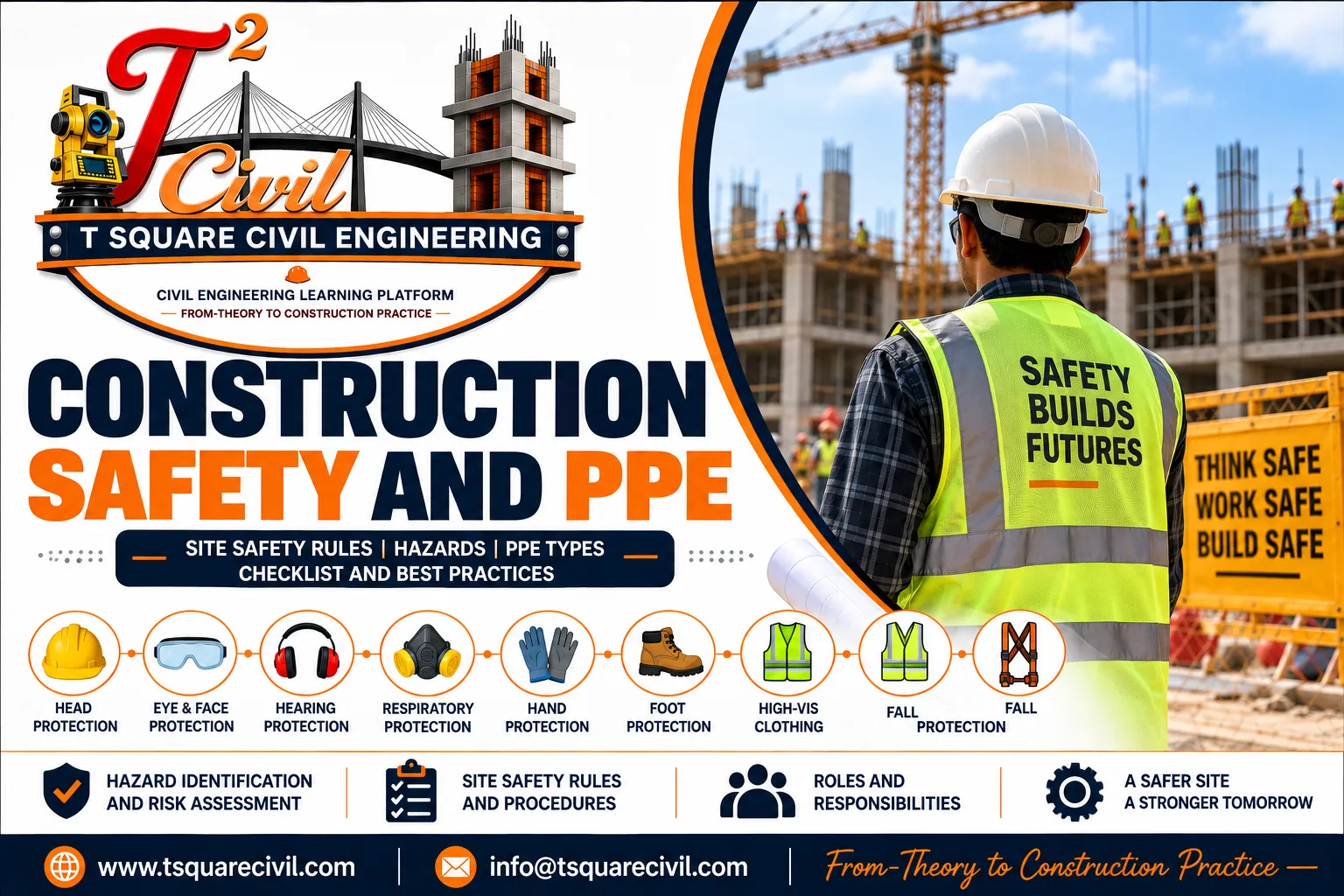
Role of PPE in Construction Safety
Personal Protective Equipment is equipment or clothing worn to reduce exposure to workplace hazards.
Typical construction PPE includes:
Safety helmets, safety footwear, eye and face protection, gloves, hearing protection, respiratory protective equipment, high-visibility clothing, protective clothing and fall-protection equipment.
PPE should be selected according to the actual hazard.
A single standard PPE set cannot provide adequate protection for every construction activity.
Common Types of Construction PPE
| Body Area / Hazard | Typical PPE | Typical Application |
|---|---|---|
| Head | Industrial safety helmet | Falling objects and impact hazards |
| Feet | Safety footwear | Falling objects, sharp materials, slips |
| Eyes and face | Safety spectacles, goggles or face shield | Cutting, grinding, dust, splash |
| Hands | Task-specific gloves | Reinforcement, handling, chemicals, welding |
| Hearing | Ear plugs or ear muffs | High-noise equipment |
| Respiratory system | Suitable respirator | Dust, fumes, vapours |
| Visibility | High-visibility clothing | Vehicle and equipment areas |
| Body | Protective clothing | Chemicals, sparks, wet work |
| Falls | Full-body harness system | Work at height where required |
| Water-related work | Personal flotation equipment where required | Work near water |
The table is a general guide only. Task-specific requirements should be determined through hazard assessment.
Safety Helmets
Safety helmets help protect workers against falling objects and certain impact hazards.
For Indian projects, IS 2925:1984 — Specification for Industrial Safety Helmets remains an important reference.
Before use, helmets should be inspected for:
Cracks, deformation, significant damage, deterioration and defective suspension components.
A helmet subjected to significant impact should be dealt with according to the manufacturer’s inspection and replacement requirements even where visible external damage appears limited.
Workers should not make unauthorised holes or modifications to helmets.
Safety Footwear
Construction footwear may need to protect against:
Impact, penetration, slipping, wet conditions or other task-specific hazards.
A current Indian reference is:
IS 15298 (Part 2):2024 — Personal Protective Equipment, Part 2: Safety Footwear.
The required footwear characteristics depend on the work activity.
The same footwear should not automatically be considered suitable for every construction task.
Eye and Face Protection
Construction activities such as grinding, cutting, drilling, chipping, welding and chemical handling can expose the eyes and face to significant hazards.
The protection should be selected according to the hazard.
Depending on the activity, this may include:
Safety spectacles, goggles, face shields or specialised welding protection.
A current Indian reference for general occupational eye and face protection is:
IS 8521 (Part 1):2022 — Eye and Face Protection for Occupational Use, Part 1: General Requirements.
This standard superseded the older IS 5983 eye-protector standard.
A face shield should not automatically be considered a substitute for suitable eye protection where both are required.
Hand Protection
Gloves should be selected according to the task.
Examples include:
Abrasion-resistant gloves for material handling, appropriate gloves for reinforcement work, specialised welding gloves and chemically compatible gloves for chemical handling.
There is no universal construction glove suitable for every hazard.
Gloves can also create an entanglement hazard around rotating machinery, so the work activity must be considered before selection.
Hearing Protection
Noise-producing activities may include:
Concrete breaking, drilling, generators, compressors, cutting machines and heavy equipment.
Noise should first be controlled through engineering or work-management measures where practicable.
Where hearing protection remains necessary, suitable ear plugs or ear muffs should be selected according to the assessed exposure.
Respiratory Protection
Construction dust can be generated during:
Concrete cutting, grinding, drilling, demolition, cement handling and surface preparation.
The preferred approach is to control airborne contamination at source using measures such as:
Wet techniques, local extraction, ventilation or enclosure.
Where respiratory protective equipment is required, it must be suitable for the actual contaminant and exposure.
An ordinary dust mask should not automatically be assumed suitable for every type of dust, silica-containing dust, fume, vapour or gas.
High-Visibility Clothing
High-visibility clothing helps mobile-equipment operators and drivers identify workers.
It is particularly useful around:
Construction vehicles, cranes, loaders, dumpers, roadwork zones and material-handling areas.
However, high-visibility clothing does not replace proper traffic-management measures such as controlled routes, barriers and equipment exclusion zones.
Full-Body Harness and Personal Fall-Arrest Systems
A full-body harness is one component of a personal fall-arrest system.
For Indian projects, IS 3521 (Part 1):2021 — Personal Fall Arrest Systems: Full Body Harness is an important current reference, with subsequent amendment provisions to be checked as applicable.
A complete system may also include:
Connectors, lanyards, energy absorbers, lifelines or anchor devices depending on the arrangement.
The system should account for:
Suitable anchorage, fall clearance, potential swing fall and rescue following a fall.
Wearing a harness without a suitable connection and anchorage arrangement does not provide effective fall-arrest protection.
PPE for Reinforcement Work
Typical hazards include:
Sharp steel, projecting bars, manual handling and cutting operations.
Depending on the task, PPE may include:
Helmet, suitable gloves, safety footwear and eye or face protection during cutting or grinding.
PPE should be combined with safe stacking, safe cutting areas and engineering controls for hazardous projections.
PPE for Formwork
Formwork operations may require:
Helmet, safety footwear, gloves and eye protection for cutting or drilling activities.
Where workers are exposed to falls, suitable work platforms, edge protection and fall-protection arrangements should also be provided according to the risk.
PPE cannot compensate for structurally unsafe formwork.
PPE for Concrete Work
Depending on the activity, workers involved in concrete work may require:
Suitable gloves, protective footwear or waterproof boots, protective clothing, safety helmet and eye protection.
Wet concrete should not be allowed to remain trapped against the skin.
Concrete-pumping hazards should be controlled separately through correct equipment, pipelines, connections and operating procedures.
PPE for Cutting and Grinding
Depending on the task, suitable PPE may include:
Eye protection, face protection, hearing protection, safety footwear and respiratory protection.
Correct equipment guards must remain in place.
PPE should never be used as a reason to remove machine safety devices.
PPE for Welding
Typical welding PPE can include:
Suitable welding eye and face protection, welding gloves, protective clothing and safety footwear.
Respiratory protection may also be required depending on the process and exposure conditions.
Welding safety must additionally address:
Fire prevention, ventilation, combustible materials and hot-work controls.
PPE Inspection
PPE should be visually inspected before use.
| PPE | Typical Inspection Items |
|---|---|
| Helmet | Shell, cracks, deformation, suspension and straps |
| Safety footwear | Sole, damage, closure and protective components |
| Eye protection | Lens condition, frame and straps |
| Face shield | Visor and attachment |
| Gloves | Tears, holes, wear and contamination |
| Harness | Webbing, stitching, buckles and attachment points |
| Lanyard | Abrasion, cuts, connectors and energy absorber |
| Respirator | Facepiece, straps, filters and valves |
| Hearing protection | Condition, cleanliness and fit |
| High-visibility clothing | Damage, cleanliness and visibility |
Defective PPE should be removed from service and managed according to the manufacturer’s instructions and project procedure.
PPE Maintenance and Storage
PPE should be stored so that it is protected from unnecessary:
Heat, moisture, chemicals, contamination, sunlight where relevant and physical damage.
Cleaning and maintenance should follow the manufacturer’s instructions.
Unauthorised repairs should not be made to critical safety equipment.
When PPE Should Be Replaced
PPE replacement should not be based only on appearance.
Equipment may require removal from service because of:
Damage, chemical contamination, impact, involvement in a fall arrest, excessive wear, missing components, failed inspection or expiration of the manufacturer’s specified service criteria.
The manufacturer and applicable project procedure should determine the final replacement decision.
Responsibilities of Site Engineers
Site engineers have an important role in integrating safety into construction activities.
Before beginning work, the engineer should confirm that the planned method is practicable and that key temporary works, access and safety controls are available.
Site engineers should coordinate with the safety team, supervisors and contractors regarding activities such as:
Excavation, formwork, lifting operations, reinforcement, concreting and work at height.
Safety should be considered during planning rather than being checked only after work has started.
Responsibilities of Supervisors
Supervisors should understand the hazards associated with the activity they control.
They should ensure that:
The work team understands the method, required controls are in place, defective equipment is not used, exclusion zones are respected and unsafe conditions are corrected.
A supervisor should not allow work to continue merely because the worker is wearing PPE when the underlying work condition remains unsafe.
Responsibilities of Workers
Workers should follow approved safety instructions, use equipment correctly and report defective equipment or unsafe conditions.
PPE should be worn and maintained according to training and site requirements.
Workers should not remove guards, barriers or other safety controls for convenience.
Common Construction Safety Mistakes
Common problems observed on construction projects can include:
Beginning work without adequate planning, poor housekeeping, unsafe access, uncontrolled slab edges, unsafe excavation, standing below suspended loads, unauthorised scaffold modification, damaged electrical cables, poor material stacking, incorrect PPE selection and failure to inspect safety equipment.
Another common mistake is assuming that PPE alone makes hazardous work acceptable.
The fundamental objective should always be to make the work system itself safe.
Construction Safety and PPE Site Checklist
| Inspection Item | Status |
|---|---|
| Activity risk assessment available where required | ☐ |
| Approved work method available where required | ☐ |
| Workers briefed before starting work | ☐ |
| Safe access and egress available | ☐ |
| Housekeeping satisfactory | ☐ |
| Work-at-height controls provided | ☐ |
| Floor openings and edges protected | ☐ |
| Scaffold condition satisfactory | ☐ |
| Ladders suitable and inspected | ☐ |
| Excavations protected and inspected | ☐ |
| Lifting equipment suitable and controlled | ☐ |
| Suspended-load area controlled | ☐ |
| Formwork and temporary works inspected | ☐ |
| Reinforcement stored and handled safely | ☐ |
| Electrical equipment visually safe | ☐ |
| Cutting and grinding controls provided | ☐ |
| Hot-work controls implemented | ☐ |
| Vehicle and pedestrian routes controlled | ☐ |
| Fire-fighting equipment accessible | ☐ |
| Emergency access available | ☐ |
| Required PPE identified | ☐ |
| PPE inspected before use | ☐ |
| Damaged PPE removed from service | ☐ |
| Workers trained for the activity | ☐ |
| Supervisor monitoring the work | ☐ |
The checklist should be adapted to the actual project, activity and risk assessment.
Important Indian Standards Related to Construction PPE
| PPE / Protection | Relevant Standard |
|---|---|
| Industrial safety helmet | IS 2925:1984 |
| Safety footwear | IS 15298 (Part 2):2024 |
| General occupational eye and face protection | IS 8521 (Part 1):2022 |
| Full-body harness | IS 3521 (Part 1):2021 |
Other standards may apply depending on the type of equipment and activity.
Indian Standards may be amended, revised or superseded. The latest BIS status and project requirements should therefore be verified before procurement or specifying PPE.
Construction Safety Requirements in India
Construction safety in India is addressed through occupational-safety and building-and-construction-worker requirements together with applicable rules and project requirements.
The Building and Other Construction Workers framework contains specific provisions addressing matters such as:
Eye protection, safety helmets, waterproof boots, hand protection and electrical hazards.
Projects may also have additional requirements arising from:
Contract conditions, client specifications, employer safety standards, state-level requirements and activity-specific procedures.
Therefore a contractor should not rely on a generic PPE checklist as the complete construction-safety system.
Practical Example: RCC Slab Construction
Consider RCC slab construction involving formwork, reinforcement and concreting.
A safe approach begins before concrete placement.
The project team should verify:
Formwork stability, support and inspection status; reinforcement condition; edge protection; slab openings; safe worker access; concrete-pump location; electrical vibrator condition; working platforms; material movement and emergency access.
Only after the work environment has been made reasonably safe should the final task-specific PPE requirements be confirmed.
Depending on the activity, workers may require:
Safety helmets, gloves, footwear, eye protection, high-visibility clothing and fall-protection equipment where applicable.
This demonstrates an important construction principle:
Good safety comes from safe planning, safe temporary works and safe construction methods supported by suitable PPE—not from PPE alone.
Construction Safety Culture
A strong safety culture develops when safety becomes part of normal engineering and construction decisions rather than a separate activity performed only by the safety department.
Engineers, supervisors, contractors and workers should be encouraged to:
Identify unsafe conditions early, report hazards, stop or correct work when necessary, discuss mistakes constructively and implement lessons learned.
Management should also provide sufficient time, equipment and resources to carry out construction safely.
Safety performance improves when workers see that reported problems are actually corrected.
Frequently Asked Questions
What is construction safety?
Construction safety is the planned control of hazards associated with construction activities to protect workers, visitors, equipment, property and the public.
It includes safe work planning, risk assessment, engineering controls, supervision, training, inspections, emergency arrangements and appropriate PPE.
What are the major hazards on a construction site?
Major hazards may include falls from height, excavation collapse, falling objects, lifting operations, equipment movement, electricity, fire, temporary-works failure, cutting and grinding, confined spaces and exposure to dust or chemicals.
The significant hazards vary from project to project.
What is PPE in construction?
PPE means Personal Protective Equipment.
It includes items such as safety helmets, safety footwear, gloves, eye and face protection, hearing protection, respirators, high-visibility clothing and fall-protection equipment.
Is PPE enough to make construction work safe?
No.
Hazards should first be eliminated or reduced through engineering, collective and administrative controls wherever reasonably practicable.
PPE is used as an additional layer of protection against remaining risk.
What is the basic PPE for a construction site?
There is no single PPE combination suitable for all construction work.
Common site PPE may include a safety helmet, suitable footwear and high-visibility clothing, while additional protection such as gloves, goggles, face shields, hearing protection, respiratory protection or fall-protection equipment may be necessary depending on the activity.
Which Indian Standard applies to safety helmets?
IS 2925:1984 covers industrial safety helmets.
The current BIS status and applicable project specification should always be checked before procurement.
Which Indian Standard applies to safety footwear?
IS 15298 (Part 2):2024 covers personal protective equipment — safety footwear.
Which Indian Standard applies to occupational eye and face protection?
IS 8521 (Part 1):2022 covers general requirements for eye and face protection for occupational use.
Which Indian Standard applies to full-body harnesses?
IS 3521 (Part 1):2021 covers full-body harnesses used as part of personal fall-arrest systems.
Applicable amendments and related parts of the IS 3521 series should also be checked for the complete system.
Is a safety harness alone sufficient for work at height?
No.
A harness is only one component of a fall-protection system.
Where a personal fall-arrest system is required, suitable anchorage, connectors, lanyard or lifeline arrangements, fall clearance and rescue provisions may also be required.
Collective fall-prevention measures should be considered first wherever practicable.
Why is housekeeping important in construction?
Good housekeeping reduces slip, trip, access, fire and material-handling hazards.
It also improves productivity and makes unsafe conditions easier to identify.
Why are toolbox talks required?
Toolbox talks help communicate the hazards and controls associated with the immediate work activity.
They are most useful when they are specific to the actual task rather than treated simply as a signature exercise.
Who is responsible for construction safety?
Construction safety is a shared responsibility.
Project management should provide an effective safety system and resources; engineers and supervisors should integrate safety into construction planning and execution; and workers should follow approved procedures and report unsafe conditions.
Conclusion
Construction safety is an essential part of professional construction management.
A safe construction site requires much more than helmets, shoes, gloves and reflective jackets.
Hazards should be identified before work starts, risks should be assessed, construction methods should be properly planned and engineering or collective controls should be used wherever practicable.
Temporary works, access, excavation, scaffolding, lifting operations, electrical installations and equipment should be properly controlled and inspected.
Workers should receive appropriate training and supervision, while emergency arrangements should be prepared before they are needed.
PPE remains an essential final protective layer, but it is most effective when it supports a properly planned and controlled construction operation.
For site engineers and construction professionals, the key principle is:
Plan the work safely, control the hazard at its source wherever practicable, supervise the work properly and use suitable PPE for the remaining risk.
About T Square Civil Engineering
T Square Civil Engineering is a civil engineering learning platform created to support students, site engineers, quantity surveyors, contractors, QA/QC personnel and construction professionals with practical learning resources, worked examples and calculators that connect engineering theory with construction practice.
From Theory to Construction Practice.