 by
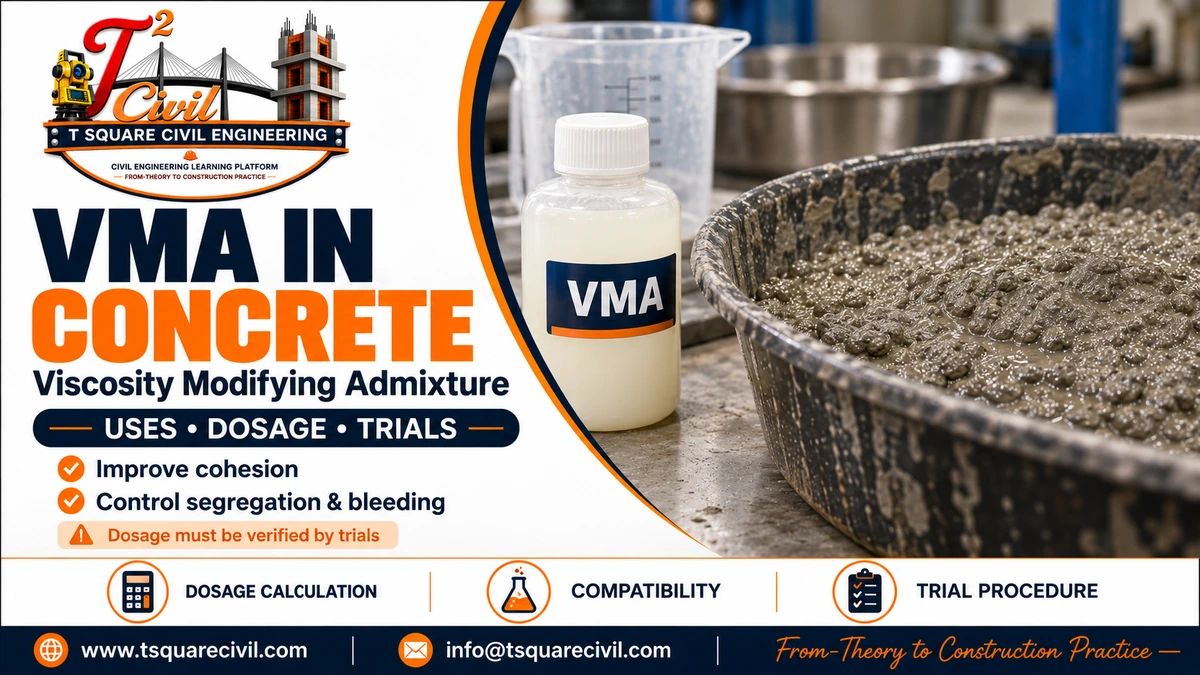
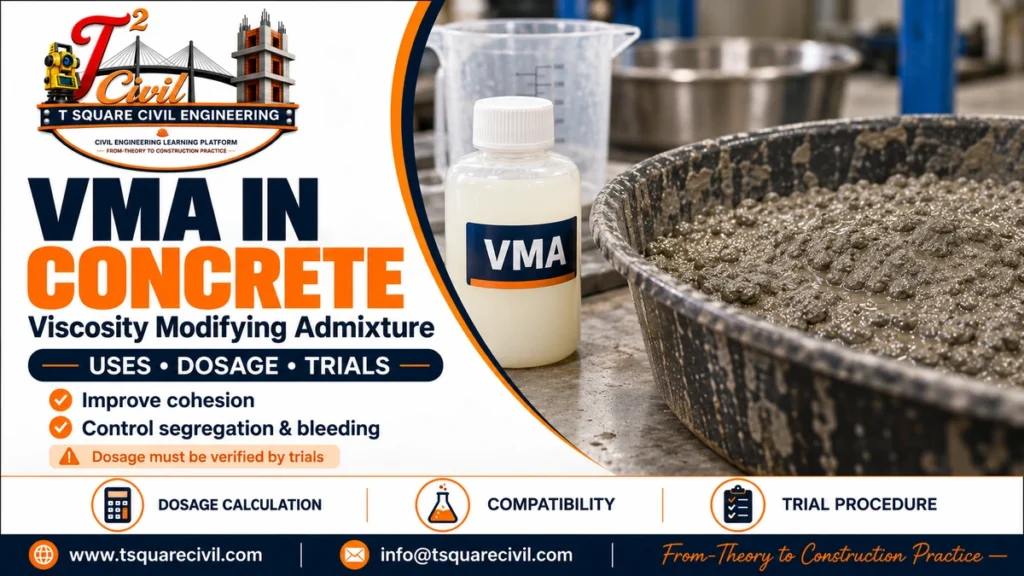
A viscosity modifying admixture (VMA) helps fresh concrete remain cohesive by modifying the behaviour of its paste. It can reduce bleeding and segregation while allowing a properly proportioned mix to maintain the flow needed for placement.
VMA is useful where concrete must flow without separating, particularly in some self-compacting concrete mixes, pumped concrete and mixes requiring additional stability. However, it cannot replace suitable aggregate grading, accurate water control or a properly developed mix design.
The correct dosage depends on the product, constituent materials and required performance. It must be established through trials using the actual project materials.
Page Contents
Quick Information Table
| Item | Practical Guidance |
|---|---|
| Full form | Viscosity modifying admixture |
| Main purpose | Improve fresh-concrete cohesion and stability |
| Common applications | Self-compacting concrete, pumped concrete and mixes requiring additional segregation control |
| Relationship with superplasticizer | VMA primarily controls stability; superplasticizer primarily provides water reduction and/or increased flow |
| Dosage basis | Product-specific: cement mass, total cementitious-material mass or another stated basis |
| Essential checks | Flow or slump, stability, retention, placing behaviour and specified hardened-concrete properties |
| Selection principle | Achieve sufficient stability without unnecessarily restricting placement |
| Main limitation | Cannot reliably compensate for uncontrolled water addition or unsuitable mix proportions |
What Is a Viscosity Modifying Admixture?
A VMA is an admixture used to adjust the rheology—the flow and deformation behaviour—of fresh concrete.
Different formulations act differently. Some water-soluble polymers increase the viscosity of the liquid phase through molecular association and entanglement. Their practical purpose is to help the paste carry the aggregate more uniformly during handling and placement.
Consider concrete flowing around reinforcement:
- The concrete must move sufficiently to fill the available space.
- The mortar and coarse aggregate must travel together.
- Water and paste should not separate excessively from the aggregate.
A mix can spread easily yet remain unstable. Conversely, a highly cohesive mix can be too resistant to flow. VMA selection therefore requires a balance between stability and placement performance.
VMA and Superplasticizer: What Is the Difference?
| Aspect | VMA | Superplasticizer |
|---|---|---|
| Primary function | Modify viscosity and improve stability | Disperse cementitious particles to reduce water demand and/or increase flow |
| Main reason for use | Control separation in a mix needing additional cohesion | Achieve required workability at a controlled water content |
| Main trial question | Does the concrete remain uniform while flowing? | Does the concrete achieve the required flow and retention? |
| Important limitation | Excessive viscosity can restrict placement | Increased flow alone does not demonstrate adequate stability |
These admixtures may be used together, but their dosages should be developed as a compatible combination.
For the water-reducing component of the mix, read our guide to superplasticizer in concrete mix design.
When Is VMA Useful in Concrete?
Self-Compacting Concrete
Self-compacting concrete must achieve filling ability, passing ability and segregation resistance together.
VMA can help when a highly flowable mix requires additional stability, including certain mixes with relatively low fines content.
However, every SCC mix does not require a separately added VMA. Suitable proportions and constituent materials may provide the required stability without it.
Pumped Concrete
VMA may be considered where a proposed pumped mix shows inadequate cohesion or a tendency to separate.
Its suitability must be checked under representative pumping conditions. A visually stable laboratory mix does not by itself establish satisfactory pipeline behaviour.
Aggregate proportions, mortar volume and the pumping arrangement remain important. These are discussed separately in our guide to pumped concrete mix design.
Mixes Sensitive to Material Variation
Some VMAs can improve the stability of mixes affected by small variations in constituent materials. Product-specific applications may include low-fines concrete and mixes requiring reduced bleeding.
This additional stability is not permission to relax aggregate-moisture checks or batching accuracy.
If concrete quality changes between batches, investigate the source of variation before adjusting VMA dosage.
Underwater Concrete
Some specialised viscosity-modifying products are designed as anti-washout admixtures for underwater placement.
However, a general-purpose VMA should not automatically be treated as an underwater-concrete admixture.
Use a product specifically intended for the application and verify the required performance through the approved placement procedure.
Check the Mix Before Adding VMA
When concrete shows bleeding or segregation, first examine:
- Actual water content, including aggregate surface moisture.
- Fine-aggregate grading and available fines.
- Coarse-aggregate grading and proportion.
- Paste and mortar volumes.
- Superplasticizer dosage.
- Mixing uniformity and addition sequence.
- Handling, discharge and placement conditions.
For example, if wet sand contributes more water than allowed for in the batch calculation, adding VMA may make the concrete appear more cohesive without correcting its excessive water content.
Correct the water balance first using the principles explained in moisture correction in concrete mix design.
For a wider diagnosis of separation problems, see segregation of concrete.
How to Calculate VMA Dosage
Before calculating a quantity, read the current product data sheet and establish:
- The recommended dosage range.
- The material quantity on which dosage is based.
- Whether the quantity refers to the product as supplied or its active solids.
- Whether batching is by mass or volume.
- The product density where conversion is required.
A dosage percentage is incomplete unless its basis is stated.
Common Dosage Expressions
| Manufacturer’s Dosage Expression | Calculation Basis |
|---|---|
| Percentage by mass of cement | Cement mass only |
| Percentage by mass of total cementitious material | Total cementitious mass defined for that product |
| mL per 100 kg of cementitious material | Specified volume for each 100 kg |
| L/m³ of concrete | Concrete batch volume |
| Percentage of active solids | Requires product concentration information |
Do not transfer a dosage percentage from one product to another. Products can differ in concentration, formulation, recommended dosage and dosage basis.
Formula for Dosage by Mass
When dosage is expressed as a percentage of total cementitious-material mass:
VMA mass (kg/m³) = [Dosage (%) ÷ 100] × Total cementitious material (kg/m³)
Total cementitious material may include cement and supplementary cementitious materials such as fly ash or GGBS, according to the product’s stated dosage basis.
Formula for Converting Mass to Volume
VMA volume (L/m³) = VMA mass (kg/m³) ÷ Product density (kg/L)
Use the density applicable to the actual product.
Do not assume that 1 litre of liquid admixture weighs 1 kilogram.
Formula for a Concrete Batch
VMA quantity per batch = VMA quantity per m³ × Concrete batch volume (m³)
Keep the units consistent:
- kg/m³ × m³ = kg per batch.
- L/m³ × m³ = litres per batch.
Worked Example: VMA Quantity for a Concrete Batch
The following values are hypothetical educational inputs. They are not a recommended mix or universal dosage.
Assumed Mix and Product Details
| Parameter | Assumed Value |
|---|---|
| Cement content | 280 kg/m³ |
| Fly ash content | 120 kg/m³ |
| Total cementitious-material content | 400 kg/m³ |
| Selected trial dosage | 0.20% of total cementitious-material mass |
| VMA density | 1.04 kg/L |
| Production batch volume | 6 m³ |
Step 1: Calculate Total Cementitious Material
Total cementitious material = Cement + Fly ash
Total cementitious material = 280 + 120
Total cementitious material = 400 kg/m³
Step 2: Calculate VMA Mass per Cubic Metre
VMA mass = (Dosage ÷ 100) × Total cementitious material
VMA mass = (0.20 ÷ 100) × 400
VMA mass = 0.80 kg/m³
Step 3: Convert VMA Mass to Volume
VMA volume = VMA mass ÷ Product density
VMA volume = 0.80 ÷ 1.04
VMA volume = 0.769 L/m³
VMA volume ≈ 0.77 L/m³
Step 4: Calculate the Quantity for a 6 m³ Batch
VMA mass per batch = 0.80 × 6 = 4.80 kg
VMA volume per batch = 4.80 ÷ 1.04 = 4.615 L
Therefore, the calculated batch quantity is:
4.80 kg of VMA, equivalent to approximately 4.62 litres.
Use the plant’s approved dispensing units and achievable dosing precision. Retain unrounded values during intermediate calculations.
Summary of Calculated Quantities
| Concrete Quantity | VMA Mass | VMA Volume |
|---|---|---|
| 1 m³ | 0.80 kg | Approximately 0.77 L |
| 6 m³ | 4.80 kg | Approximately 4.62 L |
| 50-litre laboratory batch | 40 g | Approximately 38.5 mL |
What Happens If Cement Alone Is Used by Mistake?
The assumed dosage is based on 400 kg/m³ of total cementitious material.
If the operator incorrectly applies it to only 280 kg/m³ of cement:
Incorrect VMA mass = (0.20 ÷ 100) × 280
Incorrect VMA mass = 0.56 kg/m³
Difference = 0.80 − 0.56
Difference = 0.24 kg/m³
Percentage below intended quantity = (0.24 ÷ 0.80) × 100
Percentage below intended quantity = 30%
The percentage entered is correct, but the dosage basis is wrong. This produces a quantity 30% below the intended dose.
Quantity for a 50-Litre Laboratory Trial
First convert the trial volume:
50 litres ÷ 1,000 = 0.05 m³
Then calculate the VMA mass:
VMA mass = 0.80 × 0.05
VMA mass = 0.040 kg
VMA mass = 40 g
Use measuring equipment suitable for this small quantity. A production dispenser may not measure a laboratory dose accurately enough.
Worked Example: Dosage in mL per 100 kg
Suppose a different product’s selected trial dosage is 200 mL per 100 kg of total cementitious material.
Assume the mix contains 400 kg/m³ of total cementitious material.
Calculate the Volume
VMA volume (mL/m³) = Dosage (mL per 100 kg) × [Cementitious content (kg/m³) ÷ 100]
VMA volume = 200 × (400 ÷ 100)
VMA volume = 200 × 4
VMA volume = 800 mL/m³ = 0.80 L/m³
This is a volume-based calculation. It should not automatically be described as a 0.20% dosage by mass.
Convert to Mass
If the assumed product density is 1.04 kg/L:
VMA mass = VMA volume × Product density
VMA mass = 0.80 × 1.04
VMA mass = 0.832 kg/m³
Calculate the Equivalent Mass Percentage
Dosage by mass (%) = [VMA mass ÷ Cementitious-material mass] × 100
Dosage by mass = (0.832 ÷ 400) × 100
Equivalent dosage by mass = 0.208%
Mass percentages and volume-based dosage instructions are not interchangeable.
Cement, SCM and Admixture Compatibility
Assess VMA with the complete proposed material combination:
- Cement source and type.
- Fly ash, GGBS or other supplementary cementitious materials.
- Superplasticizer product and dosage.
- Other admixtures, where used.
- Mixing water and aggregates.
- Expected concrete temperature and delivery time.
Approval of each material individually does not prove that the combined mix will perform satisfactorily.
Potential changes in flow retention, air content, setting behaviour and finishing should be checked during trials. Excessive dosage of certain products can increase cohesion and retard setting, but these effects are product-specific.
For the broader evaluation process, read cement–admixture compatibility in concrete mix design.
Trial Procedure for Selecting VMA Dosage
Define the Required Performance
Establish the requirements before preparing trial batches.
Record:
- Intended placement method.
- Required workability at discharge.
- Required workability-retention period.
- Stability requirements.
- Applicable strength and durability criteria.
- Expected transport and placement conditions.
For SCC, include the specified filling, passing and segregation-resistance requirements.
A large slump-flow spread alone does not establish that SCC is suitable.
Prepare a Reference Mix
Prepare a reference batch using the proposed materials and controlled water content.
Record its behaviour before deciding whether additional viscosity modification is necessary. Where appropriate, the reference can be the same proposed mix without separately added VMA.
Keep the reference conditions representative of the planned production process.
Compare Selected Dosages
A practical screening programme may use the following arrangement:
| Trial | VMA Level | Purpose |
|---|---|---|
| Reference | No separately added VMA, where appropriate | Establish baseline behaviour |
| Trial A | Lower selected dosage within supplier guidance | Assess initial stability improvement |
| Trial B | Intermediate selected dosage | Compare stability and placing behaviour |
| Trial C | Higher selected dosage within supplier guidance | Identify whether additional dosage provides benefit or excessive viscosity |
These are trial descriptions, not prescribed dosage values.
Initially keep the other mix variables as consistent as practicable. If superplasticizer adjustment is subsequently required, make and record it as a separate change.
Follow the Product’s Addition Instructions
There is no universal addition sequence for all VMAs.
Follow the manufacturer’s instructions for the specific liquid or powder product, including:
- Addition point.
- Mixing requirements.
- Restrictions on contact with dry materials.
- Separate dispensing requirements.
- Any approved preparation or dilution procedure.
Do not premix concentrated admixtures unless the manufacturers approve that practice.
Test at Relevant Times
Assess fresh concrete immediately after mixing and at the times relevant to transport and placement.
| Assessment | What It Helps Establish |
|---|---|
| Slump, where appropriate | Consistency of conventional concrete |
| Slump flow and flow time for SCC | Spread and flow behaviour |
| Specified SCC passing-ability test | Ability to pass restrictions |
| Specified segregation-resistance test | Stability under the test conditions |
| Bleeding and visual observations | Signs requiring further investigation |
| Fresh density and air content, where required | Changes affecting yield and performance |
| Setting behaviour, where relevant | Suitability for the placing and finishing window |
| Strength testing at specified ages | Compliance with project strength requirements |
Use the applicable test procedures and project acceptance limits.
Visual observations supplement testing; they do not replace specified acceptance tests.
Confirm the Selected Mix at Production Scale
Verify the selected laboratory mix using representative production equipment and conditions.
Check actual dispensing accuracy, mixing, retention, discharge and placement. For pumped concrete, include a representative pumping assessment where required.
Record any difference between laboratory and production performance before final approval.
The overall trial documentation process is covered in our concrete trial mix procedure.
Practical Interpretation of Trial Results
The following observations are illustrative and are not actual project test results.
| Observation | Interpretation and Next Check |
|---|---|
| Concrete flows readily but shows separation | Investigate proportions, water balance and admixture combination before increasing VMA |
| Concrete remains uniform and achieves specified placement performance | Candidate for further retention, hardened-property and production verification |
| Concrete remains cohesive but flows too slowly or passes reinforcement poorly | Review excessive viscosity, proportions and superplasticizer balance |
The best candidate is the mix that meets all relevant requirements consistently.
Maximum cohesion is not the objective. Concrete must also be transportable, placeable and finishable for its intended use.
Water Accounting and Batch Records
Liquid admixtures can contribute water to the concrete. Account for this contribution where required by the applicable mix-design and project procedure.
Product density alone does not establish water content. Obtain the relevant composition information from the supplier.
Maintain a complete water balance covering aggregate moisture, added water and relevant admixture contributions. Do not count the entire mass of a liquid admixture as water.
The approved batch record should identify:
- Product name and batch identification.
- Dosage basis and approved quantity.
- Dispensing units.
- Cementitious-material quantities.
- Moisture corrections.
- Addition sequence.
- Concrete temperature and test times.
- Fresh and hardened test results.
- Any authorised adjustments.
Common VMA Mistakes
| Mistake | Why It Matters | Correct Approach |
|---|---|---|
| Copying another product’s dosage | Products differ in concentration and formulation | Use the selected product’s guidance and trials |
| Using cement mass instead of total binder mass | Changes the calculated quantity | State the dosage basis explicitly |
| Confusing kilograms and litres | Causes dispensing errors | Convert using the applicable density |
| Adding water to overcome excessive viscosity | Alters the approved water balance | Review the mix and admixture combination |
| Changing several variables together | Makes results difficult to interpret | Make controlled, documented adjustments |
| Accepting SCC only by spread diameter | Does not establish passing ability or stability | Complete the specified assessment |
| Treating VMA as a cure for poor batching | Leaves the underlying variation unresolved | Correct moisture and production controls |
Relevant Standards and Product Documents
For projects following Indian standards, use the applicable editions and amendments of:
- IS 10262 for concrete mix proportioning.
- IS 9103, where applicable to the admixture’s declared classification and requirements.
- IS 1199 series for relevant fresh-concrete tests.
- Applicable hardened-concrete testing standards and project specifications.
IS 9103 is a concrete-admixture specification. It should not be presented as prescribing one universal VMA dosage.
Confirm the product’s applicable compliance documentation and any additional performance requirements for its intended use.
The approved product data sheet, compatibility results and project trial report are essential supporting documents.
Frequently Asked Questions
Is VMA Compulsory in Self-Compacting Concrete?
No. A suitably proportioned SCC mix may achieve the required stability without a separately added VMA. Establish the need through testing.
Can VMA Replace Superplasticizer?
A standalone VMA should not be treated as a substitute for a superplasticizer. Their primary functions differ. Where a commercial product combines functions, follow its specific performance documentation.
Does VMA Increase Concrete Strength?
VMA is not a strength grade or a guarantee of higher strength. Its effect must be assessed in the actual mix, including any changes in water content, air, setting and consolidation.
Can VMA Be Added at Site?
Only through an authorised procedure consistent with the product instructions and project requirements. The procedure must address dosage control, adequate mixing, retesting and documentation.
Is There a Standard VMA Dosage for M30 or M40 Concrete?
No single dosage can be selected from concrete grade alone. The product, materials, proportions and required fresh-concrete behaviour determine the trial programme.
Conclusion
VMA can help concrete remain uniform during flow and placement, but successful use starts with a correctly proportioned and accurately batched mix.
State the dosage basis clearly, convert mass and volume correctly, and assess compatibility with the complete material combination. Approve the selected dosage through trials that demonstrate stability, placement performance and the required hardened-concrete properties.
References and Further Reading
- EFCA/EFNARC — Guidelines for Viscosity Modifying Admixtures for Concrete
- Bureau of Indian Standards — IS 9103 Preview
- Sika Stabilizer-4 R IN — Product Information
- Master Builders Solutions — MasterMatrix Product Information
Manufacturer references illustrate product-specific guidance and do not constitute a product recommendation.
About T Square Civil Engineering
T Square Civil Engineering is a civil-engineering learning platform connecting technical knowledge with construction practice. We publish educational articles, practical guides, worked examples, interview questions and calculation tools covering construction materials, concrete technology, laboratory testing, surveying, structural concepts, estimation and site quality control.
Our content supports students, site engineers, QA/QC professionals, laboratory technicians and other construction professionals.
From Theory to Construction Practice.
Disclaimer
The information on this website is provided for educational purposes only. It does not replace project-specific engineering design, professional advice, approved drawings or construction specifications.
Examples, calculations and suggested procedures should not be adopted directly for construction without appropriate verification. Always check the latest applicable standards and amendments, local requirements, project specifications, material-test results and site conditions. Final design, testing, acceptance and construction decisions should be made by qualified professionals and the responsible project authorities.