 by
by High-strength concrete cannot be designed simply by taking an ordinary concrete mix and adding more cement.
As concrete strength increases, the behaviour of the complete material system becomes increasingly important.
High-strength concrete requires careful control of:
- cementitious materials;
- water-cementitious materials ratio;
- aggregate strength and grading;
- aggregate size;
- chemical admixture;
- paste volume;
- workability;
- air content;
- mixing;
- moisture correction;
- curing; and
- trial-mix performance.
IS 10262:2019 provides a separate proportioning procedure for high-strength concrete of grade M65 and above.
This is important because several commonly used values for M20 to M60 concrete should not automatically be carried into an M65, M70, M80 or higher-strength mix.
For the complete concrete mix-design learning sequence, visit the Concrete Mix Design Hub and Concrete Mix Design Procedure as per IS 10262:2019.
Page Contents
What Is High-Strength Concrete?
For the high-strength proportioning procedure of IS 10262:2019, concrete having a characteristic compressive strength of:
65 N/mm² or more
is treated under the high-strength concrete section.
Therefore, this procedure applies to:
M65 and above
within the scope of the standard.
The standard provides high-strength proportioning guidance up to a target compressive strength of approximately:
100 N/mm²
High-strength concrete should not be confused with high-performance concrete.
High strength refers primarily to compressive strength, whereas high-performance concrete may be designed for one or more enhanced properties such as:
- durability;
- permeability;
- workability retention;
- chloride resistance;
- sulphate resistance;
- heat control; or
- service-life performance.
A concrete may therefore be high strength, high performance, or both.
Why High-Strength Concrete Needs a Separate Mix-Design Approach
The behaviour of an ordinary concrete mix is often dominated by the strength of the cement paste and the quality of the paste-aggregate interface.
As the required concrete strength increases, other factors become increasingly significant.
These include:
- aggregate strength;
- aggregate microcracking;
- paste-aggregate bond;
- very low w/cm;
- chemical-admixture efficiency;
- supplementary cementitious materials;
- concrete viscosity;
- mixing energy;
- curing; and
- quality-control precision.
For this reason, increasing cement content alone is not a technically sound method of producing high-strength concrete.
Typical Applications of High-Strength Concrete
High-strength concrete may be used in:
- high-rise building columns;
- heavily loaded structural columns;
- transfer structures;
- long-span bridges;
- prestressed structural members;
- high-capacity foundations;
- major infrastructure;
- heavily stressed structural zones; and
- structures where reduced member size is beneficial.
The required concrete grade should always come from structural design and project specifications.
Step 1 – Establish the Design Requirements
Before starting the mix calculation, record:
Concrete grade
For example:
M65, M70, M80 or another specified grade.
Required workability
For example:
Slump = 100 mm, 150 mm or project requirement.
Placement method
Such as:
- direct placement;
- crane bucket;
- pump;
- tremie where applicable; or
- highly congested reinforced sections.
Exposure condition
Confirm durability requirements.
Nominal maximum aggregate size
High-strength concrete commonly considers:
- 10 mm;
- 12.5 mm; and
- 20 mm
nominal maximum aggregate sizes.
Cementitious materials
Record:
- cement;
- fly ash;
- GGBS;
- silica fume;
- metakaolin; and
- any other approved material.
Chemical admixture
Record:
- admixture type;
- product;
- dosage basis;
- specific gravity;
- expected water reduction; and
- slump-retention characteristics.
Step 2 – Determine Target Mean Strength
Concrete is not designed only to equal the characteristic strength.
The target mean compressive strength is determined from the higher of:
f’ck = fck + 1.65S
and:
f’ck = fck + X
where:
f’ck = target mean compressive strength at 28 days
fck = characteristic compressive strength
S = standard deviation
X = grade-dependent factor.
For M65, M70, M75 and M80, where sufficient established test results are not available initially, IS 10262:2019 Table 2 gives an assumed standard deviation of 6.0 N/mm² for good site control. For high-strength grades, standard deviation may also be established through actual trials based on assumed proportions before finalizing the mix. For grades above M80, do not automatically extend the 6.0 N/mm² value without appropriate trial or production data.
For M65 and above, the value of:
X = 8.0 N/mm²
is used for the second target-strength expression.
Example – Target Mean Strength for M70
For:
M70 concrete
Characteristic strength:
fck = 70 N/mm²
Assumed standard deviation:
S = 6 N/mm²
First expression
f’ck = 70 + (1.65 × 6)
= 70 + 9.9
= 79.9 N/mm²
Second expression
f’ck = 70 + 8
= 78 N/mm²
Use the higher value:
Target mean strength = 79.9 N/mm²
Therefore, the preliminary mix should be proportioned to achieve approximately:
79.9 N/mm² at 28 days
rather than merely 70 N/mm².
For the complete concept, see Target Mean Strength of Concrete.
Step 3 – Select Cementitious Materials
Material selection is critical in high-strength concrete.
The concrete may contain a combination of:
- Portland cement;
- fly ash;
- GGBS;
- silica fume;
- metakaolin; and
- other approved supplementary cementitious materials.
The purpose is not simply to maximize binder content.
The cementitious system should be optimized for:
- strength;
- particle packing;
- workability;
- durability;
- heat development;
- admixture compatibility; and
- curing behaviour.
The actual materials intended for production should be used during laboratory trials.
Cement Strength Matters
The recommended high-strength w/cm values in IS 10262 are based on the stated cement-strength basis.
Therefore, a w/cm value should not be copied blindly without considering:
- actual cement strength;
- cement composition;
- supplementary cementitious materials; and
- trial strength.
High-strength mix design is particularly sensitive to changes in cement and SCM characteristics.
Step 4 – Select Coarse Aggregate
Aggregate selection becomes increasingly important as concrete strength increases.
Coarse aggregate should be:
- strong;
- sound;
- clean;
- free from weak planes;
- free from harmful coatings;
- properly graded; and
- compliant with applicable IS 383 requirements.
IS 10262 notes that crushed stone aggregate having approximately:
impact/crushing value not greater than 22%
and:
combined flakiness and elongation index not more than 30%
has generally been found suitable for high-strength concrete.
These should not be treated as the only acceptance requirements.
The complete applicable aggregate specification and project requirements must still be checked.
Why Aggregate Strength Becomes Critical
In lower-strength concrete, failure may primarily occur through the paste or interfacial transition zone.
At very high concrete strengths, the aggregate itself can become part of the limiting strength mechanism.
Therefore, high-strength concrete should not use weak aggregate merely because its grading is acceptable.
Aggregate source selection can strongly influence achievable concrete strength.
Nominal Maximum Aggregate Size
For high-strength concrete, IS 10262 provides proportioning values for:
- 10 mm;
- 12.5 mm; and
- 20 mm
nominal maximum aggregate sizes.
The best aggregate size depends on:
- required strength;
- aggregate quality;
- reinforcement spacing;
- member dimensions;
- pumping;
- workability; and
- available aggregate source.
A smaller aggregate size can sometimes help high-strength concrete because it may reduce internal aggregate defects and improve stress distribution.
However:
smaller aggregate is not automatically better.
It also increases total surface area and may increase paste and water demand.
The final selection should be verified through trials.
See Nominal Maximum Aggregate Size in Concrete Mix Design.
Step 5 – Select Fine Aggregate
Fine aggregate should satisfy the applicable IS 383 requirements.
For high-strength concrete, the complete grading should be carefully controlled.
IS 10262 notes that relatively coarser fine aggregate, such as:
Zone I or Zone II
may be preferred because high-strength mixes often contain a significant quantity of fine cementitious material.
However, this should not be converted into a rule that Zone III can never be used.
The final suitability depends on:
- grading;
- particle shape;
- manufactured-sand fines;
- paste volume;
- workability;
- pumping; and
- trial results.
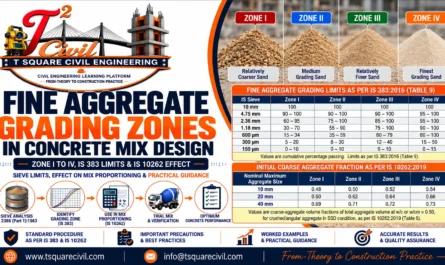
For detailed grading information, see Fine Aggregate Grading Zones in Concrete Mix Design.
Step 6 – Estimate Entrapped Air
Do not use ordinary-concrete air values automatically for high-strength concrete.
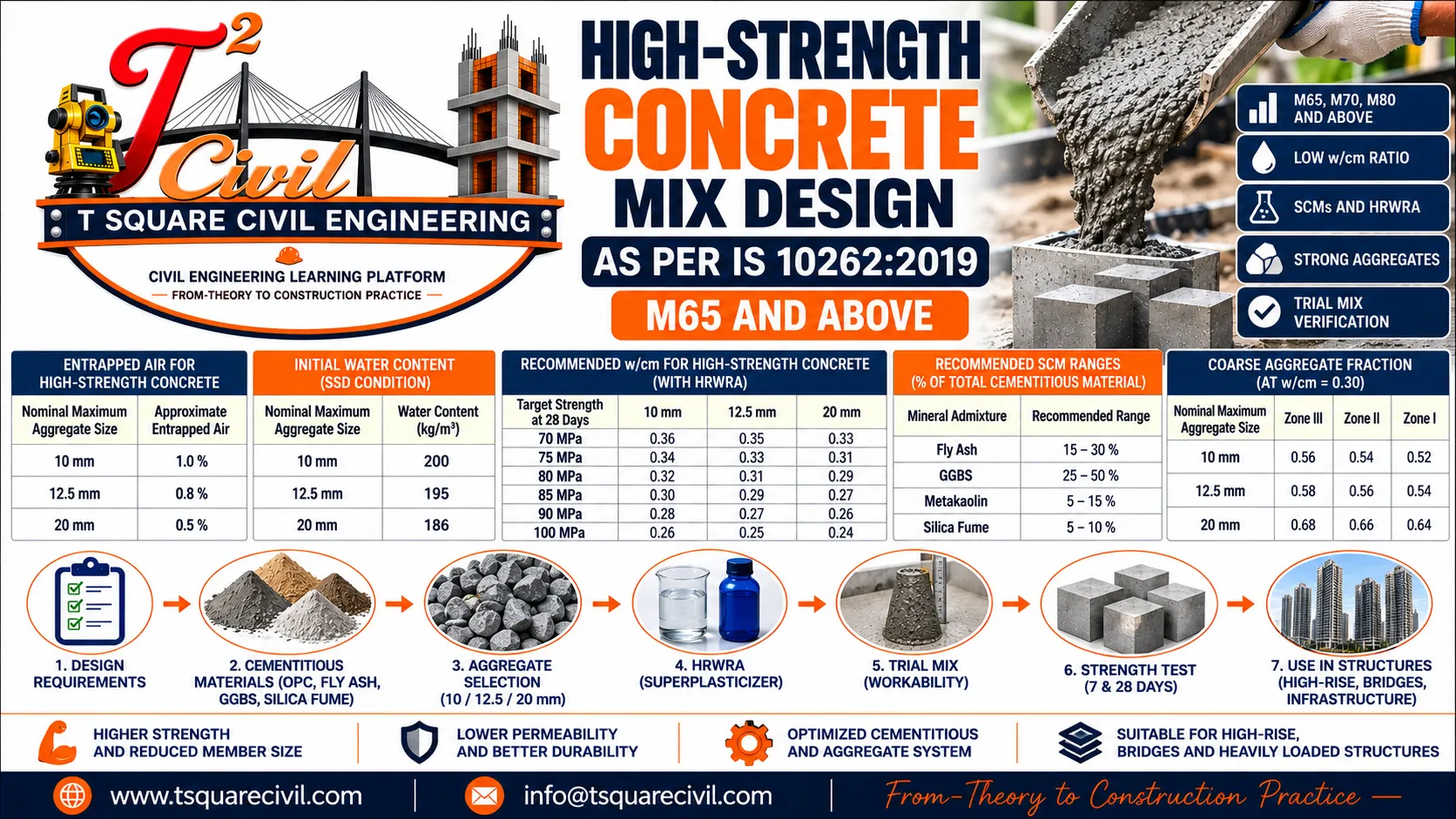
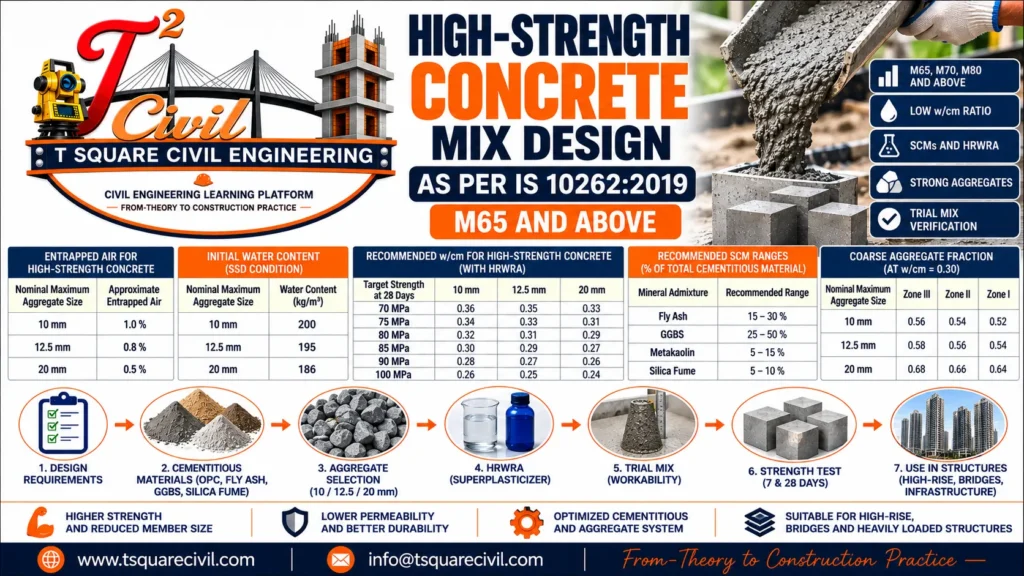
For normal non-air-entrained high-strength concrete, the approximate entrapped-air values are:
| Nominal Maximum Aggregate Size | Approximate Entrapped Air |
|---|---|
| 10 mm | 1.0% |
| 12.5 mm | 0.8% |
| 20 mm | 0.5% |
Therefore, for:
20 mm aggregate
the preliminary entrapped-air volume is:
0.5%
or:
0.005 m³ per m³ of concrete
Where reliable actual site data for a similar mix are available, actual air-content values may be used in accordance with the applicable provisions.
See Entrapped Air in Concrete Mix Design.
Step 7 – Select Preliminary Water Content
IS 10262 provides the following initial high-strength concrete water contents:
| Nominal Maximum Aggregate Size | Initial Water Content |
|---|---|
| 10 mm | 200 kg/m³ |
| 12.5 mm | 195 kg/m³ |
| 20 mm | 186 kg/m³ |
Important basis of the above water-content values: The values are initial estimates for high-strength concrete without chemical admixtures, corresponding to approximately 50 mm slump with aggregate in saturated surface dry (SSD) condition. For required workability other than 50 mm slump, the water content may be increased or decreased by about 3% for each 25 mm increase or decrease in slump, or established through trials. The calculated water requirement may subsequently be reduced through the use of a suitable high-range water-reducing admixture (HRWRA), based on actual trial performance.
These values correspond to aggregate in the:
saturated surface dry condition
and are starting values for trial proportioning.
They are not universal final water quantities.
The actual water requirement depends on:
- required workability;
- aggregate shape;
- aggregate grading;
- cementitious content;
- SCM characteristics;
- HRWRA;
- concrete temperature;
- transportation;
- pumping; and
- trial performance.
Important Difference From Ordinary Concrete
For ordinary and standard concrete, you may already be familiar with reference water values such as:
10 mm = 208 kg/m³
20 mm = 186 kg/m³
40 mm = 165 kg/m³
Do not automatically use that table for M65-and-above proportioning.
The high-strength section has its own water-content guidance including:
10, 12.5 and 20 mm aggregate.
See Water Content Calculation in Concrete Mix Design.
Step 8 – Use a High-Range Water-Reducing Admixture
High-strength concrete normally requires a very low water-cementitious materials ratio.
Such low ratios are generally difficult to achieve at workable consistency without a suitable:
high-range water-reducing admixture, or HRWRA
Polycarboxylate ether-based superplasticizers are commonly used for this purpose.
IS 10262 notes that suitable PCE-based superplasticizers capable of water reduction of approximately:
30% or more
may be used at appropriate dosage.
This does not mean every PCE product will produce exactly 30% water reduction.
Actual performance must be established using:
- manufacturer data;
- cement compatibility;
- SCM compatibility;
- dosage trials;
- slump-retention trials; and
- strength results.
For the detailed dosage procedure, see Superplasticizer in Concrete Mix Design.
Step 9 – Select Water-Cementitious Materials Ratio
IS 10262:2019 Table 8 gives recommended preliminary water-cementitious materials ratios for high-strength concrete made with silica fume and a high-range water-reducing admixture (HRWRA). The tabulated values are based on cement having a 28-day strength of 53 MPa or above. For cement having other strength values, suitable adjustment may be required. Where additional cementitious materials such as fly ash or GGBS are used, the cementitious-material content should be suitably adjusted and the w/cm recalculated on the basis of the total cementitious material. The final w/cm and material proportions must be established through trial mixes.
| Target Strength at 28 Days | 10 mm Aggregate | 12.5 mm Aggregate | 20 mm Aggregate |
|---|---|---|---|
| 70 MPa | 0.36 | 0.35 | 0.33 |
| 75 MPa | 0.34 | 0.33 | 0.31 |
| 80 MPa | 0.32 | 0.31 | 0.29 |
| 85 MPa | 0.30 | 0.29 | 0.27 |
| 90 MPa | 0.28 | 0.27 | 0.26 |
| 100 MPa | 0.26 | 0.25 | 0.24 |
These are recommended starting values, not guaranteed final values.
The final w/cm must be established from trial performance and must also satisfy applicable durability requirements.
Example – M70 With 20 mm Aggregate
From the earlier calculation:
Target mean strength:
79.9 MPa
This is approximately:
80 MPa
For:
20 mm nominal maximum aggregate
the recommended preliminary w/cm corresponding to 80 MPa target strength is:
0.29
Therefore:
Preliminary w/cm = 0.29
This must then be checked against durability requirements.
For the detailed durability check, see Durability Requirements in Concrete Mix Design as per IS 456.
Why w/cm Is Used Instead of Only w/c
High-strength concrete commonly uses supplementary cementitious materials.
Therefore, the more relevant ratio is often:
Water-Cementitious Materials Ratio
or:
w/cm
For example, if:
Water = 145 kg/m³
Cement = 420 kg/m³
Fly ash = 75 kg/m³
Silica fume = 25 kg/m³
Total cementitious material:
420 + 75 + 25 = 520 kg/m³
Then:
w/cm = 145 ÷ 520
= 0.279
approximately:
0.28
Always state clearly what materials are included in the cementitious-material denominator.
Step 10 – Calculate Preliminary Cementitious Material Content
The basic relationship is:
Cementitious Material Content = Water Content ÷ w/cm
Suppose:
Free water:
145 kg/m³
Adopted w/cm:
0.29
Then:
Cementitious material = 145 ÷ 0.29
= 500 kg/m³
This becomes the preliminary total cementitious-material quantity.
It is not automatically the final mix.
The quantity should next be checked for:
- durability;
- cement limit;
- supplementary material proportion;
- paste volume;
- workability;
- heat;
- shrinkage; and
- trial performance.
See Cementitious Material Content in Concrete Mix Design.
Step 11 – Select Supplementary Cementitious Materials
IS 10262 provides recommended ranges for mineral admixtures in high-strength mixes.
| Mineral Admixture | Recommended Range by Mass of Total Cementitious Material |
|---|---|
| Fly ash | 15–30% |
| GGBS | 25–50% |
| Metakaolin | 5–15% |
| Silica fume | 5–10% |
These values should be treated as recommended proportioning ranges, not compulsory replacement percentages for every high-strength mix.
Selection depends on:
- concrete grade;
- early-age strength;
- durability;
- heat generation;
- cement properties;
- SCM properties;
- curing;
- admixture compatibility; and
- trial results.
Do not simply combine the maximum percentage of multiple SCMs.
The complete cementitious system must be optimized as a whole.
Example – SCM Proportioning
Suppose total cementitious material is:
500 kg/m³
Trial proportions are selected as:
Fly ash:
15%
Silica fume:
5%
Fly ash:
500 × 0.15 = 75 kg/m³
Silica fume:
500 × 0.05 = 25 kg/m³
Remaining cement:
500 − 75 − 25
= 400 kg/m³
Therefore:
| Material | Quantity |
|---|---|
| Cement | 400 kg/m³ |
| Fly ash | 75 kg/m³ |
| Silica fume | 25 kg/m³ |
| Total Cementitious Material | 500 kg/m³ |
These numbers are only an illustrative trial combination.
The final combination must be established through testing.
Maximum Cement Content Must Still Be Checked
High-strength concrete may require a relatively high total cementitious-material content.
However, the cement content itself should still be checked against the applicable IS 456 provisions.
High-strength concrete should not be designed by continuously increasing OPC content.
Supplementary cementitious materials, particle packing, HRWRA and optimized aggregate grading should be considered.
Very high paste or cement content can increase:
- heat generation;
- shrinkage;
- cracking;
- stickiness; and
- cost.
Step 12 – Determine Coarse Aggregate Fraction
High-strength concrete has its own reference table for coarse aggregate volume.
The values are given for:
w/cm = 0.30
and vary with:
- nominal maximum aggregate size; and
- fine aggregate grading zone.
| Nominal Maximum Aggregate Size | Zone III | Zone II | Zone I |
|---|---|---|---|
| 10 mm | 0.56 | 0.54 | 0.52 |
| 12.5 mm | 0.58 | 0.56 | 0.54 |
| 20 mm | 0.68 | 0.66 | 0.64 |
These figures represent:
volume of coarse aggregate per unit volume of total aggregate
not:
- mass fraction of concrete;
- volume fraction of concrete; or
- percentage of total concrete.
Example – 20 mm Aggregate, Zone II Sand
For:
20 mm nominal maximum aggregate
and:
Zone II fine aggregate
at reference:
w/cm = 0.30
the preliminary coarse aggregate fraction is:
0.66
Therefore:
Fine aggregate fraction:
1 − 0.66
= 0.34
If the actual w/cm differs from 0.30, the proportion should be adjusted in accordance with the applicable IS 10262 procedure and verified through trials.
Pumped High-Strength Concrete
For concrete requiring higher workability, such as pumped concrete or concrete placed through congested reinforcement, the estimated coarse aggregate content may require reduction.
For the high-strength procedure, IS 10262 permits the estimated coarse aggregate content to be reduced:
up to 5%
where appropriate.
This does not mean:
always reduce coarse aggregate by 5%.
The reduction should depend on:
- required workability;
- pumping;
- reinforcement congestion;
- cohesiveness;
- segregation resistance; and
- trial results.
For the general pumping principles, see Pumped Concrete Mix Design.
Step 13 – Calculate Aggregate Volume by Absolute Volume Method
After determining:
- total cementitious material;
- free water;
- admixture;
- entrapped air; and
- coarse/fine aggregate fraction,
calculate the available aggregate volume.
In simplified form:
Aggregate Volume = 1 − [Air Volume + Cementitious Material Volumes + Water Volume + Admixture Volume]
Each cementitious material should be converted to absolute volume using its own specific gravity.
For example:
Volume = Mass ÷ (Specific Gravity × 1000)
Do not use one assumed specific gravity for cement, fly ash, silica fume and GGBS unless it is actually applicable.
See Absolute Volume Method for Concrete Mix Design.
Example – Absolute Volume Concept
Suppose the preliminary concrete contains:
Water:
145 kg/m³
Cement:
400 kg/m³
Fly ash:
75 kg/m³
Silica fume:
25 kg/m³
Admixture:
as established by trial
Air:
0.5%
for 20 mm aggregate.
Calculate the individual absolute volumes.
Then:
Total aggregate volume = 1 m³ − sum of all non-aggregate volumes
The resulting aggregate volume is then separated into:
- coarse aggregate; and
- fine aggregate
using the selected aggregate fractions.
Step 14 – Calculate Aggregate Mass
Once aggregate volumes are known:
Aggregate Mass = Aggregate Absolute Volume × Specific Gravity × 1000
Use the tested specific gravities of:
- fine aggregate;
- each coarse aggregate fraction; and
- blended aggregate where applicable.
Do not automatically assume:
SG = 2.65
for every source.
See Specific Gravity and Water Absorption of Aggregate.
Combined Coarse Aggregate Grading
A high-strength concrete mix may use more than one coarse aggregate fraction.
For example:
- 20 mm;
- 12.5 mm;
- 10 mm; or
- selected combinations.
The correct internal blend should be determined from actual sieve-analysis results.
Do not automatically apply:
60:40
or:
50:50
without checking the final grading.
See Combined Coarse Aggregate Grading in Concrete Mix Design.
Step 15 – Correct for Aggregate Moisture
High-strength concrete is particularly sensitive to uncontrolled water.
At a w/cm such as:
0.29
even a small error in free-water content can materially change:
- w/cm;
- workability;
- strength;
- viscosity; and
- durability.
Therefore, measure:
- aggregate absorption; and
- actual moisture content.
Apply moisture corrections separately where required.
For the detailed equations, see Moisture Correction in Concrete Mix Design.
Example – Why Moisture Control Matters
Suppose:
Design free water:
145 kg/m³
Total cementitious material:
500 kg/m³
Design:
w/cm = 145 ÷ 500 = 0.29
If unaccounted aggregate surface moisture contributes:
10 kg/m³
of extra free water:
Actual free water:
155 kg/m³
Actual:
w/cm = 155 ÷ 500
= 0.31
A change from:
0.29 to 0.31
may be significant in a high-strength concrete system.
Therefore, moisture correction is not an optional site adjustment.
Step 16 – Prepare Trial Mix No. 1
The calculated mix is only a preliminary proportion.
Prepare a laboratory trial using the actual:
- cement;
- SCMs;
- aggregates;
- water;
- HRWRA; and
- intended material sources.
Measure:
- slump;
- concrete appearance;
- cohesiveness;
- bleeding;
- segregation;
- fresh density;
- temperature; and
- other project-required fresh properties.
High-strength concrete should be carefully observed because a high slump does not automatically mean good workability.
A mix may have high slump but still be:
- sticky;
- unstable;
- segregating; or
- difficult to pump.
Step 17 – Adjust Workability Without Destroying w/cm
If Trial Mix No. 1 is too stiff, do not automatically add water.
Possible adjustments may include:
- HRWRA dosage;
- coarse aggregate content;
- fine aggregate proportion;
- paste volume;
- aggregate grading;
- SCM proportion; or
- mixing procedure.
Whenever material quantities are changed, recalculate the mix.
The selected w/cm should remain under control.
Step 18 – Check Slump Retention
High-strength concrete is often used as ready-mixed or pumped concrete.
Therefore, initial slump alone may be insufficient.
Check workability at relevant times such as:
- immediately after mixing;
- after expected transportation time;
- before pumping;
- at placement; and
- as required by the project.
Admixture dosage should not be optimized only for the initial slump.
Step 19 – Cast Strength Specimens
Prepare and cure concrete specimens according to applicable test procedures.
Strength checks may include:
- early-age strength where required;
- 7-day strength;
- 28-day strength; and
- additional ages where SCM-rich mixes require longer-term assessment.
The final mix should reliably meet the specified acceptance requirements.
See Concrete Cube Casting Procedure and Compressive Strength Test of Concrete Cubes.
Step 20 – Trial Mix Adjustment
If the first mix does not satisfy all requirements, investigate the cause.
Possible issues include:
Strength too low
Check:
- actual w/cm;
- cementitious system;
- aggregate strength;
- curing;
- compaction;
- air;
- material variability; and
- testing accuracy.
Mix too sticky
Check:
- paste volume;
- fine aggregate;
- ultrafine content;
- silica fume;
- admixture dosage; and
- aggregate grading.
Rapid slump loss
Check:
- cement-admixture compatibility;
- concrete temperature;
- PCE product;
- SCM system;
- mixing sequence; and
- transportation time.
Segregation
Check:
- aggregate grading;
- coarse aggregate quantity;
- water;
- admixture overdose;
- paste viscosity; and
- fine aggregate.
High Strength Does Not Mean Maximum Cement
This is an important principle.
High-strength concrete should be achieved through optimization of the entire material system.
It is not:
more cement + less water = automatically better concrete
The final mix should balance:
cementitious system + low controlled w/cm + strong aggregate + grading + HRWRA + paste volume + curing + quality control
Excessive cement may increase:
- thermal effects;
- drying shrinkage;
- cracking;
- viscosity;
- cost; and
- environmental impact.
Importance of Silica Fume
Silica fume may be particularly useful in high-strength concrete because of its very fine particle size and pozzolanic behaviour.
It can influence:
- particle packing;
- paste microstructure;
- interfacial transition zone;
- strength;
- permeability; and
- viscosity.
However, increasing silica fume may also increase:
- water demand;
- admixture demand; and
- stickiness.
Therefore, dosage should be established through trials rather than automatically choosing the maximum recommended percentage.
Importance of HRWRA Compatibility
At low w/cm, chemical admixture performance becomes critical.
An unsuitable cement-admixture combination may result in:
- rapid slump loss;
- abnormal setting;
- excessive retardation;
- poor water reduction;
- high dosage requirement; or
- inconsistent workability.
Trials should therefore use the same:
- cement;
- SCM;
- admixture;
- water; and
- aggregate sources
intended for production.
Concrete Temperature
High-strength concrete may contain relatively high binder contents.
Concrete temperature can influence:
- slump retention;
- admixture demand;
- setting time;
- early hydration;
- workability;
- strength development; and
- thermal cracking.
Laboratory trials conducted at cool temperatures may not reproduce site behaviour during hot-weather concreting.
Production trials should therefore represent actual construction conditions as closely as practical.
Mixing Sequence
High-strength concrete may be sensitive to mixing sequence.
The sequence can affect:
- dispersion of cementitious materials;
- HRWRA performance;
- wetting of aggregate;
- mixing time;
- workability; and
- uniformity.
The final approved mixing sequence should be recorded and reproduced during production.
Do not assume that the same material quantities will perform identically with substantially different mixing procedures.
Laboratory Mix vs Plant Mix
A laboratory mixer handles a small controlled batch.
An RMC or batching plant introduces additional factors such as:
- large batch size;
- different mixer energy;
- aggregate-bin moisture;
- weigh-batching tolerance;
- longer mixing cycle;
- transportation;
- temperature;
- slump loss; and
- pumping.
Therefore, after laboratory optimisation, a production-scale verification trial may be necessary.
High-Strength Pumped Concrete
High-strength pumped concrete requires balance between:
- very low w/cm;
- sufficient paste;
- mortar volume;
- aggregate grading;
- workability;
- viscosity;
- cohesiveness; and
- pressure requirement.
Simply increasing slump with admixture does not guarantee pumpability.
A trial pump may be required for important works.
Quality Control for High-Strength Concrete
High-strength concrete requires a high degree of production control.
Important checks include:
- cement source consistency;
- SCM quality;
- aggregate grading;
- aggregate moisture;
- aggregate strength;
- weighing accuracy;
- water measurement;
- admixture dosage;
- concrete temperature;
- workability;
- density;
- specimen preparation;
- curing; and
- compressive strength.
Small uncontrolled changes that may have limited effect on ordinary concrete can have a much larger effect at very low w/cm.
High-Strength Concrete Mix-Design Workflow
A practical sequence is:
Establish grade and performance requirements
↓
Calculate target mean strength
↓
Select strong suitable aggregates
↓
Select nominal maximum aggregate size
↓
Select cement and SCM system
↓
Estimate high-strength entrapped air
↓
Select initial water content
↓
Select HRWRA
↓
Select preliminary w/cm
↓
Check durability
↓
Calculate cementitious-material content
↓
Select SCM proportions
↓
Determine fine/coarse aggregate fraction
↓
Calculate absolute volumes
↓
Calculate aggregate masses
↓
Correct aggregate moisture
↓
Prepare laboratory trial
↓
Adjust workability without uncontrolled water
↓
Cast strength specimens
↓
Evaluate strength and fresh properties
↓
Repeat trials as required
↓
Conduct production-scale verification
↓
Approve final mix
Common Mistakes in High-Strength Concrete Mix Design
Using the Ordinary Concrete Tables for M65 and Above
The high-strength section has different air, water, w/cm and aggregate-proportioning provisions.
Increasing Cement Indefinitely
High strength depends on optimization, not maximum cement.
Ignoring Aggregate Strength
Aggregate can become a limiting component.
Selecting w/cm From Concrete Grade Alone
Use target mean strength and actual trial performance.
Ignoring SCM Properties
Different fly ash, GGBS, silica fume and metakaolin sources can behave differently.
Assuming 30% Water Reduction From Every PCE
Actual reduction depends on compatibility and dosage.
Adding Site Water to Restore Slump
This can destroy the designed w/cm.
Ignoring Moisture Correction
At low w/cm, a small water error can be significant.
Ignoring Slump Retention
Initial slump does not guarantee workability at placement.
Using Only 28-Day Strength to Judge the Mix
Fresh properties, durability, construction behaviour and project-specific performance must also be satisfactory.
Skipping Plant Trial
Laboratory and production behaviour may differ.
Frequently Asked Questions
What concrete grade is considered high-strength in IS 10262:2019?
The separate high-strength proportioning procedure applies to M65 and above.
What assumed standard deviation is used for M65 and above?
When sufficient established test data are not available initially, 6.0 N/mm² is used under the applicable good-quality-control assumptions.
What is the X value for M65 and above?
The grade-dependent value is:
X = 8.0 N/mm²
for target mean strength calculation.
What is the entrapped air for high-strength concrete with 20 mm aggregate?
The approximate value for normal non-air-entrained high-strength concrete is:
0.5%
What is the water content for high-strength concrete with 20 mm aggregate?
The IS 10262 high-strength starting value is:
186 kg/m³
in SSD condition, subject to admixture and trial adjustments.
What is the water content for 12.5 mm aggregate?
The reference starting value is:
195 kg/m³
What is the water content for 10 mm aggregate?
The reference starting value is:
200 kg/m³
Is HRWRA necessary for high-strength concrete?
Very low w/cm mixes generally require a suitable high-range water-reducing admixture to obtain workable concrete.
Can ordinary superplasticizer dosage be copied into an M70 mix?
No. Dosage should be established using the actual cementitious system and trial results.
What w/cm is used for M70 concrete?
There is no single universal w/cm for M70. The ratio depends on target mean strength, aggregate size, materials and trials.
For example, a target strength near 80 MPa with 20 mm aggregate has a preliminary recommended w/cm of approximately:
0.29
under the corresponding IS 10262 high-strength table.
Is silica fume compulsory?
No. The cementitious system should be selected based on performance requirements and trials.
Can fly ash and silica fume be used together?
A combined cementitious system may be used where technically suitable, but the combined proportions should be verified rather than simply adding maximum recommended percentages.
What fine aggregate zone is preferred?
Relatively coarser fine aggregate such as Zone I or Zone II may be preferred in high-strength mixes because of the high fine cementitious content, but final suitability depends on the complete mix.
Can M65 concrete use 20 mm aggregate?
Yes, where the aggregate quality, structural detailing and trial performance are suitable.
Why is moisture correction especially important?
Because at very low w/cm, even a small uncontrolled quantity of surface water can materially change the actual ratio.
Does M70 concrete always require more cement than M60?
Not necessarily. High-strength concrete should be optimized using the entire cementitious and aggregate system rather than comparing cement contents alone.
Related Concrete Mix Design Resources
Continue with these T Square Civil Engineering resources:
Concrete Mix Design Procedure as per IS 10262:2019
Target Mean Strength of Concrete
Durability Requirements in Concrete Mix Design
Water-Cement Ratio in Concrete
Water Content Calculation in Concrete Mix Design
Cementitious Material Content in Concrete Mix Design
Superplasticizer in Concrete Mix Design
Entrapped Air in Concrete Mix Design
Nominal Maximum Aggregate Size in Concrete Mix Design
Fine Aggregate Grading Zones in Concrete Mix Design
Combined Coarse Aggregate Grading in Concrete Mix Design
Absolute Volume Method for Concrete Mix Design
Moisture Correction in Concrete Mix Design
Conclusion
High-strength concrete mix design should be treated as a complete material-engineering process.
For M65 and above, the correct approach is:
target strength → high-quality materials → aggregate selection → high-strength air value → water content → HRWRA → w/cm → cementitious system → aggregate proportioning → absolute volume → moisture correction → trials → production verification
The high-strength procedure differs from ordinary concrete in several important areas.
For example, it uses separate guidance for:
10, 12.5 and 20 mm aggregate
and provides specific preliminary values for:
entrapped air + water content + w/cm + mineral admixtures + coarse aggregate proportion
However, these tabulated values are only the starting point.
The final mix must be established using:
actual materials + laboratory trials + durability checks + production verification + strict quality control
High-strength concrete is therefore not simply “more cement concrete.”
It is an optimized and tightly controlled concrete system in which every constituent must work together.
Engineering note: Before using any high-strength concrete mix for construction, verify the latest applicable editions and amendments of IS 10262, IS 456, IS 383, IS 9103 and the project specification. Final proportions should be established through laboratory and production trials.