 by
by The nominal maximum size of coarse aggregate is an important input in concrete mix design.
It should not be selected simply because 20 mm aggregate is commonly available at site.
The selected aggregate size affects:
- concrete water demand;
- entrapped-air allowance;
- fine and coarse aggregate proportion;
- workability;
- pumpability;
- ability of concrete to pass through reinforcement;
- placement and compaction; and
- the final concrete mix proportions.
In Indian concrete practice, the aggregate size should first satisfy the structural and placing requirements of IS 456, and the selected nominal maximum size is then used in the concrete mix-proportioning calculations of IS 10262:2019.
This article explains how to select the nominal maximum aggregate size correctly and how 10 mm, 20 mm and 40 mm aggregate influence concrete mix design.
For the complete calculation sequence, visit our Concrete Mix Design Hub and Concrete Mix Design Procedure as per IS 10262:2019.
Page Contents
What Is Nominal Maximum Aggregate Size?
Nominal maximum aggregate size is the designated aggregate size used to describe and proportion the coarse aggregate system for the concrete.
Typical nominal maximum aggregate sizes used in conventional concrete mix design include:
- 10 mm
- 20 mm
- 40 mm
High-strength concrete proportioning may also use sizes such as:
- 10 mm
- 12.5 mm
- 20 mm
The correct size depends on the structural member, reinforcement arrangement, placing method and concrete-performance requirements.
It should represent the aggregate actually proposed for production.
Why Aggregate Size Matters in Concrete Mix Design
Aggregate size affects several parts of the mix simultaneously.
For the same aggregate volume, smaller aggregate generally has greater total surface area that must be coated by cement paste.
This can affect:
- water demand;
- cementitious paste requirement;
- workability;
- admixture demand; and
- economy.
Larger aggregate can reduce total particle surface area, but it can only be used where the concrete can pass through the reinforcement and completely fill the formwork.
Therefore, the objective is not:
Use the largest aggregate available
but rather:
Use the largest suitable aggregate that can be placed, compacted and accommodated safely within the structural detailing and project requirements.
IS 456 Requirement for Maximum Aggregate Size
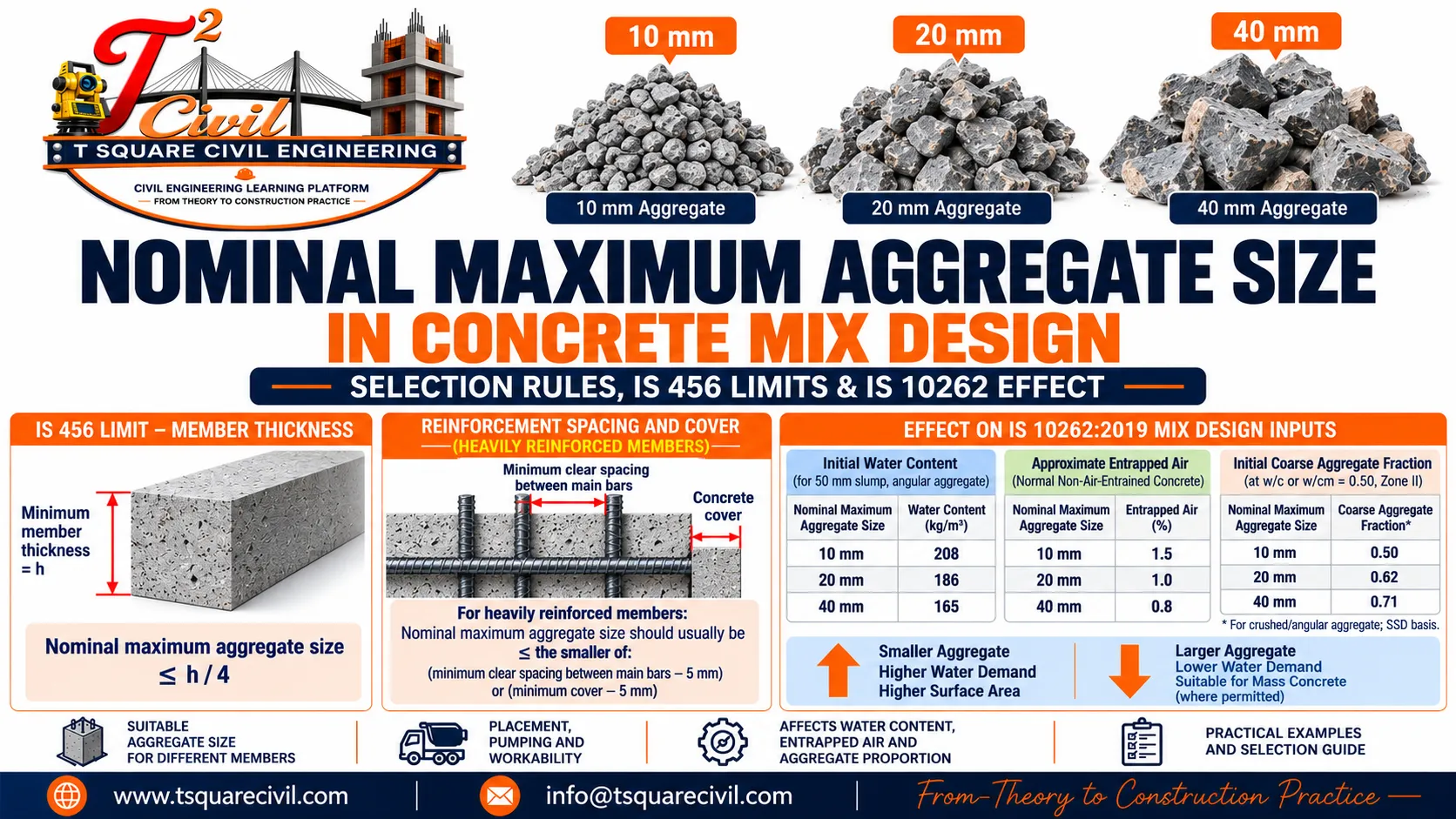
IS 456 states that the nominal maximum size of coarse aggregate should be as large as possible within the applicable limits.
However, it should not be greater than:
One-fourth of the minimum thickness of the concrete member
provided the concrete can still:
- surround the reinforcement properly;
- fill the form completely; and
- be placed without difficulty.
Therefore:
Maximum permitted aggregate size ≤ Minimum member thickness ÷ 4
This is an important preliminary check.
Example – Member Thickness Check
Suppose the minimum thickness of a concrete member is:
120 mm
One-fourth of the thickness is:
120 ÷ 4 = 30 mm
Therefore, based on this criterion alone:
40 mm nominal maximum aggregate would not be suitable.
A smaller available size such as:
20 mm
may be selected, subject to reinforcement spacing, cover, pumping and other project requirements.
Is 20 mm Aggregate Always Used for RCC?
No.
20 mm aggregate is commonly suitable for many reinforced-concrete applications, but it is not compulsory for every RCC member.
Depending on the member and reinforcement arrangement, the project may require:
- 10 mm aggregate;
- 20 mm aggregate;
- a combined 20 mm + 10 mm fraction; or
- another approved grading.
Do not select 20 mm solely because:
“RCC normally uses 20 mm aggregate.”
The structural geometry and placing conditions should be checked first.
IS 456 Guidance for General Concrete Work
For much normal concrete work, 20 mm nominal maximum aggregate is commonly suitable.
Where there is little restriction to concrete flow into the section, larger aggregate such as 40 mm may be possible.
Conversely, smaller aggregate should be considered for:
- thin concrete sections;
- closely spaced reinforcement;
- congested reinforcement;
- small cover; and
- restricted placing locations.
Therefore, 10 mm aggregate may be appropriate in situations where larger particles cannot pass safely through the available space.
Aggregate Size in Heavily Reinforced Members
Reinforcement congestion can govern aggregate-size selection.
For heavily reinforced members, IS 456 requires particular attention to:
- clear distance between reinforcement bars; and
- concrete cover.
The nominal maximum aggregate size should usually be restricted to:
5 mm less than the minimum clear distance between the main bars
or
5 mm less than the minimum cover to reinforcement
whichever produces the smaller permissible size.
This helps concrete move around reinforcement and fill the available space without aggregate particles bridging between bars.
Example – Reinforcement Spacing Check
Suppose:
Minimum clear distance between main bars = 25 mm
Minimum cover = 30 mm
From clear bar spacing:
25 − 5 = 20 mm
From cover:
30 − 5 = 25 mm
The smaller permissible value is:
20 mm
Therefore, based on this check:
20 mm nominal maximum aggregate may be used.
The final selection should still satisfy the member-thickness and placing requirements.
Example – Congested Reinforcement
Suppose:
Minimum clear distance between main bars = 18 mm
Then:
18 − 5 = 13 mm
A 20 mm nominal maximum aggregate would therefore be unsuitable around this congestion.
A smaller aggregate size such as:
10 mm
may be required, subject to the complete design and project specification.
This demonstrates why aggregate size cannot be selected from concrete grade alone.
Bar Spacing and Aggregate Passage
Concrete must be capable of passing between reinforcement bars without coarse aggregate becoming trapped.
If the aggregate is too large relative to the reinforcement spacing, possible problems include:
- blockage between bars;
- honeycombing;
- incomplete filling;
- segregation;
- poor compaction;
- exposed aggregate pockets; and
- reduced concrete quality.
Aggregate-size selection should therefore be coordinated with reinforcement detailing.
Thin Concrete Sections
Thin sections provide limited space for concrete flow.
Examples may include:
- thin walls;
- narrow beams;
- thin precast elements;
- narrow ribs; and
- heavily reinforced structural zones.
Smaller aggregate can help concrete move through these restricted sections.
However, reducing aggregate size may increase:
- particle surface area;
- water demand;
- paste demand; and
- admixture requirement.
The concrete mix should therefore be recalculated when aggregate size changes.
Aggregate Size and Concrete Water Demand
Nominal maximum aggregate size directly affects the preliminary water content used in IS 10262:2019.
For angular aggregate at approximately 50 mm slump, the initial water-content values for ordinary and standard concrete are:
| Nominal Maximum Aggregate Size | Initial Water Content |
|---|---|
| 10 mm | 208 kg/m³ |
| 20 mm | 186 kg/m³ |
| 40 mm | 165 kg/m³ |
These are starting values for mix proportioning.
They are not fixed final water quantities.
The actual water demand may change because of:
- aggregate shape;
- surface texture;
- required slump;
- grading;
- chemical admixture;
- concrete temperature; and
- trial-mix performance.
For the detailed calculation, see our Water Content Calculation in Concrete Mix Design.
Why Smaller Aggregate May Require More Water
Consider the same total aggregate volume.
If the aggregate particles become smaller, the number of particles generally increases.
This increases the total surface area that must be coated and lubricated by the cement paste.
Therefore, smaller aggregate can increase the water or paste requirement for similar workability.
This is reflected in the IS 10262 preliminary water values:
10 mm → 208 kg/m³
20 mm → 186 kg/m³
40 mm → 165 kg/m³
Again, these are initial design values rather than guaranteed production water contents.
Aggregate Size and Entrapped Air
Nominal maximum aggregate size also affects the approximate entrapped-air content used in ordinary and standard concrete mix proportioning.
Typical IS 10262:2019 values are:
| Nominal Maximum Aggregate Size | Approximate Entrapped Air |
|---|---|
| 10 mm | 1.5% |
| 20 mm | 1.0% |
| 40 mm | 0.8% |
Therefore, selecting a different nominal maximum aggregate size changes the air volume used in the absolute-volume calculation.
For the complete explanation, see our Entrapped Air in Concrete Mix Design.
Aggregate Size and Fine/Coarse Aggregate Proportion
IS 10262 also uses nominal maximum aggregate size when selecting the preliminary coarse-aggregate fraction.
For example, at a reference water-cement or water-cementitious ratio of 0.50, the preliminary coarse-aggregate fractions differ with:
- aggregate size; and
- fine aggregate grading zone.
For Zone II fine aggregate:
| Nominal Maximum Aggregate Size | Initial Coarse Aggregate Fraction |
|---|---|
| 10 mm | 0.50 |
| 20 mm | 0.62 |
| 40 mm | 0.71 |
These values are starting points.
Adjustments may be required for:
- adopted w/c or w/cm;
- pumping;
- aggregate shape;
- manufactured sand;
- workability; and
- trial-mix behaviour.
For the full calculation, see our Fine and Coarse Aggregate Proportioning in Concrete Mix Design.
Aggregate Size and Absolute Volume Calculation
Changing aggregate size does not change the basic absolute-volume formula.
However, it can change several inputs to the calculation, including:
- entrapped air;
- water content;
- fine/coarse aggregate proportion; and
- sometimes admixture requirement.
The absolute-volume relationship remains:
Absolute Volume = Mass ÷ (Specific Gravity × 1000)
After accounting for:
- cementitious materials;
- water;
- admixture; and
- entrapped air,
the remaining volume is divided between fine and coarse aggregate.
See our Absolute Volume Method for Concrete Mix Design.
10 mm vs 20 mm vs 40 mm Aggregate
A simple comparison is shown below.
| Parameter | 10 mm | 20 mm | 40 mm |
|---|---|---|---|
| Suitable for restricted/congested areas | Better | Common general option | More restricted |
| Preliminary water demand | Higher | Intermediate | Lower |
| Approx. ordinary entrapped air | 1.5% | 1.0% | 0.8% |
| Total particle surface area | Relatively higher | Intermediate | Relatively lower |
| Flow through congested steel | Easier | Depends on detailing | More difficult |
| Use in thin sections | Often suitable | Check detailing | Usually limited |
| Typical mass concrete potential | Less advantageous | Possible | More advantageous where permitted |
This is a general comparison.
The final size must satisfy actual project geometry and specifications.
Is 40 mm Aggregate Better Because It Uses Less Water?
Not necessarily.
Larger aggregate can reduce preliminary water demand and total particle surface area.
However, 40 mm aggregate may be unsuitable where:
- reinforcement is congested;
- members are thin;
- cover is small;
- pipeline diameter is restrictive;
- concrete must pass through narrow spaces; or
- project specifications limit aggregate size.
Therefore:
Lower water demand does not automatically mean better overall suitability.
Structural placement requirements govern first.
Aggregate Size for Pumped Concrete
Concrete intended for pumping requires additional consideration.
Aggregate must pass safely through:
- pump hopper;
- reducers;
- bends;
- pipeline;
- delivery hose; and
- reinforcement at the placing point.
The selected nominal maximum size should therefore be compatible with the pumping equipment and pipeline arrangement.
Do not assume that a structurally acceptable aggregate size is automatically suitable for a particular pump system.
The final selection should consider:
structural detailing + aggregate grading + pump manufacturer’s requirements + pipeline arrangement + trial pumping
For the complete discussion, see our Pumped Concrete Mix Design.
Aggregate Size for Columns
Column concrete may contain:
- main vertical bars;
- closely spaced ties;
- lap zones;
- couplers; and
- congested beam-column junctions.
Although 20 mm aggregate may be satisfactory for many columns, the reinforcement arrangement should be checked.
In heavily congested locations, smaller aggregate may be required.
Particular attention should be given to:
- lap-splice zones;
- column-beam joints;
- closely spaced ties; and
- heavily reinforced transfer regions.
Aggregate Size for Beams
Beam reinforcement may become congested near:
- supports;
- beam-column joints;
- lap zones;
- anchorage regions; and
- intersections with secondary beams.
The selected aggregate should pass between bars and permit proper vibration.
Do not select aggregate size only from the overall beam width.
The actual clear spaces inside the reinforcement cage are important.
Aggregate Size for Slabs
Many conventional slabs can accommodate 20 mm aggregate where the thickness and reinforcement arrangement permit.
However, thinner slabs and heavily reinforced slabs may require smaller aggregate.
The one-fourth member-thickness criterion should also be checked.
For example:
Slab thickness = 100 mm
One-fourth:
100 ÷ 4 = 25 mm
Therefore, from the thickness criterion alone, 20 mm aggregate may be acceptable.
Other restrictions must still be checked.
Aggregate Size for Mass Concrete
Large concrete sections with relatively unrestricted placement may permit larger aggregate.
Potential advantages can include:
- reduced total surface area;
- reduced paste demand;
- lower preliminary water demand; and
- potentially improved economy.
However, the selection must still consider:
- placing equipment;
- aggregate availability;
- grading;
- segregation resistance;
- concrete production system; and
- project specification.
Mass concrete should not automatically be assumed to require 40 mm aggregate.
Aggregate Size for Precast Concrete
Precast elements may contain:
- thin sections;
- dense reinforcement;
- narrow moulds; and
- complex geometry.
Therefore, smaller nominal maximum aggregate sizes are often useful.
The correct size should be selected based on:
- element thickness;
- reinforcement spacing;
- cover;
- concrete flow path;
- vibration method; and
- required surface finish.
Combined Coarse Aggregate Fractions
A nominal maximum aggregate size does not mean the concrete should contain only one particle size.
For example, a 20 mm nominal maximum aggregate system may contain a combination of fractions such as:
20 mm fraction + smaller coarse aggregate fraction
The exact combination should be based on actual grading.
Do not assume universally that:
20 mm : 10 mm = 60 : 40
or
20 mm : 10 mm = 50 : 50
The combined grading should be established from the materials available and confirmed by sieve analysis and concrete trials.
Importance of Aggregate Grading
Nominal maximum size is only one aggregate property.
A concrete mix can still perform poorly even if the selected maximum size is correct but the overall grading is unsuitable.
Good grading helps:
- reduce excessive voids;
- improve packing;
- improve workability;
- control segregation;
- improve pumpability; and
- reduce unnecessary paste demand.
For testing, see our Sieve Analysis / Particle Size Distribution of Aggregate.
Aggregate Size and Specific Gravity
Changing nominal maximum aggregate size does not mean that one standard specific-gravity value should be assumed.
Specific gravity depends on the actual aggregate source and material.
If different coarse aggregate fractions come from the same rock source, their specific gravities may be similar, but this should be confirmed through testing where required.
The tested values are used in the absolute-volume calculation.
For the laboratory procedure, see Specific Gravity and Water Absorption of Aggregate.
Aggregate Size and Moisture Correction
Moisture correction is required based on the actual moisture condition of each aggregate fraction.
Changing aggregate size does not eliminate this requirement.
Each stockpile may have different:
- absorption;
- moisture content;
- surface moisture; and
- wet batch mass.
Fine aggregate usually contributes more variable surface moisture than coarse aggregate, but all relevant aggregate fractions should be considered.
See our Moisture Correction in Concrete Mix Design.
Worked Example – Selecting Aggregate Size
Suppose an RCC beam has:
Minimum member thickness = 150 mm
Minimum clear distance between main bars = 28 mm
Minimum cover to reinforcement = 30 mm
Step 1: Check Member Thickness
One-fourth of minimum thickness:
150 ÷ 4 = 37.5 mm
Therefore, based only on member thickness:
Aggregate should not exceed approximately 37.5 mm.
Step 2: Check Reinforcement Clearance
Clear bar spacing criterion:
28 − 5 = 23 mm
Cover criterion:
30 − 5 = 25 mm
Take the smaller value:
23 mm
Step 3: Select Available Nominal Size
Common available options may include:
10 mm, 20 mm and 40 mm.
40 mm exceeds the reinforcement-clearance limit.
20 mm is below 23 mm.
Therefore:
20 mm nominal maximum aggregate may be selected
subject to project specifications, aggregate grading, placement and trial-mix verification.
Worked Example – Thin Congested Member
Suppose:
Member thickness = 80 mm
Minimum clear reinforcement spacing = 16 mm
Cover = 25 mm
Thickness Check
80 ÷ 4 = 20 mm
Bar-Spacing Check
16 − 5 = 11 mm
Cover Check
25 − 5 = 20 mm
The controlling value is:
11 mm
Therefore, 20 mm aggregate would not be appropriate around this congested reinforcement.
A nominal maximum aggregate size of:
10 mm
may be more suitable, subject to project requirements.
Changing Aggregate Size Changes the Mix Design
Suppose a concrete mix was designed using 20 mm aggregate and later the site decides to use 10 mm aggregate.
Do not simply replace the aggregate and keep everything else unchanged.
Changing from 20 mm to 10 mm affects at least:
- preliminary water content;
- approximate entrapped air;
- fine/coarse aggregate fraction;
- aggregate grading;
- workability;
- possibly admixture dosage; and
- final trial-mix behaviour.
Therefore, the mix should be recalculated and reverified.
20 mm Mix Converted to 10 mm – Why Recalculation Is Required
Consider the preliminary IS 10262 inputs:
20 mm Aggregate
Initial water = 186 kg/m³
Entrapped air = 1.0%
10 mm Aggregate
Initial water = 208 kg/m³
Entrapped air = 1.5%
These differences alone change:
- cementitious-material calculation;
- aggregate volume;
- fine/coarse aggregate split; and
- potentially final mix proportions.
Therefore:
Aggregate-size substitution is a mix-design change, not merely a material substitution.
Aggregate Size and Concrete Grade
Concrete grade does not by itself determine aggregate size.
For example:
M30 concrete does not automatically require 20 mm aggregate.
The correct size depends on:
- member dimensions;
- reinforcement arrangement;
- cover;
- workability;
- pumping;
- aggregate availability;
- grading; and
- project requirements.
Two different M30 concrete mixes may therefore use different nominal maximum aggregate sizes.
Aggregate Size in High-Strength Concrete
IS 10262:2019 contains separate provisions for high-strength concrete.
The tables for high-strength concrete include nominal maximum aggregate sizes such as:
- 10 mm;
- 12.5 mm; and
- 20 mm.
High-strength concrete should therefore be proportioned using the applicable high-strength section rather than blindly applying all ordinary/standard-concrete table values.
The final aggregate size should still satisfy structural clearances and actual trial performance.
Practical Selection Sequence
A useful selection workflow is:
Check project specification
↓
Check minimum member thickness
↓
Check reinforcement clear spacing
↓
Check concrete cover
↓
Check congestion and flow path
↓
Check placing method
↓
Check pumping system if applicable
↓
Select practical nominal maximum aggregate size
↓
Confirm aggregate grading
↓
Use that size in IS 10262 calculations
↓
Prepare trial mix
↓
Verify workability, segregation and strength
↓
Approve final aggregate system
Quick Selection Checklist
Before finalizing nominal maximum aggregate size, confirm:
- Project specification checked
- Member thickness checked
- One-fourth thickness criterion checked
- Clear reinforcement spacing checked
- Concrete cover checked
- Congested reinforcement zones reviewed
- Pumping system reviewed where applicable
- Placing and compaction method reviewed
- Aggregate grading tested
- Required aggregate fractions are available
- IS 10262 water value updated
- Entrapped-air value updated
- Fine/coarse aggregate fraction updated
- Absolute-volume calculation completed
- Trial mix completed
Common Mistakes
Selecting 20 mm Aggregate for Every RCC Member
20 mm is common, but it is not universally suitable.
Selecting Aggregate Size From Concrete Grade
Concrete grade alone does not determine maximum aggregate size.
Ignoring Reinforcement Congestion
A nominally acceptable aggregate may still be too large to pass through the reinforcement cage.
Ignoring Member Thickness
The aggregate-size limit should be checked against the minimum member dimension.
Using 40 mm Aggregate Only to Reduce Water Demand
Larger aggregate should not be selected if it compromises placement or reinforcement clearance.
Changing From 20 mm to 10 mm Without Recalculating the Mix
This changes several IS 10262 inputs and requires mix review.
Assuming One Fixed 20 mm-to-10 mm Aggregate Ratio
Combined coarse aggregate proportions should be based on actual grading and trials.
Ignoring Pump Requirements
Aggregate that passes structural clearance checks may still be inappropriate for a particular pumping system.
Frequently Asked Questions
What is the nominal maximum aggregate size in concrete?
It is the designated maximum aggregate size used for selecting and proportioning the coarse aggregate system for the concrete.
What nominal maximum aggregate size is commonly used for RCC?
20 mm is commonly suitable for many RCC applications, but the correct value depends on member dimensions, reinforcement spacing, cover, placing method and project requirements.
What is the maximum aggregate size according to IS 456?
The nominal maximum coarse aggregate size should generally not exceed one-fourth of the minimum thickness of the concrete member, subject to placement and reinforcement-clearance requirements.
Can 40 mm aggregate be used in RCC?
It may be possible where the member dimensions, reinforcement arrangement, placing system and project requirements permit it. It should not be selected automatically.
When should 10 mm aggregate be used?
10 mm aggregate may be appropriate for thin sections, closely spaced reinforcement, small cover, congested areas and other locations where larger aggregate cannot pass or be compacted satisfactorily.
Is 20 mm aggregate compulsory for M25 concrete?
No. Concrete grade does not by itself determine nominal maximum aggregate size.
Does aggregate size affect water content?
Yes. IS 10262 uses different preliminary water-content values for different nominal maximum aggregate sizes.
Does aggregate size affect entrapped air?
Yes. Approximate entrapped-air values differ with nominal maximum aggregate size.
Does changing aggregate size require a new mix calculation?
Yes. Water content, air content, aggregate proportions and trial behaviour may change, so the mix should be reviewed and reverified.
Can 20 mm and 10 mm aggregates be combined?
Yes. Multiple coarse aggregate fractions may be combined to obtain suitable grading, but the proportion should be based on actual material grading rather than a universal fixed ratio.
Is smaller aggregate always better for reinforced concrete?
No. Smaller aggregate can improve passage through congested reinforcement, but it can also increase total surface area and water or paste demand.
Is larger aggregate always more economical?
Not necessarily. Larger aggregate may reduce preliminary water and paste demand, but it must still satisfy structural, placement, pumping and quality requirements.
Related Concrete Mix Design Resources
Continue with these T Square Civil resources:
Concrete Mix Design Procedure as per IS 10262:2019
Concrete Mix Design Calculator as per IS 10262:2019
Water Content Calculation in Concrete Mix Design
Entrapped Air in Concrete Mix Design
Fine and Coarse Aggregate Proportioning in Concrete Mix Design
Absolute Volume Method for Concrete Mix Design
Moisture Correction in Concrete Mix Design
Sieve Analysis / Particle Size Distribution of Aggregate
Specific Gravity and Water Absorption of Aggregate
Conclusion
The nominal maximum size of coarse aggregate is not a value that should be selected from concrete grade or site habit alone.
The correct approach is to first check whether the aggregate can physically and safely be accommodated within the concrete member.
Important checks include:
member thickness + reinforcement spacing + cover + congestion + placing method + pumping system
IS 456 requires the nominal maximum aggregate size to be as large as practicable within the applicable limits and generally not greater than:
one-fourth of the minimum member thickness
For heavily reinforced members, additional limits based on clear reinforcement spacing and cover must also be considered.
Once the suitable nominal maximum size has been selected, that value becomes an important input in IS 10262 concrete mix proportioning because it affects:
water content + entrapped air + coarse aggregate fraction + absolute-volume calculation + trial-mix behaviour
Therefore:
Select aggregate size first → use the correct IS 10262 inputs → calculate the mix → prepare trials → verify workability and strength → finalize the production mix.
Engineering note: Always verify the latest applicable Indian Standards, structural drawings, reinforcement detailing, project specifications and equipment limitations before finalizing aggregate size for construction.