
 by
by Fine and coarse aggregate together form the major portion of concrete by volume. Selecting their proportions correctly is therefore an important step in concrete mix design.
The objective is not simply to use as much coarse aggregate as possible or to assume a fixed sand-to-aggregate ratio.
The suitable proportion depends on factors such as:
- nominal maximum size of coarse aggregate;
- grading zone of fine aggregate;
- adopted water-cement or water-cementitious materials ratio;
- aggregate shape;
- natural sand, manufactured sand or mixed sand;
- required workability;
- pumping requirement;
- reinforcement congestion; and
- actual trial-mix behaviour.
IS 10262:2019 provides initial coarse-aggregate volume fractions for mix proportioning. These values are then adjusted for the actual water-cementitious ratio and construction requirements.
For the complete sequence leading to this stage, see our Concrete Mix Design Procedure as per IS 10262:2019.
For the complete Mix Design learning path, visit the Concrete Mix Design Hub.
Page Contents
What Is Aggregate Proportioning in Concrete Mix Design?
Aggregate proportioning means dividing the total aggregate volume available in concrete between:
Fine Aggregate
and
Coarse Aggregate
The fine aggregate normally fills part of the void space between the coarse aggregate particles and contributes to:
- workability;
- cohesiveness;
- finishability;
- pumpability; and
- resistance to segregation.
Coarse aggregate forms a large part of the concrete skeleton and influences:
- strength;
- dimensional stability;
- paste requirement;
- shrinkage;
- workability; and
- economy.
A suitable balance between fine and coarse aggregate is therefore essential.
Too much coarse aggregate may make the concrete harsh and difficult to place.
Too much fine aggregate can increase:
- total surface area;
- paste demand;
- water demand;
- stickiness; and
- shrinkage.
The final proportion should therefore be established through calculation followed by trial-mix verification.
Fine Aggregate and Coarse Aggregate
Fine Aggregate
Fine aggregate generally consists of material passing the 4.75 mm IS sieve and may include:
- natural sand;
- manufactured sand;
- crushed stone sand; or
- an approved combination of fine aggregates.
Its grading should be established through laboratory sieve analysis.
Do not classify fine aggregate only by visual inspection.
The complete testing procedure is explained in our Sieve Analysis / Particle Size Distribution of Aggregate.
Coarse Aggregate
Coarse aggregate normally consists primarily of particles retained on the 4.75 mm sieve.
Typical nominal maximum aggregate sizes used in concrete mix design include:
- 10 mm;
- 20 mm; and
- 40 mm.
More than one coarse aggregate fraction may be combined to obtain suitable overall grading.
For example, a concrete mix may use:
20 mm fraction + 10 or 12.5 mm fraction
in proportions established from actual sieve-analysis data.
A fixed combination such as 60:40 or 50:50 should not be assumed universally.
Why Fine Aggregate Grading Zone Matters
Fine aggregate is classified into grading zones according to its particle-size distribution.
For mix proportioning, the grading zone influences how much coarse aggregate is initially selected.
Broadly:
Zone I → relatively coarser fine aggregate
Zone II → intermediate grading
Zone III → finer grading
Zone IV → comparatively fine grading
The grading zone should come from the actual sieve-analysis result.
If the source or grading of the sand changes, the aggregate proportion may also need to be reviewed.
This is one reason representative aggregate testing is required before concrete mix design. See Material Tests Required Before Concrete Mix Design for the complete input-data checklist.
Important Meaning of the IS 10262 Aggregate Table
This point is frequently misunderstood.
When IS 10262 gives a value such as:
0.62
for coarse aggregate, it does not mean:
0.62 m³ of coarse aggregate per 1 m³ of concrete.
It means:
Volume of coarse aggregate per unit volume of total aggregate = 0.62
In other words:
Coarse aggregate = 62% of the total aggregate volume
and:
Fine aggregate = 38% of the total aggregate volume
before any further adjustment.
The actual total aggregate volume must first be calculated after deducting the volumes occupied by:
- cement;
- supplementary cementitious materials;
- water;
- chemical admixture; and
- entrapped air.
This distinction is very important.
Initial Coarse Aggregate Volume as per IS 10262:2019
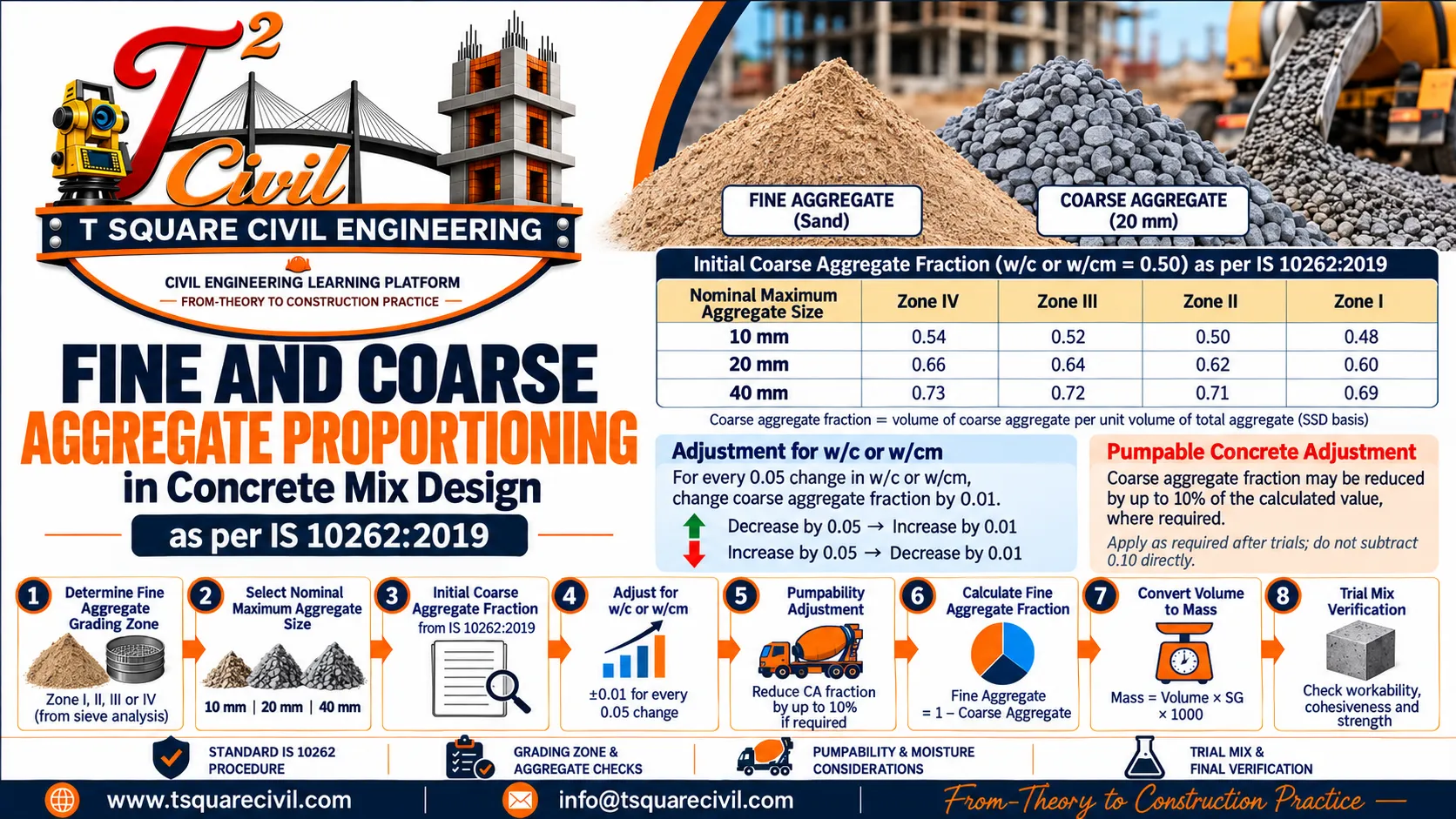
For a water-cement or water-cementitious materials ratio of 0.50, IS 10262:2019 provides the following initial coarse-aggregate fractions for crushed angular aggregate.
| Nominal Maximum Aggregate Size | Zone IV | Zone III | Zone II | Zone I |
|---|---|---|---|---|
| 10 mm | 0.54 | 0.52 | 0.50 | 0.48 |
| 20 mm | 0.66 | 0.64 | 0.62 | 0.60 |
| 40 mm | 0.73 | 0.72 | 0.71 | 0.69 |
These values represent:
Volume of coarse aggregate ÷ Total aggregate volume
for the reference conditions.
The corresponding fine aggregate fraction is:
Fine Aggregate Fraction = 1 − Coarse Aggregate Fraction
Example: 20 mm Aggregate With Zone II Sand
Suppose:
Nominal maximum coarse aggregate size:
20 mm
Fine aggregate:
Zone II
Reference w/c or w/cm:
0.50
From the table:
Coarse aggregate fraction:
0.62
Therefore:
Fine aggregate fraction:
= 1 − 0.62
= 0.38
So the preliminary division is:
Coarse aggregate = 62% of total aggregate volume
Fine aggregate = 38% of total aggregate volume
This is only the starting proportion.
The adopted water-cementitious ratio must now be considered.
Step 1: Determine the Fine Aggregate Grading Zone
Before proportioning the aggregate, determine the grading of the proposed fine aggregate through sieve analysis.
The result should represent the actual material that will be used in production.
Do not assume:
“All river sand is Zone II”
or:
“All manufactured sand is Zone II.”
The grading zone depends on the measured particle-size distribution.
If the grading changes significantly during production, the mix may require review.
Step 2: Select the Nominal Maximum Size of Coarse Aggregate
The nominal maximum size should be selected considering:
- structural member dimensions;
- spacing of reinforcement;
- cover;
- pumping system;
- placing method; and
- project specification.
Typical concrete mix designs may use:
10 mm, 20 mm or 40 mm
as the nominal maximum aggregate size.
For many RCC applications, 20 mm aggregate is commonly used where permitted by detailing and project requirements.
However, this should not be treated as a universal rule.
Step 3: Read the Initial Coarse Aggregate Fraction
Suppose:
Nominal maximum aggregate:
20 mm
Fine aggregate:
Zone II
Then, at the reference ratio of 0.50:
Initial coarse aggregate fraction = 0.62
and:
Initial fine aggregate fraction = 0.38
The next step is to adjust the coarse aggregate fraction for the actual adopted w/c or w/cm.
Step 4: Adjust the Coarse Aggregate Fraction for w/c or w/cm
The reference aggregate proportions are based on:
w/c or w/cm = 0.50
If the adopted water-cementitious ratio differs from 0.50, the coarse aggregate fraction should be adjusted.
For every:
0.05 decrease in w/c or w/cm
the coarse aggregate fraction is increased by approximately:
0.01
Similarly, for every:
0.05 increase
the coarse aggregate fraction is decreased by approximately:
0.01
Example 1: Adjustment From 0.50 to 0.40
Suppose:
Initial coarse aggregate fraction:
0.62
Reference ratio:
0.50
Adopted w/cm:
0.40
Difference:
0.50 − 0.40
= 0.10
Number of 0.05 intervals:
0.10 ÷ 0.05
= 2
Increase in coarse aggregate fraction:
2 × 0.01
= 0.02
Therefore:
Adjusted coarse aggregate fraction:
= 0.62 + 0.02
= 0.64
Fine aggregate fraction:
= 1 − 0.64
= 0.36
Therefore, before any pumpability adjustment:
Coarse aggregate = 64% of total aggregate volume
Fine aggregate = 36% of total aggregate volume
For the detailed selection of the governing ratio, refer to Water-Cement Ratio in Concrete.
Example 2: Adjustment From 0.50 to 0.45
Suppose:
20 mm aggregate
Zone II sand
Initial coarse aggregate fraction:
0.62
Adopted w/cm:
0.45
Difference:
0.50 − 0.45
= 0.05
Therefore:
Increase in coarse aggregate fraction:
0.01
Adjusted coarse aggregate fraction:
= 0.62 + 0.01
= 0.63
Fine aggregate fraction:
= 1 − 0.63
= 0.37
Example 3: Ratio Higher Than 0.50
Suppose:
20 mm aggregate
Zone II fine aggregate
Adopted w/c:
0.55
The ratio is:
0.05 higher than the reference value
Therefore:
Coarse aggregate fraction:
= 0.62 − 0.01
= 0.61
Fine aggregate fraction:
= 1 − 0.61
= 0.39
This demonstrates why the aggregate proportion should not be taken directly from the table without considering the adopted water-cementitious ratio.
Step 5: Consider Pumpable Concrete Requirements
Concrete intended for pumping requires sufficient mortar and fine material to provide:
- lubrication within the pipeline;
- cohesiveness;
- resistance to segregation; and
- reliable movement through bends and vertical sections.
For pumpable concrete, the calculated coarse aggregate fraction may be reduced by up to about 10%, where required.
This is a reduction of the calculated coarse aggregate fraction.
It does not mean subtracting:
0.10 directly from the fraction.
Correct Example
Adjusted coarse aggregate fraction:
0.64
Suppose a full 10% reduction is selected for a preliminary pumpable-concrete trial.
Then:
Coarse aggregate fraction:
= 0.64 × 0.90
= 0.576
Fine aggregate fraction:
= 1 − 0.576
= 0.424
Therefore:
Coarse aggregate fraction = 0.576
Fine aggregate fraction = 0.424
This means:
57.6% coarse aggregate
and:
42.4% fine aggregate
of the total aggregate volume.
Important
The full 10% reduction should not be automatically applied to every pumped concrete mix.
The appropriate reduction may be less than 10% or may need to be established through trials.
Actual pumpability also depends on:
- pipeline diameter;
- pumping distance;
- vertical lift;
- number of bends;
- aggregate grading;
- particle shape;
- mortar content;
- slump;
- slump retention; and
- admixture performance.
The final mix should therefore be verified through actual trial mixing and, for critical applications, pumping trials.
Why Pumpable Concrete Usually Needs More Fine Material
Concrete moves through a pump line as a cohesive mass.
An adequate mortar phase helps form a lubricating layer along the pipe wall.
If coarse aggregate content is excessive, the mix may become:
- harsh;
- difficult to pump;
- susceptible to blockage; or
- prone to segregation.
However, excessive fine aggregate can also make concrete:
- sticky;
- high in water demand;
- high in paste demand; and
- difficult to finish.
The goal is therefore a balanced aggregate grading rather than simply increasing sand.
Step 6: Calculate the Fine Aggregate Fraction
Once the final coarse aggregate fraction has been established:
Fine Aggregate Fraction = 1 − Final Coarse Aggregate Fraction
For example:
Final coarse aggregate fraction:
0.576
Then:
Fine aggregate fraction:
= 1 − 0.576
= 0.424
The sum should always be:
Coarse Aggregate Fraction + Fine Aggregate Fraction = 1.00
Step 7: Calculate the Total Aggregate Volume
The fine/coarse fractions do not directly give aggregate mass.
First determine the total absolute volume available for aggregate.
In simplified form:
Total Aggregate Volume = Concrete Volume − Entrapped Air − Cementitious Material Volume − Water Volume − Admixture Volume
For a one-cubic-metre mix:
Concrete Volume = 1.000 m³
Suppose that after deducting all non-aggregate ingredients, the remaining total aggregate volume is:
0.680 m³
This total volume must now be split between fine and coarse aggregate.
Step 8: Calculate Coarse Aggregate Volume
Suppose:
Total aggregate volume:
0.680 m³
Final coarse aggregate fraction:
0.576
Then:
Coarse aggregate absolute volume:
= 0.680 × 0.576
= 0.3917 m³
Step 9: Calculate Fine Aggregate Volume
Fine aggregate fraction:
0.424
Therefore:
Fine aggregate absolute volume:
= 0.680 × 0.424
= 0.2883 m³
Check:
0.3917 + 0.2883
= 0.6800 m³
The volume balance is correct.
Step 10: Convert Aggregate Volume to Mass
Aggregate quantities are finally obtained using their specific gravities.
Coarse Aggregate
Assume:
Coarse aggregate volume:
0.3917 m³
Coarse aggregate specific gravity:
2.70
Then:
Coarse Aggregate Mass = Volume × Specific Gravity × 1000
= 0.3917 × 2.70 × 1000
≈ 1,058 kg/m³
Fine Aggregate
Assume:
Fine aggregate volume:
0.2883 m³
Fine aggregate specific gravity:
2.65
Then:
Fine aggregate mass:
= 0.2883 × 2.65 × 1000
≈ 764 kg/m³
Therefore, the preliminary SSD aggregate quantities are approximately:
| Aggregate | Quantity |
|---|---|
| Fine Aggregate | 764 kg/m³ |
| Coarse Aggregate | 1,058 kg/m³ |
These figures are only a worked example using the stated assumptions.
Actual project quantities depend on:
- total aggregate volume;
- grading zone;
- w/c or w/cm;
- pumpability adjustment;
- specific gravities; and
- actual trial performance.
For the laboratory determination of specific gravity and absorption, see Specific Gravity and Water Absorption of Aggregate.
Complete Worked Example
Assume:
| Input | Value |
|---|---|
| Nominal maximum aggregate size | 20 mm |
| Fine aggregate grading | Zone II |
| Adopted w/cm | 0.40 |
| Concrete placement | Pumped |
| Pumpability reduction used for preliminary trial | 10% |
| Total aggregate volume | 0.680 m³ |
| Coarse aggregate specific gravity | 2.70 |
| Fine aggregate specific gravity | 2.65 |
Step A: Initial Coarse Aggregate Fraction
For:
20 mm aggregate + Zone II + reference w/cm 0.50
Initial coarse aggregate fraction:
0.62
Step B: Adjust for w/cm
Adopted w/cm:
0.40
Difference:
0.50 − 0.40
= 0.10
Adjustment:
0.10 ÷ 0.05 × 0.01
= 0.02
Therefore:
Adjusted coarse fraction:
0.62 + 0.02
= 0.64
Step C: Pumpability Adjustment
Assuming a full 10% reduction for the initial pumped-concrete trial:
0.64 × 0.90
= 0.576
Therefore:
Fine aggregate fraction:
1 − 0.576
= 0.424
Step D: Calculate Aggregate Volumes
Total aggregate volume:
0.680 m³
Coarse aggregate:
0.680 × 0.576
= 0.3917 m³
Fine aggregate:
0.680 × 0.424
= 0.2883 m³
Step E: Convert to Mass
Coarse aggregate:
0.3917 × 2.70 × 1000
≈ 1,058 kg/m³
Fine aggregate:
0.2883 × 2.65 × 1000
≈ 764 kg/m³
So the preliminary SSD aggregate quantities are:
Fine Aggregate ≈ 764 kg/m³
Coarse Aggregate ≈ 1,058 kg/m³
These quantities should now be taken to the trial-mix stage.
Table Values Are Based on SSD Aggregate
The IS 10262 aggregate proportions are based on aggregates in the saturated surface dry or SSD condition.
Actual aggregates in a stockpile may be:
- drier than SSD;
- approximately SSD; or
- wetter than SSD.
Therefore, the quantities calculated above should not automatically be used as the actual wet batching weights.
Fine and coarse aggregate quantities, together with mixer water, should be corrected for actual moisture condition.
The complete procedure is explained in Moisture Correction in Concrete Mix Design.
Aggregate Shape Also Matters
The table values are based on crushed angular coarse aggregate.
Other aggregate shapes can change:
- packing;
- workability;
- water demand; and
- aggregate proportioning.
Rounded aggregates generally behave differently from angular crushed aggregates.
Where the aggregate shape differs substantially from the reference condition, suitable adjustments should be established through trials.
Do not simply copy proportions from another project using a different aggregate source.
Natural Sand, Manufactured Sand and Crushed Sand
Fine aggregate type also affects the final proportion.
Manufactured or crushed sand may contain:
- more angular particles;
- different grading;
- different fines content; and
- different surface texture
compared with natural sand.
IS 10262 recognizes that fine aggregate from non-natural sources may require adjustment to the fine/coarse aggregate balance.
Therefore, do not assume that a mix developed with natural river sand can use the identical fine aggregate volume after switching to manufactured sand.
The new source should be tested and the trial mix reviewed.
Why Sieve Analysis Is Essential
Aggregate proportioning depends directly on actual grading.
Sieve analysis helps determine:
- fine aggregate grading zone;
- distribution of coarse aggregate sizes;
- suitability of individual fractions; and
- combined grading where multiple aggregate fractions are used.
For example, if 20 mm and 10 mm coarse aggregates are blended, the combination should be selected from their actual particle-size distributions rather than from a fixed rule.
See our Sieve Analysis / Particle Size Distribution of Aggregate for the test procedure and calculation method.
Combining Different Coarse Aggregate Fractions
Concrete may use more than one coarse aggregate fraction.
For example:
20 mm + 10 mm
or:
20 mm + 12.5 mm
The objective is to obtain suitable overall grading and packing.
There is no universal requirement that the fractions must always be:
50:50
or:
60:40
The proportion should be selected using:
- individual sieve-analysis results;
- combined grading;
- workability;
- void content;
- pumpability; and
- trial performance.
Your grade-wise Mix Design pages contain examples where different coarse aggregate fractions are combined for the particular materials used.
These should be treated as project-specific examples, not fixed ratios.
Fine Aggregate Zone IV – Important Note
Very fine aggregate requires particular attention in reinforced concrete.
Where Zone IV fine aggregate is proposed for reinforced concrete, its suitability should be established by testing rather than assuming that the normal table proportion is automatically acceptable.
The actual project specification and applicable aggregate standard should also be checked.
Effect of Lower w/cm on Aggregate Proportion
As the water-cementitious ratio decreases, the recommended coarse aggregate fraction generally increases according to the IS 10262 adjustment rule.
For example:
At 20 mm aggregate and Zone II:
Reference at w/cm 0.50:
0.62
At w/cm 0.45:
0.63
At w/cm 0.40:
0.64
At w/cm 0.35:
0.65
before other applicable adjustments.
This should not be interpreted as a universal final aggregate fraction.
Pumpability, manufactured sand, actual grading and trial behaviour may require modification.
Do Not Confuse Aggregate Fraction With Aggregate Ratio by Mass
Suppose:
Fine aggregate volume fraction:
0.40
Coarse aggregate volume fraction:
0.60
This does not necessarily mean the mass ratio will also be:
40:60
because fine and coarse aggregate may have different specific gravities.
Mass depends on:
Mass = Absolute Volume × Specific Gravity × 1000
Therefore, the volume fractions must first be applied to the total aggregate volume and then converted to mass using the appropriate specific gravity.
Aggregate Specific Gravity Should Be Tested
Using assumed specific gravity can alter the calculated aggregate mass.
Suppose two aggregates occupy the same absolute volume but have different specific gravities.
The heavier aggregate will require a greater mass to occupy that same volume.
Therefore, representative test results for the actual source should be used wherever possible.
Do not automatically use:
2.65
for every fine or coarse aggregate simply because it is a commonly seen example value.
Aggregate Moisture Does Not Change the Design SSD Proportion Directly
The calculated aggregate proportion is normally developed on an SSD basis.
Actual stockpile moisture changes the batching quantity, not the fundamental SSD design proportion.
For example, wet sand contains extra surface water.
Therefore:
- the wet sand batch mass increases; and
- the separately added mixing water decreases.
The SSD design remains the reference.
This distinction is important during production quality control.
What Happens if Fine Aggregate Content Is Too Low?
Too little fine aggregate may produce concrete that is:
- harsh;
- difficult to finish;
- poorly cohesive;
- prone to segregation; and
- difficult to pump.
The trial mix may also show visible stone pockets or insufficient mortar.
What Happens if Fine Aggregate Content Is Too High?
Excessive fine aggregate may:
- increase total surface area;
- increase water demand;
- increase paste demand;
- make concrete sticky;
- reduce economy; and
- affect shrinkage.
Therefore, the correct solution is not simply:
“More sand for better workability.”
Aggregate proportion should be optimized as part of the complete mix.
Trial Mix Verification Is Essential
The calculated fine/coarse aggregate balance is an initial proportion.
Prepare the trial using the actual:
- cementitious materials;
- aggregates;
- water;
- admixture; and
- moisture condition.
Observe:
- workability;
- cohesiveness;
- segregation;
- bleeding;
- finishability; and
- pumpability where applicable.
If the aggregate balance is unsatisfactory, adjust it systematically.
For the complete procedure, see Concrete Trial Mix: Procedure, Adjustments & Approval.
Using the Concrete Mix Design Calculator
For preliminary calculations using your own:
- aggregate size;
- fine aggregate grading zone;
- w/c or w/cm;
- aggregate specific gravities;
- pumping requirement; and
- project quantity,
use our Concrete Mix Design Calculator as per IS 10262:2019.
The calculator provides preliminary quantities for trial proportioning.
The result should still be verified using the actual project materials.
Common Mistakes in Fine and Coarse Aggregate Proportioning
Treating 0.62 as 0.62 m³ of Coarse Aggregate per m³ of Concrete
Incorrect.
The table value is the coarse aggregate fraction of total aggregate volume.
Ignoring Fine Aggregate Grading Zone
Zone I, II, III and IV do not have identical reference aggregate proportions.
Ignoring the Adopted w/c or w/cm
The table is based on a reference ratio and should be adjusted when the adopted ratio differs.
Subtracting 0.10 for Pumpable Concrete
A 10% reduction means reducing the calculated coarse aggregate fraction by 10%.
For example:
0.64 × 0.90 = 0.576
not:
0.64 − 0.10 = 0.54
Applying the Full 10% Pumpability Reduction Automatically
The standard permits reduction up to the relevant amount.
The actual requirement should be established through trials.
Assuming M-Sand Behaves Exactly Like Natural Sand
Particle shape, fines and grading may differ significantly.
Assuming a Fixed 20 mm:10 mm Coarse Aggregate Ratio
Individual fractions should be combined based on actual grading and trial performance.
Converting Volume Fraction Directly to Mass Percentage
Specific gravity must be considered.
Ignoring Aggregate Moisture
SSD design quantities must be converted to actual batching quantities.
Skipping the Trial Mix
Calculated proportions must be verified with the real materials.
Quick Formula Reference
| Calculation | Formula |
|---|---|
| Fine aggregate fraction | 1 − Coarse aggregate fraction |
| w/cm adjustment | ±0.01 CA fraction for each ∓0.05 change from reference ratio |
| Pumpability adjustment | Adjusted CA fraction × selected reduction factor |
| Coarse aggregate volume | Total aggregate volume × CA fraction |
| Fine aggregate volume | Total aggregate volume × FA fraction |
| Aggregate mass | Absolute volume × Specific gravity × 1000 |
Practical Aggregate Proportioning Workflow
Test fine and coarse aggregate
↓
Determine fine aggregate grading zone
↓
Select nominal maximum aggregate size
↓
Obtain initial coarse aggregate fraction
↓
Adjust for adopted w/c or w/cm
↓
Consider sand type and aggregate shape
↓
Apply pumpability adjustment where required
↓
Calculate fine aggregate fraction
↓
Determine total absolute aggregate volume
↓
Split total volume into fine and coarse aggregate
↓
Convert volumes to mass using specific gravity
↓
Apply moisture corrections for actual batching
↓
Prepare trial mix
↓
Check workability, cohesion and pumpability
↓
Adjust if technically required
↓
Finalize the aggregate proportion
Frequently Asked Questions
How is fine aggregate quantity calculated in concrete mix design?
First determine the final coarse aggregate fraction.
Then:
Fine Aggregate Fraction = 1 − Coarse Aggregate Fraction
The fine aggregate absolute volume is calculated from the total aggregate volume and converted to mass using its specific gravity.
What is the coarse aggregate fraction for 20 mm aggregate and Zone II sand?
At the reference w/c or w/cm of 0.50:
Coarse aggregate fraction = 0.62
This value should be adjusted for the actual adopted ratio and other applicable requirements.
What is the fine aggregate fraction when coarse aggregate is 0.62?
Fine aggregate fraction:
= 1 − 0.62
= 0.38
How is coarse aggregate proportion adjusted for water-cement ratio?
For each 0.05 decrease in w/c or w/cm from the reference value, the coarse aggregate fraction is increased by approximately 0.01.
For each 0.05 increase, it is reduced by approximately 0.01.
Is a 10% reduction compulsory for pumpable concrete?
No.
The coarse aggregate fraction may be reduced by up to the applicable amount where required.
The final adjustment should be confirmed through trials.
Does manufactured sand require a different aggregate proportion?
It may.
Manufactured sand can have different shape, grading and fines content compared with natural sand, so the fine/coarse aggregate balance should be verified with the actual material.
Can I always use 50% 20 mm and 50% 10 mm coarse aggregate?
No.
The combination of individual coarse aggregate fractions should be based on sieve analysis, combined grading and trial performance.
Are aggregate proportions calculated by mass or volume?
The initial IS 10262 fractions are volume fractions of the total aggregate.
They are subsequently converted to mass using the respective aggregate specific gravities.
Why is specific gravity required?
Specific gravity is required to convert aggregate absolute volume into mass.
Why is moisture correction required after aggregate proportioning?
The design quantities are referenced to an SSD condition, while site aggregates may contain more or less moisture.
Actual batching masses and mixer water must therefore be corrected.
Is the calculated fine/coarse aggregate proportion the final production proportion?
Not automatically.
The preliminary proportion should be verified through laboratory trials and applicable field or pumping trials.
Conclusion
Fine and coarse aggregate proportioning is an important part of concrete mix design because aggregate grading directly affects:
workability + cohesiveness + paste demand + pumpability + strength + economy
The correct calculation sequence is:
Fine Aggregate Grading Zone → Nominal Aggregate Size → Initial Coarse Aggregate Fraction → w/c or w/cm Adjustment → Pumpability Adjustment → Fine Aggregate Fraction → Absolute Aggregate Volume → Specific Gravity → Aggregate Mass → Trial Mix Verification
The most important points are:
- the IS table values are fractions of total aggregate volume, not fractions of total concrete volume;
- fine aggregate fraction equals 1 minus the final coarse aggregate fraction;
- the reference aggregate fraction must be adjusted when the adopted w/c or w/cm differs;
- pumping adjustment should not be applied blindly;
- manufactured sand and changed aggregate sources may require further adjustment;
- actual specific gravities should be used; and
- the calculated proportion must be verified through trials.
For the complete learning sequence, visit the Concrete Mix Design Hub.
For preliminary project-specific calculations, use the Concrete Mix Design Calculator as per IS 10262:2019, and use Concrete Trial Mix: Procedure, Adjustments & Approval before adopting the proportions for production.
Engineering Note: This article is intended for civil-engineering education and preliminary mix-design guidance. Final aggregate proportions should be established using the latest applicable standards and amendments, approved project specifications, representative aggregate-test data and laboratory or field trial results.