 by
by Page Contents
Introduction
Specific gravity and water absorption of aggregate are important physical properties used in concrete mix design, aggregate quality assessment and moisture correction during concrete production.
Specific gravity indicates the relative density of aggregate compared with water, while water absorption indicates the amount of water that can enter the permeable pores of an aggregate when it changes from an oven-dry condition to a saturated surface-dry condition.
In India, these properties are determined according to:
IS 2386 (Part III):1963 – Methods of Test for Aggregates for Concrete: Specific Gravity, Density, Voids, Absorption and Bulking
IS 2386 Part III provides different test methods depending on the particle size of the aggregate. The wire basket method is commonly used for coarse aggregate larger than 10 mm, while the pycnometer method is used for aggregate smaller than 10 mm.
Quick Information
| Parameter | Details |
|---|---|
| Test | Specific Gravity and Water Absorption of Aggregate |
| IS code | IS 2386 (Part III):1963 |
| Aggregate >10 mm | Method I – Wire Basket Method |
| Aggregate 10–40 mm | Method I or Method II |
| Aggregate <10 mm | Method III – Pycnometer Method |
| Soaking period | 24 ± ½ hours |
| Water temperature | 22°C to 32°C |
| Oven temperature | 100°C to 110°C |
| Oven-drying period | 24 ± ½ hours |
| Main results | Specific gravity, apparent specific gravity and water absorption |
What Is Specific Gravity of Aggregate?
Specific gravity of aggregate is the ratio of the mass of a given volume of aggregate to the mass of an equal volume of water at the specified test condition.
Specific gravity is a dimensionless number.
For example:
If the specific gravity of an aggregate is:
2.65
it means that the solid aggregate material is approximately 2.65 times as dense as an equal volume of water under the defined test basis.
Specific gravity is widely used when converting aggregate mass into absolute volume during concrete mix proportioning.
What Is Water Absorption of Aggregate?
Water absorption is the increase in mass of aggregate caused by water entering its permeable pores.
It is expressed as a percentage of the oven-dry mass of aggregate.
The basic relationship is:
Water Absorption (%) = [(SSD Mass − Oven-Dry Mass) ÷ Oven-Dry Mass] × 100
Water absorption should not be confused with free surface moisture.
In the saturated surface-dry or SSD condition:
- the permeable pores contain water;
- but no free water remains on the external aggregate surface.
Why Are Specific Gravity and Water Absorption Important?
Specific gravity and absorption affect several concrete calculations and quality-control decisions.
They are used for:
- concrete mix design;
- absolute-volume calculations;
- aggregate yield calculations;
- moisture correction;
- correction of batch water;
- comparison of aggregate sources;
- assessment of aggregate porosity; and
- interpretation of aggregate quality.
High water absorption generally indicates that an aggregate has a greater volume of permeable pores. However, an aggregate should not be accepted or rejected based on water absorption alone.
IS Code for Specific Gravity and Water Absorption of Aggregate
The applicable Indian Standard is:
IS 2386 (Part III):1963
The standard covers:
- specific gravity;
- apparent specific gravity;
- water absorption;
- bulk density;
- voids;
- bulking of fine aggregate; and
- surface moisture.
For specific gravity and water absorption, IS 2386 Part III specifies three principal methods according to particle size:
| Aggregate Size | Applicable Method |
|---|---|
| Larger than 10 mm | Method I |
| Between 40 mm and 10 mm | Method I or Method II |
| Smaller than 10 mm | Method III |
| Smaller than 40 mm | Alternate Method IV is also permitted |
These size-based method selections are stated directly in IS 2386 Part III.
Specific Gravity vs Apparent Specific Gravity
These two terms should not be treated as identical.
Specific Gravity
The specific gravity determined by the standard method is based on the bulk volume of the aggregate particle, including its permeable pore volume as applicable to the test definition.
Apparent Specific Gravity
Apparent specific gravity considers the volume of the solid material while excluding the volume of permeable pores.
Therefore:
Apparent specific gravity is normally greater than bulk specific gravity for a porous aggregate.
Aggregate Moisture Conditions
Understanding moisture condition is essential for this test.
Oven-Dry Condition
The aggregate has been dried in an oven so that moisture has been removed from its permeable pores.
Air-Dry Condition
The aggregate surface is dry, but some moisture may remain inside its pores.
Saturated Surface-Dry Condition
The permeable pores are filled with water but the particle surface carries no free water.
This condition is known as:
SSD condition
Wet Condition
The permeable pores are filled and additional free water is also present on the surface.
The SSD condition is especially important in aggregate testing and concrete mix-water correction.
Specific Gravity and Water Absorption of Fine Aggregate by Pycnometer
The pycnometer procedure described in Method III of IS 2386 Part III is applicable to aggregate smaller than 10 mm.
For material between 10 mm and 4.75 mm, a sample of approximately 1 kg is used.
For material finer than 4.75 mm, approximately 500 g is used.
Apparatus Required for Pycnometer Method
The main apparatus consists of:
- Pycnometer or suitable constant-volume vessel
- Balance of at least 3 kg capacity, readable to 0.5 g
- Oven maintained at 100°C to 110°C
- Tray
- Airtight container
- Filter paper and funnel
- Arrangement for supplying a gentle current of warm air
- Distilled water
The pycnometer described in IS 2386 Part III is approximately 1 litre capacity and has a watertight metal conical screw top with a 6 mm diameter hole at the apex. A suitable gas jar with a ground-glass plate is also permitted.
Sample Quantity for Pycnometer Test
Use approximately:
1 kg for aggregate between 10 mm and 4.75 mm
or:
500 g for material finer than 4.75 mm.
Procedure for Pycnometer Method
Step 1: Take the Aggregate Sample
Take a representative sample of the aggregate.
The sample size should be appropriate to the aggregate grading.
Step 2: Soak the Aggregate
Place the sample in a tray and cover it completely with distilled water maintained at:
22°C to 32°C
Remove entrapped air by gently agitating the aggregate with a rod.
Keep the sample immersed for:
24 ± ½ hours.
Step 3: Drain the Water
After soaking, carefully drain the water by decantation through filter paper.
Any solid material retained on the filter paper should be returned to the sample.
Step 4: Bring the Aggregate to SSD Condition
Expose the wet aggregate to a gentle current of warm air.
Stir the aggregate frequently so that drying occurs uniformly.
Continue until:
- no visible surface moisture remains; and
- the aggregate has just reached a free-running condition.
Take care not to dry the material beyond the SSD condition.
Step 5: Weigh the SSD Sample
Weigh the saturated surface-dry aggregate.
Let:
A = mass of SSD aggregate, g
Step 6: Place Aggregate in the Pycnometer
Transfer the complete SSD sample into the pycnometer.
Fill the pycnometer with distilled water.
Step 7: Remove Entrapped Air
Remove all trapped air.
For the standard conical-top pycnometer, this is done carefully by rotating the pycnometer on its side while controlling the opening.
Entrapped air must be removed because air bubbles produce an incorrect displaced-water volume.
Step 8: Fill to Constant Volume
Top up the pycnometer with distilled water so that the required constant volume is obtained.
Dry the outside of the vessel.
Weigh:
B = mass of pycnometer + aggregate + distilled water, g
Step 9: Weigh Pycnometer Filled with Water Only
Empty the aggregate completely from the pycnometer.
Refill the pycnometer with distilled water to exactly the same level.
Dry the outside and weigh:
C = mass of pycnometer + distilled water only, g
The difference between the water temperatures during the B and C measurements should not exceed:
2°C.
Step 10: Oven-Dry the Aggregate
Drain the aggregate carefully.
Transfer the sample to a tray and place it in an oven maintained at:
100°C to 110°C
for:
24 ± ½ hours
Stir the material occasionally to help drying.
After drying, cool it in an airtight container.
Weigh:
D = mass of oven-dried aggregate, g
Two tests should be carried out.
Formula for Specific Gravity by Pycnometer
According to IS 2386 Part III:
Specific Gravity = D ÷ [A − (B − C)]
where:
A = mass of SSD sample, g
B = mass of pycnometer containing sample and distilled water, g
C = mass of pycnometer filled with distilled water only, g
D = mass of oven-dried aggregate, g
This is the specific-gravity formula given for Method III.
Formula for Apparent Specific Gravity
Apparent Specific Gravity = D ÷ [D − (B − C)]
Formula for Water Absorption
Water Absorption (%) = [100 × (A − D)] ÷ D
These equations are specified in IS 2386 Part III for the pycnometer method.
Worked Example – Fine Aggregate by Pycnometer
Assume:
A = SSD sample mass = 500 g
B = Pycnometer + SSD sample + water = 1810 g
C = Pycnometer + water only = 1500 g
D = Oven-dried sample = 490 g
First:
B − C = 1810 − 1500
= 310 g
Then:
A − (B − C) = 500 − 310
= 190 g
Specific Gravity
Specific Gravity = 490 ÷ 190
= 2.58
Apparent Specific Gravity
Apparent Specific Gravity = 490 ÷ (490 − 310)
= 490 ÷ 180
= 2.72
Water Absorption
Water Absorption = [100 × (500 − 490)] ÷ 490
= 1000 ÷ 490
≈ 2.04%
Test Result
Specific gravity:
2.58
Apparent specific gravity:
2.72
Water absorption:
2.04%
The final result should be based on the individual and mean results of the required determinations.
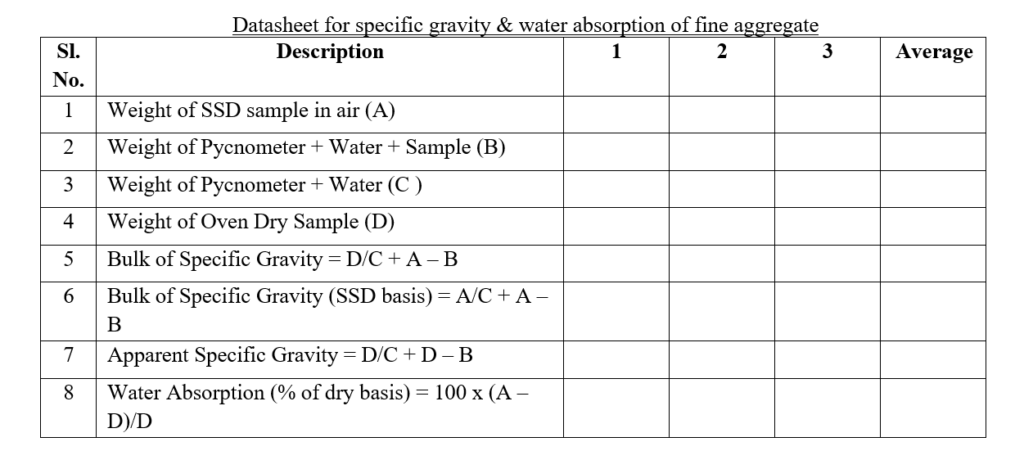
Observation Table – Pycnometer Method
| Observation | Symbol | Value |
|---|---|---|
| SSD aggregate mass | A | 500 g |
| Pycnometer + aggregate + water | B | 1810 g |
| Pycnometer + water only | C | 1500 g |
| Oven-dry aggregate mass | D | 490 g |
| Specific gravity | — | 2.58 |
| Apparent specific gravity | — | 2.72 |
| Water absorption | — | 2.04% |
Specific Gravity and Water Absorption of Coarse Aggregate by Wire Basket Method
For aggregate larger than 10 mm, IS 2386 Part III Method I uses the wire-basket procedure.
Sample Quantity
A sample of not less than:
2,000 g
should be tested.
Two tests should be carried out.
Apparatus for Wire Basket Method
The main apparatus includes:
- balance of at least 3 kg capacity;
- arrangement for weighing the suspended basket in water;
- oven maintained at 100°C to 110°C;
- wire basket with mesh not greater than 6.3 mm;
- watertight container;
- absorbent cloths;
- shallow tray; and
- airtight container.
IS 2386 Part III specifies a wire basket of not more than 6.3 mm mesh, not a fixed 2.36 mm mesh.
Procedure for Coarse Aggregate
Step 1: Wash the Sample
Wash the aggregate thoroughly to remove fine particles and dust.
Drain excess water.
Step 2: Place in Wire Basket
Place the washed aggregate in the wire basket.
Immerse the basket completely in distilled water maintained at:
22°C to 32°C
Provide at least:
50 mm of water above the top of the basket.
Step 3: Remove Entrapped Air
Immediately after immersion, lift the basket approximately:
25 mm
above the base of the tank and allow it to drop.
Repeat:
25 times
at approximately:
one drop per second.
The basket and sample should remain completely immersed during this procedure.
Step 4: Soak the Aggregate
Keep the aggregate completely immersed for:
24 ± ½ hours
after the initial air-removal operation.
Step 5: Determine Mass in Water
After the soaking period, jolt the basket as specified and determine the submerged mass.
The mass of the empty basket in water is also determined.
The difference gives:
A = mass of saturated aggregate in water
Step 6: Determine SSD Mass in Air
Remove the aggregate from the basket and allow it to drain.
Gently surface-dry the aggregate using absorbent cloth.
Spread the particles no more than one stone deep and allow them to reach the SSD condition away from direct sunlight or other heat.
Weigh:
B = mass of saturated surface-dry aggregate in air
Step 7: Oven-Dry the Aggregate
Place the aggregate in the oven at:
100°C to 110°C
for:
24 ± ½ hours
Cool the specimen in an airtight container.
Weigh:
C = mass of oven-dried aggregate in air
The procedure and SSD preparation requirements are specified in Method I of IS 2386 Part III.
Formula for Coarse Aggregate – Wire Basket Method
Specific Gravity
Specific Gravity = C ÷ (B − A)
Apparent Specific Gravity
Apparent Specific Gravity = C ÷ (C − A)
Water Absorption
Water Absorption (%) = [100 × (B − C)] ÷ C
where:
A = mass of saturated aggregate in water
B = mass of saturated surface-dry aggregate in air
C = mass of oven-dried aggregate in air
These are the Method I formulas specified in IS 2386 Part III.
Worked Example – Coarse Aggregate
Suppose:
A = Saturated aggregate mass in water = 1240 g
B = SSD aggregate mass in air = 2000 g
C = Oven-dry aggregate mass = 1980 g
Specific Gravity
Specific Gravity = C ÷ (B − A)
= 1980 ÷ (2000 − 1240)
= 1980 ÷ 760
≈ 2.61
Apparent Specific Gravity
Apparent Specific Gravity = 1980 ÷ (1980 − 1240)
= 1980 ÷ 740
≈ 2.68
Water Absorption
Water Absorption = [100 × (2000 − 1980)] ÷ 1980
= 2000 ÷ 1980
≈ 1.01%
Result
Specific gravity:
2.61
Apparent specific gravity:
2.68
Water absorption:
1.01%
Observation Table – Coarse Aggregate
| Observation | Symbol | Result |
|---|---|---|
| Saturated aggregate mass in water | A | 1240 g |
| SSD aggregate mass in air | B | 2000 g |
| Oven-dry aggregate mass | C | 1980 g |
| Specific gravity | — | 2.61 |
| Apparent specific gravity | — | 2.68 |
| Water absorption | — | 1.01% |
Pycnometer Method vs Wire Basket Method
| Parameter | Pycnometer Method | Wire Basket Method |
|---|---|---|
| IS method | Method III | Method I |
| Main aggregate size | Smaller than 10 mm | Larger than 10 mm |
| Typical use | Fine/small aggregate | Coarse aggregate |
| Principal apparatus | Pycnometer | Wire basket |
| Soaking period | 24 ± ½ h | 24 ± ½ h |
| Water temperature | 22–32°C | 22–32°C |
| Oven temperature | 100–110°C | 100–110°C |
| Results | SG, apparent SG, absorption | SG, apparent SG, absorption |
Why Is SSD Condition Important?
SSD stands for:
Saturated Surface Dry
In this condition:
- water has filled the permeable aggregate pores;
- there is no free water on the outer surface.
SSD is important because concrete mix calculations distinguish between:
water inside aggregate pores
and:
free water available to the concrete mix.
If an aggregate is drier than SSD, it may absorb some of the batch water.
If the aggregate is wetter than SSD, surface moisture contributes additional water to the concrete.
Therefore, proper moisture correction is necessary to maintain the intended effective water-cement ratio.
Specific Gravity in Concrete Mix Design
Aggregate specific gravity is used to convert aggregate mass into absolute volume.
In simplified form:
Absolute Volume = Aggregate Mass ÷ (Specific Gravity × Density of Water)
Therefore, an incorrect specific-gravity value can affect:
- calculated aggregate volume;
- total concrete yield;
- fine-to-coarse aggregate proportions; and
- trial-mix quantities.
This is why actual laboratory values should be used in concrete mix design rather than assuming one generic specific gravity for all aggregates.
Effect of Water Absorption on Concrete Mix Water
Assume an aggregate has:
Water absorption = 1.0%
and the aggregate is used in an oven-dry condition.
For:
1000 kg of aggregate
the water required to bring it theoretically to SSD is approximately:
10 kg
This water may be absorbed by the aggregate rather than remaining completely available for cement hydration and workability.
Actual batch-water correction should be based on the measured moisture condition of the aggregates at the time of batching.
Is Specific Gravity Always 2.65?
No.
A value near 2.65 is often used as an illustrative value for many natural aggregates, but it should not be assumed for every aggregate.
Specific gravity depends on:
- rock type;
- mineral composition;
- porosity;
- manufacturing process;
- recycled-material content; and
- aggregate source.
Concrete mix design should use the actual measured value for the material being used.
Is Water Absorption Below 2% Always Mandatory?
No.
It is common to see the statement:
“Aggregate water absorption must always be less than 2%.”
This should not be applied as a universal rule to every type of aggregate.
IS 2386 Part III is primarily a test-method standard. Acceptance requirements depend on the aggregate type, applicable edition of IS 383, project specification and intended application.
For example, IS 383:2016 provides additional requirements for several types of manufactured aggregates, and these requirements are not simply a universal 2% limit for all aggregate categories.
Therefore, report the measured water absorption accurately and compare it with the specification applicable to the actual material.
Specific Gravity vs Bulk Density
Specific gravity and bulk density are different properties.
Specific Gravity
Represents the density of the aggregate material relative to water.
It has:
no unit
Bulk Density
Represents the mass of aggregate occupying a given bulk volume, including:
- aggregate particles; and
- void spaces between particles.
Bulk density is commonly expressed in:
kg/m³
Therefore:
Specific Gravity ≠ Bulk Density
Factors Affecting Test Results
Important factors include:
- incomplete removal of entrapped air;
- incorrect SSD condition;
- moisture remaining on the particle surface;
- excessive drying beyond SSD;
- inaccurate pycnometer filling;
- difference in water temperature;
- loss of fine particles;
- insufficient soaking;
- incorrect oven temperature;
- incomplete drying; and
- weighing errors.
Precautions
For accurate test results:
- Use a representative aggregate sample.
- Wash the aggregate to remove dust and loose fine material where required.
- Use distilled water as specified in the test method.
- Maintain water temperature between 22°C and 32°C.
- Maintain the full 24 ± ½ hour soaking period.
- Remove all entrapped air carefully.
- Establish the SSD condition accurately.
- Do not overdry the sample while producing SSD condition.
- Do not lose fine particles during decantation.
- Keep the outside of the pycnometer dry before weighing.
- Fill the pycnometer to the same constant volume for each measurement.
- Keep the difference in water temperature between relevant pycnometer weighings within 2°C.
- Maintain oven temperature between 100°C and 110°C.
- Oven-dry for the specified period.
- Cool oven-dried aggregate in an airtight container.
- Use calibrated weighing equipment.
- Carry out the required repeat determinations.
- Record the aggregate grading along with the result.
Common Laboratory Errors
Using the Wrong Formula
The pycnometer and wire-basket methods use different symbols and equations.
Always identify the method before calculating the result.
Using Oven-Dry Aggregate Instead of SSD Aggregate for A
In the pycnometer Method III formula:
A represents the saturated surface-dry sample mass.
Leaving Air Bubbles Inside the Pycnometer
Entrapped air changes the apparent displaced-water volume and can significantly affect the calculated specific gravity.
Overdrying Fine Aggregate During SSD Preparation
The required point is just when the sample becomes free-running with no visible free surface moisture.
If internal pore water begins to evaporate, the sample is no longer SSD.
Using an Incorrect Wire Basket
For Method I, IS 2386 Part III specifies a basket with mesh not greater than 6.3 mm.
Assuming Every Aggregate Must Have SG = 2.65
Actual laboratory results should be used.
Applying a Universal Water-Absorption Limit
Acceptance criteria must be checked against the applicable aggregate specification and project requirements.
Practical Importance for Site and QA/QC Engineers
Specific gravity and water absorption values should be established for each approved aggregate source.
They are particularly important when:
- preparing concrete trial mixes;
- revising a mix design after changing aggregate source;
- calculating batch-water correction;
- investigating changes in concrete workability;
- comparing natural and manufactured aggregates; and
- monitoring aggregate quality over time.
If the source or geological characteristics of the aggregate change significantly, the engineer should consider whether the specific gravity and absorption values need to be re-established.
Sample Laboratory Report
| Item | Result |
|---|---|
| Project | __________ |
| Aggregate source | __________ |
| Aggregate type | Fine / Coarse |
| Aggregate size/grading | __________ |
| Test method | Pycnometer / Wire Basket |
| IS code | IS 2386 Part III |
| Date sampled | __________ |
| Date tested | __________ |
| SSD mass | __________ g |
| Oven-dry mass | __________ g |
| Specific gravity | __________ |
| Apparent specific gravity | __________ |
| Water absorption | __________ % |
| Trial 1 | __________ |
| Trial 2 | __________ |
| Mean result | __________ |
| Applicable specification | __________ |
| Tested by | __________ |
| Checked by | __________ |
Frequently Asked Questions
What is the specific gravity of aggregate?
Specific gravity is the ratio of the mass of a given volume of aggregate to the mass of an equal volume of water under specified test conditions.
Which IS code is used for specific gravity of aggregate?
IS 2386 (Part III):1963 covers determination of specific gravity, apparent specific gravity and water absorption of aggregates for concrete.
Which method is used for fine aggregate?
For aggregate smaller than 10 mm, IS 2386 Part III Method III uses a pycnometer or suitable constant-volume vessel.
Which method is used for coarse aggregate?
For aggregate larger than 10 mm, Method I uses the wire basket method.
How long is aggregate soaked in water?
The specified soaking period is:
24 ± ½ hours
under the relevant procedures.
What is SSD condition?
SSD means saturated surface dry. The aggregate pores contain water but the external surface has no free moisture.
What is the formula for water absorption?
Water Absorption (%) = [(SSD mass − Oven-dry mass) ÷ Oven-dry mass] × 100
What is the pycnometer specific-gravity formula?
Using the IS 2386 Part III notation:
Specific Gravity = D ÷ [A − (B − C)]
where A is SSD sample mass, B is pycnometer plus sample and water, C is pycnometer plus water, and D is oven-dry sample mass.
What is the wire-basket specific-gravity formula?
Specific Gravity = C ÷ (B − A)
where A is saturated aggregate mass in water, B is SSD aggregate mass in air and C is oven-dry aggregate mass.
Why is apparent specific gravity higher than specific gravity?
Apparent specific gravity excludes the volume of permeable pores from the aggregate volume, so it is normally greater than the bulk specific gravity for porous material.
Is 2.65 the standard specific gravity of aggregate?
No. Approximately 2.65 is a common illustrative value for many natural aggregates, but actual specific gravity varies with aggregate mineralogy, porosity and source.
Why is water absorption important in concrete?
Water absorption helps determine how much water an aggregate can absorb into its pores and is therefore important for moisture correction and effective mix-water control.
Is water absorption of aggregate limited to 2%?
A universal 2% limit should not be applied to every aggregate type. The measured result should be compared with the applicable material standard and project specification.
Key Points to Remember
- Test standard: IS 2386 Part III
- Aggregate >10 mm: Wire Basket Method
- Aggregate <10 mm: Pycnometer Method
- Soaking period: 24 ± ½ h
- Water temperature: 22–32°C
- Oven temperature: 100–110°C
- Pycnometer sample: approximately 1 kg for 10–4.75 mm
- Pycnometer sample: approximately 500 g below 4.75 mm
- Wire-basket sample: minimum 2 kg
- Wire-basket mesh: not greater than 6.3 mm
- Two determinations are required
- SSD condition must be established carefully
- Entrapped air must be completely removed
- Specific gravity has no unit
- Water absorption is expressed as a percentage of oven-dry mass
- Do not assume a universal SG of 2.65 or universal 2% absorption limit
Conclusion
Specific gravity and water absorption are essential aggregate properties used in laboratory quality control and concrete mix proportioning.
According to IS 2386 (Part III):1963, different procedures are used according to aggregate particle size.
For aggregate smaller than 10 mm, the pycnometer method determines specific gravity, apparent specific gravity and water absorption from SSD, displaced-water and oven-dry measurements.
For aggregate larger than 10 mm, the wire basket method determines the same properties using submerged, SSD and oven-dry masses.
Correct identification of the SSD condition, complete removal of trapped air, accurate weighing and controlled soaking and drying are critical for obtaining reliable results.
Engineers should use actual laboratory specific-gravity and absorption results during concrete mix design and moisture correction rather than relying on assumed values.
Acceptance of an aggregate should always be based on the applicable material specification, approved project requirements and the actual aggregate type being supplied.
References
- IS 2386 (Part III):1963 – Methods of Test for Aggregates for Concrete: Specific Gravity, Density, Voids, Absorption and Bulking.
- IS 383:2016 – Coarse and Fine Aggregate for Concrete – Specification.
- Applicable concrete mix-design standards, approved project specifications and laboratory quality procedures.
- Latest applicable amendments and revisions should be verified before contractual material acceptance.
Datasheet for specific gravity & water absorption of fine aggregate