 by
by Page Contents
Introduction
The compressive strength test of cement is one of the most important physical tests used to assess the quality and strength development of hydraulic cement.
Cement itself is not tested as a neat solid cube. Instead, its compressive strength is determined using standard cement mortar cubes prepared with cement and standard sand in specified proportions.
In India, the test is carried out according to IS 4031 (Part 6):1988 – Methods of Physical Tests for Hydraulic Cement: Determination of Compressive Strength of Hydraulic Cement Other Than Masonry Cement.
The test helps determine whether cement develops the minimum compressive strength required for its type and grade.
What Is Compressive Strength of Cement?
Compressive strength of cement is the maximum compressive stress that a standard cement mortar specimen can withstand before failure.
It is calculated as:
Compressive Strength = Maximum Load at Failure ÷ Loaded Area
The result is normally expressed in:
N/mm², which is numerically equal to MPa.
For example:
40 N/mm² = 40 MPa
Why Is Cement Tested Using Mortar Cubes?
Cement powder cannot be tested directly in compression.
If neat cement paste were used, the result would be highly influenced by:
- shrinkage;
- cracking;
- water content;
- compaction;
- specimen preparation; and
- paste characteristics.
Therefore, cement is tested using a standardized mortar made with:
1 part cement : 3 parts standard sand by mass
This provides a reproducible method for comparing cement strength.
IS Code for Compressive Strength of Cement
The main Indian Standard is:
IS 4031 (Part 6):1988
This standard covers determination of the compressive strength of hydraulic cement other than masonry cement using mortar cubes compacted by a standard vibration machine.
Other related standards include:
IS 650 – Standard sand for testing cement.
IS 10080 – Moulds and associated equipment used for cement and concrete tests.
IS 4031 (Part 4) – Determination of standard consistency of cement paste.
For Ordinary Portland Cement, the product specification is:
IS 269:2015 – Ordinary Portland Cement – Specification.
Size of Cube Used for Cement Compressive Strength Test
The nominal cube size is:
70.6 mm × 70.6 mm × 70.6 mm
IS 4031 Part 6 specifies a 70.6 mm cube mould conforming to the applicable apparatus standard.
The nominal loaded area is approximately:
70.6 × 70.6 = 4,984 mm²
which is approximately:
5,000 mm²
However, for accurate calculation, the standard requires the cross-sectional area to be determined from the mean dimensions of the specimen.
Materials Required
The test requires:
- Cement sample
- Standard sand conforming to the applicable standard
- Potable or distilled water
The standard sand helps ensure that differences in strength are mainly due to cement properties rather than variations in natural sand.
Apparatus Required
The main apparatus includes:
- 70.6 mm cube mould
- vibration machine
- poking rod
- gauging trowel
- weighing balance
- graduated measuring cylinder
- non-porous mixing plate
- moist room or moist cabinet
- water-curing tank
- compression testing machine
The testing equipment should be properly maintained and calibrated.
Laboratory Temperature and Humidity
During specimen preparation:
Temperature of materials, water and moulding room = 27 ± 2°C
The laboratory relative humidity should be:
65 ± 5%
The moist room or moist cabinet should be maintained at:
27 ± 2°C
with relative humidity:
not less than 90%.
Mix Proportion for Cement Compressive Strength Test
For each cube, IS 4031 Part 6 specifies:
Cement = 200 g
Standard sand = 600 g
Therefore:
Cement : Standard sand = 1 : 3 by mass
The material for each cube is mixed separately.
Water Required for the Test
One of the most important points is that the water quantity is not simply a fixed water-cement ratio such as 0.40.
The water is calculated using the standard-consistency value.
The formula is:
Water = (P/4 + 3.0)% of the combined mass of cement and standard sand
Where:
P = percentage of water required to produce cement paste of standard consistency
For one cube:
Cement = 200 g
Standard sand = 600 g
Combined mass:
200 + 600 = 800 g
Therefore:
Water = (P/4 + 3.0)% × 800 g
This is the water requirement specified in IS 4031 Part 6.
Example Calculation of Water
Assume the standard consistency of cement is:
P = 30%
Then:
Water percentage = (30/4 + 3)
= 7.5 + 3
= 10.5%
Combined cement and sand mass:
= 800 g
Therefore:
Water = 10.5/100 × 800
Water = 84 g
So, for this example:
- Cement = 200 g
- Standard sand = 600 g
- Water = 84 g
Important
Do not use a fixed water-cement ratio unless it is specifically required by the applicable test method.
The correct IS method relates the water quantity to the standard consistency P.
Preparation of Cement Mortar
Step 1: Weigh the Materials
For one cube, weigh:
200 g cement
and
600 g standard sand
Calculate the required water using:
(P/4 + 3.0)% of combined cement and sand mass
Step 2: Dry Mixing
Place the cement and standard sand on a clean, non-porous plate.
Mix them dry using a trowel for approximately:
1 minute
until the mixture appears uniform.
Step 3: Add Water
Add the calculated quantity of water.
Continue mixing until a uniform mortar is obtained.
The total mixing time should not be less than:
3 minutes
If a uniform colour is not obtained within:
4 minutes
the mix should be rejected and a fresh batch prepared.
Preparation of Cube Mould
Before casting:
- Clean the mould thoroughly.
- Apply a thin film of petroleum jelly to the joints between mould halves.
- Apply petroleum jelly between the mould and base plate to prevent water leakage.
- Apply a thin coating of mould oil to the internal faces.
- Assemble and clamp the mould securely.
Correct mould preparation helps prevent leakage and dimensional defects.
Casting Procedure
Step 1: Position the Mould
Place the assembled mould on the vibration-machine table.
Clamp it firmly.
Attach the hopper to the top of the mould.
Step 2: Place First Portion of Mortar
Immediately after mixing, place part of the mortar into the mould.
Prod the mortar:
20 times in approximately 8 seconds
to help remove entrained air and avoid honeycombing.
Step 3: Add Remaining Mortar
Add the remaining mortar.
Again prod it:
20 times
in the prescribed manner.
Step 4: Vibrate the Cube
Compact the mortar using the standard vibration machine.
The vibration period is:
2 minutes
at:
12,000 ± 400 vibrations per minute.
Step 5: Finish the Surface
After vibration:
- remove the mould from the vibration machine;
- smooth the top surface using a trowel; and
- identify the specimen properly.
Initial Curing of Cement Mortar Cubes
Keep the filled moulds in a moist cabinet or moist room.
The amended requirement is:
24 ± 1 hours
after completion of vibration.
After this period:
- remove the cubes carefully from the moulds;
- immediately place them in clean fresh water.
Water Curing
After demoulding, the cubes are completely submerged in clean fresh water.
Water temperature:
27 ± 2°C
The curing water should be renewed:
every 7 days.
The cubes should remain immersed until immediately before testing.
After removal from water, they must not be allowed to dry before testing.
Number of Cubes Required
For each required test age:
Three cubes are tested
under IS 4031 Part 6.
For example, if cement is to be tested at:
- 3 days
- 7 days
- 28 days
then normally:
3 cubes × 3 ages = 9 cubes
are required.
The actual test ages depend on the applicable cement specification.
Testing of Cement Mortar Cubes
Step 1: Remove Cube from Water
Take the cube from the curing tank immediately before testing.
Do not allow it to become dry.
Step 2: Position the Cube
Place the cube in the compression testing machine.
The cube is tested:
on its sides
without packing between the specimen and steel platens.
Step 3: Apply Load
Apply load continuously and uniformly from zero.
The loading rate should be:
35 N/mm²/min.
Continue loading until the specimen fails.
Step 4: Record Maximum Load
Record the maximum load carried by the cube.
Formula for Compressive Strength of Cement
Compressive Strength = P / A
Where:
P = maximum load at failure, N
A = loaded cross-sectional area of specimen, mm²
Result:
N/mm² or MPa
Example Calculation
Suppose:
Maximum load:
P = 200 kN
Convert to newtons:
200 kN = 200,000 N
Assume measured loaded area:
A = 5,000 mm²
Then:
Compressive Strength = 200,000 / 5,000
= 40 N/mm²
Therefore:
Compressive Strength = 40 MPa
Observation Table
| Cube | Failure Load | Loaded Area | Compressive Strength |
|---|---|---|---|
| Cube 1 | 200 kN | 5,000 mm² | 40.0 MPa |
| Cube 2 | 205 kN | 5,000 mm² | 41.0 MPa |
| Cube 3 | 195 kN | 5,000 mm² | 39.0 MPa |
Average strength:
(40 + 41 + 39) / 3
= 40 MPa
Therefore:
Average compressive strength = 40 MPa
Reporting of Test Result
IS 4031 Part 6 requires the measured compressive strength to be calculated from:
maximum applied load ÷ actual cross-sectional area
and expressed to the nearest:
0.5 N/mm².
The three specimen results should be examined before calculating the final result.
Acceptance of Individual Cube Results
Do not consider:
- visibly defective specimens; or
- specimens whose strength differs by more than 10% from the average strength of all test specimens.
If, after discarding unsuitable results, fewer than two valid strength results remain, the test should be repeated.
This is an important quality-control requirement and should not be omitted from laboratory reporting.
Compressive Strength Requirements of OPC
For normal OPC grades under IS 269:2015, the commonly specified minimum compressive strengths are:
| OPC Grade | 3-Day Strength | 7-Day Strength | 28-Day Strength |
|---|---|---|---|
| OPC 33 | 16 MPa | 22 MPa | 33 MPa |
| OPC 43 | 23 MPa | 33 MPa | 43 MPa |
| OPC 53 | 27 MPa | 37 MPa | 53 MPa |
The grade designation corresponds to the specified minimum 28-day compressive strength of standard cement mortar.
Always verify the latest edition, amendments and applicable cement specification before material acceptance.
What Does OPC 53 Mean?
OPC 53 does not mean that concrete made using the cement will automatically achieve 53 MPa.
It means that the cement must satisfy the prescribed compressive-strength requirement when tested using the standardized cement-mortar test method.
Concrete strength depends on many additional factors, including:
- water-cement ratio;
- aggregate quality;
- mix proportions;
- admixtures;
- mixing;
- compaction;
- curing; and
- concrete age.
Therefore:
Cement grade ≠ Concrete grade
Cement Strength vs Concrete Cube Strength
This is a very important distinction.
Cement Compressive Strength Test
Uses:
70.6 mm cement mortar cubes
Mix:
1 cement : 3 standard sand
Test standard:
IS 4031 Part 6
Purpose:
Assess strength of cement.
Concrete Compressive Strength Test
Commonly uses:
150 mm concrete cubes
Materials:
cement + fine aggregate + coarse aggregate + water + admixtures, where applicable.
Purpose:
Assess compressive strength of concrete.
Therefore, a cement mortar cube test and concrete cube test are different tests.
Why 70.6 mm Cube Is Used
The nominal 70.6 mm cube provides a loaded area close to:
5,000 mm²
This specimen size is suitable for standard cement mortar and allows convenient testing while limiting material requirements.
It also provides a standardized specimen geometry for comparing different cement samples.
Why Standard Sand Is Used
Natural sand varies in:
- grading;
- particle shape;
- mineral composition;
- surface texture;
- moisture; and
- impurities.
Such variations could significantly affect mortar strength.
Using standardized sand reduces this variability and makes cement test results more comparable.
Why Three Cubes Are Tested
Testing three specimens provides a more reliable estimate of the strength than using a single cube.
It also helps identify:
- casting defects;
- compaction problems;
- abnormal specimen results; and
- testing variation.
Factors Affecting Cement Compressive Strength
Several factors can affect the measured result.
Cement Composition
Different clinker minerals influence early and later strength development.
Cement Fineness
Finer cement generally hydrates more rapidly and may develop early strength more quickly.
Water Content
Incorrect water quantity can significantly affect mortar strength.
Standard Sand
Use of non-standard or improperly graded sand can invalidate the test.
Mixing Time
Insufficient or excessive mixing can affect uniformity.
Compaction
Inadequate compaction increases voids and lowers measured strength.
Curing Temperature
Incorrect curing temperature can change hydration and strength development.
Specimen Moisture
Allowing cubes to dry before testing can affect results.
Loading Rate
Applying load too quickly or too slowly can alter measured compressive strength.
Common Errors in the Test
Using a Fixed Water-Cement Ratio
The IS test does not simply use a fixed w/c ratio such as 0.40.
The required water depends on:
P = standard consistency
and is calculated using:
(P/4 + 3.0)% of the combined cement and sand mass
Using Ordinary River Sand
Use the specified standard sand, not uncontrolled natural sand.
Casting All Cubes from One Uncontrolled Batch
IS 4031 Part 6 states that the material for each cube is mixed separately.
Using 50 mm or 150 mm Cubes
The standard cement mortar specimen is a:
70.6 mm cube
Using Concrete Cube Loading Procedure Without Verification
Cement mortar cubes should be loaded according to the requirements of IS 4031 Part 6.
Allowing Cubes to Dry
Specimens should remain wet until immediately before testing.
Precautions
- Use a representative cement sample.
- Use standard sand conforming to the applicable standard.
- Determine standard consistency correctly.
- Calculate water accurately.
- Maintain the test-room temperature at 27 ± 2°C.
- Maintain proper laboratory humidity.
- Use a clean, non-porous mixing surface.
- Mix cement and sand uniformly.
- Follow the specified mixing time.
- Prevent loss of mortar during transfer.
- Oil mould surfaces correctly.
- Prevent leakage through mould joints.
- Compact each specimen properly.
- Maintain vibration at the specified frequency and duration.
- Keep moulds in the moist environment for 24 ± 1 h.
- Cure cubes at 27 ± 2°C.
- Renew curing water periodically.
- Do not allow specimens to dry before testing.
- Align cubes properly in the CTM.
- Apply load uniformly at the specified rate.
- Record individual cube results.
- Check for abnormal results before calculating the final average.
Practical Importance for QA/QC Engineers
The cement compressive-strength test is useful for:
- cement acceptance;
- verification of manufacturer test certificates;
- laboratory quality control;
- investigation of cement-related strength problems;
- comparison between cement batches; and
- confirming compliance with the applicable cement specification.
However, cement compressive strength should not be used alone to assess overall cement quality.
Other tests may include:
- fineness;
- standard consistency;
- setting time;
- soundness;
- chemical tests; and
- other requirements depending on the cement specification.
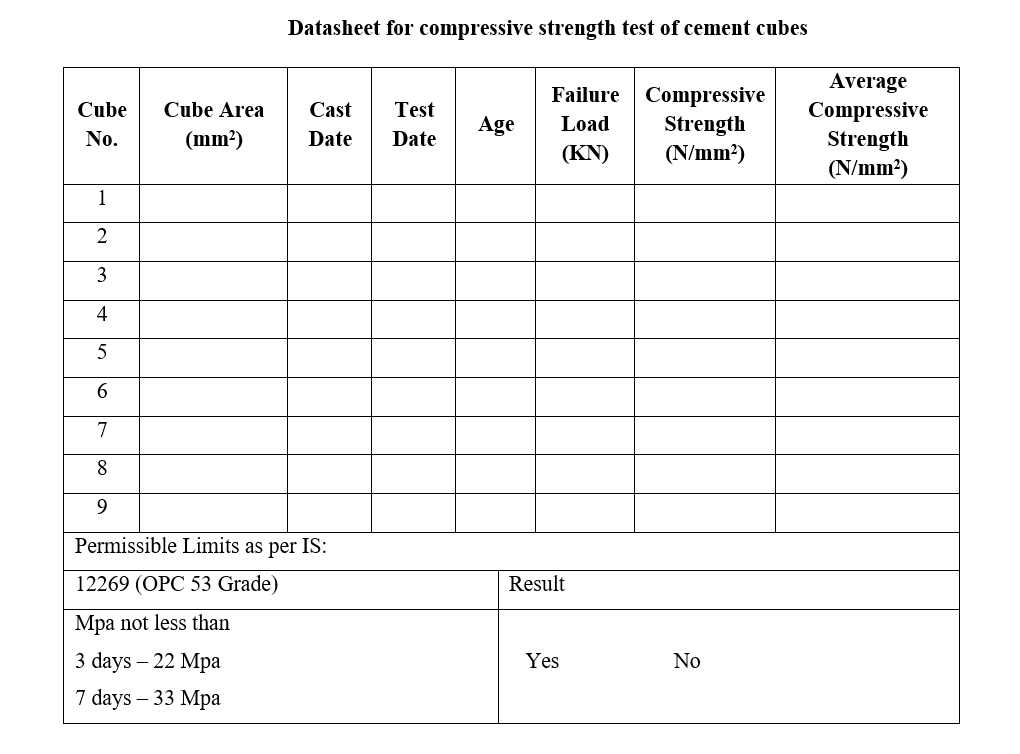
Sample Laboratory Test Report
Project: __________
Cement manufacturer: __________
Cement type: __________
Cement grade: __________
Batch/Lot number: __________
Date received: __________
Date cast: __________
Test age: __________
Standard consistency, P: __________ %
Cement per cube: 200 g
Standard sand per cube: 600 g
Calculated water: __________ g
Cube size: 70.6 mm
Cube 1 strength: __________ MPa
Cube 2 strength: __________ MPa
Cube 3 strength: __________ MPa
Average strength: __________ MPa
Applicable requirement: __________ MPa
Result: Pass / Fail as applicable
Tested by: __________
Checked by: __________
Frequently Asked Questions
What is the compressive strength of cement?
It is the compressive stress carried by a standard cement mortar cube at failure when tested under specified conditions.
Which IS code is used for compressive strength of cement?
IS 4031 (Part 6):1988 covers determination of compressive strength of hydraulic cement other than masonry cement.
What cube size is used for cement compressive strength?
A nominal:
70.6 mm × 70.6 mm × 70.6 mm
mortar cube is used.
What is the cement-to-sand ratio?
The standard mortar uses:
1 : 3
cement to standard sand by mass.
How much cement and sand are used for one cube?
For each cube:
Cement = 200 g
Standard sand = 600 g
How much water is required?
Water is calculated as:
(P/4 + 3.0)% of the combined mass of cement and standard sand
where P is the standard-consistency water percentage.
How many cubes are tested?
Three cubes are tested for each specified curing age.
What is the loading rate?
The load is applied uniformly at:
35 N/mm²/min
under IS 4031 Part 6.
What is the formula for compressive strength?
Compressive Strength = Maximum Load / Loaded Area
Is cement strength the same as concrete strength?
No.
Cement strength is measured on standardized cement mortar cubes, whereas concrete strength is measured on concrete specimens containing cement, aggregates and water.
What does OPC 53 mean?
It means the cement is required to achieve the specified minimum 28-day compressive strength for OPC 53 when tested using the standard cement-mortar procedure.
It does not mean that every concrete made with OPC 53 will achieve 53 MPa.
Why is standard sand used?
Standard sand reduces variation due to natural sand properties and makes cement test results more reproducible.
Key Points to Remember
- Test standard: IS 4031 Part 6
- Cube size: 70.6 mm
- Cement : standard sand = 1 : 3
- Cement per cube = 200 g
- Standard sand per cube = 600 g
- Water = (P/4 + 3.0)% of combined mass
- Dry mixing ≈ 1 minute
- Total mixing = 3–4 minutes
- Prodding = 20 strokes per layer
- Vibration = 2 minutes
- Vibration frequency = 12,000 ± 400/min
- Initial moist curing = 24 ± 1 h
- Water curing temperature = 27 ± 2°C
- Three cubes per test age
- Loading rate = 35 N/mm²/min
- Result = Load / actual loaded area
- Report strength to the required precision
- Cement grade and concrete grade are different
Conclusion
The compressive strength test of cement is a standardized laboratory test used to determine the strength development of hydraulic cement.
According to IS 4031 (Part 6):1988, cement is tested in the form of 70.6 mm mortar cubes prepared using cement and standard sand in a 1:3 ratio by mass.
For each cube, 200 g of cement and 600 g of standard sand are mixed with water calculated from the cement’s standard consistency.
The cubes are compacted using a standard vibration machine, initially cured in a moist environment, then submerged in water at 27 ± 2°C, and tested at the ages required by the applicable cement specification.
The compressive strength is calculated by dividing the maximum failure load by the loaded cross-sectional area.
Engineers should always distinguish between cement mortar strength and concrete compressive strength, and the final cement acceptance decision should be based on the applicable cement specification, latest amendments and project requirements.
References
- IS 4031 (Part 6):1988 – Methods of Physical Tests for Hydraulic Cement: Determination of Compressive Strength of Hydraulic Cement Other Than Masonry Cement.
- IS 4031 (Part 4) – Determination of Consistency of Standard Cement Paste.
- IS 650 – Standard Sand for Testing Cement.
- IS 269:2015 – Ordinary Portland Cement – Specification.
- Applicable project specifications and latest amendments to relevant standards.
Datasheet for compressive strength test of cement cubes