 by
by Entrapped air is a small but important part of concrete mix design.
When concrete ingredients are mixed together, a certain amount of air remains naturally trapped inside the fresh concrete.
This air occupies volume.
Therefore, when designing concrete for 1 m³, the air volume must be considered before calculating the quantity of fine and coarse aggregate.
Ignoring entrapped air can cause the calculated ingredient volumes to exceed one cubic metre and can lead to incorrect aggregate quantities.
IS 10262:2019 therefore provides approximate entrapped-air values for normal non-air-entrained concrete based on the nominal maximum size of aggregate.
This article explains:
- what entrapped air is;
- the IS 10262:2019 values;
- how entrapped air is included in the absolute-volume calculation;
- the difference between entrapped and entrained air;
- how actual air-content data may be used;
- common calculation mistakes; and
- worked examples for concrete mix design.
For the complete learning sequence, visit our Concrete Mix Design Hub and Concrete Mix Design Procedure as per IS 10262:2019.
Page Contents
What Is Entrapped Air in Concrete?
Entrapped air is air that becomes unintentionally trapped inside concrete during:
- mixing;
- transportation;
- placing; and
- compaction.
These air voids are generally irregular in shape and relatively larger than intentionally entrained microscopic air bubbles.
Even when concrete is properly compacted, a small amount of entrapped air may remain.
In mix proportioning, this expected air volume must be included in the one-cubic-metre volume balance.
Why Entrapped Air Matters in Concrete Mix Design
Concrete mix design is normally calculated for:
1 m³ of compacted concrete
That one cubic metre contains the combined absolute volumes of:
- cement;
- supplementary cementitious materials;
- water;
- chemical admixture;
- fine aggregate;
- coarse aggregate; and
- air.
Therefore:
Total volume of all ingredients + air = 1 m³
If the air volume is ignored, too much volume may be allocated to the solid ingredients.
This is particularly important when calculating fine and coarse aggregate using the absolute-volume method.
For the complete calculation method, see our Absolute Volume Method for Concrete Mix Design.
Entrapped Air Values as per IS 10262:2019
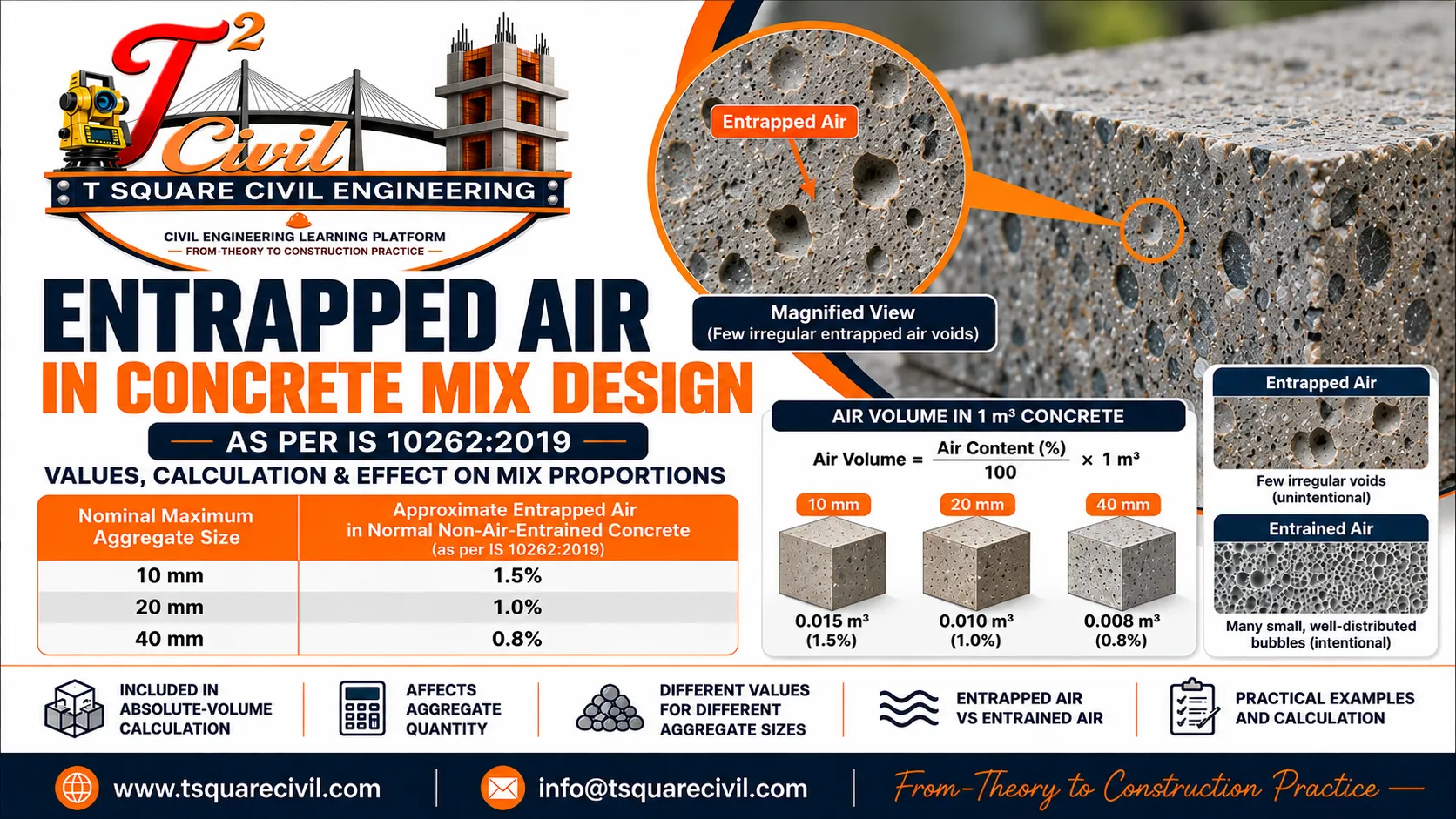
For ordinary and standard grades of normal non-air-entrained concrete, IS 10262:2019 provides approximate entrapped-air values based on the nominal maximum size of aggregate. High-strength concrete of grade M65 and above is covered separately in Section 3 of the standard.
| Nominal Maximum Aggregate Size | Approximate Entrapped Air |
|---|---|
| 10 mm | 1.5% |
| 20 mm | 1.0% |
| 40 mm | 0.8% |
These values are expressed as a percentage of the total volume of concrete.
Therefore, they must be converted to cubic metres before being used in the absolute-volume calculation.
Converting Air Percentage to Volume
The calculation is:
Air Volume = Air Content (%) ÷ 100 × 1 m³
For one cubic metre of concrete:
For 10 mm Aggregate
Entrapped air = 1.5%
Air volume:
1.5 ÷ 100 = 0.015 m³
For 20 mm Aggregate
Entrapped air = 1.0%
Air volume:
1.0 ÷ 100 = 0.010 m³
For 40 mm Aggregate
Entrapped air = 0.8%
Air volume:
0.8 ÷ 100 = 0.008 m³
These volumes are deducted from the total one-cubic-metre concrete volume.
Why Smaller Aggregate Generally Has Higher Entrapped Air Allowance
Smaller nominal maximum aggregate size generally means that a larger number of individual particles are present within the concrete volume.
This results in:
- greater total particle surface area;
- more interfaces between particles;
- greater mortar requirement; and
- different packing characteristics.
Accordingly, IS 10262 provides different approximate air contents for different nominal maximum aggregate sizes.
Do not use one fixed air percentage for all aggregate sizes.
How Entrapped Air Enters the Absolute-Volume Calculation
The general volume balance is:
1 = Air + Cement + SCM + Water + Admixture + Fine Aggregate + Coarse Aggregate
Therefore:
Aggregate Volume = 1 − Air Volume − Volume of Cement − Volume of SCM − Volume of Water − Volume of Admixture
The remaining aggregate volume is then divided between:
- fine aggregate; and
- coarse aggregate.
For the aggregate split, see our Fine and Coarse Aggregate Proportioning in Concrete Mix Design.
Worked Example – Entrapped Air for 20 mm Aggregate
Suppose a concrete mix uses:
Nominal maximum aggregate size = 20 mm
Approximate entrapped air = 1.0%
Therefore:
Air volume = 1.0 ÷ 100
= 0.010 m³
Suppose the other calculated absolute volumes are:
Cementitious materials = 0.125 m³
Water = 0.160 m³
Chemical admixture = 0.003 m³
Then:
Total aggregate volume:
= 1 − (0.010 + 0.125 + 0.160 + 0.003)
= 1 − 0.298
= 0.702 m³
Therefore:
0.702 m³
is available for fine and coarse aggregate together.
The selected fine/coarse aggregate proportions are then applied to this volume.
Example of Fine and Coarse Aggregate Calculation
Suppose:
Total aggregate volume = 0.702 m³
Selected coarse aggregate fraction = 0.62
Fine aggregate fraction:
= 1 − 0.62
= 0.38
Therefore:
Coarse Aggregate Volume
0.702 × 0.62
= 0.4352 m³
Fine Aggregate Volume
0.702 × 0.38
= 0.2668 m³
If:
Specific gravity of coarse aggregate = 2.70
Specific gravity of fine aggregate = 2.65
then:
Coarse Aggregate Mass
0.4352 × 2.70 × 1000
= 1175 kg/m³ approximately
Fine Aggregate Mass
0.2668 × 2.65 × 1000
= 707 kg/m³ approximately
These are preliminary calculated quantities and must still be verified by trial mix.
What Happens If Entrapped Air Is Ignored?
Using the previous example, suppose the 1.0% air volume is accidentally ignored.
The calculated aggregate volume would become:
1 − (0.125 + 0.160 + 0.003)
= 0.712 m³
Correct aggregate volume:
0.702 m³
Difference:
0.712 − 0.702 = 0.010 m³
That difference is exactly the omitted air volume.
If an approximate aggregate specific gravity of 2.65 were considered merely to illustrate the scale of the error:
0.010 × 2.65 × 1000
≈ 26.5 kg
This does not mean the mix will always contain exactly 26.5 kg/m³ excess aggregate because the actual error is distributed between fine and coarse aggregate according to their proportions and specific gravities.
However, it demonstrates why air volume should not be ignored.
Entrapped Air vs Entrained Air
These two terms should not be confused.
Entrapped Air
Entrapped air:
- occurs naturally during mixing and placing;
- is not intentionally introduced;
- consists mainly of irregular air voids;
- is generally reduced by proper compaction; and
- is estimated during normal non-air-entrained concrete mix design.
Entrained Air
Entrained air:
- is intentionally introduced;
- normally uses an air-entraining admixture;
- consists of a controlled system of very small air bubbles;
- may be used for specific performance requirements; and
- requires appropriate mix-design and testing procedures.
Therefore:
Entrapped air ≠ Entrained air
The approximate IS 10262 entrapped-air values for normal concrete should not automatically be used as the target air content of intentionally air-entrained concrete.
Is Air Entrapment Always Undesirable?
Excessive uncontrolled entrapped air is generally undesirable because it can reduce concrete density and strength.
However, a small amount of entrapped air is naturally expected even in properly proportioned and compacted concrete.
This is why concrete mix design accounts for an approximate air volume instead of assuming:
Air content = 0%
The objective is not to claim that all air can be eliminated.
The objective is to properly account for the air expected in the concrete.
Effect of Entrapped Air on Concrete Strength
Excessive air voids can reduce the effective load-carrying area of hardened concrete.
Therefore, inadequate compaction can reduce strength even when:
- cement content is correct;
- water-cement ratio is correct; and
- concrete grade has been properly designed.
This is why laboratory trial specimens and structural concrete must be compacted properly.
Do not confuse:
air assumed for mix proportioning
with:
air caused by poor site compaction.
Poor compaction can create considerably more voids than the amount assumed in the mix-design calculation.
Entrapped Air and Concrete Density
Air has negligible mass compared with the solid and liquid concrete ingredients.
Therefore, increasing air content generally reduces the fresh and hardened concrete density.
If actual measured density differs significantly from the expected value, possible causes may include:
- variation in aggregate density;
- incorrect batching;
- excessive air;
- incorrect moisture correction;
- segregation;
- yield error; or
- material variation.
The cause should be investigated rather than automatically adjusting the mix.
Does Compaction Remove All Entrapped Air?
No.
Proper compaction removes a significant portion of undesirable trapped air, but normal concrete still contains a small residual air volume.
The mix-design air allowance represents this expected residual volume.
Poor compaction, however, can leave excessive voids and reduce concrete quality.
Entrapped Air and Workability
Concrete workability can influence how easily trapped air escapes during compaction.
A very stiff concrete may require greater compaction effort.
A highly unstable concrete may segregate rather than compact uniformly.
Therefore, adequate workability should be achieved through proper mix proportioning rather than uncontrolled addition of water.
For the initial water calculation, see our Water Content Calculation in Concrete Mix Design.
Effect of Superplasticizer
A superplasticizer can improve workability without requiring the same increase in free water.
Improved workability may assist placement and compaction when the complete mix remains cohesive.
However, admixture type and dosage can also influence fresh concrete behaviour.
The final dosage should therefore be established through trials.
See our detailed guide on Superplasticizer in Concrete Mix Design.
Entrapped Air and Pumped Concrete
Pumped concrete requires:
- adequate workability;
- cohesiveness;
- suitable aggregate grading;
- appropriate mortar content; and
- stable flow through the pumping line.
The entrapped-air allowance remains part of the volume calculation.
Pumpability adjustments should not be made by deleting the air allowance from the concrete volume balance.
Instead, adjust the appropriate:
- coarse/fine aggregate proportion;
- water;
- admixture;
- paste content; and
- trial-mix variables.
Actual Air Content Instead of Tabulated Values
IS 10262 allows actual air-content values to be considered when reliable data for similar concrete are available.
This can be useful where a concrete producer has established consistent historical data for:
- similar materials;
- similar mix proportions;
- similar production equipment; and
- similar concrete conditions.
The data should be technically representative.
Do not replace the standard approximate value with one isolated test result.
Minimum Number of Previous Results
Where actual air-content data are adopted under the IS 10262 provision, the standard refers to site data based on at least five results for similar concrete.
Therefore, one or two isolated air-content measurements should not be treated as a reliable established value for mix proportioning.
The data should reflect similar concrete and production conditions.
High-Strength Concrete Requires Separate Attention
IS 10262:2019 provides a separate mix-proportioning procedure for high-strength concrete of grade M65 and above.
The approximate entrapped-air values given for high-strength normal non-air-entrained concrete are:
| Nominal Maximum Aggregate Size | Approximate Entrapped Air |
|---|---|
| 10 mm | 1.0% |
| 12.5 mm | 0.8% |
| 20 mm | 0.5% |
These values are different from the values used for ordinary and standard grades.
Therefore, do not automatically apply:
10 mm = 1.5%
20 mm = 1.0%
40 mm = 0.8%
to M65-and-above concrete.
For high-strength concrete, use the applicable provisions of the high-strength section of IS 10262:2019 and verify the final proportions through trial mixes.
Where representative site data are available, the standard also permits actual air-content values to be adopted based on at least five results for a similar mix.
Air Content in the Concrete Mix Design Calculator
A concrete mix design calculator should deduct the applicable air volume before calculating total aggregate volume.
The calculation sequence is:
1 m³ concrete
minus
entrapped air
minus
cementitious-material volume
minus
water volume
minus
admixture volume
equals
volume available for total aggregate
You can use our Concrete Mix Design Calculator as per IS 10262:2019 for preliminary mix proportioning.
Calculator results should still be checked through laboratory trials.
Common Mistakes in Entrapped-Air Calculation
Using Old Air-Content Values
Do not copy values from old notes, old editions, coaching material or unrelated design examples without verifying the applicable IS 10262:2019 requirement.
Using the Same Air Percentage for Every Aggregate Size
Air content depends on nominal maximum aggregate size.
Ignoring Air Completely
The air volume occupies part of the one cubic metre and must be included in the volume balance.
Subtracting 1 Instead of 0.01
For 1% entrapped air:
Correct:
1% = 0.01 m³
Incorrect:
1% = 1 m³
Always convert percentage to decimal form.
Adding Air Mass
Air is considered as a volume allowance.
You do not add an “air mass” in kilograms to the batch.
Confusing Entrapped and Entrained Air
They are different concepts and should not be used interchangeably.
Using a High-Strength Concrete Air Value for Normal Concrete
Use the appropriate section of the mix-design standard.
Ignoring Actual Site Data
Where reliable established data exist and the applicable standard permits their use, actual air-content information can improve the representation of the real concrete.
Complete Example
Consider the following preliminary mix-design data:
Nominal maximum aggregate size = 20 mm
Entrapped air = 1.0%
Cement = 320 kg/m³
Specific gravity of cement = 3.15
GGBS = 100 kg/m³
Specific gravity of GGBS = 2.90
Water = 160 kg/m³
Admixture = 3.5 kg/m³
Specific gravity of admixture = 1.08
Step 1: Air Volume
1.0 ÷ 100 = 0.0100 m³
Step 2: Cement Volume
320 ÷ (3.15 × 1000)
= 0.1016 m³
Step 3: GGBS Volume
100 ÷ (2.90 × 1000)
= 0.0345 m³
Step 4: Water Volume
160 ÷ 1000
= 0.1600 m³
Step 5: Admixture Volume
3.5 ÷ (1.08 × 1000)
= 0.00324 m³ approximately
Step 6: Total Non-Aggregate Volume
= 0.0100 + 0.1016 + 0.0345 + 0.1600 + 0.00324
= 0.30934 m³
Step 7: Total Aggregate Volume
= 1 − 0.30934
= 0.69066 m³
Therefore:
0.69066 m³
is available for fine and coarse aggregate combined.
The selected aggregate fractions can now be applied.
This illustrates exactly why entrapped air must be included before calculating aggregate quantity.
Trial Mix Verification
The calculated entrapped-air value is part of preliminary mix proportioning.
The complete mix must still be verified through laboratory trials.
Check:
- slump;
- cohesiveness;
- segregation;
- bleeding;
- fresh concrete behaviour;
- density;
- compressive strength; and
- overall suitability.
Where actual air content is measured as part of project quality control, compare the test results with the applicable project requirements and established mix behaviour.
For the complete procedure, see our Concrete Trial Mix Procedure.
Practical Mix Design Sequence
Entrapped air fits into the concrete mix-design process as follows:
Design stipulations
↓
Material properties
↓
Target mean strength
↓
Water-cementitious ratio
↓
Entrapped air
↓
Water content
↓
Cementitious material content
↓
Fine/coarse aggregate proportion
↓
Absolute-volume calculation
↓
Moisture correction
↓
Trial mix
↓
Strength and workability verification
↓
Final mix approval
Entrapped air may appear to be a small input, but it affects the aggregate volume calculation directly.
Frequently Asked Questions
What is entrapped air in concrete?
Entrapped air is air unintentionally trapped in concrete during mixing, placing and compaction.
What is the entrapped air content for 20 mm aggregate as per IS 10262:2019?
For normal non-air-entrained concrete with 20 mm nominal maximum aggregate size, the approximate entrapped-air content is 1.0% by volume.
What is the entrapped air content for 10 mm aggregate?
The approximate value for normal non-air-entrained concrete is 1.5% by volume.
What is the entrapped air content for 40 mm aggregate?
The approximate value for normal non-air-entrained concrete is 0.8% by volume.
How is 1% air used in concrete mix design?
For one cubic metre of concrete:
1% air = 0.01 m³
This volume is deducted before calculating the volume available for aggregate.
Is entrapped air the same as entrained air?
No. Entrapped air occurs unintentionally, whereas entrained air is deliberately introduced as a controlled system of microscopic bubbles.
Why is air deducted in the absolute-volume method?
Air occupies part of the one-cubic-metre concrete volume. Therefore, that volume is not available to cement, water or aggregate.
Can actual air content be used instead of the approximate IS value?
Where applicable, reliable site data for similar concrete may be used in accordance with the mix-design procedure.
Does more entrapped air reduce concrete strength?
Excessive air voids can reduce concrete density and compressive strength. Proper compaction is therefore important.
Does vibration remove all air from concrete?
No. Proper vibration removes much of the undesirable trapped air, but a small residual air content remains.
Should entrapped air be added in kilograms?
No. Entrapped air is considered as a volume, not as a batch mass.
Related Concrete Mix Design Resources
Continue with these T Square Civil resources:
Concrete Mix Design Procedure as per IS 10262:2019
Concrete Mix Design Calculator as per IS 10262:2019
Absolute Volume Method for Concrete Mix Design
Water Content Calculation in Concrete Mix Design
Fine and Coarse Aggregate Proportioning in Concrete Mix Design
Superplasticizer in Concrete Mix Design
Moisture Correction in Concrete Mix Design
Conclusion
Entrapped air is a small but necessary component of concrete mix proportioning.
For normal non-air-entrained concrete, IS 10262:2019 provides approximate entrapped-air values based on nominal maximum aggregate size:
10 mm → 1.5%
20 mm → 1.0%
40 mm → 0.8%
The selected percentage must be converted into volume and deducted from one cubic metre before calculating the aggregate quantity.
For example:
1% entrapped air = 0.010 m³ per cubic metre of concrete
Ignoring this volume can lead to an incorrect aggregate calculation and disrupt the absolute-volume balance.
The correct approach is therefore:
select applicable air content → convert percentage to volume → deduct air from 1 m³ → calculate remaining ingredient volumes → determine aggregate volume → prepare trial mix → verify actual performance
Entrapped air should also not be confused with deliberately entrained air.
As with every part of concrete mix design, the calculated value is a starting point. The final mix should be verified using actual materials, laboratory trials and applicable project requirements.
Engineering note: Use the latest applicable Indian Standards, project specifications and reliable site data when finalizing air-content assumptions for concrete mix proportioning.