 by
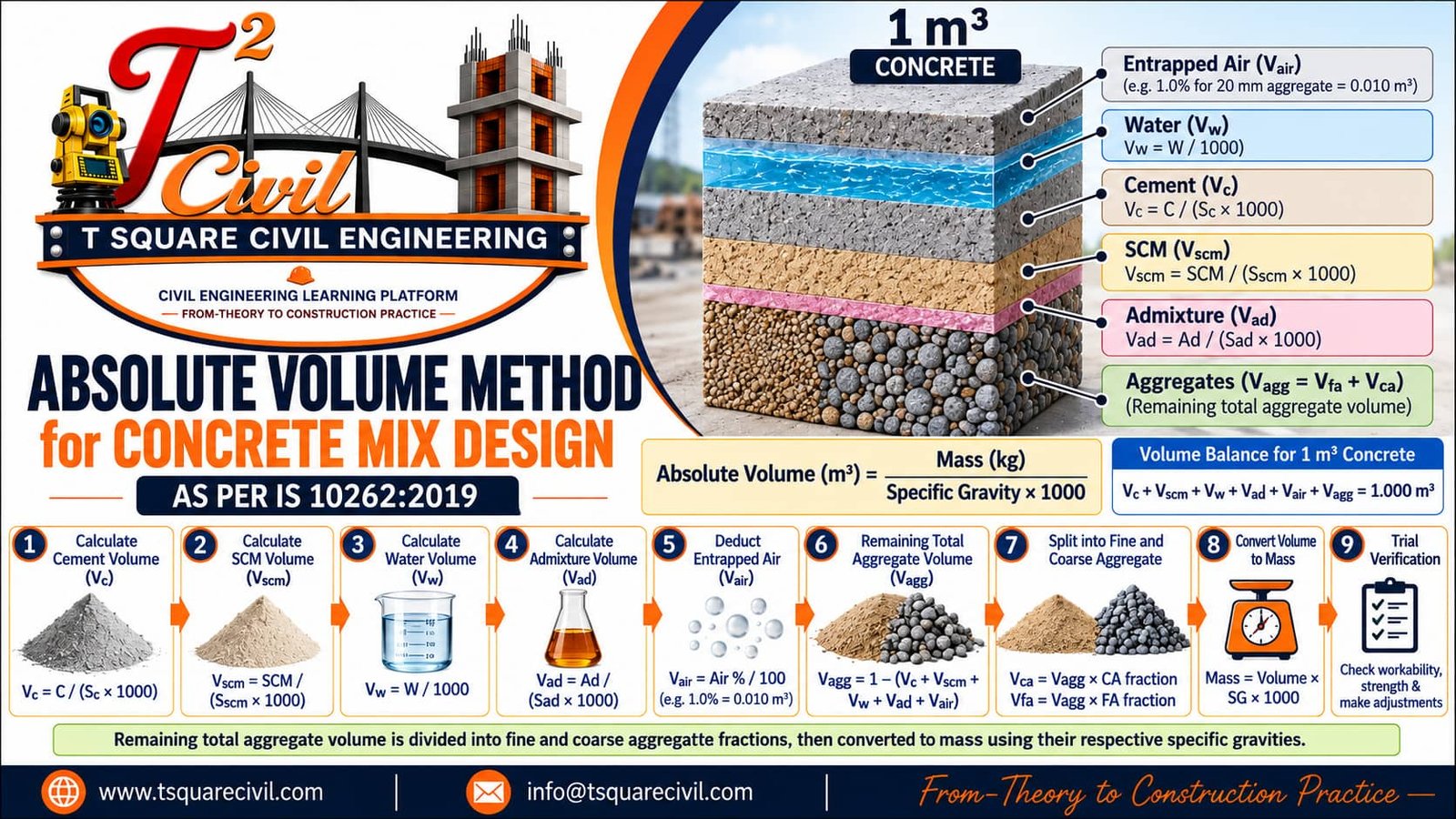
by The absolute volume method is an important part of concrete mix design because concrete ingredients are selected by mass, while the final concrete is required to occupy a specified volume.
For most mix-design calculations, the basis is:
1 m³ of concrete
Cement, supplementary cementitious materials, water, chemical admixtures, fine aggregate and coarse aggregate each occupy a certain absolute volume inside that one cubic metre.
The absolute volume method converts the mass of each ingredient into the actual volume occupied by that material using its specific gravity.
The general relationship is:
Absolute Volume = Mass ÷ (Specific Gravity × 1000)
After calculating the volumes occupied by cementitious materials, water, admixture and entrapped air, the remaining volume is available for fine and coarse aggregate.
This article explains the complete absolute-volume calculation step by step.
For the complete mix-design sequence, first read our Concrete Mix Design Procedure as per IS 10262:2019.
You can also perform preliminary calculations using the Concrete Mix Design Calculator as per IS 10262:2019.
Page Contents
What Is the Absolute Volume Method?
The absolute volume method determines the actual volume occupied by each concrete ingredient.
Two materials having the same mass do not necessarily occupy the same volume because their specific gravities can be different.
For example:
100 kg of cement
and
100 kg of fly ash
will generally occupy different absolute volumes if their specific gravities are different.
Therefore, concrete mix design should not be based only on the mass of ingredients.
The total occupied volume must also be checked.
For a one-cubic-metre concrete mix:
Volume of all ingredients + entrapped air = 1.000 m³
This volume balance is the basis of the absolute-volume method.
Why Is the Absolute Volume Method Required?
Concrete is normally batched by mass, but mix design is carried out for a required finished volume.
For example:
- cement is measured in kg;
- water is measured in kg or litres;
- fine aggregate is measured in kg;
- coarse aggregate is measured in kg; and
- admixture is measured in kg or litres.
Simply adding these masses does not tell us whether the ingredients will occupy exactly one cubic metre.
The absolute-volume method allows the designer to determine:
- volume occupied by cement;
- volume occupied by SCMs;
- volume occupied by water;
- volume occupied by chemical admixture;
- volume occupied by entrapped air;
- total aggregate volume;
- fine aggregate volume;
- coarse aggregate volume; and
- corresponding aggregate masses.
Basic Absolute Volume Formula
For a material:
Absolute Volume = Mass ÷ (Specific Gravity × Density of Water)
For practical concrete mix calculations, the density of water is taken approximately as:
1000 kg/m³
Therefore:
Absolute Volume = Mass ÷ (Specific Gravity × 1000)
Where:
Mass = quantity of material in kg
Specific Gravity = relative density of the material
Absolute Volume = volume occupied by the material in m³
Example of the Basic Formula
Suppose:
Cement mass = 315 kg
Specific gravity of cement = 3.15
Then:
Absolute volume of cement
= 315 ÷ (3.15 × 1000)
= 0.100 m³
Therefore, 315 kg of this cement occupies approximately:
0.100 m³
inside one cubic metre of concrete.
Step 1: Select the Concrete Volume Basis
Concrete mix design is normally calculated for:
1 m³ of concrete
Therefore:
Total design volume = 1.000 m³
All individual ingredient volumes must fit within this total volume.
The final relationship is:
Cement Volume + SCM Volume + Water Volume + Admixture Volume + Aggregate Volume + Air Volume = 1.000 m³
Step 2: Calculate the Volume of Cement
For cement:
Vc = C ÷ (Sc × 1000)
Where:
Vc = volume of cement in m³
C = mass of cement in kg
Sc = specific gravity of cement
Example
Cement:
320 kg/m³
Specific gravity:
3.15
Therefore:
Vc
= 320 ÷ (3.15 × 1000)
= 0.1016 m³
So:
Volume of cement ≈ 0.102 m³
The specific gravity should represent the actual proposed material rather than being assumed without verification.
The importance of material-specific values is explained in Material Tests Required Before Concrete Mix Design.
Step 3: Calculate the Volume of Supplementary Cementitious Materials
Where SCMs such as:
- fly ash;
- GGBS; or
- silica fume
are used, each material should normally be calculated separately using its own specific gravity.
The formula is:
Vscm = SCM Mass ÷ (SCM Specific Gravity × 1000)
Example With GGBS
Suppose:
GGBS = 80 kg/m³
Specific gravity of GGBS = 2.90
Then:
Vggbs
= 80 ÷ (2.90 × 1000)
= 0.0276 m³
Therefore:
GGBS volume ≈ 0.028 m³
Do not combine the cement and GGBS masses first and divide by the specific gravity of cement.
Each material can have a different specific gravity.
Why Cement and SCM Volumes Must Be Calculated Separately
Suppose:
Cement = 320 kg/m³
GGBS = 80 kg/m³
Total cementitious material:
= 400 kg/m³
It would be incorrect to calculate:
400 ÷ (3.15 × 1000)
if the GGBS specific gravity is different from the cement specific gravity.
Instead:
Cement volume
plus
GGBS volume
should be calculated separately.
This improves the accuracy of the paste-volume calculation.
For the calculation of total binder quantity before this stage, see Cementitious Material Content Calculation in Concrete Mix Design.
Step 4: Calculate the Volume of Water
The specific gravity of water is approximately:
1.00
Therefore:
Water Volume = Water Mass ÷ 1000
Suppose:
Free water:
160 kg/m³
Then:
Water volume
= 160 ÷ 1000
= 0.160 m³
Since 1 kg of water is approximately 1 litre for normal practical mix-design work:
160 kg ≈ 160 litres
However, the mix-design calculation should continue to use the appropriate free-water quantity.
For how the preliminary water value is selected, see Water Content Calculation in Concrete Mix Design as per IS 10262:2019.
Step 5: Calculate the Volume of Chemical Admixture
Chemical admixtures also occupy volume.
For a liquid admixture:
Vad = Admixture Mass ÷ (Specific Gravity × 1000)
Suppose:
Admixture quantity:
4.0 kg/m³
Specific gravity:
1.10
Then:
Vad
= 4 ÷ (1.10 × 1000)
= 0.00364 m³
Therefore:
Admixture volume ≈ 0.0036 m³
Even though the admixture volume is relatively small, it should not be ignored in a detailed mix calculation.
For dosage and water-reduction considerations, refer to Superplasticizer in Concrete Mix Design.
Important Note About Water in Liquid Admixtures
Liquid chemical admixtures occupy a measurable volume in the concrete and should be included in the absolute-volume calculation.
For a liquid admixture:
Admixture Volume = Admixture Mass ÷ (Specific Gravity of Admixture × 1000)
For example, if:
Admixture mass = 4.0 kg/m³
Specific gravity = 1.10
then:
Admixture volume
= 4.0 ÷ (1.10 × 1000)
= 0.00364 m³
Where a liquid admixture contributes an appreciable quantity of water, that water should also be considered when checking the final free-water content and water-cementitious materials ratio.
The same water should not be counted twice. The admixture volume calculation and free-water calculation should remain internally consistent.
For detailed guidance on admixture dosage and water reduction, see Superplasticizer in Concrete Mix Design.
Step 6: Allow for Entrapped Air
Entrapped air occupies part of the total volume of concrete and should therefore be considered before calculating the volume available for fine and coarse aggregates.
For ordinary and standard normal non-air-entrained concrete, the approximate entrapped-air contents used in IS 10262:2019 are:
| Nominal Maximum Aggregate Size | Approximate Entrapped Air |
|---|---|
| 10 mm | 1.5% |
| 20 mm | 1.0% |
| 40 mm | 0.8% |
The corresponding air volume is calculated as:
Entrapped Air Volume = Air Content (%) ÷ 100
For example, if the concrete uses:
Nominal maximum aggregate size = 20 mm
Entrapped air = 1.0%
then:
Air volume
= 1.0 ÷ 100
= 0.010 m³
Therefore, for the worked example in this article:
Entrapped Air Volume = 0.010 m³
This volume is deducted from the available one-cubic-metre concrete volume before determining the total aggregate volume.
These values should not automatically be applied to high-strength, air-entrained or other special concretes. For such concrete, use the applicable provisions of IS 10262:2019 and the project specification.
Entrapped Air and Air-Entrained Concrete Are Different
Entrapped air and intentionally entrained air should not be confused.
Entrapped Air
Small air voids remain naturally in normal concrete after mixing and compaction.
Entrained Air
Air-entraining admixtures intentionally introduce a controlled system of small air bubbles for specific performance requirements.
The applicable mix-design procedure should be followed where air-entrained concrete is required.
Step 7: Calculate the Volume Occupied by Non-Aggregate Ingredients
Suppose a preliminary concrete mix contains:
| Ingredient | Quantity | Specific Gravity |
|---|---|---|
| Cement | 320 kg/m³ | 3.15 |
| GGBS | 80 kg/m³ | 2.90 |
| Free Water | 160 kg/m³ | 1.00 |
| Admixture | 4 kg/m³ | 1.10 |
| Entrapped Air | 1.0% | — |
The calculated volumes are:
Cement
320 ÷ (3.15 × 1000)
= 0.1016 m³
GGBS
80 ÷ (2.90 × 1000)
= 0.0276 m³
Water
160 ÷ 1000
= 0.1600 m³
Admixture
4 ÷ (1.10 × 1000)
= 0.0036 m³
Air
= 0.0100 m³
Total occupied volume:
= 0.1016 + 0.0276 + 0.1600 + 0.0036 + 0.0100
= 0.3028 m³
Therefore:
Volume occupied before aggregates = 0.3028 m³
Step 8: Calculate the Total Aggregate Volume
For one cubic metre of concrete:
Total Aggregate Volume = 1 − Volume Occupied by Cementitious Materials, Water, Admixture and Air
Using the previous example:
Total aggregate volume:
= 1.000 − 0.3028
= 0.6972 m³
Therefore:
Total available aggregate volume ≈ 0.697 m³
This volume must now be divided between:
fine aggregate
and
coarse aggregate
Step 9: Divide Total Aggregate Volume Into Fine and Coarse Aggregate
The fine/coarse aggregate fractions should already have been selected from the applicable aggregate-proportioning procedure.
Suppose the final proportions are:
Coarse aggregate fraction:
0.64
Fine aggregate fraction:
0.36
Check:
0.64 + 0.36
= 1.00
The total available aggregate volume is:
0.6972 m³
Coarse Aggregate Volume
= 0.6972 × 0.64
= 0.4462 m³
Fine Aggregate Volume
= 0.6972 × 0.36
= 0.2510 m³
Check:
0.4462 + 0.2510
= 0.6972 m³
The volume balance is correct.
For the complete method of selecting these fractions, see Fine and Coarse Aggregate Proportioning in Concrete Mix Design.
Step 10: Convert Coarse Aggregate Volume to Mass
Suppose:
Coarse aggregate volume:
0.4462 m³
Specific gravity:
2.70
Then:
Coarse Aggregate Mass = Volume × Specific Gravity × 1000
= 0.4462 × 2.70 × 1000
≈ 1,205 kg/m³
Therefore:
Coarse aggregate ≈ 1,205 kg/m³
Step 11: Convert Fine Aggregate Volume to Mass
Suppose:
Fine aggregate volume:
0.2510 m³
Specific gravity:
2.65
Then:
Fine aggregate mass
= 0.2510 × 2.65 × 1000
≈ 665 kg/m³
Therefore:
Fine aggregate ≈ 665 kg/m³
Complete Absolute Volume Example
The preliminary mix now becomes approximately:
| Ingredient | Quantity |
|---|---|
| Cement | 320 kg/m³ |
| GGBS | 80 kg/m³ |
| Free Water | 160 kg/m³ |
| Fine Aggregate | 665 kg/m³ |
| Coarse Aggregate | 1,205 kg/m³ |
| Admixture | 4 kg/m³ |
The total cementitious material is:
320 + 80
= 400 kg/m³
The corresponding free-water/cementitious-material ratio is:
160 ÷ 400
= 0.40
These quantities represent an illustrative preliminary mix based on the stated assumptions.
They are not universal quantities for a particular grade of concrete.
Check the Absolute Volume Balance
A useful quality check is to convert all quantities back to volume.
Cement
320 ÷ (3.15 × 1000)
= 0.1016 m³
GGBS
80 ÷ (2.90 × 1000)
= 0.0276 m³
Water
= 0.1600 m³
Admixture
= 0.0036 m³
Fine Aggregate
665 ÷ (2.65 × 1000)
≈ 0.2509 m³
Coarse Aggregate
1,205 ÷ (2.70 × 1000)
≈ 0.4463 m³
Entrapped Air
= 0.0100 m³
Total:
≈ 1.000 m³
Small differences may occur because calculated masses are rounded.
This volume check is useful for identifying calculation errors.
Why Specific Gravity Is Critical
Specific gravity is one of the most important inputs in an absolute-volume calculation.
Consider two fine aggregates.
Fine Aggregate A
Specific gravity:
2.65
Fine Aggregate B
Specific gravity:
2.50
If both are required to occupy the same absolute volume, Aggregate B requires less mass because its specific gravity is lower.
Therefore, copying aggregate masses from another project can be misleading even when the concrete grade is the same.
Representative values should be used for the actual material source.
For aggregate testing, see Specific Gravity and Water Absorption of Aggregate.
Do Not Assume Every Aggregate Has a Specific Gravity of 2.65
A value such as 2.65 is frequently used in worked examples.
It should not automatically be used as the project value.
Actual aggregate specific gravity can differ because of:
- mineral composition;
- source;
- porosity;
- rock type; and
- manufacturing process.
Use representative test data wherever possible.
Absolute Volume of Mixed Coarse Aggregate Fractions
Concrete frequently contains more than one coarse aggregate fraction.
For example:
- 20 mm aggregate; and
- 10 mm aggregate.
The total coarse aggregate mass may be divided between the fractions according to the adopted combined grading.
If both fractions have approximately the same specific gravity, the distribution is relatively simple.
However, if their specific gravities differ meaningfully, each fraction should be considered carefully in the volume calculation.
A fixed 60:40 or 50:50 split should not be assumed without considering actual grading and trial behaviour.
Absolute Volume and Aggregate Moisture
The absolute-volume calculation for aggregates is normally based on the appropriate design moisture condition, commonly SSD for mix proportioning.
Actual site aggregates may be:
- dry;
- partially dry;
- SSD; or
- wet.
Moisture correction is therefore carried out after the design SSD quantities have been established.
For example:
Design fine aggregate:
665 kg/m³ SSD
may require a different actual wet-batch mass if the stockpile contains surface moisture.
The amount of separately added mixer water must also be corrected.
For the complete calculation, see Moisture Correction in Concrete Mix Design.
Absolute Volume and Yield of Concrete
The absolute-volume method also helps understand concrete yield.
Yield
Yield is the actual volume of concrete produced from a batch.
If the measured fresh-concrete yield differs significantly from the calculated value, possible causes include:
- incorrect material weights;
- incorrect specific gravity;
- unexpected air content;
- aggregate moisture errors;
- batching errors; or
- incorrect assumed volumes.
Therefore, volume balance can be useful both in design and quality control.
What Happens if Specific Gravity Is Entered Incorrectly?
Suppose the actual fine aggregate specific gravity is:
2.55
but the calculation uses:
2.70
The mass calculated to occupy the required fine aggregate volume will be too high.
This can affect:
- aggregate balance;
- concrete yield;
- workability;
- paste content; and
- practical batching quantities.
This is why input-data quality is as important as the calculation formula.
Difference Between Absolute Volume and Bulk Volume
These two terms should not be confused.
Absolute Volume
The actual solid volume occupied by a material inside concrete, excluding the external voids between loose particles.
Bulk Volume
The apparent volume occupied by loose material, including spaces between individual particles.
Concrete mix design normally uses absolute volume, not loose bulk volume.
This is why specific gravity rather than loose bulk density is normally used in the mix-design volume calculation.
Difference Between Specific Gravity and Bulk Density
Specific gravity and bulk density are also different properties.
Specific Gravity
Compares the density of a material with the density of water.
It is dimensionless.
Bulk Density
Represents mass divided by bulk volume, including voids between particles.
It is normally expressed as:
kg/m³
Do not use aggregate bulk density in place of specific gravity in the absolute-volume formula.
Absolute Volume and Cementitious Material Changes
If the total cementitious-material content changes during trial adjustment, the absolute-volume calculation should also be updated.
For example:
Initial cementitious material:
400 kg/m³
Revised cementitious material:
420 kg/m³
Changing the binder mass changes:
- paste volume;
- remaining aggregate volume;
- actual w/cm if water is unchanged; and
- final fine/coarse aggregate masses.
Therefore, the aggregate calculation should be repeated rather than simply adding 20 kg of binder to the existing mix.
Absolute Volume and Water Changes
The same principle applies if free water is changed.
Increasing water by:
10 kg/m³
adds approximately:
0.010 m³
to the occupied volume.
If the finished concrete must still occupy exactly one cubic metre, the volume available to other materials must change accordingly.
This demonstrates why trial adjustments should be recalculated rather than made arbitrarily.
Absolute Volume and Admixture Dosage Changes
Chemical admixture usually occupies a comparatively small volume, but it still forms part of the volume balance.
If the dosage changes significantly during trials, recalculate:
- admixture mass;
- admixture absolute volume;
- any relevant water contribution; and
- remaining aggregate volume.
This is especially useful for high-dose admixture systems and high-performance concrete.
Common Mistakes in the Absolute Volume Method
Ignoring Entrapped Air
If air volume is ignored, the calculated solid and liquid ingredients can be proportioned to occupy more volume than intended.
Adding Ingredient Masses Instead of Volumes
The masses of cement, water and aggregate cannot simply be added to determine concrete volume.
Using the Same Specific Gravity for Every Material
Cement, fly ash, GGBS and aggregates may all have different specific gravities.
Combining Cement and SCM Before Volume Calculation
Where their specific gravities differ, calculate their absolute volumes separately.
Ignoring Chemical Admixture Volume
The admixture occupies real volume and should be included where applicable.
Using Bulk Density Instead of Specific Gravity
Bulk density includes particle voids and is not the correct input for the basic absolute-volume equation.
Confusing Total Aggregate Volume With Coarse Aggregate Volume
The remaining volume after deducting other ingredients is:
total aggregate volume
It must still be divided between fine and coarse aggregate.
Applying Moisture Correction Before Establishing the SSD Design
First establish the design aggregate quantities on the appropriate basis.
Then convert them into actual batch quantities using measured moisture.
Forgetting to Recalculate After Changing Water or Binder
Any significant change in ingredient quantity changes the volume balance.
Treating the Calculated Mix as Final
The mix must still be verified through laboratory trials.
Quick Formula Reference
| Calculation | Formula |
|---|---|
| Absolute volume | Mass ÷ (Specific Gravity × 1000) |
| Water volume | Water Mass ÷ 1000 |
| Air volume | Air % ÷ 100 |
| Total aggregate volume | 1 − Sum of non-aggregate volumes |
| Coarse aggregate volume | Total Aggregate Volume × CA Fraction |
| Fine aggregate volume | Total Aggregate Volume × FA Fraction |
| Aggregate mass | Volume × Specific Gravity × 1000 |
Practical Absolute Volume Calculation Sequence
Fix design basis at 1 m³
↓
Calculate cement volume
↓
Calculate individual SCM volumes
↓
Calculate free-water volume
↓
Calculate admixture volume
↓
Deduct applicable entrapped-air volume
↓
Determine total aggregate volume
↓
Apply fine/coarse aggregate fractions
↓
Calculate fine aggregate volume
↓
Calculate coarse aggregate volume
↓
Convert aggregate volumes to mass using specific gravity
↓
Check total absolute-volume balance
↓
Apply aggregate moisture correction
↓
Prepare laboratory trial mix
↓
Check workability, cohesiveness and strength
↓
Recalculate if the mix is adjusted
↓
Finalize the approved production mix
Absolute Volume Method and Trial Mix Verification
The absolute-volume calculation provides a mathematically balanced preliminary concrete mix.
However, it cannot fully predict the behaviour of actual materials.
The trial mix should still verify:
- slump or specified workability;
- cohesiveness;
- segregation;
- bleeding;
- finishability;
- fresh concrete density;
- compressive strength; and
- other specified performance requirements.
If the trial mix is adjusted, the absolute-volume calculation should also be updated.
For the complete verification procedure, see Concrete Trial Mix: Procedure, Adjustments & Approval.
Using the Concrete Mix Design Calculator
The Concrete Mix Design Calculator as per IS 10262:2019 uses the same basic volume-balance principle to calculate preliminary:
- cementitious-material quantities;
- water;
- admixture;
- fine aggregate;
- coarse aggregate;
- entrapped-air allowance; and
- moisture-corrected batching quantities.
Use representative material properties for meaningful results.
The calculator gives preliminary trial proportions, not an automatically approved production mix.
Frequently Asked Questions
What is the absolute volume formula in concrete mix design?
The basic formula is:
Absolute Volume = Mass ÷ (Specific Gravity × 1000)
where mass is expressed in kg and volume is obtained in cubic metres.
Why is absolute volume used in concrete mix design?
Concrete ingredients are batched by mass, but the finished concrete must occupy a specified volume. The absolute-volume method converts ingredient masses into the actual volume occupied by each material.
What is the basis of the absolute volume method?
Concrete mix proportioning is commonly carried out for:
1 m³ of finished concrete
The sum of ingredient absolute volumes and applicable air volume should approximately equal this design volume.
How is water volume calculated?
Since the specific gravity of water is approximately 1:
Water Volume = Water Mass ÷ 1000
How is cement volume calculated?
Cement Volume = Cement Mass ÷ (Specific Gravity of Cement × 1000)
Should cement and GGBS be combined before calculating volume?
Not if their specific gravities are different.
Calculate each material volume separately and then add the volumes.
How is total aggregate volume calculated?
Subtract the volumes occupied by cementitious materials, water, admixture and air from one cubic metre.
The balance is the total volume available for aggregates.
How are fine and coarse aggregate masses calculated?
First divide the total aggregate volume using the selected fine/coarse aggregate fractions.
Then:
Aggregate Mass = Aggregate Volume × Specific Gravity × 1000
Is aggregate bulk density used in the absolute volume method?
No.
The basic method uses material specific gravity rather than loose bulk density.
Does aggregate moisture affect absolute volume calculation?
The design quantities are generally established on the appropriate reference moisture condition. Actual site batching quantities and mixer water are subsequently corrected for measured aggregate moisture.
Why is entrapped air deducted?
Entrapped air occupies part of the finished concrete volume. Ignoring it can distort the calculated volume available for other ingredients.
Is an absolute-volume calculation the final approved mix?
No.
It provides preliminary calculated proportions that must be verified through laboratory trials and applicable field testing.
Conclusion
The absolute volume method is the foundation of the final quantity calculation in concrete mix design.
It ensures that the selected masses of:
cement + SCM + water + admixture + fine aggregate + coarse aggregate + air
fit within the required concrete volume.
The basic relationship is:
Absolute Volume = Mass ÷ (Specific Gravity × 1000)
The complete sequence is:
1 m³ Design Volume → Cement Volume → SCM Volume → Water Volume → Admixture Volume → Air Allowance → Remaining Aggregate Volume → Fine/Coarse Aggregate Split → Convert Volume to Mass → Moisture Correction → Trial Verification
The most important principles are:
- use actual or appropriately established specific gravity values;
- calculate materials with different specific gravities separately;
- deduct entrapped air;
- distinguish total aggregate volume from fine/coarse aggregate fractions;
- convert aggregate volume into mass using specific gravity;
- correct SSD quantities for actual site moisture only after the design calculation;
- and recalculate the volume balance whenever significant trial adjustments are made.
For the complete learning sequence, visit the Concrete Mix Design Hub.
For preliminary project-specific calculation, use the Concrete Mix Design Calculator as per IS 10262:2019.
Engineering Note: This article is intended for civil-engineering education and preliminary mix-design guidance. Final concrete proportions should be established using the latest applicable Indian Standards and amendments, approved project specifications, representative material properties and laboratory or field trial results.