The Concrete Volume Calculator helps calculate the theoretical volume of concrete required for common structural and construction elements using their geometric dimensions.
It can be used for:
- Rectangular slabs
- Rectangular beams
- Rectangular columns
- Circular columns
- Rectangular footings
- Circular footings
- Trapezoidal footings of uniform thickness
- Sloped footings or rectangular prismoids
- Concrete walls
- Tapered or trapezoidal walls
- Circular slabs and tank bases
- Circular piles
- Annular or ring-shaped concrete members
- Triangular prism or wedge-shaped concrete
- Pavements and PCC works
- Other rectangular concrete members
Enter the dimensions in metres, feet, or millimetres, select the number of identical members, and the calculator will provide the theoretical concrete volume in both cubic metres (m³) and cubic feet (ft³).
The calculator also includes an optional field for a project-specific additional ordering allowance. No fixed wastage percentage is automatically applied.
Important: The calculator determines theoretical concrete volume from the dimensions entered. Actual concrete ordering quantities may differ because of construction tolerances, excavation overbreak, formwork conditions, irregular geometry, embedded items, placement conditions, and other project-specific factors. Dimensions and final construction quantities should be checked against approved drawings, specifications, and site conditions.

From Theory to Construction Practice
View Calculation Details & Formula
Page Contents
What Is a Concrete Volume Calculator?
A Concrete Volume Calculator is a construction quantity-estimation tool used to calculate the theoretical volume of concrete required for a structural or non-structural member from its geometric dimensions.
For rectangular concrete members, the basic calculation is based on:
Volume = Length × Width × Height or Thickness
For circular members, the volume is calculated from the member diameter and height or thickness.
This calculator can be used for preliminary concrete quantity calculations for:
- RCC slabs
- Rectangular beams
- Rectangular and circular columns
- Rectangular and circular footings
- Trapezoidal footings of uniform thickness
- Sloped footings or rectangular prismoids
- Concrete walls
- Tapered or trapezoidal walls
- Circular slabs and tank bases
- Circular piles
- Annular or ring-shaped concrete members
- Triangular prism or wedge-shaped concrete
- PCC works
- Pavements
- Custom rectangular concrete members
What Does the Calculator Calculate?
Depending on the selected structure type and dimensions, the calculator determines:
- Volume of one concrete member
- Number of identical members
- Total theoretical concrete volume
- Concrete volume in cubic metres (m³)
- Concrete volume in cubic feet (ft³)
- Optional additional allowance entered by the user
- Final concrete quantity after applying the entered allowance
The dimensions can be entered in:
- Metres (m)
- Feet (ft)
- Millimetres (mm)
The calculator converts the entered dimensions internally and provides the final concrete quantity in m³ and ft³.
Why Is Concrete Volume Calculation Important?
Concrete volume calculation is an important part of construction quantity take-off because it helps engineers, contractors, estimators, quantity surveyors, and site personnel determine the approximate concrete requirement before casting.
A properly prepared quantity calculation can assist with:
- Ready-mix concrete planning
- Preliminary budgeting
- Quantity verification
- Material planning
- Comparing drawing quantities with site requirements
- Preparing estimates and BOQs
- Checking repeated structural members
Engineering Note: The calculator determines the theoretical geometric volume of the concrete member. It does not automatically account for construction tolerances, excavation overbreak, irregular formwork, embedded items, voids, site losses, or other project-specific conditions.
Quantity Take-Off Note: When calculating connected members such as slabs, beams, columns, and walls, take care not to double-count overlapping concrete at junctions. The quantity take-off method specified for the project should govern.
Formula Used for Concrete Volume Calculation
The formula used depends on the geometry of the concrete member.
1. Rectangular Concrete Members
For slabs, beams, rectangular columns, rectangular footings, walls, pavements, PCC works, and other rectangular members:
V = L × B × H
Where:
- V = Concrete volume
- L = Length
- B = Breadth or width
- H = Height, depth, or thickness
If all dimensions are entered in metres, the result is obtained directly in cubic metres (m³).
For example:
Length = 5 m
Width = 4 m
Thickness = 0.15 m
Therefore:
V = 5 × 4 × 0.15
= 3.00 m³
2. Circular Concrete Members
For circular columns and circular footings:
V = πD²/4 × H
Where:
- V = Concrete volume
- D = Diameter
- H = Height or thickness
- π ≈ 3.1416
For example, for a circular column:
Diameter = 0.40 m
Height = 3.00 m
Therefore:
V = π × 0.40² ÷ 4 × 3.00
≈ 0.377 m³
3. Multiple Identical Members
When several identical concrete members are involved:
Total Concrete Volume = Volume of One Member × Number of Members
For example, if one footing requires:
2.00 m³
and there are four identical footings:
Total Volume = 2.00 × 4
= 8.00 m³
4. Additional Ordering Allowance
If a project-specific allowance is entered:
Allowance Volume = Total Theoretical Volume × Allowance (%) ÷ 100
The final quantity becomes:
Final Concrete Quantity = Total Theoretical Volume + Allowance Volume
For example, if:
Theoretical Volume = 10 m³
and the user enters:
Allowance = 2%
then:
Allowance Volume = 10 × 2 ÷ 100
= 0.20 m³
Therefore:
Final Concrete Quantity = 10 + 0.20
= 10.20 m³
Important: The calculator does not assume any fixed wastage or ordering percentage. Any additional allowance should be based on actual project conditions, construction tolerances, formwork, excavation conditions, placement method, and approved site procedures.
5. Conversion from Cubic Metres to Cubic Feet
The calculator uses:
1 m³ = 35.3147 ft³
Therefore:
Volume in ft³ = Volume in m³ × 35.3147
For example:
3.00 m³ × 35.3147
≈ 105.94 ft³
Dimension Unit Conversion
The calculator accepts dimensions in:
- Metres
- Feet
- Millimetres
For calculation, the dimensions are converted internally to metres.
The basic conversions are:
1 ft = 0.3048 m
1 mm = 0.001 m
The final volume is then displayed in both m³ and ft³.
Additional Concrete Geometry Formulas
The calculator also supports several concrete geometries that require formulas other than the basic rectangular or circular volume equations.
Trapezoidal Footing of Uniform Thickness
For a footing that is trapezoidal in plan and has a uniform thickness:
V = L × (B₁ + B₂) / 2 × T
Where:
- V = Concrete volume
- B₁ = Width at one parallel end
- B₂ = Width at the other parallel end
- L = Perpendicular distance between the two parallel end widths
- T = Uniform footing thickness
For example:
- L = 5.0 m
- B₁ = 2.0 m
- B₂ = 3.0 m
- T = 0.50 m
Calculation:
V = 5 × (2 + 3) ÷ 2 × 0.50
= 6.25 m³
Geometry Note: In this calculation, L is the perpendicular distance between the two parallel end widths B₁ and B₂. It should not be taken as either inclined side of the trapezoidal plan.
Sloped Footing / Rectangular Prismoid
For a sloped footing where the top and bottom faces are parallel rectangles and the corresponding dimensions vary linearly through the vertical depth:
V = H/6 × [L₁B₁ + L₂B₂ + (L₁ + L₂)(B₁ + B₂)]
Where:
- L₁ = Bottom length
- B₁ = Bottom width
- L₂ = Top length
- B₂ = Top width
- H = Vertical depth of the sloped portion
For example:
- Bottom length, L₁ = 2.5 m
- Bottom width, B₁ = 2.5 m
- Top length, L₂ = 1.0 m
- Top width, B₂ = 1.0 m
- Sloped portion depth, H = 0.50 m
Calculation:
V = 0.50/6 × [(2.5 × 2.5) + (1.0 × 1.0) + (2.5 + 1.0)(2.5 + 1.0)]
= 1.625 m³
Important: This calculation represents the sloped or prismoidal portion between the specified top and bottom faces. If the footing also contains a separate uniform base slab, pedestal, or other concrete portion, calculate that portion separately and avoid double-counting overlapping concrete.
Tapered or Trapezoidal Concrete Wall
For a wall of constant length where the thickness varies linearly from bottom to top:
V = L × H × (T₁ + T₂) / 2
Where:
- L = Wall length
- H = Wall height
- T₁ = Bottom thickness
- T₂ = Top thickness
For example:
- L = 10 m
- H = 3 m
- T₁ = 0.40 m
- T₂ = 0.20 m
Calculation:
V = 10 × 3 × (0.40 + 0.20) ÷ 2
= 9.00 m³
This formula applies when the wall length remains constant and the wall thickness changes linearly between the entered bottom and top thicknesses.
Circular Pile Concrete Volume
For a straight cylindrical pile:
V = πD²/4 × L
Where:
- D = Pile diameter
- L = Concrete pile length
For example:
- D = 0.60 m
- L = 10 m
Calculation:
V = π × 0.60² ÷ 4 × 10
≈ 2.827 m³
Site Note: This is the theoretical cylindrical concrete volume. Actual placed concrete quantity for cast-in-situ piles may differ because of bore conditions, overbreak, construction method, and other project-specific factors.
Annular or Ring Concrete
For a concentric annular or ring-shaped concrete member:
V = π/4 × (Dₒ² − Dᵢ²) × H
Where:
- Dₒ = Outer diameter
- Dᵢ = Inner diameter
- H = Height or thickness
The outer and inner diameters refer to concentric circles, and Dₒ must be greater than Dᵢ.
For example:
- Dₒ = 4.0 m
- Dᵢ = 3.0 m
- H = 0.50 m
Calculation:
V = π/4 × (4.0² − 3.0²) × 0.50
≈ 2.749 m³
Triangular Prism or Wedge Concrete
For a concrete member having a constant triangular cross-section along its length:
V = ½ × B × H × L
Where:
- B = Triangular base width
- H = Perpendicular triangular height
- L = Prism length
For example:
- B = 2.0 m
- H = 0.50 m
- L = 5.0 m
Calculation:
V = 0.5 × 2.0 × 0.50 × 5.0
= 2.50 m³
Geometry Note: This formula applies to a triangular prism with a constant triangular cross-section along its length. It should not be used directly where the cross-section changes along the length.
Engineering Note: Concrete quantity should be calculated from the actual geometry shown in approved drawings or verified site dimensions. Tapered, sloping, stepped, curved, or irregular members may require subdivision into suitable geometric shapes or a project-specific quantity take-off method.
Concrete Volume Calculation for Different Structural Elements
Concrete volume is calculated from the geometry and dimensions of each member. The examples below show how to calculate the theoretical concrete quantity for common construction elements.
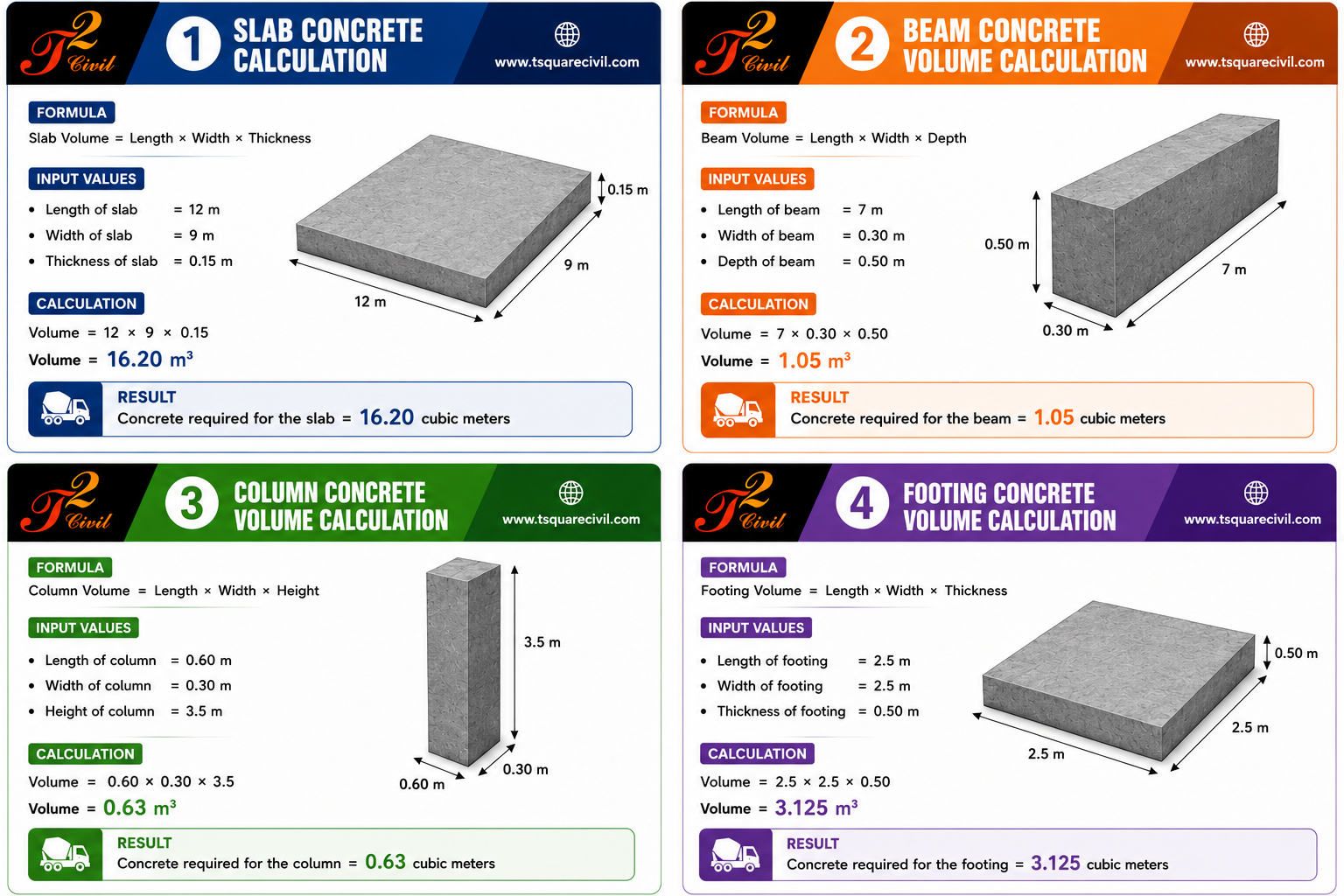
Slab Concrete Volume Calculation
For a rectangular slab:
Slab Volume = Length × Width × Thickness
Example: Slab Concrete Calculation
Assume:
- Length = 12 m
- Width = 9 m
- Thickness = 0.15 m
Calculation:
Volume = 12 × 9 × 0.15
= 16.20 m³
Therefore, the theoretical concrete volume of the slab is:
16.20 m³
Use the slab thickness shown in the approved structural drawing rather than assuming a standard thickness.
Beam Concrete Volume Calculation
For a rectangular beam:
Beam Volume = Length × Width × Depth
Example: Beam Concrete Calculation
Assume:
- Length = 7 m
- Width = 0.30 m
- Overall depth used for the quantity calculation = 0.50 m
Calculation:
Volume = 7 × 0.30 × 0.50
= 1.05 m³
Therefore, the theoretical concrete volume of the beam is:
1.05 m³
Quantity Take-Off Note: When beams and slabs are cast monolithically, the adopted quantity take-off method should avoid double-counting concrete at overlapping portions.
Rectangular Column Concrete Volume Calculation
For a rectangular column:
Column Volume = Width × Breadth × Height
Example: Rectangular Column
Assume:
- Width = 0.60 m
- Breadth = 0.30 m
- Height = 3.50 m
Calculation:
Volume = 0.60 × 0.30 × 3.50
= 0.63 m³
Therefore, the theoretical concrete volume of one column is:
0.63 m³
If there are 6 identical columns:
Total Column Volume = 0.63 × 6
= 3.78 m³
Circular Column Concrete Volume Calculation
For a circular column:
Volume = πD²/4 × H
Where:
- D = Column diameter
- H = Column height
Example: Circular Column
Assume:
- Diameter = 0.40 m
- Height = 3.00 m
Calculation:
Volume = π × 0.40² ÷ 4 × 3.00
≈ 0.377 m³
Therefore, the theoretical concrete volume of one circular column is approximately:
0.377 m³
Rectangular Footing Concrete Volume Calculation
For a rectangular footing:
Footing Volume = Length × Width × Thickness
Example: Rectangular Footing
Assume:
- Length = 2.5 m
- Width = 2.5 m
- Thickness = 0.50 m
Calculation:
Volume = 2.5 × 2.5 × 0.50
= 3.125 m³
Therefore, the theoretical concrete volume of one footing is:
3.125 m³
If there are 4 identical footings:
Total Footing Volume = 3.125 × 4
= 12.50 m³
Circular Footing Concrete Volume Calculation
For a circular footing of uniform thickness:
Volume = πD²/4 × T
Where:
- D = Footing diameter
- T = Footing thickness
Example: Circular Footing
Assume:
- Diameter = 2.0 m
- Thickness = 0.45 m
Calculation:
Volume = π × 2.0² ÷ 4 × 0.45
≈ 1.414 m³
Therefore, the theoretical concrete volume is approximately:
1.414 m³
For stepped, sloped, tapered, or non-uniform footings, calculate each geometric portion separately rather than using the simple uniform-thickness formula for the complete footing.
Trapezoidal Footing Concrete Volume Calculation
For a footing that is trapezoidal in plan and has uniform thickness:
Volume = L × (B₁ + B₂) / 2 × T
Where:
- B₁ = Width at one parallel end
- B₂ = Width at the other parallel end
- L = Perpendicular distance between B₁ and B₂
- T = Uniform thickness
Example: Trapezoidal Footing
Assume:
- Distance between parallel end widths, L = 5.0 m
- Width B₁ = 2.0 m
- Width B₂ = 3.0 m
- Thickness T = 0.50 m
Calculation:
Volume = 5 × (2 + 3) ÷ 2 × 0.50
= 6.25 m³
Therefore, the theoretical concrete volume of the trapezoidal footing is:
6.25 m³
Geometry Note: L is the perpendicular distance between the parallel end widths B₁ and B₂, not the inclined side length of the trapezoidal plan.
Sloped Footing Concrete Volume Calculation
A sloped footing with parallel rectangular top and bottom faces can be treated as a rectangular prismoid when the corresponding plan dimensions vary linearly through the vertical depth.
The volume is:
V = H/6 × [L₁B₁ + L₂B₂ + (L₁ + L₂)(B₁ + B₂)]
Example: Sloped Footing
Assume:
- Bottom length, L₁ = 2.5 m
- Bottom width, B₁ = 2.5 m
- Top length, L₂ = 1.0 m
- Top width, B₂ = 1.0 m
- Vertical depth of sloped portion, H = 0.50 m
Calculation:
V = 0.50/6 × [(2.5 × 2.5) + (1.0 × 1.0) + (2.5 + 1.0)(2.5 + 1.0)]
= 1.625 m³
Therefore, the theoretical concrete volume of the sloped portion is:
1.625 m³
If the footing also includes a uniform base slab, pedestal, or other concrete portion, calculate those portions separately and add them without overlapping the quantities.
Tapered Wall Concrete Volume Calculation
For a wall of constant length whose thickness varies linearly between the bottom and top:
Volume = L × H × (T₁ + T₂) / 2
Example: Tapered Wall
Assume:
- Wall length = 10 m
- Wall height = 3 m
- Bottom thickness = 0.40 m
- Top thickness = 0.20 m
Calculation:
Volume = 10 × 3 × (0.40 + 0.20) ÷ 2
= 9.00 m³
Therefore:
Tapered Wall Concrete Volume = 9.00 m³
This calculation assumes that the wall length remains constant and that its thickness changes linearly from bottom to top.
Circular Pile Concrete Volume Calculation
For a straight cylindrical pile:
Pile Volume = πD²/4 × L
Where:
- D = Pile diameter
- L = Concrete pile length
Example: Circular Pile
Assume:
- Pile diameter = 0.60 m
- Concrete length = 10 m
Calculation:
Volume = π × 0.60² ÷ 4 × 10
≈ 2.827 m³
Therefore, the theoretical cylindrical concrete volume is approximately:
2.827 m³
Site Note: Actual placed concrete quantity for cast-in-situ piles may differ from the theoretical cylindrical volume because of bore conditions, overbreak, construction method, and other site-specific factors.
Annular or Ring Concrete Volume Calculation
For a concentric annular concrete member:
V = π/4 × (Dₒ² − Dᵢ²) × H
Where:
- Dₒ = Outer diameter
- Dᵢ = Inner diameter
- H = Height or thickness
Example: Annular Concrete
Assume:
- Outer diameter = 4.0 m
- Inner diameter = 3.0 m
- Height = 0.50 m
Calculation:
V = π/4 × (4.0² − 3.0²) × 0.50
≈ 2.749 m³
Therefore, the theoretical concrete volume is approximately:
2.749 m³
The inner and outer diameters should refer to concentric circles.
Triangular Prism or Wedge Concrete Volume Calculation
For a concrete member having a constant triangular cross-section:
V = ½ × B × H × L
Where:
- B = Triangular base width
- H = Perpendicular triangular height
- L = Prism length
Example: Triangular Prism
Assume:
- Base width = 2.0 m
- Perpendicular triangular height = 0.50 m
- Prism length = 5.0 m
Calculation:
Volume = 0.5 × 2.0 × 0.50 × 5.0
= 2.50 m³
Therefore:
Triangular Prism Concrete Volume = 2.50 m³
This formula applies when the triangular cross-section remains constant along the entered length.
Concrete Wall Volume Calculation
For a rectangular concrete wall:
Wall Volume = Length × Thickness × Height
Example: Concrete Wall
Assume:
- Length = 10 m
- Thickness = 0.20 m
- Height = 3.0 m
Calculation:
Volume = 10 × 0.20 × 3.0
= 6.00 m³
Therefore:
Concrete Wall Volume = 6.00 m³
Openings such as doors, windows, ducts, and large service penetrations should be treated according to the project’s quantity measurement rules.
Pavement or PCC Concrete Volume Calculation
For a rectangular pavement, rigid flooring, or PCC layer:
Concrete Volume = Length × Width × Thickness
Example: Pavement Concrete
Assume:
- Length = 20 m
- Width = 4 m
- Thickness = 0.15 m
Calculation:
Volume = 20 × 4 × 0.15
= 12.00 m³
Therefore:
Concrete Volume = 12.00 m³
The actual pavement or PCC thickness should be taken from the approved drawing or project specification.
Multiple Identical Concrete Members
For several identical members:
Total Concrete Volume = Volume of One Member × Number of Members
For example, if one column requires:
0.63 m³
and there are 8 identical columns:
Total Volume = 0.63 × 8
= 5.04 m³
Irregular or Composite Concrete Members
A single rectangular or circular formula may not be suitable for:
- Stepped footings
- Sloping slabs
- Haunched beams
- Tapered members
- Irregular foundations
- Members with varying thickness
- Composite geometric shapes
For these cases, divide the member into suitable simple geometric portions, calculate the volume of each portion separately, and then add them:
Total Volume = V₁ + V₂ + V₃ + …
Engineering Note: All dimensions used for construction quantity calculations should be taken from approved drawings, verified measurements, or applicable project documents. The calculated values represent theoretical geometric volume and may differ from the final concrete quantity ordered or placed on site.
How to Select Dimensions for Concrete Volume Calculation
The accuracy of a concrete volume calculation depends directly on the dimensions entered into the calculator.
For construction quantity estimation, dimensions should normally be taken from:
- Approved structural drawings
- Approved architectural drawings where applicable
- Issued-for-construction drawings
- Approved shop drawings
- Project specifications
- Verified site measurements
- Approved quantity take-off documents
Slab Thickness
For slab concrete volume:
Slab Volume = Length × Width × Thickness
Use the actual slab thickness specified in the structural drawing.
Do not assume a standard slab thickness merely for quantity calculation, because the required thickness depends on structural design and project requirements.
Beam Dimensions
For a rectangular beam:
Beam Volume = Length × Width × Depth
Use the beam width and depth shown on the approved structural drawing.
Where beams and slabs are cast together, the project quantity take-off method should be followed to avoid double-counting overlapping concrete.
Column Dimensions
For rectangular columns, use:
Volume = Width × Breadth × Height
For circular columns, use:
Volume = πD²/4 × Height
Column dimensions and concrete height should be taken from the relevant structural drawings and floor levels.
Footing Dimensions
For a rectangular footing of uniform thickness:
Volume = Length × Width × Thickness
For a circular footing:
Volume = πD²/4 × Thickness
Stepped, sloped, tapered, or irregular footings should be divided into suitable geometric portions and calculated separately.
Concrete Wall Dimensions
For a rectangular concrete wall:
Wall Volume = Length × Thickness × Height
Use the wall thickness and dimensions shown on the approved drawings.
Openings and deductions should be handled according to the applicable project measurement rules.
Pavement and PCC Thickness
For pavement, flooring, levelling concrete, or PCC:
Volume = Length × Width × Thickness
The thickness should be taken from the approved drawing or project specification for that particular work.
Dimensions for Trapezoidal and Sloped Footings
For a trapezoidal footing of uniform thickness, identify:
- B₁ = Width at one parallel end
- B₂ = Width at the other parallel end
- L = Perpendicular distance between the two parallel end widths
- T = Uniform footing thickness
Do not use an inclined side of the trapezoidal plan as L.
For a sloped footing or rectangular prismoid, identify:
- L₁ and B₁ = Bottom-face length and width
- L₂ and B₂ = Top-face length and width
- H = Vertical depth between the top and bottom faces
The calculator option is intended for parallel rectangular top and bottom faces where the corresponding dimensions vary linearly through the depth.
Dimensions for Tapered Walls
For a tapered or trapezoidal wall:
- L = Wall length
- H = Wall height
- T₁ = Bottom thickness
- T₂ = Top thickness
The calculator assumes that the wall length remains constant and that the thickness varies linearly between T₁ and T₂.
Dimensions for Circular Piles
For a straight cylindrical pile:
- D = Pile diameter
- L = Concrete pile length used for the quantity calculation
Use drawing dimensions and the applicable project quantity take-off method.
Dimensions for Annular or Ring Concrete
For annular concrete:
- Dₒ = Outer diameter
- Dᵢ = Inner diameter
- H = Height or thickness
The inner and outer diameters must represent concentric circles, and the outer diameter must be greater than the inner diameter.
Dimensions for Triangular Prism or Wedge Concrete
For a triangular prism:
- B = Triangular base width
- H = Perpendicular height of the triangular cross-section
- L = Length over which the triangular cross-section remains constant
If the cross-section changes along the length, divide the member into suitable geometric portions or use an appropriate project-specific quantity calculation.
Do Not Use Generic Thickness Values for Structural Design
This calculator is intended to calculate volume from known dimensions. It does not determine or recommend the structural dimensions of slabs, beams, columns, footings, walls, tanks, pavements, or other concrete elements.
Engineering Note: Structural dimensions depend on design loads, spans, support conditions, material properties, durability requirements, serviceability requirements, detailing, project specifications, and other design considerations. Use the dimensions specified by the responsible designer or approved project documents.
Why Use Our Concrete Volume Calculator?
The Concrete Volume Calculator provides a quick way to calculate the theoretical concrete volume of common structural and construction elements from their dimensions.
It can help engineers, contractors, quantity surveyors, estimators, site supervisors, students, and construction professionals perform preliminary quantity checks before concreting work.
Key Benefits
- Calculates concrete volume for common rectangular and circular members
- Supports slabs, beams, columns, footings, walls, pavements, PCC works, and custom rectangular members
- Accepts dimensions in metres, feet, and millimetres
- Calculates the volume of one member
- Calculates the total volume for multiple identical members
- Displays results in both cubic metres (m³) and cubic feet (ft³)
- Allows a project-specific additional allowance to be entered when required
- Does not apply any fixed wastage percentage automatically
- Shows the calculation formula and detailed calculation steps
- Helps with preliminary quantity take-off and concrete planning
Useful for Ready-Mix Concrete Planning
The calculator can help estimate the theoretical concrete volume before placing a ready-mix concrete order.
However, the calculated geometric volume should not automatically be treated as the final quantity to order.
Actual concrete requirements can be affected by:
- Construction tolerances
- Excavation overbreak
- Formwork dimensions
- Irregular surfaces
- Placement conditions
- Embedded items
- Site measurement differences
- Project-specific allowances
- Quantity take-off methodology
Any additional ordering allowance should therefore be based on actual project and site conditions rather than a universal percentage.
Useful for Quantity Verification
The calculator can also be used to compare manually calculated quantities with dimensions shown in drawings.
For example, it can assist with checking:
- Slab concrete quantities
- Beam quantities
- Column quantities
- Footing quantities
- Wall quantities
- Pavement or PCC quantities
- Repeated-member quantities
This is useful during preliminary estimating, BOQ checking, site planning, and quantity reconciliation.
Transparent Calculation Method
The calculator displays the formula and calculation details so that users can understand how the result is obtained.
For rectangular members:
Volume = Length × Width × Height, Depth, or Thickness
For circular members:
Volume = πD²/4 × Height or Thickness
For repeated members:
Total Volume = Volume of One Member × Number of Members
If an additional allowance is entered:
Final Concrete Quantity = Theoretical Volume + Additional Allowance Volume
Engineering Note: The calculator is a quantity-estimation tool and does not perform structural design. Member dimensions should be taken from approved drawings, specifications, or verified site measurements.
Applications of the Concrete Volume Calculator
The Concrete Volume Calculator can be used for preliminary quantity estimation for a wide range of concrete construction works.
It is especially useful when the required member dimensions are available from approved drawings or verified site measurements.
RCC Slabs
For rectangular slabs:
Concrete Volume = Length × Width × Thickness
The calculator can be used for:
- Floor slabs
- Roof slabs
- Terrace slabs
- Podium slabs
- Other rectangular RCC slabs
Use the slab dimensions shown in the approved structural drawing.
RCC Beams
For rectangular beams:
Concrete Volume = Length × Width × Depth
The calculator can help estimate the theoretical concrete volume of:
- Individual beams
- Multiple identical beams
- Plinth beams
- Tie beams
- Grade beams
- Other rectangular RCC beams
When beams and slabs overlap, follow the project quantity take-off method to avoid double-counting concrete.
RCC Columns
For rectangular columns:
Volume = Width × Breadth × Height
For circular columns:
Volume = πD²/4 × Height
The calculator can be used to estimate concrete for:
- Individual columns
- Groups of identical columns
- Rectangular columns
- Circular columns
Column dimensions and heights should be taken from the approved structural drawings and relevant level information.
Isolated Footings
For a rectangular footing of uniform thickness:
Volume = Length × Width × Thickness
For a circular footing:
Volume = πD²/4 × Thickness
The calculator can assist with preliminary concrete quantity estimation for individual or repeated footings.
For stepped, sloped, tapered, or irregular footings, calculate the separate geometric portions individually.
Combined and Raft Foundations
The calculator can also assist with quantity calculations for rectangular portions of:
- Combined footings
- Raft foundations
- Mat foundations
- Foundation slabs
For irregular foundation geometry, divide the foundation into suitable simple shapes and calculate each portion separately.
Concrete Walls
For a rectangular concrete wall:
Wall Volume = Length × Thickness × Height
The calculator can be used for:
- RCC walls
- Retaining-wall portions of uniform geometry
- Basement walls
- Shear-wall portions
- Other rectangular concrete walls
Openings, varying wall thicknesses, and irregular portions should be handled according to the project measurement method.
PCC Works
The calculator can be used for plain cement concrete quantities such as:
- Levelling concrete
- Blinding concrete
- Foundation PCC
- Base concrete
- Flooring bases
- Other rectangular PCC layers
Use the thickness and dimensions specified in the approved drawing or project specification.
Pavements and Rigid Flooring
For rectangular pavement or flooring sections:
Volume = Length × Width × Thickness
The calculator can assist with estimating concrete for:
- Concrete pavements
- Rigid flooring
- Pathways
- Yard slabs
- Hardstand areas
- Other rectangular concrete surfaces
Multiple Identical Members
When several members have the same dimensions:
Total Volume = Volume of One Member × Number of Members
This is useful for:
- Multiple columns
- Repeated footings
- Similar beams
- Repeated wall panels
- Identical precast or cast-in-place members
Ready-Mix Concrete Quantity Planning
The calculator can provide the theoretical geometric volume needed as a starting point for ready-mix concrete planning.
The final quantity ordered may require project-specific consideration of:
- Construction tolerances
- Excavation overbreak
- Formwork conditions
- Placement method
- Irregular geometry
- Site measurements
- Project-specific allowance requirements
No fixed additional percentage should be applied automatically.
BOQ and Quantity Take-Off Checks
The calculator can also assist with:
- Preliminary BOQ preparation
- Quantity verification
- Checking drawing-based calculations
- Comparing manual calculations
- Site quantity reconciliation
- Preliminary cost estimation
- Construction planning
Engineering Note: This calculator is intended for concrete quantity estimation from known geometry. It does not determine structural member dimensions, concrete grade, reinforcement, mix design, or other design requirements.
Frequently Asked Questions
Q1. How is concrete volume measured?
Answer: Concrete volume is generally expressed in cubic metres (m³) or cubic feet (ft³).
The unit represents three-dimensional volume.
For example:
1 m³ = 1 m × 1 m × 1 m
The Concrete Volume Calculator displays the calculated quantity in both m³ and ft³.
Q2. What is the formula for calculating concrete volume?
Answer: For a rectangular concrete member:
Volume = Length × Width × Height, Depth, or Thickness
or:
V = L × B × H
For example, for a slab:
Length = 5 m
Width = 4 m
Thickness = 0.15 m
Therefore:
Volume = 5 × 4 × 0.15
= 3.00 m³
Q3. How do you calculate concrete volume for a slab?
Answer: For a rectangular slab:
Slab Volume = Length × Width × Thickness
For example:
- Length = 15 m
- Width = 10 m
- Thickness = 0.15 m
Calculation:
15 × 10 × 0.15 = 22.50 m³
Therefore, the theoretical concrete volume is:
22.50 m³
Use the slab thickness shown in the approved structural drawing.
Q4. How do you calculate concrete volume for a beam?
Answer: For a rectangular beam:
Beam Volume = Length × Width × Depth
For example:
- Length = 6 m
- Width = 0.30 m
- Depth = 0.45 m
Calculation:
6 × 0.30 × 0.45
= 0.81 m³
If several identical beams are involved:
Total Beam Volume = Volume of One Beam × Number of Beams
Quantity Take-Off Note: When beams and slabs overlap, use the project quantity take-off method to avoid double-counting concrete.
Q5. How do you calculate concrete volume for a rectangular column?
Answer: For a rectangular column:
Column Volume = Width × Breadth × Height
For example:
- Width = 0.40 m
- Breadth = 0.30 m
- Height = 3.00 m
Calculation:
0.40 × 0.30 × 3.00
= 0.36 m³
Therefore, one column requires a theoretical concrete volume of:
0.36 m³
Q6. How do you calculate concrete volume for a circular column?
Answer: For a circular column:
Volume = πD²/4 × H
Where:
- D = Diameter
- H = Height
- π ≈ 3.1416
For example:
- Diameter = 0.40 m
- Height = 3.00 m
Calculation:
π × 0.40² ÷ 4 × 3.00
≈ 0.377 m³
Therefore, the theoretical concrete volume is approximately:
0.377 m³
Q7. How do you calculate concrete volume for a footing?
Answer: For a rectangular footing of uniform thickness:
Footing Volume = Length × Width × Thickness
For example:
- Length = 2.0 m
- Width = 2.0 m
- Thickness = 0.50 m
Calculation:
2.0 × 2.0 × 0.50
= 2.00 m³
If four identical footings are required:
Total Volume = 2.00 × 4
= 8.00 m³
For stepped, tapered, sloping, or irregular footings, calculate the individual geometric portions separately.
Q8. How do you calculate concrete volume for a circular footing?
Answer: For a circular footing of uniform thickness:
Volume = πD²/4 × T
Where:
- D = Footing diameter
- T = Footing thickness
For example:
- Diameter = 2.0 m
- Thickness = 0.45 m
Calculation:
π × 2.0² ÷ 4 × 0.45
≈ 1.414 m³
Q9. How do you calculate concrete volume for a wall?
Answer: For a rectangular concrete wall:
Wall Volume = Length × Thickness × Height
For example:
- Length = 8 m
- Thickness = 0.20 m
- Height = 3 m
Calculation:
8 × 0.20 × 3
= 4.80 m³
Openings and deductions should be treated according to the applicable project measurement method.
Q10. Does the Concrete Volume Calculator include wastage automatically?
Answer: No.
The calculator does not apply any fixed wastage or ordering percentage automatically.
Instead, it provides an optional Additional Allowance (%) field.
If an additional allowance is required, the percentage should be selected according to actual project conditions such as:
- Construction tolerances
- Excavation overbreak
- Formwork conditions
- Placement method
- Irregular surfaces
- Site measurement
- Project specifications
- Approved site procedures
There is no single percentage that should automatically be applied to every concrete work.
Q11. What is the difference between theoretical concrete volume and final ordering quantity?
Answer: Theoretical concrete volume is calculated directly from the geometric dimensions of the concrete member.
For example:
Theoretical Volume = Length × Width × Thickness
Actual ordering quantity may differ because of project-specific conditions such as:
- Construction tolerances
- Excavation overbreak
- Irregular geometry
- Formwork conditions
- Placement conditions
- Site measurement differences
- Approved quantity allowances
Therefore, the calculator distinguishes between:
Total Theoretical Volume
and, when an allowance is entered:
Final Concrete Quantity
Q12. How is an additional concrete allowance calculated?
Answer: If a project-specific percentage is entered:
Additional Allowance Volume = Theoretical Volume × Allowance (%) ÷ 100
For example:
- Theoretical volume = 10 m³
- Entered allowance = 2%
Then:
Allowance Volume = 10 × 2 ÷ 100
= 0.20 m³
Therefore:
Final Concrete Quantity = 10 + 0.20
= 10.20 m³
The calculator leaves this percentage entirely to the user and does not assume a standard allowance.
Q13. Can I calculate several identical columns, beams, or footings at once?
Answer: Yes.
Enter the dimensions of one member and then enter the Number of Identical Members.
The calculator uses:
Total Concrete Volume = Volume of One Member × Number of Members
For example:
If one footing requires:
2.00 m³
and there are:
6 identical footings
then:
Total Volume = 2.00 × 6
= 12.00 m³
The number of identical members should be entered as a whole number.
Q14. Can I enter concrete dimensions in millimetres?
Answer: Yes.
The calculator accepts dimensions in:
- Metres (m)
- Feet (ft)
- Millimetres (mm)
When millimetres are selected, the dimensions are converted internally using:
1 mm = 0.001 m
The volume is then calculated and displayed in m³ and ft³.
Q15. Can I enter concrete dimensions in feet?
Answer: Yes.
Select Feet (ft) as the dimension unit.
The calculator converts the dimensions internally using:
1 ft = 0.3048 m
It then displays the resulting concrete volume in both cubic metres and cubic feet.
Q16. How many cubic feet are in 1 cubic metre of concrete?
Answer:
1 m³ = 35.3147 ft³
Therefore:
Cubic Feet = Cubic Metres × 35.3147
For example:
3 m³ × 35.3147
≈ 105.94 ft³
Q17. How much concrete is required for a 1500 sq. ft. slab with 150 mm thickness?
Answer: First convert the floor area into square metres:
1500 ft² × 0.09290304
≈ 139.355 m²
Thickness:
150 mm = 0.150 m
Therefore:
Concrete Volume = 139.355 × 0.150
≈ 20.90 m³
So the theoretical slab concrete volume is approximately:
20.90 m³
This assumes the entire 1500 sq. ft. area has a uniform thickness of 150 mm.
Q18. Does the calculator calculate dry concrete volume using 1.54?
Answer: No.
The Concrete Volume Calculator is designed specifically to calculate the geometric volume of finished concrete from the dimensions of the member.
It does not multiply the calculated concrete volume by 1.54.
If preliminary quantities of cement, sand, and coarse aggregate are required from a selected nominal mix proportion, use the Cement, Sand & Aggregate Calculator.
The dry-volume factor used for preliminary material estimation should not be confused with geometric concrete volume or concrete mix design.
Q19. Does this calculator calculate cement, sand, and aggregate quantities?
Answer: No.
This calculator determines the required concrete volume.
For example:
Slab dimensions → Concrete Volume
After calculating the concrete volume, you can use the Cement, Sand & Aggregate Calculator for preliminary material quantity estimation using its stated assumptions.
This separation avoids confusing geometric concrete volume with concrete ingredient proportioning.
Q20. Can this calculator be used for ready-mix concrete ordering?
Answer: It can be used to determine the theoretical geometric volume as a starting point for ready-mix concrete planning.
However, the calculated theoretical volume should not automatically be treated as the final order quantity.
The final quantity should consider applicable project and site factors, including:
- Actual measurements
- Construction tolerances
- Excavation condition
- Formwork condition
- Placement method
- Irregular geometry
- Project-specific allowance
- Supplier and site procedures
Q21. Can the calculator be used for irregular concrete shapes?
Answer: A single rectangular or circular formula may not be sufficient for irregular shapes.
For members such as:
- Stepped footings
- Tapered foundations
- Sloping slabs
- Haunched beams
- Irregular walls
- Members with varying thickness
Divide the member into suitable simple geometric portions.
Calculate each volume separately:
Total Volume = V₁ + V₂ + V₃ + …
Then add the individual quantities.
Q22. Does the calculator determine slab, beam, column, or footing size?
Answer: No.
The calculator does not perform structural design and does not determine the required dimensions of any structural member.
Dimensions should be taken from:
- Approved structural drawings
- Approved project drawings
- Project specifications
- Verified site measurements
- Other authorised project documents
The calculator then uses those dimensions to determine the theoretical concrete volume.
Q23. How accurate is the Concrete Volume Calculator?
Answer: The calculator applies the appropriate geometric formula to the dimensions entered by the user.
Therefore, the mathematical result represents the theoretical geometric volume based on those inputs.
Actual site concrete consumption or ordering quantity may differ due to:
- Incorrect or approximate input dimensions
- Construction tolerances
- Excavation overbreak
- Formwork variation
- Irregular geometry
- Site conditions
- Placement conditions
- Quantity take-off methodology
For construction use, verify the dimensions and final quantities against approved drawings, specifications, and site conditions.
Q24. How do you calculate concrete volume for a trapezoidal footing?
Answer: For a footing that is trapezoidal in plan and has uniform thickness:
V = L × (B₁ + B₂) / 2 × T
Where:
- B₁ and B₂ are the two parallel end widths
- L is the perpendicular distance between those parallel widths
- T is the uniform footing thickness
For example:
- L = 5 m
- B₁ = 2 m
- B₂ = 3 m
- T = 0.50 m
Calculation:
V = 5 × (2 + 3) ÷ 2 × 0.50
= 6.25 m³
Q25. How do you calculate concrete volume for a sloped footing?
Answer: A sloped footing with parallel rectangular top and bottom faces can be calculated as a rectangular prismoid when the corresponding dimensions vary linearly through the vertical depth.
The formula is:
V = H/6 × [L₁B₁ + L₂B₂ + (L₁ + L₂)(B₁ + B₂)]
Where:
- L₁ and B₁ = Bottom dimensions
- L₂ and B₂ = Top dimensions
- H = Vertical depth of the sloped portion
Any separate uniform base slab, pedestal, or other concrete portion should be calculated separately without double-counting overlapping volumes.
Q26. How do you calculate concrete volume for a tapered wall?
Answer: For a wall of constant length where the thickness varies linearly from bottom to top:
V = L × H × (T₁ + T₂) / 2
Where:
- L = Wall length
- H = Wall height
- T₁ = Bottom thickness
- T₂ = Top thickness
For example:
L = 10 m, H = 3 m, T₁ = 0.40 m, T₂ = 0.20 m
Therefore:
V = 10 × 3 × (0.40 + 0.20) ÷ 2
= 9.00 m³
Q27. How do you calculate the theoretical concrete volume of a circular pile?
Answer: For a straight cylindrical pile:
V = πD²/4 × L
Where:
- D = Pile diameter
- L = Concrete pile length
For example, for a 600 mm diameter pile with a concrete length of 10 m:
D = 0.60 m
V = π × 0.60² ÷ 4 × 10
≈ 2.827 m³
This is the theoretical cylindrical volume. Actual concrete consumption for cast-in-situ piles may differ depending on bore conditions, overbreak, construction method, and other project-specific factors.
Q28. How do you calculate annular or ring concrete volume?
Answer: For a concentric annular concrete member:
V = π/4 × (Dₒ² − Dᵢ²) × H
Where:
- Dₒ = Outer diameter
- Dᵢ = Inner diameter
- H = Height or thickness
The outer diameter must be greater than the inner diameter.
For example:
Dₒ = 4 m, Dᵢ = 3 m, H = 0.50 m
V = π/4 × (4² − 3²) × 0.50
≈ 2.749 m³
Q29. How do you calculate triangular wedge concrete volume?
Answer: For a triangular prism or wedge having a constant triangular cross-section along its length:
V = ½ × B × H × L
Where:
- B = Triangular base width
- H = Perpendicular triangular height
- L = Prism length
For example:
B = 2 m, H = 0.50 m, L = 5 m
V = 0.5 × 2 × 0.50 × 5
= 2.50 m³
This formula should not be applied directly where the triangular cross-section changes along the length.
Related Civil Engineering Calculators
Use these related T Square Civil Engineering calculators for concrete material estimation, reinforcement quantities, masonry work, plastering, and construction planning.
Cement, Sand & Aggregate Calculator for Concrete M5 to M20
After calculating the required concrete volume, use this calculator to estimate the approximate quantities of cement, sand, and coarse aggregate for selected nominal concrete proportions from M5 to M20.
The calculator clearly states its estimating assumptions and should not be treated as a substitute for an approved concrete mix design.
Cement Bags Calculator
Estimate the approximate number of 50 kg cement bags required from the calculated cement quantity.
This is useful for preliminary material planning and quantity estimation.
Steel Bar Weight Calculator
Calculate the approximate theoretical weight of TMT bars, reinforcement steel, and rebars from bar diameter, length, and quantity using the D²/162 method.
This calculator can be used together with concrete volume calculations when preparing preliminary RCC quantities.
Bar Bending Schedule (BBS) Calculator for Construction Sites
Calculate reinforcement cutting lengths, bar quantities, total reinforcement length, and steel weight for common reinforcement arrangements.
Use approved reinforcement drawings and project detailing requirements for construction quantities.
Brick Quantity Calculator
Estimate the approximate number of bricks required for masonry walls based on wall dimensions, openings, mortar-joint dimensions, and entered project inputs.
Plaster Quantity Calculator
Estimate the approximate quantities of cement and sand required for plastering work based on plaster area, thickness, and selected mortar proportion.
House Construction Cost Calculator
Estimate the approximate construction cost of a residential building from the entered built-up area and project assumptions.
The result is intended for preliminary budgeting and should not be treated as a contractor quotation or final project cost.
Tile Quantity Calculator
Calculate the approximate number of floor or wall tiles required from the surface dimensions, selected tile size, and project inputs.
Paint Quantity Calculator
Estimate the approximate quantity of paint required for walls, ceilings, and exterior surfaces based on surface area, number of coats, and selected coverage.
Lap Length Calculator for Reinforcement Steel Bars
Calculate reinforcement lap length and development length for flexural tension, direct tension, compression, and drawing-specified custom D values.
Approved structural drawings, detailing requirements, and applicable design provisions should govern construction use.
About T Square Civil Engineering
T Square Civil Engineering is a civil engineering learning platform created to support students, site engineers, and construction professionals with practical and easy-to-understand educational resources. Our content includes guides, worked examples, calculators, and industry-focused learning materials designed to connect engineering theory with real-world construction practice.
Continue Your Learning
If you found this Concrete Volume Calculator useful, continue with these related T Square Civil Engineering resources covering concrete materials, quantity estimation, concrete testing, quality control, and construction practice.
Concrete Quantity and Estimation
- Cement, Sand & Aggregate Calculator
- Cement Bags Calculator
- Steel Weight Calculator
- Bar Bending Schedule (BBS) Calculator
- Lap Length Calculator
Concrete Testing and Quality Control
- Ultrasonic Pulse Velocity Test of Concrete
- Rebound Hammer Test of Concrete
- Concrete Cube Compressive Strength Test
- Concrete Cube Casting Procedure
- Slump Test of Concrete
- Flexural Strength Test of Concrete
- Split Tensile Strength Test of Concrete
Cement and Concrete Technology
- Concrete Curing Methods
- Standard Consistency Test of Cement
- Initial & Final Setting Time Test of Cement
- Concrete Mix Design – M60
- Concrete Technology Interview Questions and Answers
These resources help civil engineering students, site engineers, quantity surveyors, QA/QC personnel, contractors, and construction professionals understand the complete workflow from quantity estimation and material planning to concrete placement, testing, quality control, and construction practice.
Disclaimer: The information provided on T Square Civil Engineering is intended for educational and general reference purposes only. The content is prepared with care; however, errors, omissions, interpretation differences, or outdated information may occur. Readers should independently verify applicable and current Indian Standards (IS Codes), project drawings, approved mix designs, specifications, contractual requirements, manufacturer information, and relevant regulations before using any information for design, construction, testing, estimation, procurement, or quality control. Calculators and worked examples provide indicative or theoretical results based on the inputs and assumptions stated and should not be treated as professional design approval, construction instructions, quotations, or project-specific engineering advice. Site-specific engineering decisions should be made by appropriately qualified professionals. T Square Civil Engineering does not accept responsibility for loss, damage, or consequences arising from reliance on or use of the information provided.