
 by
by Page Contents
Quick Answer
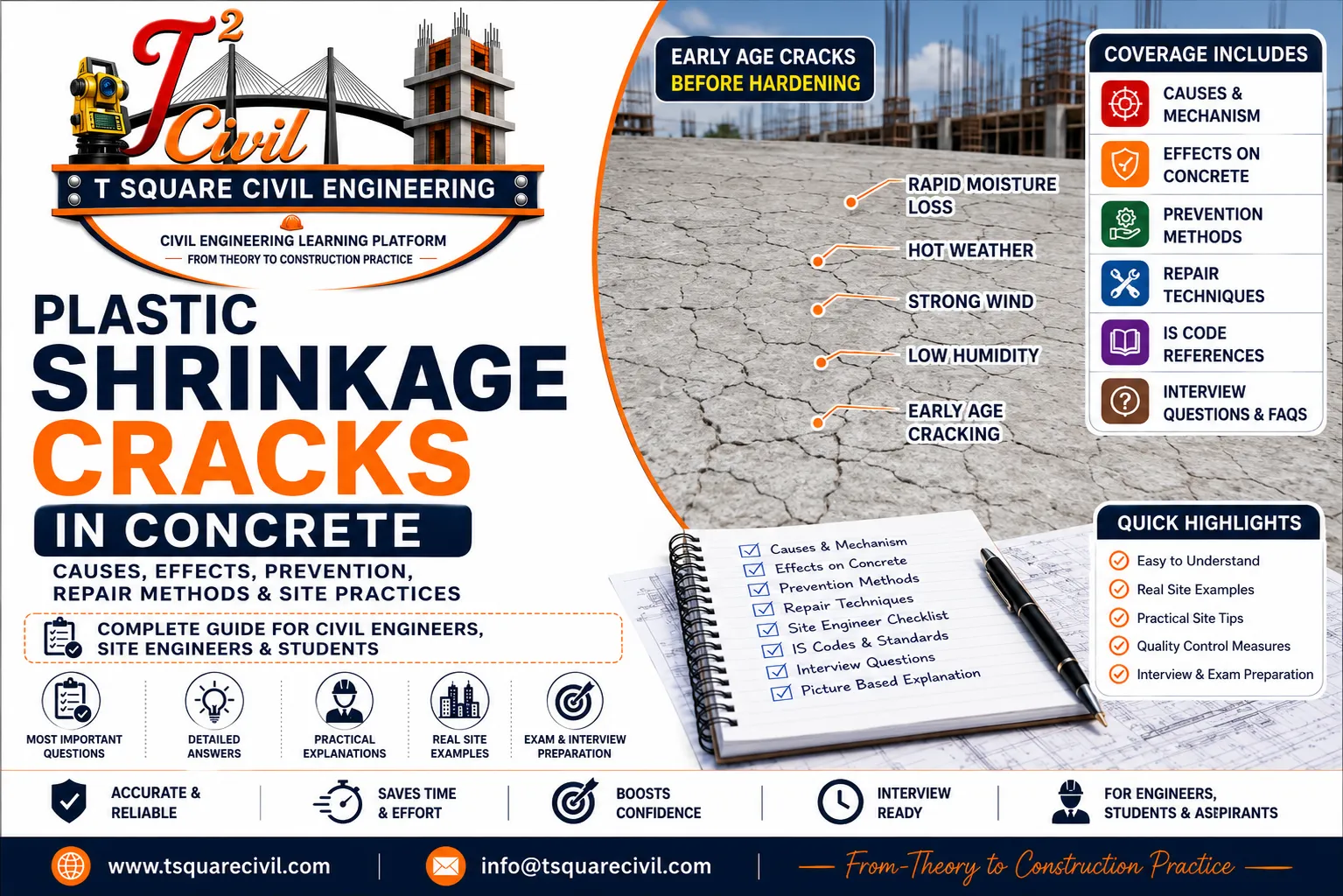
Plastic Shrinkage Cracks are shallow cracks that develop on the surface of freshly placed concrete before it hardens, usually within the first few hours after placement. These cracks occur when the rate of moisture evaporation from the concrete surface exceeds the rate at which bleed water rises to the surface. Rapid drying due to high temperatures, low humidity, strong winds, or direct sunlight causes the concrete surface to shrink while the underlying concrete remains plastic, resulting in random cracks.
Although plastic shrinkage cracks are often non-structural, if ignored, they can reduce durability, increase water permeability, and allow harmful substances to reach the reinforcement.
Key Highlights
- Plastic shrinkage cracks develop before concrete hardens.
- They generally appear within 30 minutes to 6 hours after concrete placement.
- Rapid moisture loss from the surface is the primary cause.
- High temperature, low humidity, wind, and direct sunlight increase the risk.
- Proper curing and protection immediately after finishing are essential preventive measures.
- Early repair helps improve durability and surface performance.
Information Table
| Particular | Details |
|---|---|
| Defect Name | Plastic Shrinkage Cracks |
| Category | Fresh Concrete Surface Defect |
| Stage of Occurrence | Before Initial Setting of Concrete |
| Typical Time | Approximately 30 minutes to 6 hours after placing (depending on environmental conditions) |
| Main Cause | Rapid evaporation of surface moisture |
| Crack Pattern | Random, shallow, irregular surface cracks |
| Structural Effect | Usually non-structural but may reduce durability if untreated |
| Prevention | Proper curing, wind protection, adequate workability, and timely finishing |
| Common Repair | Surface sealing or suitable repair methods depending on crack severity |
| Related Standards | IS 456:2000, IS 1199 Series, IS 10262 (refer to the latest applicable editions) |
Introduction
Concrete undergoes several physical and chemical changes from the time it is mixed until it becomes fully hardened. During the early stages after placement, the concrete remains in a plastic state, meaning it has not yet developed sufficient strength. At this stage, it is highly sensitive to environmental conditions.
One of the most common early-age defects is plastic shrinkage cracking. These cracks develop when moisture evaporates from the concrete surface faster than bleed water can replace it. As the surface dries rapidly, it begins to shrink. Since the concrete beneath the surface is still plastic and does not shrink at the same rate, tensile stresses develop on the surface, leading to the formation of cracks.
Plastic shrinkage cracks are particularly common during hot weather concreting, windy conditions, and low relative humidity. Although these cracks may appear small initially, they can increase water penetration, reduce durability, and affect the long-term performance of concrete if not properly controlled.
Understanding the causes, prevention methods, and repair techniques is essential for site engineers, contractors, QA/QC engineers, and students to ensure the construction of durable and high-quality concrete structures.
What are Plastic Shrinkage Cracks?
Plastic shrinkage cracks are shallow, irregular surface cracks that develop in freshly placed concrete before it reaches its initial set.
They occur because the concrete surface loses water rapidly through evaporation, causing the surface layer to shrink while the underlying concrete remains plastic. This difference in movement creates tensile stresses that exceed the early tensile capacity of the concrete, resulting in cracking.
These cracks generally do not extend through the full depth of the concrete but can significantly affect durability if they are not addressed.
Plastic shrinkage cracks commonly occur in:
- Concrete slabs.
- Pavements.
- Industrial floors.
- Roof slabs.
- Bridge decks.
- Canal linings.
- Large exposed concrete surfaces.
Why do Plastic Shrinkage Cracks Occur?
Plastic shrinkage cracks occur because the surface of fresh concrete dries faster than moisture can be replenished from within the concrete.
The process generally follows these stages:
- Fresh concrete is placed and finished.
- Water begins to evaporate from the surface.
- If evaporation exceeds the rate of bleeding, the surface starts to dry.
- The surface layer shrinks while the lower concrete remains plastic.
- Tensile stresses develop on the surface.
- When these stresses exceed the concrete’s early tensile strength, cracks appear.
The risk is highest during the first few hours after concrete placement.
Mechanism of Plastic Shrinkage Cracking
Plastic shrinkage is primarily controlled by the balance between evaporation and bleeding.
Moisture Evaporation
Heat, wind, and low humidity accelerate the evaporation of water from the concrete surface.
Surface Shrinkage
As water is lost, the surface concrete contracts.
Restrained Movement
The concrete below the surface remains wetter and does not shrink at the same rate, restraining the surface movement.
Tensile Stress Development
The restraint creates tensile stresses within the surface layer.
Crack Formation
Once these tensile stresses exceed the tensile capacity of the plastic concrete, random surface cracks develop.
Importance of Preventing Plastic Shrinkage Cracks
Preventing plastic shrinkage cracks offers several important engineering benefits.
Improved Durability
Concrete with fewer cracks resists weathering and environmental attack more effectively.
Better Watertightness
Reducing cracks decreases the possibility of water seepage through concrete.
Protection of Reinforcement
Limiting moisture ingress helps protect reinforcement from corrosion.
Improved Surface Finish
Crack-free concrete provides a better appearance and requires less maintenance.
Longer Service Life
Durable concrete structures generally require fewer repairs and have a longer design life.
Reduced Maintenance Cost
Preventing cracks during construction is significantly more economical than repairing them later.
Characteristics of Plastic Shrinkage Cracks
Plastic shrinkage cracks have several distinctive characteristics that help distinguish them from other types of concrete cracks.
Typical Features
- Develop before concrete hardens.
- Usually appear within a few hours after placement.
- Generally shallow.
- Random in pattern.
- Often roughly parallel but irregular.
- Most common on large exposed surfaces.
- More frequent during hot and windy weather.
Factors Affecting Plastic Shrinkage Cracks
Several environmental, material, and construction factors influence the occurrence of plastic shrinkage cracks.
Environmental Factors
- High air temperature.
- Low relative humidity.
- Strong wind.
- Direct sunlight.
Concrete Factors
- Low bleeding rate.
- Improper workability.
- High cement content.
- Large exposed surface area.
Construction Factors
- Delayed curing.
- Improper finishing.
- Poor site planning.
- Inadequate protection from weather.
Types of Plastic Shrinkage Cracks
Although plastic shrinkage cracks are generally similar, they may appear in different forms depending on site conditions.
Random Cracks
Irregular cracks distributed across the surface.
Parallel Cracks
Nearly parallel cracks occurring due to directional drying caused by wind.
Network Cracks
Fine interconnected cracks covering large concrete surfaces.
Key Points to Remember
- Plastic shrinkage cracks occur before the concrete has hardened.
- Rapid evaporation of surface moisture is the primary cause.
- Hot weather, wind, and low humidity significantly increase the risk.
- Proper curing should begin as soon as practicable after finishing, using methods appropriate to the concrete and project specifications.
- Early protection of fresh concrete is one of the most effective ways to prevent plastic shrinkage cracking.
- These cracks are usually shallow but should not be ignored because they can reduce long-term durability.
Major Causes of Plastic Shrinkage Cracks in Concrete
Plastic shrinkage cracks are caused by a combination of environmental conditions, material properties, and construction practices. They occur when the surface of freshly placed concrete loses moisture faster than it can be replaced by bleed water, causing the surface to shrink and crack.
The following are the major causes of plastic shrinkage cracks.
Rapid Evaporation of Surface Moisture (Primary Cause)
The most common cause of plastic shrinkage cracking is rapid evaporation of water from the concrete surface.
When evaporation exceeds the rate of bleeding, the surface begins to dry and shrink while the underlying concrete remains plastic.
Causes of Rapid Evaporation
- High ambient temperature.
- Strong wind.
- Low relative humidity.
- Direct sunlight.
- Hot concrete temperature.
Site Observation
Cracks usually appear on exposed concrete surfaces within the first few hours after placing.
High Air Temperature
High air temperature accelerates the evaporation of water from fresh concrete.
During summer concreting, especially in open areas, concrete may lose moisture rapidly, increasing the risk of plastic shrinkage.
Site Observation
Large slabs and pavements cast during hot afternoons are more susceptible.
Low Relative Humidity
Low humidity allows moisture to evaporate quickly from the concrete surface.
When the surrounding air is dry, evaporation increases significantly.
Typical Risk
Relative humidity below approximately 40–50% can increase the likelihood of rapid moisture loss, depending on temperature and wind conditions.
Strong Wind
Wind continuously removes the thin layer of moist air above the concrete surface.
This increases evaporation even if the temperature is moderate.
Site Observation
Concrete placed on bridge decks, roof slabs, highways, and elevated structures is particularly vulnerable.
Direct Exposure to Sunlight
Direct sunlight increases the temperature of the concrete surface.
A hotter surface loses water much faster than shaded concrete.
Site Observation
Concrete cast during midday without shading often develops early-age surface cracks.
Delayed Curing
Curing should begin as soon as the concrete surface can receive it without damage and in accordance with project requirements.
If curing is delayed:
- Surface drying continues.
- Moisture loss increases.
- Shrinkage stresses develop.
Improper Concrete Mix
Certain concrete mixes are more susceptible to plastic shrinkage.
Examples
- Low bleeding concrete.
- High cement content.
- Inadequate fine materials.
- Poor workability.
- Improper aggregate grading.
Large Exposed Surface Area
Concrete members having large exposed surfaces lose moisture rapidly.
Examples include:
- Industrial floors.
- Pavements.
- Roof slabs.
- Airport pavements.
- Canal linings.
Improper Finishing
Excessive finishing or finishing while bleed water is still present may disturb the concrete surface and contribute to surface defects.
Common Mistakes
- Finishing too early.
- Excessive trowelling.
- Sprinkling water during finishing without approval.
- Reworking partially dried concrete.
Poor Construction Planning
Lack of preparation before concreting often results in delayed curing and inadequate protection.
Examples include:
- Curing materials not available.
- No windbreaks.
- No shading.
- Insufficient manpower.
- Delay between finishing and curing.
Effects of Plastic Shrinkage Cracks
Although plastic shrinkage cracks are generally shallow, they can significantly affect the long-term performance of concrete.
Increased Water Permeability
Cracks provide pathways for water penetration.
This may result in:
- Water leakage.
- Moisture ingress.
- Chemical penetration.
Reduced Durability
Concrete becomes more vulnerable to:
- Weathering.
- Sulphate attack.
- Chloride penetration.
- Carbonation.
- Freeze-thaw damage (where applicable).
Reinforcement Corrosion
If moisture and aggressive chemicals reach the reinforcement through cracks, corrosion may begin earlier than expected.
Poor Surface Appearance
Visible cracks reduce the aesthetic quality of exposed concrete surfaces.
Architectural concrete is particularly affected.
Increased Maintenance Cost
Repairing cracks after construction requires additional materials, labour, and time.
Preventing cracks during construction is generally more economical.
Reduced Service Life
If left untreated, cracks may widen over time and reduce the long-term durability and service life of the structure.
Identification of Plastic Shrinkage Cracks
Plastic shrinkage cracks have distinctive characteristics that make them easier to identify.
Typical observations include:
- Fine surface cracks.
- Random crack pattern.
- Shallow depth.
- Cracks crossing each other.
- Cracks appearing within a few hours of placing.
- More common on slabs and pavements.
Site Inspection
Site engineers should inspect freshly placed concrete during the first few hours after finishing.
Inspection should include:
Surface Condition
Check for:
- Fine cracks.
- Dry surface.
- Uneven moisture loss.
Environmental Conditions
Record:
- Air temperature.
- Concrete temperature (if monitored).
- Relative humidity.
- Wind speed.
- Time of concreting.
Curing Status
Confirm whether curing was started at the appropriate time using the specified method.
Crack Measurement
Record:
- Crack length.
- Crack width.
- Crack spacing.
- Crack pattern.
These records help determine the appropriate repair method and improve future concreting practices.
Severity Classification
Plastic shrinkage cracks can be classified according to their extent.
| Severity | Characteristics | Typical Action |
|---|---|---|
| Minor | Fine, shallow cracks with limited extent | Continue curing and monitor; surface treatment may be considered if required |
| Moderate | More numerous or wider surface cracks | Assess the surface condition and apply an appropriate repair method if necessary |
| Severe | Extensive cracking over large areas or cracks affecting serviceability | Engineering assessment and appropriate repair strategy before the structure is put into service |
Practical Site Example
A reinforced concrete roof slab was cast during summer under hot and windy weather conditions.
Although the concrete mix met the design requirements, curing materials were not ready immediately after finishing. Strong winds and high temperatures caused rapid evaporation of surface moisture. Within approximately three hours, fine random cracks appeared across the slab surface.
The cracks were identified as plastic shrinkage cracks. The contractor reviewed the curing procedure and implemented improved protection measures, including immediate curing, windbreaks, and shading for subsequent pours. No similar cracking was observed in later concreting operations.
Comparison: Plastic Shrinkage Cracks vs Plastic Settlement Cracks
| Property | Plastic Shrinkage Cracks | Plastic Settlement Cracks |
|---|---|---|
| Main Cause | Rapid evaporation of surface moisture | Settlement of fresh concrete around reinforcement or inserts |
| Time of Occurrence | Before initial setting | Before initial setting |
| Crack Pattern | Random, irregular, shallow | Usually follows reinforcement or embedded items |
| Typical Location | Large exposed concrete surfaces | Above reinforcement, ducts, and embedded services |
| Primary Prevention | Proper curing and protection from rapid drying | Proper compaction, suitable concrete mix, and correct detailing |
Key Learning Points
- Plastic shrinkage cracks develop when evaporation exceeds bleeding.
- Hot weather, low humidity, wind, and direct sunlight significantly increase the risk.
- These cracks usually occur within the first few hours after concrete placement.
- Early inspection is essential for timely identification and corrective action.
- Proper planning before concreting, including arrangements for curing and weather protection, is one of the most effective preventive measures.
Prevention of Plastic Shrinkage Cracks in Concrete
Plastic shrinkage cracks can be prevented by proper planning, good concreting practices, timely curing, and protection of fresh concrete from rapid moisture loss. Prevention is always more effective and economical than repairing cracks after they develop.
Plan Concreting According to Weather Conditions
Before starting concreting, weather conditions should be assessed.
Recommended Practices
- Avoid concreting during the hottest part of the day whenever practical.
- Prefer early morning, late evening, or night concreting where appropriate.
- Check weather forecasts before scheduling large concrete pours.
- Postpone concreting during extremely hot, dry, or windy conditions if suitable protective measures cannot be implemented.
Maintain Proper Concrete Temperature
High concrete temperature accelerates moisture evaporation.
Good Practices
- Store aggregates in shaded areas.
- Use cool mixing water where appropriate.
- Avoid overheating of cement during storage.
- Minimise delays between batching and placing.
Provide Adequate Workability
Concrete should have sufficient workability to allow proper placing and finishing without excessive water addition.
Recommendations
- Use an approved mix design.
- Maintain the specified water-cement ratio.
- Use suitable water-reducing admixtures when required.
- Do not add extra water at the construction site without engineering approval.
Protect Fresh Concrete from Rapid Evaporation
Fresh concrete should be protected immediately after placing.
Protection Methods
- Install windbreaks around exposed slabs.
- Use temporary sunshades.
- Cover concrete with damp hessian, wet burlap, or curing blankets as appropriate.
- Use evaporation reducers where approved.
Start Curing at the Appropriate Time
Curing is one of the most effective methods of preventing plastic shrinkage cracks.
Good Practices
- Begin curing as soon as the concrete surface can receive it without damage and in accordance with project specifications.
- Maintain continuous curing for the specified duration.
- Ensure the concrete surface remains adequately moist during the curing period.
Proper Finishing Operations
Finishing should be carried out carefully and at the appropriate stage.
Best Practices
- Do not finish while excessive bleed water is present.
- Avoid over-trowelling.
- Do not sprinkle additional water onto the concrete surface unless permitted by the approved procedure.
- Complete finishing promptly after placement.
Proper Site Planning
Proper planning reduces delays that contribute to surface drying.
Before concreting, ensure:
- Curing materials are available.
- Water supply is ready.
- Sufficient labour is available.
- Finishing equipment is operational.
- Weather protection arrangements are prepared.
Repair Methods for Plastic Shrinkage Cracks
The repair method depends on the crack width, depth, location, exposure conditions, and service requirements. A qualified engineer should evaluate significant cracking before selecting the repair procedure.
Repair of Minor Plastic Shrinkage Cracks
Minor cracks are generally fine and shallow.
Procedure
Step 1
Inspect the affected surface and confirm that the cracks are superficial.
Step 2
Continue proper curing to reduce further moisture loss.
Step 3
If required by project specifications, apply a suitable surface sealer or crack-filling material compatible with the concrete.
Step 4
Monitor the repaired surface during subsequent inspections.
Repair of Moderate Plastic Shrinkage Cracks
Moderate cracks may affect appearance and durability.
Procedure
Step 1
Clean the cracked surface.
Step 2
Remove loose particles and contaminants.
Step 3
Fill cracks using an approved repair material suitable for the crack width and exposure conditions.
Step 4
Finish the repaired surface to match the surrounding concrete.
Step 5
Carry out curing as recommended for the repair material.
Repair of Severe Plastic Shrinkage Cracks
Where cracking is extensive or affects serviceability, engineering assessment is necessary.
Typical Approach
- Detailed inspection.
- Measurement of crack width and extent.
- Assessment of structural significance.
- Selection of an appropriate repair system.
- Post-repair quality inspection.
Quality Control Measures
Effective quality control minimises the occurrence of plastic shrinkage cracks.
Before Concreting
- Check weather conditions.
- Verify approved concrete mix.
- Confirm workability requirements.
- Ensure curing materials are available.
- Arrange windbreaks and shading where necessary.
- Inspect formwork and reinforcement.
During Concreting
- Place concrete continuously.
- Avoid unnecessary delays.
- Complete finishing promptly.
- Protect exposed concrete from wind and direct sunlight.
- Observe the concrete surface for rapid drying.
After Concreting
- Start curing at the appropriate time.
- Maintain continuous curing.
- Inspect the concrete during the first few hours.
- Record any cracks for evaluation.
- Repair cracks if required by the project specifications.
Site Engineer Checklist
Before approving the completion of concreting operations, the Site Engineer should verify the following:
| Sl. No. | Inspection Item | Yes ✓ | No ✗ |
|---|---|---|---|
| 1 | Weather conditions are suitable for concreting. | ☐ | ☐ |
| 2 | Approved concrete mix has been used. | ☐ | ☐ |
| 3 | Concrete workability is satisfactory. | ☐ | ☐ |
| 4 | Wind protection arrangements are available (if required). | ☐ | ☐ |
| 5 | Sunshades or protective covers are available (if required). | ☐ | ☐ |
| 6 | Curing materials and water supply are ready before finishing. | ☐ | ☐ |
| 7 | Finishing has been completed at the correct stage. | ☐ | ☐ |
| 8 | Curing has started at the appropriate time. | ☐ | ☐ |
| 9 | Concrete surface has been inspected for early-age cracking. | ☐ | ☐ |
| 10 | Any observed cracks have been documented and reported. | ☐ | ☐ |
Common Mistakes Leading to Plastic Shrinkage Cracks
- Delaying curing after finishing.
- Concreting during hot and windy weather without protective measures.
- Failure to provide windbreaks.
- Poor construction planning.
- Excessive finishing operations.
- Adding water to the surface during finishing without approval.
- Inadequate supervision during the early-age period.
- Ignoring early surface cracks.
Comparison: Plastic Shrinkage Cracks vs Drying Shrinkage Cracks vs Thermal Cracks
| Property | Plastic Shrinkage Cracks | Drying Shrinkage Cracks | Thermal Cracks |
|---|---|---|---|
| Time of Occurrence | Before concrete hardens | After hardening during moisture loss | Due to temperature changes after casting |
| Main Cause | Rapid evaporation of surface moisture | Long-term drying and shrinkage | Expansion and contraction caused by temperature differences |
| Crack Depth | Usually shallow | May vary depending on restraint | May be shallow or deep |
| Typical Location | Slabs, pavements, exposed surfaces | Walls, slabs, long concrete members | Mass concrete, thick sections, restrained members |
| Primary Prevention | Timely curing and protection from rapid evaporation | Proper curing, movement joints, and crack control measures | Temperature control, proper detailing, and controlled construction practices |
Summary of Relevant IS Code References
The following Indian Standards provide guidance on concrete materials, production, placement, and curing. Always consult the latest official editions for complete technical requirements.
| Standard | General Purpose |
|---|---|
| IS 456 | Requirements for plain and reinforced concrete, including workmanship, curing, and durability. |
| IS 1199 Series | Methods for sampling and testing fresh concrete, including workability-related tests. |
| IS 10262 | Guidelines for concrete mix proportioning. |
| IS 7861 (Part 1) | Guidance on concreting under hot weather conditions. |
Note: The descriptions above are original educational summaries and are not reproductions of the standards.
Key Learning Points
- Plastic shrinkage cracks can usually be prevented through proper planning and timely curing.
- Weather conditions play a significant role in crack formation.
- Protection against rapid moisture evaporation is essential during the first few hours after concrete placement.
- Early inspection helps identify cracks before they affect long-term durability.
- Good construction planning and quality control are the most effective methods for preventing plastic shrinkage cracking.
Frequently Asked Questions (FAQs)
1. What are Plastic Shrinkage Cracks in Concrete?
Answer:
Plastic shrinkage cracks are shallow surface cracks that develop in freshly placed concrete before it hardens due to rapid evaporation of moisture from the surface.
2. When do plastic shrinkage cracks occur?
Answer:
They usually occur within 30 minutes to 6 hours after placing concrete, before the concrete reaches its initial set. The exact timing depends on weather conditions, concrete properties, and construction practices.
3. What is the main cause of plastic shrinkage cracks?
Answer:
The primary cause is rapid evaporation of water from the concrete surface, where the rate of evaporation exceeds the rate at which bleed water reaches the surface.
4. Are plastic shrinkage cracks structural cracks?
Answer:
Generally, plastic shrinkage cracks are non-structural because they are usually shallow. However, if left untreated, they may reduce durability and allow water and harmful chemicals to penetrate the concrete.
5. Which weather conditions increase the risk?
Answer:
The risk increases under:
- High air temperature.
- Strong winds.
- Low relative humidity.
- Direct sunlight.
- High concrete temperature.
6. Which concrete members are most susceptible?
Answer:
Plastic shrinkage cracks are commonly observed in:
- Roof slabs.
- Floor slabs.
- Pavements.
- Industrial floors.
- Canal linings.
- Bridge decks.
- Large exposed concrete surfaces.
7. How can plastic shrinkage cracks be prevented?
Answer:
They can be prevented by:
- Proper curing.
- Protecting concrete from rapid evaporation.
- Maintaining adequate workability.
- Using windbreaks and sunshades where required.
- Proper planning of concreting operations.
8. Does curing help prevent plastic shrinkage cracks?
Answer:
Yes. Timely curing helps retain moisture within the concrete and significantly reduces the risk of plastic shrinkage cracking.
9. Can strong wind cause plastic shrinkage cracks?
Answer:
Yes. Wind removes the moist air above the concrete surface, increasing the rate of evaporation and making plastic shrinkage cracking more likely.
10. How do plastic shrinkage cracks appear?
Answer:
They generally appear as:
- Fine surface cracks.
- Random or irregular patterns.
- Shallow cracks.
- Intersecting cracks over large exposed areas.
11. What is the difference between plastic shrinkage and drying shrinkage cracks?
Answer:
Plastic shrinkage cracks occur before concrete hardens, whereas drying shrinkage cracks develop after hardening due to long-term moisture loss.
12. Can plastic shrinkage cracks affect durability?
Answer:
Yes. These cracks can increase permeability, allowing water and harmful chemicals to enter the concrete, which may reduce long-term durability.
13. What is the best time to inspect for plastic shrinkage cracks?
Answer:
The best time is during the first few hours after concrete placement, especially immediately after finishing and before the concrete has fully hardened.
14. Is hot weather concreting more susceptible to plastic shrinkage cracks?
Answer:
Yes. High temperatures accelerate evaporation and increase the risk of plastic shrinkage cracking.
15. Can plastic shrinkage cracks be repaired?
Answer:
Yes. The repair method depends on the crack width, depth, exposure conditions, and service requirements. Appropriate repair techniques should be selected after inspection.
Civil Engineering Interview Questions with Answers
1. Define Plastic Shrinkage Cracks.
Answer:
Plastic shrinkage cracks are shallow cracks that develop on the surface of fresh concrete before it hardens because moisture evaporates faster than bleed water reaches the surface.
2. Why do plastic shrinkage cracks occur?
Answer:
They occur because the concrete surface shrinks due to rapid moisture loss while the underlying concrete remains plastic, creating tensile stresses that exceed the concrete’s early tensile capacity.
3. What environmental factors influence plastic shrinkage cracking?
Answer:
The major environmental factors are:
- High temperature.
- Strong wind.
- Low relative humidity.
- Direct sunlight.
4. How can a site engineer prevent plastic shrinkage cracks?
Answer:
By:
- Planning concreting according to weather conditions.
- Starting curing at the appropriate time.
- Protecting fresh concrete from rapid drying.
- Maintaining proper workability.
- Supervising finishing operations carefully.
5. Why is curing important?
Answer:
Curing helps maintain adequate moisture within the concrete, reducing shrinkage stresses and improving strength and durability.
6. What is the role of workability?
Answer:
Proper workability allows easier placement and finishing, helping produce a uniform concrete surface that is less susceptible to early-age cracking.
7. Can plastic shrinkage cracks be avoided completely?
Answer:
While the risk can be greatly reduced through good planning and construction practices, preventing every crack may not always be possible under adverse environmental conditions.
8. Which structures are most vulnerable?
Answer:
Large exposed concrete surfaces such as slabs, pavements, bridge decks, and industrial floors are more susceptible.
9. What is the first step after observing plastic shrinkage cracks?
Answer:
Inspect the cracks, record their extent, continue appropriate curing if applicable, and determine whether repair is necessary based on engineering assessment.
10. Which construction practice is most effective for preventing these cracks?
Answer:
Protecting fresh concrete from rapid moisture loss through proper curing and weather protection is one of the most effective preventive measures.
Viva Questions with Answers
1. What are plastic shrinkage cracks?
Answer: Early-age surface cracks caused by rapid moisture evaporation from fresh concrete.
2. When do they occur?
Answer: Before the concrete hardens, typically within the first few hours after placing.
3. What is the primary cause?
Answer: Rapid evaporation of surface moisture.
4. Are they structural cracks?
Answer: Generally, they are non-structural but can reduce durability if left untreated.
5. Which weather condition increases evaporation the most?
Answer: Hot, dry, and windy weather.
6. Which concrete members commonly develop these cracks?
Answer: Slabs, pavements, bridge decks, industrial floors, and other large exposed concrete surfaces.
7. Does delayed curing increase the risk?
Answer: Yes.
8. Can direct sunlight contribute to cracking?
Answer: Yes.
9. Which operation should be carefully controlled after finishing?
Answer: Curing.
10. What is the best prevention method?
Answer: Protect fresh concrete from rapid moisture loss and start curing at the appropriate time.
Important Examination Questions
Short Answer Questions (2–5 Marks)
- Define plastic shrinkage cracks in concrete.
- State the main causes of plastic shrinkage cracks.
- Mention four effects of plastic shrinkage cracks.
- List the preventive measures for plastic shrinkage cracks.
- Differentiate between plastic shrinkage cracks and drying shrinkage cracks.
- Why is curing important in preventing plastic shrinkage cracks?
- How does strong wind influence plastic shrinkage cracking?
- Mention the concrete members most susceptible to plastic shrinkage cracks.
- Explain the role of workability in reducing early-age cracking.
- State any four quality control measures to prevent plastic shrinkage cracks.
Long Answer Questions (10–15 Marks)
- Explain plastic shrinkage cracks in concrete with their causes, mechanism, effects, prevention, and repair methods.
- Discuss the influence of environmental conditions on plastic shrinkage cracking.
- Explain the importance of curing in preventing plastic shrinkage cracks.
- Describe the quality control measures that should be adopted on construction sites to minimise plastic shrinkage cracks.
- Compare plastic shrinkage cracks, plastic settlement cracks, and drying shrinkage cracks with suitable examples.
Quick Revision Notes
- Plastic shrinkage cracks develop before concrete hardens.
- They occur when surface moisture evaporates faster than bleed water can replace it.
- Hot weather, low humidity, strong winds, and direct sunlight increase the risk.
- Slabs, pavements, and large exposed concrete surfaces are the most vulnerable.
- Timely curing and protection from rapid drying are the most effective preventive measures.
- These cracks are usually shallow but should be repaired if they may affect durability or serviceability.
- Good planning, proper supervision, and effective quality control significantly reduce the occurrence of plastic shrinkage cracks.
Conclusion
Plastic Shrinkage Cracks are among the earliest defects that can develop in freshly placed concrete. These cracks usually appear within the first few hours after concrete placement when the rate of moisture evaporation from the concrete surface exceeds the rate of bleed water rising to the surface. As a result, the surface layer shrinks while the underlying concrete remains plastic, creating tensile stresses that lead to crack formation.
Although plastic shrinkage cracks are generally shallow and non-structural, they should never be ignored. If left untreated, they can increase the permeability of concrete, allow the ingress of water and harmful chemicals, reduce durability, and increase future maintenance costs. In structures exposed to aggressive environments, these cracks may also accelerate reinforcement corrosion by providing direct pathways for moisture and chlorides.
The good news is that plastic shrinkage cracks are largely preventable. Proper planning, monitoring weather conditions, maintaining adequate workability, protecting fresh concrete from rapid evaporation, and initiating curing at the appropriate time are among the most effective preventive measures. Site engineers should also ensure that curing materials, windbreaks, shading arrangements, and sufficient manpower are available before concreting begins.
For students, site engineers, QA/QC professionals, contractors, and construction supervisors, understanding the causes, prevention, and repair of plastic shrinkage cracks is essential for producing durable, high-quality concrete structures. By following good concreting practices and maintaining strict quality control, the occurrence of these cracks can be significantly reduced, resulting in stronger, more durable, and longer-lasting structures.
Key Takeaways
- Plastic shrinkage cracks develop before concrete hardens.
- They are caused by rapid evaporation of surface moisture.
- Hot weather, strong winds, low humidity, and direct sunlight significantly increase the risk.
- These cracks are generally shallow but may reduce durability if left untreated.
- Proper curing and protection from rapid moisture loss are the most effective preventive measures.
- Early inspection and timely corrective action help improve the long-term performance of concrete structures.
- Good planning and quality control are the best methods for preventing plastic shrinkage cracking.
Related Articles
Expand your knowledge of concrete technology with these related articles on T Square Civil Engineering:
Fresh Concrete Technology
- Workability of Concrete
- Bleeding of Concrete
- Segregation of Concrete
- Honeycombing of Concrete
- Cold Joints in Concrete
- Plastic Settlement Cracks in Concrete
- Surface Crazing in Concrete
Concrete Testing
- Slump Cone Test
- Flow Table Test
- Compaction Factor Test
- Vee Bee Consistometer Test
- Concrete Cube Casting Procedure
- Compressive Strength Test of Concrete Cubes
- Rebound Hammer Test
- Ultrasonic Pulse Velocity (UPV) Test
Cement Testing
- Standard Consistency Test of Cement
- Initial Setting Time Test
- Final Setting Time Test
- Soundness Test of Cement
- Fineness Test of Cement
- Specific Gravity of Cement
Related Calculators
Use these practical calculators available on T Square Civil Engineering:
- Steel Weight Calculator
- Cement Bags Calculator
- Concrete Volume Calculator
- Cement, Sand & Aggregate Calculator
- Brick Quantity Calculator
- Plaster Quantity Calculator
- Tile Quantity Calculator
- Paint Quantity Calculator
- Bar Bending Schedule (BBS) Calculator
- Lap Length Calculator
References
The information presented in this article has been prepared using accepted engineering principles and standard technical references.
Indian Standards
- IS 456:2000 – Plain and Reinforced Concrete – Code of Practice.
- IS 1199 (Latest Applicable Edition) – Methods for Sampling and Testing of Concrete.
- IS 10262 (Latest Applicable Edition) – Concrete Mix Proportioning Guidelines.
- IS 7861 (Part 1) – Recommended Practice for Hot Weather Concreting.
Standard Reference Books
- M. S. Shetty – Concrete Technology
- A. M. Neville – Properties of Concrete
- S. C. Rangwala – Concrete Technology
Note: This article has been written in original language for educational purposes. The references listed above are provided for further study. Readers should consult the latest official editions of applicable standards for complete technical requirements.
T Square Civil Engineering
Civil Engineering Learning Platform: From Theory to Construction Practice
T Square Civil Engineering is dedicated to providing original, technically accurate, and practical civil engineering knowledge for students, engineers, educators, contractors, and competitive examination aspirants.
Our content is developed using accepted engineering principles, practical construction practices, and trusted technical references. Every article is carefully written to simplify complex civil engineering concepts while maintaining technical accuracy and practical relevance.
Our mission is to become one of the most trusted Civil Engineering Learning Platforms, helping learners bridge the gap between engineering theory and real-world construction practices through high-quality educational content, professional calculators, original illustrations, and practical site guidance.
Website: www.tsquarecivil.com
Disclaimer
The information provided in this article is intended for educational and informational purposes only.
Every effort has been made to ensure that the content is technically accurate and based on accepted engineering principles and reliable engineering references. However, engineering decisions should always be made based on the latest applicable standards, project specifications, site conditions, and professional judgment.
Where Indian Standards (IS Codes) are referenced, the explanations are written in the original language for educational purposes and do not reproduce the official standards. Readers should always consult the latest official editions of the relevant IS Codes for complete technical requirements.
T Square Civil Engineering shall not be liable for any loss, damage, or consequences arising from the use of the information presented in this article without appropriate professional verification.
