 by
by Page Contents
Plastic Settlement Cracks in Concrete
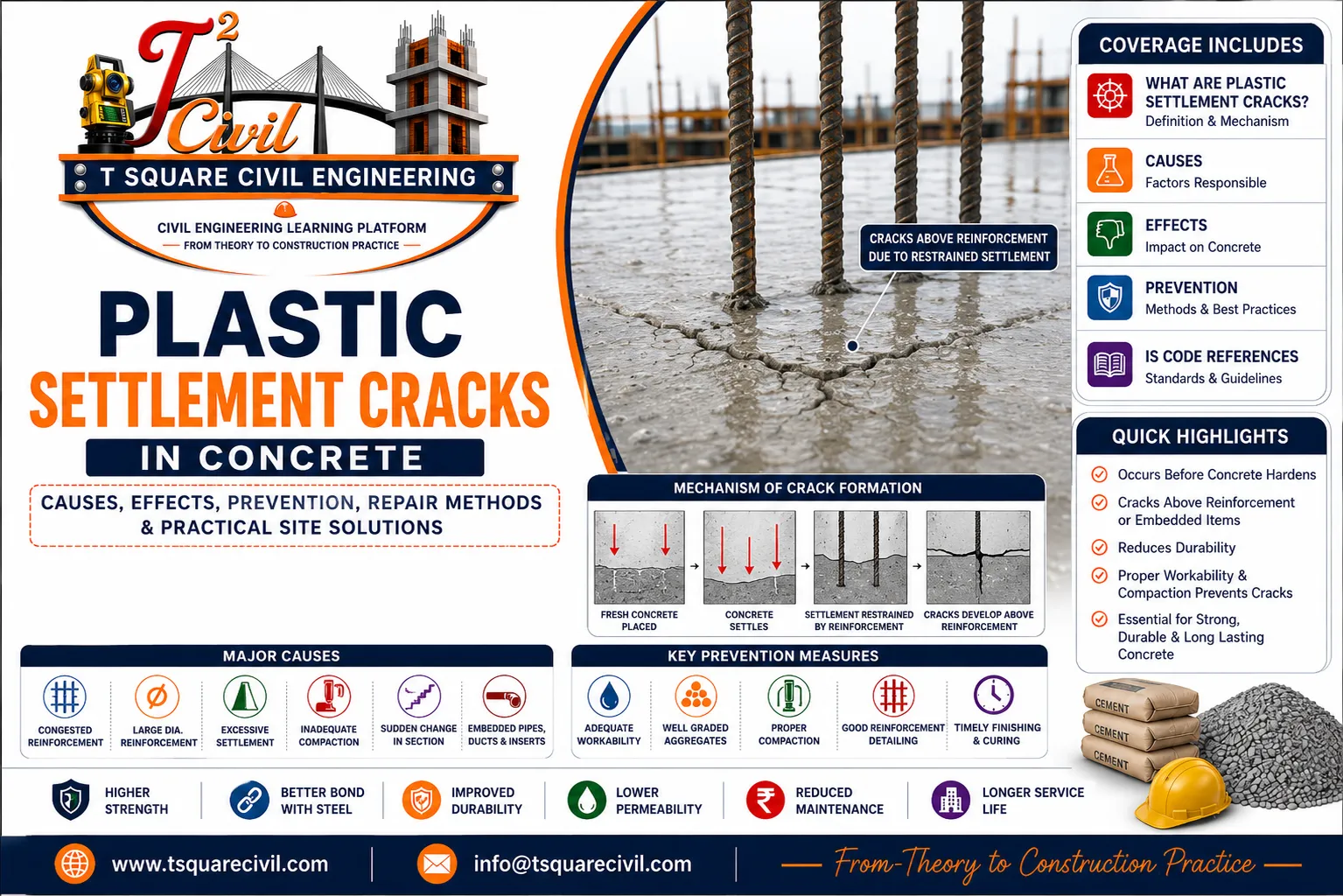
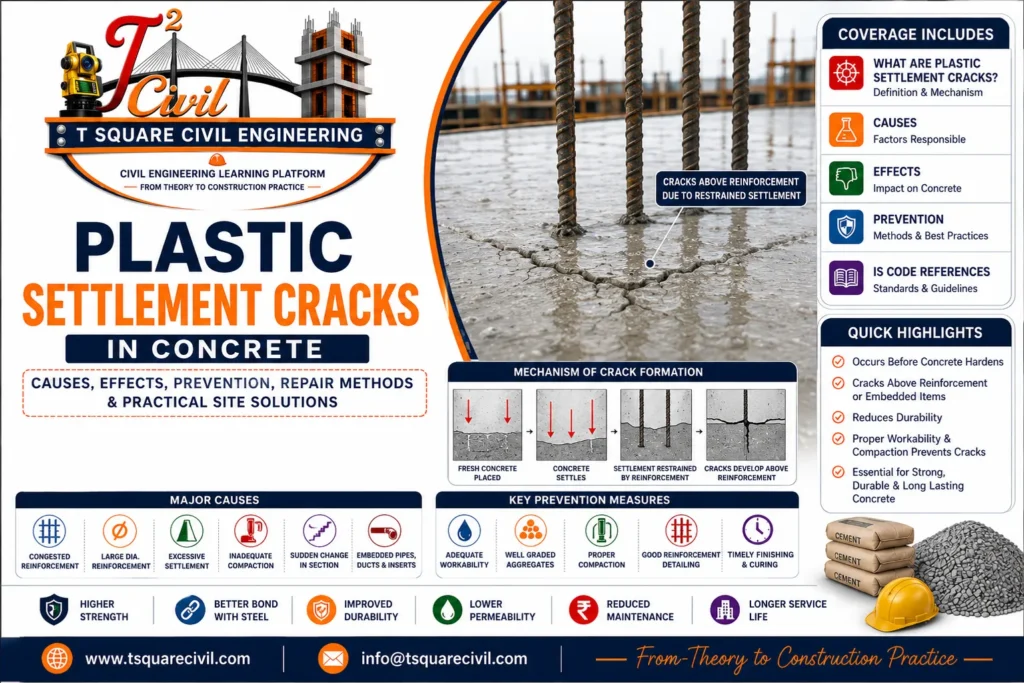
Plastic Settlement Cracks are early-age cracks that develop in fresh concrete before it hardens due to the downward settlement of concrete being restrained by reinforcement bars, embedded pipes, ducts, or sudden changes in section. These cracks generally appear directly above the obstruction where the concrete cannot settle uniformly.
Although these cracks are usually non-structural in the early stage, they should not be ignored because they may increase permeability, reduce durability, and allow moisture and harmful chemicals to reach the reinforcement.
Understanding the causes, identification, prevention, and repair of plastic settlement cracks is essential for producing durable reinforced concrete structures and maintaining high construction quality.
Quick Answer
Plastic Settlement Cracks in Concrete are early-age cracks that form before the concrete hardens when the natural settlement of fresh concrete is restrained by reinforcement bars, embedded items, or abrupt changes in member thickness. Proper concrete placement, adequate compaction, suitable workability, and correct reinforcement detailing significantly reduce the risk of plastic settlement cracking.
Quick Information Table
| Particular | Details |
|---|---|
| Defect Type | Early-age concrete crack |
| Stage of Occurrence | Before concrete hardens (plastic stage) |
| Main Cause | Restrained settlement of fresh concrete |
| Typical Location | Above reinforcement bars, ducts, pipes, and embedded items |
| Crack Pattern | Usually follows reinforcement or embedded objects |
| Structural Significance | Usually non-structural initially but may affect durability if untreated |
| Prevention | Proper concrete placement, compaction, workability, reinforcement detailing, and timely finishing |
| Applicable Standards | IS 456, IS 1199 Series, IS 10262, IS 7861 (Part 1) (summarised) |
What are Plastic Settlement Cracks?
Plastic Settlement Cracks are cracks that develop in freshly placed concrete before initial setting because the concrete naturally settles under its own weight, but this settlement is locally restrained.
When reinforcement bars, ducts, conduits, anchor bolts, or embedded inserts obstruct the downward movement of concrete, tensile stresses develop above these obstructions. Since the concrete has very little tensile strength at this stage, cracks appear on the surface directly over the restrained locations.
These cracks are generally straight, continuous, and aligned with the reinforcement.
Why are Plastic Settlement Cracks Important?
Plastic settlement cracks may appear minor during construction, but they can significantly affect the long-term performance of reinforced concrete if ignored.
Their importance includes:
- Increase the permeability of concrete.
- Provide pathways for water and aggressive chemicals.
- Accelerate reinforcement corrosion.
- Reduce durability.
- Increase maintenance costs.
- Affect the appearance of exposed concrete.
- Reduce the service life of structures if left untreated.
Proper identification and early corrective action are therefore essential.
Objectives of Understanding Plastic Settlement Cracks
Understanding plastic settlement cracks helps engineers to:
- Identify early-age concrete defects accurately.
- Distinguish them from plastic shrinkage and drying shrinkage cracks.
- Improve concrete placement practices.
- Ensure proper reinforcement detailing.
- Maintain construction quality.
- Reduce repair costs.
- Improve the long-term durability of reinforced concrete structures.
Mechanism of Plastic Settlement Crack Formation
Fresh concrete behaves like a plastic mass immediately after placement.
During this period:
- Concrete settles under its own weight.
- Coarse aggregates also move downward.
- Reinforcement bars and embedded objects restrain this movement.
- Differential settlement develops above these obstructions.
- Tensile stresses are generated at the concrete surface.
- Since the concrete has very low tensile strength, cracks develop directly above the restrained locations.
This process usually occurs before the concrete reaches its initial set.
Where Do Plastic Settlement Cracks Commonly Occur?
Plastic settlement cracks are commonly observed in reinforced concrete members having congestion or embedded components.
Typical locations include:
- Above top reinforcement in beams.
- Above reinforcement in slabs.
- Over heavily reinforced columns.
- Around anchor bolts.
- Above ducts in prestressed concrete.
- Around electrical conduits.
- Around embedded pipes.
- Near sudden changes in member depth.
- Adjacent to construction inserts.
Characteristics of Plastic Settlement Cracks
Plastic settlement cracks possess several distinctive characteristics that help engineers identify them on site.
Typical Characteristics
- Develop before concrete hardens.
- Usually appear within the first few hours after placing.
- Straight or nearly straight crack pattern.
- Generally follow the reinforcement layout.
- Commonly occur above embedded objects.
- Usually continuous over reinforcement.
- More frequent in members with congested reinforcement.
- Often shallow initially but may become more significant if neglected.
Difference Between Plastic Settlement Cracks and Plastic Shrinkage Cracks
| Property | Plastic Settlement Cracks | Plastic Shrinkage Cracks |
|---|---|---|
| Main Cause | Restrained settlement of fresh concrete | Rapid evaporation of surface moisture |
| Crack Direction | Usually follows reinforcement or embedded items | Random and irregular |
| Typical Location | Above reinforcement, ducts, or inserts | Large exposed concrete surfaces |
| Time of Occurrence | Before initial setting | Before initial setting |
| Primary Prevention | Proper placement, compaction, reinforcement detailing, and workability | Proper curing and protection from rapid evaporation |
Factors Influencing Plastic Settlement Cracks
Several factors increase the likelihood of plastic settlement cracking.
These include:
- Congested reinforcement.
- Large diameter reinforcement bars.
- Inadequate concrete compaction.
- Improper concrete workability.
- Excessive concrete settlement.
- Poor aggregate grading.
- High concrete depth.
- Sudden changes in member thickness.
- Delayed finishing.
- Improper placement techniques.
Why Site Engineers Should Understand Plastic Settlement Cracks
Every site engineer should be able to identify plastic settlement cracks because early detection helps prevent long-term durability problems.
Knowledge of these cracks enables engineers to:
- Improve construction quality.
- Reduce repair costs.
- Protect reinforcement from early corrosion.
- Ensure compliance with project specifications.
- Improve the service life of reinforced concrete structures.
- Deliver safer and more durable construction projects.
Key Learning Points
- Plastic Settlement Cracks develop before concrete hardens.
- They occur due to restrained settlement of fresh concrete.
- Cracks usually form directly above reinforcement or embedded items.
- They differ from plastic shrinkage cracks, which result from rapid moisture evaporation.
- Proper concrete placement, adequate workability, correct compaction, and good reinforcement detailing significantly reduce the risk of plastic settlement cracking.
Causes of Plastic Settlement Cracks
Plastic settlement cracks occur when the natural downward settlement of fresh concrete is restrained by reinforcement bars, embedded items, or sudden changes in section. Several construction and material-related factors contribute to their formation.
Congested Reinforcement
One of the most common causes is closely spaced reinforcement bars.
When concrete settles after placement, the reinforcement restricts its downward movement. This restraint creates tensile stresses directly above the bars, leading to crack formation.
Common Locations
- Beam-column junctions
- Column reinforcement cages
- Heavily reinforced slabs
- Transfer girders
- Shear walls
Large Diameter Reinforcement Bars
Large reinforcement bars create greater obstruction to the settlement of fresh concrete than smaller bars.
As a result, the concrete above these bars experiences higher tensile stresses, increasing the likelihood of cracking.
Excessive Concrete Settlement
Fresh concrete naturally settles due to gravity.
Excessive settlement may occur because of:
- High paste content.
- Poor aggregate grading.
- High workability without adequate cohesion.
- Improper mix proportioning.
Greater settlement results in larger differential movement around reinforcement.
Improper Concrete Workability
Concrete that is either too stiff or too fluid can contribute to settlement-related problems.
Low Workability
- Difficult placement.
- Poor compaction.
- Non-uniform settlement.
Excessively High Workability
- Increased settlement.
- Greater bleeding.
- Reduced cohesion.
- Higher risk of segregation.
Proper workability should always be achieved using an approved mix design rather than by adding excess water at the site.
Inadequate Compaction
Poor compaction leaves voids and prevents the concrete from properly surrounding reinforcement.
Consequences include:
- Uneven settlement.
- Poor bond with reinforcement.
- Increased cracking.
- Honeycombing.
Improper Concrete Placement
Concrete should always be placed as close as practicable to its final position.
Improper practices such as dropping concrete from excessive heights or moving it over long distances with vibrators can disturb uniform settlement and increase cracking.
Sudden Changes in Member Thickness
Plastic settlement cracks frequently occur where the thickness of a structural member changes abruptly.
Examples include:
- Beam-column junctions.
- Deep beams.
- Thick slab intersections.
- Drop panels.
These locations experience differential settlement between adjacent sections.
Embedded Items
Objects embedded in concrete may obstruct settlement.
Examples include:
- Electrical conduits.
- Water pipes.
- Prestressing ducts.
- Anchor bolts.
- Embedded plates.
- Sleeves.
Cracks often develop directly above these embedded components.
Poor Aggregate Grading
Poorly graded aggregates reduce the stability and cohesion of fresh concrete.
This may result in:
- Increased settlement.
- Segregation.
- Higher cracking tendency.
Proper aggregate grading improves particle packing and reduces differential settlement.
Delay in Finishing
If finishing operations are delayed, settlement cracks that have already begun to form may remain open and become visible after hardening.
Timely finishing helps close very fine cracks while the concrete is still plastic, provided this is done without damaging the surface or violating project procedures.
Effects of Plastic Settlement Cracks
Although plastic settlement cracks are generally shallow during the early stages, they can significantly affect the long-term performance of reinforced concrete.
Increased Permeability
Cracks provide direct pathways for:
- Water.
- Chlorides.
- Sulphates.
- Carbon dioxide.
- Other aggressive substances.
Higher permeability reduces durability.
Reinforcement Corrosion
Cracks located directly above reinforcement facilitate the ingress of moisture and oxygen, increasing the risk of reinforcement corrosion over time.
Reduced Durability
Concrete containing untreated settlement cracks is generally more vulnerable to environmental deterioration, especially in aggressive exposure conditions.
Reduced Service Life
Continuous exposure to moisture and chemicals through cracks may shorten the service life of the structure.
Increased Maintenance Cost
Repairing cracks after the structure is in service is usually more expensive than preventing them during construction.
Poor Surface Appearance
Settlement cracks reduce the visual quality of exposed concrete and may lead to rejection of architectural concrete finishes.
Identification of Plastic Settlement Cracks
Correct identification is essential because plastic settlement cracks are often confused with plastic shrinkage cracks.
Visual Characteristics
Plastic settlement cracks generally:
- Are straight or nearly straight.
- Follow reinforcement lines.
- Occur above embedded items.
- Are continuous over reinforcement.
- Develop before concrete hardens.
- Are relatively shallow initially.
Typical Locations
Site engineers should inspect:
- Top reinforcement of slabs.
- Beam reinforcement.
- Column cages.
- Embedded conduits.
- Anchor bolt locations.
- Prestressing ducts.
- Construction inserts.
Timing of Inspection
Inspection should be carried out:
- Immediately after finishing.
- During the first few hours after placement.
- Before concrete reaches its initial set.
- During early curing.
Severity Classification
Plastic settlement cracks may be classified for inspection purposes based on their apparent extent.
| Severity | Typical Observation | Recommended Action |
|---|---|---|
| Minor | Fine, shallow surface cracks above reinforcement | Continue curing, monitor, and assess if repair is necessary |
| Moderate | Visible cracks following reinforcement over longer lengths | Inspect carefully and repair if required by project specifications |
| Severe | Wide or continuous cracks over major reinforced areas | Engineering evaluation and appropriate repair before further construction |
Note: The significance of a crack depends on its width, depth, location, exposure conditions, and structural requirements.
Practical Site Examples
Example 1 – RCC Slab
During slab concreting, straight cracks appeared directly above the top reinforcement approximately two hours after placement.
Cause: Restrained settlement above reinforcement.
Example 2 – Beam
Settlement cracks developed along the top reinforcement of a heavily reinforced transfer beam.
Cause: Congested reinforcement and differential settlement.
Example 3 – Electrical Conduit
Cracks formed directly above an embedded electrical conduit in a floor slab.
Cause: Settlement restrained by the conduit.
Example 4 – Anchor Bolt
Concrete surrounding anchor bolts showed fine longitudinal cracks shortly after finishing.
Cause: Differential settlement around embedded anchor bolts.
Comparison with Other Early-Age Concrete Cracks
| Property | Plastic Settlement Cracks | Plastic Shrinkage Cracks | Surface Crazing |
|---|---|---|---|
| Main Cause | Restrained settlement | Rapid moisture evaporation | Surface drying and finishing-related effects |
| Crack Pattern | Straight, follows reinforcement | Random, irregular | Very fine network of shallow cracks |
| Typical Location | Above reinforcement and embedded items | Large exposed concrete surfaces | Surface layer only |
| Time of Occurrence | Before initial setting | Before initial setting | Shortly after hardening |
| Primary Prevention | Proper placement, compaction, reinforcement detailing | Proper curing and evaporation control | Proper finishing and curing |
Engineering Case Study
Case Study: Plastic Settlement Cracks in a Commercial Building Slab
During the construction of a reinforced concrete floor slab, fine longitudinal cracks were observed directly above the top reinforcement approximately three hours after concrete placement.
Investigation
The quality control team found:
- Congested reinforcement in beam zones.
- Concrete placed satisfactorily but settlement occurred around the reinforcement.
- No evidence of rapid surface drying.
- Crack locations matched the reinforcement layout.
Corrective Measures
- Continued curing as specified.
- Detailed inspection of crack extent.
- Appropriate repair where required by the project engineer.
- Improved concrete placement and reinforcement detailing in subsequent pours.
Lesson Learned
Proper reinforcement detailing, adequate workability, careful compaction, and timely inspection significantly reduce the occurrence of plastic settlement cracks.
Key Learning Points
- Plastic settlement cracks are caused by restrained settlement, not by moisture evaporation.
- They usually occur directly above reinforcement or embedded items.
- Congested reinforcement is one of the most common causes.
- Early identification allows timely corrective action.
- Good placement, proper compaction, and adequate workability are essential for preventing these cracks.
Prevention of Plastic Settlement Cracks
Plastic settlement cracks can be significantly reduced through proper planning, correct reinforcement detailing, appropriate concrete mix design, careful placement, and effective supervision during concreting. Preventive measures are always more economical than repairing cracks after concrete has hardened.
Ensure Proper Concrete Workability
Concrete should possess sufficient workability to flow around reinforcement and embedded items without segregation or excessive settlement.
Recommended Practices
- Use the approved concrete mix design.
- Maintain the specified water-cement ratio.
- Use suitable chemical admixtures where required.
- Never add excess water at the construction site without engineering approval.
- Verify workability by conducting the required field tests before placement.
Site Tip: Concrete with adequate cohesion settles more uniformly and is less likely to develop plastic settlement cracks.
Provide Proper Reinforcement Detailing
Congested reinforcement is one of the primary causes of plastic settlement cracks.
Good Practices
- Maintain the reinforcement spacing specified in the structural drawings.
- Avoid unnecessary reinforcement congestion.
- Ensure proper concrete cover using approved cover blocks.
- Secure reinforcement firmly to prevent displacement during concreting.
- Provide sufficient clearance for concrete to flow around the reinforcement.
Place Concrete Near Its Final Position
Concrete should be deposited as close as practicable to its final location.
Avoid
- Dropping concrete from excessive heights.
- Dragging concrete over long distances.
- Moving concrete using vibrators.
- Re-handling concrete unnecessarily.
Proper placement minimizes disturbance and promotes uniform settlement.
Carry Out Proper Compaction
Adequate compaction helps concrete settle uniformly around reinforcement and embedded items.
Best Practices
- Use suitable mechanical vibrators.
- Insert vibrators vertically at appropriate intervals.
- Ensure complete compaction around congested reinforcement.
- Avoid under-vibration.
- Avoid over-vibration that may lead to segregation.
Minimise Delays During Concreting
Long interruptions during placing may result in non-uniform settlement.
Recommendations
- Ensure adequate manpower.
- Arrange sufficient equipment before concreting starts.
- Plan the concrete placing sequence.
- Maintain a continuous concrete supply.
Maintain Proper Aggregate Grading
Well-graded aggregates improve particle packing and reduce excessive settlement.
Proper grading also:
- Improves concrete cohesion.
- Reduces segregation.
- Promotes uniform settlement.
- Enhances concrete durability.
Monitor Embedded Items
Before concreting, verify that:
- Pipes are securely fixed.
- Electrical conduits are stable.
- Anchor bolts are properly aligned.
- Prestressing ducts are adequately supported.
- Embedded inserts are correctly positioned.
Movement of embedded items during concreting may increase the likelihood of settlement cracking.
Repair Methods for Plastic Settlement Cracks
The repair method depends on the crack width, depth, location, exposure conditions, and structural significance. A qualified engineer should assess significant cracking before selecting the repair procedure.
Repair of Minor Cracks
Minor plastic settlement cracks are generally shallow and limited to the concrete surface.
Procedure
Step 1
Inspect and document the crack pattern.
Step 2
Continue curing as specified to reduce further moisture loss.
Step 3
If required by project specifications, apply a suitable surface repair material compatible with the concrete.
Step 4
Monitor the repaired area during subsequent inspections.
Repair of Moderate Cracks
Moderate cracks may require localised repair.
Procedure
- Clean the cracked surface.
- Remove loose particles.
- Apply an approved repair material suitable for the crack characteristics.
- Finish the repaired surface to match the surrounding concrete.
- Cure the repaired area in accordance with the repair material manufacturer’s recommendations and project specifications.
Repair of Severe Cracks
Where cracks are extensive or affect structural performance, engineering evaluation is essential.
Typical steps include:
- Detailed inspection.
- Crack width and depth measurement.
- Assessment of structural significance.
- Selection of an appropriate repair system.
- Post-repair inspection and documentation.
Quality Control Measures
Effective quality control significantly reduces the occurrence of plastic settlement cracks.
Before Concreting
- Verify reinforcement spacing.
- Inspect cover blocks.
- Check embedded items.
- Confirm the approved mix design.
- Ensure adequate workability.
- Inspect formwork.
- Arrange vibration equipment.
- Review weather conditions.
During Concreting
- Place concrete continuously.
- Compact concrete properly.
- Avoid excessive concrete drop heights.
- Ensure uniform concrete placement.
- Observe concrete settlement around reinforcement.
- Supervise vibration carefully.
After Concreting
- Inspect for early-age cracks.
- Continue curing according to project specifications.
- Record observations.
- Repair cracks where required.
- Review construction practices before the next concrete pour.
Site Engineer Checklist
Before approving the completed concrete placement, the Site Engineer should verify the following:
| Sl. No. | Inspection Item | Yes ✓ | No ✗ |
|---|---|---|---|
| 1 | Reinforcement spacing complies with drawings. | ☐ | ☐ |
| 2 | Cover blocks are correctly placed. | ☐ | ☐ |
| 3 | Embedded items are securely fixed. | ☐ | ☐ |
| 4 | Approved concrete mix has been used. | ☐ | ☐ |
| 5 | Concrete workability is satisfactory. | ☐ | ☐ |
| 6 | Vibrators are available and functioning properly. | ☐ | ☐ |
| 7 | Concrete has been placed near its final position. | ☐ | ☐ |
| 8 | Proper compaction has been completed. | ☐ | ☐ |
| 9 | Early-age inspection has been carried out. | ☐ | ☐ |
| 10 | Curing has started as specified. | ☐ | ☐ |
Practical Site Tips
Tip 1
Always inspect congested reinforcement areas before concrete placement.
Tip 2
Never move concrete using internal vibrators.
Tip 3
Ensure concrete flows freely around reinforcement without segregation.
Tip 4
Avoid unnecessary delays during placing and compaction.
Tip 5
Inspect reinforcement zones during the first few hours after placing because settlement cracks generally become visible during this period.
Common Mistakes Leading to Plastic Settlement Cracks
- Congested reinforcement without adequate spacing.
- Improper concrete workability.
- Poor compaction.
- Excessive concrete drop height.
- Inadequate supervision.
- Improper vibration techniques.
- Poor planning of concrete placement.
- Unsecured embedded pipes or conduits.
- Failure to inspect reinforcement before concreting.
Corrective Actions
| Problem Observed | Possible Cause | Corrective Action |
|---|---|---|
| Straight cracks above reinforcement | Restrained settlement | Inspect cracks, continue curing, and repair if required by project specifications |
| Cracks above embedded conduits | Settlement restrained by conduits | Verify conduit installation and improve future placement practices |
| Cracks in congested reinforcement zones | Inadequate concrete flow | Improve reinforcement detailing and ensure proper workability |
| Poor compaction around reinforcement | Inadequate vibration | Use appropriate vibration techniques and verify compaction during placement |
| Repeated settlement cracks in similar locations | Construction planning deficiencies | Review mix design, reinforcement detailing, placement sequence, and supervision before the next pour |
Comparison: Plastic Settlement Cracks vs Plastic Shrinkage Cracks vs Honeycombing
| Property | Plastic Settlement Cracks | Plastic Shrinkage Cracks | Honeycombing |
|---|---|---|---|
| Main Cause | Restrained settlement | Rapid evaporation of surface moisture | Incomplete compaction or poor concrete flow |
| Time of Occurrence | Before initial setting | Before initial setting | During concreting, visible after formwork removal |
| Typical Location | Above reinforcement and embedded items | Large exposed concrete surfaces | Corners, reinforcement congestion, formwork edges |
| Appearance | Straight cracks following reinforcement | Random surface cracks | Voids and exposed aggregates |
| Primary Prevention | Proper placement, reinforcement detailing, and compaction | Timely curing and evaporation control | Proper compaction, workability, and formwork |
Summary of Relevant IS Code References
The following Indian Standards provide guidance on concrete materials, workmanship, and quality control. Always consult the latest official editions for complete technical requirements.
| Standard | General Purpose |
|---|---|
| IS 456 | Plain and Reinforced Concrete – Code of Practice, including workmanship, durability, and curing requirements. |
| IS 1199 (Part 2) | Methods for sampling and testing fresh concrete, including workability tests. |
| IS 10262 | Concrete mix proportioning guidelines. |
| IS 7861 (Part 1) | Recommended practices for concreting under hot weather conditions. |
Note: The descriptions above are original educational summaries and are not reproductions of the official standards.
Key Learning Points
- Plastic settlement cracks are caused by restrained settlement of fresh concrete, not by moisture evaporation.
- They commonly develop above reinforcement bars, embedded pipes, ducts, and inserts.
- Proper workability, reinforcement detailing, concrete placement, and compaction are the most effective preventive measures.
- Early inspection and quality control help detect cracks before the concrete hardens.
- Good planning and supervision significantly reduce the occurrence of plastic settlement cracks and improve the long-term durability of reinforced concrete structures.
Frequently Asked Questions (FAQs)
1. What are Plastic Settlement Cracks in Concrete?
Answer:
Plastic settlement cracks are early-age cracks that develop in fresh concrete before it hardens due to the restrained settlement of concrete around reinforcement bars, embedded pipes, ducts, anchor bolts, or other obstructions.
2. When do plastic settlement cracks occur?
Answer:
They generally occur within the first few hours after concrete placement, before the concrete reaches its initial setting time.
3. What is the primary cause of plastic settlement cracks?
Answer:
The primary cause is the restriction of the natural downward settlement of fresh concrete by reinforcement bars or embedded items.
4. Are plastic settlement cracks structural cracks?
Answer:
They are usually non-structural when shallow. However, if they are deep or remain unrepaired, they may reduce durability and increase the risk of reinforcement corrosion.
5. Where do plastic settlement cracks usually occur?
Answer:
They commonly occur:
- Above reinforcement bars.
- Over prestressing ducts.
- Around embedded conduits.
- Around anchor bolts.
- At sudden changes in member depth.
6. How do plastic settlement cracks appear?
Answer:
They generally appear as straight or nearly straight cracks following the reinforcement layout or embedded objects.
7. How are plastic settlement cracks different from plastic shrinkage cracks?
Answer:
Plastic settlement cracks are caused by restrained settlement, whereas plastic shrinkage cracks result from rapid evaporation of surface moisture.
8. Does congested reinforcement increase the risk?
Answer:
Yes. Closely spaced reinforcement restricts concrete settlement and significantly increases the likelihood of plastic settlement cracking.
9. Can improper compaction contribute to plastic settlement cracks?
Answer:
Yes. Poor compaction prevents uniform settlement around reinforcement and may increase cracking.
10. How can plastic settlement cracks be prevented?
Answer:
They can be minimized by:
- Proper reinforcement detailing.
- Adequate workability.
- Correct concrete placement.
- Effective compaction.
- Good construction planning.
- Proper supervision.
11. Do embedded pipes and conduits cause settlement cracks?
Answer:
Yes. Embedded items restrain the natural settlement of fresh concrete, making cracks more likely directly above them.
12. Can plastic settlement cracks affect durability?
Answer:
Yes. These cracks may increase permeability, allowing water and harmful chemicals to reach the reinforcement.
13. Can these cracks be repaired?
Answer:
Yes. The repair method depends on the crack width, depth, location, and service conditions. Significant cracks should be assessed by a qualified engineer before repair.
14. Why is inspection important during the first few hours?
Answer:
Plastic settlement cracks develop before concrete hardens. Early inspection helps identify defects while timely corrective measures are still possible.
15. Which concrete members are most susceptible?
Answer:
- Heavily reinforced beams.
- Slabs.
- Columns.
- Shear walls.
- Prestressed concrete members.
- Members containing embedded conduits and inserts.
Civil Engineering Interview Questions with Answers
1. Define Plastic Settlement Cracks.
Answer:
Plastic settlement cracks are early-age cracks caused by restrained settlement of fresh concrete around reinforcement or embedded objects before the concrete hardens.
2. What is the mechanism of plastic settlement cracking?
Answer:
Fresh concrete settles under gravity. Reinforcement or embedded objects restrain this settlement, generating tensile stresses in the concrete above them. Since the concrete has very little tensile strength at this stage, cracks develop.
3. Why do these cracks usually follow reinforcement?
Answer:
Because the reinforcement restrains the downward movement of the surrounding concrete, cracks typically form directly above the reinforcement bars.
4. How can a site engineer identify plastic settlement cracks?
Answer:
They are generally straight, shallow cracks that appear above reinforcement or embedded items during the first few hours after concrete placement.
5. What are the major preventive measures?
Answer:
- Proper reinforcement detailing.
- Adequate workability.
- Correct concrete placement.
- Proper compaction.
- Effective supervision.
- Good quality control.
6. Why is workability important?
Answer:
Concrete with adequate workability flows uniformly around reinforcement, reducing differential settlement and the risk of crack formation.
7. Does vibration eliminate plastic settlement cracks?
Answer:
No. Proper vibration helps improve compaction, but it cannot compensate for poor reinforcement detailing or improper concrete placement.
8. Why should concrete be placed near its final position?
Answer:
This minimizes disturbance to fresh concrete, promotes uniform settlement, and reduces the likelihood of settlement-related defects.
9. Can settlement cracks occur in plain concrete?
Answer:
They are less common in plain concrete because there is little or no reinforcement to restrain settlement.
10. What is the role of quality control?
Answer:
Quality control ensures that the concrete mix, workability, reinforcement detailing, placement, compaction, and curing comply with project requirements, reducing the likelihood of plastic settlement cracks.
Viva Questions with Answers
1. What are plastic settlement cracks?
Answer: Early-age cracks caused by restrained settlement of fresh concrete.
2. When do they occur?
Answer: Before the concrete hardens.
3. What is the main cause?
Answer: Restrained settlement around reinforcement or embedded objects.
4. Which members are most affected?
Answer: Heavily reinforced concrete members.
5. Do they usually follow reinforcement?
Answer: Yes.
6. Are they structural cracks?
Answer: Usually non-structural initially.
7. Can embedded conduits cause these cracks?
Answer: Yes.
8. Is adequate workability important?
Answer: Yes.
9. Why is proper compaction required?
Answer: To ensure uniform settlement and good concrete consolidation.
10. What is the best prevention method?
Answer: Proper reinforcement detailing, adequate workability, correct placement, and proper compaction.
11. Can poor reinforcement detailing increase cracking?
Answer: Yes.
12. Which stage is critical for inspection?
Answer: The first few hours after concrete placement.
13. Can settlement cracks reduce durability?
Answer: Yes.
14. Which IS Code governs general concrete construction?
Answer: IS 456 (latest applicable edition).
15. Should these cracks be ignored?
Answer: No. They should be inspected and assessed before deciding on corrective action.
Important Examination Questions
Short Answer Questions (2–5 Marks)
- Define plastic settlement cracks.
- State the primary causes of plastic settlement cracks.
- Mention four preventive measures.
- Explain why reinforcement causes settlement cracks.
- Differentiate between plastic settlement cracks and plastic shrinkage cracks.
- State the effects of plastic settlement cracks on durability.
- Mention the locations where settlement cracks commonly occur.
- Explain the importance of proper compaction.
- State the role of workability in preventing settlement cracks.
- List quality control measures to minimise settlement cracks.
Long Answer Questions (10–15 Marks)
- Explain plastic settlement cracks with suitable sketches, causes, mechanism, effects, prevention, and repair methods.
- Discuss the influence of reinforcement detailing on plastic settlement cracking.
- Describe the quality control measures adopted to prevent plastic settlement cracks during construction.
- Compare plastic settlement cracks, plastic shrinkage cracks, and honeycombing with suitable examples.
- Explain the repair methods for plastic settlement cracks with practical site considerations.
Quick Revision Notes
- Plastic settlement cracks occur before concrete hardens.
- They are caused by restrained settlement of fresh concrete.
- Cracks generally form directly above reinforcement or embedded objects.
- Congested reinforcement is one of the major contributing factors.
- Proper workability, reinforcement detailing, concrete placement, and compaction significantly reduce the risk.
- Early inspection and quality control improve concrete durability.
- These cracks should not be ignored because they may increase permeability and accelerate reinforcement corrosion.
Conclusion
Plastic Settlement Cracks are one of the most common early-age defects in reinforced concrete. They develop before the concrete hardens when the natural downward settlement of fresh concrete is restrained by reinforcement bars, embedded pipes, ducts, anchor bolts, or sudden changes in the cross-section of structural members.
Although these cracks are generally non-structural in their initial stages, they should never be overlooked. If left untreated, they can increase the permeability of concrete, provide pathways for moisture and aggressive chemicals, accelerate reinforcement corrosion, reduce durability, and increase maintenance costs throughout the service life of the structure.
The occurrence of plastic settlement cracks can be significantly reduced by adopting proper concreting practices. Adequate workability, correct reinforcement detailing, placing concrete near its final position, proper vibration, careful supervision, and timely inspection are essential measures for minimising the risk of these cracks. Quality control before, during, and after concreting plays a vital role in producing durable reinforced concrete structures.
For civil engineering students, site engineers, QA/QC professionals, contractors, consultants, and competitive examination aspirants, understanding plastic settlement cracks is essential for improving construction quality and ensuring long-term structural durability. Early identification and corrective action not only reduce repair costs but also enhance the performance and service life of concrete structures.
Key Takeaways
- Plastic Settlement Cracks develop before concrete hardens.
- They are caused by the restrained settlement of fresh concrete.
- Cracks usually appear directly above reinforcement bars or embedded items.
- Congested reinforcement and poor concrete workability significantly increase the risk.
- Proper reinforcement detailing, adequate workability, correct placement, and effective compaction are the most effective preventive measures.
- Early inspection helps identify cracks before the concrete fully hardens.
- Proper quality control and construction planning significantly improve the durability of reinforced concrete structures.
Related Articles
Continue learning with these related articles on T Square Civil Engineering:
Concrete Technology
- Workability of Concrete
- Slump Cone Test of Concrete
- Flow Table Test of Concrete
- Compaction Factor Test
- Vee Bee Consistometer Test
- Bleeding of Concrete
- Segregation of Concrete
- Honeycombing of Concrete
- Plastic Shrinkage Cracks in Concrete
- Cold Joints in Concrete
- Surface Crazing in Concrete
- Curing of Concrete
- Durability of Concrete
- Carbonation of Concrete
- Sulphate Attack on Concrete
Concrete Testing
- Concrete Cube Casting Procedure
- Compressive Strength Test of Concrete Cubes
- Rebound Hammer Test
- Ultrasonic Pulse Velocity (UPV) Test
Cement Testing
- Standard Consistency Test of Cement
- Initial Setting Time Test
- Final Setting Time Test
- Soundness Test of Cement
- Fineness Test of Cement
Related Calculators
Explore these practical engineering calculators available on T Square Civil Engineering:
- Steel Weight Calculator
- Concrete Volume Calculator
- Cement Bags Calculator
- Cement, Sand & Aggregate Calculator
- Bar Bending Schedule (BBS) Calculator
- Brick Quantity Calculator
- Plaster Quantity Calculator
- Tile Quantity Calculator
- Paint Quantity Calculator
- Lap Length Calculator
References
This article has been prepared using accepted engineering principles and reliable technical references.
Indian Standards
- IS 456:2000 – Plain and Reinforced Concrete – Code of Practice.
- IS 1199 (Part 2): 2018 – Fresh Concrete – Sampling and Testing Methods.
- IS 10262 (Latest Applicable Edition) – Concrete Mix Proportioning Guidelines.
- IS 7861 (Part 1) – Recommended Practice for Hot Weather Concreting.
Standard Reference Books
- M. S. Shetty – Concrete Technology
- A. M. Neville – Properties of Concrete
- S. C. Rangwala – Concrete Technology
Note: The explanations in this article are original educational summaries based on accepted engineering principles and standard references. Readers should consult the latest official editions of applicable standards for complete technical requirements.
T Square Civil Engineering
Civil Engineering Learning Platform: From Theory to Construction Practice
T Square Civil Engineering is dedicated to providing original, technically accurate, practical, and easy-to-understand civil engineering knowledge for students, engineers, educators, contractors, and construction professionals.
Every article is carefully developed using accepted engineering principles, practical site experience, and trusted technical references. Our objective is to simplify complex civil engineering concepts while maintaining technical accuracy and practical relevance.
We are committed to creating one of the most trusted Civil Engineering Learning Platforms, helping learners bridge the gap between engineering theory and real-world construction practices through original articles, practical site guides, engineering calculators, professional illustrations, and quality educational resources.
Website: www.tsquarecivil.com
Disclaimer
The information provided in this article is intended solely for educational and informational purposes.
Every effort has been made to ensure that the content is technically accurate and based on accepted engineering principles and reliable engineering references. However, engineering decisions should always be made considering the latest applicable standards, project specifications, site conditions, and professional judgment.
Where Indian Standards (IS Codes) are referenced, the explanations are presented in the original language for educational purposes only and do not reproduce the official publications. Readers should always consult the latest official editions of the relevant standards for complete technical requirements.
T Square Civil Engineering shall not be responsible for any loss, damage, or consequences resulting from the use of the information presented in this article without appropriate professional verification.
Why This Article Matters
Plastic settlement cracks are often confused with other early-age concrete defects, leading to incorrect diagnosis and ineffective repairs. This article provides a structured understanding of their causes, identification, prevention, and repair, enabling engineers to make informed decisions on construction sites.
By combining engineering theory with practical construction practices, this guide serves as a valuable reference for:
- Civil Engineering Students
- Site Engineers
- QA/QC Engineers
- Consultants
- Contractors
- Construction Supervisors
- Government Exam Aspirants
- Interview Candidates