 by
by Concrete mix design is not governed by compressive strength alone.
A concrete mix may achieve the required 28-day strength and still be unsuitable for a structure if its durability requirements are not satisfied.
The environmental exposure of concrete influences important mix-design limits such as:
- maximum free water-cement ratio;
- minimum cement content;
- minimum concrete grade;
- concrete quality and permeability;
- nominal cover to reinforcement;
- cement and supplementary cementitious material selection;
- curing requirements; and
- protection against aggressive substances.
For this reason, exposure condition should be established before the final concrete mix proportions are approved.
In Indian practice, IS 456 provides durability requirements for plain and reinforced concrete, while IS 10262 provides the procedure for proportioning the concrete mix.
A practical concrete mix-design sequence is therefore:
Determine exposure → establish durability limits → determine strength requirement → calculate preliminary mix → check durability → prepare trial mixes → approve final mix
For the complete mix-design sequence, visit the Concrete Mix Design Hub and Concrete Mix Design Procedure as per IS 10262:2019.
Page Contents
Why Durability Is Important in Concrete Mix Design
Concrete is expected to perform throughout its intended service life.
Depending on its location, concrete may be exposed to:
- rain;
- alternating wetting and drying;
- groundwater;
- coastal atmosphere;
- seawater;
- chlorides;
- sulphates;
- aggressive soil;
- industrial chemicals;
- freezing conditions; or
- combinations of these actions.
These exposures can contribute to deterioration such as:
- reinforcement corrosion;
- cracking;
- surface scaling;
- loss of concrete section;
- sulphate attack;
- increased permeability; and
- reduced service life.
Concrete durability therefore depends not only on achieving strength but also on producing concrete with sufficiently low permeability and adequate resistance to the actual environment.
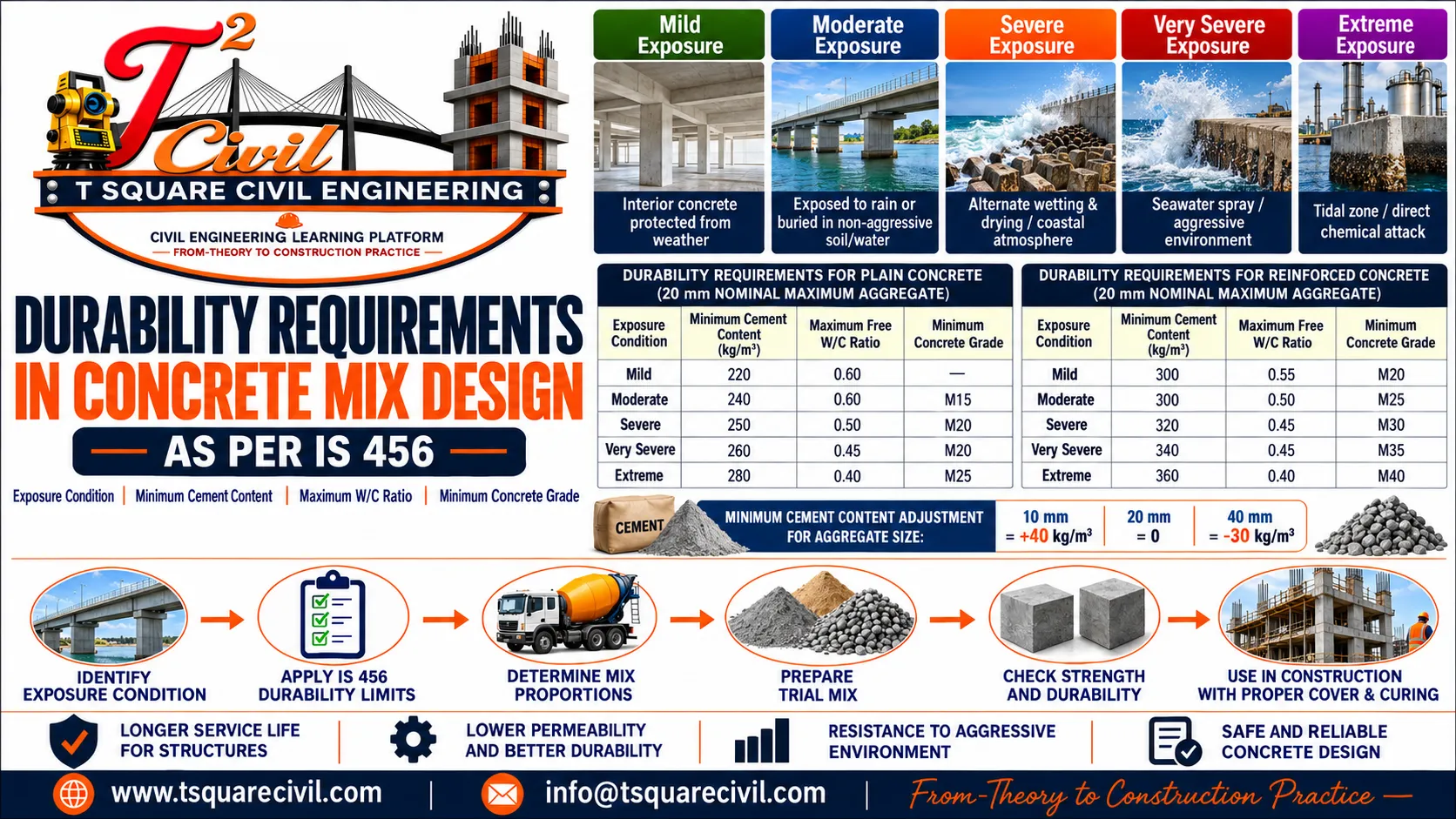
Exposure Conditions as per IS 456
IS 456 classifies environmental exposure into five broad categories:
- Mild
- Moderate
- Severe
- Very Severe
- Extreme
The exposure becomes progressively more demanding from mild to extreme.
The exposure classification should be based on the actual environmental conditions of the structural member.
It should not be selected merely to obtain convenient concrete proportions.
Mild Exposure
Mild exposure generally represents concrete that is substantially protected from aggressive environmental conditions.
Typical situations may include concrete:
- inside buildings;
- protected from direct weather;
- away from aggressive soil or groundwater; and
- not subjected to significant coastal or chemical exposure.
Even under mild exposure, reinforced concrete must satisfy the durability requirements applicable to RCC.
Moderate Exposure
Moderate exposure can include concrete subjected to environmental moisture or weather conditions that are more demanding than mild exposure but are not strongly aggressive.
Examples may include:
- surfaces exposed to rain;
- continuously submerged concrete under non-aggressive conditions;
- concrete subjected to condensation;
- contact with non-aggressive soil or groundwater; and
- certain sheltered coastal conditions.
The actual classification should always be confirmed from the applicable design basis and project specification.
Severe Exposure
Severe exposure represents more demanding conditions.
Examples may include concrete exposed to:
- severe rain;
- repeated wetting and drying;
- harsh coastal environments;
- seawater immersion; or
- other conditions that significantly increase durability demand.
The permissible water-cement ratio becomes lower and the required concrete grade becomes higher.
Very Severe Exposure
Very severe exposure may include concrete subjected to conditions such as:
- seawater spray;
- aggressive groundwater;
- aggressive soil;
- corrosive fumes; or
- severe environmental actions while the concrete remains wet.
Concrete quality, permeability, cover and construction control become particularly important.
Extreme Exposure
Extreme exposure represents highly aggressive conditions.
Examples include:
- tidal-zone concrete;
- direct contact with aggressive chemicals; and
- similarly demanding service environments.
Such applications require strict durability control and may also require project-specific provisions beyond the basic concrete mix-design limits.
IS 456 Durability Requirements for 20 mm Aggregate
The basic IS 456 durability requirements for normal-weight concrete using 20 mm nominal maximum aggregate can be summarized as follows.
Plain Concrete
| Exposure | Minimum Cement Content | Maximum Free W/C Ratio | Minimum Concrete Grade |
|---|---|---|---|
| Mild | 220 kg/m³ | 0.60 | Not specifically prescribed in Table 5 |
| Moderate | 240 kg/m³ | 0.60 | M15 |
| Severe | 250 kg/m³ | 0.50 | M20 |
| Very Severe | 260 kg/m³ | 0.45 | M20 |
| Extreme | 280 kg/m³ | 0.40 | M25 |
Reinforced Concrete
| Exposure | Minimum Cement Content | Maximum Free W/C Ratio | Minimum Concrete Grade |
|---|---|---|---|
| Mild | 300 kg/m³ | 0.55 | M20 |
| Moderate | 300 kg/m³ | 0.50 | M25 |
| Severe | 320 kg/m³ | 0.45 | M30 |
| Very Severe | 340 kg/m³ | 0.45 | M35 |
| Extreme | 360 kg/m³ | 0.40 | M40 |
These values apply to normal-weight concrete with 20 mm nominal maximum aggregate.
Important: All Three Requirements Must Be Checked
A common mistake is to check only one durability parameter.
For example:
“The cement content is more than 300 kg/m³, therefore the mix is durable.”
That conclusion is incomplete.
The concrete must satisfy all applicable requirements.
For reinforced concrete under moderate exposure, for example, check:
Minimum cement content ≥ 300 kg/m³
AND
Free water-cement ratio ≤ 0.50
AND
Concrete grade ≥ M25
Meeting only one of these conditions is not sufficient.
Strength Requirement vs Durability Requirement
Concrete mix design normally has at least two independent controls:
Strength Control
The water-cementitious ratio must be low enough to achieve the required strength.
Durability Control
The water-cement ratio must not exceed the permissible limit corresponding to the environmental exposure.
The final adopted ratio should satisfy both.
In practical terms:
Adopt the more restrictive requirement.
Example – Strength Requires W/C = 0.48
Suppose an RCC structure has:
Concrete grade:
M25
Exposure:
Moderate
Strength-based trial requirement:
W/C = 0.48
Maximum permitted durability value:
W/C = 0.50
Compare:
Strength requirement = 0.48
Durability maximum = 0.50
Therefore:
Adopt W/C ≤ 0.48
because 0.48 is the more restrictive value.
Example – Strength Allows W/C = 0.52
Suppose the strength relationship indicates:
W/C = 0.52
But moderate exposure RCC permits a maximum:
W/C = 0.50
Then:
0.52 cannot be adopted
even if the required strength appears achievable.
The mix must satisfy:
W/C ≤ 0.50
and the trial mix should be developed accordingly.
For a detailed explanation, see Water-Cement Ratio in Concrete.
Minimum Concrete Grade Is Also a Durability Requirement
Concrete grade should not be selected from structural strength demand alone.
Suppose structural calculations suggest that M20 concrete would be adequate.
But the reinforced concrete member is exposed to:
Severe exposure
The durability requirement calls for at least:
M30
Therefore, M20 should not be adopted for that exposure merely because structural strength calculations require only M20.
The durability-controlled minimum grade becomes governing.
Example – Grade Selection
Structural requirement:
M25
Exposure:
Severe
Minimum RCC grade for severe exposure:
M30
Therefore:
Adopt at least M30
subject to all other project requirements.
Minimum Cement Content
Minimum cement content is intended to help provide concrete with adequate durability characteristics.
However, minimum cement content should not be considered independently.
A mix containing a high cement content can still be poor concrete if it has:
- excessive water;
- high permeability;
- inadequate compaction;
- poor curing;
- segregation; or
- inadequate cover.
Therefore:
Minimum cement content does not compensate for excessive water-cement ratio.
For the complete calculation, see Cementitious Material Content in Concrete Mix Design.
Adjustment for Aggregate Sizes Other Than 20 mm
The minimum cement contents in the basic IS 456 durability table correspond to:
20 mm nominal maximum aggregate
When another nominal maximum aggregate size is used, the minimum cement content is adjusted.
| Nominal Maximum Aggregate Size | Adjustment to Minimum Cement Content |
|---|---|
| 10 mm | +40 kg/m³ |
| 20 mm | 0 |
| 40 mm | −30 kg/m³ |
This adjustment applies to the minimum cement content.
It does not mean the maximum water-cement ratio or minimum grade can automatically be changed by the same proportion.
Example – 10 mm Aggregate
Consider RCC under moderate exposure.
Base minimum cement content for 20 mm aggregate:
300 kg/m³
But the selected nominal maximum aggregate size is:
10 mm
Adjustment:
+40 kg/m³
Therefore:
Minimum cement content = 300 + 40
= 340 kg/m³
The other applicable requirements must still be checked independently.
Example – 40 mm Aggregate
For the same moderate RCC exposure:
Base minimum cement content:
300 kg/m³
40 mm aggregate adjustment:
−30 kg/m³
Therefore:
Adjusted minimum cement content = 270 kg/m³
This does not mean that 40 mm aggregate should automatically be selected.
The aggregate size must also satisfy:
- member dimensions;
- reinforcement spacing;
- cover;
- placing requirements; and
- construction method.
For aggregate-size selection, see Nominal Maximum Aggregate Size in Concrete Mix Design.
Maximum Cement Content
Very high cement content is not automatically beneficial.
IS 456 states that cement content excluding certain mineral additions such as fly ash and ground-granulated blast-furnace slag should not normally exceed:
450 kg/m³
unless special consideration is given.
Excessive cement content can contribute to:
- higher heat generation;
- thermal cracking;
- drying shrinkage;
- excessive paste volume; and
- other durability concerns.
Therefore, concrete mix design is not simply:
more cement = better concrete
The objective is to use a technically appropriate cementitious system.
Cementitious Materials and Durability
Supplementary cementitious materials may be used as part of the concrete binder system where permitted and demonstrated suitable.
Examples include:
- fly ash;
- ground-granulated blast-furnace slag;
- silica fume; and
- other permitted mineral additions.
Depending on their characteristics and proportion, these materials may help improve properties such as:
- permeability;
- later-age strength;
- resistance to certain aggressive environments;
- heat evolution; and
- long-term durability.
However, their use should comply with:
- applicable Indian Standards;
- project specifications;
- cement type;
- exposure requirements; and
- successful trial results.
Do not assume that every supplementary cementitious material automatically improves every durability condition.
Free Water-Cement Ratio
The durability table refers to the free water-cement ratio.
Free water is the water available in the concrete mix after proper consideration of aggregate moisture and absorption.
Therefore, inaccurate aggregate moisture correction can alter the actual water-cement ratio.
For example:
Design water:
160 kg/m³
Cementitious basis used for the ratio:
360 kg/m³
Design ratio:
160 ÷ 360 = 0.444
If wet sand introduces an additional:
15 kg/m³ free water
and this water is not deducted from the added mixing water:
Actual free water becomes:
175 kg/m³
Actual ratio:
175 ÷ 360 = 0.486
The actual concrete may therefore have a significantly higher ratio than the design value.
This is why moisture correction is also a durability-control issue.
See Moisture Correction in Concrete Mix Design.
Water Reduction Using Superplasticizer
One practical way to achieve good workability while maintaining a low water-cement ratio is to use a suitable water-reducing admixture.
For example:
Required slump may be:
150 mm
But simply increasing mixing water to obtain that slump may violate:
- strength requirements; and
- durability limits.
A properly selected superplasticizer may provide the required workability while maintaining a lower water content.
However, water reduction and dosage must be established through:
- manufacturer data;
- material compatibility tests; and
- concrete trials.
See Superplasticizer in Concrete Mix Design.
Exposure Condition Does Not Determine W/C Ratio Alone
The durability table gives a:
maximum permitted ratio
It does not mean that every concrete mix under that exposure should use exactly that value.
For example:
Moderate RCC maximum:
0.50
This means:
W/C must not exceed 0.50
It does not mean:
W/C must equal 0.50
A mix may require:
0.46
or:
0.42
to achieve strength and performance.
The lower value may therefore govern.
Minimum Cement Content Does Not Mean Exact Cement Content
Similarly:
Minimum cement content:
300 kg/m³
does not mean:
every mix must contain exactly 300 kg/m³
The actual required amount may be greater because of:
- selected water content;
- adopted water-cementitious ratio;
- strength requirement;
- workability;
- supplementary cementitious materials; or
- project specification.
The minimum is simply a lower durability boundary.
Durability Check Example – M30 RCC
Suppose the design conditions are:
Concrete:
RCC
Exposure:
Moderate
Nominal maximum aggregate:
20 mm
Required structural grade:
M30
Selected free water:
160 kg/m³
Strength-based selected ratio:
0.45
Step 1 – Check Minimum Grade
Moderate RCC minimum:
M25
Proposed:
M30
Therefore:
Pass
Step 2 – Check Maximum W/C Ratio
Maximum permitted:
0.50
Selected:
0.45
Therefore:
Pass
Step 3 – Calculate Cementitious Requirement
Using:
C = W ÷ (W/C)
C = 160 ÷ 0.45
= 355.6 kg/m³
Say:
356 kg/m³
Step 4 – Check Minimum Cement Content
Moderate exposure minimum for 20 mm RCC:
300 kg/m³
Calculated:
356 kg/m³
Therefore:
Pass
The preliminary mix satisfies these basic durability checks.
It must still be validated by trial mixes and all other project requirements.
Durability Check Example – Severe Exposure
Suppose:
RCC exposure:
Severe
Nominal maximum aggregate:
20 mm
Structural concrete grade requested:
M25
Selected water:
155 kg/m³
Proposed ratio:
0.48
Now check durability.
Minimum Grade
Required:
M30
Proposed:
M25
Not acceptable
Maximum W/C Ratio
Allowed:
0.45
Proposed:
0.48
Not acceptable
Minimum Cement Content
Required:
320 kg/m³
Therefore, the proposed mix must be redesigned.
This demonstrates why concrete strength alone cannot be used to finalize the mix.
Exposure Condition and Concrete Cover
Concrete durability is also strongly affected by reinforcement cover.
Adequate cover helps protect reinforcement from:
- moisture;
- chlorides;
- carbon dioxide; and
- aggressive environmental exposure.
Therefore:
durability mix design + proper concrete cover + good compaction + good curing
must work together.
Increasing cement content cannot compensate for inadequate reinforcement cover.
Exposure and Permeability
Low permeability is one of the most important characteristics of durable concrete.
Permeability is influenced by:
- water-cementitious ratio;
- aggregate quality;
- paste quality;
- compaction;
- curing;
- cracking;
- air voids;
- construction joints; and
- workmanship.
A low designed W/C ratio will not provide durable concrete if the concrete is poorly compacted or inadequately cured.
Exposure and Curing
Curing allows the cementitious system to hydrate and develop the intended microstructure.
Poor curing may result in:
- weak surface concrete;
- increased permeability;
- shrinkage cracking;
- reduced durability; and
- lower strength.
Therefore, durability requirements should never be considered only as mix-proportion numbers.
Construction practice is equally important.
Exposure and Aggregate Quality
Aggregates should be suitable for the intended concrete environment.
Check properties such as:
- grading;
- specific gravity;
- water absorption;
- deleterious materials;
- aggregate strength;
- durability;
- chloride contamination where relevant;
- sulphate contamination where relevant; and
- potential alkali-aggregate reactivity.
For material testing, see Material Tests Before Concrete Mix Design.
Sulphate Exposure Requires Additional Checks
Where concrete is exposed to sulphates in:
- soil; or
- groundwater,
the general exposure classification is not the only requirement.
Additional provisions may control:
- cement type;
- minimum cement content;
- maximum water-cement ratio; and
- protective measures.
Therefore, do not rely only on the general durability table for sulphate exposure.
The sulphate concentration and applicable provisions should be evaluated separately.
Marine Concrete Requires Special Attention
Concrete in coastal and marine environments may be exposed to:
- airborne chlorides;
- seawater;
- splash;
- spray;
- tidal wetting and drying; and
- continuous immersion.
Different parts of the same structure may therefore experience different exposure severity.
For example, a marine pile may contain:
- submerged zone;
- tidal zone;
- splash zone; and
- atmospheric zone.
Do not automatically assign one exposure condition to the entire structure without reviewing the actual service environment.
Exposure Classification Should Be Member-Specific
A building or structure does not necessarily have only one exposure condition.
For example:
Interior beam:
Mild or applicable protected exposure
Exterior column:
Different environmental exposure
Foundation:
Dependent on soil and groundwater
Water tank:
Dependent on internal and external exposure
Marine foundation:
Potentially severe to extreme depending on location
Therefore, the exposure should be determined for the actual member being designed.
Durability and Target Mean Strength Are Different
Target mean strength is used to provide statistical strength margin:
f’ck = fck + 1.65S
or the applicable governing formulation under IS 10262.
Durability requirements establish environmental limits.
These are separate checks.
A mix may satisfy:
target mean strength
but fail:
durability
or vice versa.
Both must be satisfied.
See Target Mean Strength of Concrete.
Durability and Absolute Volume Calculation
After selecting the appropriate:
- water content;
- water-cementitious ratio;
- cementitious content;
- aggregate fractions; and
- admixture dosage,
the actual quantities per cubic metre can be calculated using the absolute-volume method.
The durability limits therefore act as constraints on the inputs to the volume calculation.
See Absolute Volume Method for Concrete Mix Design.
Durability and Aggregate Proportioning
Changing exposure condition does not directly give a new fine/coarse aggregate ratio.
Fine and coarse aggregate proportions depend on parameters such as:
- nominal maximum aggregate size;
- fine aggregate grading zone;
- water-cementitious ratio;
- placement method; and
- trial performance.
Therefore, exposure controls durability limits, while aggregate proportioning remains a separate mix-design step.
See Fine and Coarse Aggregate Proportioning in Concrete Mix Design.
Durability Check During Trial Mix
After preparing the preliminary mix, verify that the trial composition still satisfies:
- maximum permitted water-cement ratio;
- minimum cement/cementitious requirement as applicable;
- minimum concrete grade;
- workability;
- cohesiveness;
- density;
- strength; and
- other project requirements.
If water or cementitious content is changed during trial adjustment, the durability checks should be repeated.
See Concrete Trial Mix Procedure.
Practical Durability Selection Procedure
Use this sequence during concrete mix design:
Step 1: Identify structural member
↓
Step 2: Determine whether concrete is plain or reinforced
↓
Step 3: Establish actual environmental exposure
↓
Step 4: Select applicable minimum concrete grade
↓
Step 5: Select maximum permitted free W/C ratio
↓
Step 6: Determine minimum cement requirement
↓
Step 7: Adjust minimum cement requirement for aggregate size where applicable
↓
Step 8: Determine strength-based W/C requirement
↓
Step 9: Adopt the more restrictive W/C requirement
↓
Step 10: Calculate water content
↓
Step 11: Calculate cementitious content
↓
Step 12: Verify minimum and maximum cement-related requirements
↓
Step 13: Calculate aggregate quantities
↓
Step 14: Correct for aggregate moisture
↓
Step 15: Prepare trial mix
↓
Step 16: Verify strength, workability and durability constraints
↓
Step 17: Approve final production mix
Durability Checklist for Concrete Mix Design
Before approving a concrete mix, confirm:
- Plain concrete or RCC identified
- Exposure condition established
- Applicable project specification checked
- Minimum concrete grade satisfied
- Maximum free W/C ratio satisfied
- Minimum cement requirement satisfied
- Aggregate-size adjustment considered
- Maximum cement provision checked
- Cementitious materials permitted and compatible
- Aggregate quality acceptable
- Moisture correction completed
- Required workability achieved without excessive water
- Superplasticizer verified by trials where used
- Concrete trial completed
- Required strength achieved
- Concrete cohesiveness acceptable
- Required cover provided
- Curing requirements established
- Special chloride/sulphate exposure considered where applicable
Common Mistakes
Selecting Exposure Only From Concrete Grade
Exposure is determined from the environment, not from whether the concrete is M20 or M40.
Using Structural Grade Without Durability Check
The environmental minimum grade may be higher.
Using the Maximum Permitted W/C as a Target
It is a limit, not necessarily the optimum design value.
Checking Only Cement Content
The W/C ratio and minimum grade must also comply.
Assuming More Cement Always Means More Durability
Excessive cement can create other problems.
Ignoring Aggregate Size Adjustment
Table values for minimum cement content are based on 20 mm nominal maximum aggregate.
Increasing Water at Site to Improve Slump
This can increase the actual W/C ratio beyond the permitted durability limit.
Ignoring Aggregate Moisture
Unaccounted free surface water can increase the actual W/C ratio.
Assuming M40 Is Automatically Durable Everywhere
Concrete grade alone does not establish durability.
Ignoring Cover and Curing
Mix design cannot compensate for poor construction practice.
Treating Every Part of a Structure as the Same Exposure
Actual member location and environment should be reviewed.
Frequently Asked Questions
What controls durability in concrete mix design?
Important controls include exposure condition, water-cement ratio, cementitious content, concrete grade, permeability, aggregate quality, reinforcement cover, compaction and curing.
What are the exposure conditions in IS 456?
The principal classifications are Mild, Moderate, Severe, Very Severe and Extreme.
What is the maximum water-cement ratio for moderate RCC exposure?
For reinforced concrete under moderate exposure using the IS 456 durability framework, the maximum free water-cement ratio is 0.50.
What is the minimum grade for moderate RCC exposure?
The minimum concrete grade is M25.
What is the minimum cement content for moderate RCC with 20 mm aggregate?
The basic minimum value is 300 kg/m³.
What is required for severe RCC exposure?
For 20 mm nominal maximum aggregate, the basic requirements include minimum M30 concrete, maximum free W/C ratio 0.45 and minimum cement content 320 kg/m³.
What is required for very severe RCC exposure?
The basic requirements include minimum M35, maximum free W/C ratio 0.45 and minimum cement content 340 kg/m³.
What is required for extreme RCC exposure?
The basic requirements include minimum M40, maximum free W/C ratio 0.40 and minimum cement content 360 kg/m³.
Does the minimum cement table apply directly to 10 mm aggregate?
The basic values are for 20 mm aggregate. For 10 mm nominal maximum aggregate, the minimum cement content is increased by 40 kg/m³.
What adjustment is made for 40 mm aggregate?
The minimum cement content is reduced by 30 kg/m³ relative to the corresponding 20 mm value.
Should I use the strength-based or durability-based W/C ratio?
The final ratio must satisfy both requirements. Normally the more restrictive value governs.
Can I increase water to obtain more slump?
Water should not be increased if doing so violates strength or durability limits. Workability should be developed through proper mix proportioning and suitable admixtures where appropriate.
Is high cement content always better for durability?
No. Excessive cement may increase heat, shrinkage and cracking risk.
Does M40 concrete automatically satisfy extreme exposure?
Not automatically. M40 may satisfy the basic minimum-grade requirement, but the W/C ratio, cementitious content, material quality, cover, curing and other durability provisions must also comply.
Does durability depend only on concrete mix design?
No. Construction practices such as batching, compaction, cover and curing are also critical.
Related Concrete Mix Design Resources
Continue with these T Square Civil Engineering resources:
Concrete Mix Design Procedure as per IS 10262:2019
Target Mean Strength of Concrete
Water-Cement Ratio in Concrete
Water Content Calculation in Concrete Mix Design
Cementitious Material Content in Concrete Mix Design
Nominal Maximum Aggregate Size in Concrete Mix Design
Fine and Coarse Aggregate Proportioning in Concrete Mix Design
Absolute Volume Method for Concrete Mix Design
Moisture Correction in Concrete Mix Design
Superplasticizer in Concrete Mix Design
Conclusion
Durability should be treated as a fundamental design constraint in concrete mix proportioning.
The correct approach is not:
Select concrete grade → calculate materials → finish
Instead:
Identify exposure → establish durability limits → establish strength requirement → adopt governing W/C ratio → calculate cementitious content → proportion aggregates → prepare trial mix → verify performance
For reinforced concrete with 20 mm nominal maximum aggregate, increasing exposure severity progressively requires tighter controls on:
concrete grade + free water-cement ratio + cement content
A concrete mix is therefore considered suitable only when it satisfies both:
strength requirements
and:
durability requirements
The final performance also depends on:
accurate batching + moisture correction + compaction + reinforcement cover + curing + quality control
Durable concrete is not produced by one number or one material. It is the result of a properly designed, tested and controlled concrete system.
Engineering note: Confirm the current applicable edition/amendments of IS 456, IS 10262 and project specifications before finalizing concrete for construction, particularly where marine, sulphate, chloride or chemical exposure is involved.