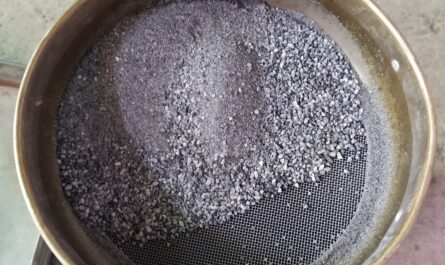
 by
by The Aggregate Crushing Value (ACV) test determines the resistance of coarse aggregate to crushing under a gradually applied compressive load. For the standard test, aggregate passing the 12.5 mm sieve and retained on the 10 mm sieve is loaded to 40 tonnes, and the percentage of material passing the 2.36 mm sieve is reported as the Aggregate Crushing Value.
Coarse aggregate used in concrete must be capable of resisting stresses developed during mixing, handling, compaction and service. When aggregate particles are subjected to compression, weaker particles may fracture and produce smaller fragments or fines.
The Aggregate Crushing Value expresses the percentage of fines produced from a standard aggregate sample under a specified compressive load.
A lower ACV generally indicates greater resistance to crushing, while a higher value indicates that a larger proportion of the aggregate has broken down under the standard loading condition.
In India, the test is carried out according to IS 2386 (Part 4):1963 — Methods of Test for Aggregates for Concrete: Mechanical Properties. Requirements for coarse aggregate used in concrete are given in IS 383:2016. IS 2386 (Part 4) specifically describes ACV as a relative measure of resistance to crushing under a gradually applied compressive load.
Disclaimer: This article provides educational, and practical laboratory guidance. Always verify the latest applicable Indian Standards, amendments, approved project specifications and laboratory quality procedures before using test results for material acceptance.
Page Contents
What Is Aggregate Crushing Value?
Aggregate Crushing Value is the percentage by mass of fines produced when a prepared coarse aggregate sample is subjected to a specified gradually applied compressive load.
For the standard test, aggregate:
passes the 12.5 mm IS sieve
and is
retained on the 10 mm IS sieve.
After loading, the crushed material is sieved through the 2.36 mm IS sieve.
The percentage of the original test-sample mass passing the 2.36 mm sieve is reported as the Aggregate Crushing Value.
What Does Aggregate Crushing Value Indicate?
ACV indicates the resistance of coarse aggregate to crushing under gradual compressive loading.
The test can therefore be used to compare the mechanical strength characteristics of different aggregate sources.
In general:
Lower ACV → greater resistance to crushing
Higher ACV → greater breakdown under compression
However, ACV should not be treated as the only indicator of aggregate quality.
Aggregate suitability may also depend on:
- grading;
- particle shape;
- water absorption;
- specific gravity;
- impact resistance;
- abrasion resistance;
- soundness;
- deleterious materials; and
- durability requirements.
Why Is the Aggregate Crushing Value Test Important?
Coarse aggregate forms a major proportion of concrete volume.
Its mechanical properties can influence the behaviour of the concrete, particularly where stronger concrete or severe service conditions are involved.
The ACV test is useful for:
- aggregate source approval;
- comparing aggregate sources;
- routine quality control;
- assessing crushing resistance;
- identifying weak aggregate;
- supporting concrete-material selection; and
- determining whether the ten-percent-fines test is required.
Applicable Indian Standards
Important Indian Standards related to the test include:
| Standard | Application |
|---|---|
| IS 2386 (Part 4):1963 | Mechanical-property tests including ACV and ten-percent-fines value |
| IS 383:2016 | Specification for coarse and fine aggregate for concrete |
| IS 9376:1979 | Apparatus for Aggregate Crushing Value and ten-percent-fines value |
| IS 2430:1986 | Sampling of aggregates for concrete |
BIS currently lists IS 2386 (Part 4) as reviewed in 2021 and IS 9376 as reviewed in 2023.
Standards can be amended or superseded, so the latest BIS status should always be checked for project use.
Principle of the Aggregate Crushing Value Test
A standard-sized aggregate sample is placed inside a cylindrical steel test cell.
A steel plunger is placed over the aggregate.
The assembly is then loaded in a compression-testing machine until the specified maximum load is reached gradually.
The load causes weaker aggregate particles to crush and form fines.
After loading, the entire sample is removed and sieved through the 2.36 mm sieve.
The mass passing the sieve is compared with the original sample mass.
The ratio, expressed as a percentage, is the Aggregate Crushing Value.
Standard Aggregate Size Used for ACV
For the standard test, the aggregate should consist entirely of particles:
Passing 12.5 mm
and
Retained on 10 mm.
IS 2386 also provides procedures for testing non-standard aggregate sizes when the standard size fraction is unavailable, but those results should not automatically be treated as directly comparable with the standard 12.5–10 mm test because aggregate size can affect ACV.
For routine concrete aggregate testing, the standard size fraction should therefore be used wherever available.
Apparatus Required
The standard test requires:
- ACV cylindrical steel cell;
- base plate;
- plunger;
- cylindrical metal measure;
- tamping rod;
- weighing balance;
- 12.5 mm IS sieve;
- 10 mm IS sieve;
- 2.36 mm IS sieve; and
- compression-testing machine.
The ACV apparatus should conform to IS 9376.
Important Apparatus Requirements
For the standard 150 mm apparatus, the test arrangement includes an open-ended cylindrical cell with its corresponding plunger and base plate.
The tamping rod for the standard apparatus is approximately:
16 mm diameter
and
45 to 60 cm long
with a rounded end.
A balance of approximately 3 kg capacity, readable to 1 g, is specified for the standard test.
The required sieves are:
12.5 mm, 10 mm and 2.36 mm.
Compression Testing Machine Requirement
The compression-testing machine should be capable of applying the required load uniformly.
The standard test applies a total load of:
40 tonnes
reached in approximately:
10 minutes.
Forty tonnes-force is approximately 392 kN, and it is sometimes informally rounded to about 400 kN in laboratory discussions. For technically precise reporting against IS 2386, however, it is better to state the standard requirement as 40 tonnes.
This corrects a common simplification where the test load is stated as exactly 400 kN.
Preparation of the Test Sample
Obtain a representative coarse aggregate sample.
Separate the required test fraction using the:
12.5 mm sieve
and
10 mm sieve.
Only aggregate passing 12.5 mm and retained on 10 mm should be used for the standard test.
The aggregate should be tested in a surface-dry condition.
If drying is carried out by heating:
- drying should not exceed four hours;
- the temperature should be approximately 100°C to 110°C; and
- the aggregate should be cooled to room temperature before testing.
This is different from saying that the aggregate must be in a saturated-surface-dry condition.
Determining the Required Sample Quantity
The sample quantity should be such that, after tamping inside the test cylinder, the aggregate depth is approximately:
100 mm.
A convenient way of determining the required quantity is to use the standard cylindrical measure.
Fill the measure in three approximately equal layers.
Compact each layer with:
25 strokes of the tamping rod.
After filling the final layer:
- level the surface using the tamping rod as a straightedge;
- determine the sample mass; and
- record this mass as A.
The same mass should be used for the duplicate test.
Aggregate Crushing Value Test Procedure
Place the cylindrical test cell securely on its base plate.
Add the prepared aggregate sample to the test cylinder in three approximately equal portions.
Compact each portion using:
25 strokes of the tamping rod.
After the final layer:
- carefully level the aggregate surface;
- insert the plunger;
- ensure that the plunger rests horizontally on the aggregate; and
- check that the plunger moves freely without jamming.
Place the complete apparatus between the platens of the compression-testing machine.
Apply the load as uniformly as possible.
Increase the load gradually so that the total load reaches:
40 tonnes in 10 minutes.
After reaching the specified load:
- release the load;
- remove the complete aggregate sample from the cylinder;
- collect all crushed material carefully; and
- sieve it through the 2.36 mm IS sieve.
Determine the mass passing the 2.36 mm sieve.
Two tests should be carried out.
Why Is the Load Applied Gradually?
The purpose of ACV is to assess aggregate resistance to gradually applied compression.
This is fundamentally different from AIV, where the aggregate is subjected to repeated sudden hammer impacts.
The load should therefore be applied progressively and uniformly rather than suddenly.
This distinction is important when explaining the difference between ACV and AIV.
Aggregate Crushing Value Formula
Let:
A = mass of the original surface-dry test sample
B = mass of fines passing the 2.36 mm sieve after crushing
Then:
Aggregate Crushing Value (%) = (B ÷ A) × 100
The result for each individual test is recorded to one decimal place.
Two tests are carried out, and the mean result is reported as the Aggregate Crushing Value of the tested size fraction.
Worked Example of Aggregate Crushing Value
Suppose the original sample mass is:
A = 3250 g
After loading and sieving:
Mass passing 2.36 mm sieve, B = 715 g
Then:
ACV = (715 ÷ 3250) × 100
ACV = 22.0%
Suppose the duplicate test produces:
ACV = 21.6%
Then:
Mean ACV = (22.0 + 21.6) ÷ 2
Mean ACV = 21.8%
The final reported value should be rounded in accordance with the applicable test procedure.
Sample Observation and Calculation Table
| Particular | Test 1 | Test 2 |
|---|---|---|
| Original sample mass A (g) | 3250 | 3250 |
| Mass passing 2.36 mm B (g) | 715 | 702 |
| ACV (%) | 22.0 | 21.6 |
Mean ACV = 21.8%
The values above are an illustrative worked example.
Aggregate Crushing Value Requirements as per IS 383
The ACV requirements need to be interpreted carefully because they are not the same as the AIV limits.
For aggregates used in concrete for wearing surfaces, the Aggregate Crushing Value should not exceed:
30%.
Examples of wearing surfaces include applications such as roads, pavements, runways and certain hydraulic surfaces identified by IS 383.
For concrete other than wearing surfaces, IS 383 uses a different approach.
If the Aggregate Crushing Value exceeds 30%, the ten-percent-fines value test should be carried out.
For this case, the load required to produce ten percent fines should be at least:
50 kN.
For concrete grades M65 and above, IS 383 requires stronger aggregate and gives a maximum ACV of:
22%.
Important: Do Not Use 45% as the ACV Limit
A common mistake is to state:
ACV ≤ 45% for concrete other than wearing surfaces.
That is not the correct interpretation of IS 383:2016.
The 45% limit applies to Aggregate Impact Value, not Aggregate Crushing Value.
For ACV:
- wearing-surface concrete → maximum 30%;
- other-than-wearing concrete → if ACV exceeds 30%, conduct the ten-percent-fines test, with the required ten-percent-fines load being at least 50 kN;
- M65 and above → maximum ACV 22%.
This distinction is important in laboratory reports, specifications and civil-engineering interview answers.
How to Interpret an ACV Result
Suppose the measured ACV is:
24%
For wearing-surface concrete, this is below the maximum 30% requirement.
For ordinary concrete other than wearing surfaces, it is also below the point at which IS 383 requires the ten-percent-fines test because of an ACV above 30%.
For M65 and above, however:
24% > 22%
and therefore it would not satisfy the specific ACV requirement for that higher-strength concrete category.
The same laboratory value can therefore have different implications depending on the intended use.
What Is the Ten-Percent-Fines Value?
The ten-percent-fines value is another mechanical-property test for coarse aggregate.
Instead of applying one fixed load and measuring the percentage of fines produced, the test determines the load required to produce approximately 10% fines.
The value is therefore expressed as a load, rather than as a percentage.
A higher ten-percent-fines load indicates greater resistance to crushing.
IS 2386 (Part 4) notes that ACV results can become anomalous when the Aggregate Crushing Value is around 30 or higher, and in such cases the ten-percent-fines value should be determined.
Why Is the Ten-Percent-Fines Test Useful for Weaker Aggregate?
With relatively weak aggregate, a fixed high load can produce extensive crushing.
When very large quantities of fines are produced, the conventional ACV result may become less reliable as a comparative strength measure.
The ten-percent-fines test instead determines how much load is required to produce a controlled amount of breakdown.
This can provide a more useful mechanical-strength indication for weaker aggregates.
ACV vs Ten-Percent-Fines Value
| Aggregate Crushing Value | Ten-Percent-Fines Value |
|---|---|
| Fixed load applied | Load is adjusted |
| Result expressed as percentage | Result expressed as load |
| Measures percentage of fines produced | Determines load producing about 10% fines |
| Lower result generally indicates stronger aggregate | Higher load generally indicates stronger aggregate |
| Standard test useful for normal aggregate | Particularly useful where ACV is high |
These two tests evaluate crushing resistance from different directions.
Aggregate Crushing Value vs Aggregate Impact Value
| ACV | AIV |
|---|---|
| Gradually applied compression | Sudden impact loading |
| Compression-testing machine | Impact-testing machine |
| Standard test uses 40-tonne load | Standard test uses 15 hammer blows |
| Fines passing 2.36 mm measured | Fines passing 2.36 mm measured |
| Indicates crushing resistance | Indicates impact resistance / toughness |
Both tests are included under the mechanical-property provisions for aggregates.
However, they should not be described as measuring exactly the same behaviour.
ACV vs Los Angeles Abrasion Value
ACV measures aggregate resistance to crushing under compression.
Los Angeles Abrasion Value primarily evaluates resistance to a combination of:
- abrasion;
- impact; and
- attrition
inside a rotating drum containing abrasive charge.
Therefore ACV and Los Angeles Abrasion Value are different mechanical tests and should not be used interchangeably without reference to the applicable specification.
Importance of Representative Sampling
Even a perfectly conducted laboratory test can produce a misleading result if the sample does not represent the aggregate supply.
Aggregate stockpiles may segregate by size and may contain material from different production periods or quarry zones.
Sampling should therefore be carried out using an approved representative method.
Where applicable, reference should be made to IS 2430 for sampling aggregate for concrete.
Surface-Dry Condition vs Saturated-Surface-Dry Condition
These terms should not be confused.
IS 2386 (Part 4) states that the ACV aggregate should be tested in a surface-dry condition.
It does not require the aggregate to be brought to the saturated-surface-dry state used in some specific-gravity and water-absorption procedures.
If heat drying is used for ACV preparation, the sample may be dried at approximately 100–110°C for no more than four hours and then cooled to room temperature.
This is an important correction to many simplified laboratory notes.
Common Errors During the ACV Test
Common mistakes include:
- using the wrong particle-size fraction;
- calling the sample SSD instead of surface dry;
- failing to cool heated aggregate before testing;
- using an incorrect sample quantity;
- compacting layers inconsistently;
- applying fewer or more than 25 tamping strokes per layer;
- allowing the plunger to jam;
- applying load too rapidly;
- applying an incorrect total load;
- losing fines during sample removal;
- incomplete sieving through 2.36 mm;
- weighing the retained fraction instead of the passing fraction for the formula;
- carrying out only one test;
- applying an AIV limit to an ACV result; and
- failing to carry out the ten-percent-fines test where required.
Important Precautions
Use a representative sample.
Separate the 12.5–10 mm fraction accurately.
Ensure the aggregate is in the required surface-dry condition.
If heat drying is used, cool the sample to room temperature before testing.
Use the correct sample quantity.
Compact each layer uniformly.
Keep the test cylinder clean.
Ensure the plunger rests horizontally and does not jam.
Apply the load uniformly.
Reach the specified total load in approximately 10 minutes.
Recover all crushed material carefully.
Avoid losing fines.
Sieve completely through the 2.36 mm sieve.
Carry out duplicate tests.
Use the correct IS 383 acceptance criterion for the intended concrete application.
Suggested Aggregate Crushing Value Datasheet
A practical laboratory record may contain:
Project:
Client:
Location:
Aggregate source:
Sample ID:
Date sampled:
Date tested:
Test method: IS 2386 (Part 4)
Specification: IS 383 / approved project specification
Sample size: Passing 12.5 mm and retained on 10 mm
Sample condition: Surface dry
Original sample mass A:
Applied maximum load: 40 tonnes
Loading duration: Approximately 10 min
Mass passing 2.36 mm B:
ACV Test 1:
ACV Test 2:
Mean ACV:
Ten-percent-fines test required: Yes / No
Applicable acceptance requirement:
Result / remarks:
Tested by:
Checked by:
This makes the result easier to review during QA/QC inspections and source approvals.
Practical Site Example
Suppose a project receives 20 mm nominal coarse aggregate from a new crusher.
The grading and physical appearance are satisfactory, but mechanical-property testing is required before source approval.
The standard 12.5–10 mm fraction is prepared and tested.
The two ACV results are:
31.2%
and
30.8%
Mean:
ACV = 31.0%
If the aggregate is intended for ordinary concrete other than wearing surfaces, the result exceeds 30%.
The engineer should therefore not simply compare the 31% value with a fictitious 45% ACV limit and accept the aggregate.
Instead, under IS 383, the ten-percent-fines value test should be conducted.
The corresponding load requirement should then be checked against the applicable minimum 50 kN requirement.
This is a practical example of why correct interpretation of ACV is as important as carrying out the laboratory test correctly.
Relationship of ACV to Concrete Mix Design
Aggregate mechanical strength is one consideration in concrete material selection.
For normal-strength concrete, aggregate is often stronger than the surrounding cementitious matrix.
As concrete strength increases, however, aggregate properties can become more influential.
This is one reason IS 383 specifies a stricter ACV requirement for M65 and above concrete.
When developing a concrete mix design, aggregate evaluation should therefore consider not only:
- grading;
- specific gravity;
- water absorption; and
- moisture condition,
but also the mechanical properties required for the intended concrete grade and application.
This topic will later connect directly with the Concrete Mix Design hub.
Aggregate Quality Should Not Be Judged by ACV Alone
A satisfactory ACV does not automatically mean that aggregate is suitable for concrete.
A complete assessment may also require:
- sieve analysis;
- combined flakiness and elongation index;
- Aggregate Impact Value;
- abrasion value;
- specific gravity;
- water absorption;
- soundness;
- deleterious-material testing;
- alkali-aggregate-reactivity assessment where relevant; and
- petrographic examination where required.
The required test programme should follow the approved project specification.
Frequently Asked Questions
What is Aggregate Crushing Value?
Aggregate Crushing Value is the percentage of fines produced when a standard coarse aggregate sample is subjected to a specified gradually applied compressive load.
What does ACV indicate?
ACV provides a relative measure of the resistance of coarse aggregate to crushing under gradual compression.
What is the IS code for Aggregate Crushing Value?
The test is covered by IS 2386 (Part 4):1963 — Mechanical Properties.
Aggregate requirements for concrete are specified in IS 383:2016.
What aggregate size is used for the standard ACV test?
Aggregate passing 12.5 mm and retained on 10 mm is used for the standard test.
Which sieve is used after crushing?
For the standard ACV test, the crushed aggregate is sieved through the 2.36 mm IS sieve.
What is the Aggregate Crushing Value formula?
ACV (%) = (Mass passing 2.36 mm sieve ÷ Original surface-dry sample mass) × 100
What load is used in the Aggregate Crushing Value test?
IS 2386 specifies a total load of 40 tonnes, reached gradually in approximately 10 minutes.
Is 400 kN used in the ACV test?
Forty tonnes-force is approximately 392 kN and is often rounded informally to about 400 kN.
For reporting against IS 2386, stating the specified 40-tonne load is more precise.
Is a lower ACV better?
Generally, yes.
A lower percentage means less aggregate was crushed into fines under the specified loading condition.
What is the ACV limit for wearing-surface concrete?
Under IS 383:2016, Aggregate Crushing Value should not exceed 30% for aggregates used in concrete wearing surfaces.
What is the ACV limit for ordinary concrete other than wearing surfaces?
IS 383 does not simply specify a 45% ACV limit.
If ACV exceeds 30%, the ten-percent-fines test should be performed, and the applicable minimum load is 50 kN.
What is the maximum ACV for M65 and above concrete?
For concrete grades M65 and above, the maximum Aggregate Crushing Value is 22%.
When should the ten-percent-fines value be determined?
IS 2386 notes that ACV results can become anomalous when the Aggregate Crushing Value is about 30 or higher, so the ten-percent-fines value should then be determined. IS 383 specifically requires the ten-percent-fines test for non-wearing-surface concrete when ACV exceeds 30%.
What is the difference between ACV and AIV?
ACV measures resistance to gradually applied compression, whereas AIV measures resistance to sudden impact.
Is the ACV sample saturated-surface-dry?
The test standard specifies surface-dry condition, not saturated-surface-dry condition. If heat drying is used, the aggregate is dried for not more than four hours at approximately 100–110°C and cooled to room temperature before testing.
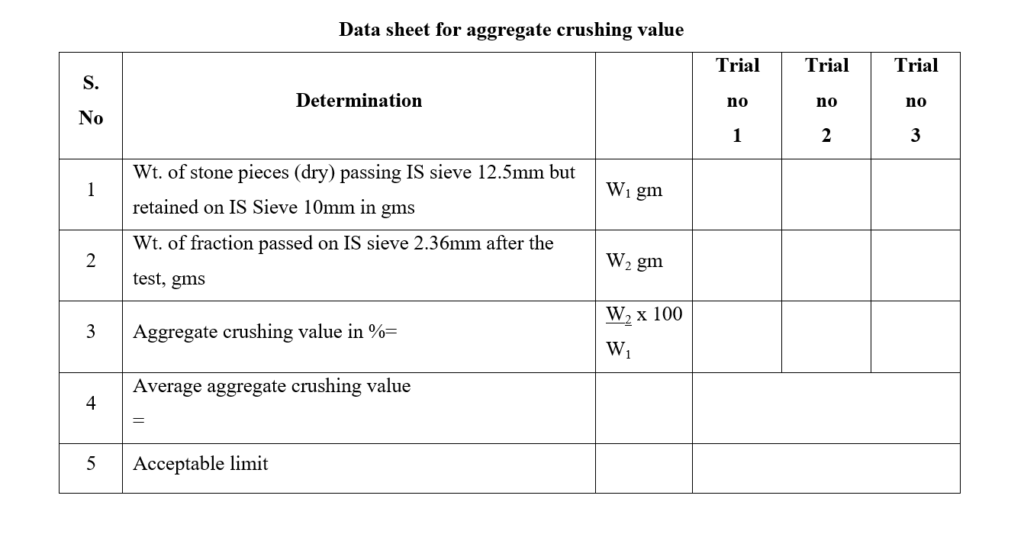
Datasheet for aggregate crushing value
Conclusion
The Aggregate Crushing Value test is an important laboratory test used to assess the resistance of coarse aggregate to gradually applied compressive loading.
For the standard test:
Aggregate size = passing 12.5 mm and retained on 10 mm
Sample condition = surface dry
Compaction = three layers, 25 strokes per layer
Maximum load = 40 tonnes
Loading duration = approximately 10 minutes
Final sieve = 2.36 mm
and:
ACV (%) = (Mass passing 2.36 mm ÷ Original sample mass) × 100
Two tests are performed and the mean result is reported.
The result must then be interpreted according to the intended use.
For wearing-surface concrete, the ACV should not exceed 30%. For non-wearing-surface concrete, an ACV above 30% requires evaluation using the ten-percent-fines test, for which the applicable minimum load is 50 kN. For concrete grade M65 and above, the maximum ACV is 22%.
Correct interpretation is therefore just as important as correct testing.
About T Square Civil Engineering
T Square Civil Engineering is a civil engineering learning platform created to support students, site engineers, QA/QC engineers, laboratory technicians, quantity surveyors, contractors and construction professionals with practical learning resources, worked examples and calculators that connect engineering theory with construction practice.
From Theory to Construction Practice.