 by
by Page Contents
Types of Tiles Used in Building Construction: Complete Guide to Ceramic, Vitrified, Porcelain, Single Charge, Double Charge, GVT, PGVT and Other Tiles
Tiles are widely used finishing materials in modern building construction. When the product and installation system are matched to the service conditions, tiles can provide durable, cleanable and attractive surfaces. Their water absorption, strength, wear resistance, slip performance and service life vary with the material, classification, surface finish and intended use.
Tiles are widely used in:
• Residential buildings
• Commercial complexes
• Industrial floors
• Institutional buildings (schools, colleges, hospitals)
• Public infrastructure (airports, railway stations, bus terminals)
They are commonly applied on:
• Floors
• Walls
• Staircases
• Kitchens and bathrooms
• Parking areas and driveways
• Building elevations and facades
Selecting the right tile is crucial because each tile type has distinct strengths, wear resistance, water absorption, cost, and suitability for different applications. This complete guide explains the types of tiles used in building construction, their properties, advantages, disadvantages, and practical applications, with a special focus on Single-Charge vs Double-Charge Vitrified Tiles.
Quick Answer: Main Types of Tiles Used in Construction
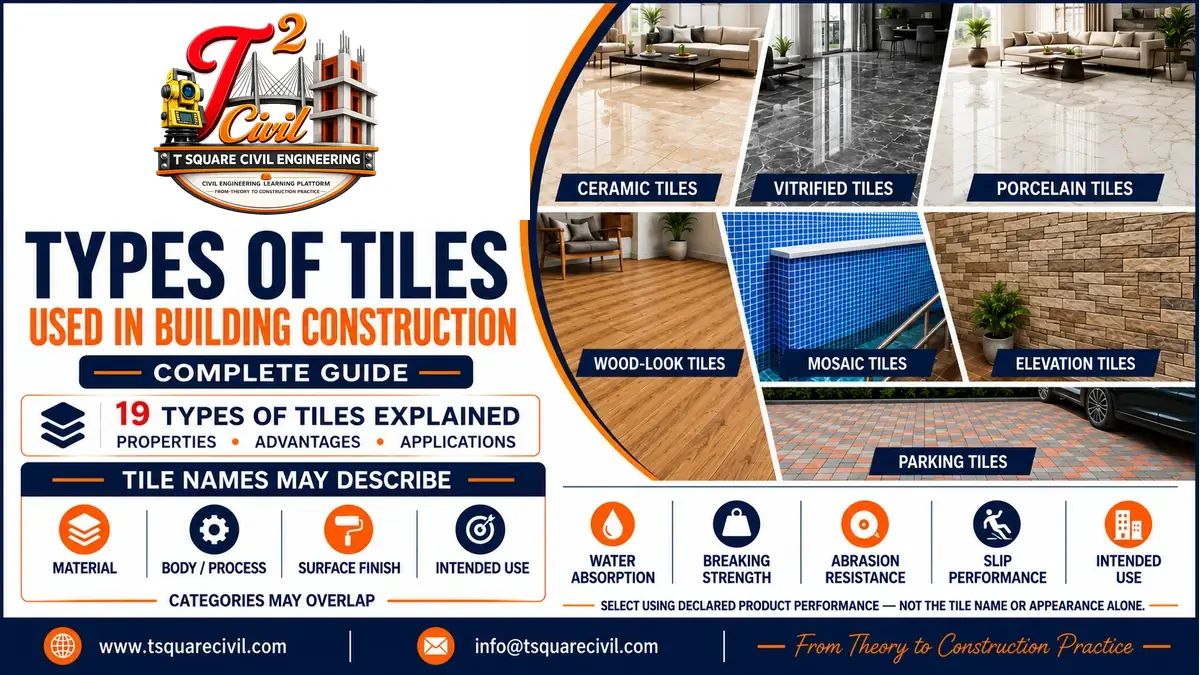
Tiles used in building construction include ceramic, porcelain, vitrified, terracotta, quarry, glass, cement, natural stone and mosaic tiles. Terms such as GVT, PGVT, single charge, double charge, full body, anti-skid, wood-look and parking tile may describe a manufacturing process, surface finish, appearance, performance feature or intended application rather than a completely separate material family.
The correct tile should be selected using its declared water absorption, breaking strength, abrasion resistance, slip performance, exposure conditions, intended use and installation requirements—not by the product name or appearance alone.
What Are Tiles?
Tiles are relatively thin units used as finishes or coverings for floors, walls, staircases, façades and other building surfaces. Depending on the product, they may be manufactured from ceramic materials, glass, cement, natural stone or other suitable materials.
Ceramic tiles are generally formed by pressing or extrusion, dried and fired at a temperature sufficient to develop the required properties. They may be glazed, unglazed, polished, textured or provided with another surface finish.
Tiles are finishing materials supported by a substrate. They should not normally be described as structural load-bearing components. Their suitability depends on the performance of the tile together with the substrate, adhesive or mortar, grout, movement joints and workmanship.
Important properties to check
The required properties depend on the intended location. Important characteristics may include:
- Water absorption
- Breaking strength
- Modulus of rupture
- Abrasion resistance
- Slip resistance
- Dimensional accuracy and surface flatness
- Stain and chemical resistance
- Frost resistance for relevant exterior locations
- Thermal-shock resistance
- Suitability for floors, walls, exteriors or wet areas
- Compatibility with the selected fixing system
A property that is important for one application may be less important for another. For example, floor tiles require appropriate mechanical and wear performance, while wall tiles may be selected mainly for dimensional quality, finish, cleanability and compatibility with the fixing system.
How Are Tiles Classified in Civil Engineering?
Tiles can be classified in several ways. The 19 tile categories explained in this article combine technical classifications with commonly used construction and market terminology.
| Classification basis | Examples |
|---|---|
| Material | Ceramic, glass, cement and natural stone |
| Forming method | Dry-pressed and extruded ceramic tiles |
| Water absorption | Low-, medium- and high-water-absorption groups |
| Surface condition | Glazed, unglazed, polished, matte and textured |
| Body or decorative construction | Full body, single charge, double charge and soluble salt |
| Decorative finish | GVT, PGVT and wood-look |
| Format | Conventional tiles, mosaics, planks and large-format tiles |
| Intended application | Floor, wall, parking, anti-skid and elevation tiles |
This distinction is important. For example, a wood-look tile may also be a glazed vitrified tile, while an anti-skid tile may be ceramic, porcelain or another suitable material.
Technical Classification and Applicable Standards
Ceramic tiles are classified using measurable characteristics rather than commercial names alone.
Under ISO 13006:2018, ceramic tiles are classified principally according to their forming method and water absorption:
- Group A: Extruded ceramic tiles
- Group B: Dry-pressed ceramic tiles
- Group I: Low water absorption
- Group II: Medium water absorption
- Group III: High water absorption
These classification groups do not automatically determine the application of a tile. Floor, wall, interior and exterior suitability must also be established from the relevant dimensional, mechanical, physical, chemical and surface-performance requirements.
ISO 13006:2018 defines porcelain tile as a fully vitrified ceramic tile having water absorption not exceeding 0.5% by dry mass. It may be extruded or dry-pressed and may have a glazed or unglazed surface.
For projects in India, IS 15622:2017 — Pressed Ceramic Tiles — Specification applies to first-quality, dry-pressed ceramic tiles used as floor and wall coverings. It covers glazed and unglazed pressed tiles and classifies them within the applicable Group B water-absorption categories.
IS 15622 should not be presented as the governing standard for every material discussed in this article. Extruded ceramic tiles, glass tiles, natural stone, cement tiles, concrete paving products and other specialised materials may be covered by different standards or project specifications.
For current procurement, certification and testing, IS 15622:2017 should be read together with Amendment No. 2 and any subsequent amendments applicable to the project.
The following references may be relevant:
- IS 15622:2017: Pressed ceramic tiles
- IS 13630 series: Test methods for ceramic tiles
- IS 15477:2019: Adhesives for ceramic, mosaic and stone tiles
- ISO 13006:2018: Ceramic-tile definitions, classification, characteristics and marking
- ISO 10545 series: International test methods for ceramic tiles
Standards may be amended or revised. The edition and amendments specified in the contract documents should be verified before procurement or testing.
Important Ceramic Tile Tests and What They Indicate
A tile should not be selected only by colour, thickness, finish or commercial name. Technical test results help establish whether the product is suitable for its intended location.
| Property or test | What it evaluates | Why it matters |
|---|---|---|
| Dimensions and surface quality | Length, width, thickness, edge straightness, rectangularity, flatness and visible defects | Affects alignment, joint uniformity and finished appearance |
| Water absorption | Quantity of water absorbed relative to dry mass | Used in ceramic-tile classification and exposure assessment |
| Breaking strength | Load required to break the tested tile under specified conditions | Helps assess suitability for the intended floor or wall application |
| Modulus of rupture | Flexural stress calculated from the test arrangement and failure load | Allows comparison of bending performance within the applicable classification |
| Surface abrasion | Wear resistance of glazed tile surfaces | Important for glazed floor tiles exposed to foot traffic |
| Deep abrasion | Volume of material removed from an unglazed surface | Important for unglazed tiles subjected to wear |
| Impact resistance | Behaviour under specified impact conditions | Relevant where accidental impact may occur |
| Thermal-shock resistance | Ability to withstand rapid temperature changes | Important for certain kitchens, façades and exterior applications |
| Frost resistance | Performance after freeze–thaw exposure | Relevant in climates where installed tiles may freeze while wet |
| Crazing resistance | Resistance of glazed surfaces to fine glaze cracking | Important for the long-term appearance of glazed tiles |
| Stain resistance | Ease of removing specified staining agents | Important for kitchens, commercial floors and other frequently cleaned surfaces |
| Chemical resistance | Resistance to specified household chemicals, salts, acids or alkalis | Important for kitchens, laboratories, pools and industrial environments |
| Slip performance | Frictional behaviour under the relevant test condition | Essential for bathrooms, ramps, stairs, entrances and wet floors |
Test results must be interpreted using the applicable standard, tile classification and project specification. One favourable result—such as low water absorption—does not automatically confirm that a tile is suitable for every floor, exterior or wet-area application.
In India, tests for pressed ceramic tiles are generally referenced through the IS 13630 series together with IS 15622:2017. International specifications may use the corresponding parts of the ISO 10545 series.
Current Indian-standard note: Amendment No. 2 to IS 15622:2017 specifies IS 18433 (Part 1) or IS 18433 (Part 2) for measuring the slip-resistance/coefficient-of-friction properties of tiles intended for floors. It also adds the determination of lead and cadmium released by glazed tiles. The amendment should be used together with the base standard and any subsequent amendments.
Quick Comparison of Common Tile Categories
| Tile category | Main characteristic | Common applications | Important check |
|---|---|---|---|
| Ceramic tile | Fired ceramic body; glazed or unglazed | Walls and suitable residential floors | Floor or wall rating |
| Porcelain tile | Fully vitrified body with very low water absorption | Interior and suitably rated exterior floors or walls | Slip, abrasion and exterior rating |
| Single-charge vitrified | Vitrified tile with a generally shallow decorative or pigmented surface zone | Residential and selected commercial floors where the product is approved | Abrasion, breaking strength, slip performance and intended use |
| Double-charge vitrified | Deeper decorative surface construction | Residential and commercial floors | Breaking strength and abrasion |
| Full-body vitrified | Colour or composition extends through the body | Traffic-prone floors | Declared mechanical properties |
| GVT | Glazed surface over a vitrified body | Floors and walls where approved | Glaze abrasion and slip rating |
| PGVT | Polished glazed vitrified surface | Mainly dry interior floors and walls | Wet slip performance |
| Terracotta or quarry | Unglazed fired-clay products | Rustic interiors and suitable exterior areas | Absorption, sealing and slip |
| Glass or mosaic | Decorative small-format finish | Backsplashes, walls, pools and features | Fixing and waterproofing system |
| Cement or natural stone | Non-ceramic finish materials | Decorative floors, walls and architectural areas | Staining, sealing and maintenance |
Planning a flooring or wall-tiling project? Use the Tile Quantity Calculator to calculate tiles, full boxes, project allowance, supplied quantity, surplus and estimated cost.
Floor Tiles vs Wall Tiles
Floor and wall tiles may look similar, but their intended applications and required performance can differ.
| Selection point | Floor tiles | Wall tiles |
|---|---|---|
| Primary function | Withstand foot traffic and service loads while providing a finished walking surface | Provide a decorative, cleanable or protective vertical finish |
| Mechanical requirement | Requires suitable breaking strength and modulus of rupture | Requirements depend on tile size, mass, substrate and fixing system |
| Wear resistance | Important for traffic-exposed glazed or unglazed surfaces | Usually less critical on surfaces not exposed to foot traffic |
| Slip performance | Important for walking surfaces, especially in wet or sloping areas | Generally not a walking-surface requirement |
| Surface finish | Selected for traffic, cleaning, safety and appearance | Selected mainly for appearance, cleaning and exposure |
| Installation | Requires a stable supporting base and adequate adhesive or mortar contact | Requires a fixing system capable of safely supporting the tile |
| Common products | Floor-rated ceramic, porcelain, vitrified and quarry tiles | Ceramic wall tile, porcelain, GVT, glass, mosaic and cladding products |
A wall tile should not be installed on a floor unless the manufacturer specifically classifies it for floor use.
A floor-rated tile may sometimes be installed on a wall, but its mass, dimensions, substrate, adhesive, fixing method and installation height must be considered. Large or heavy units may require a specially designed adhesive or mechanical fixing system.
Common Tile Sizes and Thickness
Tile dimensions vary among manufacturers, product ranges and countries. The following are common nominal-size examples and should not be treated as mandatory standard sizes.
| Application | Common nominal-size examples |
|---|---|
| Ceramic wall tiles | 250 × 375 mm, 300 × 450 mm and 300 × 600 mm |
| Conventional floor tiles | 300 × 300 mm, 600 × 600 mm and 800 × 800 mm |
| Rectangular floor and wall tiles | 600 × 1200 mm and similar formats |
| Wood-look planks | 150 × 600 mm, 200 × 1200 mm and similar formats |
| Large-format tiles and slabs | 800 × 1600 mm, 1200 × 2400 mm and larger formats |
The nominal size printed on the packaging may differ slightly from the manufacturer’s specified work size and the measured actual size. Before installation, check:
- Work size and actual dimensions
- Calibre or size batch
- Shade and production batch
- Rectified or unrectified edges
- Surface flatness
- Tiles and coverage per box
- Recommended grout-joint width
Tile thickness is product-specific and should be obtained from the manufacturer’s technical datasheet. As indicative market ranges, many conventional wall tiles are approximately 6–9 mm thick and many floor tiles are approximately 8–12 mm thick. Large slabs, special wall products and heavy-duty units may fall outside these ranges.
Thickness alone does not establish suitability for floors, heavy traffic, industrial service or vehicle use. Check the declared breaking strength, modulus of rupture, abrasion performance, tile dimensions, supporting substrate, installation system and manufacturer-approved application.
How to Read a Tile Box and Technical Datasheet
A tile carton contains information needed for quantity calculation, installation and quality control. Check the packaging and technical datasheet before approving or laying the tiles.
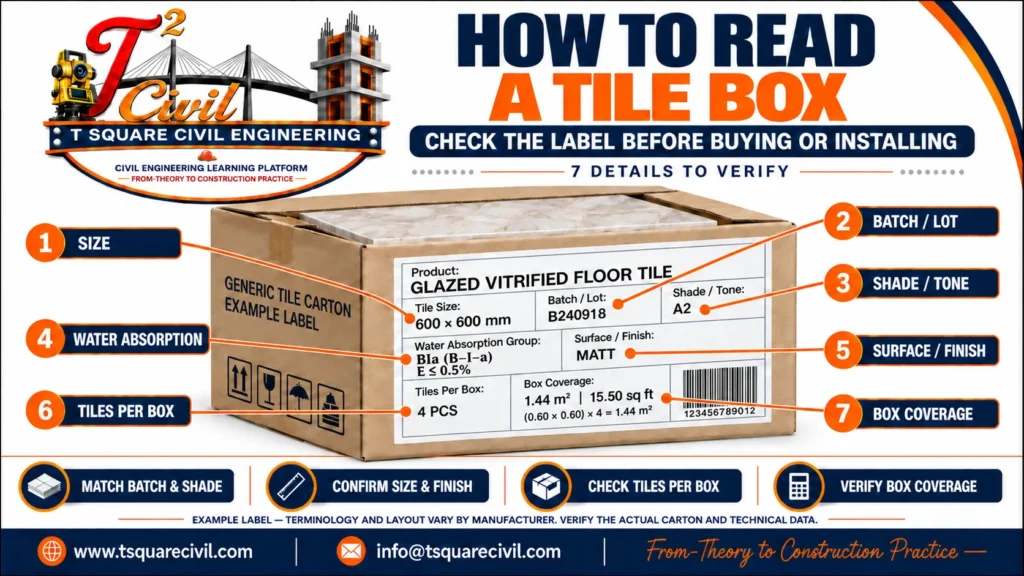
In the illustrated example, BIa identifies a dry-pressed ceramic-tile group with water absorption, E, not exceeding 0.5%. The layout, codes and information printed on actual cartons vary among manufacturers, so the product label and technical datasheet must always be verified.
1. Manufacturer and product identification
Confirm the manufacturer, brand, collection, product code and declared tile category. Similar-looking tiles from different collections may have different technical properties.
2. Applicable standard and certification
Check the stated product standard and certification information where applicable. For pressed ceramic tiles supplied in India, verify the relevant IS reference, Standard Mark and licence details when required by the project or current regulations.
3. Intended application
Look for declarations such as:
- Floor or wall
- Interior or exterior
- Residential or commercial
- Wet-area suitability
- Façade or cladding suitability
- Pool or immersion suitability
A photograph printed on the carton should not replace a formal intended-use declaration.
4. Water-absorption group
For ceramic tiles, identify the declared water-absorption classification. Do not assume that every product sold as ceramic, vitrified or porcelain has identical absorption.
5. Surface description
The packaging may identify the tile as:
- Glazed or unglazed
- Polished or unpolished
- Matte, satin, textured or glossy
- Rectified or unrectified
These descriptions explain the surface or edge treatment but do not independently establish slip or wear performance.
6. Nominal size, work size and calibre
The nominal size is the convenient commercial description. The work size is the manufacturing dimension to which the actual tile should conform within the permitted tolerance.
Tiles laid together should normally have compatible dimensions or calibre.
7. Shade and batch number
Tiles from different production batches can show differences in colour, pattern or dimensions. Check the shade and batch identification before laying begins.
Open and inspect several boxes, then distribute approved shade and pattern variation across the work.
8. Quantity and coverage per box
Check:
- Number of tiles per box
- Nominal coverage per box
- Tile dimensions
- Net or gross package weight where provided
Use these values when calculating the number of full boxes to purchase.
9. Technical performance
Obtain the product datasheet and review applicable values for:
- Water absorption
- Breaking strength
- Modulus of rupture
- Surface or deep-abrasion resistance
- Slip performance
- Stain and chemical resistance
- Frost resistance where relevant
10. Installation and maintenance instructions
Check the recommended adhesive, grout, joint width, substrate preparation, curing or protection period, cleaning products and sealing requirements.
Retain at least one carton label, product datasheet and purchase record until the work has been inspected and accepted.
1. Ceramic Tiles
“Ceramic tile” is a broad term for tiles manufactured from clay and other inorganic raw materials and then fired. Ceramic tiles may be dry-pressed or extruded and may have glazed or unglazed surfaces.
Advantages
- Available in numerous colours, sizes and finishes
- Relatively economical options are widely available
- Glazed surfaces are generally easy to clean
- Suitable products are available for both wall and floor applications
- Individual damaged tiles can usually be replaced
Limitations
- Water absorption and mechanical properties vary considerably
- A ceramic wall tile should not automatically be used on a floor
- Some products are unsuitable for heavy traffic, exterior exposure or freezing conditions
- Edges and corners can chip under impact
Common applications
- Bathroom and kitchen walls
- Backsplashes
- Internal wall cladding
- Residential floors where the product is floor-rated
- Decorative wall surfaces
Before selection, verify whether the manufacturer designates the product for floor, wall, interior, exterior or wet-area use.
2. Vitrified Tiles
Vitrification produces a dense ceramic body by developing a glass-like phase during firing. In the Indian tile market, “vitrified tile” is widely used for dense, low-water-absorption ceramic floor and wall products.
Advantages
- Dense and generally low-porosity tile body
- Wide range of dimensions and surface finishes
- Suitable products are available for residential and commercial floors
- Generally easy to clean when correctly installed and maintained
- Good dimensional consistency is available in quality products
Limitations
- Polished or glossy surfaces may be unsuitable for wet walking areas
- Low water absorption alone does not establish slip resistance
- Cutting large or dense tiles requires appropriate tools
- Improper adhesive coverage or insufficient movement accommodation may result in hollow spots, cracking or debonding
Common applications
- Living rooms and bedrooms
- Offices
- Corridors
- Shops and showrooms
- Interior walls and floors where the particular product is approved
Where Are Vitrified Tiles Mostly Used?
Vitrified tiles are mostly used for residential and commercial indoor flooring because they provide a dense tile body, low water absorption and a wide choice of finishes.
The word “vitrified” alone does not confirm suitability for bathrooms, ramps, balconies, exterior floors, heavy-traffic locations or parking areas. For these applications, verify the product’s slip resistance, breaking strength, abrasion resistance, weather-exposure rating and manufacturer-declared use.
3. Porcelain Tiles
ISO 13006:2018 defines porcelain tile as a fully vitrified ceramic tile with water absorption not exceeding 0.5% by mass. Porcelain tiles may be glazed or unglazed and can be produced for floors, walls, interiors or exteriors.
Advantages
- Very low water absorption
- Dense tile body
- Suitable products can provide high breaking strength and wear resistance
- Available in glazed, unglazed, polished and textured finishes
- Some products are manufactured for exterior and frost-exposed applications
Limitations
- Dense products may require suitable cutting and drilling equipment
- A polished surface may become slippery when contaminated or wet
- Not every porcelain tile is suitable for exterior, ramp or heavy-traffic use
- Large formats require a suitably prepared substrate and appropriate adhesive coverage
Common applications
- Residential flooring
- Commercial flooring where the product has the required rating
- Bathrooms and kitchens when slip performance is suitable
- Exterior floors and façades only when approved for those conditions
- Walls and countertops where the manufacturer permits the application
Porcelain and vitrified tiles overlap in technical and commercial usage. Selection should therefore be based on declared performance, not solely on the product name.
Terminology note: Single charge, double charge, full body, GVT, PGVT and soluble salt are widely used manufacturing and commercial descriptions in the Indian tile industry. They are not the principal classification groups used by IS 15622 or ISO 13006. Manufacturing details may differ among producers, so the product’s declared standard classification and test performance should govern selection.
4. Single-Charge Vitrified Tiles
Single charge is a commonly used market and manufacturing term for a vitrified tile in which the decorative material is introduced in a single principal feed or surface-forming operation during pressing. Exact manufacturing methods can vary among producers.
Advantages
- Often economical compared with some double-charge products
- Available in numerous colours and patterns
- Suitable products can perform well in residential interiors
- Generally easy to clean and maintain
Limitations
- Decorative-layer depth and wear performance depend on the product
- Deep wear or damage may reveal a visually different body
- The “single-charge” name does not itself establish traffic suitability
- High-traffic use requires verification of abrasion and mechanical properties
Common applications
- Bedrooms
- Living rooms
- Guest rooms
- Small offices
- Other low- or moderate-traffic interiors when permitted by the manufacturer
5. Double-Charge Vitrified Tiles
Double-charge vitrified tiles are commonly manufactured using two feeds of body or pigmented material during pressing, creating a deeper decorative surface construction than many conventional surface-printed products.
A deeper decorative layer can help the appearance remain more consistent as the surface wears. However, the term “double charge” does not automatically prove that every such tile is stronger, heavier or suitable for every commercial location.
Advantages
- Deeper decorative surface compared with many single-surface designs
- Surface wear may be less visually noticeable
- Suitable products are available for medium- and high-traffic areas
- Relatively simple stone-like patterns are widely available
Limitations
- Design variety may be more limited than digitally printed GVT
- Cost may be higher than basic single-charge products
- Polished surfaces still require slip assessment
- Actual performance must be confirmed from test data
Common applications
- Residential living areas
- Corridors and lobbies
- Offices and retail spaces
- Educational or institutional areas where the product has appropriate ratings
- Other medium- or heavy-foot-traffic floors approved by the manufacturer
Single-Charge vs Double-Charge Vitrified Tiles
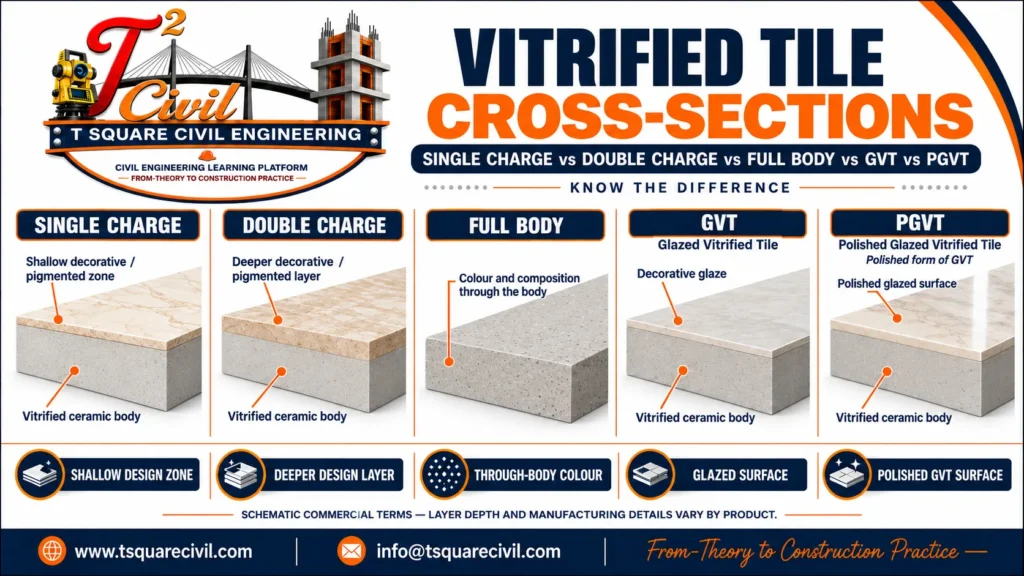
| Parameter | Single charge | Double charge |
|---|---|---|
| General construction | Single principal decorative feed or surface-forming operation | Two material or pigment feeds create a deeper decorative construction |
| Decorative-layer depth | Commonly shallower | Commonly deeper |
| Design range | Often available in many economical designs | Often simpler stone-like or two-tone designs |
| Effect of surface wear | Body may become visible after deeper wear | Deeper decorative layer may retain its appearance longer |
| Cost | Frequently lower | Frequently higher |
| Suitable traffic | Determined by tested product rating | Determined by tested product rating |
| Selection basis | Abrasion, breaking strength, slip and intended use | Abrasion, breaking strength, slip and intended use |
Which one should you choose?
Choose a suitable single-charge product when:
- The project requires economical residential flooring
- Traffic is low or moderate
- The manufacturer approves the intended application
- The declared mechanical and surface properties meet the project requirement
Consider a suitable double-charge product when:
- A deeper decorative surface is preferred
- The floor is expected to experience greater foot traffic
- The product has appropriate abrasion and breaking-strength performance
- Available colours and patterns suit the project
Neither option should be selected by the charge description alone.
6. Full-Body Vitrified Tiles
In a full-body vitrified tile, the body colour or composition extends through the tile thickness. Minor wear or edge chipping may therefore be less visually noticeable than in a tile with a contrasting body and surface.
Advantages
- Body colour continues through the tile
- Minor chips may be less conspicuous
- Suitable products are available for traffic-prone locations
- Available in polished, unpolished and textured finishes
Limitations
- Design variety may be more limited than glazed digital products
- Cost can be higher
- Full-body construction does not automatically make every product stronger
- Slip and abrasion properties still require verification
Common applications
- Commercial corridors
- Retail spaces
- Transport buildings
- Selected industrial or service areas
- Residential floors where a uniform body appearance is preferred
Use the declared breaking strength, abrasion resistance, slip performance and intended-use classification to determine suitability.
7. Glazed Vitrified Tiles (GVT)
Glazed vitrified tiles have a decorative glaze applied over a vitrified ceramic body. Digital printing can produce stone, marble, wood, concrete and other visual effects.
GVT is not limited to a glossy surface. Products may be glossy, matte, satin, textured, lappato or provided with another manufacturer-specific finish.
Advantages
- Wide selection of designs and surface appearances
- Suitable products are available for floors and walls
- Glazed surfaces are generally easy to clean
- Can reproduce natural-material appearances with consistent dimensions
Limitations
- Surface-abrasion resistance depends on the glaze and product classification
- Some finishes may show scratches, traffic wear or marks more readily
- A decorative finish does not confirm slip resistance
- Exterior and wet-area use must be specifically verified
Common applications
- Living rooms and bedrooms
- Hotels and offices
- Retail interiors
- Feature walls
- Kitchen and bathroom walls
- Floors where the product is rated for the anticipated traffic
8. Polished Glazed Vitrified Tiles (PGVT)
PGVT is a glazed vitrified product whose surface is polished to provide a high-gloss appearance. It is commonly used where a reflective, marble-like or decorative interior finish is desired.
Advantages
- High-gloss decorative appearance
- Wide range of marble, stone and abstract designs
- Smooth surface that is generally easy to clean
- Suitable for many dry residential and commercial interiors
Limitations
- Polished surfaces may provide inadequate slip resistance when wet
- Scratches or surface wear may be more visible on some finishes
- Not automatically suitable for bathrooms, ramps or exterior walking surfaces
- Glaze-abrasion classification should match expected traffic
Common applications
- Living rooms
- Bedrooms
- Hotel rooms
- Reception areas
- Offices and selected retail interiors
- Decorative walls
For wet or safety-critical floors, select by tested slip performance rather than gloss, matte appearance or marketing description.
9. Soluble Salt Tiles
Soluble salt tile is a market term generally used for a vitrified tile decorated by applying soluble colouring compounds that penetrate the upper part of the tile during manufacturing.
Advantages
- Economical options are available
- Simple stone-like patterns
- Low-water-absorption tile body
- Suitable for many residential interiors when correctly specified
Limitations
- Pattern depth and wear performance depend on manufacturing
- Design variety may be limited compared with digitally printed glazed products
- Heavy traffic may affect the visible surface over time
- Slip performance depends on the finish
Common applications
- Bedrooms
- Residential living areas
- Budget housing
- Other low- or moderate-traffic interiors
10. Mosaic Tiles
Mosaic finishes consist of small pieces of ceramic, porcelain, glass, stone or another material arranged individually or supplied on sheets.
Advantages
- Suitable for decorative patterns and feature surfaces
- Small pieces can follow curves, slopes and irregular shapes
- Numerous colours and material combinations are available
- Additional joints can assist grip when an appropriate system is used
Limitations
- Installation and alignment require care
- Numerous joints can increase cleaning and maintenance
- Suitability for floors, pools or exteriors depends on the material and installation system
- Mesh-mounted mosaics require compatible adhesive and adequate bonding
Common applications
- Bathroom and shower walls
- Kitchen backsplashes
- Swimming-pool finishes where specifically rated
- Niches and curved surfaces
- Murals and feature panels
- Floors where the mosaic system is approved
Mosaic tile is not a substitute for waterproofing. Wet areas require a properly designed waterproofing, adhesive, grout and jointing system.
11. Glass Tiles
Glass tiles are decorative units manufactured from appropriate glass compositions. Some products may contain recycled glass, but glass tiles should not automatically be described as tempered unless the manufacturer confirms it.
Advantages
- Non-porous exposed tile face
- Reflective appearance and strong colour effects
- Generally easy-to-clean surface
- Useful for decorative details
Limitations
- Cutting and drilling require suitable tools
- Transparent or translucent products may show adhesive defects
- Thermal movement and substrate preparation require attention
- Not every glass product is suitable for floors, exteriors or pools
Common applications
- Kitchen backsplashes
- Bathroom walls and niches
- Decorative bands
- Feature walls
- Swimming pools only when the complete product and fixing system are approved
Although the glass face is non-porous, grout joints and the supporting assembly are not automatically waterproof.
12. Cement Tiles
Cement tiles are generally manufactured using cementitious materials, aggregates and pigments. Many decorative cement tiles are hydraulically pressed rather than kiln-fired.
Advantages
- Distinctive colours and patterns
- Suitable for traditional and contemporary designs
- Individual tiles can be repaired or replaced
- Properly specified products can provide long service
Limitations
- Generally more porous than dense ceramic products
- May stain if incorrectly handled or left unprotected
- Sealing requirements depend on the product and exposure
- Acidic cleaners can damage cementitious surfaces
Common applications
- Interior feature floors
- Courtyards and verandas where approved
- Heritage and restoration work
- Decorative walls
- Low- or moderate-traffic architectural areas
Follow the manufacturer’s instructions for sealing, adhesive, grout, cleaning and maintenance.
13. Natural Stone Tiles
Natural stone tiles include marble, granite, slate, limestone, sandstone and other quarried stones cut into tile or slab form.
Advantages
- Natural variation and distinctive appearance
- Different stones are available for a wide range of architectural applications
- Some stones provide high wear resistance when appropriately selected
- Damaged surfaces may sometimes be refinished
Limitations
- Strength, porosity, staining and slip performance vary by stone and finish
- Some stones are sensitive to acids or moisture-related staining
- Sealing requirements are material- and exposure-specific
- Variation in colour, veining and thickness must be managed during installation
Common applications
- Residential and hotel interiors
- Staircases
- Entrance areas
- Decorative walls
- Temples and monumental buildings
- Exterior cladding or paving when the stone and fixing system are suitable
Natural stone should not be assigned one universal strength or maintenance requirement. Obtain the supplier’s technical data and consider project-specific testing where necessary.
14. Terracotta Tiles
Terracotta tiles are unglazed fired-clay products known for warm, earthy colours and a traditional appearance. Their porosity and performance vary with raw materials and firing.
Advantages
- Natural colour variation
- Suitable for traditional and rustic architecture
- Available in several shapes and surface textures
- Can develop an attractive aged appearance
Limitations
- Many products absorb appreciable water
- Staining and efflorescence can occur
- Sealing may be required
- Not every product is suitable for permanently wet or frost-exposed locations
Common applications
- Verandas and sit-out areas
- Farmhouses and traditional homes
- Interior floors
- Covered outdoor areas
- Decorative wall features
Confirm absorption, slip resistance, frost resistance where relevant, sealing requirements and exterior suitability before selection.
15. Quarry Tiles
Quarry tiles are not pieces of quarried natural stone. They are traditional extruded ceramic tiles, usually unglazed.
Under ISO 13006 terminology, quarry tile refers to an extruded tile with water absorption not exceeding 6% by mass.
Advantages
- Dense and durable products are available
- Through-body appearance can make surface wear less visible
- Suitable textures are available for service areas
- Generally simple to maintain when properly specified
Limitations
- Colour and design ranges may be limited
- Slip performance varies with the product, surface and contamination
- Some installations may require sealing or special joint treatment
- Chemical resistance should be checked for kitchens and industrial areas
Common applications
- Commercial kitchens
- Food-service areas
- Workshops
- Service corridors
- Selected industrial floors
Do not assume that every quarry tile is slip-resistant. Check tested performance for the intended wet, greasy or dry condition.
16. Wood-Look Tiles
Wood-look or wooden-finish tile describes an appearance rather than a separate tile material. These products are commonly ceramic or porcelain tiles printed and textured to resemble timber.
Advantages
- Timber-like appearance
- No risk of termite attack to the ceramic tile itself
- Lower moisture sensitivity than natural timber
- Relatively easy routine cleaning
- Suitable products can be used where natural wood may be difficult to maintain
Limitations
- The surface can feel harder and colder than timber
- Repetitive printed patterns may look artificial if poorly arranged
- Long plank formats require careful substrate preparation
- The tiled assembly is not automatically waterproof
Common applications
- Bedrooms
- Living rooms
- Hotels
- Offices
- Kitchens or selected wet areas when slip and product suitability are verified
Open several boxes and mix the tiles during laying to distribute pattern variation naturally.
17. Parking Tiles
“Parking tile” is an application or market label rather than one universal material classification. Products sold for parking areas may include heavy-duty ceramic, vitrified, concrete or other paving units.
The structural slab or pavement system carries vehicle loads. The surface tile must work with that supporting system and should not be described as carrying the vehicle load independently.
Important selection requirements
- Manufacturer approval for parking or vehicular use
- Adequate breaking strength
- Suitable abrasion resistance
- Slip performance for wet and contaminated conditions
- Exterior and weather resistance
- Appropriate thickness and unit dimensions
- Compatible bedding or adhesive system
- Stable, correctly designed supporting base
- Drainage and movement-joint provisions
Common applications
- Residential parking areas
- Driveways
- Commercial parking floors
- Covered or open parking areas where the complete system is suitable
Do not select a parking tile from thickness or surface texture alone.
18. Anti-Skid Tiles
“Anti-skid” is a common product description for tiles intended to improve underfoot grip. It is not, by itself, proof that the tile achieves the required slip performance.
Slip resistance depends on:
- Tested surface performance
- Whether the surface is dry, wet, barefoot or contaminated
- Surface wear
- Cleaning and maintenance
- Slope and drainage
- Footwear and user conditions
Common applications
- Bathroom floors
- Shower areas
- Pool surrounds
- Ramps
- Staircases
- Balconies
- Building entrances
- Outdoor walkways
Do not rely only on a matte or textured appearance. Obtain the manufacturer’s tested slip classification and confirm that the test and rating are appropriate for the intended condition.
19. Elevation and Cladding Tiles
Elevation or cladding tile is an application category for products used on exterior or interior vertical surfaces.
Advantages
- Wide selection of colours, patterns and textures
- Can protect the underlying wall finish from direct weather exposure
- Generally requires less frequent recoating than painted finishes
- Can create stone, brick, concrete or timber-like appearances
Important limitations
- Not every floor or wall tile is suitable for exterior cladding
- Wind, height, tile size and building movement affect fixing requirements
- Water must be managed through appropriate detailing
- Large or heavy units may require an engineered fixing system
- Substrate preparation and movement joints are essential
Common applications
- Building elevations
- Entrance features
- Boundary walls
- Shopfronts
- Internal feature walls
- Architectural façades
For high-level façades or large-format units, obtain a project-specific fixing design. Follow the tile, adhesive and fixing-system manufacturer’s instructions.
How to Choose the Right Tile: Step-by-Step
1. Identify the surface
Determine whether the tile will be installed on:
- An interior floor
- An exterior floor
- An interior wall
- An exterior wall
- A staircase
- A ramp
- A wet area
- A parking or service area
A tile approved only for wall use should not be installed on a floor.
2. Determine expected traffic and loading
Classify the location as residential, commercial, institutional, industrial or vehicular. Check the product’s declared breaking strength and abrasion performance against the anticipated use.
Do not judge performance solely from thickness or the words “full body,” “double charge” or “heavy duty.”
3. Check water and weather exposure
For wet or exterior locations, consider:
- Water absorption
- Slip performance
- Drainage and slope
- Frost resistance where freezing occurs
- Thermal movement
- Waterproofing beneath the tile
- Exterior suitability of the tile, adhesive and grout
Low water absorption is useful, but it does not replace waterproofing or slip evaluation.
4. Select a suitable surface finish
Glossy finishes can brighten dry interior spaces but may show marks and may be unsuitable for wet walking surfaces.
Matte and textured finishes may provide a different appearance and may hide some marks, but visual texture does not prove slip resistance. Always check the tested rating.
5. Check tile dimensions and batch information
Before ordering, confirm:
- Nominal and actual dimensions
- Calibre or work size
- Shade or batch number
- Rectified or unrectified edges
- Surface flatness
- Pattern variation
- Tiles per box
- Coverage per box
Purchase the required quantity from a consistent batch wherever practical.
6. Check installation requirements
Confirm:
- Substrate type and flatness
- Adhesive classification
- Required adhesive contact
- Need for back-buttering
- Grout-joint width
- Movement-joint layout
- Waterproofing requirements
- Curing or protection time
- Cleaning and sealing requirements
7. Compare whole-life requirements
Consider initial cost together with installation, cleaning, sealing, repair and replacement needs.
Tile Selection Guide by Location
The following table provides possible starting points. The product specification and project requirements must make the final decision.
| Location | Possible tile categories | Essential checks |
|---|---|---|
| Living room | Porcelain, vitrified, GVT or PGVT | Wear, flatness and preferred finish |
| Bedroom | Ceramic floor tile, vitrified or GVT | Floor rating and maintenance |
| Kitchen floor | Porcelain or suitable vitrified tile | Slip, stain and chemical resistance |
| Kitchen wall | Glazed ceramic, GVT, mosaic or glass | Cleanability and fixing compatibility |
| Bathroom floor | Suitable ceramic or porcelain floor tile | Wet slip rating, slope and drainage |
| Bathroom wall | Ceramic, porcelain, GVT, mosaic or glass | Wall rating and waterproofing system |
| Staircase | Suitable floor or stair tile | Slip rating, edge detail and nosing |
| Balcony | Exterior-rated ceramic or porcelain tile | Slip, drainage, weather and movement |
| Parking area | Approved parking or paving product | Vehicle-use rating and supporting system |
| Commercial floor | Rated porcelain, vitrified or quarry tile | Abrasion, breaking strength and slip |
| Industrial/service floor | Purpose-rated tile or flooring system | Load, impact, chemicals and joints |
| Swimming pool | Pool-rated ceramic, porcelain, glass or mosaic | Immersion rating and complete pool system |
| Exterior elevation | Exterior-rated cladding tile | Wind, fixing, water and movement |
Practical Tile-Selection Examples
The following examples show how tile selection should be based on service conditions rather than one commercial name.
Example 1: Residential bathroom floor
Project conditions:
- Regular water exposure
- Barefoot use
- Floor slope towards a drain
- Frequent cleaning
Selection approach:
Choose a floor-rated ceramic or porcelain product with slip performance appropriate to the expected wet and barefoot condition. Confirm dimensional suitability around the drain and select a tile size that allows the required slope to be formed without excessive lipping.
Low water absorption can be beneficial, but it does not replace the waterproofing layer below the tile. The waterproofing, drain connection, adhesive, grout and movement joints must function as one system.
Example 2: Commercial corridor
Project conditions:
- Continuous pedestrian traffic
- Dirt carried in from entrances
- Regular mechanical or chemical cleaning
- Requirement for long-term appearance
Selection approach:
Review breaking strength, modulus of rupture, abrasion resistance, slip performance and chemical resistance. A double-charge, full-body, porcelain or other suitably rated tile may be considered, but the commercial name alone is insufficient.
Entrance matting, substrate condition, adhesive contact and movement-joint detailing will also affect service performance.
Example 3: Exterior building elevation
Project conditions:
- Wind exposure
- Rain and temperature variation
- Vertical installation
- Possible installation at height
Selection approach:
Use only a product approved for exterior cladding. Check tile dimensions, mass, water absorption, thermal behaviour, substrate compatibility and fixing requirements.
Large or heavy tiles may require an engineered mechanical fixing system in addition to, or instead of, an adhesive-only installation. The façade design must also manage joints, penetrations, drainage and movement.
Example 4: Parking or driveway surface
Project conditions:
- Vehicle movement
- Tyre forces
- Outdoor exposure
- Water, dust and possible oil contamination
Selection approach:
Select a product specifically approved for the anticipated vehicular application. Review breaking strength, abrasion, slip performance, dimensions, thickness and chemical resistance.
The supporting slab, screed or pavement carries and distributes the vehicle load. Correct base design, bedding, jointing, drainage and installation are therefore as important as the surface unit.
Tile Installation Tips
Correct installation is as important as selecting the tile.
Prepare the substrate
The substrate should be stable, adequately cured, clean and suitable for receiving the selected fixing system. Check flatness, cracks, contamination, moisture and required slopes before laying begins.
Do not assume that the adhesive can correct major substrate irregularities.
Select a compatible adhesive
For projects in India, tile adhesives may be specified with reference to IS 15477:2019, subject to the latest amendments and project requirements.
Select the adhesive according to:
- Tile material and water absorption
- Tile dimensions and mass
- Floor or wall application
- Interior or exterior exposure
- Substrate type
- Wet, immersed or temperature-exposed conditions
- Required bond strength and deformability
- Manufacturer and project specifications
Do not assume that one polymer-modified adhesive is suitable for every tile and substrate. Follow the adhesive manufacturer’s requirements for surface preparation, mixing, application thickness, open time, adhesive contact and curing.
Achieve the required adhesive contact
Comb the adhesive consistently and place the tile while the adhesive remains workable. Back-buttering may be required for large-format, exterior, wet-area or demanding installations to obtain the specified contact.
There is no universal 600 × 600 mm rule that applies to every product and installation.
Provide grout and movement joints
Maintain the specified grout-joint width. Rectified tiles still require joints and should not be installed with zero-width joints.
Continue structural movement joints through the tiled finish. Provide intermediate movement joints where required by the design, exposure and installation specification.
Protect wet areas correctly
Tiles and grout are not substitutes for a waterproofing system. Bathrooms, showers, balconies, terraces and pools require correctly detailed substrates, waterproofing, drains, slopes, penetrations and movement joints.
Protect completed work
Restrict traffic and loading for the period specified by the adhesive and grout manufacturers. Protect finished surfaces from impact, abrasive debris and staining during the remaining construction work.
Common Tile Problems and Their Causes
| Problem | Possible causes | Preventive action |
|---|---|---|
| Hollow sound | Inadequate adhesive contact, expired open time or uneven substrate | Prepare the substrate and achieve the specified adhesive contact |
| Debonding | Contamination, incompatible adhesive, movement or poor application | Use a compatible system and follow installation requirements |
| Cracking | Substrate cracks, movement, impact, point loading or poor joint detailing | Treat the cause and provide required movement accommodation |
| Uneven edges or lippage | Substrate variation, tile warpage or poor alignment | Check flatness and use appropriate installation controls |
| Slippery floor | Unsuitable surface, contamination, poor drainage or inadequate cleaning | Select tested slip performance and maintain the surface |
| Grout staining | Contamination, moisture, unsuitable grout or poor maintenance | Select compatible grout and follow cleaning instructions |
| Efflorescence | Moisture movement carrying soluble salts | Control moisture sources and use suitable installation materials |
| Shade mismatch | Mixing different production batches | Check batch and distribute approved shade variation before laying |
Tile Quantity, Boxes and Project Allowance
Calculate the net tiled area after deducting openings or untreated areas where appropriate. Divide the net area by the area of one tile, then account for the selected project allowance and full-box purchasing.
There is no universal tile-wastage percentage. The required allowance depends on:
- Room shape
- Tile dimensions
- Straight or diagonal layout
- Pattern matching
- Number of corners and penetrations
- Cutting and breakage risk
- Availability of replacement stock
- Shade-batch requirements
- Full-box rounding
Use the Tile Quantity Calculator to calculate tiles, boxes, selected allowance, supplied quantity, surplus tiles and estimated cost.
Frequently Asked Questions
1. What are the main types of tiles used in civil engineering?
The main material groups include ceramic, glass, cement and natural stone tiles. Common ceramic and market categories include porcelain, vitrified, single charge, double charge, full body, GVT, PGVT, soluble salt, terracotta and quarry tiles. Anti-skid, parking, wood-look and elevation tiles mainly describe performance, appearance or application.
2. Where are vitrified tiles mostly used?
Vitrified tiles are commonly used for residential and commercial floors. Suitable products can also be used on walls and in selected exterior locations. Bathrooms, ramps, balconies and heavy-traffic areas require verification of slip, abrasion, breaking strength and exposure suitability.
3. Are vitreous and vitrified tiles the same?
Not necessarily. Vitrified describes a ceramic body in which firing has produced a dense, glass-like structure. Vitreous may be used differently in particular standards, specifications or commercial descriptions.
The two terms should not automatically be treated as interchangeable. Identify the exact product standard, water-absorption group, surface condition and intended use stated by the manufacturer.
If the intended query refers to ordinary vitrified flooring tiles, these products are commonly used for residential and commercial floors. Their suitability for wet areas, exteriors, ramps or heavy traffic must still be verified separately.
4. What is the difference between porcelain and vitrified tiles?
Porcelain is a standard-defined fully vitrified ceramic tile with very low water absorption. “Vitrified tile” is also widely used as a broader market term, particularly in India. Their descriptions may overlap, so compare water absorption, breaking strength, abrasion, surface finish, slip rating and intended use.
5. What is the difference between GVT and PGVT?
GVT has a decorative glaze over a vitrified body and can be manufactured in glossy, matte, satin or textured finishes. PGVT is a polished glazed vitrified product with a high-gloss surface. PGVT requires particular attention to slip performance on wet floors.
6. Which tile is best for house flooring?
There is no single best tile for every room. A suitable residential floor tile should have the required floor-use rating, breaking strength, abrasion resistance, slip performance and maintenance characteristics. Porcelain, vitrified, GVT and other rated ceramic products are common options.
7. Which tile is suitable for bathrooms?
For bathroom floors, choose a floor-rated tile with verified wet or barefoot slip performance. Also provide proper slope, drainage and waterproofing. Bathroom walls can use suitable ceramic, porcelain, glass, mosaic or glazed vitrified products with a compatible fixing system.
8. Which tile is strongest?
The product name alone cannot identify the strongest tile. Compare tested breaking strength and modulus of rupture, along with thickness, dimensions, substrate support and intended use. A full-body appearance does not automatically prove greater strength.
9. Are double-charge tiles better than single-charge tiles?
Not in every situation. Double-charge products generally have a deeper decorative construction that may retain its appearance better under wear. Single-charge products may be more economical. The better choice depends on tested abrasion, breaking strength, slip performance, design, traffic and cost.
10. Which tiles are suitable for commercial buildings?
Commercial floors require products rated for the expected traffic and service conditions. Depending on the project, suitable porcelain, vitrified, double-charge, full-body or quarry tiles may be considered. Verify mechanical, abrasion, slip and maintenance requirements before selection.
11. Can vitrified or double-charge tiles be used outdoors?
Only when the manufacturer approves the product for exterior use. Check water absorption, slip performance, weather or frost resistance, thermal movement, drainage, adhesive and movement-joint requirements.
12. Is a matte tile always anti-skid?
No. Matte describes appearance and does not automatically establish slip resistance. Select a tile using tested slip-performance information appropriate to the intended dry, wet, barefoot or contaminated condition.
13. Are tiles waterproof?
The exposed surface of some tiles has very low water absorption, but the complete tiled assembly is not automatically waterproof. Wet areas require an appropriate waterproofing layer, correctly treated joints, penetrations, drains and compatible installation materials.
14. Are large-format tiles better than small tiles?
Large-format tiles create fewer joints and a continuous appearance, but require a flatter substrate, careful handling and appropriate adhesive contact. Small tiles can follow curves and drainage slopes more easily. The better size depends on the surface and design.
15. How much extra tile should I order?
Use a project-specific allowance rather than a universal percentage. Consider layout, cuts, pattern matching, breakage risk, full-box rounding and spare tiles from the same shade batch. The Tile Quantity Calculator allows the selected allowance to be entered.
16. Can glossy tiles be used on floors?
Glossy tiles can be used on suitable dry interior floors when the product is floor-rated. They should not be selected for wet or safety-critical areas unless their tested slip performance is appropriate.
17. Which tiles are suitable for stairs?
Choose a floor- or stair-rated product with suitable slip resistance, breaking strength and edge detailing. Provide safe nosing and visually distinguishable step edges where required. Do not rely only on a matte finish or decorative grooves.
18. Can new tiles be installed over existing tiles?
Tile-over-tile installation may be possible when the existing finish is sound, securely bonded, clean, sufficiently flat and able to support the new system. Use a compatible primer or preparation method and an approved tile-on-tile adhesive. Investigate hollow, cracked or loose existing tiles before proceeding.
19. What grout-joint width should be used?
Joint width depends on tile dimensional variation, rectification, substrate movement, layout, exposure and the installation specification. Rectified tiles still require joints. Follow the tile, grout and installation-system requirements rather than assuming one universal width.
20. Do tiles fade in sunlight?
Performance varies with material, pigment, glaze and product rating. Use exterior-rated products where sunlight and weather exposure are expected. Interior-only decorative products should not be assumed suitable for façades or exposed outdoor work.
Practical Tile Selection Checklist
Before approving a tile, confirm:
- Intended floor, wall, interior or exterior use
- Applicable product standard
- Manufacturer and product identification
- Water-absorption group
- Breaking strength and modulus of rupture
- Abrasion classification
- Slip-performance information
- Frost resistance where relevant
- Stain and chemical resistance
- Nominal size, work size and calibre
- Shade and production batch
- Surface finish and edge condition
- Coverage and number of tiles per box
- Compatible adhesive and grout
- Waterproofing requirements
- Movement-joint requirements
- Cleaning and maintenance instructions
- Replacement stock availability
Conclusion
The 19 categories discussed in this guide include material types, ceramic body classifications, manufacturing methods, surface finishes and application-based market names. Because these categories overlap, a tile should not be selected from its name alone.
A technically appropriate selection considers the intended location, water and weather exposure, traffic, slip risk, breaking strength, abrasion, substrate, fixing system, movement joints and maintenance requirements.
After choosing the product, use the Tile Quantity Calculator to estimate the required number of tiles, full boxes, project allowance, supplied quantity, surplus and cost.
Continue Your Learning
- Tile Quantity Calculator – Calculate Tiles, Boxes, Allowance and Cost
- House Construction Cost Calculator
- Plaster Quantity Calculator
- Civil Engineering Calculators
About T Square Civil Engineering
T Square Civil Engineering is a civil engineering learning platform created to support students, site engineers, quantity surveyors, contractors and construction professionals with practical, technically reviewed learning resources, worked examples and calculators that connect engineering theory with construction practice.
Disclaimer: This article provides general educational guidance about tile types, classifications, properties, selection and installation. Product terminology, performance, availability and installation requirements vary among manufacturers, countries, applications and project conditions. Verify the latest applicable standards and amendments, manufacturer’s technical datasheet, approved project specifications and actual site conditions before procurement or installation. Obtain appropriately qualified professional advice for façades, large-format tiles, wet areas, exterior work, industrial floors and other safety-critical applications. T Square Civil Engineering is not responsible for loss or damage arising from reliance on this general information.