 by
by Page Contents
Introduction
Workability of Concrete is one of the most important properties of fresh concrete and plays a significant role in the quality, strength, durability, and finish of reinforced concrete structures. It describes how easily freshly mixed concrete can be mixed, transported, placed, compacted, and finished without segregation or bleeding.
Concrete with good workability allows workers to place and compact it efficiently around reinforcement bars, corners, and formwork. On the other hand, concrete with poor workability is difficult to handle and may lead to honeycombing, voids, inadequate compaction, and reduced structural performance.
In modern construction projects, maintaining the correct workability is essential for producing high-quality concrete in foundations, beams, columns, slabs, retaining walls, pavements, bridges, and other structural elements. Engineers commonly assess the workability of fresh concrete using tests such as the Slump Test, Compaction Factor Test, Vee Bee Consistometer Test, and Flow Table Test in accordance with the latest applicable Indian Standards.
Whether you are a civil engineering student, site engineer, QA/QC engineer, contractor, or construction professional, understanding the Workability of Concrete is essential for producing durable, safe, and high-performance concrete structures.
Why is Workability of Concrete Important?
The Workability of Concrete directly affects the ease of construction and the long-term performance of concrete structures. Concrete with suitable workability can be placed and compacted without excessive effort while maintaining a uniform mix and achieving the required strength.
Proper workability provides the following benefits:
- Ensures easy mixing, transportation, placement, and compaction.
- Reduces the risk of honeycombing and void formation.
- Minimises segregation and bleeding.
- Produces a smooth and uniform surface finish.
- Improves bond between concrete and reinforcement.
- Enhances durability by reducing permeability.
- Helps achieve the specified compressive strength.
- Increases construction efficiency and productivity.
- Reduces material wastage and rework.
- Improves the overall quality and service life of concrete structures.
For these reasons, selecting the appropriate workability for different construction activities is an essential responsibility of every site engineer and quality control engineer.
What is Workability of Concrete?
Workability of Concrete is the property of freshly mixed concrete that determines how easily it can be mixed, transported, placed, compacted, and finished while maintaining homogeneity without segregation or bleeding.
According to practical construction practice, concrete is considered workable when it can be handled and compacted with minimum effort while completely filling the formwork and surrounding the reinforcement without leaving air voids.
Workability is not determined by a single factor. Instead, it depends on the combined effect of water content, cement content, aggregate properties, admixtures, environmental conditions, and construction methods.
Concrete should neither be excessively stiff nor excessively fluid. Low-workability concrete is difficult to compact and may produce honeycombing, whereas excessively workable concrete may segregate and lose strength. Therefore, engineers aim to achieve an optimum level of workability suitable for the type of construction and method of placement.
Key Takeaways
- Workability is a property of fresh concrete.
- It determines how easily concrete can be mixed, transported, placed, compacted, and finished.
- Good workability improves construction quality and structural durability.
- Poor workability can cause honeycombing, segregation, bleeding, and inadequate compaction.
- Different construction works require different levels of workability.
- Standard tests such as the Slump Test, Compaction Factor Test, Vee Bee Test, and Flow Table Test are used to evaluate workability.
Characteristics of Good Workability of Concrete
Good Workability of Concrete means that fresh concrete can be mixed, transported, placed, compacted, and finished with minimum effort while maintaining its uniformity and without causing segregation or bleeding. A workable concrete mix should be easy to handle and capable of producing dense, durable, and defect-free concrete after compaction.
The following characteristics indicate good workability:
1. Mobility
Mobility is the ability of fresh concrete to flow and move easily within the formwork. Concrete with good mobility can spread uniformly around reinforcement bars and completely fill all corners without leaving voids.
Good mobility helps:
- Easy transportation and placement.
- Uniform filling of formwork.
- Better compaction.
- Faster construction.
However, excessive mobility caused by adding too much water may lead to segregation and bleeding.
2. Cohesion
Cohesion is the property that keeps all ingredients of concrete—cement, sand, coarse aggregate, and water—uniformly mixed without separation during handling and placement.
A cohesive concrete mix:
- Prevents segregation.
- Produces uniform concrete.
- Improves strength.
- Reduces material wastage.
- Provides better durability.
Proper grading of aggregates and adequate cement paste improve cohesion.
3. Compactability
Compactability refers to the ease with which entrapped air can be removed from fresh concrete during vibration or rodding.
Concrete with good compactability:
- Removes air voids easily.
- Produces dense concrete.
- Increases compressive strength.
- Improves durability.
- Reduces honeycombing.
Proper compaction is essential for achieving the designed strength of concrete.
4. Finishability
Finishability is the ability of concrete to produce a smooth, level, and uniform surface after placing and finishing.
Good finishability helps achieve:
- Smooth concrete surfaces.
- Better appearance.
- Reduced surface defects.
- Improved durability.
- Easier finishing operations.
This property is especially important for floors, pavements, slabs, and exposed concrete surfaces.
5. Stability
Stability is the ability of fresh concrete to remain homogeneous without segregation or bleeding during transportation, placement, and compaction.
Stable concrete maintains a uniform distribution of all ingredients throughout the mix.
Stable concrete provides:
- Uniform strength.
- Better durability.
- Improved quality control.
- Reduced repair work.
Summary of Characteristics
| Characteristic | Importance |
|---|---|
| Mobility | Easy movement and placement |
| Cohesion | Prevents segregation |
| Compactability | Removes entrapped air |
| Finishability | Produces smooth surfaces |
| Stability | Maintains uniform concrete |
Factors Affecting Workability of Concrete
The Workability of Concrete depends on several factors related to materials, environmental conditions, and construction practices. Understanding these factors helps engineers design concrete mixes that are easy to place while achieving the required strength and durability.
1. Water Content
Water content has the greatest influence on the Workability of Concrete.
Increasing the amount of water generally improves workability because it lubricates the concrete particles and allows them to move more easily.
However, adding excessive water:
- Reduces compressive strength.
- Increases bleeding.
- Causes segregation.
- Increases shrinkage.
- Reduces durability.
Therefore, water should never be added at the construction site without proper engineering approval.
2. Water-Cement Ratio
The water-cement ratio affects both workability and concrete strength.
- A low water-cement ratio produces stiff concrete with low workability.
- A high water-cement ratio increases workability but reduces strength and durability.
An optimum water-cement ratio should be selected based on the mix design and project requirements.
3. Cement Content
Cement paste acts as a lubricant between aggregate particles.
Increasing cement content generally:
- Improves workability.
- Enhances cohesion.
- Reduces segregation.
- Produces smoother concrete.
However, excessive cement content increases construction cost and heat of hydration.
4. Aggregate Size
Larger aggregates have a smaller total surface area compared to smaller aggregates.
As aggregate size increases:
- Water demand decreases.
- Workability generally increases.
- Cement requirement reduces.
However, aggregate size should always comply with structural design requirements.
5. Aggregate Shape
Aggregate shape significantly influences the Workability of Concrete.
Rounded aggregates:
- Improve workability.
- Require less water.
- Reduce friction.
Angular aggregates:
- Reduce workability.
- Increase friction.
- Require more cement paste.
Although angular aggregates reduce workability, they generally provide better bonding with cement paste.
6. Aggregate Grading
Well-graded aggregates contain particles of different sizes that fit together efficiently.
Well-graded aggregates:
- Improve workability.
- Reduce voids.
- Lower cement requirement.
- Improve strength.
- Reduce segregation.
Poorly graded aggregates produce harsh concrete that is difficult to compact.
7. Admixtures
Chemical admixtures can significantly improve the Workability of Concrete without increasing the water content.
Common admixtures include:
- Plasticizers
- Superplasticizers
- Air-entraining agents
- Retarding admixtures
- Accelerating admixtures
Superplasticisers are widely used in high-strength concrete and self-compacting concrete because they provide high workability while maintaining a low water-cement ratio.
8. Temperature
High temperatures increase the rate of water evaporation from fresh concrete.
As temperature increases:
- Workability decreases rapidly.
- Concrete stiffens quickly.
- Compaction becomes difficult.
Proper curing and timely placement are essential during hot weather concreting.
9. Mixing Time
Adequate mixing ensures uniform distribution of cement paste and aggregates.
Insufficient mixing:
- Produces non-uniform concrete.
- Reduces workability.
- Causes inconsistent strength.
Excessive mixing may also affect the properties of fresh concrete.
10. Transportation Time
Fresh concrete gradually loses workability with time.
Long transportation may result in:
- Slump loss.
- Increased stiffness.
- Difficult placement.
- Poor compaction.
Construction planning should minimise delays between batching and placement.
11. Compaction Method
The method used for compaction also affects the required workability.
Examples:
- Manual compaction requires higher workability.
- Mechanical vibration allows relatively lower workability.
- Pumped concrete generally requires higher workability.
- Self-compacting concrete requires very high workability.
Therefore, the concrete mix should always be designed considering the placement and compaction method.
Summary of Factors Affecting Workability
| Factor | Effect on Workability |
|---|---|
| Water Content | Increases workability but excessive water reduces strength |
| Water-Cement Ratio | Controls both workability and strength |
| Cement Content | Improves cohesion and lubrication |
| Aggregate Size | Larger aggregates generally increase workability |
| Aggregate Shape | Rounded aggregates improve workability |
| Aggregate Grading | Well-graded aggregates improve workability |
| Admixtures | Improve workability without adding excess water |
| Temperature | Higher temperatures reduce workability |
| Mixing Time | Proper mixing improves uniformity |
| Transportation Time | Long delays reduce workability |
| Compaction Method | Determines the required level of workability |
Site Engineer’s Note
On construction sites, workability should never be improved by adding extra water to the concrete mix. Instead, the required workability should be achieved through proper mix design or by using suitable chemical admixtures. Adding excess water may increase workability temporarily, but it can significantly reduce the concrete’s compressive strength, durability, and long-term performance.
Types of Workability of Concrete
The Workability of Concrete varies depending on the type of construction, reinforcement detailing, method of placement, and compaction. Based on the ease of handling and placement, fresh concrete can be classified into four categories.
1. Very Low Workability
Very low workability concrete is stiff and difficult to place and compact. It is generally used where powerful mechanical vibration is available.
Characteristics
- Very stiff concrete.
- Difficult to handle manually.
- Requires intensive vibration.
- Very low slump value.
- Suitable for road construction using pavers.
Applications
- Roller Compacted Concrete (RCC)
- Road pavements
- Dam construction
- Heavy mass concrete
2. Low Workability
Low workability concrete is slightly more workable than very low workability concrete but still requires mechanical compaction.
Characteristics
- Stiff concrete mix.
- Moderate compaction effort required.
- Low slump value.
- Suitable for lightly reinforced structures.
Applications
- Footings
- Retaining walls
- Plain cement concrete
- Mass concrete works
3. Medium Workability
Medium workability concrete is commonly used in most reinforced concrete construction.
Characteristics
- Easy to place.
- Easy to compact using vibrators.
- Good cohesion.
- Minimal segregation.
Applications
- RCC beams
- RCC slabs
- RCC columns
- Staircases
- Residential buildings
4. High Workability
High workability concrete flows easily with minimum effort and is used where reinforcement is congested or pumping is required.
Characteristics
- High flowability.
- Easy placement.
- Suitable for pumping.
- Excellent finish.
Applications
- Congested reinforcement
- Pumped concrete
- Thin sections
- High-rise buildings
- Complex formwork
Classification of Workability
| Workability | Slump Range (mm) | Typical Applications |
|---|---|---|
| Very Low | 0–25 | Roads, dams, RCC pavements |
| Low | 25–50 | Footings, mass concrete |
| Medium | 50–100 | Beams, slabs, columns |
| High | 100–175 | Pumped concrete, congested reinforcement |
Note: The suitable slump value depends on project specifications, mix design, placement method, and the latest applicable standards.
Methods of Testing Workability of Concrete
The Workability of Concrete cannot be judged accurately by visual inspection alone. Standard laboratory and field tests are carried out to determine the workability of fresh concrete for different construction applications.
The commonly used tests are:
- Slump Test
- Compaction Factor Test
- Vee Bee Consistometer Test
- Flow Table Test
Each test is suitable for a specific range of workability and type of concrete.
1. Slump Test
The Slump Test is the most widely used field test for determining the Workability of Concrete. It is simple, quick, economical, and suitable for most normal reinforced concrete works.
It is commonly used during concrete production to ensure that the concrete has the required consistency before placement.
Apparatus Required
- Slump cone (Abrams Cone)
- Tamping rod (16 mm diameter × 600 mm long)
- Base plate
- Measuring scale
- Scoop
- Fresh concrete sample
Dimensions of Slump Cone
| Part | Dimension |
|---|---|
| Top Diameter | 100 mm |
| Bottom Diameter | 200 mm |
| Height | 300 mm |
Procedure
- Place the slump cone on a clean, level, non-absorbent base.
- Hold the cone firmly to prevent movement.
- Fill the cone with fresh concrete in four approximately equal layers.
- Compact each layer with 25 uniform strokes using the tamping rod.
- Strike off the excess concrete and level the top surface.
- Carefully lift the cone vertically upward without twisting.
- Allow the concrete to settle freely.
- Measure the difference between the original height of the cone and the highest point of the slumped concrete.
- Record the slump value in millimetres.
Types of Slump
True Slump
- Uniform settlement.
- Indicates good concrete consistency.
- Suitable for normal RCC works.
Shear Slump
- One portion of the concrete slips sideways.
- Indicates lack of cohesion.
- Test should generally be repeated.
Collapse Slump
- Concrete collapses completely.
- Indicates excessively high workability.
- Usually caused by excess water or a very fluid mix.
Advantages of Slump Test
- Simple and quick.
- Economical.
- Suitable for field conditions.
- Requires minimum equipment.
- Immediate results.
- Widely accepted.
Limitations of Slump Test
- Not suitable for very dry concrete.
- Not suitable for self-compacting concrete.
- Does not directly measure all aspects of workability.
- Operator technique influences results.
Applications
The Slump Test is commonly used for:
- Residential buildings
- Commercial buildings
- Bridges
- Foundations
- Beams
- Slabs
- Columns
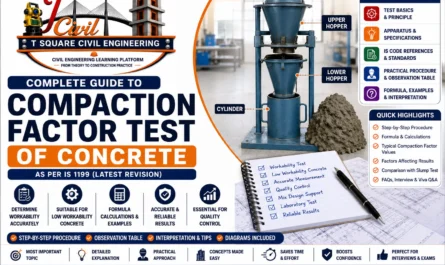
2. Compaction Factor Test
The Compaction Factor Test is used to determine the Workability of Concrete having low workability, where the slump test is not sufficiently sensitive.
It measures the degree of compaction achieved under standard conditions.
Apparatus Required
- Upper hopper
- Lower hopper
- Cylinder
- Weighing balance
- Tamping rod
Principle
The test compares:
- Weight of partially compacted concrete
- Weight of fully compacted concrete
Formula
Compaction Factor =
Weight of partially compacted concrete ÷ Weight of fully compacted concrete
Procedure
- Fill the upper hopper with fresh concrete.
- Open the trap door.
- Allow the concrete to fall into the lower hopper.
- Open the second trap door.
- Allow the concrete to fall into the cylinder.
- Strike off excess concrete.
- Weigh the partially compacted concrete.
- Repeat the test with fully compacted concrete.
- Calculate the compaction factor.
Applications
Suitable for:
- Dry concrete mixes.
- Road construction.
- Pavements.
- Mass concrete.
Advantages
- More accurate for low-workability concrete.
- Better than the slump test for stiff mixes.
- Standard laboratory method.
Limitations
- Not suitable for highly workable concrete.
- Time-consuming.
- Requires laboratory equipment.
3. Vee Bee Consistometer Test
The Vee Bee Consistometer Test is used for very low workability concrete where neither the slump test nor the compaction factor test gives reliable results.
The test measures the time required for concrete to change from a conical shape into a cylindrical shape under vibration.
Apparatus
- Vee Bee consistometer
- Vibrating table
- Slump cone
- Transparent cylinder
Procedure
- Conduct the slump test inside the cylinder.
- Start the vibrator.
- Measure the time required for the concrete to become completely remoulded.
- Record the Vee Bee time in seconds.
Applications
- Roller compacted concrete.
- Dam construction.
- Road pavements.
- Heavy concrete works.
Advantages
- Suitable for very stiff concrete.
- Accurate for low-workability mixes.
- Reliable laboratory test.
Limitations
- Cannot be used in field conditions.
- Requires special equipment.
- More time-consuming.
4. Flow Table Test
The Flow Table Test is used for highly workable concrete and concrete mixes containing superplasticisers.
It measures the flow of concrete after the table is repeatedly dropped from a specified height.
Apparatus
- Flow table
- Flow mould
- Tamping rod
- Measuring scale
Procedure
- Place the flow mould at the centre of the flow table.
- Fill the mould with fresh concrete.
- Compact each layer.
- Remove the mould vertically.
- Lift and drop the flow table the specified number of times.
- Measure the average diameter of the spread concrete.
- Record the flow value.
Applications
- Self-compacting concrete (SCC)
- High-flow concrete
- High-performance concrete
- Laboratory investigations
Advantages
- Suitable for highly workable concrete.
- Provides better assessment than the slump test for flowing concrete.
- Easy to interpret.
Limitations
- Not suitable for dry concrete.
- Laboratory equipment required.
- Not commonly used for routine site testing.
Comparison of Workability Tests
| Test | Suitable Workability | Common Use |
|---|---|---|
| Slump Test | Medium to High | Site quality control |
| Compaction Factor Test | Low | Laboratory testing |
| Vee Bee Test | Very Low | Dry concrete mixes |
| Flow Table Test | High to Very High | SCC and flowing concrete |
Site Engineer’s Note
No single test is suitable for all concrete mixes. The Slump Test is generally preferred for routine site quality control because it is simple, economical, and quick. However, for dry concrete mixes, the Compaction Factor Test or Vee Bee Consistometer Test provides more reliable results. For highly flowable and self-compacting concrete, the Flow Table Test is the preferred method.
Recommended Workability Values for Different Construction Works
The required Workability of Concrete depends on the type of structural member, reinforcement congestion, method of placement, and compaction technique. Selecting the correct workability ensures proper placement, full compaction, and long-term durability.
The table below shows the typical slump ranges used for common construction activities.
| Construction Work | Recommended Slump (mm) | Workability Level |
|---|---|---|
| Road Pavements (Vibrated) | 20–40 | Very Low |
| Mass Concrete | 25–50 | Low |
| Footings & Foundations | 25–75 | Low to Medium |
| RCC Beams | 50–100 | Medium |
| RCC Slabs | 50–100 | Medium |
| RCC Columns | 75–100 | Medium |
| Thin RCC Sections | 75–125 | Medium to High |
| Pumped Concrete | 100–150 | High |
| Heavily Reinforced Concrete | 100–150 | High |
| Self-Compacting Concrete (SCC) | 650–800 mm Flow* | Very High |
| Piling work-Tremie Concrete | 150-180 | Very High |
For Self compacting concrete(SCC), workability is assessed using slump flow rather than the conventional slump test.
Importance of Selecting the Correct Workability
Using concrete with the correct workability offers several advantages:
- Easy transportation and placement.
- Complete filling of formwork.
- Proper compaction around reinforcement.
- Reduced honeycombing and voids.
- Improved surface finish.
- Higher compressive strength.
- Better durability.
- Reduced repair and maintenance costs.
Selecting a workability that is too low or too high can lead to construction defects and reduced structural performance.
Common Problems Related to Poor Workability of Concrete
Improper Workability of Concrete can result in several defects during construction. Understanding these problems helps engineers take corrective action before permanent damage occurs.
1. Segregation
What is Segregation?
Segregation is the separation of coarse aggregates from the cement mortar during transportation, placement, or compaction.
This results in a non-uniform concrete mix and reduces structural quality.
Causes
- Excessive water content.
- Improper mix proportions.
- Excessive vibration.
- Dropping concrete from excessive height.
- Poor aggregate grading.
Effects
- Non-uniform concrete.
- Reduced compressive strength.
- Honeycombing.
- Increased permeability.
- Poor appearance.
Prevention
- Maintain the specified water-cement ratio.
- Use well-graded aggregates.
- Avoid excessive vibration.
- Limit the free fall of concrete (generally not more than about 1.5 m unless suitable measures are adopted).
- Use suitable admixtures where required.
2. Bleeding
What is Bleeding?
Bleeding is the upward movement of water to the surface of freshly placed concrete after settlement of the solid particles.
Causes
- High water content.
- Low cement content.
- Poorly graded aggregates.
- Inadequate fines in the mix.
Effects
- Weak surface layer.
- Dusting.
- Increased permeability.
- Poor bond with reinforcement.
- Plastic settlement cracks.
Prevention
- Reduce excess water.
- Increase cementitious materials where appropriate.
- Improve aggregate grading.
- Use suitable mineral or chemical admixtures.
- Ensure proper finishing practices.
3. Honeycombing
What is Honeycombing?
Honeycombing refers to the presence of cavities and exposed coarse aggregates due to inadequate filling and compaction of concrete.
Causes
- Low workability.
- Insufficient vibration.
- Congested reinforcement.
- Improper placing methods.
- Leakage of cement slurry from formwork.
Effects
- Reduced strength.
- Increased permeability.
- Corrosion of reinforcement.
- Poor appearance.
- Reduced durability.
Prevention
- Use concrete with suitable workability.
- Compact concrete adequately.
- Place concrete in layers.
- Ensure leak-proof formwork.
- Avoid interruption during concreting.
4. Cold Joints
Cold joints occur when fresh concrete is placed over concrete that has already begun to set, preventing proper bonding between the two layers.
Causes
- Long delays between pours.
- Poor concreting sequence.
- Equipment breakdown.
Prevention
- Plan continuous concreting.
- Minimize delays.
- Prepare construction joints correctly when interruptions are unavoidable.
5. Plastic Shrinkage Cracks
Plastic shrinkage cracks develop when water evaporates from the concrete surface faster than it is replaced by bleed water.
Causes
- High temperature.
- Strong winds.
- Low humidity.
- Large exposed surfaces.
Prevention
- Start curing promptly.
- Protect fresh concrete from sun and wind.
- Use evaporation control measures where necessary.
Troubleshooting Guide
| Problem | Possible Cause | Recommended Solution |
|---|---|---|
| Concrete difficult to place | Low workability | Improve mix design or use a plasticiser |
| Excessive slump | Too much water | Review batching and water dosage |
| Honeycombing | Poor compaction | Use proper vibration and suitable workability |
| Segregation | Excess water or over-vibration | Reduce water and vibrate correctly |
| Bleeding | High water content | Improve mix proportions and grading |
| Poor surface finish | Inadequate finishing | Finish at the correct time using proper techniques |
| Pump blockage | Low workability | Increase workability using approved admixtures |
Practical Site Engineer Tips
The following practices help maintain the required Workability of Concrete on construction sites:
Before Concreting
- Check the approved mix design.
- Inspect batching equipment.
- Ensure measuring equipment is calibrated.
- Verify the quality of cement and aggregates.
- Confirm the availability of vibrators and backup equipment.
During Concreting
- Perform slump tests at the required frequency.
- Place concrete close to its final position.
- Avoid dropping concrete from excessive heights.
- Compact each layer uniformly.
- Prevent over-vibration, which may cause segregation.
- Monitor weather conditions during placement.
After Concreting
- Start curing at the appropriate time.
- Inspect surfaces for honeycombing and cracks.
- Record slump values and test results.
- Maintain quality control records for future reference.
Best Practices for Maintaining Workability
- Use clean, potable water for mixing.
- Follow the approved water-cement ratio.
- Avoid adding water at the site without engineering approval.
- Use chemical admixtures when higher workability is required.
- Minimise transportation time.
- Protect fresh concrete from excessive heat and wind.
- Use properly graded aggregates.
- Carry out routine workability tests during concreting.
Field Checklist for Site Engineers
| Inspection Item | Status (✓/✗) |
|---|---|
| Approved mix design available | |
| Materials comply with specifications | |
| Water quantity verified | |
| Slump test completed | |
| Formwork cleaned and checked | |
| Reinforcement inspected | |
| Vibrators available and functional | |
| Weather conditions suitable | |
| Concrete placed in layers | |
| Proper compaction carried out | |
| Curing arrangements ready | |
| Quality records maintained |
Key Takeaways
- Select the workability based on the structural member and placement method.
- Low workability may cause honeycombing and inadequate compaction.
- Excessively high workability can lead to segregation and bleeding.
- Routine workability testing is essential for quality control.
- Never improve workability by adding extra water at the site; use the approved mix design or suitable admixtures instead.
- Proper supervision, testing, and curing are equally important for achieving durable and high-quality concrete structures.
Civil Engineering Interview Questions on Workability of Concrete
1. What is Workability of Concrete?
Answer:
Workability of concrete is the property of fresh concrete that determines how easily it can be mixed, transported, placed, compacted, and finished without segregation or bleeding.
2. Why is workability important?
Answer:
Proper workability ensures easy placement, complete compaction, improved strength, better durability, reduced honeycombing, and a smooth surface finish.
3. Which test is most commonly used to determine workability?
Answer:
The Slump Test is the most widely used field test for determining the workability of fresh concrete.
4. Which test is suitable for very low workability concrete?
Answer:
The Vee Bee Consistometer Test is suitable for very stiff or very low workability concrete.
5. Which test is suitable for low workability concrete?
Answer:
The Compaction Factor Test is suitable for low workability concrete.
6. Which test is suitable for highly workable concrete?
Answer:
The Flow Table Test is commonly used for highly workable and self-compacting concrete.
7. What causes segregation?
Answer:
Segregation is mainly caused by excessive water, poor grading of aggregates, improper handling, excessive vibration, or dropping concrete from excessive heights.
8. What is bleeding?
Answer:
Bleeding is the upward movement of water to the surface of freshly placed concrete due to the settlement of solid particles.
9. How can workability be improved?
Answer:
Workability can be improved by using suitable admixtures, proper aggregate grading, optimum water-cement ratio, and appropriate mix design. Excess water should not be added without engineering approval.
10. What is honeycombing?
Answer:
Honeycombing is the presence of cavities and exposed coarse aggregates due to inadequate compaction or poor workability.
11. Which factors affect the Workability of Concrete?
Answer:
Water content, water-cement ratio, cement content, aggregate size and shape, aggregate grading, admixtures, temperature, mixing time, transportation time, and compaction method.
12. What is the ideal workability for RCC beams and slabs?
Answer:
Medium workability is generally suitable for RCC beams and slabs, subject to the approved mix design and project requirements.
13. Can extra water be added on-site to increase workability?
Answer:
No. Adding excess water can reduce strength and durability. Workability should be achieved through the approved mix design or suitable admixtures.
14. What is slump?
Answer:
Slump is the vertical settlement of fresh concrete after the slump cone is lifted. It indicates the consistency and workability of fresh concrete.
15. Why is proper compaction necessary?
Answer:
Proper compaction removes entrapped air, increases density, improves strength, enhances durability, and prevents honeycombing.
Frequently Asked Questions (FAQs)
1. What is the Workability of Concrete?
Workability of Concrete is the ease with which fresh concrete can be mixed, transported, placed, compacted, and finished while maintaining uniformity.
2. What are the factors affecting the Workability of Concrete?
The main factors include water content, water-cement ratio, aggregate size and grading, cement content, admixtures, temperature, transportation time, and compaction method.
3. Which test is best for measuring workability?
The Slump Test is the most commonly used field test. Other tests are selected depending on the type and consistency of concrete.
4. What happens if concrete has low workability?
Low workability makes concrete difficult to place and compact, increasing the risk of honeycombing, voids, and poor strength.
5. What happens if concrete has very high workability?
Excessive workability may lead to segregation, bleeding, reduced strength, and increased permeability.
6. Can workability affect compressive strength?
Yes. Proper workability helps achieve adequate compaction, which contributes to the designed compressive strength.
7. What is the difference between workability and consistency?
Consistency refers to the degree of wetness or fluidity of concrete, whereas workability includes consistency along with ease of handling, placing, and compacting.
8. Why is the slump test widely used?
It is simple, quick, economical, and suitable for routine site quality control.
9. Which admixture improves workability?
Plasticisers and superplasticisers improve workability without significantly increasing the water-cement ratio.
10. Why should extra water not be added to concrete?
Excess water increases workability temporarily but can reduce strength, increase shrinkage, and lower durability.
11. Which structures require high workability?
High workability is preferred for pumped concrete, heavily reinforced sections, and complex formwork.
12. Which structures require low workability?
Road pavements, dams, and mass concrete works generally use low-workability concrete with proper vibration.
13. How does temperature affect workability?
High temperatures accelerate water evaporation, causing concrete to lose workability more quickly.
14. What is segregation in concrete?
Segregation is the separation of coarse aggregates from the cement mortar, leading to non-uniform concrete.
15. Which IS Code is used for workability tests?
Workability testing should follow the applicable Indian Standards for sampling and testing fresh concrete. Always refer to the latest revisions published by the Bureau of Indian Standards (BIS).
Applicable IS Codes
Use the latest editions and amendments applicable to your project.
| IS Code | Description |
|---|---|
| IS 1199 | Methods of sampling and analysis of concrete (fresh concrete tests) |
| IS 456 | Plain and Reinforced Concrete – Code of Practice |
| IS 10262 | Concrete Mix Proportioning – Guidelines |
| IS 516 Series | Methods of Tests for Strength of Concrete |
| IS 383 | Specification for Coarse and Fine Aggregates from Natural Sources for Concrete |
| IS 9103 | Specification for Concrete Admixtures |
Note: Always verify the latest revisions and amendments before applying any Indian Standard in practice.
For the latest revisions and official publications of Indian Standards, readers can refer to the Bureau of Indian Standards (BIS) website.
References
- Bureau of Indian Standards (BIS) publications.
- IS 456 – Plain and Reinforced Concrete – Code of Practice.
- IS 1199 – Methods of Sampling and Analysis of Concrete.
- IS 10262 – Concrete Mix Proportioning Guidelines.
- IS 516 Series – Methods of Tests for Strength of Concrete.
- Standard textbooks on concrete technology by recognised authors.
Related Articles
Continue learning with these topics:
- Concrete Cube Casting Procedure
- Slump Test of Concrete
- Concrete Mix Design
- Water-Cement Ratio
- Concrete Grades (M5 to M60)
- Initial Setting Time of Cement
- Final Setting Time of Cement
- Standard Consistency Test of Cement
- Compressive Strength of Concrete
You can also read our Civil Engineering Calculators
Steel Bar Weight Calculator
Calculate the weight of TMT bars, reinforcement steel, and rebars using the standard D²/162 formula for accurate quantity estimation.
Cement, Sand & Aggregate Calculator for Concrete (M5 to M20)
Estimate the quantities of cement, sand, and aggregate required for nominal concrete mixes ranging from M5 to M20 grades.
Concrete Volume Calculator for Slabs, Beams, Columns, and Footings
Calculate the volume of concrete required for various RCC structural elements quickly and accurately.
Brick Quantity Calculator
Determine the number of bricks required for walls, partitions, and masonry construction works.
Bar Bending Schedule (BBS) Calculator for Construction Sites
Prepare accurate bar-bending schedules and calculate steel reinforcement quantities for RCC structures.
Plaster Quantity Calculator
Estimate cement, sand, and water requirements for internal and external plastering works.
House Construction Cost Calculator
Calculate the approximate cost of residential building construction based on area, specifications, and construction standards.
Tile Quantity Calculator
Estimate the number of floor and wall tiles required for rooms, kitchens, bathrooms, and other spaces.
Paint Quantity Calculator
Calculate paint requirements for walls, ceilings, and exterior surfaces while minimising wastage and cost.
Lap Length Calculator for Reinforcement Steel Bars
Determine the required lap splice length for steel reinforcement bars in accordance with standard engineering practices and design requirements.
Conclusion
The Workability of Concrete is one of the most critical properties of fresh concrete because it directly influences the ease of construction, quality of compaction, strength, durability, and overall performance of a concrete structure. Selecting the appropriate workability for different construction activities helps ensure efficient placement, minimizes construction defects such as segregation and honeycombing, and contributes to durable, high-quality concrete.
Engineers should evaluate workability using the appropriate test method based on the type of concrete being used. Routine quality control, proper mix design, suitable admixtures, and adherence to relevant Indian Standards are essential for producing reliable concrete on every project.
Understanding the principles of workability not only helps students perform well in examinations but also enables practicing engineers to make informed decisions that improve construction quality and long-term structural performance.
About T Square Civil Engineering
T Square Civil Engineering is an educational platform dedicated to helping civil engineering students, site engineers, QA/QC professionals, and construction enthusiasts understand engineering concepts through practical explanations, IS Code references, calculators, solved examples, interview questions, and site-oriented learning resources.
Our mission is to bridge the gap between engineering theory and construction practice by delivering reliable, easy-to-understand, and industry-relevant content.
Disclaimer
This article is intended for educational and informational purposes only. Although every effort has been made to ensure accuracy, readers should always refer to the latest applicable Indian Standards (IS Codes), project specifications, and guidance from qualified engineers before applying any procedure in practice. TSquareCivil.com is not responsible for any loss or damage arising from the use of this information.