
 by
by Page Contents
Last Updated: 30 July 2026 | Reading Time: 15–18 Minutes
Introduction to the Vee-Bee Consistometer Test of Concrete
The Vee-Bee Consistometer Test of Concrete is a standard laboratory test used to determine the workability and consistency of very low-workability fresh concrete. Unlike the Slump Cone Test, which measures the vertical settlement of concrete, the Vee-Bee Test determines the time required for freshly mixed concrete to remould completely from a conical shape into a cylindrical shape under controlled vibration. This measured time is known as the Vee-Bee Time and is expressed in seconds.
The test is particularly suitable for stiff concrete mixes that exhibit little or no slump, where conventional workability tests such as the Slump Cone Test cannot accurately differentiate between different levels of consistency. As a result, the Vee-Bee Consistometer Test is widely used in laboratories, research institutions, and quality-control departments for evaluating concrete used in pavements, precast products, roller-compacted concrete, and mass concrete works.
By measuring the Vee-Bee Time, engineers can assess how easily concrete can be compacted under vibration, helping ensure proper placement, adequate compaction, and long-term durability of reinforced concrete structures.
Quick Answer
The Vee-Bee Consistometer Test of Concrete is a laboratory workability test used to measure the consistency of very low-workability fresh concrete. It determines the time required for concrete to change from a slump cone shape to a fully remoulded cylindrical shape under vibration. The measured Vee-Bee Time indicates the workability of the concrete, with shorter times representing higher workability and longer times indicating stiffer concrete mixes.
Quick Information
| Parameter | Details |
|---|---|
| Test Name | Vee-Bee Consistometer Test of Concrete |
| Purpose | To determine the workability of very low-workability fresh concrete |
| Standard | IS 1199 (Latest Revision) |
| Applicable Material | Fresh Concrete |
| Test Type | Laboratory Test |
| Principle | Measurement of remoulding time under vibration |
| Result | Vee-Bee Time (Seconds) |
| Suitable For | Very low-workability concrete |
| Equipment | Vee-Bee Consistometer, Slump Cone, Vibrating Table, Transparent Disc |
| Test Duration | Approximately 10–15 minutes |
| Common Applications | Pavements, Roller-Compacted Concrete, Mass Concrete, Precast Elements |
Key Takeaways
✔ The Vee-Bee Consistometer Test is designed for very low-workability concrete.
✔ The test measures the Vee-Bee Time, which is the time required for concrete to remould completely under vibration.
✔ The result is expressed in seconds, not millimetres.
✔ A shorter Vee-Bee Time indicates higher workability, while a longer time indicates a stiffer concrete mix.
✔ The test is mainly used in laboratories and research centres rather than on routine construction sites.
✔ It is more suitable than the Slump Cone Test for stiff concrete mixes with very low slump values.
✔ The Vee-Bee Test evaluates workability, not compressive strength or durability of concrete.
What is the Vee-Bee Consistometer Test?
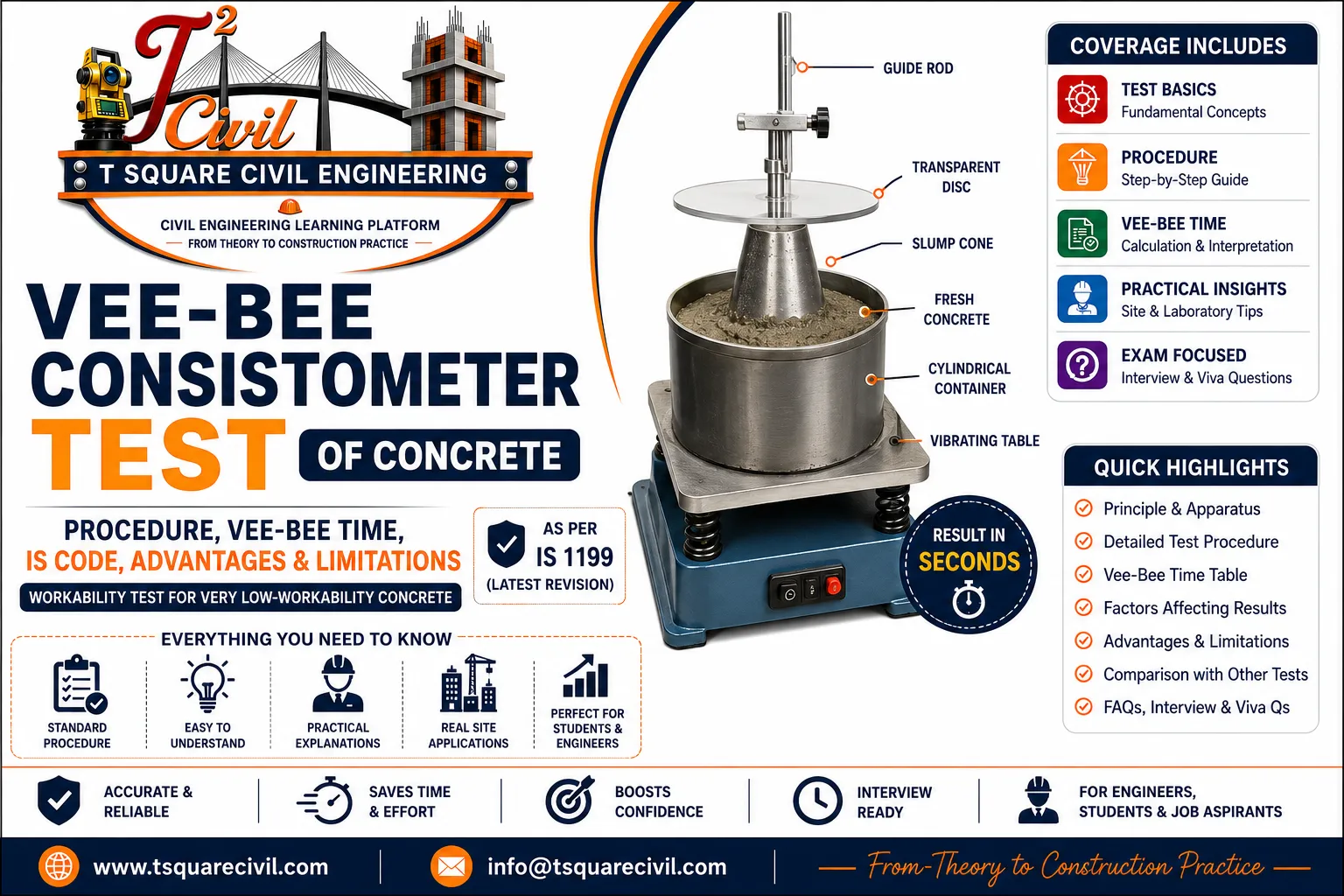
The Vee-Bee Consistometer Test is a laboratory method used to determine the workability and consistency of fresh concrete by measuring the time required for concrete to remould under vibration. In this test, freshly mixed concrete is first placed inside a standard slump cone positioned within a cylindrical container. After the slump cone is lifted, a transparent disc is placed on top of the concrete, and vibration is applied using the vibrating table.
The time required for the concrete to change completely from its original conical shape to a fully compacted cylindrical shape is called the Vee-Bee Time. This value provides a quantitative measure of the concrete’s workability.
Because the test measures the response of concrete to vibration, it is particularly useful for concrete mixes with very low workability, where the Slump Cone Test may produce little or no measurable slump.
Why is the Vee-Bee Consistometer Test Important?
The workability of fresh concrete directly influences the ease of transportation, placement, compaction, and finishing. Stiff concrete mixes are difficult to evaluate using the Slump Cone Test because they show little or no slump. The Vee-Bee Consistometer Test overcomes this limitation by measuring the time required for concrete to remould under vibration.
The test helps engineers:
- Evaluate the workability of very low-workability concrete.
- Compare different concrete mix proportions.
- Verify consistency during laboratory quality control.
- Assess the effectiveness of vibration during compaction.
- Support concrete mix design and optimisation.
- Reduce construction defects caused by inadequate compaction.
- Improve the durability and performance of hardened concrete.
Applications of the Vee-Bee Consistometer Test
The Vee-Bee Consistometer Test is commonly used for:
- Roller-compacted concrete (RCC)
- Road and pavement construction
- Mass concrete works
- Dam construction
- Precast concrete manufacturing
- Concrete mix design laboratories
- Quality-control laboratories
- Research and development institutions
- Construction material testing laboratories
- Civil engineering educational laboratories
Objectives of the Vee-Bee Consistometer Test
The main objectives of conducting the Vee-Bee Consistometer Test are:
- To determine the workability of very low-workability concrete.
- To measure the Vee-Bee Time under standard vibration.
- To compare the consistency of different concrete mixes.
- To evaluate the effect of mix proportions on workability.
- To support laboratory concrete mix design.
- To ensure concrete can be adequately compacted.
- To improve quality control during concrete production.
- To minimise defects caused by poor workability and inadequate compaction.
Site Engineer’s Note: Although the Vee-Bee Consistometer Test is primarily a laboratory test, it is highly valuable for designing and evaluating stiff concrete mixes used in pavements, precast units, and mass concrete structures.
Principle of the Vee-Bee Consistometer Test
The Vee-Bee Consistometer Test of Concrete is based on the principle that the workability of very low-workability concrete can be determined by measuring the time required for fresh concrete to remould completely under standard vibration.
Fresh concrete is first placed inside a standard slump cone positioned within a cylindrical container. After lifting the slump cone vertically, the concrete retains its conical shape or undergoes very little slump due to its low workability. A transparent surcharge disc is then placed gently on the concrete surface, and vibration is applied using the vibrating table.
The concrete gradually changes from its original conical shape into a completely remoulded cylindrical shape under the action of vibration. The time required for complete remoulding, measured in seconds, is called the Vee-Bee Time.
The Vee-Bee Time provides a quantitative indication of concrete workability.
- Shorter Vee-Bee Time → Higher Workability
- Longer Vee-Bee Time → Lower Workability
Unlike the Slump Cone Test, which measures vertical settlement, the Vee-Bee Test evaluates the concrete’s ability to compact under vibration, making it highly suitable for stiff concrete mixes.
Engineering Interpretation
- High workability concrete remoulds quickly.
- Low workability concrete requires longer vibration.
- Very stiff concrete exhibits the highest Vee-Bee Time.
- The test is particularly effective when the slump value is very low or zero.
Engineering Note: The Vee-Bee Consistometer Test simulates field compaction using vibration and therefore provides a realistic assessment of the behaviour of stiff concrete during placement.
Relevant IS Codes
The Vee-Bee Consistometer Test should be conducted according to the latest applicable Indian Standards and project specifications.
| IS Code | Description |
|---|---|
| IS 1199 (Latest Revision) | Methods of Sampling and Analysis of Concrete – Workability Tests |
| IS 456:2000 | Plain and Reinforced Concrete – Code of Practice |
| IS 10262:2019 | Concrete Mix Proportioning – Guidelines |
| IS 4926 | Ready Mixed Concrete – Specification |
| IS 516 (Latest Revision) | Methods of Tests for Strength of Concrete |
Practical Tip: Always verify the latest revision of the relevant Indian Standard before conducting laboratory testing.
Apparatus Required
The Vee-Bee Consistometer Test requires a specially designed apparatus capable of applying controlled vibration while measuring the remoulding time of fresh concrete.
The standard equipment includes:
- Vee-Bee Consistometer
- Vibrating Table
- Cylindrical Container
- Standard Slump Cone
- Transparent Surcharge Disc
- Graduated Steel Rod
- Stopwatch
- Steel Trowel
- Scoop
- Fresh Concrete Sample
Components of the Vee-Bee Consistometer
The Vee-Bee Consistometer consists of several components assembled together to provide standard testing conditions.
1. Vibrating Table
The vibrating table produces controlled vibration during the test.
Function
- Compacts fresh concrete.
- Facilitates remoulding.
- Ensures uniform vibration.
- Maintains repeatable test conditions.
2. Cylindrical Container
The cylindrical container is fixed to the vibrating table.
Function
- Holds the slump cone during filling.
- Receives the remoulded concrete after vibration.
- Provides a standard testing chamber.
3. Standard Slump Cone
The same slump cone used in the Slump Cone Test is used for this test.
Standard Dimensions
| Parameter | Dimension |
|---|---|
| Height | 300 mm |
| Top Diameter | 100 mm |
| Bottom Diameter | 200 mm |
Function
- Shapes the fresh concrete into a standard cone before vibration.
4. Transparent Surcharge Disc
A transparent circular disc is placed on top of the concrete immediately after removing the slump cone.
Function
- Applies a light surcharge.
- Allows observation of the remoulding process.
- Helps determine the exact end point of the test.
The disc should remain horizontal throughout the vibration process.
5. Graduated Steel Rod
The steel rod supports and guides the transparent disc.
Function
- Maintains proper alignment.
- Prevents tilting of the surcharge disc.
- Allows free vertical movement during remoulding.
6. Stopwatch
The stopwatch measures the Vee-Bee Time.
Function
- Starts immediately when vibration begins.
- Stops when complete remoulding is achieved.
The reading is recorded in seconds.
7. Steel Trowel
Used for:
- Striking off excess concrete.
- Levelling the concrete surface.
- Cleaning the apparatus after testing.
8. Scoop
Used to transfer fresh concrete into the slump cone without causing segregation.
Apparatus Specifications
| Apparatus | Specification |
|---|---|
| Vibrating Table | Standard laboratory vibrating table |
| Cylindrical Container | Standard steel container |
| Slump Cone | 300 mm height, 100 mm top diameter, 200 mm bottom diameter |
| Transparent Disc | Circular transparent surcharge disc |
| Steel Rod | Graduated guide rod |
| Stopwatch | Digital or mechanical stopwatch |
| Trowel | Standard steel trowel |
| Scoop | Standard metal scoop |
Sample Collection
Proper sampling is essential for obtaining accurate Vee-Bee Time values.
Guidelines
- Collect concrete immediately after mixing.
- Obtain a representative sample from the batch.
- Remix the sample gently before testing.
- Protect the sample from sunlight and excessive wind.
- Avoid segregation during transportation.
- Do not add water after sampling.
- Complete the test as quickly as possible.
Preparation Before Testing
Before beginning the test, ensure all equipment and materials are ready.
Equipment Preparation
- Clean the vibrating table thoroughly.
- Ensure the cylindrical container is clean and dry.
- Inspect the slump cone for damage.
- Verify that the surcharge disc moves freely.
- Check the vibration mechanism.
- Confirm that the stopwatch functions correctly.
- Place the apparatus on a rigid, level surface.
Concrete Preparation
- Use freshly mixed concrete.
- Ensure the sample is representative of the mixed concrete.
- Remix the concrete gently before testing.
- Avoid moisture loss before testing.
- Do not modify the water-cement ratio.
Safety Preparation
- Wear safety shoes.
- Wear gloves while handling fresh concrete.
- Use safety goggles.
- Keep hands away from moving parts of the vibrating table.
- Ensure electrical connections are safe and properly insulated.
Engineering Notes
Why is the Vee-Bee Test More Suitable for Very Low-Workability Concrete?
Concrete with very low workability often shows almost no measurable slump, making the Slump Cone Test ineffective for distinguishing between different mixes.
The Vee-Bee Consistometer Test measures the time required for remoulding under vibration, providing a more sensitive and reliable indication of workability for stiff concrete.
When Should the Vee-Bee Test Be Preferred?
The Vee-Bee Test is recommended when:
- The concrete mix has a very low slump.
- Roller-compacted concrete is being evaluated.
- Pavement-quality concrete is produced.
- Laboratory mix designs require accurate workability assessment.
- Precast concrete elements are manufactured.
- Research or quality-control investigations are conducted.
Practical Tip
For normal reinforced concrete works such as beams, slabs, and columns, the Slump Cone Test is generally sufficient. However, for stiff concrete mixes used in pavements, dams, and precast construction, the Vee-Bee Consistometer Test provides a more accurate assessment of workability under vibration.
Step-by-Step Procedure for the Vee-Bee Consistometer Test
The test should be performed carefully to obtain accurate and repeatable results.
Step 1: Prepare the Apparatus
- Clean the vibrating table, cylindrical container, slump cone, and transparent surcharge disc.
- Ensure the vibrating table is functioning properly.
- Place the apparatus on a firm, level surface.
- Check that the stopwatch is working accurately.
Observation
All equipment should be clean, dry, and free from hardened concrete before starting the test.
Step 2: Collect the Fresh Concrete Sample
Collect a representative sample of freshly mixed concrete.
Ensure that:
- The concrete is freshly mixed.
- No segregation has occurred.
- No additional water is added.
- The sample is remixed gently before testing.
Step 3: Place the Slump Cone
- Position the slump cone inside the cylindrical container.
- Hold the cone firmly to prevent movement during filling.
Step 4: Fill the Slump Cone
Fill the slump cone with fresh concrete in four equal layers.
For each layer:
- Compact with 25 strokes of the tamping rod.
- Distribute the strokes uniformly over the cross-section.
After filling the final layer:
- Strike off the surface level using a steel trowel.
- Remove excess concrete around the base.
Step 5: Lift the Slump Cone
Lift the slump cone vertically and slowly without twisting.
The concrete will retain its shape or undergo only a slight slump because of its low workability.
Step 6: Place the Transparent Surcharge Disc
Carefully lower the transparent surcharge disc onto the top surface of the concrete.
Ensure that:
- The disc rests evenly.
- The guide rod remains vertical.
- The disc moves freely during vibration.
Step 7: Start the Vibrating Table
Switch on the vibrating table and start the stopwatch simultaneously.
The vibration causes the concrete to gradually lose its conical shape and remould into the cylindrical container.
Step 8: Observe the Remoulding Process
Watch the concrete carefully throughout the vibration.
Initially:
- The concrete maintains a conical shape.
Gradually:
- The concrete spreads outward.
- The surface becomes more level.
- Air voids disappear.
- The concrete completely fills the cylindrical container.
Step 9: Stop the Stopwatch
Stop the stopwatch when the concrete has completely remoulded into a cylindrical shape, and the surface becomes horizontal beneath the transparent disc.
The recorded time is called the Vee-Bee Time.
Record the value in seconds.
Flowchart of the Vee-Bee Consistometer Test
Collect Fresh Concrete
        │
        ▼
Prepare Apparatus
        │
        ▼
Place Slump Cone in Cylinder
        │
        ▼
Fill Cone in Four Layers
        │
        ▼
Compact Each Layer
        │
        ▼
Strike Off Surface
        │
        ▼
Lift Slump Cone
        │
        ▼
Place Transparent Disc
        │
        ▼
Start Vibrating Table
        │
        ▼
Concrete Remoulds
        │
        ▼
Stop Stopwatch
        │
        ▼
Record Vee-Bee Time
        │
        ▼
Interpret Workability
Observation Table
| Observation | Value |
|---|---|
| Project Name | __________ |
| Date | __________ |
| Concrete Grade | __________ |
| Mix Proportion | __________ |
| Water-Cement Ratio | __________ |
| Ambient Temperature | __________ °C |
| Initial Slump | __________ mm |
| Start Time | __________ |
| End Time | __________ |
| Vee-Bee Time | __________ seconds |
| Remarks | __________ |
Vee-Bee Time
The Vee-Bee Time is the time required for fresh concrete to completely remould from the conical shape into a cylindrical shape under standard vibration.
The result is expressed in seconds.
Formula
Vee-Bee Time = End Time − Start Time
Engineering Interpretation
- Lower Vee-Bee Time → Higher Workability
- Higher Vee-Bee Time → Lower Workability
Unlike the Slump Test, the Vee-Bee Test measures time, not settlement.
Calculation – Example 1
Given Data
Start Time = 0 seconds
Complete Remoulding = 6 seconds
Calculation
Vee-Bee Time
= 6 − 0
= 6 seconds
Result
Vee-Bee Time = 6 seconds
The concrete possesses medium workability.
Calculation – Example 2
Given Data
Start Time = 0 seconds
Complete Remoulding = 14 seconds
Calculation
Vee-Bee Time
= 14 − 0
= 14 seconds
Result
Vee-Bee Time = 14 seconds
The concrete possesses low workability and requires greater compaction effort.
Interpretation of Results
The Vee-Bee Time indicates the ease with which fresh concrete can be compacted under vibration.
| Vee-Bee Time (seconds) | Workability | Typical Applications |
|---|---|---|
| Below 3 | Very High | Flowing concrete, highly workable mixes |
| 3–6 | High | Pumped concrete, congested reinforcement |
| 6–12 | Medium | RCC beams, slabs, columns |
| 12–18 | Low | Pavements, mass concrete |
| Above 18 | Very Low | Roller-compacted concrete, dry mixes |
Note: The acceptable Vee-Bee Time depends on the approved concrete mix design, aggregate grading, and project specifications. Always compare the measured value with project requirements.
Important Precautions During Testing
- Use freshly mixed concrete.
- Ensure the apparatus is clean and dry.
- Fill the slump cone in four equal layers.
- Compact each layer with 25 uniform strokes.
- Lift the slump cone vertically without twisting.
- Place the surcharge disc gently on the concrete.
- Start the stopwatch simultaneously with the vibrating table.
- Stop timing only when complete remoulding is achieved.
- Record the Vee-Bee Time accurately.
- Clean the apparatus immediately after the test.
Common Observations During the Test
| Observation | Interpretation |
|---|---|
| Concrete remoulds quickly | High workability |
| Concrete remoulds slowly | Low workability |
| Surface becomes smooth quickly | Good cohesion |
| Segregation observed | Excess water or poor mix design |
| Excessive bleeding | High water-cement ratio |
| Incomplete remoulding | Very stiff concrete or insufficient vibration |
Site Engineer’s Tip
When evaluating stiff concrete mixes used for roads, pavements, precast units, and roller-compacted concrete, always interpret the Vee-Bee Time along with the concrete mix design and project specifications. A longer remoulding time does not necessarily indicate poor-quality concrete; it may simply reflect a mix designed for low workability to meet specific structural or construction requirements.
Classification of Concrete Based on Vee-Bee Time
The workability of fresh concrete can be classified according to the measured Vee-Bee Time. This helps engineers determine whether the concrete is suitable for its intended application.
| Vee-Bee Time (Seconds) | Workability | Characteristics | Typical Applications |
|---|---|---|---|
| Less than 3 | Very High | Highly workable concrete requiring minimal vibration | Flowing concrete, heavily congested reinforcement |
| 3–6 | High | Easily compacted under vibration | Pumped concrete, precast members |
| 6–12 | Medium | Moderate workability | RCC beams, slabs, columns |
| 12–18 | Low | Stiff concrete requiring prolonged vibration | Pavements, retaining walls, foundations |
| More than 18 | Very Low | Very stiff concrete with almost no slump | Roller-compacted concrete, dry lean concrete(DLC), dams |
Engineering Note: As the Vee-Bee Time increases, the workability of concrete decreases because the concrete requires more vibration to become fully compacted.
Recommended Vee-Bee Time Values for Different Construction Works
Different structural elements require different levels of workability depending on reinforcement congestion, placement method, and compaction equipment.
| Construction Work | Recommended Vee-Bee Time |
|---|---|
| Roller-Compacted Concrete | 18–25 seconds |
| Road Pavements | 12–18 seconds |
| Mass Concrete | 12–18 seconds |
| Strip Footings | 10–15 seconds |
| Isolated Footings | 8–14 seconds |
| RCC Foundations | 8–12 seconds |
| RCC Beams | 6–10 seconds |
| RCC Slabs | 6–9 seconds |
| RCC Columns | 5–8 seconds |
| Retaining Walls | 8–12 seconds |
| Water Tanks | 5–8 seconds |
| Bridges | 5–8 seconds |
| Pumped Concrete | 3–6 seconds |
| Precast Concrete | 3–8 seconds |
| Self-Compacting Concrete (SCC) | Not evaluated using the Vee-Bee Test |
Important: These values are general guidelines. The acceptable Vee-Bee Time should always be verified against the approved mix design and project specifications.
Acceptance Criteria
The Vee-Bee Consistometer Test is considered satisfactory when the measured Vee-Bee Time falls within the specified range, and the concrete remoulds uniformly without segregation or excessive bleeding.
Concrete May Be Accepted When:
- The measured Vee-Bee Time complies with project specifications.
- Concrete remoulds uniformly under vibration.
- No visible segregation occurs.
- No excessive bleeding is observed.
- The concrete surface becomes smooth and level.
- The test is performed according to standard procedures.
- The apparatus functions correctly.
Concrete Should Be Investigated or Rejected When:
- The Vee-Bee Time is outside the specified limits.
- Concrete does not remould completely.
- Significant segregation is observed.
- Excessive bleeding occurs.
- Water has been added after sampling.
- The vibrating table malfunctions.
- The slump cone is lifted improperly.
- The sample is not representative of the concrete batch.
Factors Affecting the Vee-Bee Time
Several factors influence the measured Vee-Bee Time and the workability of fresh concrete.
1. Water-Cement Ratio
The water-cement ratio has the greatest influence on workability.
- Higher water content reduces the Vee-Bee Time.
- Lower water content increases the Vee-Bee Time.
- Excess water may cause segregation and bleeding.
2. Cement Content
Higher cement content generally improves cohesion and lubrication, reducing the Vee-Bee Time. However, very high cement content may increase heat of hydration and construction costs.
3. Aggregate Size
Larger aggregates reduce the total surface area requiring lubrication and may improve workability. The maximum aggregate size should always comply with structural design requirements.
4. Aggregate Grading
Well-graded aggregates improve particle packing and reduce internal friction, resulting in shorter Vee-Bee Times. Poor grading generally produces harsher mixes requiring more vibration.
5. Aggregate Shape and Surface Texture
- Rounded aggregates improve workability and reduce Vee-Bee Time.
- Angular or rough-textured aggregates increase internal friction and extend the remoulding time.
6. Chemical Admixtures
Plasticisers and superplasticisers improve workability without increasing the water-cement ratio, thereby reducing the Vee-Bee Time.
7. Moisture Content of Aggregates
Surface moisture contributes additional water to the mix, while dry aggregates absorb water. Both conditions can significantly alter the measured workability if moisture corrections are not applied.
8. Mixing Time
Proper mixing ensures uniform distribution of cement paste and aggregates. Insufficient or excessive mixing may affect workability and lead to inconsistent test results.
9. Transportation Time
Fresh concrete gradually loses workability due to hydration and evaporation. Longer transportation times generally increase the Vee-Bee Time.
10. Ambient Temperature
High temperatures accelerate water loss and cement hydration, increasing the Vee-Bee Time. Lower temperatures help retain workability for a longer duration.
Common Mistakes During the Vee-Bee Consistometer Test
| Mistake | Effect on Test Result | Preventive Measure |
|---|---|---|
| Dirty apparatus | Inaccurate remoulding | Clean all equipment before testing |
| Uneven filling of slump cone | Non-uniform compaction | Fill in four equal layers |
| Insufficient tamping | False workability results | Compact each layer with 25 strokes |
| Twisting the slump cone during lifting | Disturbed concrete shape | Lift vertically without rotation |
| Delayed start of stopwatch | Incorrect Vee-Bee Time | Start timing immediately with vibration |
| Stopping the test too early | Lower recorded time | Stop only after complete remoulding |
| Excessive vibration before timing | Misleading results | Follow the standard procedure precisely |
| Non-representative sample | Incorrect workability assessment | Collect a representative fresh sample |
Troubleshooting Guide
| Observation | Possible Cause | Corrective Action |
|---|---|---|
| Very long Vee-Bee Time | Low water content or harsh mix | Review water-cement ratio and mix proportions |
| Very short Vee-Bee Time | Excess water or high admixture dosage | Verify batching and admixture dosage |
| Segregation observed | Excess water or poor aggregate grading | Adjust mix design |
| Bleeding visible | High water-cement ratio | Reduce water content |
| Concrete fails to remould completely | Very stiff mix or inadequate vibration | Check vibration equipment and mix design |
| Wide variation between tests | Inconsistent sampling or testing | Standardise sampling and laboratory procedure |
Comparison Between Vee-Bee Test and Slump Cone Test
| Parameter | Vee-Bee Consistometer Test | Slump Cone Test |
|---|---|---|
| Purpose | Measures workability by remoulding time under vibration | Measures workability by vertical slump |
| Suitable for | Very low-workability concrete | Medium to high-workability concrete |
| Result | Vee-Bee Time (seconds) | Slump value (mm) |
| Test Location | Laboratory | Laboratory and construction site |
| Equipment | Vee-Bee Consistometer | Slump Cone, Tamping Rod, Base Plate |
| Accuracy | Higher for stiff concrete | Adequate for normal concrete |
| Test Duration | About 10–15 minutes | About 5 minutes |
| Field Use | Limited | Widely used |
Comparison Between Vee-Bee Test and Compaction Factor Test
| Parameter | Vee-Bee Consistometer Test | Compaction Factor Test |
|---|---|---|
| Principle | Measures remoulding time under vibration | Measures degree of compaction under gravity |
| Result | Time (seconds) | Ratio (dimensionless) |
| Suitable for | Very low-workability concrete | Low to medium-workability concrete |
| Equipment | Vibrating table and Vee-Bee apparatus | Two hoppers and cylinder |
| Accuracy | Very high for stiff mixes | High for low-workability mixes |
| Main Application | Pavements, dams, roller-compacted concrete | Laboratory mix design and quality control |
When Should the Vee-Bee Consistometer Test Be Preferred?
The Vee-Bee Test is recommended when:
- The concrete exhibits very low workability.
- The slump value is negligible or zero.
- Roller-compacted concrete or pavement concrete is being evaluated.
- Laboratory mix design requires precise workability measurement.
- Concrete used in dams, heavy foundations, or precast elements is being tested.
- Research and quality-control investigations require accurate assessment under vibration.
For routine site quality control of normal reinforced concrete, the Slump Cone Test remains the preferred method because it is simpler, quicker, and easier to perform.
Practical Tips for Site and Laboratory Engineers
Following proper laboratory practices ensures reliable and repeatable Vee-Bee Test results.
Before the Test
- Ensure the vibrating table is functioning correctly.
- Clean the slump cone, cylindrical container, and surcharge disc.
- Verify that the stopwatch is working accurately.
- Collect a representative sample of freshly mixed concrete.
- Do not add water after sampling.
- Perform the test immediately after collecting the sample.
During the Test
- Fill the slump cone in four equal layers.
- Compact each layer with 25 uniform strokes.
- Lift the slump cone vertically without twisting.
- Place the surcharge disc gently on the concrete surface.
- Start the stopwatch simultaneously with the vibrating table.
- Observe the remoulding process carefully.
- Stop timing only after complete remoulding.
After the Test
- Record the Vee-Bee Time accurately.
- Compare the result with the approved mix design.
- Clean the apparatus immediately.
- Inspect the equipment before storage.
- Document observations in the laboratory register.
QA/QC Checklist
Use the following checklist before accepting the test results.
| Check Point | Status (✓/✗) |
|---|---|
| Apparatus clean and dry | |
| Vibrating table functioning properly | |
| Slump cone undamaged | |
| Stopwatch operational | |
| Fresh representative sample collected | |
| No water added after sampling | |
| Four equal layers filled | |
| Each layer compacted with 25 strokes | |
| Slump cone lifted vertically | |
| Stopwatch started with vibration | |
| Vee-Bee Time recorded correctly | |
| Test results entered in QA/QC records |
Advantages of the Vee-Bee Consistometer Test
The Vee-Bee Test provides several important advantages for evaluating stiff concrete mixes.
- Highly suitable for very low-workability concrete.
- More accurate than the Slump Test for stiff mixes.
- Provides quantitative results in seconds.
- Simulates field compaction under vibration.
- Useful for laboratory concrete mix design.
- Helps maintain uniform concrete quality.
- Widely accepted for research and quality control.
- Supports evaluation of pavement and precast concrete.
Limitations of the Vee-Bee Consistometer Test
Despite its advantages, the Vee-Bee Test has some limitations.
- Not suitable for highly workable or flowing concrete.
- Cannot be used for self-compacting concrete (SCC).
- Requires specialised laboratory equipment.
- More time-consuming than the Slump Test.
- Primarily intended for laboratory use.
- Operator skill affects test accuracy.
- Does not measure concrete strength or durability directly.
Applications of the Vee-Bee Consistometer Test
The Vee-Bee Test is widely used in:
- Pavement concrete.
- Roller-compacted concrete.
- Dam construction.
- Mass concrete works.
- Precast concrete manufacturing.
- Concrete mix design laboratories.
- Civil engineering colleges.
- Construction material testing laboratories.
- Ready-mix concrete quality control.
- Research and development centres.
Safety Precautions
Personal Safety
- Wear safety shoes.
- Use protective gloves.
- Wear safety goggles.
- Avoid direct contact with fresh concrete.
Equipment Safety
- Secure the vibrating table before testing.
- Keep hands away from moving components during vibration.
- Check electrical connections before operating the equipment.
- Switch off the vibrating table before cleaning.
Laboratory Safety
- Maintain a clean and dry testing area.
- Dispose of waste concrete responsibly.
- Store equipment properly after testing.
- Follow standard laboratory safety procedures.
Frequently Asked Questions (FAQs)
Q1. What is the Vee-Bee Consistometer Test?
Answer: It is a laboratory test used to determine the workability of very low-workability fresh concrete by measuring the remoulding time under vibration.
Q2. What is Vee-Bee Time?
Answer: Vee-Bee Time is the time required for fresh concrete to completely change from a conical shape into a cylindrical shape under vibration.
Q3. What is the unit of Vee-Bee Time?
Answer: Seconds.
Q4. Which concrete is suitable for this test?
Answer: Very low-workability concrete.
Q5. Why is the Vee-Bee Test more suitable than the Slump Test for stiff concrete?
Answer: Because the Slump Test cannot accurately differentiate very stiff mixes, whereas the Vee-Bee Test measures remoulding time under vibration.
Q6. Can this test determine compressive strength?
Answer: No. It measures only the workability of fresh concrete.
Q7. What equipment is used in the Vee-Bee Test?
Answer: A Vee-Bee Consistometer, vibrating table, slump cone, cylindrical container, surcharge disc, and stopwatch.
Q8. What does a shorter Vee-Bee Time indicate?
Answer: Higher workability.
Q9. What does a longer Vee-Bee Time indicate?
Answer: Lower workability and a stiffer concrete mix.
Q10. Is the Vee-Bee Test suitable for Self-Compacting Concrete (SCC)?
Answer: No. Self-Compacting Concrete(SCC) requires specialised flow tests.
Interview Questions with Answers
Q1. Define the Vee-Bee Consistometer Test.
Answer: It is a laboratory method for determining the workability of very low-workability concrete by measuring the remoulding time under vibration.
Q2. What is the principle of the Vee-Bee Test?
Answer: The test measures the time required for fresh concrete to remould completely under standard vibration.
Q3. What is Vee-Bee Time?
Answer: The remoulding time of concrete under vibration, expressed in seconds.
Q4. Which type of concrete is tested using the Vee-Bee Consistometer?
Answer: Very low-workability concrete.
Q5. Which apparatus are used?
Answer:
- Vibrating table
- Slump cone
- Cylindrical container
- Transparent surcharge disc
- Stopwatch
Q6. Why is vibration used in this test?
Answer: To simulate field compaction and measure the remoulding behaviour of concrete.
Q7. What is the advantage of the Vee-Bee Test?
Answer: It provides accurate workability measurement for stiff concrete mixes.
Q8. Can this test replace the Slump Test?
Answer: No. It complements the Slump Test and is mainly used for very low-workability concrete.
Q9. Where is the Vee-Bee Test mainly conducted?
Answer: In laboratories and quality-control centres.
Q10. Does the Vee-Bee Test measure concrete durability?
Answer: No. It measures only workability.
Viva Voce Questions with Answers
Q1. What does the Vee-Bee Test measure?
Answer: Workability of fresh concrete.
Q2. What is recorded during the test?
Answer: Vee-Bee Time.
Q3. What is the unit of Vee-Bee Time?
Answer: Seconds.
Q4. Which apparatus provides vibration?
Answer: The vibrating table.
Q5. What is placed above the concrete during vibration?
Answer: Transparent surcharge disc.
Q6. Why is the slump cone used?
Answer: To mould the concrete into a standard conical shape before vibration.
Q7. Is the test suitable for flowing concrete?
Answer: No.
Q8. Is the test suitable for roller-compacted concrete?
Answer: Yes.
Q9. Is the test mainly a field test?
Answer: No. It is primarily a laboratory test.
Q10. What happens to the concrete during vibration?
Answer: It remoulds from a conical shape into a cylindrical shape.
References
Indian Standards
- IS 1199 (Latest Revision) – Methods of Sampling and Analysis of Concrete
- IS 456:2000 – Plain and Reinforced Concrete – Code of Practice
- IS 10262:2019 – Concrete Mix Proportioning – Guidelines
- IS 4926 – Ready Mixed Concrete – Specification
- IS 516 (Latest Revision) – Methods of Tests for Strength of Concrete
- M. S. Shetty – Concrete Technology: Theory and Practice
Conclusion
The Vee-Bee Consistometer Test of Concrete is one of the most reliable laboratory methods for evaluating the workability of very low-workability concrete. By measuring the Vee-Bee Time, engineers can determine how easily fresh concrete remoulds under vibration, making the test particularly valuable for pavements, roller-compacted concrete, precast elements, dams, and other stiff concrete applications.
Although it requires specialised equipment and is generally limited to laboratory use, the Vee-Bee Test provides a more accurate assessment than the Slump Test for stiff concrete mixes. When carried out according to the applicable Indian Standards and interpreted alongside the approved mix design and project specifications, it helps ensure proper compaction, improved concrete quality, enhanced durability, and reliable structural performance.
You can also read the following articles
- Slump Cone Test of Concrete
- Compaction Factor Test of Concrete
- Flow Table Test of Concrete
- Concrete Cube Casting Procedure
- Compressive Strength Test of Concrete
- Concrete Mix Design
- Water-Cement Ratio
- Concrete Volume Calculator
- Cement Bags Calculator
- Steel Weight Calculator