
 by
by Page Contents
Introduction
Concrete is one of the most widely used construction materials in the world, but its long-term performance depends not only on proper mix design and placement but also on effective curing. Many construction failures occur because freshly placed concrete is allowed to dry too quickly, interrupting the hydration process and reducing the concrete’s strength and durability.
Concrete curing is the controlled process of maintaining sufficient moisture and a suitable temperature in concrete immediately after placement. It enables cement particles to react with water, producing hydration products that bind the aggregates together and create a dense, durable, and strong concrete structure.
Proper curing is essential for all types of concrete works, including residential buildings, commercial complexes, bridges, pavements, retaining walls, dams, and industrial structures. It minimises shrinkage, reduces cracking, improves abrasion resistance, enhances water tightness, and increases the overall service life of the structure.
This comprehensive guide explains the methods of concrete curing, their importance, IS 456 recommendations, practical procedures, advantages, limitations, and field applications. Whether you are a civil engineering student, site engineer, quality control engineer, contractor, or competitive exam aspirant, this article will provide a complete understanding of concrete curing and its role in producing durable, high-quality concrete.
Quick Answer
Concrete curing is the process of maintaining adequate moisture, temperature, and time after concrete placement to ensure proper cement hydration and strength development. Proper curing improves the compressive strength, durability, impermeability, abrasion resistance, and service life of concrete. According to IS 456:2000, concrete should be cured for at least 7 days for Ordinary Portland Cement (OPC), while blended cement concretes generally require 10 days or more, depending on environmental conditions and project specifications.
Quick Information Table
| Parameter | Details |
|---|---|
| Test/Topic | Concrete Curing |
| Purpose | To maintain moisture and temperature for proper cement hydration |
| Applicable Standard | IS 456:2000 |
| Applicable Concrete | Plain Cement Concrete (PCC), Reinforced Cement Concrete (RCC), Prestressed Concrete (PSC) |
| Minimum Curing Period (OPC) | 7 Days |
| Minimum Curing Period (Blended Cement) | 10 Days (or as specified by IS 456) |
| Main Objective | Achieve desired strength and durability |
| Common Methods | Water Curing, Ponding, Sprinkling, Wet Covering, Membrane Curing, Steam Curing |
| Importance | Prevents cracking, shrinkage, and strength loss |
| Field Applications | Buildings, Bridges, Roads, Dams, Pavements, Water Tanks |
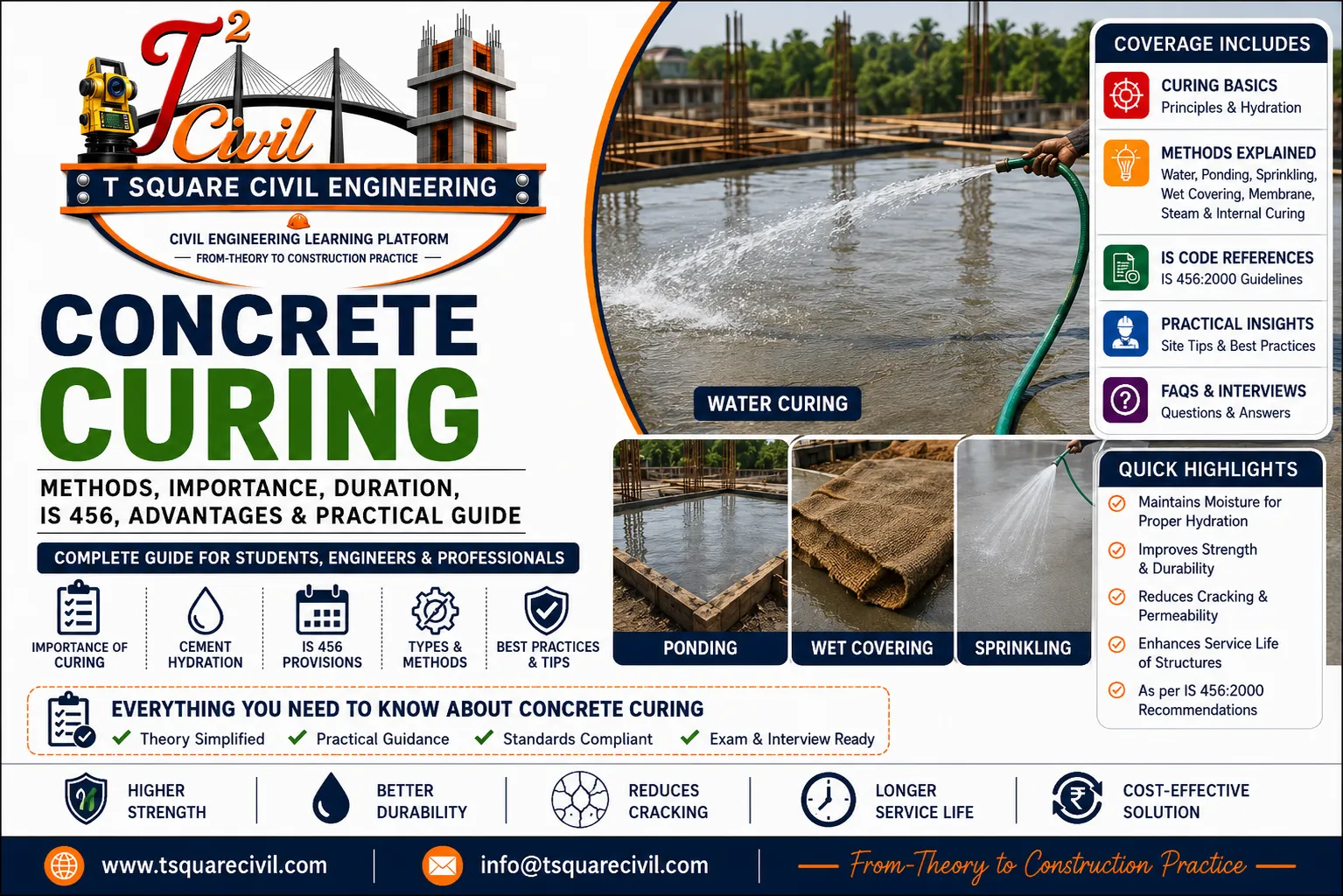
Key Takeaways
- Concrete curing is essential for proper cement hydration and strength gain.
- Well-cured concrete develops higher compressive strength and improved durability.
- Inadequate curing can lead to plastic shrinkage cracks, reduced strength, and poor surface quality.
- Water curing is the most widely used and effective curing method for normal construction.
- Different structures require different curing techniques based on site conditions and project requirements.
- Curing is one of the most economical ways to improve the long-term performance of concrete.
- Following IS 456:2000 recommendations helps ensure quality construction and a longer service life.
What is Concrete Curing?
Concrete curing is the process of maintaining adequate moisture, temperature, and time after concrete has been placed and finished so that cement hydration continues without interruption. During curing, sufficient water is retained within the concrete to allow the cement to react chemically, forming a dense and strong cement paste that binds the aggregates together.
The curing process begins immediately after the concrete has hardened enough to prevent surface damage and continues for the recommended duration specified by IS 456:2000 or project requirements. Proper curing ensures that concrete reaches its intended strength, minimizes cracking, improves durability, and enhances resistance to weathering and chemical attack.
In simple terms, curing protects young concrete during its most critical stage of strength development by preventing premature moisture loss and maintaining favorable conditions for hydration.
Definition:
Concrete curing is the process of maintaining satisfactory moisture content and temperature in freshly placed concrete for a specified period to ensure proper hydration of cement and achieve the desired strength, durability, and performance.
Objectives of Concrete Curing
The primary objectives of concrete curing are:
- Maintain sufficient moisture for continuous cement hydration.
- Achieve the specified compressive strength.
- Improve durability and service life.
- Minimize shrinkage and surface cracking.
- Reduce permeability and improve water-tightness.
- Enhance resistance to weathering and aggressive chemicals.
- Improve surface hardness and abrasion resistance.
- Ensure consistent quality throughout the concrete element.
- Protect young concrete from rapid drying and temperature extremes.
- Produce a durable, dense, and long-lasting concrete structure.
Principle of Concrete Curing
The principle of Concrete Curing is to provide and retain adequate moisture and maintain a suitable temperature in freshly placed concrete so that the hydration of cement continues uninterrupted. Cement hydration is a chemical reaction between cement and water that produces compounds responsible for the strength and durability of concrete.
Fresh concrete contains sufficient water for hydration; however, exposure to sun, wind, or high temperatures can cause rapid evaporation. If moisture is lost before hydration is complete, concrete may develop lower strength, increased permeability, surface dusting, and shrinkage cracks.
Therefore, curing aims to create favorable conditions that allow cement particles to hydrate continuously until the concrete develops the required mechanical properties.
Engineering Principle:
Concrete curing ensures continuous cement hydration by preventing premature moisture loss and maintaining favorable temperature conditions, thereby enabling concrete to achieve its designed strength, durability, and long-term performance.
Cement Hydration Process
Hydration is the chemical reaction between cement and water that forms the binding material in concrete. During hydration, complex chemical compounds known as Calcium Silicate Hydrate (C-S-H) gel and Calcium Hydroxide (Ca(OH)₂) are produced.
The C-S-H gel is the primary compound responsible for the strength of concrete. As hydration progresses, these products fill the voids between aggregate particles, creating a dense and strong matrix.
Simplified Hydration Process
Cement + Water
        ↓
Chemical Hydration
        ↓
Formation of C-S-H Gel
        ↓
Concrete Hardening
        ↓
Strength Development
        ↓
Durable Concrete
Stages of Concrete Strength Development
| Age of Concrete | Approximate Strength Development* |
|---|---|
| 1 Day | 15–20% |
| 3 Days | 35–45% |
| 7 Days | 60–70% |
| 14 Days | 85–90% |
| 28 Days | 100% (Design Strength) |
| 56–90 Days | Continued Strength Gain |
Values are approximate and depend on cement type, mix proportion, curing conditions, temperature, and water-cement ratio.
Why Concrete Needs Curing
Concrete requires curing because hydration is a time-dependent process. If moisture is lost prematurely, hydration slows or stops, leaving some cement particles unhydrated.
Proper curing helps to:
- Maintain continuous hydration.
- Increase compressive and tensile strength.
- Reduce permeability.
- Improve durability.
- Minimize plastic and drying shrinkage.
- Reduce thermal and surface cracking.
- Improve abrasion resistance.
- Enhance resistance to sulphate and chloride attack.
- Increase service life of the structure.
Effects of Inadequate Curing
Improper curing can significantly reduce the performance of concrete.
| Problem | Effect on Concrete |
|---|---|
| Rapid moisture loss | Incomplete hydration |
| Early drying | Lower compressive strength |
| Plastic shrinkage | Surface cracks |
| Poor hydration | Weak concrete matrix |
| Increased permeability | Water and chemical penetration |
| Surface dusting | Reduced wear resistance |
| Honeycombing tendency | Poor durability |
| Reduced service life | Increased maintenance cost |
Relevant IS Codes
The following Indian Standards provide guidance on concrete curing and related practices:
| IS Code | Description |
|---|---|
| IS 456:2000 | Plain and Reinforced Concrete – Code of Practice |
| IS 1199 (Part 1):2018 | Sampling and Testing of Fresh Concrete |
| IS 516 (Part 1/Sec 1):2021 | Methods of Tests for Strength of Concrete |
| IS 10262:2019 | Concrete Mix Proportioning Guidelines |
| IS 383:2016 | Coarse and Fine Aggregates Specification |
IS 456:2000 – Key Recommendations
According to IS 456:2000:
- Curing should begin as soon as the concrete surface has hardened sufficiently to prevent damage.
- Concrete should be protected against rapid drying.
- Continuous curing is preferred for better hydration.
- The curing period depends on the type of cement and exposure conditions.
- Concrete should be kept moist throughout the recommended curing period.
Recommended Minimum Curing Period (IS 456:2000)
| Cement Type | Minimum Recommended Curing Period |
|---|---|
| Ordinary Portland Cement (OPC) | 7 Days |
| Blended Cement (PPC/PSC) | 10 Days |
| Hot Weather Conditions | At least 10–14 Days (recommended) |
| Severe Exposure Conditions | Longer curing as specified by the engineer |
Note: Project specifications or exposure conditions may require curing beyond these minimum periods to achieve the desired durability.
Factors Affecting Concrete Curing
Several factors influence the effectiveness of curing and the final quality of concrete.
1. Temperature
High temperatures accelerate water evaporation and increase the risk of plastic shrinkage cracking. Low temperatures slow hydration and delay strength gain.
2. Relative Humidity
Low humidity increases evaporation from the concrete surface, while high humidity helps retain moisture and supports continuous hydration.
3. Wind Velocity
Strong winds remove surface moisture rapidly, making immediate curing essential to prevent early-age cracking.
4. Water-Cement Ratio
Concrete with a lower water-cement ratio generally requires careful curing because there is less free water available for hydration.
5. Cement Type
Different cement types hydrate at different rates. Blended cements such as PPC and PSC typically benefit from longer curing periods than OPC.
6. Member Thickness
Thin sections lose moisture faster than massive concrete members, requiring more attention during curing.
7. Exposure Conditions
Structures exposed to direct sunlight, dry climates, or coastal environments require effective curing to ensure long-term durability.
Materials and Equipment Used for Curing
Depending on the selected curing method, the following materials and equipment are commonly used:
| Material/Equipment | Purpose |
|---|---|
| Water Hose | Continuous water supply |
| Sprinkler | Uniform water spraying |
| Buckets | Manual watering |
| Ponding Bunds | Water retention on slabs |
| Hessian Cloth/Burlap | Wet covering to retain moisture |
| Plastic Sheets | Reduce moisture evaporation |
| Curing Compounds | Membrane formation to prevent water loss |
| Steam Generator | Accelerated curing in precast units |
| Water Storage Tank | Supply for continuous curing |
| Thermometer | Monitoring ambient and concrete temperatures |
Preparation Before Starting Curing
Before commencing curing, ensure the following:
- Concrete has been placed, compacted, and finished correctly.
- Initial setting has occurred, and the surface is firm enough to avoid damage during curing.
- The curing method is selected based on the type of structure and site conditions.
- Adequate water and curing materials are available.
- Drainage arrangements prevent erosion of fresh concrete.
- Weather conditions are assessed, and additional protection is planned if necessary.
- Safety measures are in place for workers performing curing operations.
Engineering Notes
Site Tip 1: Start curing as early as practical after the concrete surface has hardened sufficiently. Delaying curing can reduce the final strength and increase the likelihood of cracking.
Site Tip 2: During hot and windy weather, use wet coverings or evaporation control measures immediately after finishing to minimize moisture loss.
Site Tip 3: Continuous curing is generally more effective than intermittent wetting, as repeated drying and rewetting may lead to surface shrinkage and reduced durability.
Site Tip 4: Proper curing is one of the most cost-effective quality control measures in concrete construction. A small investment in curing can significantly improve the strength, durability, and service life of a structure.
Types of Concrete Curing Methods
Several curing methods are adopted depending on the type of structure, environmental conditions, availability of water, and project requirements. The primary objective of every method is to prevent moisture loss and ensure continuous hydration of cement.
The most commonly used methods are:
- Internal Curing
- Water Curing
- Ponding
- Sprinkling or Fogging
- Wet Covering
- Membrane Curing
- Steam Curing
1. Water Curing
Water curing is the most common and effective method used in civil engineering construction. In this method, concrete surfaces are kept continuously wet by applying water at regular intervals.
It is suitable for:
- RCC slabs
- Columns
- Beams
- Footings
- Retaining walls
- Bridge components
Advantages
- Provides continuous moisture.
- Increases compressive strength.
- Reduces shrinkage cracks.
- Improves durability.
- Economical and easy to implement.
2. Ponding Method
Ponding is mainly used for horizontal concrete surfaces such as slabs and pavements.
Small bunds are constructed around the slab, and the enclosed area is filled with water to maintain continuous moisture.
Applications
- Roof slabs
- Floor slabs
- Pavements
- Bridge decks
Advantages
- Excellent hydration.
- Uniform curing.
- Minimal labour after setup.
3. Sprinkling or Fogging
In this method, water is sprayed continuously or intermittently over the concrete surface.
It is particularly useful where ponding is not practical.
Applications
- Roads
- Pavements
- Large foundations
- Industrial floors
Advantages
- Uniform moisture distribution.
- Suitable for large areas.
- Prevents rapid drying.
4. Wet Covering
Concrete surfaces are covered with moisture-retaining materials such as:
- Wet Hessian cloth
- Burlap
- Cotton mats
- Sand layers
- Straw
These coverings are kept continuously wet throughout the curing period.
Applications
- Columns
- Beams
- Vertical surfaces
- Bridge piers
5. Membrane Curing
When water is scarce, membrane curing compounds are sprayed onto the concrete surface.
The compound forms a thin waterproof film that minimizes moisture evaporation.
Advantages
- Saves water.
- Suitable for remote construction sites.
- Reduces labour requirements.
Limitations
- Less effective than continuous water curing.
- Surface must be properly cleaned before application.
6. Steam Curing
Steam curing accelerates cement hydration by exposing concrete to controlled steam at elevated temperatures.
It is widely used in:
- Precast concrete factories
- Prestressed concrete units
- Railway sleepers
- Concrete pipes
- Prefabricated structures
Advantages
- Rapid strength gain.
- Faster production cycle.
- Early demoulding.
7. Internal Curing
Internal curing uses lightweight aggregates or special admixtures that gradually release stored water within the concrete.
Applications
- High-performance concrete
- Self-compacting concrete
- Mass concrete
- Low water-cement ratio concrete
Comparison of Concrete Curing Methods
| Method | Water Requirement | Cost | Effectiveness | Suitable For |
|---|---|---|---|---|
| Water Curing | High | Low | Excellent | General RCC works |
| Ponding | High | Low | Excellent | Slabs and pavements |
| Sprinkling | Medium | Low | Very Good | Roads and large surfaces |
| Wet Covering | Medium | Low | Very Good | Columns and beams |
| Membrane Curing | Very Low | Medium | Good | Water-scarce areas |
| Steam Curing | Medium | High | Excellent | Precast concrete |
| Internal Curing | Low | High | Excellent | HPC and SCC |
Step-by-Step Concrete Curing Procedure
Step 1: Complete Concrete Placement
Place, compact, and finish the concrete according to approved construction practices.
✔ Ensure proper vibration.
✔ Remove entrapped air.
Step 2: Allow Initial Setting
Do not begin curing immediately after finishing.
Wait until the concrete has hardened sufficiently to avoid surface damage.
Step 3: Select the Appropriate Curing Method
Choose the curing method based on:
- Type of structural member
- Availability of water
- Weather conditions
- Site accessibility
- Project specifications
Step 4: Begin Curing
Start curing as soon as the surface becomes hard enough.
Maintain continuous moisture throughout the recommended curing period.
Step 5: Maintain Moisture
Ensure that the concrete surface never dries completely.
Apply water uniformly using:
- Hose pipes
- Sprinklers
- Ponding
- Wet coverings
Step 6: Continue for the Required Duration
Maintain uninterrupted curing according to IS 456 recommendations.
Avoid stopping curing midway.
Step 7: Final Inspection
After curing is complete, inspect the concrete for:
- Surface cracks
- Honeycombing
- Uniform colour
- Proper finishing
- Surface hardness
Flowchart of Concrete Curing
Concrete Placement
        │
        ▼
Compaction
        │
        ▼
Surface Finishing
        │
        ▼
Initial Setting
        │
        ▼
Start Curing
        │
        ▼
Maintain Moisture
        │
        ▼
Continue for Recommended Period
        │
        ▼
Final Inspection
        │
        ▼
Concrete Ready for Service
Recommended Curing Methods for Different Structural Members
| Structural Member | Preferred Method |
|---|---|
| Slab | Ponding |
| Beam | Wet Covering + Water Spraying |
| Column | Wet Hessian Cloth |
| Footing | Water Ponding |
| Pavement | Continuous Sprinkling |
| Bridge Deck | Ponding or Sprinkling |
| Precast Elements | Steam Curing |
| Water Tank | Continuous Water Curing |
Practical Site Procedure
A typical curing procedure on a construction site includes:
- Inspect the finished concrete surface.
- Allow the concrete to reach its initial set.
- Construct bunds for slab ponding where required.
- Arrange a continuous water supply.
- Keep wet coverings fully saturated.
- Check curing at regular intervals throughout the day.
- Increase curing frequency during hot or windy weather.
- Record the curing start date and completion date in the site quality register.
- Ensure no heavy loads are applied before the concrete has gained sufficient strength.
Inspection Checklist
| Inspection Item | Status (✓/✗) |
|---|---|
| Concrete properly compacted | |
| Surface finished smoothly | |
| Curing started on time | |
| Continuous moisture maintained | |
| Correct curing method selected | |
| Adequate water supply available | |
| No visible shrinkage cracks | |
| Curing duration completed | |
| Surface free from dusting | |
| Site quality records maintained |
Practical Tips for Site Engineers
- Begin curing as early as possible after the concrete has hardened sufficiently to prevent surface damage.
- Never allow freshly placed concrete to dry out during the curing period.
- In hot weather, protect concrete from direct sunlight using wet coverings or shade.
- Avoid using dirty or contaminated water for curing, as it may stain or affect the concrete surface.
- Mark the curing start date and expected completion date on each structural element to ensure proper quality control.
- Inspect curing activities daily and maintain records as part of the project’s quality assurance system.
IS 456:2000 Recommendations for Concrete Curing
IS 456:2000 – Plain and Reinforced Concrete – Code of Practice emphasizes that curing is a critical process for achieving the required strength and durability of concrete.
Important Recommendations
- Curing should begin as soon as the concrete has hardened sufficiently to prevent surface damage.
- Concrete should be protected against rapid evaporation of moisture.
- Continuous curing is preferable to intermittent curing.
- Fresh concrete should be protected from direct sunlight, strong winds, frost, and extreme temperatures during the early stages.
- The curing period should not be less than the minimum duration specified in IS 456 unless otherwise approved by the engineer.
Proper curing ensures complete cement hydration, reduces permeability, and improves the long-term performance of concrete structures.
Recommended Minimum Curing Duration (IS 456:2000)
| Type of Cement | Minimum Curing Period |
|---|---|
| Ordinary Portland Cement (OPC) | 7 Days |
| PPC (Portland Pozzolana Cement) | 10 Days |
| PSC (Portland Slag Cement) | 10 Days |
| Hot Weather Conditions | 10–14 Days (Recommended) |
| Massive Concrete Structures | As specified by the design engineer |
Note: These are minimum recommendations. Longer curing often results in improved strength and durability, particularly for blended cements and structures exposed to severe environmental conditions.
Curing Duration for Different Structural Members
| Structural Member | Recommended Curing Period |
|---|---|
| Slabs | 7–14 Days |
| Beams | 7–14 Days |
| Columns | 7–10 Days |
| Footings | 7–14 Days |
| Pavements | 10–14 Days |
| Water Tanks | 14 Days or more |
| Bridges | As per project specifications |
Factors Affecting Concrete Curing
The effectiveness of curing depends on several environmental and construction-related factors.
1. Ambient Temperature
High temperatures increase the rate of water evaporation, leading to rapid moisture loss. Low temperatures slow the hydration process and delay strength development.
2. Relative Humidity
Low humidity accelerates evaporation, while high humidity helps maintain moisture within the concrete.
3. Wind Speed
Strong winds remove moisture from the concrete surface quickly, increasing the risk of plastic shrinkage cracks.
4. Cement Type
Blended cements such as PPC and PSC hydrate more slowly than OPC and therefore benefit from longer curing periods.
5. Water-Cement Ratio
Concrete with a low water-cement ratio contains less free water and requires careful curing to ensure complete hydration.
6. Member Size
Thin concrete sections lose moisture faster than thick or massive sections and may require additional protection.
7. Exposure Conditions
Concrete exposed to direct sunlight, coastal environments, or industrial chemicals requires more effective curing to enhance durability.
Benefits of Proper Concrete Curing
Proper curing significantly improves the performance and lifespan of concrete structures.
| Benefit | Description |
|---|---|
| Higher Strength | Promotes complete cement hydration and increases compressive strength. |
| Improved Durability | Enhances resistance to weathering, abrasion, and chemical attack. |
| Reduced Cracking | Minimises plastic and drying shrinkage cracks. |
| Lower Permeability | Reduces water penetration and improves watertightness. |
| Better Surface Finish | Produces a denser and smoother concrete surface. |
| Increased Service Life | Extends the life of concrete structures and reduces maintenance. |
| Enhanced Chemical Resistance | Improves resistance to sulphates, chlorides, and aggressive environments. |
Advantages of Proper Concrete Curing
- Ensures continuous hydration of cement.
- Achieves the desired compressive strength.
- Improves tensile and flexural strength.
- Enhances durability and service life.
- Minimizes shrinkage and thermal cracking.
- Reduces permeability.
- Improves abrasion resistance.
- Increases resistance to freeze-thaw cycles.
- Enhances bond between concrete and reinforcement.
- Produces high-quality concrete with better long-term performance.
Limitations and Challenges
Although curing is essential, certain challenges may arise during construction.
- Continuous water supply may not always be available.
- Labour-intensive for large projects.
- Difficult to maintain continuous curing in remote locations.
- Hot and windy climates require additional precautions.
- Membrane curing compounds increase project costs.
- Improper supervision can result in inadequate curing.
Consequences of Inadequate Curing
Failure to cure concrete properly can lead to serious quality issues.
| Defect | Cause | Effect |
|---|---|---|
| Plastic Shrinkage Cracks | Rapid moisture loss | Surface cracking |
| Drying Shrinkage | Insufficient curing | Long-term cracking |
| Dusting | Poor hydration | Weak surface |
| Reduced Strength | Incomplete hydration | Lower load-carrying capacity |
| High Permeability | Poor curing | Water ingress and corrosion |
| Surface Scaling | Premature drying | Reduced durability |
| Increased Maintenance | Poor concrete quality | Higher repair costs |
Common Mistakes During Concrete Curing
- Starting curing too late.
- Stopping curing before the recommended duration.
- Allowing the concrete surface to dry between watering cycles.
- Using contaminated or saline water for curing.
- Neglecting vertical surfaces such as columns and walls.
- Ignoring curing during hot or windy weather.
- Applying heavy loads before sufficient strength is achieved.
- Failing to monitor curing activities and maintain records.
Troubleshooting Guide
| Problem | Possible Cause | Recommended Solution |
|---|---|---|
| Surface cracks | Rapid evaporation | Start curing earlier and use wet coverings. |
| Low compressive strength | Inadequate curing | Increase curing duration and maintain continuous moisture. |
| Dusting surface | Poor hydration | Improve curing practices and prevent early drying. |
| Uneven colour | Non-uniform curing | Apply water evenly across the entire surface. |
| Honeycombing | Poor compaction and curing | Ensure proper vibration and adequate curing. |
| Surface scaling | Premature drying | Protect the surface from sun and wind immediately after finishing. |
Best Practices for Quality Control
To ensure effective curing on construction sites:
- Prepare a curing plan before concrete placement.
- Start curing immediately after the concrete has hardened sufficiently.
- Select the curing method based on the type of structure and environmental conditions.
- Ensure an uninterrupted water supply throughout the curing period.
- Inspect curing activities daily.
- Maintain a curing register with start and completion dates.
- Protect concrete from heavy loads until it has gained adequate strength.
- Follow IS 456 recommendations and project specifications.
Comparison of Different Curing Methods
| Method | Cost | Water Requirement | Effectiveness | Best Application |
|---|---|---|---|---|
| Water Curing | Low | High | Excellent | General RCC Works |
| Ponding | Low | High | Excellent | Slabs and Pavements |
| Sprinkling | Low | Medium | Very Good | Roads and Large Areas |
| Wet Covering | Low | Medium | Very Good | Columns and Beams |
| Membrane Curing | Medium | Very Low | Good | Water-Scarce Regions |
| Steam Curing | High | Medium | Excellent | Precast Concrete |
| Internal Curing | High | Low | Excellent | High-Performance Concrete |
Practical Recommendations for Site Engineers
- Plan curing before concrete placement rather than treating it as an afterthought.
- Increase the curing period during hot, dry, or windy weather.
- Use clean potable water wherever possible.
- Cover exposed concrete immediately after finishing if evaporation rates are high.
- Monitor curing continuously, especially during the first seven days, as this period is critical for strength development.
- Train site personnel on the importance of curing and maintain proper quality records for inspection and compliance.
Practical Tips for Site Engineers
Proper curing is one of the simplest yet most effective methods of improving concrete quality. The following practical tips can help achieve consistent results on construction sites:
- Start curing as soon as the concrete surface has hardened sufficiently to prevent damage.
- Maintain continuous moisture throughout the recommended curing period.
- Use clean, potable water for curing whenever possible.
- Increase the curing frequency during hot, dry, or windy weather.
- Avoid allowing the concrete surface to dry between watering cycles.
- Protect freshly placed concrete from direct sunlight and strong winds.
- Cover vertical members with wet hessian cloth or burlap to retain moisture.
- Mark the curing start and completion dates for each structural member.
- Inspect curing activities daily as part of the quality control process.
- Follow project specifications in addition to IS 456 recommendations.
Quality Assurance (QA/QC) Checklist
| Inspection Item | Status (✓/✗) |
|---|---|
| Concrete properly placed and compacted | |
| Surface finishing completed | |
| Curing started at the appropriate time | |
| Correct curing method selected | |
| Continuous moisture maintained | |
| Clean water used for curing | |
| Recommended curing period completed | |
| No visible shrinkage cracks | |
| Surface free from dusting | |
| Daily curing records maintained | |
| Final inspection completed |
Safety Precautions During Concrete Curing
Although curing is generally a safe operation, the following precautions should be observed:
- Wear appropriate PPE, including safety shoes, gloves, and helmets.
- Prevent water accumulation that may create slipping hazards.
- Use secure ladders or scaffolding when curing elevated structures.
- Handle hoses and sprinklers carefully to avoid tripping hazards.
- Ensure electrical equipment is protected from water exposure.
- Follow site safety procedures while working near excavations or formwork.
- Use approved curing compounds according to the manufacturer’s instructions.
- Maintain good housekeeping around curing areas.
Advantages of Proper Concrete Curing
- Ensures proper cement hydration.
- Increases compressive, tensile, and flexural strength.
- Improves durability and service life.
- Reduces permeability and water absorption.
- Minimizes shrinkage and thermal cracking.
- Improves abrasion resistance.
- Enhances resistance to aggressive environmental conditions.
- Produces a denser and stronger concrete matrix.
- Reduces long-term maintenance costs.
- Improves the overall quality of concrete construction.
Limitations
- Requires continuous supervision.
- Adequate water may not be available at all project sites.
- Labour-intensive for large structures.
- Longer curing periods may affect construction schedules.
- Membrane curing compounds add material costs.
- Improper execution can reduce the expected benefits.
Applications of Concrete Curing
Concrete curing is essential for:
- Residential buildings
- Commercial buildings
- High-rise structures
- Bridges and flyovers
- Highway pavements
- Airport runways
- Water tanks
- Dams
- Retaining walls
- Industrial floors
- Precast concrete elements
- Marine structures
Frequently Asked Questions (FAQs)
1. What is concrete curing?
Concrete curing is the process of maintaining adequate moisture and temperature so that cement hydration continues and the concrete develops the required strength and durability.
2. Why is concrete curing important?
It helps concrete achieve its design strength, reduces cracking, improves durability, and increases service life.
3. Which IS code covers concrete curing?
Concrete curing requirements are primarily covered under IS 456:2000.
4. When should curing start?
Curing should begin as soon as the concrete surface has hardened sufficiently to prevent damage.
5. What is the minimum curing period for OPC?
The minimum recommended curing period is 7 days under normal conditions.
6. How long should PPC or PSC concrete be cured?
A minimum of 10 days is generally recommended, with longer periods beneficial in adverse conditions.
7. Which is the best curing method?
Water curing is generally considered the most effective method for most conventional concrete works.
8. What happens if concrete is not cured properly?
Improper curing can reduce strength, increase cracking, raise permeability, and shorten the service life of the structure.
9. Can concrete gain strength after 28 days?
Yes. Concrete continues to gain strength beyond 28 days if sufficient moisture is available.
10. Is curing necessary for all concrete?
Yes. Proper curing is essential for achieving the desired performance in almost all concrete structures.
Civil Engineering Interview Questions
1. What is the purpose of concrete curing?
Answer: To maintain moisture and temperature for continuous cement hydration and strength development.
2. Why does concrete require curing?
Answer: Because cement hydration requires sufficient moisture to produce strong and durable concrete.
3. Which curing method is commonly used for slabs?
Answer: Ponding is commonly used for horizontal slab surfaces.
4. What is membrane curing?
Answer: It is a curing method in which a curing compound forms a moisture-retaining film on the concrete surface.
5. Which curing method is used for precast concrete?
Answer: Steam curing.
6. What is the minimum curing period for OPC concrete?
Answer: Seven days under normal conditions.
7. What are the effects of poor curing?
Answer: Reduced strength, increased cracking, higher permeability, and poor durability.
8. Which environmental factors affect curing?
Answer: Temperature, humidity, wind speed, and exposure conditions.
9. Why is water curing preferred?
Answer: It provides continuous moisture, resulting in better hydration and higher strength.
10. What is the role of curing in durability?
Answer: Proper curing reduces permeability and improves resistance to weathering, chemical attack, and corrosion.
Viva Questions with Answers
1. Define concrete curing.
Answer: The process of maintaining moisture and temperature to ensure proper cement hydration.
2. Which IS code recommends concrete curing practices?
Answer: IS 456:2000.
3. Name four methods of concrete curing.
Answer: Water curing, ponding, wet covering, and membrane curing.
4. Which curing method is used in precast factories?
Answer: Steam curing.
5. What is hydration?
Answer: The chemical reaction between cement and water that produces strength-giving compounds.
6. Which compound mainly contributes to concrete strength?
Answer: Calcium Silicate Hydrate (C-S-H) gel.
7. What happens if curing is stopped too early?
Answer: Strength development is reduced, and the risk of cracking increases.
8. Why are wet coverings used?
Answer: To retain moisture on the concrete surface and prevent evaporation.
9. Is curing required in cold weather?
Answer: Yes. Concrete still requires curing, although additional protection against freezing may also be necessary.
10. Can membrane curing replace water curing?
Answer: It can be used where water is scarce, but water curing is generally more effective for conventional concrete.
Conclusion
Concrete curing is one of the most critical operations in concrete construction because it directly influences the strength, durability, impermeability, and long-term performance of concrete. By maintaining adequate moisture and temperature during the early stages of hydration, curing enables concrete to achieve its intended design properties while minimising cracking and deterioration.
Selecting an appropriate curing method based on the type of structure, environmental conditions, and project requirements is essential for quality construction. Whether using water curing, ponding, wet coverings, membrane curing, or steam curing, following the recommendations of IS 456:2000 and implementing proper site supervision will significantly improve the service life and reliability of concrete structures.
About the Author
TSquare Civil Engineering is committed to providing accurate, practical, and standards-based civil engineering content for students, professionals, and competitive exam aspirants. Our articles combine theoretical concepts with field practices to support learning and professional development.
Disclaimer
This article is intended for educational and informational purposes only. Construction practices may vary depending on project specifications, site conditions, and local regulations. Always refer to the latest editions of relevant Indian Standards and consult qualified engineers before making engineering decisions.
References
- IS 456:2000 – Plain and Reinforced Concrete – Code of Practice
- IS 1199 (Part 1):2018 – Sampling and Testing of Fresh Concrete
- IS 516 (Part 1/Sec 1):2021 – Methods of Tests for Strength of Concrete
- IS 10262:2019 – Concrete Mix Proportioning – Guidelines
- IS 383:2016 – Coarse and Fine Aggregate for Concrete – Specification
- M. S. Shetty – Concrete Technology
- M. L. Gambhir – Concrete Technology
- A. M. Neville – Properties of Concrete
- ACI Manual of Concrete Practice
You can also read our other articles
- Slump Cone Test of Concrete
- Compaction Factor Test of Concrete
- Vee-Bee Consistometer Test
- Flow Table Test of Concrete
- Concrete Cube Casting Procedure
- Compressive Strength Test of Concrete
- Concrete Mix Design
- Water-Cement Ratio
- Cement Bags Calculator
- Concrete Volume Calculator