
 by
Page Contents
Introduction
M20 concrete is designed to achieve a characteristic compressive strength of 20 N/mm² at 28 days.
This article explains one M20 mix calculation using:
- OPC 53-grade cement
- 20 mm and 12.5 mm coarse aggregates
- Crushed stone sand
- Superplasticizer
- A target slump of 100 mm
The calculation is based on the material properties stated in this article. Actual cement, aggregate and admixture properties may be different, so the final mix must be checked through a laboratory or plant trial before use.
Important Technical Limitation
This example is prepared for plain concrete or for applications where M20 is permitted by the project specification.
It must not be used as an M20 reinforced-concrete mix for moderate exposure. Under Table 5 of IS 456:2000, moderate-exposure RCC requires at least M25 grade, 300 kg/m³ minimum cement and a maximum free water–cement ratio of 0.50.
Final Trial Mix per Cubic Metre
| Material | Quantity per m³ |
|---|---|
| OPC 53 cement | 240 kg |
| Free water | 142 litres |
| Superplasticizer | 1.92 kg |
| 20 mm coarse aggregate | 590 kg |
| 12.5 mm coarse aggregate | 586 kg |
| Crushed stone sand | 851 kg |
| Actual water–cement ratio | Approximately 0.592 |
| Calculated concrete density | Approximately 2,411 kg/m³ |
Approximate mass ratio:
Cement : Fine Aggregate : Total Coarse Aggregate = 1 : 3.55 : 4.90
This is a design-mix calculation. It should not be confused with the nominal M20 ratio of 1:1.5:3.
Mix Design Data
| Parameter | Adopted Value |
|---|---|
| Grade of concrete | M20 |
| Cement | OPC 53 grade conforming to IS 269 |
| Maximum nominal aggregate size | 20 mm |
| Exposure condition | Moderate exposure for plain concrete |
| Minimum cement content | 240 kg/m³ |
| Maximum free water–cement ratio | 0.60 |
| Target slump | 100 mm |
| Placing method | Pumping or bucket placing |
| Supervision | Good |
| Aggregate type | Crushed angular aggregate |
| Admixture | Superplasticizer conforming to IS 9103 |
The target slump is 100 mm. Any acceptable field tolerance must be fixed by the project specification.
Material Properties
The following values are used in this worked example.
| Material | Specific Gravity | Water Absorption |
|---|---|---|
| OPC 53 cement | 3.15 | Not applicable |
| 20 mm aggregate | 2.69 | 0.37% |
| 12.5 mm aggregate | 2.67 | 0.54% |
| Crushed stone sand | 2.57 | 2.35% |
| Superplasticizer | 1.07 | As per manufacturer |
| Water | 1.00 | Not applicable |
Coarse aggregate blend:
- 20 mm aggregate: 50%
- 12.5 mm aggregate: 50%
The crushed stone sand used in this example is reported as Zone II material.
Aggregate Grading Used
The representative combined coarse-aggregate passing values are:
| Sieve Size | Combined Passing |
|---|---|
| 20 mm | 97.51% |
| 12.5 mm | 49.58% |
| 10 mm | 26.81% |
| 4.75 mm | 0.65% |
The representative crushed stone sand passing values are:
| Sieve Size | Passing |
|---|---|
| 4.75 mm | 100% |
| 2.36 mm | 85.88% |
| 1.18 mm | 58.95% |
| 600 micron | 38.87% |
| 300 micron | 21.47% |
| 150 micron | 9.74% |
The actual grading must be checked against IS 383 requirements for the selected aggregate source.
Target Mean Strength
The characteristic strength of M20 concrete is:
fck = 20 N/mm²
The target mean strength is calculated using the higher value from:
fck + 1.65S
or
fck + X
For this example:
- Standard deviation, S = 4.0 N/mm²
- Factor, X = 5.5 N/mm²
First calculation:
20 + 1.65 × 4.0 = 26.6 N/mm²
Second calculation:
20 + 5.5 = 25.5 N/mm²
The higher value is adopted.
Target mean strength = 26.6 N/mm²
If sufficient historical test results are available, the actual standard deviation from those results should be used.
Selection of Water–Cement Ratio
For the stated moderate-exposure plain-concrete condition:
Maximum water–cement ratio = 0.60
Therefore:
Adopted maximum water–cement ratio = 0.60
The final actual ratio will be slightly lower because the cement quantity is rounded upward.
Calculation of Water Content
For 20 mm aggregate at 50 mm slump, the approximate water content is taken as:
186 litres/m³
The target slump is 100 mm.
Increase in slump:
100 − 50 = 50 mm
Using a 3% water increase for every 25 mm increase in slump:
Increase = 2 × 3% = 6%
Water before admixture reduction:
186 × 1.06 = 197.16 litres/m³
For this example, a 28% water reduction is assumed for the selected superplasticizer trial.
Water after admixture reduction:
197.16 × (1 − 0.28) = 141.96 litres/m³
Adopt:
Free water = 142 litres/m³
The 28% reduction is only a trial assumption. The actual reduction must be confirmed using the selected cement, aggregates and admixture.
Calculation of Cement Content
Cement content based on the water–cement ratio:
Cement content = Water ÷ Water–cement ratio
= 141.96 ÷ 0.60
= 236.6 kg/m³
The minimum cement content for the stated plain-concrete condition is 240 kg/m³.
Therefore:
Adopted cement content = 240 kg/m³
Water–Cement Ratio Check
Actual water–cement ratio = 141.96 ÷ 240
= 0.5915
Using rounded water:
142 ÷ 240 = 0.592
Therefore:
Actual water–cement ratio = approximately 0.59
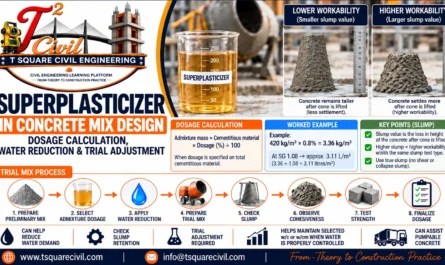
Superplasticizer Quantity
The proposed admixture dosage is 0.8% of cement mass.
Admixture = 0.8% × 240
Admixture = 1.92 kg/m³
Volume of admixture:
= 1.92 ÷ (1.07 × 1000)
= 0.00179 m³
The actual dosage must follow the manufacturer’s data sheet and trial results.
Any water contained in the liquid admixture must be considered when calculating effective free water.
Coarse and Fine Aggregate Proportion
For 20 mm angular aggregate, Zone II sand and a water–cement ratio of 0.50, the coarse-aggregate fraction is taken as 0.62.
The selected water–cement ratio is 0.60, which is 0.10 higher than 0.50.
Adjustment:
0.01 × (0.10 ÷ 0.05) = 0.02
Corrected coarse-aggregate fraction:
0.62 − 0.02 = 0.60
For pumpable concrete, the coarse-aggregate quantity may need to be reduced depending on the pumping arrangement and aggregate grading.
If a 10% reduction is required for pumpability and is supported by trial results, the coarse-aggregate fraction becomes 0.54 i.e.
0.60 × 0.90 = 0.54
For this example, the trial-adopted coarse-aggregate fraction is:
Coarse aggregate fraction = 0.57
Fine-aggregate fraction:
1.00 − 0.57 = 0.43
The value 0.57 is a trial value. It is not a universal code value and must be checked through trial mixing.
Absolute-Volume Calculation
Volume of Cement
240 ÷ (3.15 × 1000) = 0.07619 m³
Volume of Water
141.96 ÷ 1000 = 0.14196 m³
Volume of Superplasticizer
1.92 ÷ (1.07 × 1000) = 0.00179 m³
Volume of Entrapped Air
For normal, non-air-entrained concrete with a 20 mm nominal maximum aggregate size:
Entrapped air = 1.0% by volume of concrete
Volume of air:
1.0/100 × 1 = 0.010 m³
Volume of Total Aggregate
Volume of total aggregate:
= 1 − (Volume of cement + Volume of water + Volume of superplasticizer + Volume of entrapped air)
= 1 − (0.07619 + 0.14196 + 0.00179 + 0.010)
= 0.77006 m³
Coarse Aggregate Calculation
Total Coarse Aggregate Volume
= 0.77006 × 0.57
= 0.43893 m³
20 mm Aggregate
= 0.43893 × 0.50 × 2.69 × 1000
= 590.4 kg/m³
Adopt:
20 mm aggregate = 590 kg/m³
12.5 mm Aggregate
= 0.43893 × 0.50 × 2.67 × 1000
= 585.97 kg/m³
Adopt:
12.5 mm aggregate = 586 kg/m³
Fine Aggregate Calculation
Volume of fine aggregate:
= 0.77006 × 0.43
= 0.33113 m³
Quantity of fine aggregate:
= 0.33113 × 2.57 × 1000
= 850.99 kg/m³
Adopt:
Crushed stone sand = 851 kg/m³
Moisture Correction
The calculated aggregate quantities are based on saturated surface-dry condition.
Before batching:
- Test the moisture content of each aggregate.
- Deduct water contributed by wet aggregates.
- Add correction water when aggregates are drier than SSD condition.
- Check fine-aggregate moisture separately because sand can hold a significant amount of surface water.
- Do not add water at the site without checking the effective water–cement ratio.
For example, if the sand contains 2% free surface moisture:
Water contributed = 851 × 0.02
Water contributed = 17.02 litres
This water must be considered when deciding the amount of water added at the mixer.
Trial Mix and Quality Control
This calculation is a starting proportion, not a final site approval.
Carry out the following checks:
- Test aggregate moisture before batching.
- Apply moisture corrections.
- Batch the materials accurately.
- Measure slump and confirm the target workability.
- Check bleeding, segregation and cohesiveness.
- Check pumpability if the concrete is pumped.
- Measure fresh-concrete density.
- Cast concrete cubes.
- Record 7-day and 28-day strengths.
- Adjust the mix only after reviewing the trial results.
The final mix should be approved only after it satisfies the required strength, durability, workability and quality-control requirements.
Practical Site Notes
- The 240 kg/m³ cement content is applicable only to the stated plain-concrete basis.
- This mix must not be used as a moderate-exposure RCC mix.
- The actual water–cement ratio is approximately 0.59.
- The 28% water reduction must be confirmed by trial.
- Admixture dosage depends on cement compatibility.
- Aggregate moisture must be checked before production.
- The mix must be revised if the material source or grading changes.
- No extra water should be added without technical approval.
Frequently Asked Questions
Is 240 kg/m³ cement acceptable for M20 concrete?
It is acceptable for the plain-concrete moderate-exposure condition used in this example, provided the project specification permits it and the trial mix achieves the required performance.
Can this mix be used for moderate-exposure RCC?
No. Moderate-exposure RCC requires at least M25 grade, 300 kg/m³ minimum cement and a maximum water–cement ratio of 0.50 under the IS 456:2000 basis.
Why is the water quantity 142 litres?
The calculation starts with 186 litres at 50 mm slump, increases it by 6% for a 100 mm slump and then applies an assumed 28% reduction from the superplasticizer trial.
Is the 0.57 coarse-aggregate fraction mandatory?
No. It is the trial value used in this example. The final value must be confirmed by actual trial mixing and pumpability checks.
Can this mix be used directly at the construction site?
No. Moisture correction, slump testing, trial batching and cube testing are required before production use.
Related Articles
- M25 Concrete Mix Design as per IS 10262:2019:
https://tsquarecivil.com/mix-design-of-m25-grade-of-concrete/
2. Concrete Mix Design Approval and Production Control:
https://tsquarecivil.com/concrete-mix-design-approval-production-control/
3. Concrete Mix Design hubhttps://tsquarecivil.com/concrete-technology/concrete-mix-design/
4. Concrete Mix Design Calculatorhttps://tsquarecivil.com/concrete-mix-design-calculator-as-per-is-10262-2019/
Technical Disclaimer
The information in this article is provided for educational purposes only. This worked example must be verified using current material test results, laboratory trial mixes and project specifications before construction use. It is not a substitute for approval by the responsible engineer.
Read the complete T Square Civil Engineering Disclaimer.
References
- IS 10262:2019, Concrete Mix Proportioning – Guidelines.
- IS 456:2000, Plain and Reinforced Concrete – Code of Practice.
- IS 383:2016, Coarse and Fine Aggregate for Concrete.
- IS 9103:1999, Specification for Concrete Admixtures.
- Relevant parts of IS 516 for concrete strength testing.