 by
by Page Contents
Introduction
Dry Lean Concrete, commonly called DLC, is a low-cement, low-moisture concrete used mainly as a sub-base below Pavement Quality Concrete (PQC) in rigid pavement construction.
Unlike conventional concrete, DLC is not designed for high slump or easy flow.
Its performance depends mainly on:
- aggregate grading;
- cementitious content;
- optimum moisture;
- compaction;
- density;
- early-age strength;
- trial-length performance.
The basic sequence is:
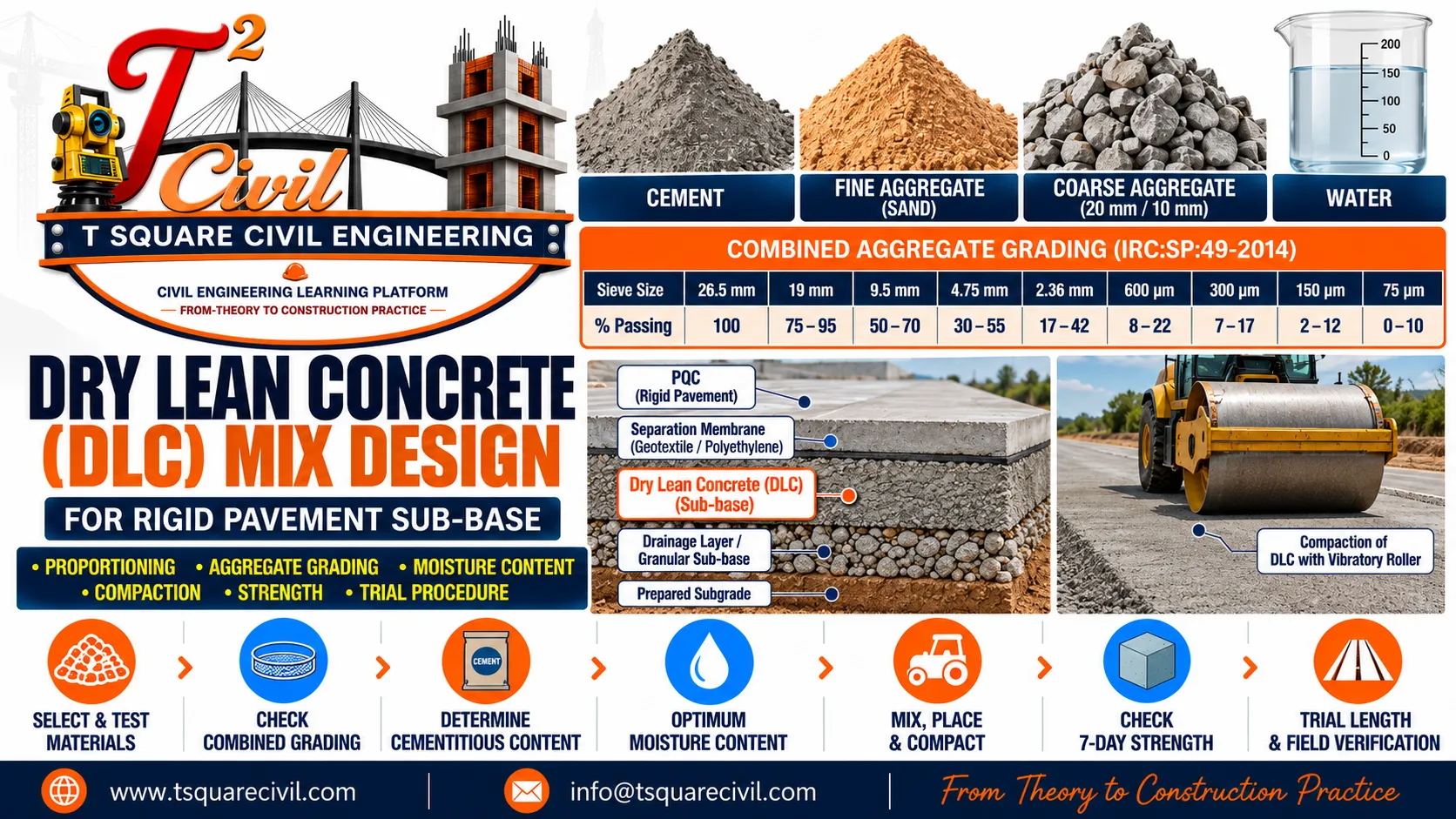
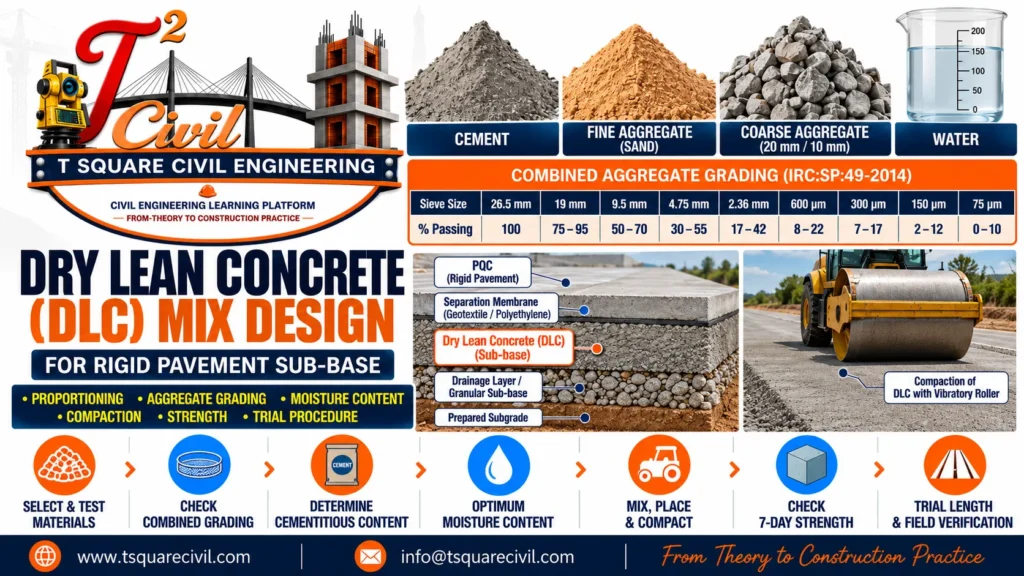
Select Materials → Check Combined Grading → Choose Cementitious Content → Determine Optimum Moisture → Prepare Trial Mixes → Check Density → Check 7-Day Strength → Construct Trial Length → Approve Production Mix
IRC:SP:49-2014 remains listed in the Indian Roads Congress catalogue as the guideline for use of DLC as sub-base for rigid pavement.
For related proportioning concepts, visit the Concrete Mix Design Hub.
What Is Dry Lean Concrete?
Dry Lean Concrete is a low-workability concrete containing:
- cementitious material;
- fine aggregate;
- coarse aggregate;
- water.
Its water content is kept low enough to permit effective rolling and compaction without producing a flowing conventional concrete.
Fresh DLC usually appears more like a damp granular concrete mixture than normal slump concrete.
It is typically:
- spread mechanically;
- compacted using vibratory rollers;
- finished as a dense sub-base;
- overlaid by PQC after the required curing period.
Main Purpose of DLC
DLC is used primarily to provide a:
- firm and uniform support layer;
- stable base below PQC;
- working platform for paving equipment;
- load-distributing sub-base;
- separation layer between PQC and lower pavement layers.
For major highway works, DLC is normally part of the rigid-pavement system rather than a structural slab itself.
DLC vs Lean Concrete
Lean concrete and DLC are not the same material.
| Parameter | Lean Concrete | Dry Lean Concrete |
|---|---|---|
| Typical Application | PCC, blinding, levelling | Rigid pavement sub-base |
| Workability | Conventional low workability | Very low workability |
| Moisture | Normal concrete-type water control | Optimum moisture-based |
| Placement | Conventional placing | Mechanical spreading |
| Compaction | Vibrator/tamping | Vibratory roller |
| Main Control | Grade and workability | Density, moisture and strength |
| Trial Method | Conventional trial mix | Moisture-density + trial length |
Governing Indian Guidance
IRC:SP:49-2014 is specifically titled:
Guidelines for the Use of Dry Lean Concrete as Sub-base for Rigid Pavement
It covers:
- DLC width and thickness;
- materials;
- aggregate grading;
- compressive strength;
- mix proportioning;
- trial mixes;
- construction;
- compaction;
- curing;
- trial length;
- quality control.
Recommended DLC Thickness
IRC:SP:49-2014 states that actual thickness should follow pavement design.
It recommends:
- minimum 150 mm for major State Highway and National Highway projects;
- 100 mm for other roads where DLC is adopted as sub-base.
Therefore:
150 mm is not a universal thickness for every DLC pavement.
The approved pavement design should govern.
DLC Width Beyond PQC Edge
IRC:SP:49 recommends extending DLC beyond the pavement edge to provide support and facilitate paving operations.
The guideline specifies:
- about 500 mm beyond the pavement edge for mechanized paving;
- about 200 mm offset for semi-mechanized or manual construction.
Materials Used in DLC
Typical DLC ingredients are:
- cement;
- fine aggregate;
- coarse aggregate;
- water;
- approved mineral admixtures where permitted.
The materials should satisfy the applicable project and standard requirements.
Cement for DLC
IRC:SP:49 permits approved use of:
- Ordinary Portland Cement;
- Portland Pozzolana Cement;
- Portland Slag Cement.
The final cement type should comply with the contract specification.
Mineral Admixtures
IRC:SP:49 allows mineral admixtures in specified proportions.
It permits:
- fly ash: 15–30% of total cementitious material;
- GGBS: 25–50% of total cementitious material,
with OPC content not less than 100 kg/m³ where these replacements are used under the guideline.
Do not apply these percentages automatically where a project specification provides different limits.
Fine Aggregate
Fine aggregate may consist of:
- natural sand;
- crushed stone sand;
- a combination of both.
It should comply with applicable grading and quality requirements.
Coarse Aggregate
IRC:SP:49 specifies clean, hard, strong and durable coarse aggregate.
Important limits include:
- maximum coarse aggregate size: 26.5 mm;
- aggregate water absorption: not more than 3%.
Combined Aggregate Grading
The combined aggregate grading is especially important because DLC contains relatively little cement paste.
IRC:SP:49 gives the following combined grading:
| Sieve Size | Percentage Passing |
|---|---|
| 26.5 mm | 100 |
| 19.0 mm | 75–95 |
| 9.5 mm | 50–70 |
| 4.75 mm | 30–55 |
| 2.36 mm | 17–42 |
| 600 µm | 8–22 |
| 300 µm | 7–17 |
| 150 µm | 2–12 |
| 75 µm | 0–10 |
These values should be checked for the combined aggregate, not each individual stockpile separately.
Why Combined Grading Is Critical
Because DLC has low paste content, poor grading may result in:
- open texture;
- segregation;
- low density;
- poor rolling behaviour;
- insufficient strength.
The aggregate skeleton carries much of the performance.
Therefore:
Good DLC begins with good combined aggregate grading.
Maximum Aggregate-Cement Ratio
IRC:SP:49 specifies a maximum aggregate-to-cement ratio of:
- 14:1 when OPC is used;
- 12:1 when PPC or PSC is used.
This is a mass ratio, not a volumetric site ratio.
Minimum Cementitious Content
IRC:SP:49 specifies:
minimum cementitious material = 140 kg/m³
If this content does not achieve the required strength, it should be increased.
However, MoRTH road specifications and individual highway contracts may use more stringent cement-content and strength requirements, so the project specification must always be checked before finalizing the DLC mix.
Important Strength Requirement Difference
This point is very important.
IRC:SP:49-2014 specifies:
- average strength of each consecutive group of 5 cubes at 7 days: not less than 7 MPa;
- individual cube strength at 7 days: not less than 5.5 MPa.
However, MoRTH road specifications commonly specify a higher DLC requirement:
- group average at 7 days: not less than 10 MPa;
- individual cube: not less than 7.5 MPa. This higher requirement is also reflected in NHAI project documentation.
Therefore:
Do not assume one universal DLC strength requirement.
Use the governing contract / MoRTH / project specification.
Why DLC Is Designed at 7 Days
DLC is normally intended to provide early support for rigid pavement construction.
Therefore, early strength is important.
The 7-day result is commonly used for:
- acceptance;
- construction sequencing;
- verification of mix adequacy.
DLC Does Not Use Conventional Slump Control
A conventional slump test is not the main control for DLC because the mix is intentionally very dry.
The key fresh-state parameter is:
moisture content required for maximum practical density under compaction.
Therefore:
DLC Mix Design ≠ Slump-Based Mix Design
Step 1 – Select Aggregate Combination
Select the available:
- coarse aggregate fractions;
- fine aggregate;
- manufactured sand where permitted.
Calculate the combined grading.
Adjust the fractions until the combined grading falls within the required limits.
Example – Combined Aggregate Blend
Suppose trial stockpiles are:
- 20 mm aggregate;
- 10 mm aggregate;
- crushed sand;
- natural sand.
A preliminary trial blend may be:
- 20 mm = 40%;
- 10 mm = 20%;
- crushed sand = 25%;
- natural sand = 15%.
These numbers are only an illustrative starting point.
The final blend must be based on actual sieve-analysis results.
Step 2 – Select Cementitious Content
Begin with a cementitious content that satisfies the applicable minimum requirement.
Under IRC:SP:49:
minimum = 140 kg/m³
subject to the strength requirement.
If the governing MoRTH or contract specification requires a higher minimum, use that value.
Step 3 – Check Aggregate-Cement Ratio
Suppose:
Total aggregate = 1960 kg/m³
Cement = 140 kg/m³
Aggregate-cement ratio:
1960 ÷ 140 = 14.0
Therefore:
A/C = 14:1
This corresponds to the maximum IRC:SP:49 limit for OPC.
If the same aggregate quantity were used with PPC/PSC, a 12:1 maximum ratio would require more binder.
Step 4 – Prepare Trial Moisture Contents
IRC:SP:49 recommends preparing trial mixes at moisture contents of:
- 5.0%
- 5.5%
- 6.0%
- 6.5%
- 7.0%
of the total material mass.
The purpose is to determine the moisture content that gives the highest practical compacted density.
Example – Moisture Quantity
Suppose total dry material mass is:
2400 kg/m³
At:
5.5% moisture
required total water is approximately:
2400 × 0.055
= 132 kg/m³
At:
6.0% moisture
water becomes:
144 kg/m³
These are trial values.
The final water is selected from the moisture-density relationship and field trial.
Step 5 – Correct for Aggregate Moisture
The calculated moisture percentage refers to the total required moisture in the mixture.
If the aggregate already contains moisture, the separately added water should be reduced accordingly.
For example:
Required water:
132 kg/m³
Existing free moisture from aggregate:
20 kg/m³
Separately added water:
132 − 20 = 112 kg/m³
This maintains the intended total moisture.
See Moisture Correction in Concrete Mix Design.
Step 6 – Prepare Moisture-Density Trials
For each trial moisture level:
- batch the materials;
- mix uniformly;
- compact specimens using the specified method;
- determine compacted density.
Plot:
Moisture Content vs Dry Density
The moisture corresponding to maximum dry density becomes the initial optimum moisture content.
Why Optimum Moisture Matters
Too little water may produce:
- poor particle lubrication;
- inadequate compaction;
- low density;
- segregation;
- open surface.
Too much water may cause:
- material movement under the roller;
- heaving;
- sticking to roller drums;
- instability during compaction.
IRC:SP:49 explicitly warns against both conditions.
Step 7 – Prepare Strength Specimens
After establishing optimum moisture, prepare strength specimens.
IRC:SP:49 specifies a set of six cubes for determination of:
- 3-day strength;
- 7-day strength.
The cubes should be compacted using the specified vibratory-hammer method rather than conventional high-slump cube-casting assumptions.
Why Cube Compaction Is Different for DLC
DLC is too dry for normal rod compaction used for workable concrete.
Laboratory compaction should simulate field densification as closely as practical.
IRC:SP:49 specifies use of a special vibratory hammer for specimen compaction.
Step 8 – Check 7-Day Strength
Compare the 7-day results with the governing requirement.
Under IRC:SP:49
Group average:
≥ 7 MPa
Individual cube:
≥ 5.5 MPa
Under MoRTH-type Highway Specification
Group average:
≥ 10 MPa
Individual cube:
≥ 7.5 MPa
The project specification should decide which requirement applies.
Step 9 – Adjust Cement if Strength Is Low
If strength is below the required value:
- verify moisture;
- verify compaction;
- verify aggregate grading;
- check cement quality;
- increase cementitious content where necessary.
Do not increase water merely to improve mixing.
More water may reduce final density.
Step 10 – Construct Trial Length
A laboratory mix is not sufficient for full DLC approval.
A field trial section should demonstrate:
- spreading;
- moisture suitability;
- roller response;
- compaction;
- density;
- surface texture;
- thickness;
- segregation;
- construction sequence.
IRC:SP:49 requires trial-length construction before finalizing the regular work.
Why Trial Length Is Essential
Laboratory compaction and field rolling are not identical.
The trial length helps establish:
- number of roller passes;
- vibration settings;
- rolling sequence;
- practical moisture;
- field density;
- surface finish.
Step 11 – Verify Bottom Surface
IRC:SP:49 requires checking the hardened trial section to identify segregation or honeycombing at the lower surface.
If segregation is observed, adjust:
- aggregate grading;
- mix proportions;
- moisture;
- construction method.
This is important because the top surface alone may look satisfactory even when the bottom is poorly compacted.
Step 12 – Establish Reference Density
The approved trial section provides the reference density for production control.
Routine DLC should then be compared against that approved reference.
The objective is consistent compaction rather than simply counting roller passes.
DLC Compaction
Typical compaction uses:
- paver/tamping action for initial densification;
- vibratory roller for main compaction;
- finishing passes as required.
Rolling should continue until the required density and surface condition are achieved.
Signs of Too Little Moisture
Possible signs include:
- dry open texture;
- aggregate segregation;
- insufficient roller densification;
- loose edges;
- low density;
- low strength.
Signs of Too Much Moisture
Possible signs include:
- pumping/heaving under rollers;
- material sticking to roller drums;
- unstable surface;
- rutting or deformation.
Field Moisture Adjustment
IRC:SP:49 permits approximately 1% higher moisture during main carriageway laying to compensate for evaporation during transport, where appropriate.
This should not be interpreted as permission for uncontrolled water addition.
The field moisture should remain within the approved trial-based procedure.
Day-to-Day Aggregate Moisture
Natural aggregate moisture should be checked regularly.
IRC:SP:49 specifically calls for determination of aggregate moisture on a day-to-day basis so that the DLC moisture can be adjusted.
This is especially important after:
- rainfall;
- stockpile watering;
- hot weather;
- material-source changes.
Transportation of DLC
DLC should be transported with minimum delay and protected from excessive moisture loss.
Long transport time may alter:
- field moisture;
- workability;
- compaction response.
The moisture selected in the laboratory may therefore require field verification through the trial section.
DLC Placement
The prepared drainage/sub-base layer should be:
- stable;
- properly graded;
- free from soft spots;
- at correct level;
- approved before DLC placement.
DLC should not be used to compensate for a poorly prepared lower layer.
Drainage Layer Below DLC
IRC:SP:49 requires a drainage layer below the DLC sub-base to facilitate water removal. Law Resource
The rigid-pavement system should therefore be considered as a complete pavement structure, not only PQC plus DLC.
Surface Level and Thickness Control
The DLC surface should satisfy specified:
- line;
- level;
- crossfall;
- thickness;
- surface regularity.
IRC:SP:49 gives a thickness tolerance of:
±10 mm.
Project specifications may impose additional tolerances.
Curing of DLC
DLC requires curing after compaction.
Curing should begin promptly and prevent excessive moisture loss.
The method should follow:
- IRC provisions;
- project specification;
- approved method statement.
Separation Between DLC and PQC
In many rigid pavement systems, a separation layer or membrane is provided between DLC and PQC.
Its functions may include:
- reducing bond;
- accommodating relative movement;
- preventing loss of PQC paste into the DLC surface.
The exact material and thickness should follow the pavement specification.
DLC Is Not PQC
This distinction is fundamental.
DLC
Designed mainly for:
- support;
- density;
- sub-base performance;
- early compressive strength.
PQC
Designed mainly for:
- pavement structural capacity;
- flexural strength;
- fatigue resistance;
- surface performance.
DLC should never be designed using PQC requirements.
Example DLC Trial Calculation
Assume:
Total dry material = 2400 kg/m³
Cementitious material = 160 kg/m³
Aggregate:
2400 − 160 = 2240 kg/m³
Aggregate-cementitious ratio:
2240 ÷ 160
= 14.0
Trial moisture:
5.5%
Water:
2400 × 0.055
= 132 kg/m³
This may be a reasonable trial starting point where the governing aggregate-cement ratio and specification permit it.
It is not a universal DLC mix.
The final design depends on:
- grading;
- cement type;
- required strength;
- moisture-density relation;
- trial section.
Example Trial Moisture Table
| Trial | Moisture Content | Dry Density |
|---|---|---|
| A | 5.0% | ___ kg/m³ |
| B | 5.5% | ___ kg/m³ |
| C | 6.0% | ___ kg/m³ |
| D | 6.5% | ___ kg/m³ |
| E | 7.0% | ___ kg/m³ |
Plot the results and identify the moisture content corresponding to maximum density.
Example Strength Record
| Cube | 3-Day Strength | 7-Day Strength |
|---|---|---|
| 1 | ___ MPa | ___ MPa |
| 2 | ___ MPa | ___ MPa |
| 3 | ___ MPa | ___ MPa |
| 4 | ___ MPa | ___ MPa |
| 5 | ___ MPa | ___ MPa |
| 6 | ___ MPa | ___ MPa |
The final acceptance criterion must follow the governing specification.
DLC Quality-Control Record
A practical record may include:
| Parameter | Result |
|---|---|
| Cement Type | ___ |
| Cementitious Content | ___ kg/m³ |
| Aggregate-Cement Ratio | ___ |
| 26.5 mm Passing | ___ % |
| 19 mm Passing | ___ % |
| 9.5 mm Passing | ___ % |
| 4.75 mm Passing | ___ % |
| 2.36 mm Passing | ___ % |
| 600 µm Passing | ___ % |
| 300 µm Passing | ___ % |
| 150 µm Passing | ___ % |
| 75 µm Passing | ___ % |
| Optimum Moisture | ___ % |
| Maximum Dry Density | ___ kg/m³ |
| Field Moisture | ___ % |
| Field Density | ___ kg/m³ |
| 7-Day Strength | ___ MPa |
| Layer Thickness | ___ mm |
| Remarks | ___ |
Recommended DLC Mix-Design Workflow
Confirm Pavement Design
↓
Confirm Governing IRC/MoRTH Specification
↓
Select Cementitious System
↓
Select Aggregate Fractions
↓
Check Combined Grading
↓
Select Initial Cementitious Content
↓
Check Aggregate-Cement Ratio
↓
Prepare 5.0–7.0% Moisture Trials
↓
Determine Maximum Density & Optimum Moisture
↓
Prepare Strength Cubes
↓
Check 3-Day & 7-Day Strength
↓
Adjust Binder if Required
↓
Construct Trial Length
↓
Establish Roller Pattern & Reference Density
↓
Check Bottom Surface for Segregation
↓
Approve Mix & Construction Procedure
↓
Begin Production
Common DLC Mix-Design Mistakes
Treating DLC Like Ordinary PCC
DLC is controlled by moisture-density-compaction behaviour, not conventional slump.
Using a Fixed Mix Ratio
There is no universal DLC ratio suitable for every aggregate and project.
Ignoring Combined Aggregate Grading
Poor grading can prevent satisfactory compaction even with adequate cement.
Adding Excess Water
Too much moisture can make the mix unstable under rollers.
Using Too Little Water
Insufficient moisture produces low density and open texture.
Ignoring Aggregate Moisture
Existing stockpile moisture is part of total DLC moisture.
Checking Strength Without Checking Density
Low density may indicate poor compaction even if one strength result appears satisfactory.
Using Laboratory Results Without Trial Length
Field roller behaviour must be demonstrated.
Assuming 7 MPa or 10 MPa Is Universal
The governing specification must be checked.
Assuming 150 mm Thickness Everywhere
Thickness should come from the approved pavement design.
Frequently Asked Questions
What Is Dry Lean Concrete?
DLC is a low-cement, low-moisture concrete used mainly as a sub-base below PQC in rigid pavements.
Which Guideline Covers DLC in India?
IRC:SP:49-2014 provides guidelines for DLC as a rigid-pavement sub-base.
What Is the Maximum Aggregate Size for DLC?
IRC:SP:49 specifies a maximum coarse aggregate size of 26.5 mm.
What Is the Minimum Cementitious Content?
IRC:SP:49 specifies 140 kg/m³, but MoRTH/project specifications may require a higher value.
What Is the Aggregate-Cement Ratio for DLC?
IRC:SP:49 limits it to:
- 14:1 for OPC
- 12:1 for PPC or PSC.
What Moisture Content Is Used for DLC Trials?
IRC:SP:49 recommends trials at:
5.0, 5.5, 6.0, 6.5 and 7.0% total moisture.
What Is the 7-Day Strength Requirement for DLC?
It depends on the governing specification.
IRC:SP:49 gives 7 MPa group average and 5.5 MPa individual minimum, while MoRTH highway specifications commonly require 10 MPa average and 7.5 MPa individual minimum.
Is Slump Tested for DLC?
Conventional slump is generally not the primary DLC control because the mixture is intentionally very dry.
How Is DLC Compacted?
It is normally mechanically spread and compacted using vibratory rolling equipment.
Why Is a Trial Length Required?
It verifies field moisture, roller passes, density, segregation, thickness and construction procedure.
Can Fly Ash Be Used in DLC?
Yes, where permitted by the governing specification. IRC:SP:49 includes provisions for fly ash replacement.
Can GGBS Be Used in DLC?
Yes, where permitted and verified by trials. IRC:SP:49 includes provisions for GGBS.
Is DLC the Same as Lean Concrete?
No. Lean concrete is a broader low-cement concrete category, whereas DLC is primarily a very-low-workability pavement sub-base material.
Is DLC Structural Concrete?
DLC mainly performs as a pavement sub-base and should not be treated as structural PQC.
What Is the Recommended DLC Thickness?
IRC:SP:49 recommends 150 mm for major SH/NH projects and 100 mm for other roads, subject to pavement design.
Related Concrete Mix Design Resources
Concrete Mix Design Troubleshooting
Moisture Correction in Concrete Mix Design
Combined Coarse Aggregate Grading
Concrete Mix Design Approval and Production Control
Concrete Batching Plant Calibration
Conclusion
Dry Lean Concrete is not simply low-grade concrete with less water.
Its performance depends on the complete system:
Aggregate Grading + Cementitious Content + Optimum Moisture + Mechanical Compaction + Density + 7-Day Strength + Trial-Length Verification
The correct design approach is:
Check Specification → Blend Aggregates → Select Binder → Determine Moisture-Density Relation → Check Strength → Construct Trial Length → Establish Field Compaction → Approve Production
The most important principles are:
DLC ≠ Conventional Slump Concrete
More Water ≠ Better DLC
Low Cement ≠ Poor Control
Laboratory Density ≠ Automatic Field Density
Trial Mix ≠ Trial Length
One Strength Limit Does Not Apply to Every Project
For highway works in particular, always verify whether the governing requirement is IRC:SP:49, MoRTH Specifications, the contract specification, or a combination of them before finalizing cement content, strength criteria and acceptance limits.
Engineering Note: IRC:SP:49-2014 remains listed by IRC as the guideline for DLC sub-base construction, but project specifications may impose stricter MoRTH-type requirements. Use the governing contract documents for final acceptance criteria.