 by
by Page Contents
Introduction
Lean concrete is concrete containing a relatively low quantity of cementitious material compared with the total quantity of aggregate.
It is commonly used where the main purpose is to provide:
- a clean and level working surface;
- separation between structural concrete and soil;
- a firm base below foundations;
- blinding concrete;
- levelling courses;
- non-structural filling;
- bedding or similar low-strength applications.
Lean concrete should not be confused with poorly controlled concrete.
Although the cement content is relatively low, the concrete still needs correct:
- material selection;
- aggregate grading;
- water control;
- batching;
- mixing;
- placing;
- compaction;
- curing.
Typical low grades such as M5, M7.5 and M10 may be specified for lean concrete depending on the application and project requirements.
However:
Lean Concrete ≠ One Universal Mix Ratio
The required grade, proportions and performance should always follow the drawing, specification and applicable standards.
For the overall proportioning process, visit the Concrete Mix Design Hub.
What Is Lean Concrete?
Lean concrete is a concrete mixture having a relatively high aggregate-to-cement ratio and comparatively low cementitious content.
The term describes the character of the mixture, not one particular grade.
Lean concrete is generally intended for applications where:
- high structural strength is not required;
- reinforcement is absent or not structurally relied upon;
- a firm, clean and uniform base is needed.
A typical lean concrete layer may be placed below structural RCC so that reinforcement and formwork are not placed directly on soil.
Why Is It Called “Lean” Concrete?
A concrete mix with more cement paste relative to aggregate is often described as a richer mix.
A mix containing less cement paste relative to aggregate is described as a leaner mix.
Therefore:
Rich Mix → Higher Paste/Cementitious Content
Lean Mix → Lower Paste/Cementitious Content
This terminology should not be interpreted to mean that lean concrete can be produced without engineering control.
Common Applications of Lean Concrete
Lean concrete may be used for:
- PCC below isolated footings;
- raft-foundation blinding;
- levelling below foundations;
- flooring base;
- pipe bedding where specified;
- trench bottom preparation;
- non-structural filling;
- equipment-foundation levelling;
- base preparation before waterproofing;
- separation between structural concrete and soil.
The actual grade and thickness should be taken from the approved structural drawing or project specification.
Lean Concrete vs PCC
The terms are often used interchangeably on construction sites, but they do not mean exactly the same thing.
PCC means Plain Cement Concrete, which is concrete without structural reinforcement.
PCC can be:
- lean concrete;
- normal-strength plain concrete;
- richer plain concrete.
Lean concrete describes the relatively low binder content of the mix.
Therefore:
Most Lean Concrete Used Below Foundations Is PCC
but:
Not Every PCC Mix Is Necessarily Lean Concrete
Lean Concrete vs Nominal Mix Concrete
Another common source of confusion is between:
lean concrete
and:
nominal mix concrete.
Lean concrete describes the relative richness of the mixture.
Nominal mix describes a method of specifying proportions using prescribed quantities instead of designing the mix from material-performance relationships.
IS 456 provides nominal-mix provisions for lower concrete grades.
A lean concrete mix may therefore be produced using:
- an approved nominal mix; or
- a designed/proportioned mix,
depending on the project requirements.
Common Lean Concrete Grades
Typical low grades that may be encountered include:
- M5;
- M7.5;
- M10.
Some projects may specify other grades.
The grade designation represents characteristic compressive strength at 28 days.
For example:
M10 → characteristic compressive strength = 10 N/mm² at 28 days
where the grade and strength criteria apply according to the relevant specification.
Important Note About M5, M7.5 and M10
M5, M7.5 and M10 should not automatically be selected simply because the work is called PCC.
The grade should be specified based on:
- function of the concrete;
- exposure;
- structural drawings;
- durability requirements;
- contract specifications.
Low-grade lean concrete should not replace structural concrete where higher strength or durability is required.
Nominal Mix Provisions in IS 456
IS 456:2000 Table 9 gives nominal mix provisions for grades from M5 to M20.
The table is specified primarily in terms of:
- maximum total dry aggregate per 50 kg of cement;
- fine-to-coarse aggregate proportion by mass;
- maximum water per 50 kg of cement.
For M5, M7.5 and M10:
| Grade | Maximum Total Dry Aggregate per 50 kg Cement | Maximum Water per 50 kg Cement |
|---|---|---|
| M5 | 800 kg | 60 L |
| M7.5 | 625 kg | 45 L |
| M10 | 480 kg | 34 L |
The fine-to-coarse aggregate proportion is generally around:
1 : 2 by mass
but may be adjusted approximately between:
1 : 1.5 and 1 : 2.5
depending on fine aggregate grading and nominal maximum aggregate size.
The values in the table are limits and proportioning guidance, not an instruction to use the maximum possible water in every batch.
Commonly Quoted Lean Concrete Ratios
At construction sites, the following conventional volume ratios are frequently quoted:
| Grade | Common Conventional Ratio |
|---|---|
| M5 | 1 : 5 : 10 |
| M7.5 | 1 : 4 : 8 |
| M10 | 1 : 3 : 6 |
where:
Cement : Fine Aggregate : Coarse Aggregate
However, an important distinction should be understood:
These convenient volumetric ratios are widely used conventional expressions, while IS 456 Table 9 specifies nominal mix primarily on a mass basis.
Therefore, do not present the conventional ratios as exact substitutes for proper batching and code compliance.
For further discussion, see Nominal Mix Proportions of Concrete.
Why Lean Concrete Still Needs Proper Proportioning
Because the cementitious content is low, lean concrete can become particularly sensitive to poor aggregate proportioning.
If the aggregate skeleton is poorly graded, the mix may become:
- harsh;
- difficult to compact;
- highly porous;
- segregated;
- difficult to finish.
Adding excess water to compensate can make the problem worse.
Good lean concrete relies heavily on:
properly graded aggregate + adequate paste + controlled water + proper compaction
Step 1 – Confirm the Required Concrete Grade
Do not decide the grade at site without approval.
Check:
- drawing;
- BOQ;
- specification;
- method statement.
For example:
Foundation blinding may be specified as:
M10 PCC
on one project, while another project may specify a different grade.
The specified project grade governs.
Step 2 – Identify the Purpose of the Lean Concrete
The required performance depends on the function.
Blinding Concrete
Main functions may include:
- providing a clean working surface;
- preventing soil contamination of structural concrete;
- creating a level base.
Levelling Concrete
Used to correct uneven excavation or provide the required founding level.
Bedding Concrete
May support pipes, drains or similar elements where specified.
Non-Structural Filling
Used where a concrete fill is required but high structural strength is unnecessary.
Understanding the application prevents unnecessarily rich or unnecessarily weak concrete.
Step 3 – Check Cement Requirements
The cement should comply with the applicable material specification.
Lean concrete should not contain excessive cement merely because more cement appears safer.
Excess cement can unnecessarily increase:
- cost;
- heat generation;
- shrinkage.
At the same time, cementitious content must not be reduced below the level needed to satisfy:
- specified grade;
- durability;
- cohesion;
- project requirements.
Step 4 – Select Fine Aggregate
Fine aggregate should have suitable:
- grading;
- cleanliness;
- particle shape;
- specific gravity;
- water absorption.
Natural sand or suitable manufactured sand may be used when permitted.
Poorly graded sand may increase the amount of paste required to fill voids.
See Fine Aggregate Grading Zones in Concrete Mix Design.
Step 5 – Select Coarse Aggregate
Common coarse aggregate sizes may include:
- 10 mm;
- 20 mm;
- 40 mm,
depending on:
- layer thickness;
- placing method;
- specification;
- available aggregate.
For many ordinary lean concrete works, 20 mm nominal maximum aggregate may be practical.
Larger aggregate may be economical in sufficiently thick and uncongested placements, but should not be selected blindly.
See Nominal Maximum Aggregate Size in Concrete Mix Design.
Why Aggregate Grading Is Important in Lean Concrete
Lean concrete contains relatively little cement paste.
The aggregate skeleton therefore becomes particularly important.
Well-graded aggregates help:
- reduce voids;
- improve compactability;
- reduce unnecessary paste demand;
- improve density;
- reduce harshness.
Poor grading can create a mix that looks dry even when the water content is already high.
The correct solution is not always more water.
Step 6 – Establish Fine-to-Coarse Aggregate Balance
For nominal mix concrete, the fine-to-coarse aggregate proportion should reflect:
- fine aggregate grading;
- coarse aggregate size.
IS 456 Table 9 gives general guidance around:
Fine Aggregate : Coarse Aggregate = 1 : 2 by mass
with adjustment between approximately:
1 : 1.5 and 1 : 2.5
according to material grading and maximum aggregate size.
This means there is no requirement that every lean concrete batch must use exactly the same sand-to-stone ratio.
Example – Effect of Aggregate Size
With relatively smaller coarse aggregate, a higher fine aggregate proportion may be needed to achieve suitable packing.
With larger coarse aggregate and finer sand, the optimum balance may shift toward a greater coarse aggregate fraction.
This is why aggregate proportion should follow actual grading rather than a memorized ratio alone.
Step 7 – Control Water Content
Water is one of the most frequently misused ingredients in lean concrete.
Because lean concrete may initially appear dry or harsh, workers sometimes add large quantities of water.
This can result in:
- excessive w/c;
- segregation;
- bleeding;
- lower strength;
- porous concrete;
- laitance.
The water quantity should therefore be the minimum required for satisfactory placing and compaction, while satisfying the specified concrete requirements.
Maximum Water Does Not Mean Required Water
For nominal mix concrete, the Table 9 water quantities are maximum values.
For example, M10 shows:
34 litres maximum water per 50 kg of cement
This does not mean every M10 lean concrete batch should automatically receive exactly 34 litres.
Actual water demand depends on:
- aggregate moisture;
- grading;
- particle shape;
- workability requirement;
- method of compaction.
Step 8 – Apply Moisture Correction
Suppose the fine aggregate contains surface moisture.
This water enters the concrete whether or not it comes through the batching water tank.
Therefore:
Total Effective Water = Added Water + Free Aggregate Moisture
If aggregate moisture is ignored, the actual w/c may increase significantly.
For complete calculations, see Moisture Correction in Concrete Mix Design.
Example – Sand Moisture Effect
Suppose the intended batch water is:
170 kg/m³
and wet sand introduces:
12 kg/m³ free water
If the full 170 kg/m³ is still added separately:
Actual effective water becomes:
170 + 12 = 182 kg/m³
This additional water may cause:
- excess slump;
- bleeding;
- lower strength.
Therefore, the separately added water should be adjusted for actual surface moisture.
Step 9 – Batch Materials Accurately
Prefer batching by:
mass
where appropriate plant/weighing facilities are available.
Site volume batching introduces variability due to:
- sand bulking;
- inconsistent box filling;
- moisture;
- loose/compacted condition.
If nominal site batching is permitted, it should still follow the approved specification and proper measurement procedure.
Do not use:
- random pans;
- half-filled buckets;
- loader-bucket estimates.
Step 10 – Mix Properly
Lean concrete should be mixed until the materials are uniformly distributed.
The mixture should not show:
- dry cement pockets;
- unmixed sand;
- localized coarse aggregate;
- excessive water pockets.
Mechanical mixing generally provides better consistency than uncontrolled hand mixing.
Step 11 – Check Workability
Lean concrete generally does not need the high workability required for congested reinforced concrete.
However, it must still be workable enough for:
- placement;
- spreading;
- compaction;
- finishing.
The required workability should suit the method of construction.
A stiff concrete that cannot be compacted properly may produce poor-quality lean concrete even if the theoretical water-cement ratio appears satisfactory.
Step 12 – Check for Harshness
Lean concrete can easily become harsh because of its low paste content.
Signs include:
- exposed coarse aggregate;
- poor cohesion;
- difficult spreading;
- difficulty obtaining a closed surface.
If the mix is harsh, investigate:
- aggregate grading;
- sand proportion;
- aggregate shape;
- paste volume.
Do not immediately increase water.
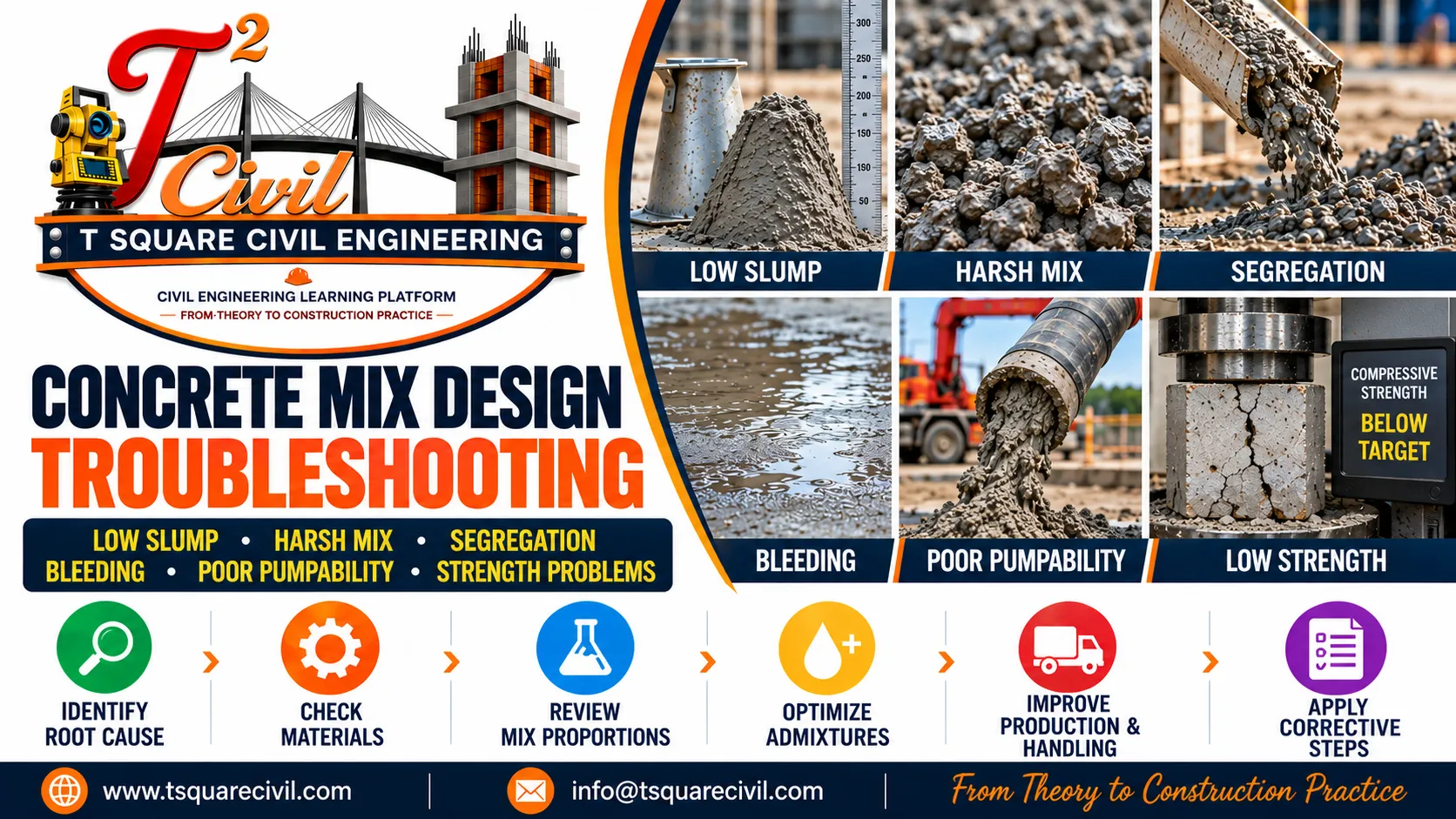
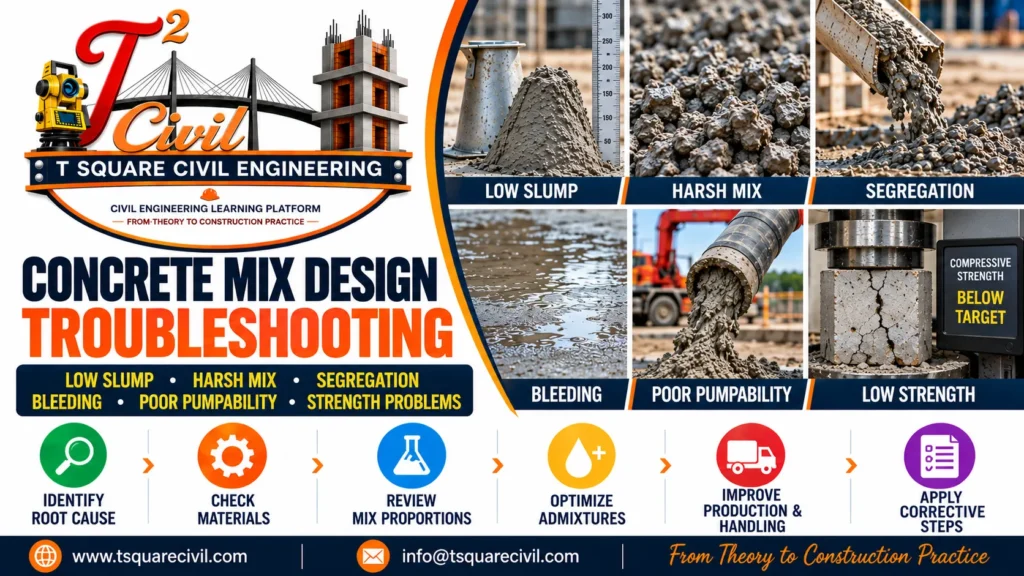
See Concrete Mix Design Troubleshooting.
Step 13 – Check Segregation
Lean concrete should remain reasonably uniform.
Segregation may occur when:
- too much water is added;
- aggregate grading is poor;
- coarse aggregate quantity is excessive;
- material is dropped or handled improperly.
Visible accumulation of stone with mortar flowing away from it indicates poor stability.
Step 14 – Prepare a Trial Mix Where Required
For controlled works, a trial batch should confirm that the proposed mix provides:
- required workability;
- adequate cohesion;
- satisfactory compaction;
- required strength;
- acceptable surface finish.
The trial should use the actual project materials.
See Concrete Trial Mix Procedure.
Example – Preliminary M10 Nominal Batch Basis
For M10 nominal mix under IS 456 Table 9:
Per 50 kg cement:
Maximum total dry aggregate:
480 kg
Maximum water:
34 L
If the selected fine-to-coarse aggregate ratio by mass is:
1 : 2
then total parts:
1 + 2 = 3
Fine aggregate:
480 × 1/3 = 160 kg
Coarse aggregate:
480 × 2/3 = 320 kg
Therefore, a preliminary nominal batch may be expressed as:
Cement = 50 kg
Fine Aggregate = 160 kg
Coarse Aggregate = 320 kg
Water ≤ 34 L
subject to:
- aggregate grading;
- moisture correction;
- required workability;
- project specification.
This example illustrates the actual mass-basis concept of Table 9.
Example – M7.5 Nominal Batch Basis
For M7.5:
Maximum dry aggregate:
625 kg per 50 kg cement
Assume preliminary fine-to-coarse aggregate ratio:
1 : 2
Fine aggregate:
625 × 1/3
≈ 208 kg
Coarse aggregate:
625 × 2/3
≈ 417 kg
Maximum water:
45 L
Preliminary batch:
Cement = 50 kg
Fine Aggregate ≈ 208 kg
Coarse Aggregate ≈ 417 kg
Water ≤ 45 L
Actual proportions should be adjusted where required for grading and moisture.
Example – M5 Nominal Batch Basis
For M5:
Maximum dry aggregate:
800 kg per 50 kg cement
At an assumed fine-to-coarse aggregate ratio of:
1 : 2
Fine aggregate:
800 × 1/3
≈ 267 kg
Coarse aggregate:
800 × 2/3
≈ 533 kg
Maximum water:
60 L
Preliminary batch:
Cement = 50 kg
Fine Aggregate ≈ 267 kg
Coarse Aggregate ≈ 533 kg
Water ≤ 60 L
Again, these are nominal-batch calculations, not universal site recipes.
Why We Should Not Convert Every Mix Into 1 m³ Using One Fixed Dry-Volume Factor
Many quantity calculations use a fixed dry-volume multiplier such as:
1.54
to estimate ingredients for concrete.
This can be useful for approximate quantity estimation.
However, it is not the best method for precise concrete proportioning because actual concrete volume depends on:
- material specific gravities;
- air;
- moisture;
- aggregate packing.
For accurate design calculations, use the appropriate absolute-volume method.
See Absolute Volume Method for Concrete Mix Design.
Lean Concrete With M-Sand
M-sand may be used where it satisfies the applicable fine aggregate requirements.
Check:
- grading;
- fines;
- specific gravity;
- absorption;
- moisture.
Because lean concrete has relatively low paste volume, a very angular or poorly graded M-sand may make the mixture excessively harsh.
See Manufactured Sand (M-Sand) in Concrete Mix Design.
Lean Concrete With Recycled Aggregate
Recycled concrete aggregate may be particularly relevant to lean concrete applications where permitted.
IS 383 provisions allow higher RCA utilization in certain lean concrete applications than in normal structural concrete, subject to the stated requirements.
However, RCA may have:
- higher absorption;
- lower specific gravity;
- attached mortar;
- variable moisture.
Therefore, it still requires proper testing and water correction.
See Recycled Aggregate Concrete Mix Design.
Lean Concrete Below Foundations
A blinding or levelling layer below a foundation may provide:
- clean working surface;
- accurate reinforcement cover reference;
- separation from soil;
- improved formwork setting;
- easier waterproofing preparation.
Its thickness and grade should come from the approved drawings.
Do not arbitrarily increase or reduce the thickness because the material is described as lean concrete.
Lean Concrete and Reinforcement Cover
Lean concrete placed below a footing does not replace the structural concrete cover requirement.
The structural cover should still be measured according to the reinforced-concrete design and applicable drawings.
Lean PCC simply creates a cleaner and more reliable base on which the structural work can be set out.
Compaction of Lean Concrete
Lean concrete should be compacted sufficiently to remove excessive entrapped voids.
Compaction method depends on:
- workability;
- layer thickness;
- accessibility.
Possible methods include:
- vibration;
- mechanical tamping;
- approved manual compaction for minor works.
Over-vibration of a very wet lean mix can increase segregation.
Surface Finishing
The required finish depends on what will be placed above it.
For foundation blinding, the surface should generally be sufficiently:
- level;
- stable;
- clean.
A highly decorative finish is normally unnecessary.
The important requirement is dimensional and functional suitability.
Curing of Lean Concrete
Lean concrete still contains cement and requires curing.
Do not assume that curing is unnecessary because the concrete is non-structural.
Proper curing helps:
- hydration;
- surface integrity;
- strength development;
- reduction of excessive drying.
The curing method and duration should follow the project specification and applicable concrete requirements.
Lean Concrete Quality Control
Depending on the work specification, QC may include:
- material checks;
- batching record;
- water control;
- workability observation/test;
- grade verification;
- cube testing where specified;
- level and thickness checks.
Not every small blinding pour will require the same level of testing as structural RCC, but the approved project QA/QC plan should govern.
Check Thickness During Placement
For lean concrete below foundations, thickness is often as important as concrete quantity.
Check:
- formation level;
- reference benchmarks;
- finished level;
- layer thickness.
Excessive thickness can increase quantity and cost.
Insufficient thickness may fail to satisfy the drawing.
Lean Concrete Quantity Example
Suppose a foundation blinding area is:
20 m × 10 m
and specified thickness is:
100 mm = 0.10 m
Concrete volume:
20 × 10 × 0.10
= 20 m³
Allowances for actual site conditions should follow the project quantity procedure.
The grade should still be taken from the approved specification.
Do Not Confuse Lean Concrete With Dry Lean Concrete
Lean concrete and Dry Lean Concrete (DLC) are different.
Conventional lean concrete may be mixed, placed and compacted similarly to ordinary low-grade concrete.
DLC is generally:
- very low workability;
- low water content;
- placed as a pavement sub-base;
- compacted mechanically, often using rollers.
We will cover DLC separately in the next article.
Do Not Confuse Lean Concrete With No-Fines Concrete
Lean concrete still normally contains:
- cement;
- fine aggregate;
- coarse aggregate;
- water.
No-fines concrete deliberately contains little or no fine aggregate to create interconnected voids.
They are fundamentally different materials.
Lean Concrete vs Dry Lean Concrete
| Parameter | Lean Concrete | Dry Lean Concrete |
|---|---|---|
| Typical Use | Blinding, PCC, levelling | Pavement sub-base |
| Consistency | Conventional low/workable consistency | Very low workability |
| Placement | Normal concrete methods | Paver/spreader-type methods |
| Compaction | Conventional compaction | Intensive mechanical/roller compaction |
| Main Control | Grade, water, placement | Moisture, density, compaction, strength |
| Application | General civil works | Primarily rigid pavement works |
This distinction prevents duplication between the two articles.
Common Mistakes in Lean Concrete
Assuming Lean Concrete Means Poor Concrete
Low cement content does not permit poor workmanship.
Using a Fixed 1:5:10, 1:4:8 or 1:3:6 Ratio Without Checking Specification
The project grade and batching basis should govern.
Treating Conventional Ratios as the Exact IS 456 Table
IS 456 Table 9 is primarily expressed on a mass basis.
Adding Excess Water Because the Mix Looks Dry
Harshness may result from aggregate grading rather than insufficient water.
Ignoring Sand Moisture
Surface moisture directly affects effective water.
Using Unmeasured Site Containers
This creates major batching variation.
Ignoring Aggregate Grading
Lean concrete has less paste to compensate for poor aggregate packing.
Making Lean Concrete Unnecessarily Rich
Excess cement increases cost without necessarily improving the required function.
Using Low-Grade Lean Concrete Where Structural Concrete Is Required
Lean concrete should never substitute for the specified structural grade.
Skipping Curing
Lean concrete still needs adequate curing.
Ignoring Level and Thickness
A correct mix placed at the wrong elevation or thickness is still defective work.
Recommended Lean Concrete Workflow
Check Drawing & Specification
↓
Confirm Application
↓
Confirm Grade
↓
Check Cement and Aggregates
↓
Check Aggregate Grading
↓
Select Fine/Coarse Aggregate Balance
↓
Establish Nominal or Designed Proportions
↓
Check Aggregate Moisture
↓
Determine Batch Water
↓
Prepare Trial Where Required
↓
Check Workability & Cohesion
↓
Place and Compact
↓
Check Level & Thickness
↓
Cure
↓
Verify Strength Where Specified
Lean Concrete Site Checklist
Before placement:
- Approved drawing available
- Grade confirmed
- Thickness confirmed
- Formation level approved
- Cement source approved
- Fine aggregate approved
- Coarse aggregate approved
- Aggregate grading acceptable
- Moisture checked
- Mixing equipment ready
- Batching method approved
During placement:
- Water controlled
- Mix uniform
- No segregation
- Proper compaction
- Correct thickness maintained
- Finished level checked
After placement:
- Surface protected
- Curing started
- Test samples taken where required
- Records completed
Frequently Asked Questions
What Is Lean Concrete?
Lean concrete is concrete containing a relatively low amount of cementitious material compared with aggregate and is commonly used for non-structural or base applications.
Is Lean Concrete the Same as PCC?
Not exactly. Lean concrete is often PCC, but PCC can also be of richer or higher-strength grades.
What Grades Are Commonly Used for Lean Concrete?
M5, M7.5 and M10 are commonly encountered low grades, but the actual grade should follow the project specification.
Is 1:5:10 an M5 Concrete Mix?
It is a commonly quoted conventional volume ratio associated with M5 nominal concrete, but IS 456 Table 9 specifies nominal proportions primarily using mass of aggregate and maximum water per 50 kg cement.
Is 1:4:8 Used for M7.5 Concrete?
It is a widely used conventional representation, but proper batching should follow the approved specification and applicable nominal-mix provisions.
Is 1:3:6 Used for M10 Concrete?
It is a commonly quoted conventional nominal ratio. The IS 456 Table 9 basis for M10 is 480 kg maximum total dry aggregate and 34 L maximum water per 50 kg cement.
What Is the Maximum Water for M10 Nominal Mix?
IS 456 Table 9 gives a maximum of 34 litres per 50 kg of cement, subject to other applicable requirements.
Does Maximum Water Mean We Must Use That Full Quantity?
No. It is an upper limit. Actual water should suit moisture condition, workability and other requirements.
Can Lean Concrete Be Used Below RCC Footings?
Yes, lean PCC is commonly specified as blinding or levelling below structural foundations where shown in the project drawings.
Does Lean Concrete Need Curing?
Yes. Cement hydration still requires adequate curing.
Does Lean Concrete Need Compaction?
Yes. Proper compaction is necessary to reduce excessive voids and obtain a uniform layer.
Can M-Sand Be Used in Lean Concrete?
Yes, where it complies with applicable aggregate requirements and produces satisfactory concrete.
Can Recycled Aggregate Be Used in Lean Concrete?
It may be used where permitted by the applicable standard and project specification after appropriate material testing.
Is Lean Concrete the Same as Dry Lean Concrete?
No. DLC is a very low-workability pavement sub-base concrete that is compacted mechanically and should be treated separately.
Should Lean Concrete Be Tested for Strength?
Where the specification defines a concrete grade or testing requirement, strength should be verified according to the approved QA/QC plan.
Related Concrete Mix Design Resources
Nominal Mix Proportions of Concrete
Concrete Mix Design Procedure as per IS 10262:2019
Absolute Volume Method for Concrete Mix Design
Nominal Maximum Aggregate Size
Moisture Correction in Concrete Mix Design
Manufactured Sand in Concrete Mix Design
Recycled Aggregate Concrete Mix Design
Concrete Mix Design Troubleshooting
Concrete Mix Design Approval and Production Control
Concrete Batching Plant Calibration
Conclusion
Lean concrete is an economical low-cement concrete used primarily where high structural strength is not required.
Its quality depends on more than simply choosing a traditional ratio such as:
1 : 5 : 10
1 : 4 : 8
or:
1 : 3 : 6
A better engineering approach is:
Confirm Grade → Check Materials → Control Aggregate Grading → Establish Proper Proportions → Correct Moisture → Control Water → Compact Properly → Cure → Verify Performance
The key principles are:
Lean Concrete ≠ Poor-Quality Concrete
Maximum Water ≠ Required Water
Conventional Ratio ≠ Complete Mix Specification
More Water ≠ Better Workability
More Cement ≠ Automatically Better Lean Concrete
A well-proportioned lean concrete mix should provide the required:
- grade;
- stability;
- compactability;
- level;
- thickness;
- economy.
For M5, M7.5 and M10 nominal mixes, IS 456 Table 9 provides useful mass-based proportioning limits, while actual project requirements should always govern the final grade, construction method and quality-control requirements.
Engineering Note: Lean concrete applications, grades and proportions should be selected from the approved drawing and project specification. Where durability, structural or exposure requirements demand a higher grade, low-grade lean concrete should not be substituted merely for economy.