
 by
by Target mean strength is one of the first important calculations in concrete mix design. A concrete mix is not proportioned merely to achieve the characteristic strength written in the grade designation. A higher design strength is used to provide a margin for the normal variation that occurs during concrete production and testing.
For example, M25 concrete has a specified characteristic compressive strength of 25 N/mm² at 28 days, but the concrete mix is designed for a target mean strength higher than 25 N/mm².
This article explains the target mean strength formula, standard deviation, the X value used in IS 10262:2019, grade-wise values from M10 to M60, and practical calculation examples.
For the complete concrete mix-design learning sequence, visit our Concrete Mix Design Hub.
Page Contents
What Is Target Mean Strength of Concrete?
Target mean strength is the average compressive strength for which a concrete mix is proportioned so that normal variations in production do not cause an unacceptable number of results to fall below the specified characteristic strength.
It is therefore normally higher than the characteristic compressive strength of the concrete grade.
For example:
- M20 → characteristic strength = 20 N/mm²
- M25 → characteristic strength = 25 N/mm²
- M30 → characteristic strength = 30 N/mm²
These values are not automatically the target mean strengths.
The target value must be calculated using the statistical provisions applicable to concrete mix proportioning.
Characteristic Strength vs Target Mean Strength
These two terms should not be confused.
| Parameter | Characteristic Strength | Target Mean Strength |
|---|---|---|
| Symbol | fck | f′ck |
| Meaning | Specified characteristic compressive strength | Strength used for mix proportioning |
| Used for | Concrete grade and structural requirements | Initial concrete mix design |
| Relative value | Lower | Normally higher than fck |
| Example for M25 | 25 N/mm² | Usually greater than 25 N/mm² |
The additional strength margin is required because concrete strength varies due to materials, batching, mixing, placing, compaction, curing and testing.
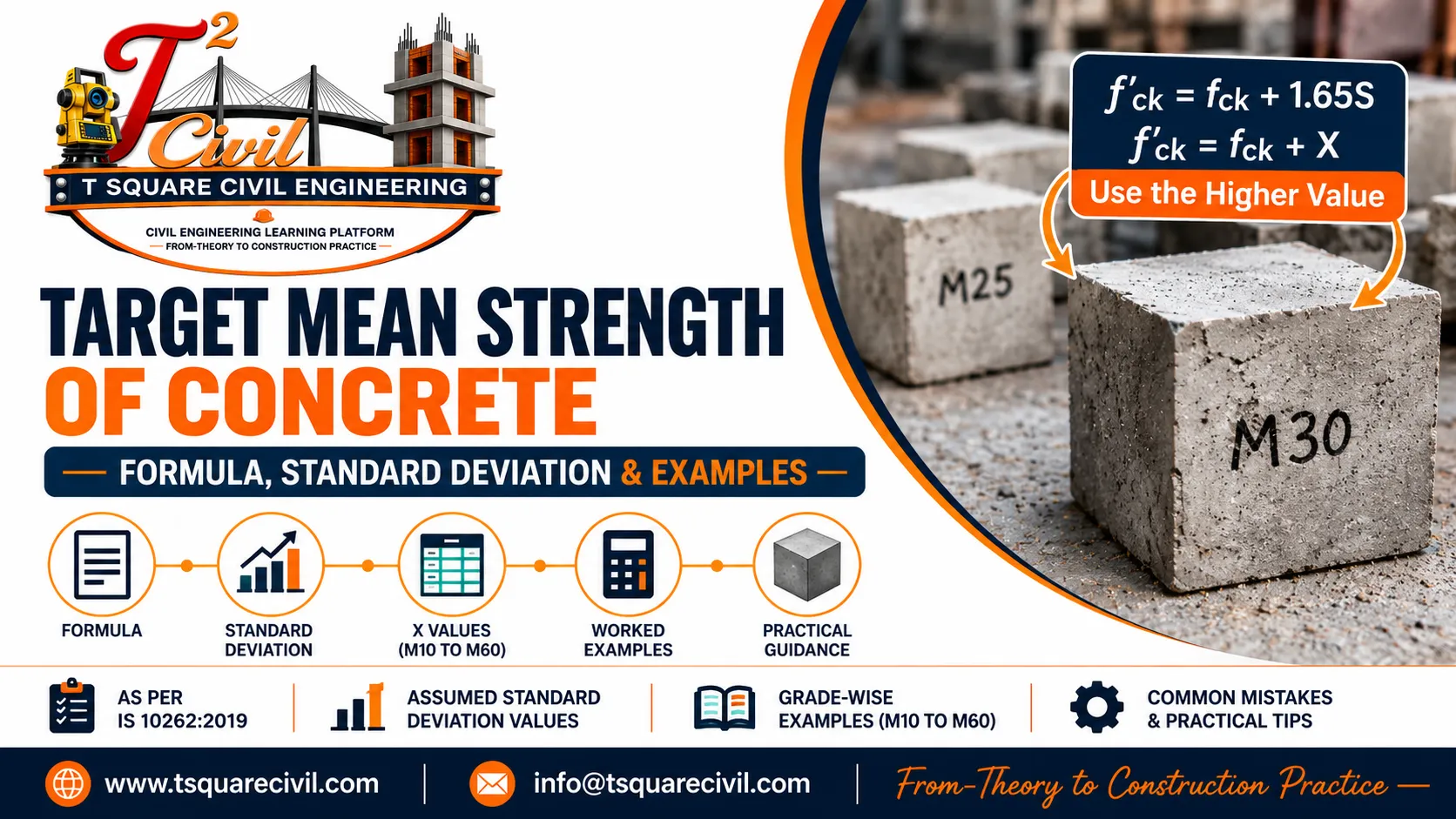
Target Mean Strength Formula as per IS 10262:2019
For concrete mix proportioning, calculate the target mean strength using both of the following expressions:
f′ck = fck + 1.65S
and
f′ck = fck + X
The higher of the two calculated values is adopted.
Where:
f′ck = target mean compressive strength at 28 days, N/mm²
fck = specified characteristic compressive strength at 28 days, N/mm²
S = standard deviation, N/mm²
X = grade-dependent margin specified for mix proportioning
Checking both equations is important. It is not sufficient to calculate only fck + 1.65S.
Value of X for Concrete Grades
For the grades commonly used in normal and standard concrete mix proportioning, the following X values apply:
| Concrete Grade | X Value, N/mm² |
|---|---|
| M10 | 5.0 |
| M15 | 5.0 |
| M20 | 5.5 |
| M25 | 5.5 |
| M30 | 6.5 |
| M35 | 6.5 |
| M40 | 6.5 |
| M45 | 6.5 |
| M50 | 6.5 |
| M55 | 6.5 |
| M60 | 6.5 |
These values should not be confused with standard deviation. X and S are different inputs performing different roles in the target-strength calculation.
What Is Standard Deviation in Concrete?
Standard deviation is a statistical measure of the variation in concrete compressive-strength results.
A small standard deviation generally indicates that production is comparatively consistent, while a larger value indicates greater variation.
Concrete strength may vary because of changes in:
- cementitious materials;
- aggregate grading;
- aggregate moisture;
- batching accuracy;
- water content;
- admixture dosage;
- mixing;
- transportation;
- placing;
- compaction;
- curing; and
- testing.
For this reason, the standard deviation used in a mix design should represent the actual production conditions wherever adequate data are available.
Assumed Standard Deviation for Preliminary Mix Design
Where sufficient previous test results are not available, assumed standard-deviation values may be used initially.
For good site control, the commonly applicable assumed values for M10 to M60 are:
| Concrete Grade | Assumed Standard Deviation S, N/mm² |
|---|---|
| M10 | 3.5 |
| M15 | 3.5 |
| M20 | 4.0 |
| M25 | 4.0 |
| M30 | 5.0 |
| M35 | 5.0 |
| M40 | 5.0 |
| M45 | 5.0 |
| M50 | 5.0 |
| M55 | 5.0 |
| M60 | 5.0 |
These assumed values are intended for initial proportioning where adequate actual strength records are unavailable.
Once sufficient representative production data become available, the calculated standard deviation should be reviewed and the mix design revised where necessary.
Good Site Control and Fair Site Control
The assumed standard-deviation values above correspond to a good degree of site control.
Good control generally requires practices such as:
- proper storage of cementitious materials;
- weigh batching of materials;
- controlled water addition;
- regular material testing;
- checking aggregate grading;
- monitoring aggregate moisture;
- regular workability testing; and
- systematic concrete-strength testing.
Where these controls are not adequately maintained and site control is considered fair, the assumed standard-deviation values are increased by 1 N/mm².
For example, for M25 concrete:
Good control: S = 4 N/mm²
For fair control:
S = 4 + 1 = 5 N/mm²
This adjustment relates to the assumed standard-deviation table. Where an established standard deviation is obtained from adequate representative test data, the actual statistically established value should be considered in accordance with the applicable provisions.
Why Are Two Target Mean Strength Equations Used?
The first expression is:
f′ck = fck + 1.65S
This equation incorporates the observed or assumed variability of concrete production.
The second expression is:
f′ck = fck + X
This provides an additional minimum margin associated with the concrete grade.
The higher result is selected.
This becomes particularly important when an established standard deviation is relatively low.
For example, suppose M30 concrete has an established standard deviation of only 3 N/mm².
Using the first equation:
f′ck = 30 + (1.65 × 3)
f′ck = 34.95 N/mm²
Using the second equation:
f′ck = 30 + 6.5
f′ck = 36.50 N/mm²
Therefore:
Target mean strength = 36.50 N/mm²
In this example, the second equation governs.
Target Mean Strength Calculation for M25 Concrete
Consider M25 concrete with good site control and no established historical standard deviation.
Characteristic strength:
fck = 25 N/mm²
Assumed standard deviation:
S = 4 N/mm²
X value:
X = 5.5 N/mm²
First Calculation
f′ck = fck + 1.65S
= 25 + (1.65 × 4)
= 25 + 6.60
= 31.60 N/mm²
Second Calculation
f′ck = fck + X
= 25 + 5.5
= 30.50 N/mm²
The higher value is:
Target mean strength = 31.60 N/mm²
This is the value used as the statistical strength target during the initial mix-proportioning process.
Target Mean Strength Calculation for M30 Concrete
For M30 concrete with the assumed standard deviation for good control:
fck = 30 N/mm²
S = 5 N/mm²
X = 6.5 N/mm²
First calculation:
f′ck = 30 + (1.65 × 5)
= 38.25 N/mm²
Second calculation:
f′ck = 30 + 6.5
= 36.50 N/mm²
Therefore:
Target mean strength = 38.25 N/mm²
Grade-Wise Target Mean Strength from M10 to M60
The following table shows the calculated target mean strength when the assumed standard deviation for good site control is used.
| Grade | fck | S | X | fck + 1.65S | fck + X | Adopted Target |
|---|---|---|---|---|---|---|
| M10 | 10 | 3.5 | 5.0 | 15.78 | 15.00 | 15.78 |
| M15 | 15 | 3.5 | 5.0 | 20.78 | 20.00 | 20.78 |
| M20 | 20 | 4.0 | 5.5 | 26.60 | 25.50 | 26.60 |
| M25 | 25 | 4.0 | 5.5 | 31.60 | 30.50 | 31.60 |
| M30 | 30 | 5.0 | 6.5 | 38.25 | 36.50 | 38.25 |
| M35 | 35 | 5.0 | 6.5 | 43.25 | 41.50 | 43.25 |
| M40 | 40 | 5.0 | 6.5 | 48.25 | 46.50 | 48.25 |
| M45 | 45 | 5.0 | 6.5 | 53.25 | 51.50 | 53.25 |
| M50 | 50 | 5.0 | 6.5 | 58.25 | 56.50 | 58.25 |
| M55 | 55 | 5.0 | 6.5 | 63.25 | 61.50 | 63.25 |
| M60 | 60 | 5.0 | 6.5 | 68.25 | 66.50 | 68.25 |
Important: These are calculated values based on the assumed standard deviations shown above. They should not be treated as universal project-specific target strengths where an established standard deviation or different production condition applies.
How Is an Established Standard Deviation Calculated?
Where adequate representative concrete-strength records are available, the standard deviation can be calculated statistically.
For one group of test results:
S = √[Σ(Xi − X̄)² / (n − 1)]
Where:
S = standard deviation
Xi = individual sample test result
X̄ = average strength of the sample results
n = number of sample test results
An acceptable statistical record should contain sufficient representative results. IS 10262:2019 requires an acceptable record used for calculation of standard deviation to contain not less than 30 sample test results, subject to the applicable provisions regarding the production record.
The data should represent concrete produced under conditions reasonably similar to those for which the mix is being designed.
Example of Established Standard Deviation
Suppose a batching plant has sufficient previous M30 concrete test records and the calculated standard deviation is:
S = 3.0 N/mm²
Do not automatically replace the target-strength calculation with:
30 + 1.65 × 3 = 34.95 N/mm²
The X equation must also be checked.
For M30:
X = 6.5 N/mm²
Therefore:
30 + 6.5 = 36.50 N/mm²
Since 36.50 N/mm² is higher than 34.95 N/mm²:
Adopted target mean strength = 36.50 N/mm²
This example shows why both equations are necessary.
Where Is Target Mean Strength Used in Concrete Mix Design?
Target mean strength is used near the beginning of the concrete mix-proportioning process.
A simplified workflow is:
Concrete Grade → Target Mean Strength → Preliminary Water-Cement Ratio → Durability Check → Water Content → Cementitious Content → Aggregate Proportioning → Absolute Volume Calculation → Trial Mix → Testing → Adjustment → Approval
Target mean strength therefore does not by itself give the cement quantity, water-cement ratio or aggregate quantities.
Those values depend on the actual materials, required workability, durability conditions and trial performance.
You can use our Concrete Mix Design Calculator as per IS 10262:2019 to prepare preliminary trial proportions using project-specific material inputs.
Does Higher Target Mean Strength Mean Add More Cement?
Not automatically.
If a trial mix does not achieve the required strength, simply adding more cement without investigation is not good concrete-mix-design practice.
Strength depends on several factors, including:
- effective water-cementitious ratio;
- cementitious-material properties;
- aggregate characteristics;
- batching accuracy;
- admixture performance;
- compaction;
- curing; and
- test procedure.
The complete mix should be reviewed before making an adjustment.
Target Mean Strength Is Not the Same as Acceptance Strength
This distinction is very important.
Target mean strength is a mix-design parameter.
It is used to proportion concrete with a statistical margin above the specified characteristic strength.
It should not be used directly as the acceptance criterion for every cube result at the construction site.
Production-concrete acceptance is assessed separately using the applicable acceptance criteria, sampling requirements, project specification and current standards.
For the laboratory strength-testing procedure, see our Concrete Cube Compressive Strength Test.
Common Mistakes in Target Mean Strength Calculation
Using Only fck + 1.65S
Both target-strength expressions should be checked. The higher value governs.
Using the Same Standard Deviation for Every Grade
The assumed standard deviation changes with the concrete-grade range.
Confusing X with Standard Deviation
X is a separate grade-dependent margin. It is not a replacement for S.
Using Assumed S Even When Reliable Production Data Exist
Where sufficient representative historical results are available, the established standard deviation should be evaluated.
Treating Target Mean Strength as the Required Strength of Every Cube
Target mean strength is used for mix proportioning. Concrete acceptance is a separate procedure.
Ignoring Production Control
Variation can increase where batching, moisture correction, material control or testing is poor. Statistical inputs must reflect the applicable production conditions.
Practical Example for a Site Engineer
Suppose an RCC structure requires M25 concrete.
The site engineer should not start by saying:
“Required strength is 25 N/mm², so I will design the mix for exactly 25 N/mm².”
Instead:
- Confirm the specified concrete grade.
- Determine the appropriate standard deviation.
- Calculate
fck + 1.65S. - Calculate
fck + X. - Select the higher target mean strength.
- Establish the preliminary strength-based water-cementitious ratio.
- Check durability requirements.
- Calculate preliminary constituent quantities.
- Conduct laboratory trial mixes.
- Check workability and compressive strength.
- Adjust and confirm the mix before production.
This approach recognizes the real variability of concrete production.
Frequently Asked Questions
What is the target mean strength of concrete?
Target mean strength is the strength used for concrete mix proportioning. It is set above the characteristic strength to provide a margin for normal production variability.
What is the formula for target mean strength?
For IS 10262:2019 mix proportioning, calculate:
f′ck = fck + 1.65S
and
f′ck = fck + X
and adopt the higher value.
What is the target mean strength of M20 concrete?
Using the assumed standard deviation of 4 N/mm² for good site control:
20 + 1.65 × 4 = 26.60 N/mm²
The second check gives:
20 + 5.5 = 25.50 N/mm²
Therefore the higher calculated value is 26.60 N/mm².
What is the target mean strength of M25 concrete?
Using an assumed standard deviation of 4 N/mm²:
25 + 1.65 × 4 = 31.60 N/mm²
The X check gives 30.50 N/mm².
Therefore the higher value is 31.60 N/mm².
What is the target mean strength of M30 concrete?
Using an assumed standard deviation of 5 N/mm²:
30 + 1.65 × 5 = 38.25 N/mm²
The X check gives 36.50 N/mm².
Therefore the higher calculated value is 38.25 N/mm².
Why is target mean strength greater than characteristic strength?
Because concrete strength naturally varies during production. Designing for a higher mean strength provides statistical margin against that variation.
Can I use an actual standard deviation?
Yes. Where adequate representative previous strength records are available, an established standard deviation should be calculated and used in accordance with the applicable requirements. The X-value equation still needs to be checked.
Is target mean strength the cube-test acceptance criterion?
No. Target mean strength is primarily a mix-proportioning parameter. Production concrete is evaluated separately using the applicable acceptance criteria.
Related Concrete Mix Design Resources
Continue with these resources:
- Concrete Mix Design Hub – M10 to M60
- Concrete Mix Design Calculator as per IS 10262:2019
- Sieve Analysis of Aggregate
- Specific Gravity and Water Absorption of Aggregate
- Concrete Cube Compressive Strength Test
Conclusion
Target mean strength provides the statistical strength margin used at the beginning of concrete mix proportioning.
For M10 to M60 concrete, both fck + 1.65S and fck + X should be calculated and the higher result adopted. Where adequate production records are unavailable, the applicable assumed standard deviation can be used initially; where sufficient representative results exist, the established standard deviation should be considered.
The calculated target mean strength is only one input in the overall mix-design process. Final concrete proportions must still be developed and verified using actual material properties, durability requirements, workability requirements, laboratory trials and strength testing.
Engineering note: Always verify the current applicable Indian Standards, amendments, project specification and approved quality-control requirements before using any mix design for construction.
