
 by
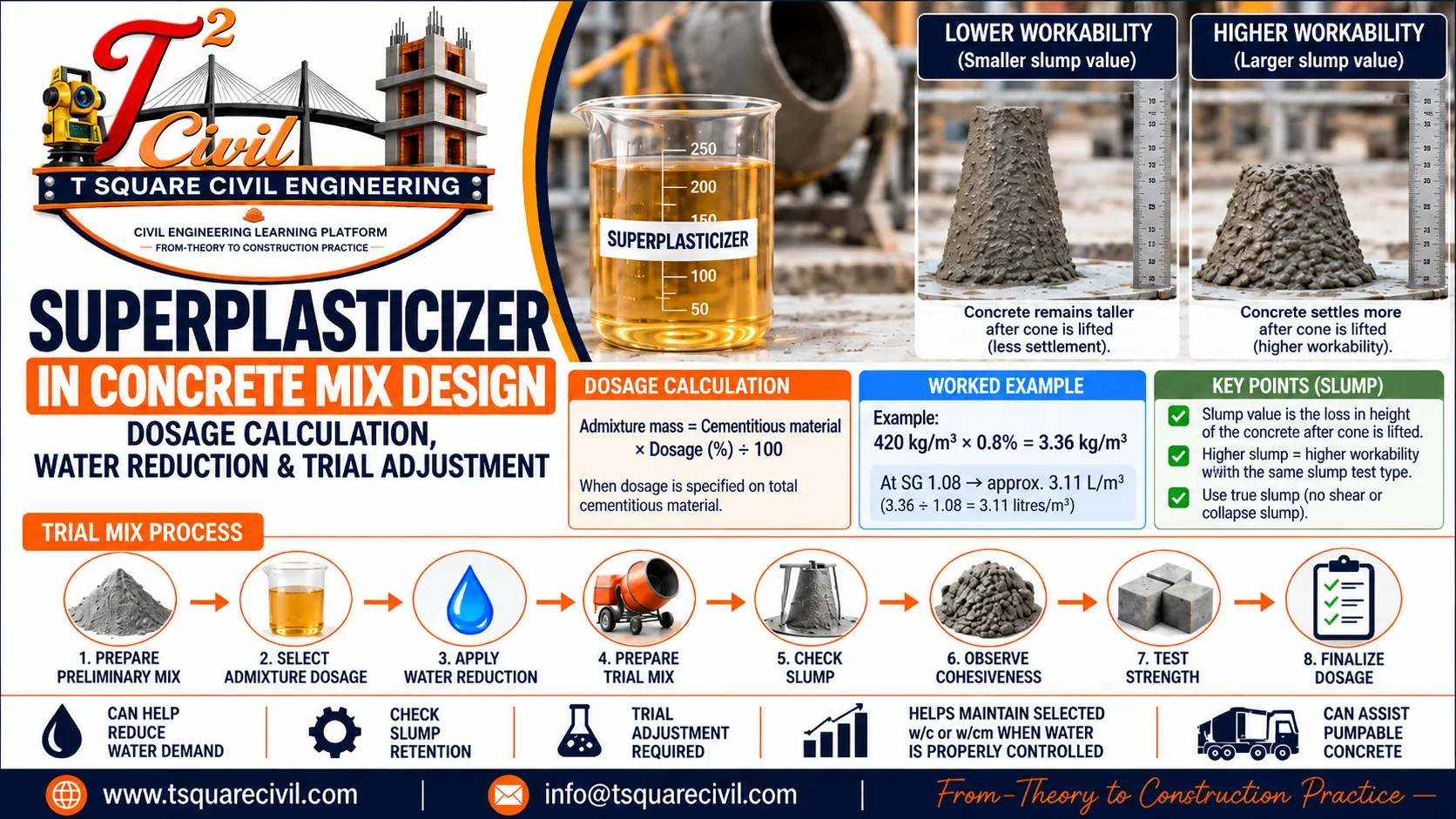
by Superplasticizer is one of the most important chemical admixtures used in modern concrete mix design.
It can help obtain the required workability at a lower water content, improve placing and pumping characteristics, and assist in producing concrete with a controlled water-cement or water-cementitious ratio.
However, the superplasticizer dosage should not be selected as one fixed percentage for every concrete grade.
The appropriate dosage depends on the actual cementitious materials, admixture product, required slump, slump retention, temperature, aggregate characteristics and trial-mix performance.
This article explains how superplasticizer dosage is calculated, how water reduction is evaluated, how admixture volume is included in concrete mix calculations, and how the final dosage should be established through laboratory trials.
For the complete learning sequence, visit our Concrete Mix Design Hub, Water-Cement Ratio in Concrete, Material Tests Required Before Concrete Mix Design and Concrete Trial Mix Procedure.
Page Contents
What Is a Superplasticizer in Concrete?
A superplasticizer is a chemical admixture used to significantly modify the workability and water demand of concrete.
Depending on the product, dosage and concrete materials, it may be used to:
- reduce mixing-water demand;
- increase workability without the same increase in water;
- produce higher-slump concrete;
- assist pumping;
- improve flow around congested reinforcement;
- help maintain a lower water-cementitious ratio; and
- improve practical placing and compaction.
A superplasticizer does not replace proper concrete mix design.
It should be considered as one constituent of the complete mix.
The concrete must still satisfy requirements for:
strength, durability, workability, cohesiveness, segregation resistance and production consistency.
Superplasticizer vs Ordinary Water-Reducing Admixture
Both products can reduce the quantity of water required to achieve a given workability.
A superplasticizer, or high-range water-reducing admixture, is generally intended to provide a greater workability increase or water reduction than an ordinary water-reducing admixture.
The actual performance should be established using the approved product and actual project materials.
Do not assume the same percentage of water reduction for every superplasticizer.
Different products can behave differently with different cements and supplementary cementitious materials.
Why Superplasticizer Is Important in Concrete Mix Design
Consider concrete designed for a relatively low water-cementitious ratio.
The concrete may have sufficient strength potential but insufficient workability if no suitable chemical admixture is used.
Increasing water merely to obtain slump can increase the water-cementitious ratio and change the approved mix.
A suitable superplasticizer can instead help improve workability while controlling the amount of free water.
This is especially important in:
- pumped concrete;
- high-strength concrete;
- highly reinforced members;
- concrete requiring high slump;
- concrete containing supplementary cementitious materials; and
- situations requiring slump retention during transportation.
For the relationship between free water, strength and durability, see our Water-Cement Ratio in Concrete guide.
Is Superplasticizer Dosage Fixed for a Concrete Grade?
No.
There is no universal rule such as:
M25 = 0.5%
M30 = 0.7%
M40 = 1.0%
that can be applied to every project.
The required dosage may change with:
- cement type and source;
- total cementitious content;
- fly ash or GGBS content;
- silica fume or other SCMs;
- admixture chemistry;
- required initial slump;
- slump retention;
- concrete temperature;
- aggregate grading;
- aggregate fines;
- water-cementitious ratio; and
- mixing and transport conditions.
Therefore, the manufacturer’s recommended dosage range may be used as a starting point, but the final dosage should be established through trials.
Information Required Before Selecting an Admixture Dosage
Before starting the admixture calculation, record the following:
| Parameter | Required Information |
|---|---|
| Concrete grade | ______ |
| Total cementitious material | ______ kg/m³ |
| Cement type | ______ |
| SCM type and percentage | ______ |
| Selected w/c or w/cm | ______ |
| Required slump | ______ mm |
| Slump retention requirement | ______ min |
| Placement method | Pump / Bucket / Other |
| Admixture product | ______ |
| Admixture type | ______ |
| Specific gravity | ______ |
| Manufacturer dosage range | ______ % |
| Initial trial dosage | ______ % |
| Concrete temperature | ______ °C |
For the material information required before mix proportioning, see Material Tests Required Before Concrete Mix Design.
Superplasticizer Dosage Calculation
Admixture dosage is commonly specified as a percentage by mass of the relevant cementitious material.
The exact dosage basis should follow the approved product technical data and project requirements.
Where the approved dosage is stated as a percentage of total cementitious material, the calculation is:
Admixture Mass = Cementitious Material × Dosage (%) ÷ 100
Example
Suppose:
Total cementitious material = 420 kg/m³
Selected trial dosage = 0.8%
Then:
Admixture = 420 × 0.8 ÷ 100
= 3.36 kg/m³
Therefore, the initial trial would contain:
3.36 kg of admixture per cubic metre
provided 0.8% is within the approved trial range for that particular product.
Dosage Based on Cement Only vs Total Cementitious Material
This is an important point.
Do not automatically assume that every admixture dosage is based on total cementitious content.
A manufacturer’s technical document may specify the dosage relative to:
- cement;
- total cementitious material; or
- another clearly defined binder basis.
For example, consider:
Cement = 320 kg/m³
GGBS = 100 kg/m³
Total cementitious material = 420 kg/m³
At 0.8%:
If dosage is based on cement only:
320 × 0.8% = 2.56 kg/m³
If dosage is based on total cementitious material:
420 × 0.8% = 3.36 kg/m³
These are significantly different quantities.
Always verify the dosage basis before performing the calculation.
Converting Admixture Mass to Litres
Liquid admixtures may be measured by mass or volume depending on the batching system.
If specific gravity is known, an approximate liquid volume can be calculated.
For an admixture having:
Mass = 3.36 kg
Specific gravity = 1.08
Density is approximately:
1.08 kg/L
Therefore:
Volume = Mass ÷ Density
= 3.36 ÷ 1.08
= 3.11 litres
So approximately:
3.11 L/m³
would correspond to 3.36 kg/m³ for an admixture having a specific gravity of approximately 1.08.
For batching control, follow the measuring system and calibration procedure used by the batching plant.
Admixture Volume in Absolute-Volume Mix Calculation
The chemical admixture also occupies volume inside one cubic metre of concrete.
Its absolute volume can be calculated as:
Volume of Admixture = Mass ÷ (Specific Gravity × 1000)
For the same example:
Admixture mass = 3.36 kg
Specific gravity = 1.08
Therefore:
Volume = 3.36 ÷ (1.08 × 1000)
= 0.00311 m³ approximately
This volume should be considered where the adopted mix-proportioning method includes the admixture as a separate constituent in the absolute-volume calculation.
Your Concrete Mix Design Calculator as per IS 10262:2019 includes chemical-admixture dosage and specific gravity as project-specific inputs.
How Superplasticizer Reduces Water Demand
The estimated mixing water required for concrete depends on factors including:
- maximum aggregate size;
- aggregate shape;
- aggregate texture;
- required workability;
- cementitious materials;
- temperature; and
- chemical admixture.
A suitable superplasticizer can reduce the water quantity needed to obtain a particular workability.
However, the actual reduction should be verified by laboratory trials.
Do not automatically enter a large water-reduction percentage simply because the admixture is described as a superplasticizer.
Example of Water-Reduction Calculation
Suppose the preliminary water content before considering superplasticizer is:
186 kg/m³
Assume laboratory experience suggests that an initial trial may be made at:
20% water reduction
Then:
Water reduction = 186 × 20 ÷ 100
= 37.2 kg/m³
Reduced trial water:
186 − 37.2
= 148.8 kg/m³
Say approximately:
149 kg/m³
This is only a trial calculation.
The final water requirement should be established from the actual workability achieved with the actual materials and admixture.
Water Reduction Changes Cementitious Content
Changing the selected water content can affect the calculated cementitious-material requirement.
Suppose:
Water = 149 kg/m³
Selected w/cm = 0.35
Then:
Cementitious Material = Water ÷ w/cm
= 149 ÷ 0.35
= 425.7 kg/m³
Say approximately:
426 kg/m³
This quantity should then be checked against the applicable durability and project requirements.
Therefore, water reduction and admixture selection should not be treated as isolated calculations.
They affect the complete mix proportion.
Do Not Confuse Admixture Dosage With Water Reduction
A dosage of:
0.8%
does not mean:
0.8% water reduction.
Similarly, a superplasticizer dosage of 1% does not automatically provide a particular percentage of water reduction.
These are different parameters.
Dosage percentage describes the amount of admixture used relative to the specified binder basis.
Water reduction percentage describes the reduction in mixing-water demand achieved while maintaining the required workability.
The relationship between them depends on actual material compatibility and trial results.
Cement–Admixture Compatibility
An admixture that performs well with one cement may not perform identically with another.
Compatibility can be influenced by:
- cement composition;
- cement fineness;
- sulphate balance;
- SCM type;
- SCM percentage;
- concrete temperature; and
- admixture chemistry.
Possible compatibility problems may appear as:
- rapid slump loss;
- delayed setting;
- excessive retardation;
- excessive air;
- bleeding;
- segregation; or
- unexpectedly high admixture demand.
This is one reason laboratory trials should use the actual cementitious materials intended for production.
BIS guidance for IS 9103 similarly emphasizes that admixture performance depends on the admixture, cement compatibility, mix proportions, and field conditions. Bureau of Indian Standards
Effect of Superplasticizer on Slump
A superplasticizer can substantially increase the workability of concrete without requiring the same increase in free water.
For example, suppose Trial Mix No. 1 gives:
Slump = 60 mm
while the project requires:
120 mm
Instead of immediately adding water, the engineer may evaluate an increased admixture dosage within the approved range.
Suppose the next trial produces:
Slump = 125 mm
with acceptable cohesiveness and no excessive segregation.
That dosage may then become a candidate for further strength and slump-retention trials.
The actual result depends on the specific concrete and should not be generalized.
For the workability-testing procedure, see our Slump Cone Test of Concrete.
Initial Slump vs Slump Retention
Initial slump alone may not be sufficient for selecting the admixture dosage.
Concrete transported from an RMC plant may need to retain suitable workability for:
- batching;
- transportation;
- waiting time;
- pumping; and
- placement.
A concrete mix may have excellent initial slump but lose workability too rapidly.
Therefore, trial records may include slump measurements at selected time intervals where slump retention is important.
The required period should match the actual project transportation and placing conditions.
Admixture Dosage for Pumped Concrete
Pumped concrete requires suitable:
- workability;
- cohesiveness;
- mortar content;
- aggregate grading; and
- slump retention.
A superplasticizer can help achieve the required workability without excessive water.
However, pumping problems should not automatically be solved by increasing admixture dosage.
Poor pumpability may also result from:
- inappropriate fine aggregate proportion;
- unsuitable aggregate grading;
- insufficient mortar;
- excessive coarse aggregate;
- segregation; or
- rapid slump loss.
The complete concrete mix should be evaluated.
Trial Adjustment of Superplasticizer Dosage
Admixture dosage should be finalized through controlled trials.
Suppose the manufacturer’s approved dosage range permits several trial levels.
A laboratory programme might evaluate, for example:
Trial A = 0.5%
Trial B = 0.7%
Trial C = 0.9%
These values are examples only and should be selected within the approved range for the actual product.
For every trial, record:
- initial slump;
- slump retention;
- segregation;
- bleeding;
- concrete temperature;
- fresh density;
- setting behaviour where important; and
- compressive strength.
The objective is to identify the lowest technically suitable dosage that provides the required overall concrete performance—not simply the highest slump.
Example Trial Comparison
Consider a hypothetical concrete mix:
Total cementitious material = 420 kg/m³
| Trial | Dosage | Admixture Mass | Slump | Observation |
|---|---|---|---|---|
| A | 0.50% | 2.10 kg/m³ | 75 mm | Workability low |
| B | 0.70% | 2.94 kg/m³ | 110 mm | Good cohesiveness |
| C | 0.90% | 3.78 kg/m³ | 150 mm | Check segregation/retention |
These figures are only illustrative.
The final dosage should be selected from actual test performance and project requirements.
Do not conclude automatically that Trial C is best simply because it gives the highest slump.
Why More Superplasticizer Is Not Always Better
Increasing admixture dosage beyond what is required can produce undesirable effects depending on the admixture and concrete system.
Possible issues may include:
- excessive retardation;
- excessive workability;
- segregation;
- bleeding;
- delayed strength development;
- unwanted air changes; or
- economic waste.
The optimum dosage is therefore the dosage that achieves the required overall performance.
It is not necessarily the highest permitted dosage.
Effect of Temperature
Concrete temperature can significantly affect admixture behaviour.
Hot weather may increase:
- slump loss;
- water demand; and
- difficulty maintaining workability during transport.
The same dosage that works well under moderate laboratory conditions may behave differently during hot site conditions.
Trial and field verification should therefore consider expected production temperatures.
Do not finalize admixture dosage using only one ideal laboratory condition if the actual project will experience substantially different temperatures.
Effect of Fly Ash and GGBS
Supplementary cementitious materials can change:
- water demand;
- workability;
- early strength;
- setting behaviour; and
- admixture compatibility.
For example, concrete containing GGBS or fly ash should not automatically use the same superplasticizer dosage as an OPC-only mix.
The binder combination should be treated as a complete cementitious system.
Changing the SCM percentage may therefore require admixture re-evaluation.
Effect of Silica Fume
Silica fume has a very high specific surface area and can substantially influence the water and admixture demand of concrete.
Concrete containing silica fume may therefore require careful evaluation of superplasticizer dosage and mixing procedure.
Do not copy an admixture dosage from an OPC-only mix without trials.
Admixture and Concrete Setting Time
Some admixtures may influence concrete setting.
Depending on product chemistry, dosage, cement, temperature and SCMs, setting may be:
- accelerated;
- retarded; or
- otherwise modified.
This becomes important when concrete must be:
- transported over long distances;
- placed in large pours;
- finished within a specific period; or
- stripped early.
Trial observations should therefore include setting behaviour where it is important to construction operations.
Admixture and Aggregate Moisture
Aggregate moisture correction should be completed separately from admixture dosage calculation.
Wet sand may contribute additional free water to the concrete.
If moisture correction is ignored, the resulting higher free-water content may make it appear that the selected admixture dosage is providing more workability than it actually is.
Therefore:
first control the actual free-water quantity, then evaluate admixture performance.
Do not use superplasticizer dosage as a substitute for proper moisture control.
Water Present in Liquid Admixture
Liquid admixtures contain a carrier phase and may contain a significant proportion of water depending on the product formulation.
Whether this water needs to be explicitly accounted for in the effective mixing-water calculation should follow the approved mix-design procedure, product information and project requirements.
Do not assume every liquid admixture has identical solids content.
Where required, use the manufacturer’s technical data and approved project method to determine the correct treatment.
Superplasticizer During Trial Mix Development
The admixture dosage should be integrated into your concrete trial-mix programme.
A practical sequence is:
Calculate preliminary mix → Select initial admixture dosage → Apply required water reduction → Prepare Trial Mix → Measure slump → Observe cohesiveness/segregation → Adjust dosage or water systematically → Recalculate proportions where necessary → Cast specimens → Test strength → Confirm slump retention → Conduct field trial → Finalize dosage
For the complete trial procedure, see our Concrete Trial Mix Procedure.
Changing Admixture Product After Mix Approval
Do not automatically substitute one superplasticizer with another merely because both products belong to the same general admixture category.
Products may differ in:
- chemistry;
- specific gravity;
- solids content;
- water reduction;
- slump retention;
- setting behaviour; and
- compatibility.
A product change should therefore be evaluated according to the project quality requirements.
Additional laboratory trials or mix revalidation may be necessary.
Admixture Dosage Record
Keep a clear record during laboratory and field trials.
| Parameter | Trial Record |
|---|---|
| Admixture manufacturer | ______ |
| Product name | ______ |
| Admixture type | ______ |
| Specific gravity | ______ |
| Dosage basis | Cement / Total cementitious |
| Trial dosage | ______ % |
| Admixture mass | ______ kg/m³ |
| Approx. liquid volume | ______ L/m³ |
| Water before reduction | ______ kg/m³ |
| Water reduction | ______ % |
| Final free water | ______ kg/m³ |
| Initial slump | ______ mm |
| Slump after specified time | ______ mm |
| Segregation | Yes / No |
| Bleeding | ______ |
| Concrete temperature | ______ °C |
| 7-day strength | ______ N/mm² |
| 28-day strength | ______ N/mm² |
| Remarks | ______ |
This makes changes in dosage traceable and helps prevent accidental use of an unapproved quantity during production.
Practical Calculation Example
Consider a concrete mix with:
Cement = 320 kg/m³
GGBS = 100 kg/m³
Total cementitious material = 420 kg/m³
Selected trial admixture dosage = 0.8% of total cementitious material
Specific gravity of admixture = 1.08
Step 1: Calculate Admixture Mass
420 × 0.8 ÷ 100
= 3.36 kg/m³
Step 2: Calculate Approximate Admixture Volume
3.36 ÷ 1.08
= 3.11 L/m³ approximately
Step 3: Calculate Absolute Volume
3.36 ÷ (1.08 × 1000)
= 0.00311 m³
Step 4: Prepare the Trial
Use the calculated preliminary mix and measure:
- slump;
- cohesiveness;
- segregation;
- bleeding;
- slump retention; and
- compressive strength.
Step 5: Adjust if Required
If workability is insufficient, adjust the admixture dosage or other appropriate variable within the approved trial procedure.
Do not change the mix randomly.
Record each adjustment and repeat the required tests.
Common Superplasticizer Mistakes
Using One Fixed Dosage for Every Grade
Concrete grade alone does not determine admixture dosage.
Copying Dosage From Another Project
Different cement, aggregate and SCM systems can respond differently.
Confusing Dosage With Water Reduction
A 1% admixture dosage does not mean a 1% water reduction.
Ignoring Specific Gravity
Specific gravity is required when converting admixture mass to volume and when calculating its absolute volume.
Adding More Admixture Only to Increase Slump
Higher slump alone does not prove better concrete.
Ignoring Slump Retention
Initial slump may be satisfactory while workability falls rapidly during transport.
Changing the Admixture Without New Trials
A replacement product may behave differently even when described by the same general category.
Ignoring Aggregate Moisture
Incorrect water content can distort the apparent effectiveness of the admixture.
Frequently Asked Questions
What is superplasticizer in concrete?
A superplasticizer is a chemical admixture used to increase workability and/or reduce the quantity of water required for a particular concrete consistency.
How is superplasticizer dosage calculated?
Where dosage is specified as a percentage of total cementitious material:
Admixture Mass = Cementitious Material × Dosage (%) ÷ 100
The actual dosage basis should always be verified from the approved product information.
What is the ideal superplasticizer dosage?
There is no universal ideal dosage. The suitable value depends on the product, cementitious materials, required workability, temperature and trial results.
Is superplasticizer dosage based on cement or total cementitious material?
It depends on the manufacturer’s specified dosage basis and project requirements. Verify this before calculating the quantity.
How do I convert admixture kg to litres?
For a liquid admixture:
Volume (L) ≈ Mass (kg) ÷ Density (kg/L)
If specific gravity is 1.08, density is approximately 1.08 kg/L.
Does superplasticizer reduce water-cement ratio?
A superplasticizer can reduce water demand while maintaining required workability. Whether the water-cementitious ratio decreases depends on how the overall mix is proportioned.
Can I add extra superplasticizer at site?
Any site adjustment should follow the approved concrete procedure, manufacturer’s limitations and project quality requirements. Uncontrolled addition should be avoided.
Does superplasticizer increase concrete strength?
It can help produce concrete at a lower water-cementitious ratio while maintaining workability, which may support higher strength. Strength still depends on the complete concrete system and curing.
Can the same superplasticizer dosage be used with OPC and GGBS concrete?
Not automatically. The binder combination can influence water demand, slump retention and admixture compatibility, so trials should be performed.
Should superplasticizer be included in the absolute-volume calculation?
Where the adopted mix-proportioning calculation treats it as a separate constituent, its volume can be calculated using its mass and specific gravity.
Related Concrete Mix Design Resources
Continue with these clean original T Square Civil resources:
Water-Cement Ratio in Concrete
Material Tests Required Before Concrete Mix Design
Concrete Mix Design Calculator as per IS 10262:2019
Conclusion
Superplasticizer dosage should be determined from the actual concrete materials and required performance, not from the concrete grade alone.
The basic dosage calculation is straightforward:
Admixture Mass = Applicable Cementitious Mass × Dosage (%) ÷ 100
but the correct percentage must be established using approved product information and concrete trials.
The complete process should consider:
cement compatibility → binder system → water demand → required slump → dosage → slump retention → fresh-concrete stability → strength → field performance.
The final admixture dosage should provide the required concrete performance without unnecessary water or excessive chemical dosage.
A good concrete mix therefore does not ask only:
“How much superplasticizer should I add?”
It asks:
“What dosage gives the required workability, strength, durability and production performance with these actual materials?”
Engineering note: Verify the latest applicable Indian Standards, approved admixture product data, project specification and trial-mix results before adopting any chemical-admixture dosage for construction.