
 by
by Water content is one of the most important inputs in concrete mix design because it directly influences workability, cementitious-material requirement, water-cementitious ratio and the behaviour of fresh concrete.
However, the quantity of water required for concrete should not be selected only from the concrete grade.
An M30, M40 or M50 concrete mix does not have one fixed water content.
The actual water requirement depends on factors such as:
- nominal maximum aggregate size;
- required slump;
- aggregate shape;
- aggregate surface texture;
- fine and coarse aggregate grading;
- chemical admixture;
- cementitious materials;
- concrete temperature; and
- actual trial-mix performance.
IS 10262:2019 provides initial water-content values that can be used as a starting point for concrete mix proportioning. These values are then adjusted according to the required workability, aggregate characteristics and admixture performance.
For the complete mix-design sequence, read our Concrete Mix Design Procedure as per IS 10262:2019.
You can also use the Concrete Mix Design Calculator as per IS 10262:2019 for preliminary calculations using your own project inputs.
Page Contents
What Is Water Content in Concrete Mix Design?
Water content is the quantity of free mixing water required per cubic metre of concrete to achieve the selected workability with the proposed materials.
It is normally expressed as:
kg/m³
Since the density of water is approximately 1 kg/litre, a quantity such as:
186 kg/m³
is approximately equivalent to:
186 litres/m³
for practical concrete mix calculations.
Water content is important because it is subsequently used to calculate the required cementitious-material quantity.
In simplified form:
Cementitious Material Content = Free Water Content ÷ Adopted Water-Cementitious Ratio
Therefore, unnecessarily increasing the water content can also increase the required binder quantity when the selected water-cementitious ratio is maintained.
Scope of the Reference Water-Content Values
The reference values discussed in this article apply to the ordinary and standard concrete proportioning procedure using the relevant IS 10262:2019 provisions.
The commonly used values of:
- 208 kg/m³;
- 186 kg/m³; and
- 165 kg/m³
should not automatically be applied to every type of concrete.
High-strength concrete, self-compacting concrete, mass concrete and other special concretes may require different proportioning considerations.
The values in this article should therefore be treated as initial values for the applicable ordinary and standard concrete mix-design procedure, followed by trial verification.
Water Content and Water-Cement Ratio Are Different
Water content and water-cement ratio are related, but they do not mean the same thing.
Water Content
Water content is the actual mass of free water used in one cubic metre of concrete.
Example:
Water = 160 kg/m³
Water-Cementitious Ratio
The water-cementitious ratio compares the mass of free water with the mass of the applicable cementitious materials.
For example:
Water = 160 kg/m³
Cementitious material = 400 kg/m³
Then:
w/cm = 160 ÷ 400
w/cm = 0.40
The detailed selection of the ratio based on strength and durability is explained separately in Water-Cement Ratio in Concrete.
This article focuses specifically on how the preliminary water quantity is selected and adjusted.
Initial Water Content for Ordinary and Standard Concrete as per IS 10262:2019
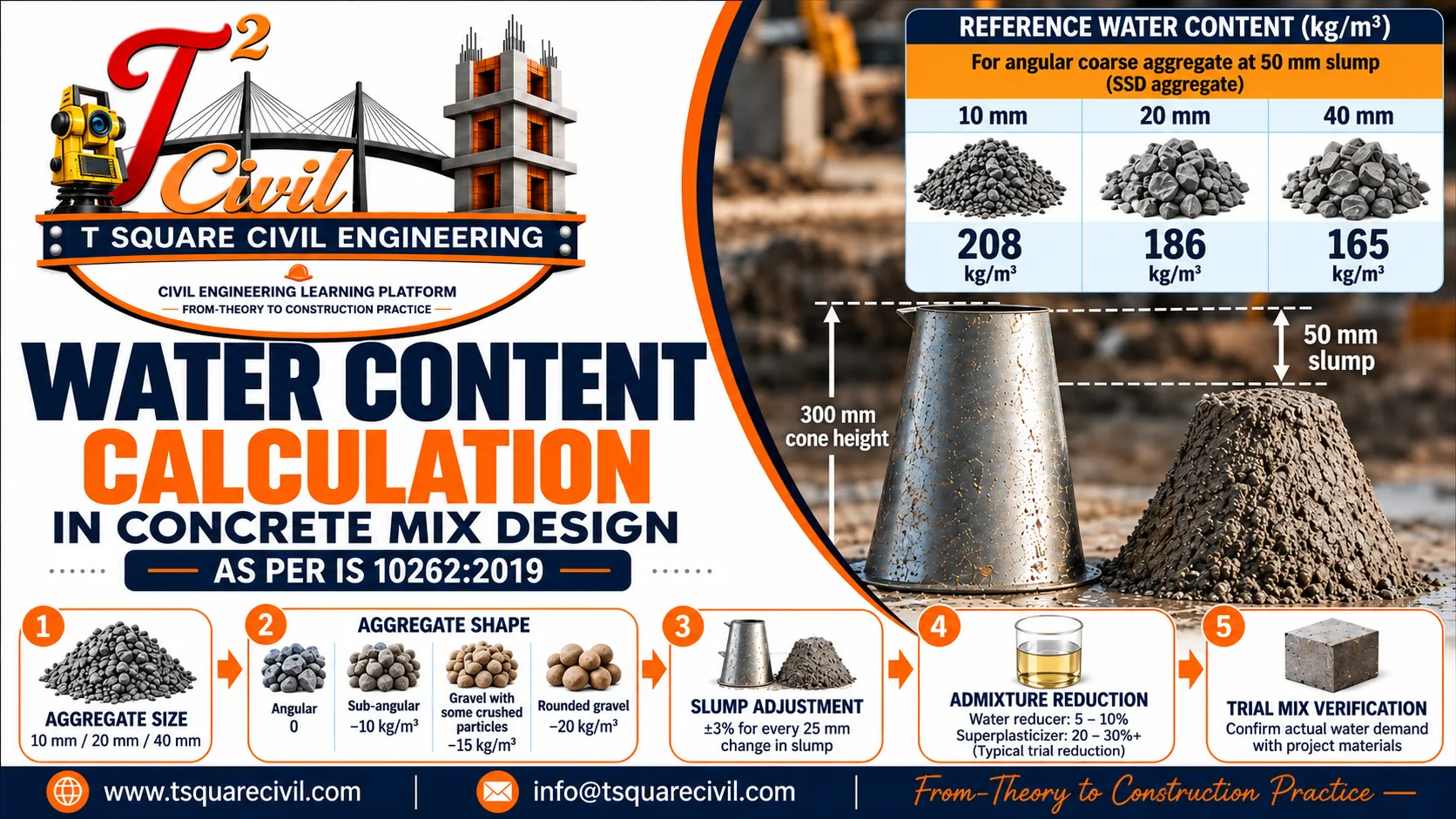
For angular coarse aggregate and approximately 50 mm slump, the initial water-content values commonly used in the ordinary and standard concrete proportioning procedure are:
| Nominal Maximum Aggregate Size | Initial Water Content |
|---|---|
| 10 mm | 208 kg/m³ |
| 20 mm | 186 kg/m³ |
| 40 mm | 165 kg/m³ |
These values correspond to aggregate considered in the appropriate SSD reference condition for mix proportioning.
They are starting values, not automatically the final production water content.
For example:
20 mm aggregate does not mean every concrete mix must contain exactly 186 litres of water per cubic metre.
The value may need adjustment for:
- slump;
- aggregate shape;
- aggregate surface texture;
- chemical admixture;
- actual material behaviour; and
- laboratory trial results.
Why Does Aggregate Size Affect Water Requirement?
Aggregate size affects the total particle surface area that has to be coated by paste.
For the same aggregate volume, smaller aggregate particles generally provide a larger total surface area.
A greater surface area can increase the paste and water demand required to achieve comparable workability.
This is one reason the initial water-content values reduce as the nominal maximum aggregate size increases:
10 mm aggregate → 208 kg/m³
20 mm aggregate → 186 kg/m³
40 mm aggregate → 165 kg/m³
However, aggregate size is not the only factor.
Shape, surface texture and grading can also significantly affect concrete water demand.
For this reason, aggregate properties should be evaluated before carrying out the final mix design. See Material Tests Required Before Concrete Mix Design for the important input tests.
Step 1: Select the Initial Water Content
Start by identifying the nominal maximum size of coarse aggregate.
Suppose:
Nominal maximum aggregate size = 20 mm
For angular aggregate at approximately 50 mm slump:
Initial water content = 186 kg/m³
This becomes the starting value before applying other applicable adjustments.
Step 2: Adjust Water Content for the Required Slump
The reference water-content values correspond to approximately:
50 mm slump
If the required slump differs from this value, the preliminary water content may be adjusted by approximately:
3% for every 25 mm change in slump
The final water demand should still be verified through actual concrete trials.
General Approach
For an increase in slump:
Adjusted Water = Initial Water × (1 + Adjustment)
For a reduction in slump:
Adjusted Water = Initial Water × (1 − Adjustment)
Example 1: Water Content for 20 mm Aggregate and 75 mm Slump
Given:
Initial water content:
186 kg/m³
Reference slump:
50 mm
Required slump:
75 mm
Difference:
75 − 50
= 25 mm
Approximate increase:
3%
Therefore:
Water content
= 186 × 1.03
= 191.58 kg/m³
Say approximately:
192 kg/m³
This is still a preliminary value and should not be treated as the final site batching water.
Example 2: Water Content for 20 mm Aggregate and 100 mm Slump
Given:
Initial water content:
186 kg/m³
Required slump:
100 mm
Difference from the 50 mm reference slump:
100 − 50
= 50 mm
Number of 25 mm increments:
50 ÷ 25
= 2
Approximate adjustment:
2 × 3%
= 6%
Therefore:
Water content
= 186 × 1.06
= 197.16 kg/m³
Say approximately:
197 kg/m³
This is the preliminary water demand before considering aggregate shape and chemical admixture.
Fresh concrete workability should later be checked by an appropriate test. For normal workable concrete, see our Slump Cone Test of Concrete.
Step 3: Adjust for Aggregate Shape
Aggregate shape affects concrete water demand because it influences:
- particle friction;
- surface area;
- packing;
- movement of aggregate particles; and
- overall workability.
Angular crushed aggregate generally requires more water than rounded aggregate to obtain comparable workability.
Compared with the reference angular aggregate, the preliminary water content may be reduced approximately as follows:
| Coarse Aggregate Shape | Approximate Reduction From Reference Water |
|---|---|
| Angular | 0 kg/m³ |
| Sub-angular | 10 kg/m³ |
| Gravel with some crushed particles | 15 kg/m³ |
| Rounded gravel | 20 kg/m³ |
These values are preliminary adjustments.
Actual water demand may still differ because of aggregate surface texture, grading and other material characteristics.
Example 3: Adjustment for Sub-Angular Aggregate
Suppose the water content after slump adjustment is:
192 kg/m³
The coarse aggregate is:
Sub-angular
Approximate reduction:
10 kg/m³
Therefore:
192 − 10
= 182 kg/m³
The estimated water content becomes:
182 kg/m³
before considering any water reduction from chemical admixture.
Why Angular Aggregate Usually Requires More Water
Angular aggregate has:
- sharp edges;
- irregular particle geometry;
- greater interparticle friction; and
- generally lower mobility than rounded aggregate.
More paste or water may therefore be required to obtain comparable workability.
Rounded particles generally move more easily within fresh concrete and can reduce the water requirement for the same workability.
However, actual trial performance should always govern the final design.
Step 4: Consider Water Reduction From Chemical Admixture
Modern concrete frequently uses chemical admixtures to achieve the required workability while controlling water content.
Water-reducing admixtures can reduce the water demand, while superplasticizers can provide substantially greater water reduction.
As general guidance, water reduction may commonly be in the range of:
Water-reducing admixture: about 5% to 10%
Superplasticizer: about 20% to 30% or more at an appropriate dosage
These values should not be automatically entered into every mix design.
The actual reduction depends on:
- admixture chemistry;
- dosage;
- cement type;
- supplementary cementitious materials;
- aggregate characteristics;
- temperature;
- mixing conditions; and
- trial results.
For detailed guidance on dosage, water reduction, slump retention and compatibility, read Superplasticizer in Concrete Mix Design.
Example 4: Water Content With Superplasticizer
Suppose:
Water before admixture reduction:
197 kg/m³
Laboratory trials demonstrate that the selected superplasticizer allows:
20% water reduction
Water reduction:
197 × 20/100
= 39.4 kg/m³
Therefore:
Final preliminary water content
= 197 − 39.4
= 157.6 kg/m³
Say:
158 kg/m³
This does not mean every superplasticizer should be assumed to provide 20% water reduction.
The selected percentage should be supported by the product characteristics and actual trial performance.
Important Note on Water Present in Liquid Admixture
If a liquid chemical admixture introduces an appreciable quantity of water into the mix, that water should also be considered when checking the final free-water content and water-cementitious ratio.
This can become particularly important when the adopted water-cementitious ratio is close to the governing durability limit.
Complete Water-Content Calculation Example
Consider a preliminary concrete mix with:
- nominal maximum aggregate size = 20 mm;
- required slump = 100 mm;
- angular coarse aggregate; and
- demonstrated superplasticizer water reduction = 20%.
Step 1: Initial Water Content
For 20 mm angular aggregate at approximately 50 mm slump:
Initial water = 186 kg/m³
Step 2: Slump Adjustment
Required slump:
100 mm
Difference from reference slump:
100 − 50
= 50 mm
Approximate increase:
6%
Therefore:
186 × 1.06
= 197.16 kg/m³
Step 3: Aggregate Shape Adjustment
The aggregate is angular.
Therefore:
No reduction is applied for aggregate shape.
Water remains:
197.16 kg/m³
Step 4: Superplasticizer Water Reduction
Water reduction:
20%
Reduction:
197.16 × 0.20
= 39.43 kg/m³
Final preliminary water:
197.16 − 39.43
= 157.73 kg/m³
Say approximately:
158 kg/m³
Therefore, the preliminary free-water content for further mix calculations is:
158 kg/m³
This value must still be verified through an actual trial mix.
Step 5: Use Water Content to Calculate Cementitious Material
Once the preliminary free-water quantity has been established, it can be used with the adopted water-cementitious ratio to calculate the preliminary cementitious-material content.
Suppose:
Water = 158 kg/m³
Adopted w/cm = 0.40
Then:
Cementitious material
= 158 ÷ 0.40
= 395 kg/m³
Therefore:
Preliminary cementitious-material content = 395 kg/m³
This quantity should then be checked against the applicable durability requirements, project specifications and mix-design provisions.
The complete binder calculation should be treated as a separate design step rather than extending the water-content calculation unnecessarily.
Water Content Should Not Be Increased Freely to Improve Slump
One of the most common site mistakes is adding extra water whenever concrete appears difficult to place.
Suppose an approved mix requires:
Free water = 158 kg/m³
If additional water is added at site without technical approval, the actual water-cementitious ratio increases.
This can result in:
- lower compressive strength;
- increased permeability;
- excessive bleeding;
- higher segregation risk;
- increased shrinkage;
- reduced durability; and
- inconsistent concrete quality.
Therefore, slump should be controlled using approved mix-design adjustments and suitable admixture rather than uncontrolled water addition.
Effect of Fine Aggregate on Water Demand
Fine aggregate can significantly influence the actual water requirement of concrete.
Important factors include:
- particle shape;
- grading;
- fines content;
- surface texture; and
- moisture condition.
For example, manufactured sand and natural river sand may require different water quantities even when their nominal grading appears similar.
Fine aggregate grading should therefore be determined by proper testing.
For the laboratory procedure, see Sieve Analysis / Particle Size Distribution of Aggregate.
Effect of Cementitious Materials on Water Demand
The cementitious-material system can also affect concrete water demand.
A mix may contain:
- OPC;
- PPC;
- fly ash;
- GGBS;
- silica fume; or
- a combination of approved materials.
These materials can differ in:
- fineness;
- particle shape;
- specific surface;
- water demand; and
- interaction with chemical admixtures.
Therefore, the practical water requirement of a concrete mix should ultimately be established using the actual cementitious system and representative materials.
Design Free Water and Actual Batch Water
The water determined during mix proportioning represents the required free water for the concrete.
However, the quantity physically added at the mixer may not be exactly the same because aggregates can contain moisture or may be drier than the SSD condition.
If wet aggregate contributes free surface moisture, that water should be deducted from the separately added batch water.
If aggregate is drier than the reference condition, absorption may also have to be considered.
Therefore:
Design Free Water ≠ Always Water Added Separately at the Mixer
For the complete calculation covering:
- SSD condition;
- absorption;
- total moisture;
- free surface moisture;
- corrected wet aggregate mass; and
- corrected mixer water,
see Moisture Correction in Concrete Mix Design.
Does Higher Slump Always Require More Water?
No.
Without chemical admixture, obtaining substantially greater workability may require an increase in water.
However, modern concrete can often achieve a higher slump using a suitable superplasticizer while maintaining controlled water content.
For example, two concretes can have similar water content but different slump because of differences in:
- admixture dosage;
- cementitious system;
- aggregate grading; and
- material compatibility.
Therefore:
Higher slump does not automatically mean higher water-cementitious ratio.
The complete concrete system must be considered.
Should the IS 10262 Reference Water Value Be Used Directly?
No.
The reference value is the starting point for proportioning.
The actual water requirement can be affected by:
- aggregate shape;
- aggregate surface texture;
- fine aggregate grading;
- fines content;
- cementitious materials;
- chemical admixture;
- required slump;
- concrete temperature; and
- mixing conditions.
The correct approach is therefore:
Reference water content
↓
Slump adjustment
↓
Aggregate shape adjustment
↓
Admixture water reduction
↓
Preliminary free-water content
↓
Trial-mix verification
The table value by itself should not be treated as an approved production water quantity.
Verification Through Trial Mix
The calculated water content is an initial value for trial proportioning.
Actual water demand may differ because of:
- aggregate texture;
- grading;
- fines;
- cementitious materials;
- temperature;
- mixing efficiency; and
- admixture performance.
Prepare a trial mix and evaluate:
- actual slump;
- cohesiveness;
- segregation;
- bleeding; and
- overall fresh-concrete behaviour.
If the required performance is not achieved, make a controlled technical adjustment instead of simply adding uncontrolled water.
For the complete verification procedure, see Concrete Trial Mix: Procedure, Adjustments & Approval.
Water Content for Pumpable Concrete
Pumpable concrete requires adequate:
- workability;
- cohesiveness;
- mortar volume;
- fines content; and
- slump retention.
However, pumpability should not be achieved by simply adding more water.
Pumpable concrete should be developed by considering:
- aggregate grading;
- fine/coarse aggregate proportion;
- cementitious materials;
- chemical admixture; and
- trial pumping behaviour.
Any increase in free water must still satisfy the adopted water-cementitious ratio and durability requirements.
What About High-Strength Concrete?
The 208, 186 and 165 kg/m³ reference values discussed earlier should not automatically be applied as a complete design method for high-strength concrete.
High-strength concrete may require separate consideration of:
- very low water-cementitious ratios;
- high-range water-reducing admixtures;
- supplementary cementitious materials;
- aggregate strength;
- grading;
- particle packing;
- viscosity;
- workability retention; and
- extensive trial data.
For this reason, M50, M55 or M60 water quantities should be treated as part of a complete project-specific mix design rather than as universal values.
Our Concrete Mix Design Hub contains grade-wise worked examples from M10 to M60 for learning purposes.
Common Mistakes in Water-Content Calculation
Using 186 Litres for Every Concrete Mix
The value of 186 kg/m³ is an initial reference value for 20 mm angular aggregate under the specified reference workability condition.
It is not a universal quantity.
Selecting Water Only From the Concrete Grade
M20, M30 or M40 does not independently determine the required water content.
Ignoring Required Slump
The required workability affects the preliminary water demand.
Ignoring Aggregate Shape
Angular, sub-angular and rounded aggregates can require different water quantities for comparable workability.
Assuming a Fixed Superplasticizer Reduction
Do not automatically use 20%, 25% or 30% reduction without supporting product information and trial results.
Adding Water at Site to Increase Slump
Uncontrolled water addition changes the actual free-water content and can increase the water-cementitious ratio.
Ignoring Aggregate Moisture
Water carried by wet aggregate contributes to the concrete and affects the separately added batching water.
Confusing Water Content With Water-Cement Ratio
Water content is expressed in:
kg/m³
while w/c or w/cm is a:
mass ratio
Treating the Calculated Water as the Final Approved Quantity
The preliminary value must be checked through laboratory trial mixing.
Quick Reference Table
| Factor | General Effect on Water Requirement |
|---|---|
| Smaller nominal aggregate size | Generally increases water demand |
| Larger nominal aggregate size | Generally reduces water demand |
| Higher slump without admixture | Generally increases water demand |
| Lower slump | Generally reduces water demand |
| Angular aggregate | Higher relative water demand |
| Sub-angular aggregate | Lower than angular aggregate |
| Rounded aggregate | Lower relative water demand |
| Water-reducing admixture | Can reduce water requirement |
| Superplasticizer | Can substantially reduce water requirement |
| Poor aggregate grading | May increase water demand |
| Excessive fines | May increase water demand |
| Wet aggregate | Reduces separately added mixer water after correction |
Practical Water-Content Calculation Workflow
Use the following sequence during concrete mix design:
Identify nominal maximum aggregate size
↓
Select initial water content
↓
Adjust for required slump
↓
Adjust for aggregate shape
↓
Apply demonstrated admixture water reduction
↓
Determine preliminary free-water content
↓
Use the adopted w/cm to calculate cementitious material
↓
Calculate remaining concrete ingredients
↓
Correct for actual aggregate moisture
↓
Prepare laboratory trial mix
↓
Measure slump and observe concrete behaviour
↓
Make controlled adjustments where required
↓
Establish the final practical water demand
Frequently Asked Questions
What is the water content for 20 mm aggregate as per IS 10262:2019?
For ordinary and standard concrete using angular coarse aggregate at approximately 50 mm slump, the initial reference water content is 186 kg/m³. The actual value may require adjustment for slump, aggregate shape, chemical admixture and trial performance.
What is the initial water content for 10 mm aggregate?
The initial reference value is approximately:
208 kg/m³
for angular coarse aggregate at approximately 50 mm slump under the applicable ordinary and standard concrete proportioning conditions.
What is the initial water content for 40 mm aggregate?
The initial reference value is approximately:
165 kg/m³
for angular coarse aggregate at approximately 50 mm slump under the applicable conditions.
How is water content adjusted for slump?
The preliminary water quantity may be increased or decreased by approximately 3% for every 25 mm change from the reference 50 mm slump.
The final quantity should still be verified by trial.
Is 186 litres of water compulsory for M20 concrete?
No.
The 186 kg/m³ value relates to the reference conditions for 20 mm angular aggregate.
The actual water requirement depends on workability, aggregate characteristics, admixture and trial results.
Does M30 concrete have a fixed water quantity?
No.
Concrete grade alone does not determine the mixing water requirement.
Can superplasticizer reduce water content?
Yes.
A suitable superplasticizer can substantially reduce the amount of water required to achieve the selected workability.
The actual reduction should be demonstrated using the proposed materials and admixture dosage.
Does higher slump always mean more water?
No.
Higher slump can often be achieved using an appropriate superplasticizer without increasing the water-cementitious ratio.
Why is aggregate moisture correction required after calculating water content?
Aggregates may contain free surface moisture or may absorb water.
Therefore, the amount of water added separately at the mixer may differ from the design free-water quantity.
Is the calculated water content the final production water quantity?
Not automatically.
It is a preliminary mix-design value that should be verified and refined through trial mixes and actual production control.
Conclusion
Water-content calculation in concrete mix design begins with a reference value, but that value should not be used directly without evaluating the actual concrete requirements.
For ordinary and standard concrete using angular coarse aggregate at approximately 50 mm slump, the common starting values are:
10 mm aggregate = 208 kg/m³
20 mm aggregate = 186 kg/m³
40 mm aggregate = 165 kg/m³
The designer should then consider:
slump adjustment + aggregate shape + admixture water reduction + material characteristics + trial-mix performance
The key principle is:
Use the IS 10262 reference water content as a starting point and use representative project materials and trial mixes to establish the practical water requirement.
Once the preliminary free-water quantity has been established, it becomes an important input for calculating the cementitious-material content using the selected water-cementitious ratio.
For the full calculation sequence, continue with our Concrete Mix Design Procedure as per IS 10262:2019.
You can also use the Concrete Mix Design Calculator for preliminary calculations and refer to the Concrete Mix Design Hub for the complete learning sequence.
Engineering Note: This article is intended for civil-engineering education and preliminary mix-design guidance. Final water content and concrete proportions should be established using the latest applicable standards, approved project specifications, representative material-test data and laboratory or field trial results.