 by
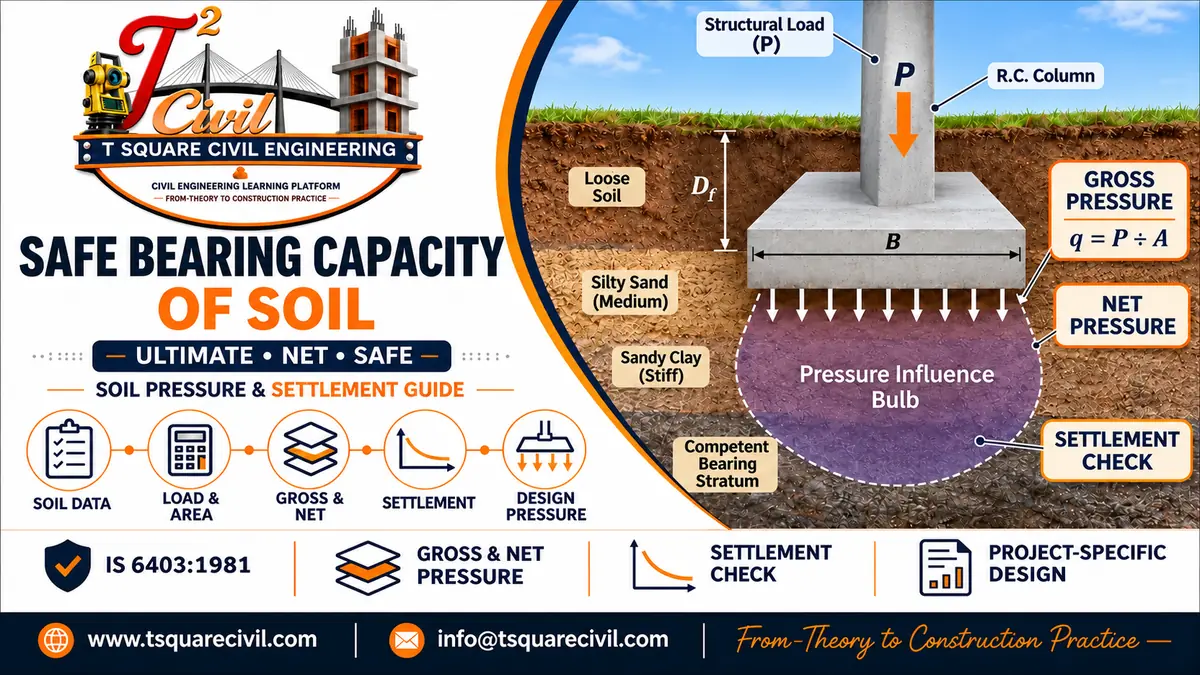
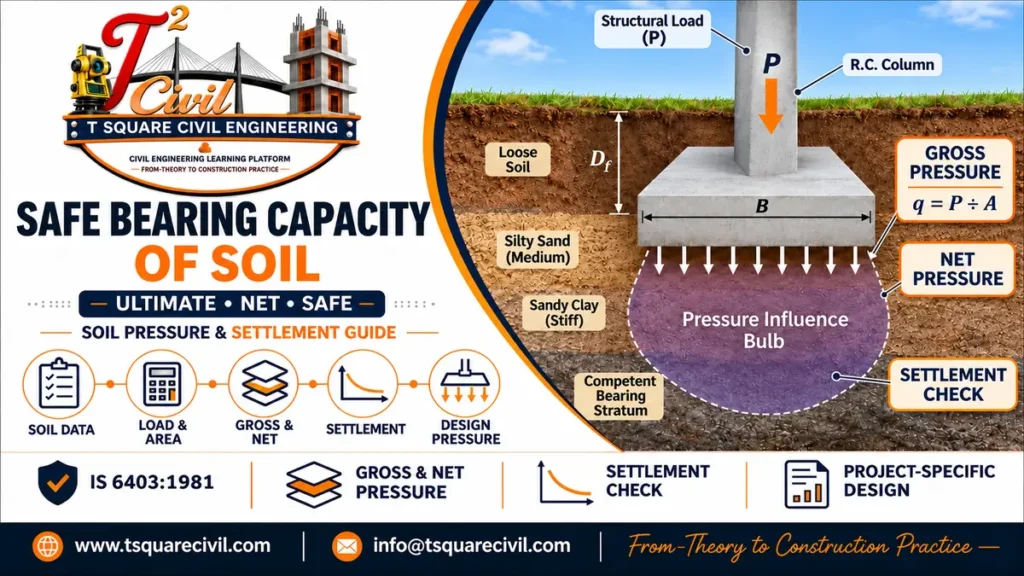
Safe bearing capacity of soil is the allowable pressure that a foundation can transmit to the supporting soil without shear failure and without excessive settlement.
It is not a universal value for every building or site. It depends on soil strength, foundation size, foundation depth, groundwater, structural loading, eccentricity, soil layering and settlement requirements.
The terms ultimate bearing capacity, net bearing capacity, gross bearing capacity, safe bearing capacity and allowable bearing pressure are related but should not be used interchangeably.
Page Contents
Quick Answer
Safe bearing capacity is the allowable foundation pressure selected after considering:
- Ultimate shear resistance of the soil
- Factor of safety
- Total and differential settlement
- Foundation size and depth
- Groundwater conditions
- Structural loads and moments
- Soil profile and construction conditions
The final value must be obtained from project-specific geotechnical investigation and design.
Quick Information Table
| Item | Description |
|---|---|
| Main topic | Safe bearing capacity of soil |
| Main terms | Ultimate, net, gross, safe and allowable bearing capacity |
| Common unit | kN/m² or kPa |
| Main shallow-foundation reference | IS 6403:1981 |
| General foundation reference | IS 1904:2021 |
| Important checks | Shear failure, settlement, eccentricity and groundwater |
| Final design value | Project-specific geotechnical recommendation |
What Is Bearing Capacity of Soil?
Bearing capacity is the ability of soil to support the pressure transferred by a foundation.
When a foundation carries a structural load, pressure develops below its base. The supporting soil must resist this pressure without:
- Shear failure
- Excessive settlement
- Differential settlement
- Excessive tilting
- Lateral movement
- Loss of stability
For a simple concentric load:
Average foundation pressure = Total load ÷ Foundation area
q = P ÷ A
Where:
- q = average foundation pressure
- P = applied load
- A = foundation base area
If the foundation is subjected to bending moments or eccentric loading, the pressure below the footing will not be uniform.
Before using a bearing-capacity value, the soil profile should be established through proper investigation. Read Site Investigation for Foundation Design for the investigation process.
Why Is Safe Bearing Capacity Important?
Safe bearing capacity is used to determine whether the soil can support a proposed foundation.
It helps engineers to:
- Select suitable foundation dimensions
- Check isolated footings
- Check strip and wall footings
- Compare shallow-foundation options
- Estimate allowable foundation pressure
- Assess settlement risk
- Identify the need for ground improvement
- Review geotechnical recommendations
- Prepare preliminary foundation calculations
Bearing capacity is only one part of foundation design. A soil may have sufficient shear strength but still produce excessive settlement.
For a broader explanation of foundation systems, refer to Foundation in Civil Engineering.
Important Terms Used in Bearing Capacity
Gross Ultimate Bearing Capacity
Gross ultimate bearing capacity is the total pressure at the foundation base at which shear failure of the supporting soil may occur.
It includes the pressure caused by the soil overburden above the foundation level.
It is commonly represented as:
q_gross,ult
The value depends on foundation geometry, soil parameters, groundwater, loading and ground conditions.
Net Ultimate Bearing Capacity
Net ultimate bearing capacity is the increase in pressure above the existing overburden pressure at foundation level that may cause shear failure.
Net ultimate bearing capacity = Gross ultimate bearing capacity − Overburden pressure
q_net,ult = q_gross,ult − q₀
Where:
- q_net,ult = net ultimate bearing capacity
- q_gross,ult = gross ultimate bearing capacity
- q₀ = existing overburden pressure at foundation level
For a simple uniform soil condition:
Overburden pressure = Unit weight of soil × Foundation depth
q₀ ≈ γ × Df
Where:
- γ = relevant unit weight of soil
- Df = foundation depth below ground level
The actual overburden pressure may need adjustment for groundwater, layered soil and the selected effective-stress analysis.
Factor of Safety
The factor of safety provides a margin between the calculated ultimate soil resistance and the adopted allowable pressure.
It considers uncertainties such as:
- Natural variation in soil properties
- Limitations of site investigation
- Uncertainty in load estimation
- Construction tolerances
- Simplifications in the calculation method
- Variation between investigation points
The factor of safety must be selected according to the project design basis and applicable standards. A value should not be adopted simply because it was used on another project.
Net Safe Bearing Capacity
Net safe bearing capacity is the net ultimate bearing capacity divided by the selected factor of safety.
Net safe bearing capacity = Net ultimate bearing capacity ÷ Factor of safety
q_net,safe = q_net,ult ÷ Fs
Where:
- q_net,safe = net safe bearing capacity
- q_net,ult = net ultimate bearing capacity
- Fs = selected factor of safety
Gross Allowable Bearing Pressure
When a net allowable pressure is adopted, the corresponding gross allowable pressure may be obtained by adding the relevant overburden pressure.
Gross allowable pressure = Overburden pressure + Net safe bearing capacity
q_gross,allow = q₀ + q_net,safe
This relationship should only be used when the same net-pressure design convention is followed consistently.
Allowable Bearing Pressure
Allowable bearing pressure is the pressure permitted under the selected design method.
It may be controlled by:
- Shear failure
- Total settlement
- Differential settlement
- Structural requirements
- Eccentricity
- Sliding or overturning
- Groundwater
- Construction limitations
Therefore, allowable bearing pressure is not automatically equal to ultimate bearing capacity divided by a factor of safety.
Safe Load
Safe load is the allowable soil pressure multiplied by the effective foundation area.
Safe load = Allowable bearing pressure × Foundation area
This is only a preliminary relationship. Actual design must also consider foundation self-weight, moments, eccentricity, settlement and structural strength.
Difference Between Ultimate, Net and Safe Bearing Capacity
| Term | Meaning | Main consideration |
|---|---|---|
| Gross ultimate bearing capacity | Total pressure at shear failure | Includes overburden pressure |
| Net ultimate bearing capacity | Pressure above existing overburden at failure | Excludes existing overburden |
| Net safe bearing capacity | Net ultimate capacity divided by factor of safety | Shear-based net allowable value |
| Gross allowable pressure | Gross pressure corresponding to the adopted design convention | Includes the relevant overburden component |
| Allowable bearing pressure | Design pressure permitted after relevant checks | May be controlled by shear or settlement |
| Service contact pressure | Pressure caused by working loads | Compared with the adopted allowable value |
Important Terminology Note
Different textbooks and design documents may use the term “safe bearing capacity” differently.
Some procedures divide the gross ultimate pressure directly by a factor of safety. Other procedures first calculate net ultimate capacity, divide it by the factor of safety and then add the overburden pressure.
Therefore, a geotechnical report should clearly state:
- Whether the value is gross or net
- Whether it is ultimate or allowable
- The foundation level
- The settlement criterion
- The groundwater assumption
- The factor of safety
- The applicable load condition
Do not mix a net value with a gross value during foundation design.
Basic Bearing Capacity Formula
For educational understanding, a simplified bearing-capacity expression for a strip footing under central vertical loading may be written as:
Gross ultimate bearing capacity ≈ Cohesion term + Surcharge term + Unit-weight term
q_gross,ult ≈ c′Nc + q₀Nq + 0.5 × γ × B × Nγ
Where:
- c′ = effective cohesion
- Nc, Nq and Nγ = bearing-capacity factors
- q₀ = overburden pressure at foundation level
- γ = relevant unit weight of soil
- B = foundation width
This simplified expression does not include all practical correction factors.
Actual design may require consideration of:
- Foundation shape
- Foundation depth
- Load inclination
- Eccentricity
- Base inclination
- Ground inclination
- Groundwater
- Layered soil
- Surcharge
- Seismic effects
- Soil-structure interaction
The applicable procedure should be followed for final design. Coefficients from different theories or standards should not be mixed without engineering justification.
Bearing Capacity Factors
The commonly used bearing-capacity factors include:
- Nc
- Nq
- Nγ
Their values depend on the selected analytical method and soil friction angle.
Important points include:
- Effective-stress parameters are generally used for drained analysis.
- Undrained shear strength may be used for suitable short-term cohesive-soil conditions.
- Drained and undrained parameters should not be mixed.
- Bearing-capacity factors must be consistent with the selected design method.
- Different equations may produce different values, especially for the Nγ factor.
Factors Affecting Safe Bearing Capacity
Soil Type
Sand, clay, silt, gravel, fill, expansive soil and rock behave differently under foundation loading.
Each material requires suitable parameters and engineering interpretation.
Soil Shear Strength
Shear strength depends on:
- Cohesion
- Friction angle
- Density
- Drainage condition
- Saturation
- Stress history
- Soil structure
Weak or loose soil may have low bearing resistance and high settlement potential.
Foundation Width
Foundation width affects the stress distribution below the foundation.
Increasing the width may reduce average contact pressure, but it may also increase the depth and width of the soil influence zone.
Foundation Depth
Foundation depth may affect:
- Overburden pressure
- Soil confinement
- Shear resistance
- Excavation requirements
- Groundwater conditions
- Settlement behaviour
A greater foundation depth does not automatically guarantee a higher safe bearing capacity.
Foundation Shape
Strip, square, rectangular and circular foundations distribute pressure differently.
Shape factors may be required when the foundation is not a long strip footing.
Groundwater Level
Groundwater may reduce effective stress and change the relevant unit weight used in calculations.
It may also affect:
- Excavation stability
- Soil erosion
- Dewatering
- Piping
- Concrete placement
- Long-term settlement
Load Eccentricity
When a footing carries bending moment, pressure below the footing becomes non-uniform.
A general pressure relationship may be written as:
Foundation pressure = Average pressure ± Moment ÷ Section modulus
q = P ÷ A ± M ÷ Z
Where:
- P ÷ A = average pressure
- M = bending moment
- Z = relevant base section modulus
The applicable design procedure must be used when the resultant is eccentric or when tensile contact is possible.
Soil Layering
A strong layer below a weak layer does not automatically solve the foundation problem.
The load may influence the weaker layer depending on:
- Foundation width
- Thickness of the upper layer
- Depth of the stronger stratum
- Relative soil stiffness
- Groundwater
- Stress distribution
Layered soil requires appropriate geotechnical analysis.
Settlement
Settlement may govern the allowable pressure even when the shear-based bearing capacity is high.
This may occur in:
- Soft clay
- Loose sand
- Compressible silt
- Organic soil
- Filled ground
- Reclaimed land
Bearing Capacity and Settlement
Bearing capacity and settlement must be checked separately.
| Bearing-capacity check | Settlement check |
|---|---|
| Considers shear failure | Considers soil deformation |
| Related to soil strength | Related to compressibility and stiffness |
| Uses strength parameters | Uses stiffness and consolidation parameters |
| Failure may be sudden | Settlement may develop gradually |
| Does not confirm serviceability alone | May control the final allowable pressure |
A foundation may be safe against shear failure but still be unsuitable because of:
- Excessive total settlement
- Differential settlement
- Tilting
- Structural distortion
- Cracking of walls or finishes
The final allowable foundation pressure should be based on the more critical applicable condition.
Procedure for Determining Safe Bearing Capacity
Confirm Structural Requirements
Collect the relevant structural information, including:
- Column or wall loads
- Service loads
- Factored loads
- Bending moments
- Shear forces
- Uplift
- Lateral loads
- Settlement limits
- Foundation layout
Obtain Reliable Ground Information
The soil profile and design parameters should come from an appropriate site investigation.
The investigation may include:
- Boreholes
- Trial pits
- In-situ tests
- Soil sampling
- Laboratory tests
- Groundwater observations
- Soil classification
- Shear-strength testing
- Consolidation testing
Establish the Foundation Level
The engineer should identify:
- Proposed founding level
- Supporting soil or rock stratum
- Excavation condition
- Groundwater condition
- Required soil improvement
- Separation from unsuitable layers
The foundation should not be placed on loose fill, organic soil, soft pockets or disturbed material without an approved treatment method.
Select Soil Parameters
The parameters may include:
- Unit weight
- Effective cohesion
- Effective friction angle
- Undrained shear strength
- Compressibility
- Soil stiffness
- Permeability
- Groundwater condition
The selected parameters must match the relevant load duration and drainage condition.
Select the Calculation Method
The calculation method depends on:
- Foundation type
- Soil condition
- Foundation geometry
- Groundwater
- Soil layering
- Loading
- Project design standard
For shallow foundations, the applicable procedure should be selected with reference to IS 6403:1981 and the project geotechnical design basis.
Calculate Ultimate Resistance
Calculate the ultimate bearing resistance using appropriate soil parameters and correction factors.
The analysis may need to consider:
- Foundation size
- Embedment depth
- Shape
- Load inclination
- Eccentricity
- Water table
- Surcharge
- Ground slope
- Soil profile
Apply the Design Safety Method
Clearly identify whether the result is:
- Gross ultimate capacity
- Net ultimate capacity
- Net safe capacity
- Gross allowable pressure
- Settlement-controlled allowable pressure
The selected factor of safety or design approach must be applied consistently.
Check Settlement
Assess:
- Immediate settlement
- Consolidation settlement
- Long-term settlement
- Differential settlement
- Angular distortion
The allowable pressure may need to be reduced if settlement controls the design.
State the Final Recommendation
A professional geotechnical recommendation should mention:
- Foundation level
- Recommended pressure
- Gross or net basis
- Settlement criterion
- Groundwater assumption
- Load condition
- Foundation size range
- Ground-improvement requirements
- Construction restrictions
- Limitations of the investigation
Worked Examples
The following examples are simplified for educational understanding. They are not project-specific foundation-design recommendations.
Example 1: Net and Gross Safe Bearing Capacity
Assume:
- Gross ultimate bearing capacity =
300 kPa - Overburden pressure at foundation level =
60 kPa - Selected factor of safety =
3
Net Ultimate Bearing Capacity
Net ultimate bearing capacity = Gross ultimate bearing capacity − Overburden pressure
q_net,ult = 300 − 60 = 240 kPa
Net Safe Bearing Capacity
Net safe bearing capacity = Net ultimate bearing capacity ÷ Factor of safety
q_net,safe = 240 ÷ 3 = 80 kPa
Gross Allowable Pressure
Gross allowable pressure = Overburden pressure + Net safe bearing capacity
q_gross,allow = 60 + 80 = 140 kPa
Therefore, the illustrative gross allowable pressure is:
140 kPa
A different design convention may divide gross ultimate capacity directly by the factor of safety:
300 ÷ 3 = 100 kPa
These two methods must not be mixed. The geotechnical report must clearly state whether the recommended value is gross or net.
Example 2: Preliminary Footing Area
Assume:
- Total service load at the foundation base =
720 kN - Assumed gross allowable bearing pressure =
180 kPa
Required Foundation Area
Required foundation area = Service load ÷ Allowable pressure
Required area = 720 ÷ 180 = 4.0 m²
For a square footing:
Square footing side = √Required area
Square footing side = √4.0 = 2.0 m
The preliminary footing size is therefore:
2.0 m × 2.0 m
Actual design must also consider:
- Footing self-weight
- Soil above the footing
- Bending moments
- Eccentricity
- Settlement
- One-way shear
- Punching shear
- Reinforcement
- Applicable load combinations
Example 3: Eccentric Footing Pressure
Assume:
- Footing length =
3.0 m - Footing width =
2.0 m - Service load =
900 kN - Bending moment =
180 kN·m
Eccentricity
Eccentricity = Bending moment ÷ Service load
e = 180 ÷ 900 = 0.20 m
For a simple linear pressure check:
B ÷ 6 = 2.0 ÷ 6 = 0.333 m
Since:
e < B ÷ 6
the simplified pressure distribution remains compressive across the full base.
Average Pressure
Footing area = Length × Width
Area = 3.0 × 2.0 = 6.0 m²
Average pressure = Service load ÷ Footing area
q_avg = 900 ÷ 6 = 150 kPa
Maximum and Minimum Pressure
Maximum pressure = Average pressure × [1 + (6 × e ÷ B)]
q_max = 150 × [1 + (6 × 0.20 ÷ 2.0)]
q_max = 240 kPa
Minimum pressure = Average pressure × [1 − (6 × e ÷ B)]
q_min = 150 × [1 − (6 × 0.20 ÷ 2.0)]
q_min = 60 kPa
Therefore:
- Maximum pressure = 240 kPa
- Minimum pressure = 60 kPa
If the assumed allowable pressure is 220 kPa, the maximum edge pressure exceeds that value and the footing arrangement requires review.
This simplified check does not replace the applicable geotechnical design procedure.
Example 4: Settlement-Controlled Allowable Pressure
Assume:
- Shear-based allowable pressure =
200 kPa - Settlement-based allowable pressure =
125 kPa
The final allowable pressure should generally be governed by the more critical condition.
Final allowable pressure = Lower applicable value
Final allowable pressure = 125 kPa
For a footing measuring 2.0 m × 2.0 m:
Footing area = 2.0 × 2.0 = 4.0 m²
Allowable service load = Allowable pressure × Footing area
Allowable service load = 125 × 4 = 500 kN
If the actual service load is 560 kN:
Service pressure = Service load ÷ Footing area
Service pressure = 560 ÷ 4 = 140 kPa
Since 140 kPa is greater than the settlement-controlled value of 125 kPa, the footing size, soil improvement or foundation system must be reviewed.
This example demonstrates that settlement may control the design even when the shear-based allowable pressure is higher.
Practical Site Checks
Before placing foundation concrete, check that:
- The founding level matches the approved drawing.
- The exposed soil matches the geotechnical report.
- Loose soil and soft pockets have been removed.
- Organic material and uncontrolled fill are absent.
- Standing water is safely controlled.
- Excavation sides are stable.
- The foundation base has not been disturbed.
- Required soil improvement has been completed.
- The supporting stratum has been accepted by the responsible engineer.
- Reinforcement, cover, formwork and concrete requirements are verified.
If the soil condition differs from the geotechnical report, do not continue based on assumption. Obtain a project-specific instruction.
Common Mistakes
Treating SPT Values as Safe Bearing Capacity
An SPT result is not directly equal to bearing capacity in kPa.
SPT results require proper recording, correction, correlation and engineering interpretation.
Using One Value for the Entire Site
Soil conditions may vary between locations. A value from one borehole should not automatically be applied to the entire project.
Confusing Gross and Net Values
Using a net allowable value as a gross pressure, or adding overburden twice, can produce an incorrect foundation design.
Using Ultimate Capacity as Allowable Pressure
Ultimate pressure represents a failure condition. It should not be used directly as the working foundation pressure.
Ignoring Settlement
A foundation may pass a shear check and still experience excessive settlement.
Ignoring Groundwater
Water-table changes can affect effective stress, unit weight, excavation and settlement.
Using a Fixed Value for Every Building
A small residential footing, heavily loaded column foundation and industrial foundation do not necessarily require the same allowable pressure.
Ignoring Eccentricity
Average pressure may appear safe while maximum edge pressure becomes excessive because of moment or eccentricity.
Applying a Simple Formula to Complex Ground
Layered soil, slopes, weak seams, cavities, rock and adjacent excavations require special analysis.
Increasing Loads Without Rechecking
Additional floors, tanks, machinery or changes in column loads may require a new foundation assessment.
QA/QC Checklist
| Check | Required confirmation |
|---|---|
| Soil investigation | Adequate locations, depths and tests |
| Foundation level | Clearly stated in drawings and report |
| Supporting stratum | Suitable layer identified |
| Pressure basis | Gross or net clearly mentioned |
| Units | kPa or kN/m² correctly used |
| Groundwater | Water-table assumption recorded |
| Load condition | Service or factored load identified |
| Settlement | Total and differential settlement considered |
| Eccentricity | Moments and pressure variation checked |
| Construction | Excavation and base acceptance procedure defined |
| Site variation | Engineer review required if conditions differ |
For additional soil and construction testing resources, visit the Civil Engineering Lab Test hub.
Relationship With Foundation Selection
Safe bearing capacity helps compare foundation options, but it should not be used alone.
Foundation selection may also depend on:
- Soil profile
- Settlement
- Structural loading
- Groundwater
- Excavation access
- Adjacent structures
- Construction equipment
- Ground improvement
- Cost and construction programme
- Long-term performance
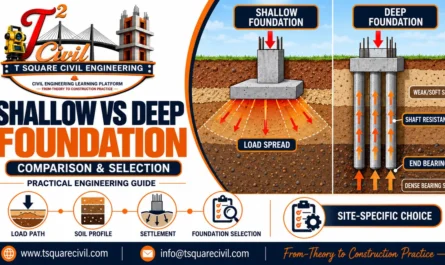
For a comparison of foundation systems, refer to Shallow vs Deep Foundation.
Relevant Indian Standards
The following standards may be relevant depending on the project:
- IS 6403:1981 — Code of practice for determination of bearing capacity of shallow foundations.
- IS 1904:2021 — General requirements for design and construction of foundations in soils.
- IS 1892:2021 — Subsurface investigation for foundations.
- IS 2131:2025 — Standard Penetration Test of Soil — Method of Test.
- IS 456:2000 — Plain and reinforced concrete, where applicable to foundation elements.
- IS 2911 series — Design and construction of pile foundations, where deep foundations are considered.
Always verify the latest applicable edition, amendments, project specifications and authority requirements before using a standard for design or construction.
Interview and Viva Questions
What is safe bearing capacity?
Safe bearing capacity is the allowable soil pressure that can be applied by a foundation without shear failure and with acceptable settlement.
What is ultimate bearing capacity?
Ultimate bearing capacity is the pressure at which the supporting soil reaches a shear-failure condition.
What is the difference between net and gross bearing capacity?
Gross bearing capacity includes the overburden pressure at foundation level. Net bearing capacity excludes the existing overburden pressure.
Is bearing capacity the same as settlement?
No. Bearing capacity relates mainly to soil shear resistance, while settlement relates to soil deformation and compressibility.
Can SPT N-value be directly converted into safe bearing capacity?
No. SPT values require suitable corrections, correlations and engineering interpretation.
Does greater foundation depth always provide greater safe bearing capacity?
No. The result depends on soil profile, groundwater, foundation geometry, settlement and construction conditions.
What is the unit of safe bearing capacity?
Safe bearing capacity is generally expressed in kN/m² or kPa.
1 kN/m² = 1 kPa
What happens if site soil differs from the report?
Construction should stop at the affected location and the responsible geotechnical or structural engineer should review the condition.
Frequently Asked Questions
Is safe bearing capacity the same for every soil?
No. It varies with soil strength, density, foundation size, foundation depth, groundwater, loading and settlement requirements.
Can safe bearing capacity be assumed from soil colour?
No. Soil colour alone cannot establish soil strength or allowable foundation pressure. Proper investigation and testing are required.
Is 100 kPa safe for every building?
No. A value such as 100 kPa cannot be treated as a universal safe bearing capacity. The required value depends on the structure and ground conditions.
Is safe bearing capacity the same as allowable bearing pressure?
The terms are sometimes used interchangeably in conventional practice, but their exact meaning depends on the design document. Always check whether the value is gross, net, ultimate or settlement-controlled.
How is safe load calculated?
For a simple concentric loading condition:
Safe load = Allowable pressure × Foundation area
Actual design must also include self-weight, moments, eccentricity, settlement and structural checks.
Does groundwater always reduce bearing capacity?
Groundwater can reduce effective stress and alter the relevant unit weight, but the exact effect depends on water-table position, soil type, drainage condition and foundation geometry.
Can a plate-load test alone determine the final foundation pressure?
A plate-load test provides information about local load-deformation behaviour, but the result must be interpreted for foundation size, depth, soil layering, groundwater and project settlement requirements.
Can the safe bearing capacity of nearby land be used?
Not automatically. Nearby sites may have different soil layers, groundwater conditions, fill depths and foundation levels. Project-specific verification is required.
What should be stated in a geotechnical report?
The report should state the recommended pressure, gross or net basis, foundation level, settlement criterion, groundwater assumption, load condition, limitations and construction requirements.
Related Civil Engineering Guides
- Foundation in Civil Engineering: Types, Selection, Construction and Common Problems
- Shallow vs Deep Foundation: Differences, Types, Selection Criteria and Applications
- Site Investigation for Foundation Design: Methods, Tests, Procedure and Report
- Civil Engineering Lab Test
- Civil Engineering Articles
Conclusion
Safe bearing capacity is an important foundation-design parameter, but it should never be treated as a universal soil value.
A reliable recommendation must clearly identify:
- Soil and foundation conditions
- Gross or net pressure
- Ultimate or allowable value
- Factor of safety
- Settlement basis
- Groundwater condition
- Load condition
- Foundation level
- Design limitations
The final foundation pressure should be selected only after proper site investigation, geotechnical analysis, settlement evaluation and review by qualified professionals.
References and Further Reading
- Bureau of Indian Standards, IS 6403:1981, Code of practice for determination of bearing capacity of shallow foundations.
- Bureau of Indian Standards, IS 1904:2021, General requirements for design and construction of foundations in soils.
- Bureau of Indian Standards, IS 1892:2021, Subsurface investigation for foundations.
- Bureau of Indian Standards, IS 2131:2025, Standard Penetration Test of Soil — Method of Test.
- Relevant project specifications, geotechnical reports and approved foundation-design documents.
Always verify the latest applicable editions and amendments before design or construction.
About T Square Civil Engineering
T Square Civil Engineering is a civil engineering learning platform created to support students, site engineers and construction professionals with practical and easy-to-understand educational resources.
Our content includes guides, worked examples, calculators and industry-focused learning materials designed to connect engineering theory with real-world construction practice.
Disclaimer
The information on this website is provided for educational purposes only.
This article is not a substitute for professional advice, site-specific soil investigation, approved structural or geotechnical design, drawings, specifications, calculations, qualified supervision or local regulatory requirements. Actual foundation decisions must be based on verified site data, the latest applicable standards, project requirements and review and approval by qualified civil and geotechnical engineers.