
 by
by Page Contents
Cold Joints in Concrete
Cold joints in concrete are one of the most common construction defects that occur when fresh concrete is placed against concrete that has already begun to set, resulting in poor bonding between the two layers. Unlike properly planned construction joints, cold joints are generally unintentional and may adversely affect the strength, durability, watertightness, and appearance of reinforced concrete structures.
Cold joints commonly develop due to interruptions in concrete placement caused by equipment breakdown, delays in concrete supply, inadequate manpower, poor planning, or adverse weather conditions. If appropriate preventive measures are not adopted, they can become weak planes within the concrete, allowing water penetration and increasing the risk of reinforcement corrosion.
Understanding the causes, identification, prevention, and repair of cold joints is essential for civil engineers, contractors, quality control personnel, and students to ensure durable and high-quality concrete construction.
Quick Answer
A Cold Joint in Concrete is an unplanned joint formed when fresh concrete is placed against concrete that has partially or completely lost its plasticity due to a delay in placement. This interruption prevents proper bonding between successive layers of concrete, creating a potential weak plane that may reduce structural performance and durability if not properly treated.
Quick Information Table
| Particular | Details |
|---|---|
| Defect Type | Construction defect |
| Stage of Occurrence | During concrete placement |
| Primary Cause | Delay between successive concrete placements |
| Typical Location | Construction lifts, slabs, beams, columns, walls and foundations |
| Appearance | Visible line or plane separating two concrete layers |
| Structural Significance | May reduce bond, watertightness and durability if untreated |
| Prevention | Continuous concreting, proper planning and adequate supervision |
| Repair | Depends on the severity, location and structural requirements |
| Applicable Standards | IS 456, IS 1199 (Part 2), IS 7861 (Part 1) and other relevant standards (summarised) |
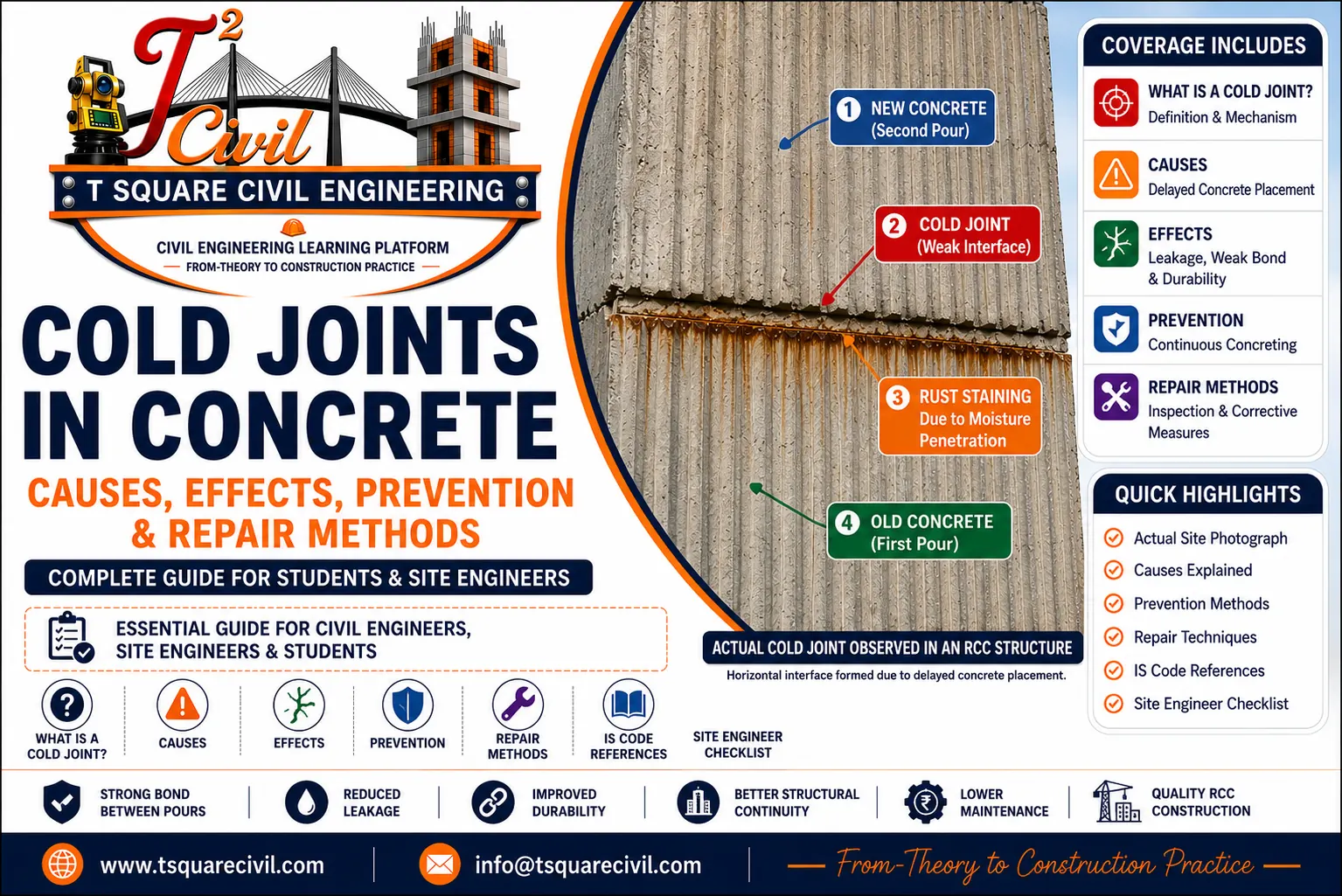
What are Cold Joints in Concrete?
A Cold Joint is an unintentional discontinuity that forms when one layer of concrete hardens or begins to set before the next layer is placed. Because the earlier layer has lost sufficient plasticity, the newly placed concrete cannot develop a proper monolithic bond with it.
The resulting interface acts as a plane of weakness that may permit water seepage, reduce structural integrity, and affect the durability of the concrete member if not properly addressed.
Cold joints should not be confused with construction joints, which are intentionally planned and detailed in accordance with the structural design.
Why are Cold Joints Important?
Cold joints can significantly influence the long-term performance of reinforced concrete structures.
Their importance includes:
- Reduce the bond between concrete layers.
- Increase the possibility of water leakage.
- Increase permeability.
- Accelerate reinforcement corrosion.
- Reduce durability.
- Affect structural continuity.
- Increase maintenance and repair costs.
- Reduce the service life of the structure.
Early identification and proper corrective measures are therefore essential.
Objectives of Understanding Cold Joints
Understanding cold joints enables engineers to:
- Identify unplanned construction defects.
- Differentiate cold joints from construction joints.
- Improve concrete placement planning.
- Maintain continuity during concreting.
- Enhance structural durability.
- Reduce repair costs.
- Improve overall construction quality.
Mechanism of Cold Joint Formation
Cold joints develop when the continuity of concrete placement is interrupted.
The sequence is generally as follows:
- The first layer of concrete is placed and compacted.
- An unexpected delay occurs before the next layer is placed.
- The previously placed concrete begins to lose its plasticity and starts setting.
- Fresh concrete is subsequently placed over the partially hardened concrete.
- Because proper intermixing does not occur, a weak interface forms.
- This interface becomes known as a Cold Joint.
The longer the interruption, the greater the likelihood of poor bonding between the two layers.
Characteristics of Cold Joints
Cold joints possess several identifiable characteristics that assist engineers during site inspection.
Typical Characteristics
- Visible straight or irregular line between concrete layers.
- Clearly distinguishable interface.
- Poor bond between successive concrete placements.
- May allow water seepage.
- Often associated with changes in concrete texture or colour.
- Frequently observed after delays in concreting.
- Usually located horizontally but may also occur vertically depending on the construction sequence.
Types of Cold Joints
Cold joints may be classified according to their orientation and location.
Horizontal Cold Joints
These occur between successive horizontal layers of concrete.
Examples
- Slabs
- Raft foundations
- Thick footings
- Mass concrete
Vertical Cold Joints
These occur when adjacent concrete sections are cast at different times without adequate bonding.
Examples
- Shear walls
- Retaining walls
- Lift walls
- Water tanks
Inclined Cold Joints
These are less common and may develop where concrete placement is uneven or interrupted on sloping surfaces.
Where Do Cold Joints Commonly Occur?
Cold joints are most frequently observed in structures requiring large volumes of concrete or multiple lifts.
Typical locations include:
- RCC slabs
- Beams
- Columns
- Retaining walls
- Shear walls
- Water tanks
- Raft foundations
- Machine foundations
- Bridge decks
- Mass concrete structures
Difference Between Cold Joint and Construction Joint
| Property | Cold Joint | Construction Joint |
|---|---|---|
| Formation | Unplanned | Planned |
| Purpose | Undesirable construction defect | Intended construction sequence |
| Bond | Generally weaker | Designed to achieve proper bond |
| Structural Performance | May reduce continuity if untreated | Considered during structural design |
| Treatment | Requires inspection and corrective action | Prepared according to approved construction procedures |
Why Site Engineers Should Understand Cold Joints
Every site engineer should be able to identify cold joints because they directly affect construction quality and long-term structural performance.
Knowledge of cold joints helps engineers to:
- Plan concrete placement effectively.
- Minimise construction delays.
- Improve coordination between batching, transportation, and placement.
- Maintain proper quality control.
- Reduce future repair costs.
- Improve the durability and service life of reinforced concrete structures.
Key Learning Points
- Cold joints are unplanned construction defects.
- They occur when fresh concrete is placed against concrete that has already started setting.
- They are different from planned construction joints.
- Delays during concrete placement are the primary cause.
- Proper planning, uninterrupted concreting, and effective supervision are the most effective preventive measures.
- Early detection and appropriate treatment improve structural durability and service performance.
Causes of Cold Joints in Concrete
Cold joints are primarily caused by interruption in the continuous placement of concrete. When the previously placed concrete begins to lose its plasticity before the next layer is placed, a weak bond forms between the two layers.
The following are the major causes of cold joints in concrete.
Delay in Concrete Placement
The most common cause of cold joints is a significant delay between successive concrete pours.
If fresh concrete is not placed before the previously placed concrete begins to set, proper bonding cannot occur.
Common Reasons for Delay
- Traffic congestion affecting transit mixers.
- Delayed batching.
- Equipment breakdown.
- Concrete pump failure.
- Labour shortages.
- Poor site coordination.
Insufficient Concrete Supply
Concrete should be supplied continuously during placement.
An inadequate supply can interrupt concreting operations, resulting in the formation of cold joints.
Typical reasons include:
- Limited batching plant capacity.
- Insufficient transit mixers.
- Unexpected demand from multiple projects.
- Production delays.
Equipment Failure
Breakdown of construction equipment is another major cause.
Examples include:
- Concrete pump failure.
- Crane malfunction.
- Bucket lifting equipment failure.
- Vibrator breakdown.
- Generator failure.
Proper standby equipment should always be available for major concreting works.
Poor Planning of Concrete Placement
Inadequate planning before concreting often leads to interruptions.
Planning should include:
- Concrete quantity estimation.
- Concrete placing sequence.
- Equipment availability.
- Manpower allocation.
- Emergency backup arrangements.
Adverse Weather Conditions
Weather conditions may interrupt concrete placement.
Examples include:
- Heavy rainfall.
- Lightning.
- Strong winds affecting crane operations.
- Extremely high temperatures.
- Dust storms.
These situations may force temporary suspension of concreting.
Inadequate Manpower
Insufficient labour can delay placing, compacting, and finishing operations.
This results in:
- Slow concrete placement.
- Delayed vibration.
- Interrupted concreting.
Improper Layer Thickness
Concrete should be placed in layers of suitable thickness.
Very thick layers require more time for placement and compaction, increasing the possibility that the lower layer may begin setting before the upper layer is placed.
Delayed Compaction
Concrete should be compacted immediately after placement.
Delayed vibration may result in:
- Poor bonding.
- Honeycombing.
- Cold joints.
- Voids within the concrete.
Lack of Supervision
Poor supervision during concreting often results in:
- Delayed placement.
- Improper vibration.
- Poor coordination.
- Failure to recognise developing cold joints.
Continuous supervision by qualified engineers is essential.
Effects of Cold Joints in Concrete
Cold joints may affect both the appearance and long-term performance of reinforced concrete structures.
Reduced Bond Between Concrete Layers
Cold joints reduce the monolithic action between successive concrete layers.
The interface may behave as a weak plane under loading.
Reduced Structural Continuity
Structural members are intended to behave as a single continuous unit.
Cold joints interrupt this continuity and may reduce structural efficiency depending on their location and severity.
Water Leakage
Cold joints frequently become leakage paths.
This is particularly critical in:
- Water tanks.
- Reservoirs.
- Basements.
- Retaining walls.
- Swimming pools.
Increased Permeability
Poor bonding allows water and aggressive chemicals to penetrate the concrete more easily.
Reinforcement Corrosion
Moisture entering through cold joints may eventually reach the reinforcement, increasing the risk of corrosion.
Reduced Durability
Structures exposed to aggressive environments may deteriorate more rapidly when untreated cold joints are present.
Increased Maintenance Cost
Repairing leakage and deterioration after construction is significantly more expensive than preventing cold joints during concreting.
Poor Surface Appearance
Cold joints are often visible as distinct lines, reducing the aesthetic quality of exposed concrete surfaces.
Identification of Cold Joints
Proper identification is essential because cold joints may sometimes resemble construction joints or surface cracks.
Visual Characteristics
Cold joints generally exhibit:
- A visible line between two concrete layers.
- Change in concrete colour or texture.
- Straight or irregular interface.
- Localised discontinuity.
- Occasionally, slight separation along the joint.
Typical Locations
Cold joints are commonly observed in:
- Slabs.
- Beams.
- Columns.
- Retaining walls.
- Lift cores.
- Water-retaining structures.
- Raft foundations.
- Mass concrete.
Site Inspection Procedure
During inspection, the engineer should verify:
- Whether concreting was interrupted.
- Duration of the interruption.
- Surface condition of the first concrete layer.
- Quality of bonding.
- Presence of seepage.
- Visible separation or discontinuity.
- Compliance with approved construction procedures.
Severity Classification
Cold joints can be classified according to their apparent condition and potential effect on structural performance.
| Severity | Typical Observation | Recommended Action |
|---|---|---|
| Minor | Thin visible joint with good bonding and no leakage | Monitor during service and maintain proper curing |
| Moderate | Clearly visible joint with localised seepage or weak bonding | Detailed inspection and repair if required by project specifications |
| Severe | Continuous joint with poor bonding, leakage, or structural concern | Engineering evaluation and appropriate repair before further construction |
Note: The significance of a cold joint depends on its location, extent, structural function, exposure conditions, and project requirements.
Practical Site Examples
Example 1 – RCC Slab
Concrete placement stopped for approximately 90 minutes because of transit mixer delays.
When concreting resumed, a visible horizontal joint developed.
Cause: Delay in concrete supply.
Example 2 – Column
Concrete pumping was interrupted due to pump failure.
The lower concrete had already begun setting before placement resumed.
Cause: Equipment breakdown.
Example 3 – Retaining Wall
Heavy rainfall forced concreting to stop.
After the rain ended, fresh concrete was placed over partially set concrete.
Cause: Weather interruption.
Example 4 – Water Tank
Concrete placement continued after a prolonged interruption without adequate preparation of the existing surface.
Leakage later developed along the interface.
Cause: Poor bonding at the cold joint.
Engineering Case Study
Case Study: Cold Joint in an Underground Water Tank Wall
During construction of an underground reinforced concrete water tank, concrete placement was interrupted for approximately two hours because of a concrete pump malfunction.
Investigation
The quality control team observed:
- A continuous horizontal joint along the wall.
- Difference in surface colour between successive pours.
- Local water seepage during the water-tightness test.
- Inadequate preparation of the previously placed concrete before placement resumed.
Corrective Measures
- Detailed inspection of the affected area.
- Assessment by the project engineer.
- Repair using an approved repair method suitable for the project.
- Revision of the concreting plan to ensure backup equipment for future pours.
Lesson Learned
Proper planning, uninterrupted concrete placement, standby equipment, and effective supervision are essential to minimise the occurrence of cold joints.
Comparison with Other Concrete Defects
| Property | Cold Joint | Construction Joint | Honeycombing | Plastic Settlement Cracks |
|---|---|---|---|---|
| Formation | Unplanned interruption | Planned construction sequence | Poor compaction | Restrained settlement of fresh concrete |
| Stage of Occurrence | During concrete placement | Planned during construction | During concreting | Before concrete hardens |
| Appearance | Visible interface between concrete layers | Prepared joint surface | Voids with exposed aggregate | Straight cracks above reinforcement |
| Main Cause | Delay between concrete pours | Construction planning | Inadequate compaction | Restrained settlement |
| Primary Prevention | Continuous concreting | Proper joint preparation | Proper compaction | Proper workability and reinforcement detailing |
Key Learning Points
- Cold joints occur due to interruption in continuous concrete placement.
- Delay between successive concrete pours is the most common cause.
- Cold joints reduce bonding between concrete layers.
- They increase the risk of leakage, permeability, and reinforcement corrosion.
- Proper planning, uninterrupted concreting, and effective supervision are the best preventive measures.
- Early identification and timely corrective action improve the long-term durability of reinforced concrete structures.
Prevention of Cold Joints in Concrete
Cold joints can be prevented by careful planning, uninterrupted concrete placement, proper supervision, and effective quality control. Since cold joints are generally caused by delays during concreting, every effort should be made to maintain a continuous concreting operation.
Plan Concrete Placement Properly
Proper planning before concreting is the most effective way to prevent cold joints.
Planning Should Include
- Concrete quantity estimation.
- Pour sequence planning.
- Batching plant coordination.
- Transit mixer scheduling.
- Pump location planning.
- Backup equipment availability.
- Adequate manpower.
- Emergency response plan.
Site Tip: Never begin a major concrete pour without confirming that concrete supply and equipment are sufficient to complete the operation continuously.
Ensure Continuous Concrete Supply
Concrete should be supplied without unnecessary interruptions.
Good Practices
- Arrange sufficient transit mixers.
- Coordinate with the batching plant.
- Monitor transportation time.
- Keep reserve capacity available during large pours.
Continuous supply minimises delays between successive layers.
Maintain Proper Layer Thickness
Concrete should be placed in layers of suitable thickness to ensure proper compaction and bonding.
Excessively thick layers:
- Increase placement time.
- Delay compaction.
- Increase the possibility of cold joints.
Layer thickness should comply with the project specifications and approved method statement
Place Concrete Near Its Final Position
Concrete should always be deposited as close as possible to its final location.
Avoid:
- Excessive rehandling.
- Dragging concrete across the formwork.
- Moving concrete using vibrators.
Proper placement improves bonding between successive layers.
Compact Concrete Immediately
Each concrete layer should be compacted immediately after placement.
Best Practices
- Use suitable mechanical vibrators.
- Ensure overlap between successive vibration zones.
- Penetrate slightly into the previously placed plastic concrete to improve bonding.
- Avoid under-vibration.
- Avoid over-vibration.
Minimise Delays Between Layers
The time interval between placing successive layers should be as short as practicable.
If an unavoidable delay occurs:
- Assess the condition of the previously placed concrete.
- Follow the approved construction procedure before continuing the pour.
- Seek guidance from the project engineer if the concrete has begun to set.
Maintain Adequate Manpower
Ensure sufficient manpower for:
- Concrete placing.
- Vibration.
- Finishing.
- Supervision.
- Quality control.
Proper staffing helps maintain the required placing rate.
Keep Backup Equipment Ready
Standby equipment should be available during major concreting operations.
Recommended backup equipment includes:
- Concrete vibrators.
- Generator.
- Concrete pump (where feasible).
- Lighting equipment for night concreting.
- Communication equipment.
Monitor Weather Conditions
Weather conditions should be reviewed before concreting.
If adverse weather is expected:
- Adjust the concreting schedule.
- Protect freshly placed concrete.
- Provide rain covers where necessary.
- Follow approved hot or cold weather concreting procedures.
Repair Methods for Cold Joints
The repair method depends on the location, severity, service conditions, and structural significance of the cold joint. The selected repair technique should always comply with the project specifications and be approved by the responsible engineer.
Repair of Minor Cold Joints
Minor cold joints generally show no significant separation or leakage.
Procedure
Step 1
Inspect the joint thoroughly.
Step 2
Clean the surface to remove dust, laitance, loose particles, or contaminants.
Step 3
Apply an approved repair material where required by the project specifications.
Step 4
Cure the repaired area according to the repair material manufacturer’s recommendations.
Repair of Moderate Cold Joints
Moderate cold joints may require more extensive surface preparation.
Typical procedure:
- Inspect the entire joint.
- Remove weak or unsound concrete if necessary.
- Clean the interface thoroughly.
- Apply the approved bonding or repair system.
- Restore the concrete profile using an approved repair material.
- Cure adequately.
Repair of Severe Cold Joints
Where cold joints affect structural performance or watertightness, engineering assessment is essential.
Typical steps include:
- Detailed structural inspection.
- Measurement of the joint extent.
- Assessment of leakage or loss of bond.
- Selection of an appropriate repair technique.
- Post-repair inspection and documentation.
Quality Control Measures
Proper quality control before, during, and after concreting significantly reduces the occurrence of cold joints.
Before Concreting
- Verify reinforcement.
- Inspect formwork.
- Confirm concrete supply arrangements.
- Check pump availability.
- Inspect vibrators.
- Review the concreting sequence.
- Verify weather conditions.
- Conduct a pre-pour meeting.
During Concreting
- Monitor placing rate.
- Avoid unnecessary interruptions.
- Compact each layer properly.
- Maintain communication between the batching plant and the site.
- Record any delays.
- Ensure continuous supervision.
After Concreting
- Inspect the surface.
- Identify visible cold joints.
- Record observations.
- Repair defects where required.
- Review lessons learned before the next concrete pour.
Site Engineer Checklist
Before approving the concrete work, the Site Engineer should verify the following:
| Sl. No. | Inspection Item | Yes ✓ | No ✗ |
|---|---|---|---|
| 1 | Concrete supply is continuous. | ☐ | ☐ |
| 2 | Reinforcement inspection is complete. | ☐ | ☐ |
| 3 | Formwork is secure and leak-proof. | ☐ | ☐ |
| 4 | Vibrators are available and operational. | ☐ | ☐ |
| 5 | Backup equipment is available. | ☐ | ☐ |
| 6 | Layer thickness is within specification. | ☐ | ☐ |
| 7 | Concrete is placed near its final position. | ☐ | ☐ |
| 8 | Each layer is compacted immediately. | ☐ | ☐ |
| 9 | No excessive interruption occurred during concreting. | ☐ | ☐ |
| 10 | Surface inspection after concreting is satisfactory. | ☐ | ☐ |
Practical Site Tips
Tip 1
Schedule concrete pours during periods when continuous supply can be maintained.
Tip 2
Always confirm the availability of standby vibrators before starting large pours.
Tip 3
Coordinate closely with the batching plant to avoid interruptions in concrete delivery.
Tip 4
Monitor the condition of previously placed concrete if any delay occurs.
Tip 5
Record the start time, finish time, and any interruptions for every concrete pour as part of the quality records.
Common Mistakes Leading to Cold Joints
- Poor planning of concrete pours.
- Insufficient concrete supply.
- Delayed concrete delivery.
- Equipment breakdown without backup.
- Inadequate manpower.
- Improper vibration.
- Long delays between successive layers.
- Lack of communication between the batching plant and site.
- Failure to inspect the interface before resuming concreting.
Corrective Actions
| Problem Observed | Possible Cause | Corrective Action |
|---|---|---|
| Visible line between concrete layers | Delay during placement | Inspect the joint and repair if required by project specifications |
| Leakage along the joint | Poor bond between pours | Assess the extent of leakage and apply an approved repair method |
| Weak bond at the interface | Concrete placed after initial setting | Evaluate the joint and follow the approved repair procedure |
| Repeated cold joints in similar locations | Poor planning | Improve scheduling, concrete supply, and supervision |
| Frequent interruptions during concreting | Equipment or logistics issues | Arrange standby equipment and improve coordination with the batching plant |
Difference Between Cold Joint and Planned Construction Joint
| Property | Cold Joint | Planned Construction Joint |
|---|---|---|
| Purpose | Unintentional | Intentional |
| Planning | Not planned | Planned during design and construction |
| Surface Preparation | Usually absent | Prepared according to approved procedures |
| Bonding | May be weak | Designed to achieve satisfactory bond |
| Structural Performance | May be adversely affected | Considered in structural design |
Summary of Relevant IS Code References
The following Indian Standards provide general guidance on concrete construction, workmanship, quality control, and concrete placement. Always consult the latest official editions for complete technical requirements.
| Standard | General Purpose |
|---|---|
| IS 456 | Plain and Reinforced Concrete – Code of Practice, including requirements for workmanship, concreting, construction joints, curing, and durability. |
| IS 1199 (Part 2) | Methods for sampling and testing fresh concrete, including workability assessment before placement. |
| IS 10262 | Guidelines for concrete mix proportioning to achieve the required workability and performance. |
| IS 7861 (Part 1) | Recommended practices for concreting under hot weather conditions to reduce placement-related problems. |
Note: The information provided above is an original educational summary and should not be considered a substitute for the official Indian Standards.
Key Learning Points
- Cold joints are primarily caused by interruptions during concrete placement.
- Continuous concreting is the most effective preventive measure.
- Proper planning, adequate manpower, and backup equipment significantly reduce the risk of cold joints.
- Immediate compaction and close coordination between the batching plant and the construction site are essential.
- Early inspection and timely repair improve the durability and long-term performance of reinforced concrete structures.
Frequently Asked Questions (FAQs)
1. What is a cold joint in concrete?
Answer:
A cold joint is an unplanned interface formed when fresh concrete is placed against concrete that has already started setting, resulting in inadequate bonding between the two layers.
2. Why are cold joints formed?
Answer:
Cold joints are mainly caused by delays during concrete placement due to interruptions in concrete supply, equipment failure, inadequate manpower, poor planning, or adverse weather conditions.
3. Are cold joints harmful?
Answer:
Yes. If left untreated, cold joints may reduce bond strength, increase permeability, cause water leakage, accelerate reinforcement corrosion, and reduce the durability of the structure
4. Where do cold joints commonly occur?
Answer:
Cold joints commonly occur in:
- RCC slabs
- Beams
- Columns
- Retaining walls
- Water tanks
- Raft foundations
- Mass concrete structures
5. What is the difference between a cold joint and a construction joint?
Answer:
A construction joint is intentionally planned and detailed as part of the construction sequence, whereas a cold joint is an unintended defect caused by interruption during concrete placement.
6. How can a cold joint be identified?
Answer:
Cold joints generally appear as a visible line or interface between two concrete layers, often accompanied by a change in texture or colour.
7. Can cold joints cause leakage?
Answer:
Yes. Cold joints can become pathways for water seepage, especially in water-retaining structures such as tanks, reservoirs, and basements.
8. Can cold joints affect structural strength?
Answer:
Depending on their location and severity, cold joints may reduce structural continuity and bonding between concrete layers, potentially affecting performance.
9. How can cold joints be prevented?
Answer:
Cold joints can be minimised by ensuring continuous concrete placement, proper planning, adequate manpower, timely compaction, and effective supervision.
10. Can cold joints be repaired?
Answer:
Yes. Repair methods depend on the location, severity, structural significance, and project requirements. A qualified engineer should assess significant cold joints before selecting the repair method.
11. Does weather affect the formation of cold joints?
Answer:
Yes. Heavy rainfall, extreme temperatures, or other adverse weather conditions can interrupt concreting operations and increase the risk of cold joints.
12. Why is continuous concrete placement important?
Answer:
Continuous placement ensures that successive concrete layers bond properly before the earlier layer begins to set.
13. What is the role of vibration in preventing cold joints?
Answer:
Proper vibration consolidates fresh concrete and helps achieve good bonding between successive layers when concreting is continuous.
14. Should cold joints always be repaired?
Answer:
Not necessarily. Minor cold joints may only require monitoring, while moderate or severe cold joints should be evaluated and repaired as required by the project specifications and the responsible engineer.
15. Why is planning essential before major concrete pours?
Answer:
Proper planning helps ensure continuous concrete supply, adequate equipment, sufficient manpower, and effective coordination, reducing the likelihood of cold joints
Civil Engineering Interview Questions with Answers
1. Define a cold joint in concrete.
Answer:
A cold joint is an unplanned discontinuity formed when fresh concrete is placed against concrete that has already started setting, resulting in inadequate bonding between the two concrete layers.
2. What is the primary cause of cold joints?
Answer:
The primary cause is an interruption in continuous concrete placement, allowing the previously placed concrete to begin setting before the next layer is placed.
3. Why are cold joints considered undesirable?
Answer:
They create weak interfaces that may reduce bond strength, increase permeability, cause leakage, and reduce durability.
4. How can site engineers minimise cold joints?
Answer:
By ensuring continuous concreting, proper planning, adequate manpower, standby equipment, effective supervision, and timely compaction.
5. Which structures are most susceptible to cold joints?
Answer:
Water tanks, retaining walls, basements, raft foundations, bridge decks, shear walls, and mass concrete structures are particularly susceptible
6. How can cold joints be identified during inspection?
Answer:
By observing visible interfaces, changes in concrete texture or colour, seepage, or evidence of interrupted concreting.
7. What is the difference between a cold joint and honeycombing?
Answer:
A cold joint results from delayed concrete placement, whereas honeycombing is caused by inadequate compaction or poor concrete flow.
8. Why should standby equipment be available during concreting?
Answer:
Standby equipment helps avoid interruptions caused by equipment failure, reducing the likelihood of cold joint formation.
9. Can cold joints occur in columns?
Answer:
Yes. They can occur in columns if concrete placement is interrupted before the previous layer has adequately bonded with the next.
10. What quality control measures reduce cold joints?
Answer:
Proper planning, continuous concrete supply, inspection of equipment, monitoring placement intervals, timely vibration, and effective site supervision.
Viva Questions with Answers
1. What is a cold joint?
Answer: An unplanned joint caused by delayed concrete placement.
2. When do cold joints form?
Answer: During concreting when placement is interrupted.
3. What is the main cause?
Answer: Delay between successive concrete layers.
4. Are cold joints planned?
Answer: No.
5. What is the planned equivalent?
Answer: A construction joint.
6. Can cold joints cause leakage?
Answer: Yes.
7. Which structures are most affected?
Answer: Water-retaining and heavily reinforced concrete structures.
8. How can cold joints be prevented?
Answer: By continuous concrete placement and proper planning.
9. Does vibration help?
Answer: Yes. Proper vibration improves consolidation and bonding when concrete is placed continuously.
10. Is supervision important?
Answer: Yes. Effective supervision helps identify and prevent delays during concreting.
11. Can equipment failure cause cold joints?
Answer: Yes.
12. Does weather influence cold joint formation?
Answer: Yes.
13. Can cold joints reduce durability?
Answer: Yes.
14. Which IS Code provides general guidance for concrete construction?
Answer: IS 456 (latest applicable edition).
15. Should visible cold joints always be ignored?
Answer: No. They should be inspected and evaluated before deciding on corrective action.
Important Examination Questions
Short Answer Questions (2–5 Marks)
- Define a cold joint in concrete.
- State the causes of cold joints.
- Mention four preventive measures for cold joints.
- Differentiate between a cold joint and a construction joint.
- Explain the effects of cold joints on durability.
- List the locations where cold joints commonly occur.
- Explain the role of continuous concrete placement.
- State the importance of proper planning during concreting.
- Mention quality control measures to prevent cold joints.
- Explain the significance of timely compaction.
Long Answer Questions (10–15 Marks)
- Explain cold joints in concrete with suitable sketches, causes, effects, prevention, repair methods, and practical site considerations.
- Discuss the importance of uninterrupted concrete placement in preventing cold joints.
- Describe the quality control measures adopted during concreting to minimise cold joints.
- Compare cold joints, construction joints, honeycombing, and plastic settlement cracks.
- Explain the repair methods for cold joints with practical construction examples.
Quick Revision Notes
- Cold joints are unplanned construction defects.
- They occur when fresh concrete is placed against concrete that has already started setting.
- The primary cause is interruption during concrete placement.
- Cold joints reduce bonding between successive concrete layers.
- They may increase permeability, leakage, reinforcement corrosion, and maintenance costs.
- Continuous concrete placement, proper planning, adequate manpower, and effective supervision are the best preventive measures.
- Cold joints should be inspected and assessed before selecting an appropriate repair method.
Conclusion
Cold joints in concrete are one of the most common construction defects encountered during reinforced concrete construction. They occur when there is an unintended interruption in concrete placement, allowing the previously placed concrete to lose its plasticity before the next layer is placed. As a result, proper bonding between successive concrete layers is not achieved, creating a potentially weak interface within the structure.
Although cold joints may not always result in immediate structural failure, they can significantly affect the long-term performance of concrete structures. They may reduce structural continuity, increase permeability, permit water leakage, accelerate reinforcement corrosion, reduce durability, and increase maintenance costs. In water-retaining structures, basements, bridges, and other critical infrastructure, untreated cold joints may lead to serious serviceability problems if appropriate preventive measures are not adopted.
Cold joints can be effectively prevented through proper planning, continuous concrete placement, adequate manpower, reliable equipment, effective supervision, timely compaction, and strict quality control. When unavoidable interruptions occur, the condition of the previously placed concrete should be carefully assessed, and appropriate construction procedures should be followed before continuing the concrete placement.
For civil engineering students, site engineers, QA/QC professionals, contractors, consultants, and competitive examination aspirants, understanding cold joints is essential for ensuring durable, watertight, and high-quality reinforced concrete construction. Proper planning and early corrective action remain the most effective approaches for minimising cold joint-related problems.
Key Takeaways
- Cold joints are unplanned construction defects caused by interruptions during concrete placement.
- They form when fresh concrete is placed against concrete that has already begun to set.
- Cold joints are different from planned construction joints.
- Poor bonding between concrete layers may reduce durability and watertightness.
- Continuous concrete placement is the most effective preventive measure.
- Proper planning, backup equipment, adequate manpower, and effective supervision significantly reduce the occurrence of cold joints.
- Early inspection and timely repair improve the long-term performance of reinforced concrete structures.
Related Articles
Continue learning with these related articles on TSquareCivil.com:
Concrete Technology
- Workability of Concrete
- Slump Cone Test of Concrete
- Flow Table Test of Concrete
- Compaction Factor Test
- Vee Bee Consistometer Test
- Bleeding of Concrete
- Segregation of Concrete
- Honeycombing in Concrete
- Plastic Shrinkage Cracks in Concrete
- Plastic Settlement Cracks in Concrete
- Surface Crazing in Concrete
- Curing of Concrete
- Permeability of Concrete
- Durability of Concrete
- Carbonation of Concrete
- Sulphate Attack on Concrete
- Alkali–Aggregate Reaction
- Drying Shrinkage of Concrete
- Creep of Concrete
Concrete Testing
- Concrete Cube Casting Procedure
- Compressive Strength Test of Concrete Cubes
- Rebound Hammer Test
- Ultrasonic Pulse Velocity (UPV) Test
Cement Testing
- Standard Consistency Test of Cement
- Initial Setting Time Test of Cement
- Final Setting Time Test of Cement
- Soundness Test of Cement
- Fineness Test of Cement
Related Calculators
Explore these practical engineering calculators on TSquareCivil.com:
- Steel Weight Calculator
- Concrete Volume Calculator
- Cement Bags Calculator
- Cement, Sand & Aggregate Calculator
- Concrete Quantity Calculator
- Bar Bending Schedule (BBS) Calculator
- Brick Quantity Calculator
- Plaster Quantity Calculator
- Tile Quantity Calculator
- Paint Quantity Calculator
- Lap Length Calculator
References
This article has been prepared using accepted engineering principles and reliable technical references.
Indian Standards
- IS 456:2000 – Plain and Reinforced Concrete – Code of Practice.
- IS 10262 (Latest Applicable Edition) – Concrete Mix Proportioning Guidelines.
- IS 1199 (Part 2):2018 – Sampling and Testing of Fresh Concrete.
- IS 7861 (Part 1) – Recommended Practice for Hot Weather Concreting.
Standard Reference Books
- M. S. Shetty – Concrete Technology
- A. M. Neville – Properties of Concrete
- S. C. Rangwala – Concrete Technology
Note: This article presents original educational explanations based on accepted engineering principles and standard technical references. Readers should always refer to the latest official editions of the applicable Indian Standards and project specifications for complete technical requirements.
T Square Civil Engineering
Civil Engineering Learning Platform: From Theory to Construction Practice
T Square Civil Engineering is dedicated to providing original, technically accurate, practical, and easy-to-understand civil engineering knowledge for students, engineers, educators, contractors, and construction professionals.
Every article is carefully developed using accepted engineering principles, practical construction practices, and trusted technical references. The objective is to simplify complex civil engineering concepts while maintaining technical accuracy and practical relevance.
The platform aims to become one of the most trusted Civil Engineering Learning Platforms, helping learners bridge the gap between engineering theory and real-world construction through original articles, practical site guides, engineering calculators, professional illustrations, and quality educational resources.
Website: www.tsquarecivil.com
Disclaimer
The information provided in this article is intended solely for educational and informational purposes.
Every effort has been made to ensure that the content is technically accurate and based on accepted engineering principles and reliable engineering references. However, engineering decisions should always be made considering the latest applicable standards, project specifications, site conditions, and professional judgment.
Where Indian Standards (IS Codes) are referenced, the explanations are presented in simple language for educational purposes only and do not reproduce the official publications. Readers should always consult the latest official editions of the relevant standards for complete technical requirements.
T Square Civil Engineering shall not be responsible for any loss, damage, or consequences resulting from the use of the information presented in this article without appropriate professional verification.
Why This Article Matters
Cold joints are among the most common and preventable defects encountered during concrete construction. A thorough understanding of their causes, identification, prevention, and repair enables engineers to improve construction quality, maintain structural continuity, and enhance the durability and watertightness of reinforced concrete structures.
This guide combines engineering theory with practical site practices, making it a valuable reference for:
- Civil Engineering Students
- Site Engineers
- QA/QC Engineers
- Contractors
- Consultants
- Construction Supervisors
- Government Examination Aspirants
- Interview Candidates