
 by
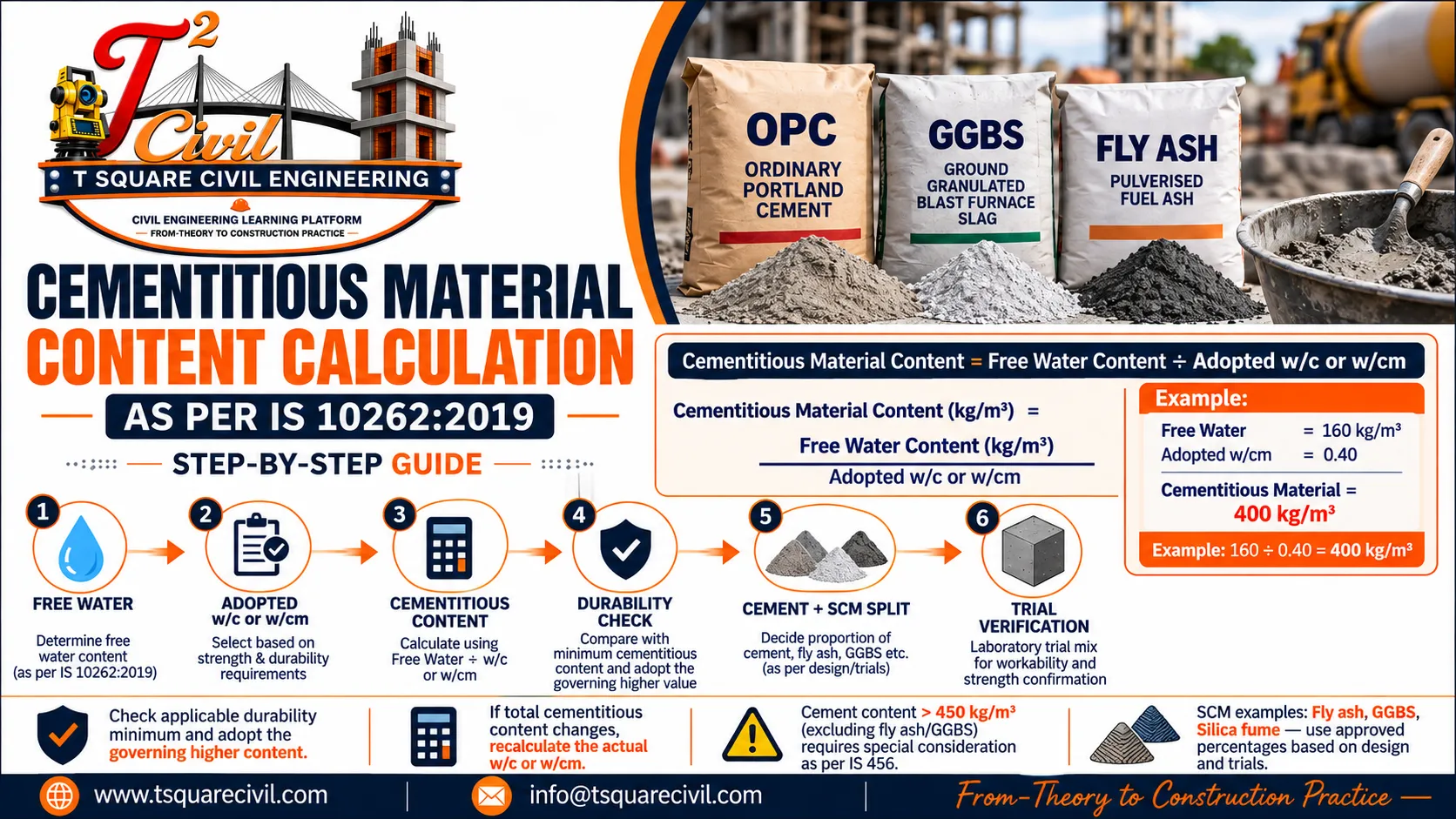
by Cementitious material content is one of the main calculations in concrete mix design. Once the preliminary free-water content and the adopted water-cement or water-cementitious materials ratio are known, the quantity of cementitious material required per cubic metre of concrete can be calculated.
The basic relationship is:
Cementitious Material Content = Free Water Content ÷ Adopted Water-Cementitious Materials Ratio
However, the calculation should not stop with this formula.
The resulting quantity must also be checked against:
- strength requirements;
- durability requirements;
- applicable minimum cement or cementitious-material requirements;
- maximum cement-content provisions;
- use of supplementary cementitious materials;
- workability;
- heat development;
- chemical admixture compatibility; and
- laboratory trial performance.
For the complete calculation sequence, first read our Concrete Mix Design Procedure as per IS 10262:2019.
You can also use the Concrete Mix Design Calculator as per IS 10262:2019 for preliminary calculations using your actual project inputs.
Page Contents
What Is Cementitious Material Content?
Cementitious material content is the total quantity of approved cementitious materials present in one cubic metre of concrete.
Depending on the concrete mix, this may include:
- cement;
- fly ash;
- ground granulated blast-furnace slag or GGBS;
- silica fume; and
- other approved supplementary cementitious materials.
For a concrete containing only OPC:
Cementitious Material Content = Cement Content
For concrete containing cement and an SCM:
Total Cementitious Material Content = Cement + Approved SCM
For example:
Cement = 300 kg/m³
GGBS = 100 kg/m³
Therefore:
Total cementitious material = 400 kg/m³
Cement Content and Cementitious Material Content Are Not Always the Same
This distinction is important in modern concrete mix design.
Cement Content
Cement content means the quantity of cement used per cubic metre.
Example:
Cement = 320 kg/m³
Cementitious Material Content
Cementitious material content can include cement together with approved supplementary cementitious materials.
Example:
Cement = 300 kg/m³
GGBS = 100 kg/m³
Therefore:
Cement content = 300 kg/m³
but:
Total cementitious material content = 400 kg/m³
The distinction must be clearly maintained when calculating water-cementitious ratio, absolute volumes and material quantities.
Scope of This Calculation
The basic relationship between free water, water-cementitious ratio and cementitious-material content applies throughout concrete mix proportioning.
However, IS 10262:2019 contains separate proportioning provisions for ordinary, standard, high-strength and certain special concretes.
Therefore, individual limits, supplementary-material provisions and trial requirements should always be checked against the section of the standard applicable to the concrete being designed.
This article explains the fundamental calculation and practical checks that apply to conventional concrete mix-design work.
Step 1: Determine the Preliminary Free-Water Content
The cementitious-material calculation should be carried out only after the preliminary free-water requirement has been established.
Water demand depends on several factors, including:
- nominal maximum aggregate size;
- required slump;
- aggregate shape;
- aggregate surface texture;
- grading;
- chemical admixture; and
- actual trial behaviour.
For example, suppose the calculated preliminary free-water content is:
158 kg/m³
This becomes the water quantity used in the cementitious-material calculation.
For the complete water-selection procedure, see Water Content Calculation in Concrete Mix Design as per IS 10262:2019.
Step 2: Select the Governing Water-Cement or Water-Cementitious Ratio
The next input is the adopted water-cement or water-cementitious materials ratio.
This value should satisfy both:
strength requirement
and
durability requirement
The strength-based ratio should be developed using appropriate strength relationships, available data and trial results for the actual materials.
It should then be checked against the applicable maximum ratio required for durability.
The more restrictive requirement governs.
For example:
Strength consideration gives:
w/cm = 0.42
Durability requirement permits a maximum:
w/cm = 0.40
Then the preliminary design should not continue with 0.42.
The governing value is:
w/cm = 0.40
The detailed selection process is explained in Water-Cement Ratio in Concrete.
Step 3: Calculate the Cementitious Material Content
Once the free water and governing ratio are known:
Cementitious Material Content = Free Water Content ÷ Adopted w/cm
Example
Free water:
158 kg/m³
Adopted w/cm:
0.40
Therefore:
Cementitious material content
= 158 ÷ 0.40
= 395 kg/m³
So the preliminary calculated total cementitious-material content is:
395 kg/m³
This is not automatically the final approved quantity.
It must next be checked against durability and other applicable requirements.
Cement-Only Concrete Calculation
If cement is the only cementitious material, the basic calculation becomes:
Cement Content = Free Water ÷ Adopted Water-Cement Ratio
Example
Free water:
165 kg/m³
Adopted w/c:
0.45
Cement content:
= 165 ÷ 0.45
= 366.67 kg/m³
Say:
367 kg/m³
The calculated quantity should then be checked against the applicable durability and project requirements.
Step 4: Check the Minimum Requirement for Durability
The calculated cementitious-material quantity should not be adopted without checking the applicable durability requirements.
Suppose the direct calculation gives:
325 kg/m³
but the applicable requirement for the project is:
340 kg/m³
Then the lower calculated quantity should not simply be used.
The governing quantity becomes:
340 kg/m³
subject to the applicable code provisions and project specification.
The water-cementitious ratio should then be recalculated using the adopted quantity.
Example
Free water:
155 kg/m³
Adopted cementitious material:
340 kg/m³
Actual w/cm:
= 155 ÷ 340
= 0.456
This value must again be checked against the applicable maximum ratio.
This illustrates an important point:
Concrete mix design is an iterative calculation.
A change in one important input may require another parameter to be recalculated.
Minimum Cement Requirement Should Not Be Checked in Isolation
A common mistake is to check only the minimum cement quantity and assume the concrete is automatically durable.
Durability depends on the complete concrete system.
Important factors include:
- free water-cementitious ratio;
- concrete grade;
- cementitious materials;
- aggregate quality;
- permeability;
- compaction;
- curing;
- cover to reinforcement; and
- exposure conditions.
Meeting a minimum cement requirement does not compensate for poor control of the water-cement ratio or poor construction practice.
Step 5: Check the Maximum Cement Content
Very high cement content should also be avoided unless technically justified.
Under the current IS 456 provision, cement content excluding mineral admixtures such as fly ash and GGBS should not normally exceed 450 kg/m³ unless special consideration is given to the associated risks.
This provision is important because excessive cement can increase:
- heat generation;
- early thermal cracking risk;
- drying-shrinkage cracking;
- paste volume; and
- risk associated with alkali-silica reaction under relevant conditions.
Important Distinction
The 450 kg/m³ provision refers to cement content excluding fly ash and GGBS.
It should not automatically be interpreted as:
Maximum total cementitious material = 450 kg/m³
For example, a technically developed mix may contain:
Cement = 390 kg/m³
GGBS = 100 kg/m³
Total cementitious material:
= 490 kg/m³
The cement component is:
390 kg/m³
not 490 kg/m³.
Whether such a total binder content is suitable still depends on the applicable concrete category, project specification, thermal behaviour, durability requirements and successful trials.
Why More Cement Does Not Automatically Mean Better Concrete
A common misconception is:
More cement = stronger and more durable concrete
This is not necessarily true.
Consider two simplified mixes.
Mix A
Cement = 450 kg/m³
Water = 225 kg/m³
w/c:
= 225 ÷ 450
= 0.50
Mix B
Total cementitious material = 400 kg/m³
Water = 160 kg/m³
w/cm:
= 160 ÷ 400
= 0.40
It would be incorrect to conclude that Mix A is automatically better simply because it contains more cement.
Concrete performance depends on the complete combination of:
- free water;
- binder system;
- aggregate;
- admixture;
- compaction;
- curing; and
- production control.
Step 6: Decide Whether Supplementary Cementitious Materials Will Be Used
Concrete may contain supplementary cementitious materials such as:
- fly ash;
- GGBS;
- silica fume; or
- another approved material.
Their use may be considered for reasons such as:
- durability;
- later-age strength;
- reduced heat development;
- permeability control;
- workability;
- sustainability;
- resistance to specific exposure conditions; and
- project specifications.
SCM quantity should not be selected from a universal percentage found online.
The appropriate proportion depends on:
- SCM type;
- SCM quality;
- cement type;
- strength development;
- curing;
- exposure;
- required durability;
- chemical admixture compatibility; and
- actual trial results.
The relevant material properties should be obtained before proportioning. See Material Tests Required Before Concrete Mix Design for the required input data.
Step 7: Calculate Cement and SCM Quantities
Once the total cementitious-material content and adopted SCM percentage are established, individual quantities can be calculated.
If:
Total cementitious material = C
SCM percentage of total cementitious material = P
then:
SCM Quantity = C × P ÷ 100
and:
Cement Quantity = C − SCM Quantity
Example
Total cementitious material:
400 kg/m³
Adopted GGBS proportion:
30% of total cementitious material
GGBS:
= 400 × 30/100
= 120 kg/m³
Cement:
= 400 − 120
= 280 kg/m³
Therefore:
| Material | Quantity |
|---|---|
| Cement | 280 kg/m³ |
| GGBS | 120 kg/m³ |
| Total Cementitious Material | 400 kg/m³ |
The percentage basis should always be clearly stated.
For example, do not simply write:
“30% GGBS”
without clarifying whether it means 30% of total cementitious material or another specified replacement basis.
Step 8: Consider Whether an Increase in Total Cementitious Material Is Required for an SCM Trial
When cement is partly replaced by fly ash, GGBS, silica fume or another approved supplementary material, the directly calculated total cementitious-material content is not always the final trial value.
Depending on the SCM, replacement level, strength-development requirement and previous experience, an increase in total cementitious content may be considered for preliminary trials.
This is not a compulsory increase for every SCM concrete.
The decision should be based on:
- previous experience;
- material quality;
- required strength;
- curing conditions;
- project specification; and
- laboratory trials.
For relevant ordinary/standard concrete cases, IS 10262 permits a 10% increase in the calculated cementitious-material content as a preliminary trial option where such an increase is considered necessary.
The water-cementitious materials ratio must then be recalculated using the increased total cementitious content.
Example: 10% Preliminary Increase in Cementitious Material
Suppose:
Free water:
160 kg/m³
Initial w/cm:
0.40
Calculated cementitious material:
= 160 ÷ 0.40
= 400 kg/m³
Suppose the selected SCM system justifies a 10% increase for the preliminary trial.
Revised cementitious material:
= 400 × 1.10
= 440 kg/m³
The water remains:
160 kg/m³
Therefore, the revised actual w/cm becomes:
160 ÷ 440
= 0.364
Say approximately:
0.36
This is important.
Do not continue reporting:
w/cm = 0.40
after changing the total cementitious-material content to 440 kg/m³.
The ratio must be recalculated.
Example With Fly Ash
Suppose:
Revised cementitious material:
440 kg/m³
Fly ash:
25% of total cementitious material
Fly ash quantity:
= 440 × 25/100
= 110 kg/m³
Cement quantity:
= 440 − 110
= 330 kg/m³
Therefore:
| Material | Quantity |
|---|---|
| Cement | 330 kg/m³ |
| Fly ash | 110 kg/m³ |
| Total Cementitious Material | 440 kg/m³ |
| Free Water | 160 kg/m³ |
| Actual w/cm | 0.364 |
The 25% value is used here only to demonstrate the calculation.
It is not a universal fly-ash percentage.
Step 9: Calculate Chemical Admixture Quantity
Chemical admixture dosage is commonly related to the quantity of cement or total cementitious material, depending on the manufacturer’s stated dosage basis.
Always check the product technical data before calculating the dosage.
If the selected superplasticizer dosage is specified as:
0.8% by mass of total cementitious material
and:
Total cementitious material = 400 kg/m³
then:
Admixture quantity:
= 400 × 0.8/100
= 3.2 kg/m³
If the admixture is liquid, its:
- specific gravity;
- solids content where relevant; and
- water contribution
may also need to be considered.
For a detailed explanation, see Superplasticizer in Concrete Mix Design.
Step 10: Include Cementitious Materials in the Absolute-Volume Calculation
After selecting the preliminary binder quantities, each cementitious material should be included separately in the absolute-volume calculation.
The general formula is:
Absolute Volume = Mass ÷ (Specific Gravity × 1000)
For cement:
Vc = Cement Mass ÷ (Specific Gravity of Cement × 1000)
For GGBS:
Vggbs = GGBS Mass ÷ (Specific Gravity of GGBS × 1000)
For fly ash:
Vfa = Fly Ash Mass ÷ (Specific Gravity of Fly Ash × 1000)
Different cementitious materials have different specific gravities.
Therefore:
300 kg of cement does not occupy the same absolute volume as 300 kg of fly ash or GGBS.
This difference affects the volume remaining for fine and coarse aggregate.
Example of Cement Absolute Volume
Suppose:
Cement = 300 kg/m³
Specific gravity of cement = 3.15
Absolute volume:
= 300 ÷ (3.15 × 1000)
= 0.0952 m³
Suppose:
GGBS = 100 kg/m³
and its tested specific gravity is 2.90.
Volume of GGBS:
= 100 ÷ (2.90 × 1000)
= 0.0345 m³
The volumes should be included separately when determining the remaining aggregate volume.
Use actual approved material properties rather than copying assumed specific-gravity values from another project.
Why Specific Gravity Matters
Concrete mix proportioning is carried out for a required total volume, commonly:
1 m³ of concrete
Therefore, it is not enough to know only the mass of each ingredient.
The volume occupied by that mass must also be known.
Incorrect cementitious-material specific gravity can change:
- calculated paste volume;
- aggregate volume;
- fine aggregate quantity;
- coarse aggregate quantity; and
- final concrete yield.
Representative input data should therefore be obtained before beginning the mix calculation.
Step 11: Prepare the Preliminary Mix Quantities
After the preliminary calculation, prepare a clear summary.
For example:
| Material | Preliminary Quantity |
|---|---|
| Cement | 330 kg/m³ |
| Fly ash | 110 kg/m³ |
| Total Cementitious Material | 440 kg/m³ |
| Free Water | 160 kg/m³ |
| Fine Aggregate | ___ kg/m³ |
| Coarse Aggregate | ___ kg/m³ |
| Chemical Admixture | ___ kg/m³ |
| Actual w/cm | 0.364 |
These are preliminary trial quantities.
They are not automatically the approved production mix.
Cementitious Content and Aggregate Moisture Are Different Issues
Aggregate moisture correction does not mean the designed cementitious-material content should be randomly changed.
The design free-water content and cementitious-material quantity establish the intended water-cementitious ratio.
During batching, wet aggregates may introduce free surface water.
The amount of water added separately at the mixer should therefore be corrected so that the intended free-water quantity remains controlled.
For the complete calculation, see Moisture Correction in Concrete Mix Design.
Cementitious Material Content and Workability
Cementitious material contributes to the paste phase of concrete.
Too little paste may produce concrete that is:
- harsh;
- difficult to compact;
- difficult to finish; or
- unsuitable for pumping.
However, excessive paste can also create problems.
A very high cementitious-material content may result in:
- sticky concrete;
- increased shrinkage;
- higher heat generation;
- higher cost; and
- increased cracking risk.
The objective should therefore be optimum, not maximum, binder content.
Cementitious Material Content in Pumped Concrete
Pumpable concrete requires sufficient mortar and paste to move through the pumping line without blockage or excessive segregation.
However, pumpability should not be achieved by increasing cement alone.
The complete mix should consider:
- aggregate grading;
- fine aggregate proportion;
- coarse aggregate content;
- cementitious-material volume;
- water content;
- admixture dosage; and
- slump retention.
Actual pumping behaviour should be verified where required.
Cementitious Material Content in High-Strength Concrete
High-strength concrete may use:
- lower water-cementitious ratios;
- high-range water-reducing admixtures;
- carefully selected aggregates;
- supplementary cementitious materials; and
- comparatively high binder contents.
However, high-strength concrete should not be designed simply by adding more cement.
IS 10262:2019 provides separate provisions for high-strength concrete, and these should be followed for applicable grades.
The grade-specific examples available through our Concrete Mix Design Hub should be treated as worked examples based on their stated inputs, not as universal mix proportions.
Trial Mix Verification
The calculated cementitious-material quantity is only the starting value for the laboratory trial.
The trial should evaluate:
- workability;
- cohesiveness;
- segregation;
- bleeding;
- finishing characteristics;
- fresh density where required;
- strength development; and
- other specified performance requirements.
A mathematically correct calculation does not guarantee that the actual material combination will perform satisfactorily.
For the complete verification process, read Concrete Trial Mix: Procedure, Adjustments & Approval.
What If Trial Strength Is Low?
If the trial mix does not achieve the required strength, do not immediately increase the cement quantity.
First investigate:
- actual free-water content;
- actual w/cm;
- aggregate moisture;
- batching accuracy;
- admixture dosage;
- cement properties;
- SCM properties;
- aggregate quality;
- compaction;
- curing; and
- testing procedure.
The required strength target itself should already have been established before this stage. See Target Mean Strength of Concrete for the statistical strength calculation used during mix proportioning.
What If the Mix Is Too Sticky?
An excessively sticky mix may result from:
- excessive paste volume;
- excessive fine material;
- high cementitious content;
- SCM characteristics;
- inappropriate fine/coarse aggregate proportion; or
- admixture interaction.
The solution should be developed through controlled trial adjustment.
Do not automatically reduce water, increase aggregate or decrease cement without considering the complete mix.
Common Mistakes in Cementitious Material Calculation
Using Concrete Grade in the Formula
Incorrect:
Cement = Water ÷ M30
Concrete grade is not used as the denominator.
Use the selected:
w/c or w/cm
Confusing Cement With Total Cementitious Material
If SCMs are used:
Cement ≠ Total Cementitious Material
unless cement is the only binder.
Ignoring the Durability Minimum
The directly calculated quantity may be lower than the applicable minimum requirement.
Always carry out the durability check.
Treating 450 kg/m³ as a Maximum Total Binder Content
This is incorrect.
The current IS 456 provision refers to cement content excluding mineral admixtures such as fly ash and GGBS, subject to its stated conditions.
Using a Universal SCM Percentage
Fly ash, GGBS and silica-fume contents should be selected according to the material, performance requirement and trials.
Automatically Increasing Binder by 10%
The 10% increase is a possible preliminary trial provision in applicable SCM situations.
It is not compulsory for every mix.
Forgetting to Recalculate w/cm
If total cementitious material changes while water remains unchanged, the actual w/cm also changes.
Increasing Cement Whenever Strength Is Low
Investigate the complete mix before changing the cementitious system.
Using Assumed Specific Gravity Without Verification
Representative material data should be used wherever available.
Ignoring Water Contributed by Liquid Admixture
If the contribution is appreciable, it should be considered when checking the final free water and w/cm.
Treating the Calculated Binder as the Approved Production Mix
The calculated quantity must be verified through trial mixes and applicable field verification.
Quick Formula Reference
| Calculation | Formula |
|---|---|
| Cement-only concrete | Cement = Free Water ÷ w/c |
| Total cementitious material | Cementitious Material = Free Water ÷ w/cm |
| SCM quantity | Total Cementitious × SCM % ÷ 100 |
| Cement quantity | Total Cementitious − SCM Quantity |
| Revised w/cm | Free Water ÷ Revised Total Cementitious Material |
| Admixture quantity | Applicable Binder Mass × Dosage % ÷ 100 |
| Absolute volume | Mass ÷ (Specific Gravity × 1000) |
Practical Calculation Workflow
Use the following sequence:
Determine preliminary free-water content
↓
Select governing w/c or w/cm
↓
Calculate preliminary cementitious-material content
↓
Check the applicable durability minimum
↓
Adopt the governing quantity
↓
Check the applicable maximum cement-content provision
↓
Select SCM proportion where required
↓
Consider any justified preliminary increase in binder
↓
Recalculate actual w/cm
↓
Calculate individual cement and SCM quantities
↓
Calculate chemical-admixture dosage
↓
Calculate absolute volumes
↓
Determine fine and coarse aggregate quantities
↓
Correct batching water for aggregate moisture
↓
Prepare trial mix
↓
Check workability and strength
↓
Adjust technically if required
↓
Approve the final production mix
Frequently Asked Questions
How is cement content calculated in concrete mix design?
For concrete containing cement as the only cementitious material:
Cement Content = Free Water Content ÷ Adopted Water-Cement Ratio
The result should then be checked against the applicable durability and project requirements.
How is total cementitious material calculated?
Where the mix-design basis uses total cementitious material:
Total Cementitious Material = Free Water ÷ Adopted w/cm
The total can then be divided between cement and approved supplementary cementitious materials.
Is cement content the same as cementitious material content?
Not always.
Cementitious material may include cement plus approved materials such as fly ash, GGBS or silica fume.
What happens if the calculated cementitious content is below the durability requirement?
The applicable durability requirement should be checked and the governing higher value adopted.
The resulting actual water-cementitious ratio should then be recalculated.
Is 450 kg/m³ the maximum total cementitious-material content?
No.
The current IS 456 provision refers to cement content excluding mineral admixtures such as fly ash and GGBS.
It should not be interpreted as a universal maximum total binder content.
Can fly ash or GGBS be included in a concrete mix design?
Yes, where permitted by the applicable standards and project specification and where their suitability is demonstrated through material evaluation and trials.
Is a 10% increase in cementitious material compulsory when SCMs are used?
No.
It is a possible preliminary trial approach in applicable situations.
The actual increase, if any, should be based on experience, material characteristics and trial performance.
How is an SCM quantity calculated?
Where the SCM percentage is defined as a percentage of total cementitious material:
SCM Quantity = Total Cementitious Material × SCM % ÷ 100
Always state the percentage basis clearly.
Why must w/cm be recalculated after changing binder content?
Because:
w/cm = Free Water ÷ Total Cementitious Material
Changing the denominator changes the actual ratio.
Is more cement always better?
No.
Excessive cement can increase heat generation, shrinkage, cracking risk and cost.
The objective is an optimized concrete mix that meets strength, durability and workability requirements.
Is the calculated cementitious-material content the final approved quantity?
No.
It is a preliminary design quantity that must be checked through laboratory trials and applicable field verification.
Conclusion
Cementitious-material calculation is the link between the selected free-water quantity and the adopted water-cementitious ratio.
The basic relationship is:
Cementitious Material Content = Free Water Content ÷ Adopted w/cm
But the calculation does not end there.
A technically complete process is:
Free water → Governing w/cm → Calculated cementitious material → Durability check → Maximum cement check → SCM selection → Revised w/cm → Absolute-volume calculation → Trial mix → Verification → Approval
The most important points are:
- do not confuse cement content with total cementitious material;
- do not select SCM percentages universally;
- do not treat the 450 kg/m³ cement provision as a universal total-binder limit;
- recalculate w/cm whenever total cementitious material changes; and
- do not use a calculated binder quantity directly in production without trial verification.
For the full learning sequence, visit the Concrete Mix Design Hub.
For preliminary project-specific calculations, use the Concrete Mix Design Calculator as per IS 10262:2019, and before final approval follow the Concrete Trial Mix: Procedure, Adjustments & Approval.
Engineering Note: This article is intended for civil-engineering education and preliminary mix-design guidance. Final cement, SCM and total cementitious-material quantities should be established using the latest applicable Indian Standards and amendments, approved project specifications, representative material-test data and laboratory/field trial results.