
 by
by Page Contents
Introduction
Cold weather can significantly change the behaviour of fresh and hardened concrete.
At low temperature:
- cement hydration becomes slower;
- setting time increases;
- early-age strength develops more slowly;
- finishing may be delayed;
- formwork removal may require more time;
- concrete may suffer serious damage if it freezes before developing adequate strength.
Cold-weather concreting therefore requires more than simply increasing the cement content or adding an accelerator.
The correct approach is:
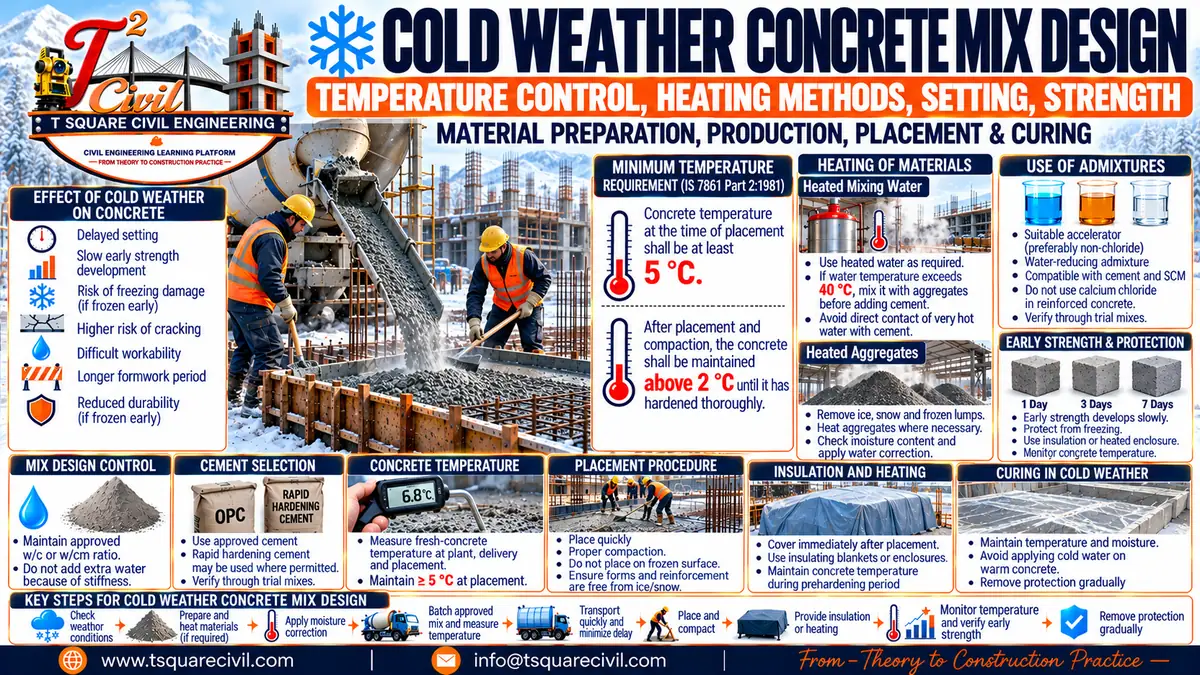
Check Weather → Control Material Temperature → Maintain Approved Water–Cementitious Ratio → Produce Concrete at Suitable Temperature → Place Quickly → Protect From Freezing → Monitor Concrete Temperature → Remove Protection Gradually
For the opposite condition, see Hot Weather Concrete Mix Design.
What Is Cold Weather Concreting?
IS 7861 (Part 2):1981 defines cold-weather concreting as concreting carried out at an atmospheric temperature of about:
5°C or below
The standard deals with precautions for concrete used in general construction such as:
- buildings;
- bridges;
- highways;
- pavements;
- foundations;
- other similar structures.
BIS currently lists IS 7861 (Part 2):1981 as reviewed in 2026.
Cold weather should therefore be treated as a concrete-production and protection condition, not simply as a seasonal description.
Why Is Cold Weather Dangerous for Concrete?
Concrete strength develops through cement hydration.
Hydration is strongly affected by temperature.
When concrete temperature falls:
Hydration Rate ↓ → Setting Slows → Early Strength Development Slows
If the concrete freezes while it is still young, the consequences can be much more serious.
Water expands when it freezes.
If significant pore water freezes before the concrete has developed sufficient strength, it can:
- disrupt the cement paste;
- weaken paste–aggregate bond;
- increase permeability;
- reduce compressive strength;
- reduce durability.
Therefore:
Cold Concrete ≠ Automatically Failed Concrete
but:
Early Freezing = Serious Risk
Main Effects of Cold Weather on Concrete
1. Delayed Setting
Lower temperature slows cement hydration.
As a result:
- initial setting may be delayed;
- final setting may be delayed;
- finishing operations take longer;
- construction cycles become slower.
2. Slow Early Strength Development
Concrete cured at low temperature generally gains early strength more slowly than concrete maintained at normal curing temperature.
Therefore, normal-weather assumptions for:
- formwork removal;
- loading;
- prestressing;
- construction sequencing;
should not automatically be used during cold weather.
3. Freezing of Fresh Concrete
Fresh concrete is particularly vulnerable to freezing.
IS 7861 explains that even one freezing cycle during the early period can cause substantial permanent strength loss.
Therefore, freshly placed concrete must be protected from freezing until sufficient strength has developed.
4. Repeated Freeze–Thaw Exposure
After hardening, saturated concrete exposed repeatedly to freezing and thawing may experience:
- scaling;
- internal cracking;
- reduction in stiffness;
- durability loss.
Where freeze–thaw exposure is expected during service, the concrete should be designed specifically for that exposure condition.
5. Thermal Cracking
Rapid cooling of warm concrete may create temperature differences between:
- concrete core;
- surface;
- ambient air.
Excessive temperature gradients may produce tensile stresses and cracking.
Therefore, cold-weather protection should not be removed suddenly.

Indian Standard for Cold-Weather Concreting
The principal Indian Standard is:
IS 7861 (Part 2):1981 — Code of Practice for Extreme Weather Concreting: Part 2 Recommended Practice for Cold Weather Concreting
The standard covers:
- effects of cold weather;
- material preparation;
- heating of aggregates and water;
- admixtures;
- concrete temperature;
- production and delivery;
- placement;
- protection;
- curing;
- formwork removal;
- temperature monitoring;
- strength verification.
The key principle is simple:
Concrete should be produced, placed and protected so that it does not freeze during its vulnerable early-age period.
Minimum Concrete Temperature at Placement
IS 7861 requires concrete placed at or near freezing conditions to have a temperature of at least:
5°C at the time of placement
The standard also requires the concrete temperature after placement and compaction to be maintained above approximately:
2°C
until the concrete has hardened sufficiently.
Therefore:
Concrete Temperature at Placement ≥ 5°C
is an important cold-weather control requirement under IS 7861.
Project specifications may require a higher placing temperature.
Always follow the stricter applicable requirement.
Delivery Temperature
IS 7861 also requires concrete to be delivered to the point of placing at not less than:
5°C
Concrete should then be:
- placed quickly;
- compacted properly;
- covered or insulated promptly.
In severe cold conditions, a higher delivery temperature may be selected so that the concrete does not fall below the minimum required temperature before placement.
Do Not Make Concrete Excessively Hot
Cold-weather concreting does not mean the concrete should be heated excessively.
Very hot concrete can create:
- rapid moisture loss;
- thermal gradients;
- greater temperature drop after placement;
- possible setting problems.
The objective is:
Adequate Concrete Temperature — Not Maximum Concrete Temperature
Cold-Weather Mix Design Is Not a Separate Concrete Grade
Cold-weather concrete is not normally a separate strength grade.
For example:
M30 remains M30.
The required grade, durability requirement and approved w/c or w/cm ratio still govern.
What changes is the strategy for:
- material temperatures;
- early strength;
- admixtures;
- batching;
- transport;
- protection;
- curing.
Maintain the Approved w/c or w/cm Ratio
Do not increase water simply because concrete appears stiff in cold weather.
The approved:
water-cement ratio
or:
water-cementitious-material ratio
should be maintained.
Uncontrolled additional water can increase:
- porosity;
- permeability;
- bleeding;
- shrinkage;
and reduce:
- strength;
- durability.
For detailed guidance, see Water–Cement Ratio in Concrete.
Keep Aggregates Free From Ice and Frozen Lumps
Aggregates should not contain:
- snow;
- ice;
- frozen lumps.
Frozen aggregate can cause:
- inaccurate batching;
- non-uniform concrete temperature;
- additional uncontrolled water after melting;
- poor mixing.
IS 7861 recommends heating aggregate where necessary so that frozen lumps, ice and snow are eliminated while overheating is avoided.
Heating Aggregates
Where aggregate temperature is too low, it may be heated.
Possible systems include:
- steam pipes;
- heated enclosures;
- controlled warm-air systems;
- other approved heating arrangements.
The objective is to produce a uniform material temperature.
Avoid direct uncontrolled heating that:
- dries some portions excessively;
- overheats local areas;
- causes non-uniform moisture;
- contaminates aggregate.
Aggregate Moisture Still Matters
Heating aggregate may change its moisture content.
Therefore, aggregate moisture should be checked and the batch water corrected accordingly.
See Moisture Correction in Concrete Mix Design.
A correct cold-weather sequence is:
Heat Aggregate → Measure Moisture → Apply Water Correction → Batch Concrete
Heated Mixing Water
Heating the mixing water is one of the most practical methods of increasing concrete temperature during cold weather.
Water has a relatively high heat capacity, so raising its temperature can significantly influence the fresh-concrete temperature.
However, hot water must be used correctly.
Important Rule for Hot Mixing Water
Where mixing water or aggregate is heated above approximately 40°C, IS 7861 requires the water and aggregate to be mixed together before cement is introduced.
The purpose is to prevent very hot water from directly contacting the cement.
This reduces the risk of:
- flash setting;
- localized rapid hydration;
- non-uniform concrete.
Therefore:
Hot Water → Contact Aggregate First → Then Add Cement
not:
Very Hot Water → Directly Onto Cement
Can Boiling-Hot Water Be Used?
IS 7861 permits very hot mixing water under controlled circumstances, provided the cold aggregate reduces the combined water–aggregate temperature sufficiently before cement is introduced.
This should not be interpreted as a general recommendation to use boiling water.
For practical batching:
- determine the required material temperatures;
- avoid unnecessary overheating;
- use controlled heating;
- confirm the actual fresh-concrete temperature.
Concrete Temperature Calculation
Concrete temperature can be estimated from the:
- mass of aggregates;
- aggregate temperature;
- cement mass;
- cement temperature;
- mixing-water mass;
- water temperature;
- aggregate free moisture.
IS 7861 provides a calculation method for estimating fresh-concrete temperature.
However:
Calculated Temperature ≠ Final Acceptance Measurement
The actual fresh-concrete temperature should also be measured.
Measuring Fresh-Concrete Temperature
Temperature should be determined using a suitable temperature-measuring device.
A practical method is:
- Obtain a representative sample.
- Insert the temperature probe sufficiently into the concrete.
- Avoid contact with the container wall.
- Allow the reading to stabilize.
- Record the result.
- Compare with the approved temperature requirement.
Temperature monitoring may be required at:
- batching plant;
- mixer discharge;
- site arrival;
- placement;
- early curing period.
Example – Cold-Weather Temperature Planning
Suppose:
Ambient temperature:
1°C
Aggregate temperature:
2°C
Cement temperature:
10°C
Normal mixing water:
3°C
The resulting concrete may be too cold for the required placing temperature.
A suitable controlled response may include:
- warming the mixing water;
- heating aggregates;
- reducing transport delay;
- insulating the mixer or delivery system.
The final concrete should then be measured to confirm that the required temperature has been achieved.
The exact heating requirement should be established by calculation and trial.
Cement Selection in Cold Weather
Cement type influences early strength development.
Where project specifications permit, a cement system providing faster early-age strength development may assist cold-weather construction.
However, cement should not be changed simply because the weather becomes cold.
A cement change can affect:
- water demand;
- setting time;
- admixture compatibility;
- strength development;
- heat generation.
Any significant material change should be validated through trials.
Rapid-Hardening Cement
Where technically appropriate and permitted by the project specification, rapid-hardening cement may help achieve earlier strength.
However, the complete concrete system must still comply with:
- strength requirements;
- durability requirements;
- temperature-control requirements;
- project specifications.
Do not confuse rapid strength development with protection from freezing.
Even accelerated concrete must be protected during its vulnerable early period.
Chemical Admixtures in Cold Weather
Chemical admixtures may be used to improve cold-weather performance.
Depending on the concrete and project requirements, suitable admixtures can help with:
- water reduction;
- setting-time control;
- early-strength development;
- workability.
The selected admixture should be compatible with the actual:
- cement;
- SCM;
- water;
- aggregate;
- temperature conditions.
See Cement–Admixture Compatibility in Concrete Mix Design.
Accelerating Admixtures
An approved accelerating admixture may help:
- shorten setting time;
- increase early strength;
- reduce the period during which concrete remains highly vulnerable.
However:
Accelerator ≠ Substitute for Thermal Protection
Concrete still needs adequate temperature and protection from freezing.
Avoid Uncontrolled Chloride Accelerators
Chloride-containing accelerators require particular caution because chloride can promote corrosion of embedded steel.
For reinforced, prestressed or durability-sensitive concrete, admixture selection should comply with:
- IS 9103;
- applicable structural standards;
- project specifications.
A suitable non-chloride accelerator may be preferred where acceleration is required.
Do not add calcium chloride or another chloride chemical at site without explicit technical approval.
Air-Entraining Admixtures and Freeze–Thaw Resistance
Where hardened concrete will be exposed to repeated freezing and thawing, properly controlled air entrainment can improve freeze–thaw durability.
Entrained microscopic air voids provide space to accommodate pressure generated when water freezes.
However, air entrainment also affects:
- workability;
- density;
- strength.
Therefore, air content must be designed and verified rather than added arbitrarily.
Supplementary Cementitious Materials in Cold Weather
SCMs such as:
- fly ash;
- GGBS;
- silica fume;
can influence early-age strength and setting differently.
Some binder combinations may develop strength more slowly under low-temperature conditions.
Therefore, where SCMs are used, cold-weather trials should evaluate:
- setting;
- early strength;
- required protection period;
- formwork-removal strength.
Do not automatically remove SCMs from a mix because the weather is cold.
Instead, verify the actual performance of the approved binder system.
Trial Mix for Cold Weather
A cold-weather trial should represent expected site conditions as closely as practical.
Step 1 – Use Actual Project Materials
Use the actual:
- cement;
- SCM;
- fine aggregate;
- coarse aggregate;
- water;
- admixture.
Step 2 – Establish Expected Temperatures
Record expected:
- ambient temperature;
- aggregate temperature;
- cement temperature;
- water temperature.
Step 3 – Select Heating Method
Determine whether the project requires:
- heated water;
- heated aggregate;
- heated enclosure;
- combination of methods.
Step 4 – Prepare Trial Batch
Produce the approved concrete proportions.
Do not arbitrarily increase:
- water;
- cement;
- admixture.
Step 5 – Measure Fresh-Concrete Temperature
Check that the concrete temperature is suitable for delivery and placement.
Step 6 – Check Workability
Measure:
- slump;
or the applicable fresh-concrete workability parameter.
Step 7 – Check Setting Behaviour
Low-temperature trials should evaluate whether setting becomes excessively delayed.
Step 8 – Prepare Strength Specimens
Check early-age and specified-age strength.
Where useful, additional specimens may be cured under simulated field conditions.
Step 9 – Establish Protection Requirement
Use the results to determine:
- insulation;
- enclosure heating;
- curing method;
- likely formwork duration.
Site-Cured Strength Specimens
Cold-weather concrete may develop strength very differently from laboratory specimens maintained under standard curing conditions.
IS 7861 recommends additional specimens exposed to temperature and humidity conditions representative of the actual structure.
These specimens can help confirm whether the concrete has developed sufficient strength before:
- stripping formwork;
- loading;
- discontinuing protection.
This is particularly important for:
- slabs;
- beams;
- columns;
- exposed members.
Prehardening Period
IS 7861 uses the term prehardening period for the period during which freshly placed concrete must be maintained above freezing.
The purpose is to allow concrete to develop sufficient strength to resist damage from early freezing.
The required period depends on factors such as:
- concrete grade;
- cement type;
- cement content;
- w/c ratio;
- concrete temperature;
- insulation;
- environmental exposure.
Therefore, do not use one fixed protection duration for all concrete.
Early Freezing Strength Requirement
IS 7861 discusses early freezing resistance in relation to strength development and notes that the required prehardening period is associated with the concrete reaching an early compressive-strength level.
The practical lesson is:
Do Not Stop Protection Only Because a Fixed Number of Hours Has Passed
Protection should be based on:
- applicable code guidance;
- concrete temperature history;
- site-cured strength;
- approved project procedure.
Placement Surface Must Not Be Frozen
Concrete should not be placed directly onto:
- frozen ground;
- snow;
- ice;
- frozen formwork;
- frozen reinforcement where it can adversely affect placement.
Before concreting:
- remove snow and ice;
- thaw or prepare the substrate where required;
- ensure forms are suitable;
- ensure reinforcement is free from harmful ice accumulation.
Formwork in Cold Weather
Formwork helps retain heat.
Timber and insulated forms can provide significant thermal protection.
Where required, additional insulation may include:
- insulating blankets;
- tarpaulins;
- expanded-polystyrene sheets;
- waterproof covers;
- suitable insulating boards.
In cold weather, early form removal may expose warm concrete suddenly to freezing air.
Therefore, formwork should not be removed prematurely.
Concrete Placement Procedure
A practical cold-weather placement sequence is:
Prepare Site
↓
Remove Ice/Snow
↓
Check Forms and Reinforcement
↓
Measure Concrete Temperature
↓
Place Without Delay
↓
Compact Properly
↓
Finish Surface
↓
Cover Immediately
↓
Apply Insulation / Heated Enclosure
↓
Monitor Temperature
↓
Verify Strength Before Removing Protection
Place Concrete Quickly
Once heated concrete reaches the site, unnecessary waiting should be avoided.
Long delays can cause heat loss.
Coordinate:
- batching;
- transit mixer;
- pump;
- labour;
- formwork inspection;
- reinforcement inspection;
- site access.
The site should be ready before dispatch.
Insulation After Placement
Fresh concrete should be insulated as soon as possible.
Possible insulation materials include:
- insulating blankets;
- tarpaulin systems;
- dry insulating coverings;
- expanded polystyrene;
- other approved thermal protection.
The objective is to retain:
- heat of hydration;
- initial concrete heat.
Heated Enclosures
Where ambient temperature is near or below freezing, heated enclosures may be required.
Possible systems include:
- steam heating;
- warm-air heating;
- heated temporary enclosures.
The heating system should provide reasonably uniform conditions.
Avoid direct heating that:
- dries the concrete surface;
- produces large local temperature differences;
- introduces harmful combustion products.
Cold-Weather Curing
Cold-weather curing must maintain adequate:
- temperature;
- moisture.
However, when the air is freezing or near freezing, indiscriminate water curing may create problems.
IS 7861 recognizes that evaporation is relatively low in cold conditions.
For concrete inside suitable insulated formwork, retaining moisture may be achieved by proper covering.
After protective formwork is removed, appropriate moisture protection should continue as required.
Do Not Apply Cold Water to Warm Concrete
Concrete that has just been removed from insulated formwork should not be suddenly saturated with cold water.
This can cause:
- thermal shock;
- steep temperature gradients.
Protection should be changed gradually.
Gradual Removal of Thermal Protection
One important cold-weather rule is:
Do not suddenly expose warm concrete to very cold air.
When thermal protection is discontinued, concrete surface temperature should be allowed to adjust gradually toward ambient temperature.
This reduces the risk of cracking from thermal shock.
Temperature Monitoring After Placement
Cold-weather concrete temperature should be monitored.
IS 7861 recommends monitoring temperature:
- at placement;
- when protection is applied;
- during the protection period.
For important work, keep records of:
- ambient temperature;
- concrete temperature;
- time;
- protection method;
- heating conditions.
This creates a useful QA/QC record for deciding when protection can safely be removed.
Suggested Cold-Weather Temperature Record
| Parameter | Record |
|---|---|
| Date | ___ |
| Concrete Grade | ___ |
| Batch No. | ___ |
| Ambient Temperature | ___ °C |
| Concrete at Plant | ___ °C |
| Concrete at Site | ___ °C |
| Concrete at Placement | ___ °C |
| Protection Start Time | ___ |
| Temperature During Protection | ___ °C |
| Heating Method | ___ |
| Insulation Type | ___ |
| Site-Cured Strength | ___ MPa |
| Protection Removal Time | ___ |
| Remarks | ___ |
Formwork Removal in Cold Weather
Formwork removal should be based on actual strength development, not only the normal-weather calendar.
Cold conditions can delay:
- early strength;
- stripping;
- loading.
The safest approach is to use:
- applicable IS requirements;
- approved formwork schedule;
- temperature history;
- site-cured test specimens.
See Concrete Cube Compressive Strength Test.
Cold Weather and Pumped Concrete
Low temperature may change:
- viscosity;
- setting;
- admixture response;
- pumping behaviour.
Long pipe systems can also result in additional heat loss.
Therefore:
- minimize delays;
- maintain suitable workability;
- avoid frozen pipelines or equipment;
- coordinate pumping before dispatch.
See Pumped Concrete Mix Design.
Cold Weather and High-Strength Concrete
High-strength concrete commonly contains:
- low w/cm;
- high binder content;
- chemical admixtures;
- SCMs.
Its higher cementitious content can generate more hydration heat, but this does not eliminate freezing risk.
Cold-weather trials should verify:
- workability;
- concrete temperature;
- setting;
- early strength;
- thermal gradients.
See High Strength Concrete Mix Design.
Cold Weather and SCC
Self-compacting concrete depends on carefully controlled rheology.
Low temperature may change:
- viscosity;
- admixture efficiency;
- setting time.
Therefore, SCC used in cold conditions should be checked for:
- slump flow;
- passing ability;
- stability;
- setting;
- temperature.
See Self-Compacting Concrete Mix Design.
Example – Cold-Weather Production Plan
Suppose:
Ambient temperature:
2°C
Required minimum placement temperature:
5°C
Expected transport heat loss:
2°C
Producing the concrete at exactly 5°C at the batching plant would be unsuitable because it could arrive below the required placement temperature.
The plant may therefore need a higher dispatch temperature established through:
- material-temperature calculation;
- trial batching;
- actual transit monitoring.
This example demonstrates an important principle:
Plant Temperature Target > Required Placement Temperature
where significant heat loss is expected.
The actual target should be project-specific.
Cold-Weather Troubleshooting Table
| Problem | Possible Cause | Recommended Check |
|---|---|---|
| Concrete below placement temperature | Cold materials | Heat water/aggregate |
| Very slow setting | Low concrete temperature | Temperature and admixture |
| Poor early strength | Low curing temperature | Protection and curing |
| Ice in aggregate | Frozen stockpile | Aggregate preparation |
| Variable batch temperature | Uneven heating | Heating control |
| Surface freezing | Insufficient insulation | Protection system |
| Thermal cracking | Protection removed too quickly | Gradual cooling |
| Delayed form stripping | Slow strength gain | Site-cured strength |
| Poor pumping | Cold/stiff concrete | Temperature/workability |
| Unexpected admixture response | Low-temperature compatibility | Trial testing |
What to Check Before Changing the Mix
Before modifying the approved mix because concrete is performing poorly in cold weather, check:
- ambient temperature;
- aggregate temperature;
- aggregate moisture;
- mixing-water temperature;
- cement temperature;
- concrete temperature;
- admixture dosage;
- transport time;
- protection system;
- plant calibration.
The problem may be temperature control rather than mix proportions.
See Concrete Batching Plant Calibration.
Common Cold-Weather Concreting Mistakes
Adding Extra Cement Without Trial
More cement is not automatically the correct solution.
Increasing Water
Extra water may reduce strength and durability.
Using Extremely Hot Water Directly on Cement
This can cause undesirable localized rapid hydration or flash setting.
Ignoring Frozen Aggregate
Ice and frozen lumps can alter both water content and batching accuracy.
Assuming an Accelerator Prevents Freezing
It does not replace thermal protection.
Removing Formwork at Normal-Weather Timing
Cold concrete may develop strength much more slowly.
Removing Insulation Suddenly
Rapid cooling can create thermal stresses.
Using Water Curing Indiscriminately Below Freezing
Curing method should be selected according to environmental conditions and approved procedure.
Failing to Record Concrete Temperature
Without temperature records, strength development and protection decisions become difficult to justify.
Recommended Cold-Weather Concrete Workflow
Check Weather Forecast
↓
Prepare Heating & Insulation
↓
Remove Snow / Ice
↓
Measure Material Temperatures
↓
Check Aggregate Moisture
↓
Heat Water / Aggregate as Required
↓
Batch Approved Mix
↓
Measure Fresh-Concrete Temperature
↓
Dispatch Promptly
↓
Check Temperature at Placement
↓
Place & Compact Quickly
↓
Apply Insulation / Heating
↓
Monitor Concrete Temperature
↓
Verify Early Strength
↓
Remove Protection Gradually
Cold-Weather Concrete Checklist
Before Batching
- Weather forecast checked
- Aggregate free from snow and ice
- Aggregate temperature checked
- Aggregate moisture checked
- Heating equipment operational
- Water temperature controlled
- Admixture approved
- Site protection ready
At the Batching Plant
- Approved mix proportions used
- Moisture correction applied
- Hot water does not directly contact cement where temperature is excessive
- Fresh-concrete temperature recorded
- Workability checked
- Dispatch started promptly
At Site
- Placement area free from ice/snow
- Forms ready
- Reinforcement condition checked
- Concrete temperature checked
- Concrete placed without unnecessary delay
- Proper compaction completed
- Insulation applied promptly
During Protection
- Concrete temperature monitored
- Heating system checked
- Insulation remains secure
- Excessive drying avoided
- Protection duration verified
- Strength confirmed before critical stripping/loading
Frequently Asked Questions
What Is Cold-Weather Concreting?
IS 7861 (Part 2) defines cold-weather concreting as concreting carried out at approximately 5°C atmospheric temperature or below.
Which Indian Standard Covers Cold-Weather Concreting?
IS 7861 (Part 2):1981 covers recommended practice for cold-weather concreting in India.
What Is the Minimum Concrete Temperature at Placement?
IS 7861 requires concrete placed under cold conditions to have a temperature of at least approximately 5°C at the time of placement.
What Temperature Should Concrete Be Maintained Above After Placement?
IS 7861 requires the placed and compacted concrete to be maintained above approximately 2°C until it has hardened sufficiently.
Why Does Cold Weather Delay Concrete Strength?
Low temperature slows cement hydration, reducing the rate of early-age strength development.
Can Concrete Freeze Immediately After Placement?
It must not be allowed to freeze during its vulnerable early period. Early freezing can cause permanent strength and durability loss.
Can Hot Water Be Used for Concrete Mixing?
Yes, where required for cold-weather production.
However, very hot mixing water should contact the aggregate before cement is introduced so that excessive direct heating of cement is avoided.
Can Aggregate Be Heated?
Yes.
Aggregates may be heated where necessary, but ice and frozen lumps must be eliminated and overheating should be avoided.
Can an Accelerator Replace Cold-Weather Protection?
No.
An accelerating admixture may help setting and early strength, but concrete still requires adequate thermal protection.
Can Calcium Chloride Be Added to Reinforced Concrete?
Do not add chloride-based accelerators without explicit compliance with the applicable structural standard and project specification. For reinforced, prestressed and durability-sensitive concrete, suitable approved non-chloride systems are generally safer.
Should Formwork Be Removed at the Normal Time?
Not automatically.
Cold weather slows strength development. Formwork removal should be based on applicable requirements and confirmed concrete strength.
Should Concrete Be Water-Cured During Freezing Weather?
The curing method should be selected carefully. Cold-weather protection must maintain suitable temperature and moisture without introducing freezing water onto the concrete.
Why Should Insulation Be Removed Gradually?
Suddenly exposing warm concrete to cold air may produce a steep temperature gradient and thermal cracking.
Should Site-Cured Cubes Be Used?
They are very useful in cold weather because they can indicate strength development under conditions similar to the actual structure.
Related Articles
Hot Weather Concrete Mix Design
Concrete Temperature Control at Batching Plant
Water–Cement Ratio in Concrete
Moisture Correction in Concrete Mix Design
Superplasticizer in Concrete Mix Design
Cement–Admixture Compatibility in Concrete Mix Design
Concrete Batching Plant Calibration
Concrete Mix Design Troubleshooting
Concrete Mix Design Approval and Production Control
High Strength Concrete Mix Design
Self-Compacting Concrete Mix Design
Concrete Cube Compressive Strength Test
Conclusion
Cold-weather concrete requires control of both temperature and early strength development.
The correct engineering approach is:
Prepare → Heat Materials Where Required → Maintain Approved Mix → Measure Temperature → Place Quickly → Insulate → Monitor → Verify Strength → Cool Gradually
The most important practical rules are:
Cold Weather ≠ Add More Water
Accelerator ≠ Protection From Freezing
Frozen Aggregate ≠ Acceptable Batching Material
Concrete at Placement Should Be at Least 5°C
Fresh Concrete Must Be Protected From Early Freezing
Normal-Weather Formwork Timing ≠ Cold-Weather Formwork Timing
Protection Should Not Be Removed Suddenly
Temperature Records + Site Strength Verification = Safer Cold-Weather Concrete
For important structural concrete, the cold-weather procedure should be established before concreting starts and verified using actual project materials, actual expected temperatures and representative site conditions.