
 by
by Page Contents
Introduction
Slump loss is the reduction in concrete workability with time after mixing.
A concrete mix may leave the batching plant with satisfactory slump but arrive at the construction site with significantly lower workability.
This can affect:
- pumping;
- placing;
- compaction;
- finishing;
- surface quality;
- site productivity.
Slump loss is especially important in:
- ready-mixed concrete;
- pumped concrete;
- hot-weather concreting;
- long transport distances;
- high-strength concrete;
- low water-cement ratio concrete;
- concrete containing modern chemical admixtures.
However, slump loss should not be treated simply by adding water at site.
The correct approach is:
Identify Cause → Check Time & Temperature → Verify Moisture and Admixture → Check Slump Retention → Apply Approved Correction
For basic slump-testing procedure, see Slump Cone Test of Concrete.
What Is Slump Loss?
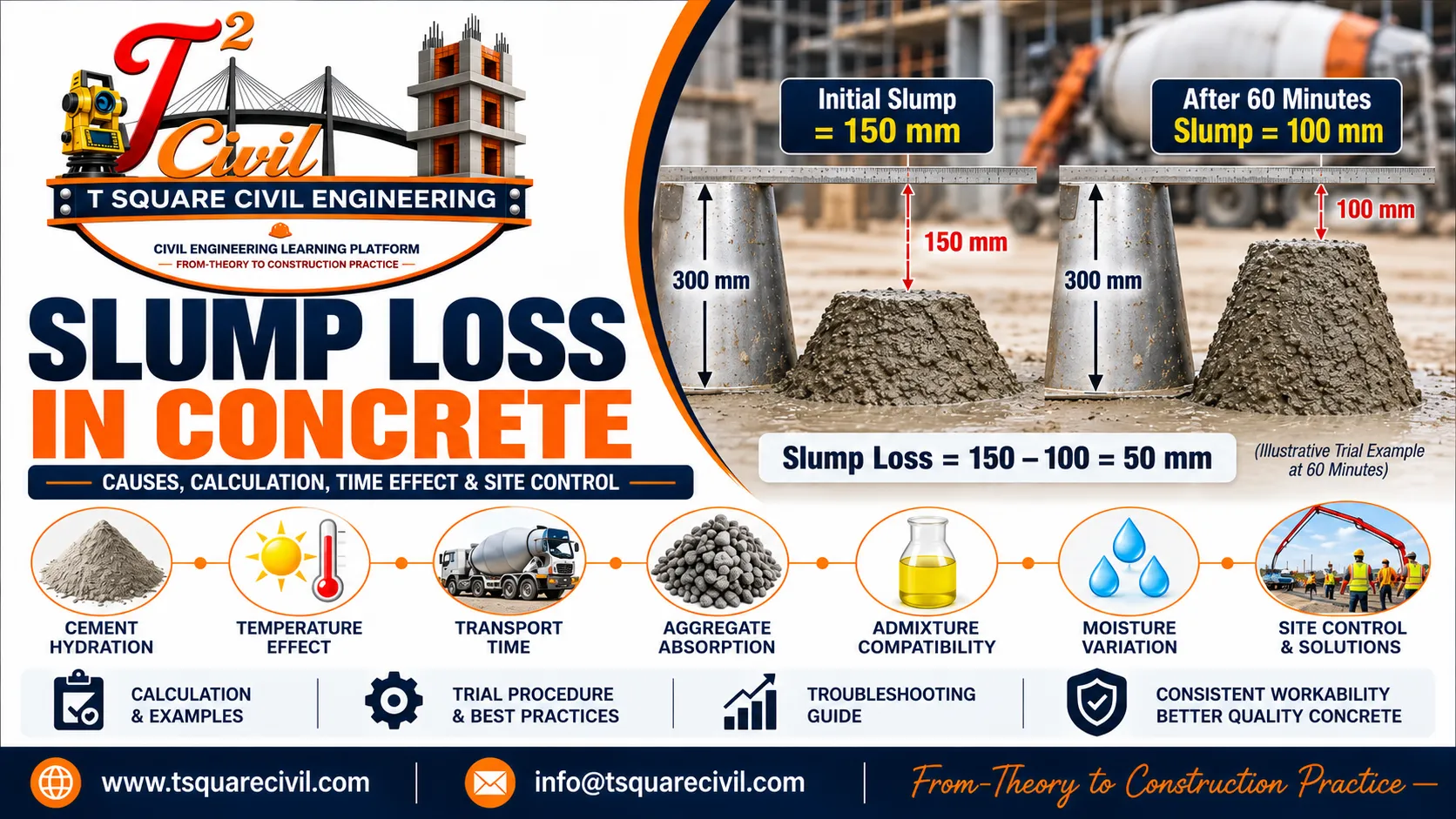
Slump loss is the decrease in slump value between two measurements taken at different times after concrete mixing.
For example:
Initial slump = 150 mm
Slump after 60 minutes = 100 mm
Slump loss:
150 − 100 = 50 mm
This means the concrete has lost:
50 mm of slump in 60 minutes
The concrete has become less workable during that period.
Slump Loss Formula
The simplest expression is:
Slump Loss = Initial Slump − Slump at Later Time
where:
- Initial Slump = slump measured soon after mixing;
- Later Slump = slump measured after a specified elapsed time.
Example:
Initial slump = 180 mm
Slump after 90 minutes = 110 mm
Therefore:
Slump Loss = 180 − 110 = 70 mm
Slump Retention
Slump retention describes the ability of fresh concrete to maintain workable consistency over time.
A concrete with good slump retention may show only a small reduction in slump during transport and placement.
A concrete with poor slump retention may stiffen rapidly.
Slump retention is especially important for:
- RMC;
- high-rise pumping;
- raft pours;
- congested reinforcement;
- long haul distances.
Slump Loss vs Initial Low Slump
These are not the same problem.
Initial Low Slump
Concrete is already too stiff immediately after mixing.
Possible causes include:
- low batch water;
- incorrect aggregate moisture correction;
- excessive aggregate absorption;
- admixture under-dosing;
- incorrect batching.
Slump Loss
Concrete initially has acceptable slump but becomes less workable with time.
Possible causes include:
- cement hydration;
- temperature;
- evaporation;
- aggregate absorption;
- admixture compatibility;
- delayed transport.
This distinction is important because the corrective action can be different.
Why Does Concrete Lose Slump?
Fresh concrete is not a chemically inactive material.
Once cement comes into contact with water:
- hydration begins;
- cement particles interact;
- free water gradually becomes less available;
- the mixture becomes progressively stiffer.
Some slump loss is therefore normal.
The engineering concern is excessive or unusually rapid slump loss.
Main Causes of Slump Loss
1. Cement Hydration
Hydration begins immediately after water is added.
As hydration proceeds:
- water is consumed;
- flocculation develops;
- paste becomes less fluid.
Therefore, workability naturally decreases with time.
2. High Concrete Temperature
Higher concrete temperature generally accelerates:
- hydration;
- water evaporation;
- slump loss.
This is why hot-weather concreting often requires special slump-retention planning.
3. High Ambient Temperature
High ambient temperature can raise the temperature of:
- aggregates;
- mixing water;
- fresh concrete;
especially where materials are exposed to direct sunlight or stored without adequate protection.
Higher fresh-concrete temperature can accelerate:
- cement hydration;
- evaporation;
- loss of workability.
The combined effect may result in faster slump reduction.
The actual rate of slump loss depends on the complete combination of:
- concrete temperature;
- cement characteristics;
- admixture system;
- aggregate moisture;
- wind;
- relative humidity;
- transport duration.
4. Long Transportation Time
The longer concrete remains in transit, the greater the opportunity for:
- hydration;
- evaporation;
- aggregate absorption;
- admixture performance changes.
Long haul distance is therefore a common reason for slump loss in RMC.
5. Aggregate Absorption
Dry or absorptive aggregate can continue absorbing water from the concrete mixture.
This reduces the amount of free water available for lubrication.
Typical high-absorption materials may include:
- some crushed aggregates;
- lightweight aggregate;
- recycled concrete aggregate.
For RCA-related water control, see Recycled Aggregate Concrete Mix Design.
6. Incorrect Aggregate Moisture Correction
If aggregate moisture is measured incorrectly, the actual effective water in the mix may be lower than intended.
This can appear as rapid slump loss even though the root cause began at batching.
See Moisture Correction in Concrete Mix Design.
7. Cement–Admixture Incompatibility
A superplasticizer may perform very well with one cement and poorly with another.
Compatibility depends on factors such as:
- cement chemistry;
- sulfate balance;
- C3A content;
- cement fineness;
- admixture chemistry;
- dosage.
Poor compatibility may produce:
- rapid slump loss;
- delayed setting;
- excessive retardation;
- abnormal stiffening.
See Cement–Admixture Compatibility in Concrete Mix Design.
8. Insufficient Admixture Dosage
If the admixture dosage is too low for the required:
- w/c ratio;
- slump;
- transport time;
- temperature,
the initial slump may be acceptable but retention may be poor.
9. Wrong Admixture Type
A high-range water reducer designed mainly for initial slump increase may not provide long slump retention.
For long-duration transport, the selected admixture should provide adequate retention characteristics.
See Superplasticizer in Concrete Mix Design.
10. High Cementitious Content
High binder content can increase:
- surface area;
- water demand;
- admixture demand.
This may increase slump loss if the admixture system is not optimized.
11. Low Water-Cement Ratio
Low w/c concrete generally has less free water.
Therefore, high-strength and durable mixes may be more sensitive to slump retention.
See Water–Cement Ratio in Concrete.
12. Very Fine Materials
Fine materials such as:
- silica fume;
- very fine cement;
- high fines in manufactured sand;
increase total surface area.
This can increase:
- water demand;
- admixture demand;
- slump loss.
13. M-Sand Characteristics
Angular manufactured sand can increase:
- internal friction;
- water demand;
- admixture demand.
Poorly controlled fines may further reduce slump retention.
See Manufactured Sand in Concrete Mix Design.
14. Delayed Discharge
Concrete waiting in a transit mixer at site may continue losing slump before placement.
Common reasons include:
- pump breakdown;
- traffic congestion;
- formwork delay;
- reinforcement inspection delay;
- crane availability;
- site access problems.
Slump Loss Is Not Always a Mix-Design Failure
An important troubleshooting rule is:
Slump Loss ≠ Automatically Poor Mix Design
The problem may originate from:
- transport;
- batching;
- moisture control;
- plant calibration;
- waiting time;
- temperature.
Before modifying the approved mix, first identify the true cause.
See Concrete Mix Design Troubleshooting.
Effect of Time on Slump
Slump commonly decreases with elapsed time after mixing, although the rate and pattern of loss depend on the concrete materials, temperature, admixture system and handling conditions.
A typical site trial may record:
| Time After Mixing | Slump |
|---|---|
| 0 min | 180 mm |
| 30 min | 165 mm |
| 60 min | 145 mm |
| 90 min | 120 mm |
| 120 min | 90 mm |
This is only an illustrative example.
Actual slump-loss behaviour depends on:
- concrete temperature;
- cement;
- admixture;
- w/c ratio;
- SCMs;
- aggregate condition.
Slump-Loss Rate
For practical comparison, a simple average rate may be expressed as:
Slump-Loss Rate = Slump Loss ÷ Time
Example:
Initial slump = 180 mm
Slump after 90 min = 120 mm
Loss:
60 mm
Average slump-loss rate:
60 ÷ 90 = 0.67 mm/min
This value is useful only for comparing trial behaviour over the same test conditions.
Slump loss is not always linear with time.
Slump Retention Percentage
A useful internal comparison can be:
Slump Retention (%) = Later Slump ÷ Initial Slump × 100
Example:
Initial slump = 180 mm
Slump after 90 min = 120 mm
Retention:
120 ÷ 180 × 100
= 66.7%
Slump retention percentage is a useful internal trial-comparison tool, but it is not a universal acceptance criterion specified by IS 1199 or IS 4926. Project-specific acceptance should be based on the specified workability at the agreed point and time of testing.
Standard Slump Test
Fresh-concrete consistency testing in India is covered by IS 1199 (Part 2):2018, which covers determination of consistency of fresh concrete. BIS shows this standard as reviewed in 2023. Bureau of Indian Standards
For detailed procedure, visit Slump Cone Test of Concrete.
Ready-Mixed Concrete and Slump Loss
IS 4926:2003 covers the production and supply of ready-mixed concrete in India.
For RMC, slump-retention planning should consider:
- batching time;
- transport duration;
- waiting time at site;
- pumping time;
- discharge sequence;
- ambient temperature;
- concrete temperature.
IS 4926:2003 generally requires concrete to be discharged from the truck mixer within 2 hours from the time of loading.
A longer period may be permitted under suitable conditions, such as:
- use of retarding admixtures;
- cool and humid weather;
- use of chilled concrete;
- other approved conditions supported by the producer and purchaser.
The standard also emphasizes rapid site discharge and recommends that site arrangements should allow a full truck load to be discharged within about 30 minutes of arrival, where practicable.
Therefore, the target plant slump should be selected based on the required workability at the point of discharge and placement, not only the slump measured immediately after batching.
Example – Plant Slump vs Site Slump
Suppose required placing slump is:
120 ± 25 mm
Expected transport slump loss:
40 mm
The plant trial may therefore require a higher initial slump, provided the approved mix remains:
- cohesive;
- non-segregating;
- within the approved admixture dosage;
- within the specified w/c ratio.
The initial target should come from trials, not guesswork.
Why Adding Water at Site Is Risky
Adding uncontrolled water may improve slump temporarily, but it can also increase:
- water-cement ratio;
- bleeding;
- segregation;
- shrinkage;
- permeability.
It may also reduce:
- strength;
- durability.
Therefore:
Low Slump at Site ≠ Add Water Automatically
Important Site Note: Any controlled addition of water, where specifically permitted by the producer, project specification and approved procedure, should remain within the approved mix water limit and should be properly recorded. Uncontrolled water addition should not be used as a routine solution for slump loss.
Correct Way to Manage Slump Loss
A better approach includes:
- optimized slump-retaining admixture;
- correct moisture adjustment;
- appropriate initial slump;
- temperature control;
- reduced waiting time;
- approved admixture redosing where permitted;
- site logistics planning.
Admixture Redosing at Site
In special circumstances, an additional dose of chemical admixture may be added at the project site to regain workability, provided this is carried out under an approved procedure.
IS 4926:2003 permits additional admixture dosing with mutual agreement between the producer and purchaser.
Site redosing should therefore be:
- approved by the producer or responsible technical authority;
- compatible with the cement–admixture system;
- within the admixture manufacturer’s recommended dosage range;
- accurately measured;
- mixed adequately in the transit mixer;
- recorded on the delivery or production record;
- followed by fresh-concrete testing where required.
Do not add an arbitrary quantity of superplasticizer at site without control.
Why Approved Admixture Redosing May Be Preferred to Uncontrolled Water Addition
Where technically approved and validated, admixture redosing can restore workability without directly increasing the water-cement ratio.
However, excessive or incompatible admixture dosage may cause:
- segregation;
- delayed setting;
- excessive slump;
- abnormal air entrainment;
- finishing problems.
Therefore, admixture redosing should be based on:
- trial data;
- manufacturer recommendations;
- approved project procedure;
- actual site conditions.
Admixture redosing should not be treated as an uncontrolled site adjustment.
Hot-Weather Slump Loss
Hot weather can produce rapid slump loss due to:
- high cement temperature;
- hot aggregates;
- warm water;
- high ambient temperature;
- high wind;
- low relative humidity.
Possible controls include:
- shaded aggregates;
- chilled mixing water where required;
- shorter transport;
- slump-retaining admixture;
- night or early-morning pours;
- faster site discharge.
We will cover Hot Weather Concrete Mix Design in a dedicated article later.
Pumped Concrete and Slump Loss
Pumped concrete needs adequate workability and cohesion at the pump intake and throughout placement.
Excessive slump loss may cause:
- high pump pressure;
- reduced pumping rate;
- line blockage;
- difficult placing.
However, simply increasing water may also increase segregation and blockage risk.
See Pumped Concrete Mix Design.
Slump Loss in High-Strength Concrete
High-strength concrete is particularly sensitive because it generally contains:
- low w/cm;
- high binder content;
- high-range water reducer;
- SCMs.
Slump-retention trials are therefore important.
See High Strength Concrete Mix Design.
Slump Loss in SCC
Self-compacting concrete relies on high flowability while maintaining stability.
Loss of flow can affect:
- filling ability;
- passing ability;
- reinforcement congestion performance.
For SCC, slump-flow retention is often more relevant than conventional slump.
See Self-Compacting Concrete Mix Design.
Slump Loss Due to Aggregate Moisture Variation
Consider a mix designed for:
170 kg/m³ effective water
If unexpected dry aggregate absorbs:
8 kg/m³ water
available free water may effectively fall.
The concrete may appear to show abnormal slump loss.
This is why aggregate moisture and absorption should be checked before changing the mix.
Slump Loss Due to Cement Change
Suppose the same concrete proportions and admixture are used after changing cement brand.
The new concrete shows:
- same initial slump;
- much faster loss after 45 minutes.
Possible cause:
cement–admixture compatibility
The correct response is to carry out compatibility and retention trials, not automatically increase water.
Slump Loss Due to Admixture Change
Even products from the same admixture category may behave differently.
Changing from one superplasticizer to another may alter:
- initial slump;
- slump retention;
- setting;
- air content;
- strength development.
Any significant product change should be validated by trial.
Trial Procedure for Slump Retention
Slump-retention trials should represent the expected field condition as closely as possible.
The trial duration should consider:
- batching time;
- transport time;
- expected site waiting time;
- pumping or placing duration;
- ambient and concrete temperature.
The objective is to verify that the concrete maintains the required workability until the actual point and time of placement, not merely immediately after mixing.
A practical trial may follow this sequence:
Step 1 – Prepare Trial Batch
Use actual project materials.
Step 2 – Record Initial Conditions
Record:
- concrete temperature;
- ambient temperature;
- material temperature;
- admixture dosage;
- moisture corrections.
Step 3 – Measure Initial Slump
Measure slump shortly after mixing.
Step 4 – Maintain Representative Mixing
Keep the concrete under controlled conditions representative of transport.
Step 5 – Repeat Slump Tests
Possible intervals:
- initial;
- 30 min;
- 60 min;
- 90 min;
- 120 min,
or according to project transport requirement.
Step 6 – Observe Mix Behaviour
Check:
- segregation;
- bleeding;
- stickiness;
- harshness;
- cohesion.
Step 7 – Check Strength
Do not approve a retention adjustment only from slump.
Confirm:
- compressive strength;
- setting behaviour;
- durability-related requirements.
Sample Slump-Retention Trial Record
| Parameter | Trial Result |
|---|---|
| Concrete Grade | ___ |
| Cement Type | ___ |
| SCM | ___ |
| w/cm | ___ |
| Admixture | ___ |
| Dosage | ___ % |
| Concrete Temperature | ___ °C |
| Initial Slump | ___ mm |
| 30-Min Slump | ___ mm |
| 60-Min Slump | ___ mm |
| 90-Min Slump | ___ mm |
| 120-Min Slump | ___ mm |
| Bleeding | Yes / No |
| Segregation | Yes / No |
| Setting | ___ |
| 7-Day Strength | ___ MPa |
| 28-Day Strength | ___ MPa |
Slump-Loss Troubleshooting Table
| Problem | Possible Cause | Recommended Check |
|---|---|---|
| Rapid loss immediately | Cement/admixture incompatibility | Compatibility trial |
| Loss during transport | Long haul / heat | Time and temperature |
| Low slump on arrival | Aggregate moisture error | Moisture correction |
| Rapid stiffening | Cement chemistry | Cement/admixture test |
| Pump pressure increasing | Slump loss / harsh mix | Workability and grading |
| Excessive water demand | M-sand fines | Grading and fines |
| Good morning, poor afternoon slump | Temperature change | Concrete temperature |
| Only one truck affected | Batching error | Batch record |
| All trucks affected | Mix/system issue | Materials/admixture |
What to Check Before Changing the Mix
Before modifying the approved concrete mix, check:
- Actual batch water
- Aggregate moisture
- Admixture dosage
- Cement source
- Aggregate grading
- Concrete temperature
- Transport time
- Waiting time
- Mixer operation
- Plant calibration
See Concrete Batching Plant Calibration.
Common Mistakes
Adding Water Automatically
This may violate the approved w/c ratio.
Increasing Initial Slump Excessively
Very high initial slump can create segregation.
Ignoring Temperature
A mix that works in winter may lose slump rapidly in summer.
Ignoring Cement Change
Compatibility can change even when cement grade remains the same.
Ignoring M-Sand Fines
Fine-content variation can change water and admixture demand.
Changing Admixture Without Trial
Different admixtures can behave differently.
Using Only Initial Slump
A good initial result does not guarantee adequate workability after transport.
Changing Mix Proportions Before Checking Plant Error
The concrete design may be correct while batching is wrong.
Recommended Slump-Loss Control Workflow
Confirm Required Placement Slump
↓
Estimate Transport & Placement Time
↓
Check Concrete Temperature
↓
Check Materials & Moisture
↓
Select Suitable Admixture
↓
Conduct Slump-Retention Trial
↓
Measure Slump at Time Intervals
↓
Check Segregation & Bleeding
↓
Check Strength & Setting
↓
Approve Plant Target Slump
↓
Monitor RMC Deliveries
↓
Investigate Deviations Before Adjusting Mix
Frequently Asked Questions
What Is Slump Loss in Concrete?
Slump loss is the reduction in concrete slump with elapsed time after mixing.
Why Does Concrete Lose Slump?
Main causes include hydration, high temperature, evaporation, aggregate absorption, admixture behaviour and long transport time.
How Is Slump Loss Calculated?
Slump Loss = Initial Slump − Later Slump
Is Slump Loss Normal?
Some slump loss is normal. Excessive or rapid loss indicates a need for investigation.
Can Water Be Added to Restore Slump?
Uncontrolled water addition should be avoided because it may increase w/c ratio and reduce concrete quality.
Can Superplasticizer Be Added at Site?
Controlled redosing may be permitted if approved, validated and within manufacturer limits.
Does Hot Weather Increase Slump Loss?
Yes. Higher temperature generally increases hydration rate and evaporation.
Does M-Sand Increase Slump Loss?
It can, especially where particle shape and fines increase water or admixture demand.
Does High-Strength Concrete Lose Slump Faster?
It may be more sensitive because of low w/cm, high binder content and chemical-admixture dependence.
What Is Slump Retention?
Slump retention is the ability of concrete to maintain workability over time.
Which Standard Covers Slump Testing in India?
IS 1199 (Part 2):2018 covers determination of consistency of fresh concrete. Bureau of Indian Standards
Which Standard Applies to Ready-Mixed Concrete?
IS 4926:2003 covers production and supply of ready-mixed concrete. Bureau of Indian Standards
Related Articles
Concrete Mix Design Troubleshooting
Superplasticizer in Concrete Mix Design
Cement–Admixture Compatibility in Concrete Mix Design
Water–Cement Ratio in Concrete
Moisture Correction in Concrete Mix Design
Self-Compacting Concrete Mix Design
Concrete Batching Plant Calibration
Concrete Mix Design Approval and Production Control
Conclusion
Slump loss is not simply a problem of insufficient water.
It is controlled by the interaction of:
Time + Temperature + Cement + Aggregate + Moisture + Admixture + Transport + Site Delay
The correct engineering approach is:
Measure → Record → Identify Cause → Conduct Retention Trial → Correct the System → Verify Performance
The most important rules are:
Low Site Slump ≠ Add Water Automatically
High Initial Slump ≠ Good Slump Retention
Slump Loss ≠ Always Mix-Design Failure
Admixture Redosing ≠ Uncontrolled Site Addition
Initial Workability ≠ Placement Workability
For RMC and pumped concrete, the mix should be designed to deliver the required workability at the point of placement, not simply at the batching plant.