 by
by Page Contents
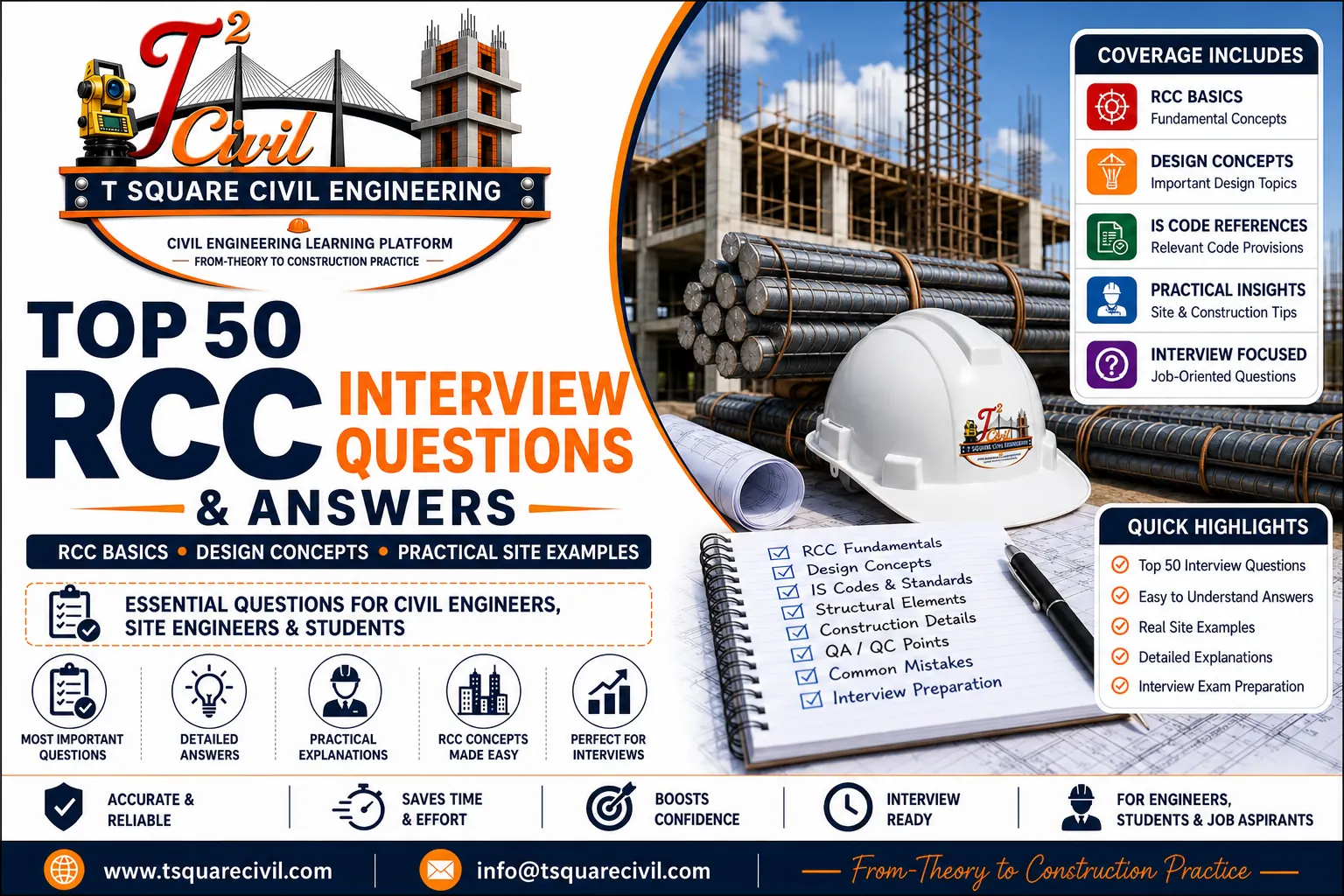
Top 50 RCC Interview Questions and Answers | Civil Engineering Interview Guide
Introduction
If you are preparing for a Civil Engineering interview, understanding Reinforced Cement Concrete (RCC) concepts is essential. Most interviews for freshers, site engineers, QA/QC engineers, and quantity surveyors include questions on RCC because it is the backbone of modern construction.
This guide presents the Top 50 RCC Interview Questions and Answers with practical explanations, real construction examples, interview tips, and engineering concepts to help you prepare with confidence.
Whether you are a student, a diploma holder, a graduate engineer, or an experienced professional, this guide will strengthen your understanding of RCC and improve your interview performance.
Reinforced Cement Concrete (RCC) is one of the most important areas of civil engineering because it combines the compressive strength of concrete with the tensile resistance provided by reinforcement steel. RCC knowledge is essential for civil engineering students, freshers, site engineers, QA/QC engineers and construction professionals involved in structural work.
In an RCC interview, questions may cover structural elements such as slabs, beams, columns and footings, reinforcement detailing, concrete placement, cover, development length, construction practices, quality control and common site problems. Understanding these concepts from both theoretical and practical perspectives helps candidates answer technical interview questions confidently.
Who Should Read This Guide?
✔ Civil Engineering Students
✔ Diploma Students
✔ Site Engineers
✔ QA/QC Engineers
✔ Quantity Surveyors
✔ Freshers Preparing for Interviews
✔ Government Exam Aspirants
✔ Construction Professionals
RCC Interview Questions and Answers
Q1. What is RCC?
Answer
RCC stands for Reinforced Cement Concrete. It is a composite construction material in which concrete provides high compressive strength, while steel reinforcement provides high tensile strength. Together, they form a durable structural material capable of resisting bending, shear, compression, and tension.
RCC is widely used in residential buildings, commercial structures, bridges, water tanks, retaining walls, industrial buildings, and foundations.
Practical Site Example
Before concreting an RCC beam, the site engineer checks reinforcement size, spacing, lap length, concrete cover, and formwork to ensure the member performs as designed.
Interview Tip
Many interviewers ask:
Why is steel used with concrete?
Mention that concrete is strong in compression but weak in tension, while steel complements it by resisting tensile forces.
If you are preparing specifically for a construction site engineer interview, see our detailed Civil Site Engineer Interview Questions and Answers – 180 Practical Questions, which covers site execution, surveying, reinforcement, formwork, concrete, QA/QC, safety, estimation and practical site situations.
Q2. Why is steel used in RCC?
Answer
Steel is used because it has excellent tensile strength. Concrete alone cannot resist significant tensile stresses, but when reinforced with steel, the resulting RCC member can safely carry bending and tensile loads.
Another important advantage is that steel and concrete have similar coefficients of thermal expansion, allowing them to work together effectively under temperature changes.
Practical Site Example
In an RCC beam, the bottom reinforcement bars resist tensile forces, while the concrete above primarily resists compression.
Interview Tip
Always mention tensile strength first, followed by bond and thermal compatibility.
Q3. What are the main ingredients of RCC?
Answer
The primary ingredients are:
- Cement
- Fine Aggregate (Sand)
- Coarse Aggregate
- Water
- Steel Reinforcement
Depending on project requirements, admixtures such as plasticisers, superplasticisers, or fly ash may also be used to improve workability or durability.
Practical Site Example
For a M25-grade RCC beam, the concrete mix is prepared using approved materials, and the reinforcement is placed according to the structural drawings before concreting.
Q4. What are the advantages of RCC?
Answer
Major advantages include:
- High strength
- Excellent durability
- Fire resistance
- Long service life
- Good structural performance
- Can be moulded into various shapes
- Economical maintenance
- Suitable for residential, commercial, and industrial construction
Interview Tip
Mention both strength and durability in your answer.
Q5. What are the disadvantages of RCC?
Answer
Some disadvantages include:
- Higher self-weight compared to steel structures.
- Longer construction time due to curing requirements.
- Repairs can be difficult if reinforcement corrodes.
- Formwork is required during construction.
- Cracks may develop if design or construction practices are inadequate.
Practical Site Example
Insufficient concrete cover may expose reinforcement to moisture, increasing the likelihood of corrosion over time.
Q6. What is the difference between PCC and RCC?
Answer
| PCC | RCC |
|---|---|
| Plain Cement Concrete | Reinforced Cement Concrete |
| No steel reinforcement | Steel reinforcement provided |
| Used for levelling and bedding | Used for structural members |
| Lower load-carrying capacity | Higher load-carrying capacity |
Practical Site Example
PCC is commonly used below footings as a levelling course, while RCC is used to construct the footing itself.
Q7. What is concrete cover?
Answer
Concrete cover is the shortest distance between the outer surface of the concrete and the nearest reinforcing steel bar. It protects reinforcement from corrosion, fire, and environmental exposure while improving durability and bond.
Practical Site Example
Before pouring concrete, the site engineer verifies that the correct cover blocks are installed to maintain the specified concrete cover.
Learn More
Read our Concrete Cover Calculator and Concrete Cover Guide for a detailed explanation and practical examples.
Q8. Why is concrete cover important?
Answer
Concrete cover is important because it:
- Protects reinforcement from corrosion.
- Improves fire resistance.
- Enhances structural durability.
- Provides a proper bond between concrete and steel.
- Increases the service life of the structure.
Interview Tip
If asked about inadequate cover, explain that it can lead to reinforcement corrosion, cracking, spalling, and reduced durability.
Q9. What is nominal cover?
Answer
Nominal cover is the concrete cover specified by the structural designer after considering durability, exposure conditions, fire resistance, and construction tolerances. It is the value generally shown on structural drawings and maintained during construction.
Practical Site Example
During reinforcement inspection, the site engineer checks the installed cover blocks to ensure they provide the nominal cover specified in the drawings.
Q10. What is the difference between nominal cover and effective cover?
Answer
Nominal cover is the distance from the concrete surface to the nearest reinforcement bar.
Effective cover is the distance from the concrete surface to the centre of the reinforcement bar and is commonly used in structural design calculations.
Interview Tip
A simple way to remember:
- Nominal Cover → Used on drawings and construction.
- Effective Cover → Used in structural design and calculations.
Quick Revision(Questions 1–10)
Remember these key points:
- RCC = Concrete + Steel Reinforcement.
- Concrete is strong in compression; steel is strong in tension.
- PCC is non-structural, while RCC is structural.
- Concrete cover protects reinforcement.
- Nominal cover is specified on drawings.
- Effective cover is measured to the centre of the reinforcement bar.
Q11. What is Clear Cover?
Answer
Clear cover is the shortest distance between the outer surface of the reinforcement bar and the nearest concrete surface. It is measured to the outside of the steel bar, not to its centre.
Clear cover protects reinforcement from corrosion, moisture, fire, and environmental effects while ensuring adequate bond between concrete and steel.
Practical Site Example
Before concreting a slab, the site engineer checks whether the specified cover blocks (20 mm or 25 mm, depending on the drawing) are properly placed to maintain the required clear cover.
Interview Tip
Don’t confuse clear cover with effective cover. Many candidates make this mistake.
Q12. What is Effective Cover?
Answer
Effective cover is the distance from the outer surface of the concrete to the centre of the main reinforcement bar.
Structural engineers use effective cover while designing beams, slabs, and columns because it helps determine the effective depth, which influences bending strength and load-carrying capacity.
Practical Site Example
For a beam with:
- Clear cover = 25 mm
- Bar diameter = 20 mm
Effective cover = 25 + (20 ÷ 2) = 35 mm
Interview Tip
Remember:
- Clear Cover → from outside of steel
- Effective Cover → from the Centre of steel
Q13. What is Effective Depth?
Answer
Effective depth is the distance between the compression face of the concrete and the centre of the tension reinforcement.
It is one of the most important dimensions in RCC design because it directly affects the moment-carrying capacity of beams and slabs.
Practical Site Example
If the beam depth is 500 mm and the effective cover is 40 mm:
Effective Depth = 500 − 40 = 460 mm
Interview Tip
Greater effective depth generally increases the bending capacity of an RCC member.
Q14. What is Development Length?
Answer
Development length is the minimum length of reinforcement bar embedded in concrete required to safely transfer stress between steel and concrete through bond.
If the provided development length is insufficient, the reinforcement may slip before reaching its full strength.
Practical Site Example
Extra reinforcement length is provided near beam supports to satisfy development length requirements before terminating bars.
Interview Tip
Development length depends on:
- Steel grade
- Concrete grade
- Bar diameter
- Bond conditions
Learn More
Read our Development Length Calculator for calculations and practical examples.
Q15. What is Lap Length?
Answer
Lap length is the distance over which two reinforcement bars overlap so that the load can be transferred safely from one bar to the other.
Lapping is used because reinforcement bars are manufactured in standard lengths and often need extension during construction.
Practical Site Example
When casting a column, if the reinforcement bar length is insufficient, another bar is overlapped to meet the specified lap length as shown in the structural drawing.
Interview Tip
Never say that lap length is always 50D. The required lap length depends on the design and applicable standards. In general, site practice lap length varies from 40D to 60D.
Learn More
Read our Lap Length Calculator for detailed guidance.
Q16. What is Anchorage Length?
Answer
Anchorage length is the length of reinforcement embedded beyond a critical section to ensure the bar develops its full strength without slipping.
Hooks, bends, and straight embedment are commonly used to achieve the required anchorage.
Practical Site Example
Beam reinforcement is anchored into the supporting column to ensure proper force transfer.
Interview Tip
Development length and anchorage length are related but not identical concepts.
Q17. What are Main Reinforcement Bars?
Answer
Main reinforcement bars are the primary steel bars provided to resist tensile forces in RCC members.
They carry the major structural loads and are designed according to structural calculations.
Practical Site Example
In a simply supported slab, the main reinforcement is placed along the shorter span where bending is greater.
Interview Tip
Mention that main bars are usually larger in diameter than distribution bars.
Q18. What are Distribution Bars?
Answer
Distribution bars are secondary reinforcement bars placed perpendicular to the main reinforcement.
Their functions include:
- Distributing loads
- Controlling shrinkage cracks
- Holding main bars in position
- Providing temperature reinforcement
Practical Site Example
In an RCC slab, distribution bars are placed over the main reinforcement to improve crack control and maintain reinforcement spacing.
Interview Tip
Distribution bars are generally smaller in diameter than main reinforcement.
Q19. What are Stirrups?
Answer
Stirrups are closed reinforcement bars provided in RCC beams and columns to resist shear forces and hold the longitudinal reinforcement in position.
They also improve the ductility and confinement of concrete.
Practical Site Example
Near beam supports, stirrup spacing is reduced because shear forces are highest in these regions.
Interview Tip
A common follow-up question is:
Why is stirrup spacing closer near supports?
Answer:
Because the shear force is maximum near the supports.
Q20. What are Cover Blocks?
Answer
Cover blocks are precast concrete or approved non-corrosive blocks placed beneath reinforcement to maintain the specified concrete cover during concreting.
They help ensure proper durability, corrosion protection, and fire resistance.
Practical Site Example
Before concreting a slab, cover blocks are placed at regular intervals to prevent reinforcement from touching the shuttering.
Interview Tip
Do not use bricks or stones as cover blocks unless specifically permitted by the project specifications. Proper concrete or approved cover blocks should be used.
Quick Revision (Questions 11–20)
Remember these key concepts:
- Clear Cover → Distance from the concrete surface to the outside of the reinforcement.
- Effective Cover → Distance from the concrete surface to the centre of the reinforcement.
- Effective Depth → Compression face to centre of tension steel.
- Development Length → Length needed to develop full bar strength.
- Lap Length → Overlap length between two reinforcement bars.
- Anchorage Length → Embedded length that prevents bar slippage.
- Main Bars → Resist tensile forces.
- Distribution Bars → Control cracks and distribute loads.
- Stirrups → Resist shear and confine reinforcement.
- Cover Blocks → Maintain the required concrete cover.
Q21. What is a Beam in RCC?
Answer
A beam is a horizontal structural member designed to transfer loads from slabs, walls, and other structural components to columns or load-bearing walls. RCC beams primarily resist bending moments and shear forces.
Practical Site Example
In a residential building, the slab transfers its load to the beams, which then transfer it to the columns.
Interview Tip
Remember the load path:
Slab → Beam → Column → Footing → Soil
Q22. What is a Column?
Answer
A column is a vertical compression member that transfers loads from beams and slabs to the foundation. Columns are among the most critical structural elements because their failure can affect the entire building.
Practical Site Example
Before concreting a column, engineers verify reinforcement, stirrup spacing, cover blocks, and vertical alignment.
Interview Tip
Columns primarily carry axial compressive loads but may also resist bending in some structures.
Q23. What is an RCC Slab?
Answer
An RCC slab is a flat, horizontal structural element used to form floors and roofs. It distributes loads to supporting beams or walls and resists bending moments induced by applied loads.
Practical Site Example
Before slab concreting, reinforcement spacing, electrical conduits, sleeves, and cover blocks are checked.
Interview Tip
Know the difference between:
- One-way slab
- Two-way slab
Interviewers frequently ask this.
Q24. What is a Footing?
Answer
A footing is the lowest part of the foundation that transfers structural loads safely to the supporting soil. It spreads the load over a larger area to reduce soil pressure.
Practical Site Example
Before placing reinforcement in a footing, engineers verify excavation dimensions, PCC level, reinforcement arrangement, and concrete cover.
Interview Tip
Footings are classified into isolated, combined, strip, raft, and pile foundations.
Q25. What is Formwork?
Answer
Formwork is a temporary mould or framework used to support freshly placed concrete until it gains sufficient strength to support itself.
Common formwork materials include:
- Steel
- Timber
- Aluminium
- Plastic
- Plywood
Practical Site Example
Beam and slab formwork is inspected for alignment, level, stability, and tight joints before concrete placement.
Interview Tip
Good formwork should be:
- Strong
- Rigid
- Leak-proof
- Easy to remove
- Economical
Q26. What is Shuttering?
Answer
Shuttering is the actual surface or panels that come into direct contact with fresh concrete. It is a part of the complete formwork system.
Practical Site Example
Before concreting, shuttering oil is applied to prevent concrete from sticking and to achieve a smooth surface finish.
Interview Tip
Many candidates use “formwork” and “shuttering” interchangeably. Explain that shuttering is a component of the overall formwork system.
Q27. What is Honeycombing in Concrete?
Answer
Honeycombing is a defect where voids or cavities remain in hardened concrete due to insufficient mortar filling around the coarse aggregate.
Causes
- Poor compaction
- Improper vibration
- Inadequate concrete workability
- Congested reinforcement
- Leaking formwork
Practical Site Example
Honeycombing is often observed near heavily reinforced beam-column joints if vibration is inadequate.
Interview Tip
Explain both the cause and the prevention.
Q28. What is Segregation of Concrete?
Answer
Segregation is the separation of coarse aggregate from the cement mortar during handling, transportation, or placing of concrete.
Causes
- Excessive water
- Improper mixing
- Dropping concrete from excessive height
- Poor handling
Prevention
- Proper mix design
- Controlled water-cement ratio
- Correct placement methods
- Adequate vibration
Practical Site Example
Concrete dropped from a significant height without a chute may segregate, leading to weak zones.
Q29. What is Bleeding in Concrete?
Answer
Bleeding is the upward movement of water to the surface of freshly placed concrete due to the settlement of solid particles.
Effects
- Weak surface layer
- Reduced bond with reinforcement
- Increased permeability
- Dusting and surface defects
Prevention
- Proper mix design
- Lower water-cement ratio
- Use of suitable admixtures
- Adequate finishing practices
Interview Tip
Don’t confuse bleeding with segregation. Bleeding involves water rising to the surface, whereas segregation involves the separation of aggregates from the mortar.
Q30. What is the curing of Concrete?
Answer
Curing is the process of maintaining adequate moisture and temperature in concrete after placing so that cement hydration continues and the concrete develops the required strength and durability.
Common Methods
- Water ponding
- Sprinkling
- Wet hessian covering
- Curing compounds
- Plastic sheet covering
Practical Site Example
Slabs are commonly cured by ponding water for several days after initial setting.
Interview Tip
Mention that proper curing:
- Increases strength
- Reduces shrinkage cracks
- Improves durability
- Enhances long-term performance
Quick Revision (Questions 21–30)
Remember these key concepts:
- Beam → Horizontal member carrying bending and shear.
- Column → Vertical member carrying compressive loads.
- Slab → Horizontal floor or roof element.
- Footing → Transfers building load safely to soil.
- Formwork → Temporary mould supporting fresh concrete.
- Shuttering → Surface panels forming part of the formwork.
- Honeycombing → Voids due to poor compaction or inadequate vibration.
- Segregation → Separation of coarse aggregate from mortar.
- Bleeding → Water rising to the concrete surface.
- Curing → Maintaining moisture for proper strength development.
Related Calculators
- Concrete Cover Calculator
- Concrete Volume Calculator
- Cement Bags Calculator
- Steel Weight Calculator
- Bar Bending Schedule (BBS) Calculator
Q31. What is the Water-Cement Ratio?
Answer
The water-cement (W/C) ratio is the weight of water to the weight of cement in a concrete mix. It is one of the most important factors affecting the strength, workability, durability, and permeability of concrete.
A lower water-cement ratio generally produces stronger and more durable concrete, provided proper compaction is achieved.
Practical Site Example
For structural concrete, site engineers measure water accurately rather than adding it by guesswork to maintain the specified water-cement ratio.
Interview Tip
Never say “more water gives stronger concrete.” Excess water usually reduces concrete strength and durability.
Q32. What is Concrete Compaction?
Answer
Concrete compaction is the process of removing entrapped air from freshly placed concrete to obtain a dense, strong, and durable mass.
Compaction is commonly carried out using:
- Needle Vibrator
- Surface Vibrator
- Screed Vibrator
- Table Vibrator (for precast work)
Practical Site Example
During beam concreting, a needle vibrator is inserted at regular intervals to eliminate air pockets and ensure complete compaction.
Interview Tip
Poor compaction can lead to honeycombing and reduced strength.
Q33. Why is Vibrating Concrete Important?
Answer
Concrete vibration helps:
- Remove entrapped air
- Increase density
- Improve the bond with reinforcement
- Reduce honeycombing
- Improve compressive strength
- Produce a better surface finish
Practical Site Example
Operators insert the vibrator vertically and withdraw it slowly after air bubbles stop appearing.
Interview Tip
Over-vibration may cause segregation, while under-vibration may leave voids in the concrete.
Q34. What are Construction Joints?
Answer
Construction joints are planned joints formed where concreting is stopped and later resumed. They allow construction to proceed in stages while maintaining structural continuity.
Practical Site Example
Large slabs are often cast in multiple pours, with construction joints located as specified by the structural engineer.
Interview Tip
Construction joints should be planned in locations of lower structural stress whenever possible.
Q35. What are Expansion Joints?
Answer
Expansion joints are gaps provided in structures to accommodate expansion and contraction caused by temperature changes, shrinkage, or other movements.
They help prevent uncontrolled cracking and structural distress.
Practical Site Example
Expansion joints are commonly provided in long buildings, bridges, pavements, and retaining structures.
Interview Tip
Do not confuse expansion joints with construction joints. Expansion joints allow movement; construction joints are used because of staged construction.
Q36. What is Shrinkage in Concrete?
Answer
Shrinkage is the reduction in the volume of concrete due to moisture loss, hydration, and drying.
Types include:
- Plastic Shrinkage
- Drying Shrinkage
- Autogenous Shrinkage
Practical Site Example
If slabs are not properly cured after casting, drying-shrinkage cracks may appear on the surface.
Interview Tip
Proper curing significantly reduces shrinkage-related cracking.
Q37. What is Creep in Concrete?
Answer
Creep is the gradual increase in deformation of concrete under a sustained load over time.
It becomes more significant in long-span beams, prestressed members, and heavily loaded structures.
Practical Site Example
Long-span beams may experience additional deflection over several years due to creep.
Interview Tip
Creep is a time-dependent deformation, while elastic deformation occurs immediately after loading.
Q38. What are the Common Causes of Cracks in RCC?
Answer
Common causes include:
- Plastic shrinkage
- Drying shrinkage
- Thermal movement
- Settlement
- Overloading
- Poor curing
- Corrosion of reinforcement
- Improper reinforcement detailing
- Poor workmanship
Practical Site Example
Insufficient curing after slab casting can lead to early-age shrinkage cracks.
Interview Tip
Interviewers appreciate answers that include both causes and preventive measures.
Q39. How Can Cracks in RCC Be Prevented?
Answer
Crack prevention measures include:
- Proper structural design
- Correct reinforcement placement
- Maintaining the specified water-cement ratio
- Adequate compaction
- Proper curing
- Using good-quality materials
- Providing control and expansion joints where required
Practical Site Example
Daily curing and maintaining correct concrete cover greatly improve the durability of RCC members.
Interview Tip
There is no single solution for crack prevention. Good design and good construction practices work together.
Q40. What Checks Should Be Done Before RCC Concreting?
Answer
Before concrete placement, the site engineer should verify:
- Reinforcement diameter and spacing
- Lap length
- Development length
- Concrete cover
- Cover blocks
- Formwork alignment
- Formwork cleanliness
- Shuttering supports
- Embedded pipes and conduits
- Electrical sleeves
- Concrete grade
- Availability of vibrators
- Concrete slump (if specified)
- Safety arrangements
Practical Site Example
A pre-concreting inspection checklist is completed and approved before the concrete pour begins.
Interview Tip
This is a common question for Site Engineer and QA/QC interviews. Mentioning a systematic checklist demonstrates practical site knowledge.
Quick Revision (Questions 31–40)
Remember these key concepts:
Pre-Concreting Inspection → Essential for quality and safety.
Water-Cement Ratio → Controls strength and durability.
Compaction → Removes entrapped air from concrete.
Vibration → Improves density and bond.
Construction Joint → Planned stop in concreting.
Expansion Joint → Allows movement due to temperature changes.
Shrinkage → Volume reduction caused by moisture loss and hydration.
Creep → Time-dependent deformation under sustained load.
Cracks → Can result from poor curing, overloading, shrinkage, corrosion, or workmanship.
Q41. What is the Difference Between a One-Way Slab and a Two-Way Slab?
Answer
A one-way slab transfers load primarily in one direction and bends mainly along the shorter span. It is generally used when the longer span is more than twice the shorter span.
A two-way slab transfers load in both directions and bends along both spans. It is commonly used when the ratio of the longer span to the shorter span is less than or equal to two.
Practical Site Example
A room measuring 3 m × 6.5 m is typically designed as a one-way slab, whereas a room measuring 4 m × 5 m is usually designed as a two-way slab.
Interview Tip
Remember:
- One-way slab → Main reinforcement along the shorter span.
- Two-way slab → Main reinforcement in both directions.
Q42. What is Bar Bending Schedule (BBS)?
Answer
A Bar Bending Schedule (BBS) is a detailed tabular document that lists the reinforcement required for each structural member. It includes:
- Bar mark
- Bar diameter
- Shape
- Cutting length
- Quantity
- Total length
- Weight
BBS helps in accurate steel estimation, fabrication, and site execution.
Practical Site Example
Before ordering reinforcement, quantity surveyors prepare a BBS to estimate the total steel requirement.
Interview Tip
Mention that BBS reduces steel wastage and improves project planning.
Q43. What is Reinforcement Congestion?
Answer
Reinforcement congestion occurs when too many reinforcing bars are placed in a limited space, making it difficult for concrete to flow and be properly compacted.
Problems
- Honeycombing
- Poor compaction
- Reduced bond
- Difficulty in placing concrete
Practical Site Example
Beam-column junctions in high-rise buildings often experience reinforcement congestion.
Interview Tip
Proper detailing, bar spacing, and suitable concrete workability help reduce congestion.
Q44. Why are Cover Blocks Used?
Answer
Cover blocks maintain the required concrete cover between reinforcement and the formwork.
Functions
- Protect steel from corrosion
- Improve fire resistance
- Ensure durability
- Maintain the correct reinforcement position
Practical Site Example
Before slab concreting, cover blocks are placed at regular spacing to prevent reinforcement from resting on the shuttering.
Interview Tip
Use approved concrete or polymer cover blocks rather than bricks or stones unless specified by the project.
Q45. What are the Responsibilities of a Site Engineer During RCC Work?
Answer
A site engineer is responsible for:
- Checking drawings
- Verifying reinforcement, whether it is as per the approved BBS/Drawing
- Inspecting shuttering
- Checking concrete cover
- Supervising concreting
- Monitoring vibration and compaction
- Ensuring proper curing
- Maintaining quality and safety records
Practical Site Example
Before pouring concrete in a beam, column, slab, etc., the site engineer verifies reinforcement, cover blocks, formwork alignment, embedded items, and availability of equipment.
Interview Tip
Demonstrating a systematic inspection process shows practical site knowledge.
Q46. What Quality Checks Are Performed During RCC Construction?
Answer
Typical quality checks include:
- Cement quality
- Aggregate quality
- Reinforcement diameter and spacing
- Cover block placement
- Slump test
- Cube casting
- Proper vibration
- Concrete curing
- Surface finish
- Dimensional checks
Practical Site Example
For each concrete pour, slump testing and cube sampling are carried out in accordance with the project’s quality plan.
Q47. What are the Common Reasons for RCC Failure?
Answer
Common reasons include:
- Poor structural design
- Inferior construction quality
- Incorrect reinforcement placement
- Inadequate concrete cover
- Poor curing
- Corrosion of reinforcement
- Overloading
- Foundation settlement
- Use of poor-quality materials
Practical Site Example
Buildings in aggressive environments may experience reinforcement corrosion if adequate concrete cover is not provided.
Interview Tip
Explain both design-related and construction-related causes.
Q48. How Can the Durability of RCC Be Improved?
Answer
Durability can be improved by:
- Using quality materials
- Maintaining the specified water-cement ratio
- Providing adequate concrete cover
- Proper compaction
- Proper curing
- Using suitable admixtures where required
- Following structural drawings and specifications
- Protecting concrete from aggressive environmental exposure
Practical Site Example
In coastal areas, additional concrete cover and durable concrete mixes are often specified to reduce the risk of corrosion.
Q49. What Precautions Should Be Taken During RCC Concreting?
Answer
Important precautions include:
- Verify formwork stability.
- Check reinforcement placement.
- Ensure correct concrete cover.
- Confirm concrete grade.
- Perform a slump test when required.
- Place concrete without excessive free fall.
- Compact concrete properly.
- Avoid cold joints.
- Start curing after the initial setting period.
Practical Site Example
The site engineer prepares a pre-concreting checklist and ensures all inspections are completed before concrete placement.
Q50. What Are the Most Important RCC Interview Tips?
Answer
To perform well in an RCC interview:
- Understand basic RCC concepts.
- Learn practical site procedures.
- Read structural drawings.
- Know reinforcement terminology.
- Understand concrete technology fundamentals.
- Be familiar with common site quality checks.
- Practice explaining concepts with practical examples.
- Revise common formulas and definitions.
- Stay confident and answer clearly.
Practical Site Example
When asked about lap length, explain not only the definition but also where it is provided, why it is necessary, and how it is checked on site.
Interview Tip
Interviewers often value practical understanding more than memorised definitions.
Final Quick Revision (Questions 41–50)
Remember these important points:
- One-way slab → Load mainly in one direction.
- Two-way slab → Load in both directions.
- BBS → Reinforcement planning and estimation document.
- Reinforcement congestion → Difficult concrete placement.
- Cover blocks → Maintain specified concrete cover.
- Site Engineer → Responsible for quality, safety, and execution.
- Quality checks: slump, cube test, reinforcement, curing, dimensions.
- RCC failure → Can result from poor design, poor construction, or poor maintenance.
- Durability → Depends on quality materials, cover, compaction, and curing.
- Interview success → Combine theory with practical site experience.
RCC Interview Preparation Tips
Use these points:
- Understand the difference between concrete and RCC.
- Know the functions of reinforcement in structural members.
- Revise slabs, beams, columns and footings.
- Understand basic reinforcement detailing terminology.
- Revise concrete quality-control procedures.
- Understand cover, spacing, laps and development concepts.
- Study common RCC construction problems.
- Connect theoretical answers with actual site practice.
- Revise relevant IS Code references used in the article.
- Do not memorize answers without understanding their engineering meaning.
Conclusion
Congratulations! You have completed the Top 50 RCC Interview Questions and Answers.
This guide covers the most common topics asked in interviews for:
- Civil Engineering Students
- Diploma Holders
- Graduate Engineer Trainees (GET)
- Site Engineers
- QA/QC Engineers
- Quantity Surveyors
- Construction Professionals
Use these questions to strengthen both your theoretical knowledge and your practical understanding of RCC.
Related Calculators
- Concrete Cover Calculator
- Development Length Calculator
- Lap Length Calculator
- Steel Weight Calculator
- Bar Bending Schedule (BBS) Calculator
- Concrete Volume Calculator
- Cement Bags Calculator
Quick Revision Table – Top 50 RCC Interview Questions
| Q. No. | Topic | One-Line Revision |
|---|---|---|
| 1 | What is RCC? | RCC is Reinforced Cement Concrete, which combines concrete with steel reinforcement. |
| 2 | Why is Steel Used in RCC? | Steel provides tensile strength, while concrete provides compressive strength. |
| 3 | Ingredients of RCC | Cement, sand, coarse aggregate, water, steel, and admixtures (if required). |
| 4 | Advantages of RCC | Strong, durable, fire-resistant, economical, and versatile. |
| 5 | Disadvantages of RCC | Heavy, requires curing, formwork, and skilled workmanship. |
| 6 | PCC vs RCC | PCC has no reinforcement; RCC contains steel reinforcement for structural members. |
| 7 | Concrete Cover | Protects reinforcement from corrosion and fire while improving durability. |
| 8 | Importance of Concrete Cover | Ensures durability, bond, corrosion resistance, and fire protection. |
| 9 | Nominal Cover | Concrete cover specified on structural drawings. |
| 10 | Nominal Cover vs Effective Cover | Nominal cover is to the steel surface; effective cover is to the centre of reinforcement. |
| 11 | Clear Cover | Distance from the concrete surface to the outside of the reinforcement. |
| 12 | Effective Cover | Distance from concrete surface to the centre of the reinforcement bar. |
| 13 | Effective Depth | Distance from compression face to centre of tension reinforcement. |
| 14 | Development Length | Minimum embedded bar length required to develop full strength. |
| 15 | Lap Length | Overlap length used to safely join two reinforcement bars. |
| 16 | Anchorage Length | Embedded reinforcement length preventing bar slippage. |
| 17 | Main Reinforcement | Primary bars resisting tensile forces. |
| 18 | Distribution Bars | Secondary bars control cracks and distribute loads. |
| 19 | Stirrups | Shear reinforcement that also holds longitudinal bars in position. |
| 20 | Cover Blocks | Maintain the specified concrete cover during concreting. |
| 21 | RCC Beam | Horizontal structural member carrying bending and shear. |
| 22 | RCC Column | Vertical compression member transferring loads to the foundation. |
| 23 | RCC Slab | Horizontal member providing floors and roofs. |
| 24 | Footing | Foundation element transferring building loads safely to soil. |
| 25 | Formwork | Temporary mould supporting fresh concrete until it gains strength. |
| 26 | Shuttering | Surface panels forming part of the formwork. |
| 27 | Honeycombing | Voids in concrete caused by poor compaction or vibration. |
| 28 | Segregation | Separation of coarse aggregate from mortar. |
| 29 | Bleeding | Water is rising to the surface of fresh concrete. |
| 30 | Curing | Maintaining moisture to ensure proper cement hydration. |
| 31 | Water-Cement Ratio | Controls concrete strength, durability, and workability. |
| 32 | Concrete Compaction | Removes entrapped air and increases concrete density. |
| 33 | Concrete Vibration | Ensures proper compaction and reduces honeycombing. |
| 34 | Construction Joint | Planned joint where concreting is stopped and resumed later. |
| 35 | Expansion Joint | Allows movement caused by temperature changes and shrinkage. |
| 36 | Shrinkage | Volume reduction in concrete due to moisture loss and hydration. |
| 37 | Creep | Time-dependent deformation under sustained load. |
| 38 | Causes of RCC Cracks | Shrinkage, settlement, corrosion, poor curing, overloading, and workmanship. |
| 39 | Crack Prevention | Proper design, curing, reinforcement, and quality construction practices. |
| 40 | Pre-Concreting Checks | Inspect reinforcement, cover, formwork, concrete grade, and equipment before pouring. |
| 41 | One-Way vs Two-Way Slab | One-way transfers load mainly in one direction; two-way transfers in both directions. |
| 42 | Bar Bending Schedule (BBS) | Detailed schedule of reinforcement bars for cutting, bending, and quantity estimation. |
| 43 | Reinforcement Congestion | Excessive reinforcement causing difficulty in placing and compacting concrete. |
| 44 | Importance of Cover Blocks | Maintain correct reinforcement position and concrete cover. |
| 45 | Site Engineer Responsibilities | Supervise reinforcement, concreting, curing, quality, and safety. |
| 46 | RCC Quality Checks | Check materials, reinforcement, slump, cube test, vibration, curing, and dimensions. |
| 47 | Causes of RCC Failure | Poor design, poor construction, corrosion, overloading, and foundation issues. |
| 48 | Improving RCC Durability | Use quality materials, proper cover, compaction, curing, and a correct water-cement ratio. |
| 49 | Precautions During RCC Concreting | Inspect reinforcement, formwork, cover, slump, vibration, and curing arrangements. |
| 50 | RCC Interview Tips | Combine theory with practical site experience and explain answers confidently. |
⭐ 2-Minute RCC Interview Revision
Before attending an interview, remember these key points:
✅ RCC = Concrete + Steel Reinforcement
✅ Concrete is strong in compression.
✅ Steel is strong in tension.
✅ Concrete cover protects reinforcement from corrosion.
✅ Development length transfers stress safely to concrete.
✅ Lap length joins two reinforcement bars.
✅ Stirrups resist shear force.
✅ Beams carry bending loads.
✅ Columns transfer loads to foundations.
✅ Slabs distribute loads to beams.
✅ Footings transfer loads to soil.
✅ Proper compaction prevents honeycombing.
✅ Proper curing develops strength and durability.
✅ Water-cement ratio controls concrete quality.
✅ Site engineers should always check reinforcement, cover, formwork, and quality before concreting.
Frequently Asked Questions (FAQs)
1. What are the most common RCC interview questions?
The most common RCC interview questions cover:
- Reinforced Cement Concrete (RCC)
- Concrete Cover
- Development Length
- Lap Length
- Beam
- Slab
- Column
- Footing
- Bar Bending Schedule (BBS)
- Concrete Curing
- Honeycombing
- Water-Cement Ratio
- Concrete Compaction
- Formwork
- Reinforcement Inspection
These topics are frequently asked in interviews for site engineers, QA/QC engineers, graduate engineers, and freshers.
2. Is RCC important for civil engineering interviews?
Yes. RCC is one of the most important subjects in civil engineering interviews because most residential, commercial, industrial, and infrastructure projects are constructed using Reinforced Cement Concrete.
3. What is the difference between PCC and RCC?
PCC (Plain Cement Concrete) does not contain steel reinforcement and is mainly used for levelling courses and non-structural works.
RCC (Reinforced Cement Concrete) contains steel reinforcement and is used for structural members such as beams, slabs, columns, and footings.
4. Why is concrete cover important in RCC?
Concrete cover protects reinforcement from corrosion, improves fire resistance, enhances durability, and ensures proper bond between steel and concrete. Maintaining the specified cover is essential for the long-term performance of RCC structures.
5. What is the difference between development length and lap length?
Development length is the minimum embedded length required for a reinforcement bar to safely transfer stress to the surrounding concrete.
Lap length is the overlap length between two reinforcement bars used to transfer load when extending reinforcement.
6. What practical RCC knowledge should every site engineer have?
A site engineer should understand:
- Reading structural drawings
- Reinforcement checking
- Concrete cover inspection
- Lap length and development length
- Formwork inspection
- Slump testing
- Cube casting
- Concrete vibration
- Curing methods
- Quality and safety procedures
7. Which RCC topics are most frequently asked in interviews?
The most frequently asked topics include:
- Concrete Cover
- Development Length
- Lap Length
- One-Way and Two-Way Slabs
- Beams
- Columns
- Footings
- Honeycombing
- Segregation
- Bleeding
- Water-Cement Ratio
- Bar Bending Schedule (BBS)
8. How can I prepare for an RCC interview?
Focus on understanding concepts instead of memorising definitions. Study structural members, reinforcement details, concrete technology, common site practices, and quality control procedures. Practising real project examples will improve your confidence during interviews.
9. What mistakes should I avoid during an RCC interview?
Common mistakes include:
- Confusing clear cover with effective cover.
- Mixing up development length and lap length.
- Giving theoretical answers without practical examples.
- Not understanding reinforcement detailing.
- Being unfamiliar with quality control tests and site procedures.
10. What is the role of reinforcement in RCC?
Reinforcement provides tensile strength to concrete, which is naturally strong in compression but weak in tension. Together, concrete and steel form a durable composite material capable of resisting bending, shear, compression, and tension.
11. Why are site examples important in an RCC interview?
Interviewers often assess whether candidates can apply theory to real construction work. Explaining how reinforcement is checked, how concrete is placed, or how quality inspections are performed demonstrates practical knowledge and problem-solving ability.
12. Can freshers crack RCC interviews?
Yes. Freshers who understand RCC fundamentals, revise common interview questions, practice practical examples, and communicate clearly can perform well in interviews for graduate engineer trainee, site engineer, and QA/QC positions.
13. Which IS Code should I study for RCC interviews?
For building projects in India, interviewers often expect familiarity with:
- IS 456:2000 – Plain and Reinforced Concrete
- IS 875 – Design Loads
- IS 10262 – Concrete Mix Proportioning
- IS 383 – Coarse and Fine Aggregates
- IS 1786 – High Strength Deformed Steel Bars
You don’t need to memorise every clause, but understanding the purpose of these standards is valuable.
14. How do RCC interview questions help in competitive exams?
RCC concepts are frequently tested in:
- GATE Civil Engineering
- SSC JE
- RRB JE
- State AE/JE examinations
- PSU recruitment
- Campus placements
Understanding these topics also strengthens your practical engineering knowledge.
15. Where can I learn RCC concepts with practical examples?
Continue exploring TSquareCivil.com for:
- RCC calculators
- Practical construction guides
- Concrete technology articles
- Quantity estimation tutorials
- Site engineer checklists
- Civil engineering interview series
- Step-by-step construction procedures
You can also read our Civil Engineering Calculators
Steel Bar Weight Calculator
Calculate the weight of TMT bars, reinforcement steel, and rebars using the standard D²/162 formula for accurate quantity estimation.
Cement, Sand & Aggregate Calculator for Concrete (M5 to M20)
Estimate the quantities of cement, sand, and aggregate required for nominal concrete mixes ranging from M5 to M20 grades.
Concrete Volume Calculator for Slabs, Beams, Columns, and Footings
Calculate the volume of concrete required for various RCC structural elements quickly and accurately.
Brick Quantity Calculator
Determine the number of bricks required for walls, partitions, and masonry construction works.
Bar Bending Schedule (BBS) Calculator for Construction Sites
Prepare accurate bar-bending schedules and calculate steel reinforcement quantities for RCC structures.
Plaster Quantity Calculator
Estimate cement, sand, and water requirements for internal and external plastering works.
House Construction Cost Calculator
Calculate the approximate cost of residential building construction based on area, specifications, and construction standards.
Tile Quantity Calculator
Estimate the number of floor and wall tiles required for rooms, kitchens, bathrooms, and other spaces.
Paint Quantity Calculator
Calculate paint requirements for walls, ceilings, and exterior surfaces while minimising wastage and cost.
Lap Length Calculator for Reinforcement Steel Bars
Determine the required lap splice length for steel reinforcement bars in accordance with standard engineering practices and design requirements.