
 by
by Page Contents
Quick Answer
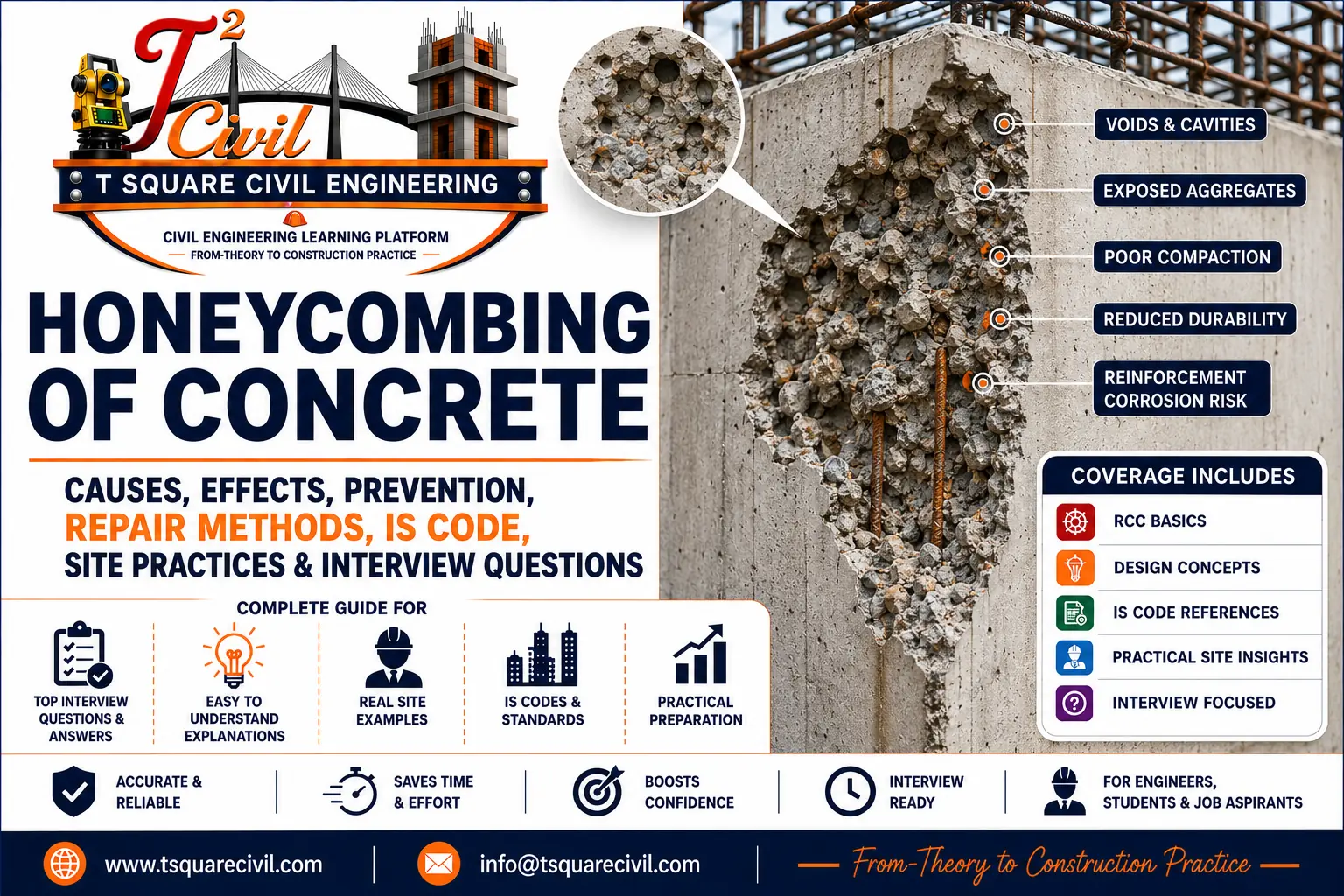
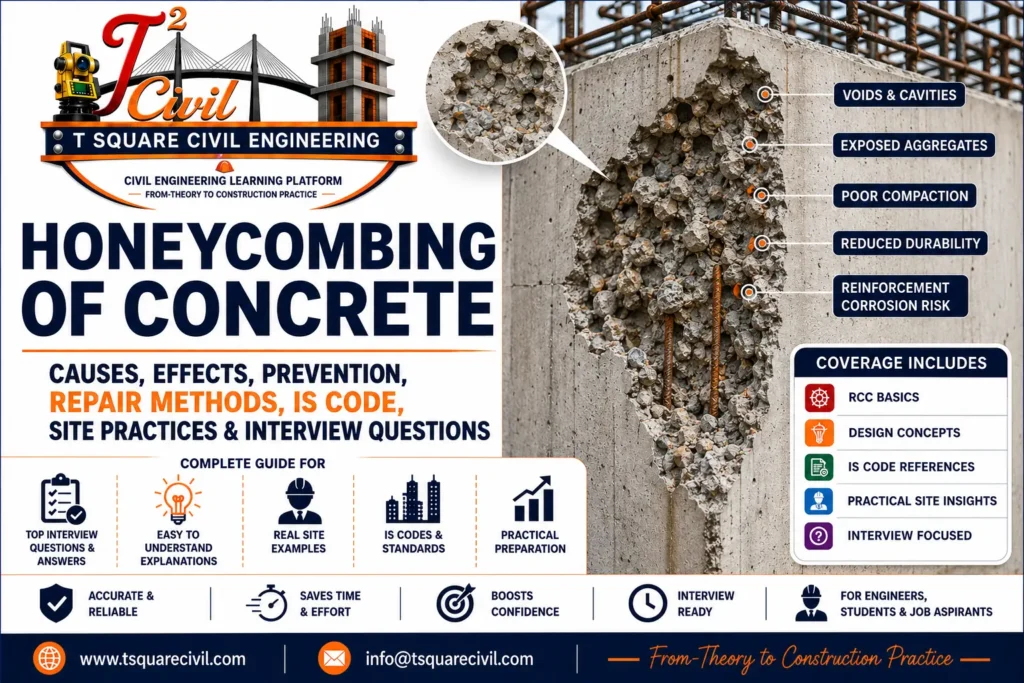
Honeycombing of concrete is a construction defect characterised by voids, cavities, and exposed coarse aggregates on the surface of hardened concrete due to incomplete filling of concrete around reinforcement or insufficient mortar between aggregates. It commonly occurs because of poor compaction, inadequate workability, congested reinforcement, improper concrete placement, or leakage of cement slurry through formwork joints. Honeycombing reduces the strength, durability, appearance, and watertightness of concrete and should be repaired using suitable repair techniques based on its severity.
Key Highlights
- Honeycombing is one of the most common concrete defects.
- It is caused by inadequate compaction and improper placement of concrete.
- Poor workability and congested reinforcement increase the risk of honeycombing.
- Honeycombing reduces structural durability and may expose reinforcement to corrosion.
- Proper mix design, vibration, and formwork are essential to prevent honeycombing.
- Minor honeycombing can be repaired using repair mortar, while severe defects may require micro-concrete or epoxy-based repair methods.
Information Table
| Particular | Details |
|---|---|
| Defect Name | Honeycombing of Concrete |
| Category | Concrete Surface Defect |
| Stage | Fresh Concrete / After Formwork Removal |
| Main Cause | Inadequate compaction and improper placement |
| Appearance | Voids and exposed coarse aggregates |
| Major Risk | Reduced durability and reinforcement corrosion |
| Prevention | Proper vibration, good workability, and quality formwork |
| Typical Repair | Polymer mortar, micro-concrete, epoxy injection (depending on severity) |
| Related Standards | IS 456:2000, IS 1199 Series, IS 516 Series (refer to the latest applicable editions) |
Introduction
Concrete is one of the most widely used construction materials because of its strength, durability, and versatility. To achieve these properties, fresh concrete must completely fill the formwork and surround the reinforcement without leaving any voids.
When concrete is not properly placed or compacted, the mortar fails to fill the spaces between coarse aggregates, leaving visible cavities after the formwork is removed. These cavities resemble the cells of a natural honeycomb, which is why the defect is known as honeycombing.
Honeycombing is more than an appearance issue. If left untreated, it can reduce structural durability, increase permeability, expose reinforcement to moisture, and shorten the service life of a structure.
Understanding the causes and prevention of honeycombing is essential for students, site engineers, contractors, and quality control engineers involved in concrete construction.
What is Honeycombing of Concrete?
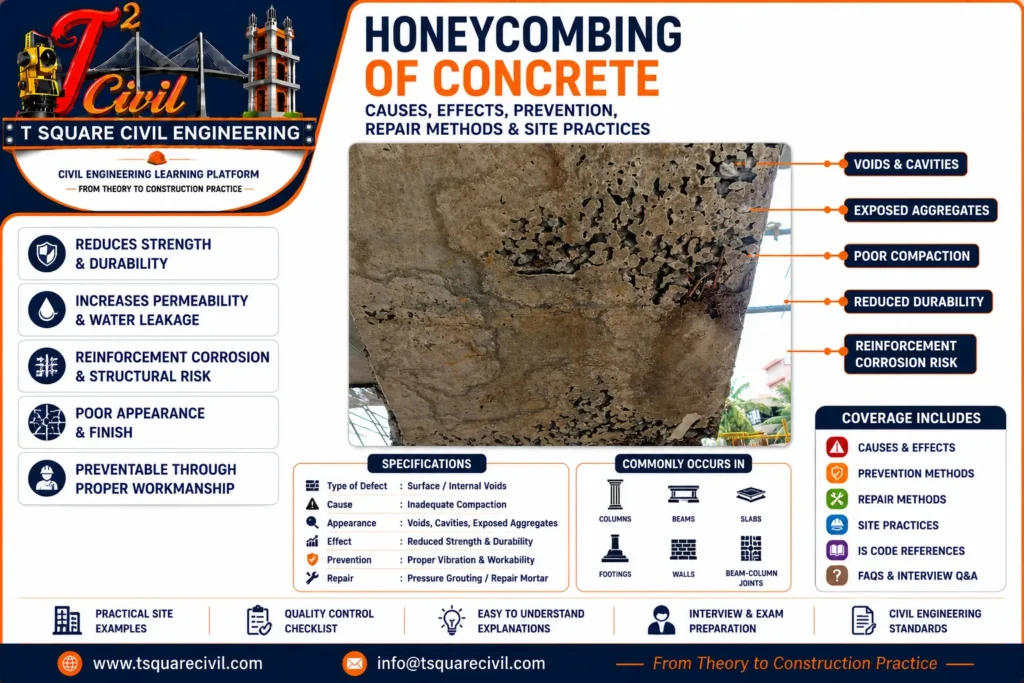
Honeycombing of concrete is the presence of voids, cavities, and exposed coarse aggregates on the surface or inside hardened concrete caused by incomplete compaction or inadequate filling of concrete during placement.
The defect occurs because sufficient cement mortar is not available around the coarse aggregates, leaving interconnected voids within the concrete.
Honeycombing may occur in:
- Columns
- Beams
- Slabs
- Footings
- Shear walls
- Retaining walls
- Bridge components
- Water retaining structures
The severity of honeycombing can range from small surface imperfections to deep structural defects requiring major repair.
Why is Honeycombing a Serious Concrete Defect?
Honeycombing affects both the appearance and performance of concrete.
The major reasons why honeycombing is considered a serious defect include:
Reduced Structural Strength
Large voids reduce the effective cross-sectional area of concrete and may reduce load-carrying capacity.
Increased Permeability
Honeycombed concrete allows water, chlorides, sulphates, and other harmful substances to penetrate more easily inside concrete.
Reinforcement Corrosion
If reinforcement becomes exposed or insufficiently covered, corrosion may begin earlier than expected.
Poor Bond Between Concrete and Steel
Voids around reinforcement reduce bond strength and can affect structural performance.
Reduced Durability
Concrete becomes more vulnerable to weathering, freeze-thaw cycles (where applicable), chemical attack, and environmental deterioration.
Unsatisfactory Appearance
Honeycombing reduces the surface finish and often requires costly repairs before a structure can be accepted.
How Honeycombing Develops in Concrete
Honeycombing generally develops during concreting due to one or more deficiencies in materials, workmanship, or construction practices.
The sequence is usually as follows:
- Fresh concrete is placed into the formwork.
- Concrete fails to flow properly around reinforcement or into corners.
- Air pockets remain trapped within the concrete.
- Concrete is inadequately compacted or improperly vibrated.
- Mortar does not completely surround the coarse aggregates.
- After removing the formwork, voids and exposed aggregates become visible.
Proper quality control during placing and compaction can prevent most cases of honeycombing.
Mechanism of Honeycombing Formation
Honeycombing develops because the coarse aggregate skeleton is not completely surrounded by cement paste and mortar.
The process typically involves:
Inadequate Workability
Concrete with low workability cannot flow into congested reinforcement or narrow formwork sections.
Entrapped Air
Without adequate compaction, air remains trapped within the concrete.
Aggregate Bridging
Large aggregates may bridge across reinforcement, preventing mortar from reaching lower sections.
Incomplete Compaction
Insufficient vibration leaves internal voids.
Mortar Deficiency
When mortar cannot completely fill the void spaces between aggregates, cavities remain after hardening of concrete.
The combined effect of these factors produces the characteristic honeycomb appearance.
Importance of Preventing Honeycombing
Preventing honeycombing offers several engineering benefits.
Improved Structural Integrity
Dense concrete provides better strength and load transfer.
Enhanced Durability
Well-compacted concrete resists environmental deterioration more effectively.
Better Reinforcement Protection
Proper concrete cover reduces the likelihood of steel corrosion.
Reduced Maintenance Costs
Preventing defects during construction is significantly more economical than repairing them later.
Better Surface Finish
Uniform concrete surfaces improve both appearance and serviceability.
Increased Service Life
Dense concrete contributes to the long-term performance of the structure.
Types of Honeycombing
Honeycombing can generally be classified based on its severity.
Surface Honeycombing
- Limited to the concrete surface.
- Usually shallow.
- Mainly affects appearance.
- Often repaired using polymer-modified repair mortar.
Moderate Honeycombing
- Extends deeper into the concrete.
- May expose portions of reinforcement.
- Requires proper inspection before repair.
Severe Honeycombing
- Large interconnected voids.
- Significant reinforcement exposure.
- May affect structural safety.
- Requires engineering assessment before selecting the repair method.
Factors Affecting Honeycombing
Several factors influence the likelihood of honeycombing during construction.
Material Factors
- Poor aggregate grading.
- Large aggregate size.
- Low mortar content.
- Poor workability.
Construction Factors
- Improper concrete placement.
- Excessive free fall.
- Congested reinforcement.
- Inadequate vibration.
- Leaking formwork.
Workmanship Factors
- Lack of supervision.
- Improper vibration technique.
- Delayed placement.
- Poor construction planning.
Key Points to Remember
- Honeycombing is caused by incomplete filling of concrete around aggregates and reinforcement.
- Proper workability significantly reduces the risk of honeycombing.
- Correct vibration is one of the most effective preventive measures.
- Good formwork prevents leakage of cement slurry.
- Honeycombing should always be inspected before selecting the repair method.
- Minor defects may be cosmetic, while severe honeycombing can affect structural performance.
- Early identification and timely repair improve durability and extend the service life of the structure.
Major Causes of Honeycombing of Concrete
Honeycombing is generally not caused by a single factor. It usually develops due to a combination of poor concrete quality, improper workmanship, inadequate supervision, and unsuitable construction practices.
The following are the major causes of honeycombing in concrete structures.
Inadequate Compaction (Most Common Cause)
Inadequate compaction is one of the primary causes of honeycombing. During concreting, fresh concrete contains entrapped air that must be removed through proper vibration or compaction. If air voids remain trapped, the concrete cannot become dense, resulting in cavities and exposed coarse aggregates.
Reasons
- Insufficient vibration time.
- Vibrator not inserted at proper spacing.
- Vibrator not reaching the full depth of concrete.
- Manual compaction performed improperly.
Site Observation
Large voids are usually seen around reinforcement, corners, and deep sections of beams and columns.
Poor Workability of Concrete
Concrete with very low workability cannot flow properly around reinforcement or into narrow spaces within the formwork.
If the concrete is too stiff, coarse aggregates remain locked together while the cement mortar cannot completely fill the voids.
Common Reasons
- Low water-cement ratio.
- Insufficient mortar.
- Poor mix proportion.
- Improper aggregate grading.
Site Observation
Honeycombing is commonly observed in heavily reinforced columns and beam-column junctions.
Congested Reinforcement
When reinforcement bars are placed too closely together, fresh concrete cannot easily pass between them.
If proper workability and vibration are not maintained, voids remain around reinforcement, resulting in honeycombing.
Typical Locations
- Beam-column joints.
- Footings with dense reinforcement.
- Shear walls.
- Bridge piers.
- Transfer girders.
Improper Concrete Placement
Concrete should always be placed as close as possible to its final position.
Improper placement methods increase segregation and prevent uniform filling.
Examples
- Dropping concrete from excessive heights.
- Pouring concrete from one side only.
- Placing concrete in very thick layers.
- Allowing concrete to accumulate at one location.
These practices prevent proper compaction and increase the risk of honeycombing.
Leakage of Cement Slurry from Formwork
If formwork joints are not properly sealed, cement slurry leaks through gaps during vibration.
The remaining concrete becomes deficient in mortar and leaves exposed coarse aggregates after hardening.
Common Causes
- Loose formwork.
- Damaged shuttering.
- Improper joint sealing.
- Poor alignment.
Improper Aggregate Grading
Poorly graded aggregates contain excessive voids.
If sufficient fine particles are unavailable to fill these voids, the concrete becomes less cohesive and more prone to honeycombing.
Proper grading improves packing density and reduces void formation.
Excessive Coarse Aggregate
When the proportion of coarse aggregate is too high compared to mortar, there is insufficient paste to surround every particle.
This leads to interconnected voids and honeycombing.
Delay in Concrete Placement
Fresh concrete begins losing workability with time.
Delayed placement without suitable measures may cause:
- Reduced flowability.
- Difficult compaction.
- Formation of honeycombing.
Improper Vibration Technique
Even when vibrators are available, incorrect usage may produce honeycombing.
Common mistakes include:
- Vibrating only the surface.
- Insufficient insertion depth.
- Large spacing between insertions.
- Removing the vibrator too quickly.
Poor Supervision During Concreting
Many cases of honeycombing occur because concreting operations are not properly supervised.
Quality control personnel should continuously monitor:
- Concrete consistency.
- Placement method.
- Vibration quality.
- Formwork condition.
- Reinforcement congestion.
Effects of Honeycombing on Concrete Structures
Honeycombing affects both structural performance and durability.
Reduction in Strength
Large voids reduce the effective cross-sectional area of concrete.
As a result:
- Load-carrying capacity decreases.
- Stress concentration increases.
- Structural performance may be affected.
Increased Permeability
Honeycombed concrete contains interconnected voids that allow:
- Water.
- Moisture.
- Chlorides.
- Sulphates.
- Harmful chemicals.
to penetrate more easily.
This significantly reduces durability.
Corrosion of Reinforcement
If reinforcement becomes exposed due to honeycombing, moisture and oxygen can reach the steel.
Over time this may result in:
- Rust formation.
- Expansion of reinforcement.
- Cracking.
- Spalling.
- Reduced service life.
Poor Bond Between Steel and Concrete
Concrete surrounding reinforcement develops bond strength.
Honeycombing interrupts this bond and may reduce force transfer between steel and concrete.
Reduced Durability
Honeycombed concrete is more vulnerable to:
- Chemical attack.
- Weathering.
- Freeze-thaw action (where applicable).
- Carbonation.
- Chloride ingress.
- Water Leakage
Honeycombing is especially dangerous in:
- Water tanks.
- Basements.
- Retaining walls.
- Lift pits.
- Sewage structures.
Water can pass through interconnected voids, leading to leakage.
Poor Appearance
Visible cavities and exposed aggregates reduce the aesthetic quality of exposed concrete surfaces.Increased Repair Cost
Repairing honeycombing after concrete hardens is significantly more expensive than preventing it during construction.
How to Identify Honeycombing on Site
Site engineers should inspect concrete immediately after formwork removal.
Common signs include:
- Visible coarse aggregates.
- Surface cavities.
- Open voids.
- Missing mortar.
- Rough concrete finish.
- Exposed reinforcement.
- Deep pockets in corners.
Any suspicious areas should be marked for further assessment.
Inspection of Honeycombing
Inspection should determine both the extent and severity of the defect before deciding on repairs.
Step-1: Visual Inspection
The first step is a detailed visual examination.
Check for:
- Size of cavities.
- Location.
- Reinforcement exposure.
- Surface finish.
- Depth (where visible).
Step-2: Hammer Sounding
A light hammer tap can indicate whether internal voids exist.
- Solid concrete gives a clear ringing sound.
- Honeycombed areas often produce a dull or hollow sound.
Step-3: Measurement of Depth
The depth of honeycombing should be measured using suitable inspection tools to assess whether the defect is superficial or extends into the structural core.
Step-4: Engineering Assessment
Where severe honeycombing is suspected, the structural engineer should determine:
- Structural significance.
- Required repair method.
- Need for further testing.
Severity Classification of Honeycombing
Honeycombing can generally be classified into three categories.
| Severity | Characteristics | Typical Action |
|---|---|---|
| Minor | Small surface voids without reinforcement exposure | Surface repair using suitable repair mortar |
| Moderate | Larger cavities with partial reinforcement exposure | Remove loose concrete and repair using polymer-modified mortar or micro-concrete, as appropriate |
| Severe | Deep interconnected voids affecting structural performance | Detailed engineering assessment followed by appropriate structural repair or strengthening |
Practical Site Example
During the concreting of an RCC column with closely spaced reinforcement, the concrete was placed rapidly without ensuring proper vibration around the reinforcement cage.
After removing the formwork, large cavities and exposed coarse aggregates were observed near the beam-column junction. Investigation revealed that the internal vibrator had not reached the lower portion of the column, leaving trapped air and insufficient mortar around the aggregates.
The affected area required removal of loose concrete and repair using an approved repair material under engineering supervision. The incident highlighted the importance of adequate workability, systematic vibration, and continuous site supervision during concreting.
Prevention of Honeycombing of Concrete
Preventing honeycombing is always more effective and economical than repairing it after the concrete has hardened. Proper planning, quality control, and supervision during concreting can eliminate most cases of honeycombing.
Use a Proper Concrete Mix
A well-designed concrete mix ensures sufficient mortar is available to surround the coarse aggregates and reinforcement.
Recommendations
- Use an approved mix design.
- Maintain the specified water-cement ratio.
- Ensure adequate cement paste content.
- Avoid harsh concrete mixes.
- Use well-graded aggregates.
Ensure Adequate Workability
Concrete should have sufficient workability to flow around reinforcement and completely fill the formwork without segregation.
Good Practices
- Check workability before placing concrete.
- Use suitable chemical admixtures when additional workability is required.
- Do not increase workability by adding excess water at the construction site.
Proper Placement of Concrete
Concrete should always be placed close to its final position.
Good Practices
- Avoid excessive free fall.
- Place concrete in layers of suitable thickness.
- Maintain continuous concreting whenever possible.
- Ensure concrete reaches corners and congested reinforcement.
Proper Compaction
Compaction is one of the most critical operations during concreting.
Best Practices
- Use suitable internal vibrators.
- Insert the vibrator vertically.
- Ensure each insertion overlaps the previous one.
- Continue vibration only until air bubbles stop escaping and the concrete becomes dense.
- Avoid both under-vibration and over-vibration.
Well-Designed Formwork
Proper formwork helps retain the cement mortar and maintain the shape of the concrete.
Requirements
- Leak-proof joints.
- Adequate rigidity.
- Correct alignment.
- Proper supports and bracing.
- Clean internal surfaces before concreting.
Proper Reinforcement Arrangement
Congested reinforcement makes concrete placement difficult.
Recommendations
- Maintain spacing according to the approved drawings.
- Use spacers and cover blocks correctly.
- Ensure adequate clear spacing for concrete flow.
Continuous Supervision
Proper supervision during concreting significantly reduces construction defects.
The supervising engineer should continuously monitor:
- Concrete consistency.
- Placement sequence.
- Vibration quality.
- Formwork condition.
- Reinforcement positioning.
- Concrete cover.
Repair Methods for Honeycombing of Concrete
The repair method depends on the location, depth, size, and structural significance of the honeycombing. A qualified engineer should assess significant defects before selecting the repair procedure.
Repair of Minor Honeycombing
Minor honeycombing generally affects only the surface and does not expose reinforcement.
Procedure
Step 1
Remove all loose concrete and weak mortar.
Step 2
Clean the surface thoroughly using compressed air or clean water.
Step 3
Apply a suitable bonding agent if specified.
Step 4
Fill the cavities with an approved polymer-modified repair mortar or other suitable repair material.
Step 5
Finish the repaired surface and cure it properly.
Repair of Moderate Honeycombing
Moderate honeycombing extends deeper and may partially expose reinforcement.
Procedure
Step 1
Remove all unsound concrete until sound concrete is reached.
Step 2
Clean the reinforcement and surrounding concrete.
Step 3
Treat corroded reinforcement if required.
Step 4
Apply a bonding coat where specified.
Step 5
Repair the cavity using an appropriate repair mortar or micro-concrete, following the manufacturer’s recommendations.
Step 6
Cure the repaired area properly.
Repair of Severe Honeycombing
Severe honeycombing may affect structural performance.
Typical Approach
- Detailed engineering inspection.
- Assessment of structural adequacy.
- Additional testing if required.
- Selection of an appropriate structural repair or strengthening method.
- Quality inspection after repair.
Structural repairs should always be carried out under the supervision of a qualified structural engineer.
Quality Control Measures
Effective quality control during concreting significantly reduces the occurrence of honeycombing.
Before Concreting
- Verify reinforcement spacing.
- Check concrete cover.
- Inspect formwork joints.
- Ensure formwork is clean.
- Confirm the approved mix design.
- Verify workability requirements.
During Concreting
- Place concrete systematically.
- Avoid segregation.
- Use proper vibration techniques.
- Maintain layer thickness as planned.
- Prevent interruption of concreting where possible.
After Concreting
- Inspect exposed surfaces after formwork removal.
- Mark any defective areas.
- Assess the severity of defects.
- Carry out repairs promptly if necessary.
- Maintain proper curing.
Site Engineer Checklist Before Concrete Placement
| Sl. No. | Inspection Item | Yes ✓ | No ✗ |
|---|---|---|---|
| 1 | Formwork is leak-proof and properly aligned. | ☐ | ☐ |
| 2 | Reinforcement is correctly fixed as per approved drawings. | ☐ | ☐ |
| 3 | Cover blocks and spacers are properly placed. | ☐ | ☐ |
| 4 | Concrete workability is satisfactory for the member being cast. | ☐ | ☐ |
| 5 | Internal vibrators are available, functional, and tested. | ☐ | ☐ |
| 6 | Adequate manpower is available for continuous concreting. | ☐ | ☐ |
| 7 | Concrete placing sequence has been planned and communicated. | ☐ | ☐ |
| 8 | Proper lighting arrangements are available for night concreting (if applicable). | ☐ | ☐ |
| 9 | Backup equipment (vibrator, generator, etc.) is available if required. | ☐ | ☐ |
| 10 | Quality Control (QA/QC) personnel are present during concreting. | ☐ | ☐ |
Practical Site Tips
Tip 1
Do not place stiff concrete in heavily reinforced sections without verifying its workability.
Tip 2
Ensure internal vibrators reach all areas, especially corners and beam-column junctions.
Tip 3
Avoid excessive free fall, particularly in deep columns and walls.
Tip 4
Inspect formwork joints carefully before concreting to prevent leakage of cement slurry.
Tip 5
Maintain continuous supervision during concreting to identify problems early.
Common Mistakes Leading to Honeycombing
- Adding water at the site without approval.
- Using damaged or leaking formwork.
- Inadequate vibration.
- Excessive vibration causing segregation.
- Poor reinforcement arrangement.
- Placing concrete in excessively thick layers.
- Delayed concrete placement.
- Failure to inspect after formwork removal.
Comparison: Honeycombing vs Bleeding vs Segregation
| Property | Honeycombing | Bleeding | Segregation |
|---|---|---|---|
| Definition | Voids and exposed coarse aggregates due to incomplete filling and compaction | Upward movement of water to the concrete surface | Separation of coarse aggregates from mortar |
| Stage | Usually visible after removing formwork | Occurs before concrete hardens | Occurs during handling and placement |
| Primary Cause | Poor compaction, poor placement, inadequate mortar | Excess water and settlement of solids | Poor cohesion, improper handling, excessive vibration |
| Main Effect | Reduced durability and possible loss of structural integrity | Weak surface layer (laitance) | Non-uniform concrete and reduced quality |
| Prevention | Proper workability, vibration, and formwork | Control water content and proper finishing | Proper mix design, handling, and compaction |
Summary of Relevant IS Code References
The following Indian Standards are commonly referred to when dealing with concreting practices and concrete quality. Readers should consult the latest official editions for complete requirements.
| Standard | General Purpose |
|---|---|
| IS 456 | General requirements for plain and reinforced concrete construction, including workmanship and durability |
| IS 1199 Series | Methods for sampling and testing fresh concrete, including workability-related tests |
| IS 516 Series | Methods for testing hardened concrete properties, including strength tests |
| IS 10262 | Guidelines for concrete mix proportioning |
Note: The descriptions above are original summaries for educational purposes and are not reproductions of the standards.
Key Learning Points
- Honeycombing is primarily a workmanship-related defect that can usually be prevented through proper planning and execution.
- Adequate workability, proper placement, and correct vibration are essential for producing dense, durable concrete.
- Early inspection after formwork removal helps identify defects before they lead to long-term durability issues.
- Repair methods should always be selected according to the severity and structural significance of the honeycombing.
- Preventive quality control is more economical and reliable than post-construction repair.
Frequently Asked Questions (FAQs)
1. What is honeycombing of concrete?
Answer:
Honeycombing of concrete is a construction defect characterised by voids, cavities, and exposed coarse aggregates on the surface or inside hardened concrete due to incomplete compaction, improper concrete placement, or insufficient mortar surrounding the aggregates.
2. Why is honeycombing considered a serious defect?
Answer:
Honeycombing reduces the density and durability of concrete, increases permeability, weakens the bond with reinforcement, and may expose steel to corrosion. Severe honeycombing can also affect the structural performance of a member.
3. What is the main cause of honeycombing?
Answer:
The most common cause is inadequate compaction (improper vibration) during concrete placement. Other contributing factors include poor workability, congested reinforcement, leaking formwork, and improper concrete placement.
4. Can honeycombing reduce the strength of concrete?
Answer:
Yes. Honeycombing reduces the effective concrete section and may decrease structural strength, especially when the defect is extensive or occurs in critical structural members.
5. How can honeycombing be prevented?
Answer:
Honeycombing can be prevented by:
- Using a properly designed concrete mix.
- Ensuring adequate workability.
- Providing proper vibration.
- Using leak-proof formwork.
- Placing concrete correctly.
- Maintaining proper supervision during concreting.
6. Is honeycombing repairable?
Answer:
Yes. Minor honeycombing can usually be repaired with suitable repair mortar, while moderate or severe defects may require micro-concrete or other approved repair methods after engineering assessment.
7. Where does honeycombing usually occur?
Answer:
Honeycombing commonly occurs in:
- Columns.
- Beam-column joints.
- Beams.
- Footings.
- Shear walls.
- Heavily reinforced members.
- Corners of formwork.
8. Does low workability increase honeycombing?
Answer:
Yes. Low-workability concrete cannot flow easily around reinforcement and into corners, increasing the likelihood of void formation.
9. Can over-vibration cause honeycombing?
Answer:
Over-vibration is more commonly associated with segregation. However, poor vibration practices, whether insufficient or excessive under unsuitable conditions, can contribute to defects in concrete quality.
10. Why is proper formwork important?
Answer:
Proper formwork prevents leakage of cement slurry, maintains the shape of the concrete, and helps ensure dense, uniform concrete without voids.
11. Does honeycombing expose reinforcement?
Answer:
Yes. Moderate and severe honeycombing may expose reinforcement, increasing the risk of corrosion and reducing durability.
12. Can honeycombing lead to water leakage?
Answer:
Yes. Honeycombing increases concrete permeability, allowing water to pass through voids, especially in water-retaining and underground structures.
13. Which structures are more vulnerable to honeycombing?
Answer:
Structures with congested reinforcement or complex formwork, such as columns, beam-column joints, retaining walls, bridge piers, and shear walls, are more susceptible if proper concreting practices are not followed.
14. What is the best way to detect honeycombing?
Answer:
The most common method is visual inspection after formwork removal. In some cases, hammer sounding and engineering evaluation are also used to assess the extent of the defect.
15. Is honeycombing a workmanship defect?
Answer:
In many cases, yes. Honeycombing is often associated with inadequate compaction, improper placement, poor supervision, or deficiencies in construction practices.
Civil Engineering Interview Questions with Answers
1. Define honeycombing of concrete.
Answer:
Honeycombing is a concrete defect where voids and exposed coarse aggregates appear because the concrete has not been properly compacted or has not completely filled the formwork.
2. Why does honeycombing occur?
Answer:
It occurs due to inadequate vibration, poor workability, congested reinforcement, improper placement, leaking formwork, or poor-quality concrete.
3. What are the major effects of honeycombing?
Answer:
- Reduced durability.
- Increased permeability.
- Reinforcement corrosion.
- Reduced bond strength.
- Poor appearance.
- Possible reduction in structural performance.
4. How would you identify honeycombing during site inspection?
Answer:
By observing:
- Surface cavities.
- Exposed coarse aggregates.
- Rough concrete finish.
- Reinforcement exposure.
- Deep voids after formwork removal.
5. Which construction activity is most important for preventing honeycombing?
Answer:
Proper compaction using suitable vibration equipment is one of the most important activities for preventing honeycombing.
6. Why is workability important in preventing honeycombing?
Answer:
Adequate workability allows concrete to flow around reinforcement and completely fill the formwork without leaving voids.
7. How should honeycombing be repaired?
Answer:
The repair method depends on the severity. Minor defects may be repaired using suitable repair mortar, while deeper or structurally significant defects require engineering assessment and appropriate repair methods.
8. Can honeycombing affect reinforcement?
Answer:
Yes. Honeycombing can expose reinforcement, increasing the likelihood of corrosion and reducing durability.
9. Why should concrete be placed near its final position?
Answer:
Placing concrete near its final position minimises segregation, improves compaction, and reduces the possibility of honeycombing.
10. What quality control measures help prevent honeycombing?
Answer:
- Proper mix design.
- Adequate workability.
- Leak-proof formwork.
- Correct vibration.
- Continuous supervision.
- Inspection after formwork removal.
Viva Questions with Answers
1. What is honeycombing?
Answer: Honeycombing is the formation of voids and exposed coarse aggregates in hardened concrete due to incomplete compaction or improper placement.
2. Is honeycombing desirable?
Answer: No. It is an undesirable construction defect.
3. What is the most common cause of honeycombing?
Answer: Inadequate vibration or compaction.
4. Can poor workability cause honeycombing?
Answer: Yes.
5. Can leaking formwork cause honeycombing?
Answer: Yes. Leakage of cement slurry reduces mortar content and increases the likelihood of voids.
6. Which structural members commonly develop honeycombing?
Answer: Columns, beams, footings, shear walls, beam-column joints, and heavily reinforced members.
7. Does honeycombing increase permeability?
Answer: Yes.
8. Can honeycombing expose reinforcement?
Answer: Yes.
9. What is the best prevention method?
Answer: Proper workability, correct placement, and adequate vibration.
10. Can honeycombing reduce durability?
Answer: Yes
Quick Revision Notes
- Honeycombing is caused by incomplete filling and inadequate compaction of concrete.
- It appears as voids and exposed coarse aggregates after formwork removal.
- The most common cause is improper vibration.
- Honeycombing increases permeability and reduces durability.
- Proper workability, formwork, and supervision are essential preventive measures.
- Repair methods depend on the severity of the defect and should be selected after proper assessment.
- Early detection and timely repair improve the long-term performance of concrete structures.
Conclusion
Honeycombing of concrete is one of the most common and significant construction defects encountered in reinforced concrete structures. It occurs when concrete fails to completely fill the spaces around reinforcement or formwork, leaving voids and exposed coarse aggregates after hardening. Although it often appears as a surface defect, severe honeycombing can adversely affect the strength, durability, watertightness, and service life of a structure.
The primary causes of honeycombing include inadequate compaction, poor workability, congested reinforcement, improper concrete placement, leakage of cement slurry through formwork, and inadequate quality control during concreting. Fortunately, these defects can be significantly reduced through proper mix design, sufficient workability, correct vibration techniques, leak-proof formwork, and continuous supervision during construction.
Timely inspection after formwork removal is essential to identify honeycombed areas. Minor defects can generally be repaired using suitable repair mortars, while moderate and severe defects require careful engineering assessment and appropriate repair methods to restore the integrity and durability of the structure.
For every civil engineer, site supervisor, QA/QC engineer, contractor, and student, understanding the causes, prevention, and repair of honeycombing is an essential part of producing durable, safe, and high-quality concrete structures. Good workmanship, proper planning, and effective quality control remain the best methods for preventing honeycombing and ensuring long-term structural performance.
Key Takeaways
- Honeycombing is a concrete defect caused by incomplete filling and inadequate compaction.
- Poor workability, congested reinforcement, and improper vibration are major contributing factors.
- Honeycombing reduces durability, increases permeability, and may expose reinforcement to corrosion.
- Proper mix design, placement, vibration, and supervision are essential preventive measures.
- Repair methods should always be selected based on the severity and structural significance of the defect.
- Prevention through quality workmanship is more effective and economical than post-construction repair.
You may read our Related Articles
To gain a better understanding of fresh concrete behaviour, quality control, and concrete technology, you may also find these articles helpful:
Fresh Concrete
- Workability of Concrete
- Slump Cone Test
- Flow Table Test
- Compaction Factor Test
- Vee Bee Consistometer Test
- Bleeding of Concrete
- Segregation of Concrete
- Plastic Shrinkage Cracks
- Cold Joints in Concrete
Concrete Testing
- Concrete Cube Casting Procedure
- Compressive Strength Test of Concrete Cubes
- Rebound Hammer Test
- Ultrasonic Pulse Velocity (UPV) Test
- Split Tensile Strength Test
- Flexural Strength Test
Cement Testing
- Standard Consistency Test of Cement
- Initial Setting Time Test
- Final Setting Time Test
- Soundness Test of Cement
- Fineness Test of Cement
You may use our Related Calculators
For practical construction calculations, use the following calculators available on T Square Civil Engineering:
- Steel Weight Calculator
- Cement Bags Calculator
- Concrete Volume Calculator
- Cement, Sand & Aggregate Calculator
- Brick Quantity Calculator
- Plaster Quantity Calculator
- Paint Quantity Calculator
- Tile Quantity Calculator
- Bar Bending Schedule (BBS) Calculator
- Lap Length Calculator
References
The information presented in this article has been prepared using accepted engineering principles and standard technical references.
Indian Standards
- IS 456:2000 – Plain and Reinforced Concrete – Code of Practice.
- IS 1199 (Latest Applicable Edition) – Methods of Sampling and Analysis of Concrete.
- IS 516 (Latest Applicable Edition) – Methods of Tests for Strength of Concrete.
- IS 10262 (Latest Applicable Edition) – Concrete Mix Proportioning.
Standard Reference Books
- M. S. Shetty – Concrete Technology.
- A. M. Neville – Properties of Concrete.
- S. C. Rangwala – Concrete Technology.
Note: The content in this article has been written in original language for educational purposes. References are provided to guide readers toward authoritative engineering resources. Readers should consult the latest official standards and publications for complete technical requirements.
T Square Civil Engineering
Civil Engineering Learning Platform: From Theory to Construction Practice
T Square Civil Engineering is dedicated to providing original, technically accurate, and practical civil engineering knowledge for students, engineers, educators, contractors, and competitive examination aspirants.
Our articles are developed using accepted engineering principles, practical construction practices, and reliable technical references to simplify complex concepts and support both academic learning and professional development.
We are committed to creating high-quality, copyright-conscious, and technically reliable educational resources that help learners build strong engineering fundamentals and practical construction knowledge.
Website: www.tsquarecivil.com
Disclaimer
The information provided in this article is intended for educational and informational purposes only.
Every effort has been made to ensure that the content is technically accurate and based on accepted engineering principles and reliable references. However, engineering decisions should always be made considering the latest applicable standards, project specifications, site conditions, and professional judgment.
References to Indian Standards (IS Codes) are provided for educational guidance only. The explanations are written in the original language and do not reproduce the standards. Readers should consult the latest official editions of the relevant standards for complete technical requirements and exact wording.
T Square Civil Engineering shall not be responsible for any loss, damage, or consequences arising from the use of the information presented in this article without appropriate professional verification.