 by
by Page Contents
Surface Crazing in Concrete
Surface crazing in concrete is a network of fine, shallow, interconnected hairline cracks that develops on the surface of hardened concrete. These cracks usually resemble a spider-web or map-like pattern and are generally confined to the top surface of the concrete. Unlike structural cracks, surface crazing is primarily an aesthetic defect and typically does not extend deep into the concrete.
Crazing commonly occurs due to rapid moisture loss from the concrete surface, improper finishing practices, excessive cement paste at the surface, inadequate curing, or adverse environmental conditions during placing and finishing. Although it rarely affects the structural strength of concrete, excessive crazing may reduce surface durability, increase water absorption, and create an undesirable appearance.
Understanding the causes, identification, prevention, and repair of surface crazing is essential for civil engineers, contractors, quality control engineers, and students to ensure durable and high-quality concrete construction.
Quick Answer
Surface Crazing in Concrete is a pattern of fine interconnected hairline cracks that develops on the surface of hardened concrete due to rapid drying, improper finishing, excessive cement paste, inadequate curing, or other construction-related factors. These cracks are generally superficial and usually do not affect the structural integrity of the concrete.
Quick Information Table
| Particular | Details |
|---|---|
| Defect Type | Surface finishing defect |
| Stage of Occurrence | After concrete hardens |
| Primary Cause | Rapid surface moisture loss and improper finishing |
| Crack Pattern | Fine interconnected hairline (map) cracks |
| Crack Depth | Usually very shallow |
| Structural Significance | Generally cosmetic; rarely affects structural strength |
| Common Locations | Floors, slabs, pavements, bridge decks and exposed concrete surfaces |
| Prevention | Proper finishing, curing and moisture control |
| Repair | Surface treatment depending on severity |
| Applicable Standards | IS 456, IS 1199 (Part 2), IS 7861 (Part 1) and other relevant standards (summarised) |
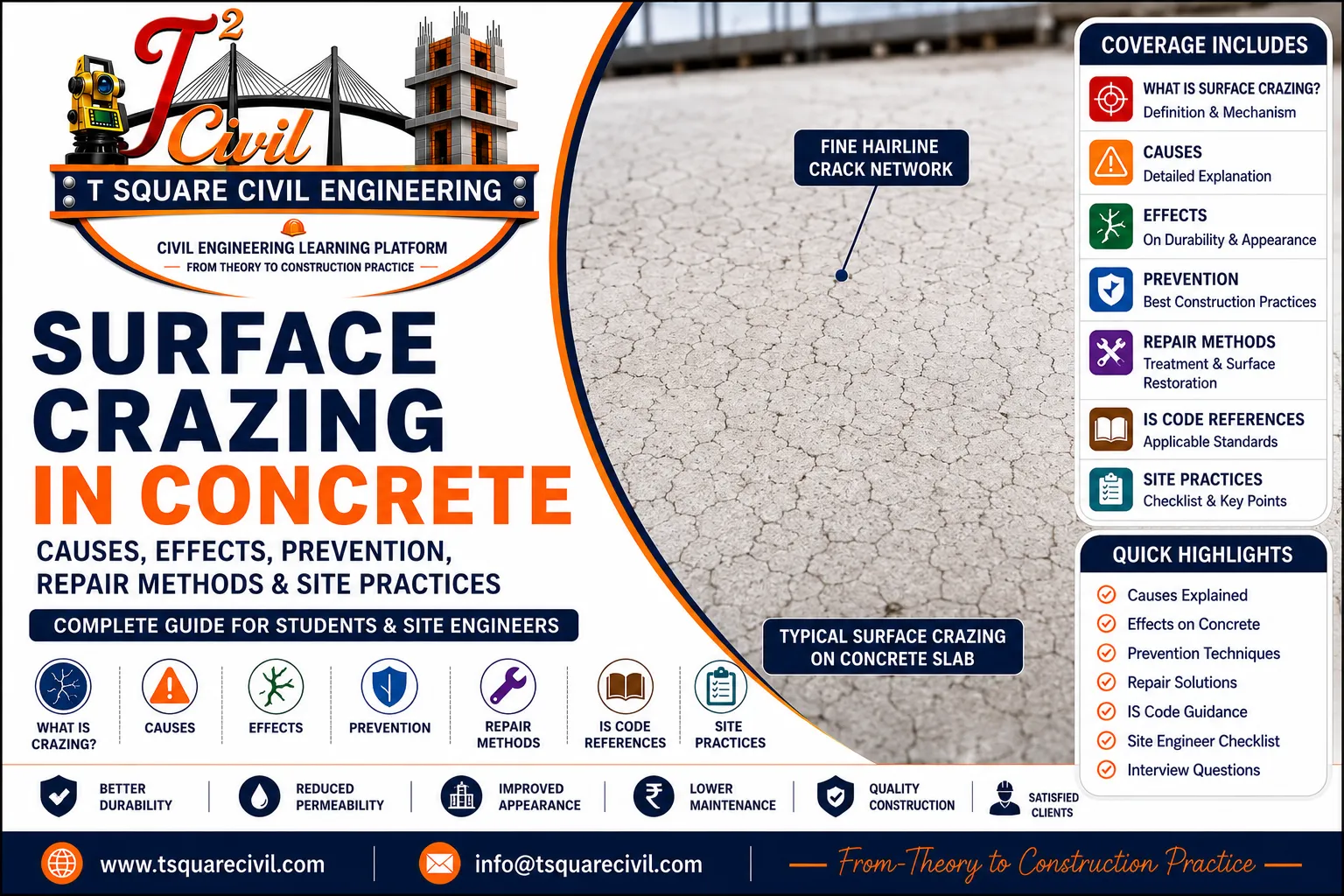
What is Surface Crazing in Concrete?
Surface crazing is a network of very fine, closely spaced cracks that develops only on the exposed surface of hardened concrete. These cracks intersect randomly to form a pattern similar to dried mud, a spider web, or a geographical map.
The cracks are generally shallow and confined to the surface layer. They usually do not penetrate through the full depth of the concrete and therefore are not considered structural cracks.
Surface crazing is mainly associated with finishing and curing practices rather than structural loading.
Why is Surface Crazing Important?
Although surface crazing is generally not a structural defect, it is important because it can affect the quality, durability, and appearance of concrete surfaces.
Its significance includes:
- Reduces aesthetic appearance.
- Indicates poor finishing or curing practices.
- May increase surface permeability.
- Can permit moisture penetration.
- May reduce abrasion resistance.
- Can accelerate surface deterioration under severe exposure conditions.
- Increases maintenance requirements.
Proper finishing and curing significantly reduce the likelihood of surface crazing.
Objectives of Understanding Surface Crazing
Understanding surface crazing enables engineers to:
- Identify surface defects correctly.
- Differentiate crazing from structural cracks.
- Improve concrete finishing practices.
- Enhance curing methods.
- Increase surface durability.
- Improve construction quality.
- Minimise repair and maintenance costs.
Mechanism of Surface Crazing Formation
Surface crazing develops due to differential shrinkage between the concrete surface and the underlying concrete.
The mechanism generally follows these stages:
- Fresh concrete is placed and finished.
- The surface loses moisture rapidly due to evaporation.
- The surface layer shrinks more than the concrete beneath it.
- Tensile stresses develop in the thin surface layer.
- Since young concrete has low tensile strength, numerous fine cracks develop.
- These interconnected cracks create the characteristic map-like or spider-web pattern known as surface crazing.
Characteristics of Surface Crazing
Surface crazing has several distinctive characteristics that help engineers identify it during inspection.
Typical Characteristics
- Fine interconnected hairline cracks.
- Random map-like pattern.
- Very shallow depth.
- Usually confined to the surface.
- Commonly appears after concrete hardens.
- Does not generally affect structural strength.
- More visible after rain or when the surface is wet.
- Usually develops over large surface areas.
Types of Surface Crazing
Surface crazing may be classified according to its appearance and severity.
Fine Surface Crazing
Characteristics:
- Very fine cracks.
- Barely visible when dry.
- Clearly visible after wetting.
- Mainly affects appearance.
Moderate Surface Crazing
Characteristics:
- More noticeable crack network.
- Covers larger areas.
- Slight increase in surface permeability.
- May require surface treatment depending on service conditions.
Severe Surface Crazing
Characteristics:
- Dense crack network.
- More pronounced surface deterioration.
- Increased permeability.
- May require engineering evaluation and repair, particularly in aggressive environments.
Random Map Crazing
This is the most common form.
Characteristics:
- Irregular interconnected cracks.
- Spider web appearance.
- Random crack orientation.
- Uniform distribution over the surface.
Polygonal Crazing
In this type:
- Small polygon-shaped crack patterns develop.
- Crack spacing is relatively uniform.
- Common on smooth finished concrete.
Localised Surface Crazing
This occurs only in isolated portions of a concrete member.
Typical reasons include:
- Local finishing errors.
- Uneven curing.
- Localized rapid drying.
- Surface moisture variations.
Difference Between Surface Crazing and Structural Cracks
| Property | Surface Crazing | Structural Crack |
|---|---|---|
| Crack Width | Very fine | May be moderate to wide |
| Crack Depth | Surface only | May extend through the member |
| Pattern | Random network | Usually straight or directional |
| Structural Effect | Generally none | May reduce structural performance |
| Main Cause | Surface shrinkage | Loading, settlement, thermal effects, design or construction issues |
| Repair Priority | Low to moderate | High, depending on severity |
Where Does Surface Crazing Commonly Occur?
Surface crazing is frequently observed on concrete surfaces exposed to rapid drying or improper finishing.
Typical locations include:
- RCC floor slabs
- Industrial floors
- Concrete pavements
- Bridge decks
- Footpaths
- Parking areas
- Concrete roofs
- Airport pavements
- Warehouse floors
- Exposed concrete surfaces
Factors Affecting Surface Crazing
Several factors increase the likelihood of surface crazing:
- Rapid evaporation of surface moisture.
- Hot and windy weather.
- Low relative humidity.
- Excessive cement paste.
- High water-cement ratio.
- Premature finishing.
- Inadequate curing.
- Improper finishing techniques.
- Excessive trowelling.
- Poor mix proportioning.
Why Site Engineers Should Understand Surface Crazing
Every Site Engineer should understand surface crazing because it directly affects:
- Surface quality.
- Appearance of finished concrete.
- Durability of exposed surfaces.
- Customer acceptance.
- Long-term maintenance.
Proper knowledge helps engineers select appropriate finishing methods, curing practices, and quality control procedures to minimise surface defects.
Key Learning Points
- Surface crazing is a network of fine, shallow hairline cracks on the concrete surface.
- It is mainly caused by rapid surface drying and differential shrinkage.
- Surface crazing is generally non-structural.
- Proper curing, finishing, and mix design significantly reduce the occurrence of crazing.
- Early identification helps distinguish surface crazing from more serious structural cracks.
Detailed Causes of Surface Crazing
Surface crazing develops primarily because the surface layer of concrete dries and shrinks faster than the underlying concrete. This differential shrinkage creates tensile stresses in the thin surface layer, resulting in a network of fine hairline cracks.
The following are the major causes encountered on construction sites.
1. Rapid Surface Drying
This is the most common cause of surface crazing.
When moisture evaporates quickly from freshly finished concrete, the surface contracts while the underlying concrete remains relatively moist. This difference in shrinkage creates fine cracks.
Causes of Rapid Drying
- High ambient temperature
- Strong winds
- Low relative humidity
- Direct sunlight
- Large exposed concrete surfaces
Site Example
A concrete floor slab cast during summer without proper curing developed numerous fine map-like cracks within a day due to rapid evaporation.
2. Improper Curing
Concrete requires sufficient moisture for proper hydration.
If curing starts late or is inadequate, the surface loses moisture rapidly, increasing the likelihood of crazing.
Common Site Mistakes
- Delayed curing
- Insufficient water curing
- No curing compound
- Premature removal of wet coverings
- Interrupted curing schedule
3. Excessive Cement Paste
Concrete containing an excessive amount of cement paste undergoes greater drying shrinkage.
Higher paste content results in increased surface contraction and a higher risk of crazing.
4. High Water-Cement Ratio
Excess mixing water increases bleeding and drying shrinkage.
After evaporation of excess water, the surface contracts significantly, promoting crazing.
5. Premature Finishing
Finishing concrete before bleed water has completely evaporated traps water beneath the surface.
As the trapped water later evaporates, it causes differential shrinkage and surface cracking.
Common Errors
- Early steel trowelling
- Finishing while bleed water is still present
- Closing the surface too early
6. Excessive Steel Trowelling
Repeated hard steel trowelling densifies the concrete surface.
The dense surface shrinks differently from the underlying concrete, resulting in crazing.
7. Poor Concrete Mix Proportion
Improper mix design increases susceptibility to shrinkage.
Examples include:
- Excess cement
- Excess water
- Insufficient fine aggregates
- Poor aggregate grading
- Inadequate workability control
8. Hot Weather Concreting
High temperatures accelerate evaporation.
Without adequate protection, the concrete surface dries rapidly before proper hydration occurs.
Additional Risks
- Faster setting
- Increased shrinkage
- Higher finishing difficulties
9. Windy Conditions
Strong winds remove surface moisture rapidly.
Even moderate temperatures combined with high wind speeds may produce severe surface crazing.
10. Low Relative Humidity
Dry atmospheric conditions increase evaporation.
Concrete cast during dry weather requires immediate curing to prevent moisture loss.
11. Poor Finishing Practices
Improper finishing techniques often contribute to crazing.
Examples include:
- Overworking the surface
- Adding water during finishing
- Uneven finishing pressure
- Improper use of power trowels
12. Inadequate Compaction
Poor compaction creates non-uniform concrete.
Although not a direct cause, it contributes to uneven moisture distribution and localised surface defects.
Effects of Surface Crazing
Surface crazing is generally considered a non-structural defect, but it may affect serviceability, appearance, and long-term durability.
1. Poor Appearance
The concrete surface develops a spider-web pattern, reducing the visual quality of exposed concrete.
2. Increased Surface Permeability
Fine cracks allow easier penetration of:
- Water
- Moisture
- Chlorides
- Sulphates
- Carbon dioxide
3. Reduced Durability
Continuous exposure to aggressive environments may accelerate surface deterioration.
4. Dust Accumulation
The crack network traps dust and dirt, making cleaning more difficult.
5. Moisture Retention
Water retained within the crack network may promote staining and weathering.
6. Reduced Wear Resistance
Industrial floors with severe crazing may experience faster surface wear under heavy traffic.
7. Client Dissatisfaction
Visible cracking often creates the impression of poor workmanship, even when the structural performance is unaffected.
8. Higher Maintenance Cost
Additional repairs or surface treatments may be required to improve appearance and durability.
Identification of Surface Crazing
Site engineers should distinguish surface crazing from structural cracks.
Visual Characteristics
- Fine hairline cracks
- Random interconnected pattern
- Map-like appearance
- Uniform distribution
- Shallow depth
- More visible after wetting
Field Identification Procedure
Step 1
Clean the concrete surface.
Step 2
Inspect under daylight.
Step 3
Sprinkle water on the surface.
Hairline cracks become more visible when wet.
Step 4
Measure crack width.
Surface crazing cracks are usually extremely fine.
Step 5
Check crack depth.
The cracks generally remain confined to the surface.
Step 6
Determine whether cracks are increasing over time.
Surface crazing generally stabilises after formation.
Practical Site Examples
Example 1 – Industrial Floor
Large warehouse floor finished with excessive steel trowelling.
Result:
- Surface crazing over large areas.
Example 2 – Residential Roof Slab
Roof slab cast during hot weather.
Delayed curing caused widespread map cracking.
Example 3 – Concrete Pavement
Concrete pavement exposed to strong winds immediately after finishing.
Fine surface crazing developed within 24 hours.
Example 4 – Decorative Concrete
Stamped decorative concrete developed surface crazing because curing compound was not applied immediately.
Site Inspection Checklist
Before approving finished concrete, the Site Engineer should verify the following:
| Inspection Item | Yes ✓ | No ✗ |
|---|---|---|
| Bleed water completely disappeared before finishing | ☐ | ☐ |
| Concrete properly compacted | ☐ | ☐ |
| Surface not over-trowelled | ☐ | ☐ |
| Proper finishing sequence followed | ☐ | ☐ |
| No water added during finishing | ☐ | ☐ |
| Curing started immediately after finishing | ☐ | ☐ |
| Adequate curing maintained | ☐ | ☐ |
| Surface protected from wind | ☐ | ☐ |
| Surface protected from direct sunlight | ☐ | ☐ |
| Final surface free from visible crazing | ☐ | ☐ |
Practical Site Tips
- Avoid finishing while bleed water is present.
- Begin curing as soon as the surface is sufficiently hard.
- Protect fresh concrete from direct sunlight.
- Use windbreaks during hot and windy weather.
- Avoid adding water during finishing.
- Follow approved mix proportions.
- Use experienced finishing crews.
- Monitor weather conditions before concreting.
- Maintain continuous curing for the specified duration.
- Inspect finished surfaces before handing over.
Comparison Between Surface Crazing and Other Concrete Cracks
| Property | Surface Crazing | Plastic Shrinkage Cracks | Drying Shrinkage Cracks | Structural Cracks |
|---|---|---|---|---|
| Time of Formation | After hardening | Before setting | Weeks or months later | Any stage |
| Crack Pattern | Random map pattern | Mostly parallel | Random or directional | Usually straight |
| Crack Depth | Very shallow | Moderate | Variable | Deep |
| Structural Effect | Generally none | Usually minor | May increase over time | Significant |
| Primary Cause | Differential surface shrinkage | Rapid evaporation before setting | Long-term moisture loss | Load, settlement, design issues |
| Repair Priority | Low | Moderate | Moderate | High |
Engineering Case Study
Project
Industrial warehouse floor.
Observation
Fine interconnected cracks appeared approximately two days after casting.
Investigation
- Concrete was finished too early.
- Bleed water remained on the surface.
- Curing began six hours late.
- Ambient temperature exceeded 36°C.
Root Cause
Differential surface shrinkage caused by rapid moisture loss and improper finishing.
Corrective Measures
- Immediate curing after finishing.
- Improved finishing procedures.
- Use of evaporation reducers during hot weather.
- Enhanced supervision during concreting.
Outcome
Subsequent concrete pours showed no signs of surface crazing.
Key Learning Points
- Rapid surface drying is the primary cause of surface crazing.
- Improper curing significantly increases the risk.
- Surface crazing is usually a durability and appearance issue rather than a structural defect.
- Proper finishing techniques and timely curing are the most effective preventive measures.
- Early identification helps distinguish crazing from structural cracking and prevents unnecessary repairs.
Prevention of Surface Crazing in Concrete
Surface crazing can be effectively prevented through proper concrete mix design, correct finishing techniques, timely curing, and adequate supervision during concreting. Since crazing mainly affects the concrete surface, preventing rapid moisture loss from the surface is the most effective solution.
1. Use a Proper Concrete Mix
A well-proportioned concrete mix reduces shrinkage and improves surface durability.
Good Practices
- Use the approved concrete mix design.
- Maintain the specified water-cement ratio.
- Avoid excessive cement content.
- Ensure proper aggregate grading.
- Use clean materials.
- Use approved admixtures where specified.
Site Tip: Excessive cement paste increases drying shrinkage and the likelihood of surface crazing.
2. Maintain the Recommended Water-Cement Ratio
A high water-cement ratio increases drying shrinkage.
Recommended Practices
- Do not add extra water at the site without engineering approval.
- Maintain workability using approved admixtures if necessary.
- Check slump before concrete placement.
- Maintain uniform concrete consistency.
3. Follow Proper Finishing Practices
Incorrect finishing is one of the major causes of surface crazing.
Best Practices
- Allow bleed water to disappear completely before finishing.
- Avoid premature trowelling.
- Do not sprinkle cement on the surface.
- Do not sprinkle water during finishing.
- Avoid excessive steel trowelling.
- Finish the surface uniformly.
4. Start Curing at the Right Time
Proper curing prevents excessive moisture loss.
Recommended Curing Practices
- Begin curing immediately after the concrete surface has hardened sufficiently.
- Maintain continuous curing for the duration specified in the project specifications.
- Prevent drying of exposed concrete.
- Use appropriate curing methods based on site conditions.
5. Protect Concrete During Hot Weather
Hot weather increases evaporation.
Protective Measures
- Cast concrete during cooler hours whenever practical.
- Use sunshades where required.
- Minimize finishing delays.
- Follow project requirements for hot weather concreting.
6. Protect Concrete from Wind
Wind significantly increases evaporation.
Site Measures
- Install temporary windbreaks.
- Cover exposed concrete with wet hessian or curing sheets where appropriate.
- Reduce the exposed surface area whenever practical.
7. Provide Adequate Supervision
Continuous supervision reduces construction errors.
The Site Engineer should monitor:
- Bleed water disappearance.
- Finishing operations.
- Curing commencement.
- Weather conditions.
- Surface appearance.
- Concrete workability.
8. Train Finishing Workers
Properly trained workers reduce finishing defects.
Training should include:
- Correct finishing sequence.
- Recognition of bleed water.
- Proper trowelling methods.
- Importance of curing.
- Surface quality requirements.
Repair Methods for Surface Crazing
The repair method depends on the severity, exposure conditions, intended use of the structure, and project specifications. Minor surface crazing often requires little or no repair, whereas surfaces exposed to severe weather or abrasion may require protective treatment.
1. Minor Surface Crazing
Minor hairline cracks usually affect appearance only.
Procedure
Step 1
Clean the concrete surface thoroughly.
Step 2
Inspect the crack pattern.
Step 3
Confirm that cracks are shallow and stable.
Step 4
Continue proper curing if the concrete is still within the curing period.
2. Moderate Surface Crazing
Where durability or appearance is affected, surface treatment may be considered.
Typical actions include:
- Cleaning the surface.
- Preparing the surface in accordance with project requirements.
- Applying a suitable protective treatment compatible with the intended service conditions.
- Inspecting the repaired surface after completion.
3. Severe Surface Crazing
Although uncommon, extensive surface crazing combined with surface deterioration should be evaluated by a qualified engineer.
Possible actions include:
- Detailed inspection.
- Assessment of crack depth and extent.
- Selection of an appropriate repair system.
- Surface restoration where required.
- Final quality inspection.
Quality Control Measures
Effective quality control minimises the occurrence of surface crazing.
Before Concreting
- Verify approved mix design.
- Check weather forecast.
- Inspect materials.
- Ensure adequate manpower.
- Confirm finishing equipment availability.
- Arrange curing materials before casting begins.
- Conduct a pre-concreting briefing.
During Concreting
- Maintain specified workability.
- Avoid segregation.
- Compact concrete properly.
- Monitor bleed water.
- Finish only after bleed water disappears.
- Protect concrete from excessive evaporation.
After Concreting
- Start curing promptly.
- Continue curing without interruption.
- Inspect the surface regularly.
- Record observations.
- Repair defects if necessary.
- Maintain quality records.
Site Engineer Checklist
Before approving the finished concrete surface, the Site Engineer should verify the following:
| Sl. No. | Inspection Item | Yes ✓ | No ✗ |
|---|---|---|---|
| 1 | Approved mix design used. | ☐ | ☐ |
| 2 | Specified water-cement ratio maintained. | ☐ | ☐ |
| 3 | Bleed water disappeared before finishing. | ☐ | ☐ |
| 4 | No water added during finishing. | ☐ | ☐ |
| 5 | No dry cement sprinkled on the surface. | ☐ | ☐ |
| 6 | Surface not over-trowelled. | ☐ | ☐ |
| 7 | Proper curing started on time. | ☐ | ☐ |
| 8 | Surface protected from wind and sunlight. | ☐ | ☐ |
| 9 | Surface free from visible crazing. | ☐ | ☐ |
| 10 | Final inspection completed and documented. | ☐ | ☐ |
Practical Site Tips
Tip 1
Never finish concrete while bleed water is still present.
Tip 2
Avoid adding water to improve surface finish.
Tip 3
Start curing immediately after the surface becomes hard enough.
Tip 4
Use windbreaks and shading during hot, dry, or windy weather.
Tip 5
Inspect large slabs several times during the first 24 hours after placement.
## Do’s and Don’ts
| Do’s ✅ | Don’ts ❌ |
|---|---|
| Follow approved mix design. | Do not increase the water content without approval. |
| Finish after bleed water disappears. | Do not finish over bleed water. |
| Start curing promptly. | Do not delay curing. |
| Protect concrete from rapid drying. | Do not expose fresh concrete to strong winds or direct sunlight unnecessarily. |
| Maintain continuous curing. | Do not stop curing before the specified duration. |
| Use trained finishing crews. | Do not overwork or over-trowel the surface. |
Common Site Mistakes
- Premature steel trowelling.
- Delayed curing.
- Excessive water in the concrete mix.
- Sprinkling water during finishing.
- Excessive steel trowelling pressure.
- Poor weather planning.
- Inadequate supervision.
- Improper mix proportioning.
- Lack of curing materials at site.
- Failure to monitor evaporation conditions.
Corrective Actions
| Problem Observed | Possible Cause | Corrective Action |
|---|---|---|
| Fine map cracks over the surface | Rapid drying | Improve curing and protect the surface from moisture loss. |
| Hairline cracks after finishing | Premature finishing | Finish only after bleed water has disappeared. |
| Extensive crazing | High water-cement ratio | Maintain the specified water-cement ratio and approved mix design. |
| Surface dusting with crazing | Poor finishing and curing | Improve finishing procedures and start curing promptly. |
| Repeated crazing on multiple pours | Inadequate quality control | Review finishing practices, curing methods, weather protection, and supervision. |
Summary of Relevant IS Code References
The following Indian Standards provide general guidance related to concrete materials, workmanship, finishing, curing, and quality control. Always refer to the latest official editions for complete technical requirements.
| Standard | General Purpose |
|---|---|
| IS 456 | Plain and Reinforced Concrete – Code of Practice, including workmanship, finishing, curing, and durability requirements. |
| IS 1199 (Part 2) | Methods for sampling and testing fresh concrete, including workability assessment. |
| IS 10262 | Concrete mix proportioning guidelines. |
| IS 7861 (Part 1) | Recommended practices for hot weather concreting to reduce rapid moisture loss and surface defects. |
Note: The descriptions above are original educational summaries and do not reproduce the official standards. Always consult the latest published editions for project-specific requirements.
Key Learning Points
- Surface crazing is primarily caused by rapid moisture loss from the concrete surface.
- Proper finishing and timely curing are the most effective preventive measures.
- Surface crazing generally affects appearance and durability rather than structural capacity.
- Weather conditions should always be considered before and during concreting.
- Good supervision, quality control, and trained finishing crews significantly reduce the occurrence of surface crazing.
Frequently Asked Questions (FAQs)
1. What is surface crazing in concrete?
Answer:
Surface crazing is a network of very fine, shallow hairline cracks that forms on the surface of hardened concrete due to differential shrinkage between the surface layer and the underlying concrete.
2. Is surface crazing a structural defect?
Answer:
No. Surface crazing is generally a non-structural defect because the cracks are confined to the surface and usually do not affect the load-carrying capacity of the concrete.
3. What causes surface crazing?
Answer:
The primary causes include rapid moisture loss, improper finishing, inadequate curing, excessive cement paste, high water-cement ratio, and hot or windy weather.
4. When does surface crazing occur?
Answer:
It generally develops after the concrete has hardened, usually within the first few days after casting.
5. Where does surface crazing commonly occur?
Answer:
It commonly occurs on:
- Floor slabs
- Pavements
- Industrial floors
- Bridge decks
- Sidewalks
- Exposed concrete surfaces
6. How can surface crazing be identified?
Answer:
It appears as a random network of fine hairline cracks resembling a spider web or map pattern and is usually more visible when the concrete surface is wet.
7. Does surface crazing affect concrete strength?
Answer:
In most cases, no. Surface crazing primarily affects the appearance and surface durability rather than the structural strength.
8. Can surface crazing increase permeability?
Answer:
Yes. Excessive surface crazing may increase surface permeability, allowing moisture and harmful substances to penetrate the concrete more easily.
9. How can surface crazing be prevented?
Answer:
Surface crazing can be minimised through proper mix proportioning, correct finishing techniques, timely curing, and protection of fresh concrete from rapid drying.
10. Can surface crazing be repaired?
Answer:
Yes. Depending on its severity and exposure conditions, surface crazing may require cleaning, protective surface treatment, or other repair measures as specified by the project requirements.
11. Does hot weather increase the risk of surface crazing?
Answer:
Yes. High temperatures accelerate evaporation from the concrete surface, increasing the likelihood of differential shrinkage.
12. Why is proper curing important?
Answer:
Proper curing maintains adequate moisture for cement hydration, reduces drying shrinkage, and minimises the risk of surface crazing.
13. Can excessive steel trowelling cause surface crazing?
Answer:
Yes. Excessive steel trowelling creates a dense surface layer that may shrink differently from the underlying concrete, increasing the risk of crazing.
14. Is surface crazing more visible after rain?
Answer:
Yes. The fine cracks become more visible when the surface is wet because water highlights the crack pattern.
15. Which IS Code provides general guidance on curing and workmanship?
Answer:
IS 456 provides general guidance on concrete workmanship, finishing, curing, and durability.
Civil Engineering Interview Questions with Answers
1. Define surface crazing in concrete.
Answer:
Surface crazing is a network of fine, shallow hairline cracks confined to the surface of hardened concrete, caused mainly by differential surface shrinkage.
2. What is the difference between surface crazing and structural cracks?
Answer:
Surface crazing affects only the concrete surface and is generally non-structural, whereas structural cracks may extend through the member and affect its performance.
3. What are the major causes of surface crazing?
Answer:
- Rapid evaporation
- Inadequate curing
- Improper finishing
- High water-cement ratio
- Excess cement paste
- Hot and windy weather
4. Why is premature finishing harmful?
Answer:
Premature finishing traps bleed water beneath the surface, leading to differential shrinkage and surface crazing.
5. What is the importance of curing?
Answer:
Curing reduces moisture loss, promotes proper hydration, improves durability, and minimises shrinkage-related surface defects.
6. Can surface crazing reduce durability?
Answer:
Yes. Although generally non-structural, severe surface crazing may increase permeability and reduce long-term durability under aggressive exposure conditions.
7. Which weather conditions increase the risk?
Answer:
High temperatures, low relative humidity, direct sunlight, and strong winds all increase the rate of evaporation and the likelihood of surface crazing.
8. How can site engineers prevent surface crazing?
Answer:
By maintaining the correct mix design, following proper finishing procedures, starting curing on time, and protecting fresh concrete from rapid drying.
9. Why should bleed water disappear before finishing?
Answer:
Finishing while bleed water is present traps moisture beneath the surface, which later evaporates and contributes to differential shrinkage and crazing.
10. What is the best preventive measure?
Answer:
Proper finishing combined with immediate and continuous curing is the most effective method for preventing surface crazing.
Viva Questions with Answers
1. What is surface crazing?
Answer: A network of fine hairline cracks on the concrete surface.
2. Is surface crazing structural?
Answer: No.
3. What is the primary cause?
Answer: Rapid surface drying.
4. When does it usually appear?
Answer: After the concrete has hardened.
5. What is the crack pattern?
Answer: Random map or spider-web pattern.
6. Does it affect load-carrying capacity?
Answer: Generally, no.
7. Can improper curing cause surface crazing?
Answer: Yes.
8. Can excessive trowelling increase the risk?
Answer: Yes.
9. Which surfaces are commonly affected?
Answer: Slabs, pavements, industrial floors, and exposed concrete surfaces.
10. Which IS Code provides general guidance?
Answer: IS 456.
11. Why is hot weather a risk factor?
Answer: It accelerates moisture evaporation from the concrete surface.
12. How can surface crazing be identified?
Answer: By observing fine interconnected cracks, especially after wetting the surface.
13. Can surface crazing increase permeability?
Answer: Yes.
14. Is early curing important?
Answer: Yes.
15. Should severe surface crazing be inspected?
Answer: Yes, especially where durability or serviceability may be affected.
Important Examination Questions
Short Answer Questions (2–5 Marks)
- Define surface crazing in concrete.
- State four causes of surface crazing.
- Mention the effects of surface crazing.
- Explain why proper curing is essential.
- Differentiate between surface crazing and structural cracks.
- List preventive measures for surface crazing.
- Explain the role of finishing in preventing crazing.
- Why should bleed water disappear before finishing?
- Mention structures where surface crazing commonly occurs.
- Explain the importance of quality control during finishing.
Long Answer Questions (10–15 Marks)
- Explain surface crazing in concrete with suitable sketches, causes, effects, prevention, and repair methods.
- Discuss the quality control measures required to prevent surface crazing during concreting.
- Differentiate between surface crazing, plastic shrinkage cracks, and structural cracks with suitable examples.
- Explain the repair methods adopted for surface crazing in concrete structures.
- Discuss the responsibilities of a Site Engineer in preventing surface crazing during RCC construction.
Quick Revision Notes
- Surface crazing consists of fine, shallow hairline cracks.
- It is mainly caused by rapid surface drying and differential shrinkage.
- It is generally non-structural.
- Proper curing is the most effective preventive measure.
- Finish concrete only after bleed water has disappeared.
- Avoid excessive steel trowelling.
- Protect fresh concrete from hot weather and strong winds.
- Surface crazing primarily affects appearance and surface durability.
- Early inspection helps distinguish it from structural cracking.
- Good finishing practices and quality control minimize its occurrence.
Conclusion
Surface crazing of concrete is one of the most common surface defects observed in concrete. It appears as a network of fine, shallow hairline cracks caused primarily by rapid moisture loss from the concrete surface, differential shrinkage, improper finishing practices, and inadequate curing. Although these cracks are generally confined to the surface and do not usually affect the structural strength of concrete, they can reduce the visual appearance, increase surface permeability, and adversely affect long-term durability if exposed to aggressive environmental conditions.
The occurrence of surface crazing can be significantly reduced by following good concreting practices, including proper mix proportioning, maintaining the specified water-cement ratio, finishing only after bleed water has disappeared, avoiding excessive steel trowelling, and starting curing at the appropriate time. Protecting freshly placed concrete from hot weather, strong winds, and rapid evaporation is equally important.
Quality control before, during, and after concreting plays a vital role in minimising surface defects. Proper supervision, trained finishing crews, and timely inspection help ensure durable, aesthetically pleasing, and high-quality concrete surfaces.
For civil engineering students, site engineers, QA/QC professionals, contractors, consultants, and competitive examination aspirants, understanding surface crazing is essential for distinguishing harmless surface defects from structural cracking and for adopting suitable preventive and corrective measures during construction.
Key Takeaways
- Surface crazing consists of fine, shallow hairline cracks confined to the concrete surface.
- It is mainly caused by rapid surface drying and differential shrinkage.
- Surface crazing is generally non-structural but may affect appearance and durability.
- Proper curing is the most effective preventive measure.
- Correct finishing techniques significantly reduce the risk of crazing.
- Avoid finishing while bleed water is present.
- Hot weather and windy conditions increase the likelihood of surface crazing.
- Early inspection helps distinguish surface crazing from structural cracks.
Related Articles
Continue learning with these related articles on T Square Civil Engineering:
Concrete Technology
- Workability of Concrete
- Slump Cone Test of Concrete
- Flow Table Test of Concrete
- Compaction Factor Test
- Vee Bee Consistometer Test
- Bleeding of Concrete
- Segregation of Concrete
- Honeycombing of Concrete
- Plastic Shrinkage Cracks in Concrete
- Plastic Settlement Cracks in Concrete
- Cold Joints in Concrete
- Curing of Concrete
- Permeability of Concrete
- Durability of Concrete
- Carbonation of Concrete
- Sulphate Attack on Concrete
- Alkali–Aggregate Reaction
- Drying Shrinkage of Concrete
- Creep of Concrete
Concrete Testing
- Concrete Cube Casting Procedure
- Compressive Strength Test of Concrete Cubes
- Rebound Hammer Test
- Ultrasonic Pulse Velocity (UPV) Test
Cement Testing
- Standard Consistency Test of Cement
- Initial Setting Time Test
- Final Setting Time Test
- Soundness Test of Cement
- Fineness Test of Cement
Related Calculators
Explore these practical engineering calculators available on T Square Civil Engineering:
- Steel Weight Calculator
- Concrete Volume Calculator
- Cement Bags Calculator
- Cement, Sand & Aggregate Calculator
- Water-Cement Ratio Calculator
- Bar Bending Schedule (BBS) Calculator
- Lap Length Calculator
- Brick Quantity Calculator
- Plaster Quantity Calculator
- Tile Quantity Calculator
- Paint Quantity Calculator
References
This article has been prepared using accepted engineering principles and reliable technical references.
Indian Standards
- IS 456:2000 – Plain and Reinforced Concrete – Code of Practice.
- IS 1199 (Part 2):2018 – Fresh Concrete – Sampling and Testing Methods.
- IS 10262 (Latest Applicable Edition) – Concrete Mix Proportioning Guidelines.
- IS 7861 (Part 1) – Recommended Practice for Hot Weather Concreting.
Standard Reference Books
- M. S. Shetty – Concrete Technology
- A. M. Neville – Properties of Concrete
- S. C. Rangwala – Concrete Technology
- P. Kumar Mehta & Paulo J. M. Monteiro – Concrete: Microstructure, Properties, and Materials
Note: The explanations in this article are original educational summaries based on accepted engineering principles and standard engineering references. Readers should always consult the latest official editions of applicable Indian Standards and project specifications for complete technical requirements.
T Square Civil Engineering
Civil Engineering Learning Platform: From Theory to Construction Practice
T Square Civil Engineering is dedicated to providing original, technically accurate, practical, and easy-to-understand civil engineering knowledge for students, engineers, educators, contractors, and construction professionals.
Every article is carefully prepared using accepted engineering principles, practical site experience, and trusted engineering references. The objective is to simplify complex civil engineering concepts while maintaining technical accuracy, practical relevance, and educational value.
The platform aims to become one of the most trusted Civil Engineering Learning Platforms by providing original articles, engineering calculators, practical site guides, professional illustrations, quality control checklists, interview preparation resources, and examination-oriented study material.
Website: www.tsquarecivil.com
Disclaimer
The information presented in this article is intended solely for educational and informational purposes.
Every effort has been made to ensure that the content is technically accurate and based on accepted engineering principles and reliable engineering references. However, engineering decisions should always be made considering the latest applicable standards, project specifications, site conditions, and professional judgment.
Where Indian Standards (IS Codes) are referenced, the explanations are presented in the original language for educational purposes only and do not reproduce the official publications. Readers should always consult the latest official editions of the relevant standards for complete technical requirements.
T Square Civil Engineering shall not be responsible for any loss, damage, or consequences arising from the use of the information presented in this article without appropriate professional verification.
Why This Article Matters
Surface crazing of concrete is frequently mistaken for structural cracking, leading to unnecessary concern or inappropriate repair methods. Understanding its causes, identification, prevention, and management enables engineers to make informed decisions on construction sites and maintain both the quality and durability of concrete surfaces.
This article combines engineering theory with practical construction practices, making it a valuable reference for:
- Civil Engineering Students
- Site Engineers
- QA/QC Engineers
- Contractors
- Consultants
- Construction Supervisors
- Government Examination Aspirants
- Interview Candidates