
 by
by Water-cement ratio is one of the most important parameters controlling the performance of concrete. It affects compressive strength, permeability, durability, workability and the ability of concrete to be properly placed and compacted.
However, there is no single water-cement ratio that can be assigned universally to M20, M25, M30 or any other concrete grade. The appropriate ratio depends on the strength requirement, exposure condition, materials, admixture performance, required workability and trial-mix results.
In concrete mix design, the water-cement ratio should first satisfy the strength requirement and then be checked against the maximum value permitted for durability. The more restrictive requirement governs.
For the complete step-by-step learning sequence, visit our Concrete Mix Design Hub.
Page Contents
What Is Water-Cement Ratio?
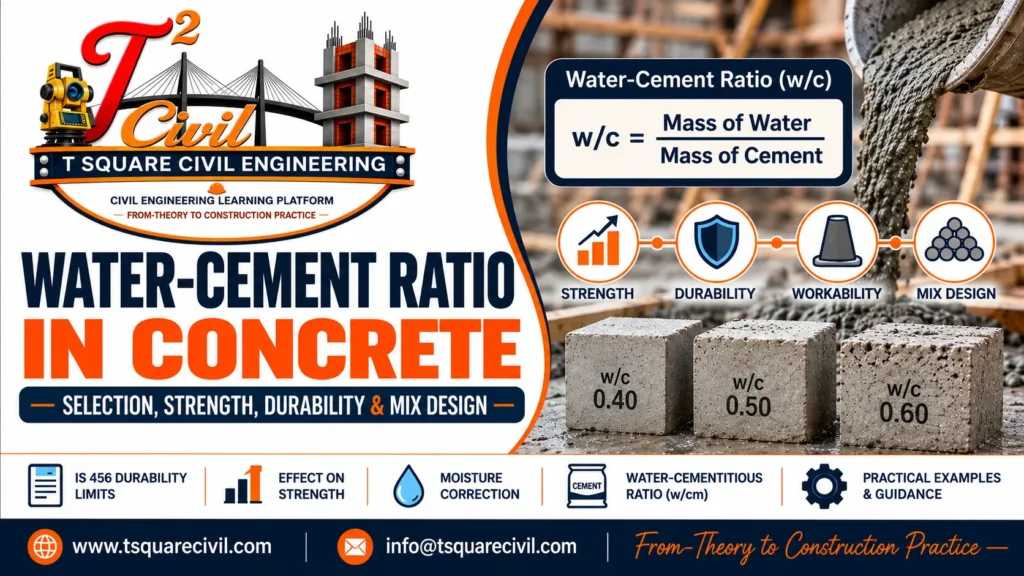
Water-cement ratio is the ratio of the mass of free water to the mass of cement used in concrete.
The basic expression is:
Water-Cement Ratio = Mass of Free Water ÷ Mass of Cement
For example, if a concrete mix contains:
Water = 180 kg
Cement = 400 kg
then:
Water-Cement Ratio = 180 ÷ 400
Water-Cement Ratio = 0.45
Because the density of water is approximately 1 kg/L for ordinary batching calculations, 180 kg of water is approximately 180 litres.
The ratio should be calculated by mass, not by volume.
Water-Cement Ratio vs Water-Cementitious Ratio
These terms should not always be treated as identical.
A conventional water-cement ratio relates water to cement.
Where supplementary cementitious materials such as fly ash, GGBS or other approved mineral additions form part of the binder system, a project may use a water-cementitious material ratio, often written as w/cm.
A simplified expression is:
w/cm = Free Water ÷ Total Cementitious Material
For example, consider:
Cement = 350 kg/m³
GGBS = 100 kg/m³
Free water = 180 kg/m³
Total cementitious material:
350 + 100 = 450 kg/m³
Therefore:
w/cm = 180 ÷ 450 = 0.40
The terminology and calculation used for code compliance should follow the applicable standard and project specification. Do not automatically substitute a water-cementitious ratio for a specified water-cement ratio without checking the governing requirement.
Why Is Water-Cement Ratio Important?
Water is required for cement hydration and for providing workable concrete. However, water added beyond what can be retained and used within the hardened cementitious system can leave additional pore space as concrete hardens.
Therefore, for otherwise comparable materials, production and curing conditions, an excessive water-cement ratio generally results in more permeable and lower-strength concrete.
A properly selected lower ratio can help produce denser and more durable concrete, but simply reducing water is not always beneficial.
If the ratio becomes too low for the available materials and admixture system, concrete may become difficult to place and compact. Poor compaction can introduce voids and offset the expected strength and durability benefits.
The objective is therefore not to use the lowest possible water-cement ratio. The objective is to select a ratio that satisfies strength and durability while allowing the required workability and proper construction.
Effect of Water-Cement Ratio on Concrete Strength
For a given set of materials, curing conditions and production practices, concrete compressive strength generally increases as the effective water-cement ratio decreases within a practical range.
For example, two properly compacted concretes made using similar materials may behave differently if one has a significantly higher water-cement ratio.
The higher-ratio mix generally contains more capillary pore space after hardening and may therefore develop lower compressive strength.
However, the relationship is not a universal table of concrete grade versus water-cement ratio.
It is incorrect to state universally that:
M20 = 0.50
or:
M30 = 0.45
or:
M40 = 0.40
without considering the actual materials and trial results.
Different cements, aggregates, supplementary cementitious materials and chemical admixtures can produce different strengths at the same water-cementitious ratio.
How Is Water-Cement Ratio Selected in Concrete Mix Design?
The strength-based water-cement ratio should be established using the relationship between water-cement ratio and compressive strength for the materials proposed for the project.
Where reliable previous data are available for similar materials and production conditions, those data can assist initial selection.
The selected ratio is then checked against the maximum permitted ratio required for durability.
The governing principle is:
Adopt the lower, more restrictive water-cement ratio.
For example, suppose the strength relationship indicates:
Required water-cement ratio for strength = 0.48
and the applicable durability requirement permits a maximum value of:
0.50
The ratio selected for preliminary proportioning would be:
0.48
Now consider another example where the strength-based value is:
0.52
but the durability limit is:
0.50
In that case:
0.50 is the maximum permitted value, so a ratio greater than 0.50 should not be adopted merely because it appears adequate for strength.
The resulting mix must still be verified through laboratory trials.
For the preceding step in this process, see our Target Mean Strength of Concrete guide.
Maximum Water-Cement Ratio for Durability
IS 456 specifies maximum free water-cement ratios depending on the exposure condition and whether the concrete is plain or reinforced.
For normal-weight concrete with 20 mm nominal maximum-size aggregate, the commonly referenced maximum free water-cement ratios are:
| Exposure Condition | Plain Concrete | Reinforced Concrete |
|---|---|---|
| Mild | 0.60 | 0.55 |
| Moderate | 0.60 | 0.50 |
| Severe | 0.50 | 0.45 |
| Very Severe | 0.45 | 0.45 |
| Extreme | 0.40 | 0.40 |
These values are maximum limits, not recommended fixed mix-design ratios.
For example, saying that reinforced concrete under moderate exposure has a maximum free water-cement ratio of 0.50 does not mean that every M25 or M30 concrete under moderate exposure should be designed at exactly 0.50.
If strength, permeability, project specifications or trial results require a lower ratio, the lower value should be adopted.
The exposure classification itself should also be established from the actual environmental conditions of the structure rather than selected only from the concrete grade.
Important Requirement for Portland Calcined Clay Limestone Cement
Where Portland calcined clay limestone cement conforming to IS 18189 is used, Amendment No. 6 to IS 456:2000 requires the maximum free water-cement ratio given in Table 5 to be reduced by 0.05.
For example, if the normal Table 5 maximum applicable to reinforced concrete is:
0.50
then, where this particular cement provision applies:
Revised maximum = 0.50 − 0.05 = 0.45
This requirement should not be applied automatically to every cement type. It relates specifically to the cement covered by the amendment.
Always check the latest applicable standard, amendments and project specification before finalizing the durability limit.
Strength Requirement vs Durability Requirement
Both requirements must be checked.
Suppose an M30 concrete mix is being developed.
The target mean strength has already been determined. Based on the strength-versus-water-cement ratio relationship for the actual materials, assume a preliminary ratio of:
0.43
Suppose the exposure condition permits a maximum ratio of:
0.45
Then:
Strength requirement = 0.43
Durability maximum = 0.45
Therefore:
Adopt 0.43 for preliminary proportioning.
The durability limit does not require the ratio to be exactly 0.45. It only establishes the maximum allowable value for that particular requirement.
Example of Water-Cement Ratio Calculation
Consider a preliminary concrete mix having:
Cement = 400 kg/m³
Selected water-cement ratio = 0.45
Required free water is:
Water = Cement × Water-Cement Ratio
Therefore:
Water = 400 × 0.45
Water = 180 kg/m³
or approximately:
180 litres/m³
This calculation does not mean that 180 litres should automatically be poured into the mixer.
Aggregate moisture and water absorption must also be considered to determine the actual batch-water addition.
Free Water Is More Important Than Water Added at the Mixer
One of the most common site mistakes is to consider only the quantity of water discharged from the water tank or batching plant.
The water-cement ratio is affected by the effective/free water available in the concrete.
Aggregates may contain surface moisture.
Wet sand can introduce a significant quantity of water into the concrete even if that water was not deliberately added from the batching system.
For example, if the design requires 180 kg/m³ of free water but wet aggregates contribute part of that quantity, the amount of water added separately should generally be reduced accordingly.
Otherwise, the effective water-cement ratio can become higher than the approved design value.
This is why aggregate moisture measurement and moisture correction are important parts of concrete quality control.
Example of Moisture Effect on Water-Cement Ratio
Assume:
Cement = 400 kg/m³
Designed free water = 180 kg/m³
Designed w/c ratio:
180 ÷ 400 = 0.45
Suppose uncontrolled aggregate surface moisture effectively contributes an additional 20 kg of free water and no correction is made.
Effective water becomes:
180 + 20 = 200 kg/m³
The actual ratio becomes:
200 ÷ 400 = 0.50
The intended mix was designed at 0.45, but the concrete is effectively being produced at 0.50.
This apparently small site change can affect strength, permeability, bleeding and consistency.
The exact correction should be calculated from measured aggregate moisture and absorption rather than estimated visually.
Why Adding Water at Site Is Risky
Concrete sometimes reaches the placement location with lower workability than expected.
A common response is to add water directly into the transit mixer or mixer drum.
Uncontrolled addition of water can increase the effective water-cement ratio and change the approved mix.
Possible consequences include reduced compressive strength, increased permeability, bleeding, segregation and greater variability between batches.
Workability should therefore be controlled through an approved mix design, correct moisture adjustment, appropriate chemical admixture and an established site procedure rather than arbitrary water addition.
Role of Superplasticizer
Modern concrete frequently uses water-reducing or high-range water-reducing admixtures.
A suitable superplasticizer can improve workability without requiring the same increase in water that would otherwise be necessary.
This makes it possible to produce workable concrete at a relatively low water-cementitious ratio.
However, admixture dosage should be established through trials considering:
cement type, cementitious system, temperature, slump requirement, slump retention, aggregate properties and compatibility.
An admixture should not be treated simply as a fixed percentage that works equally for every cement and every concrete mix.
Does Lower Water-Cement Ratio Always Mean Better Concrete?
No.
Consider a concrete mix with a very low water-cement ratio but insufficient workability.
If the concrete cannot flow around reinforcement or cannot be properly compacted, entrapped air and voids may remain inside the concrete.
The actual concrete quality may then be poorer despite the low numerical water-cement ratio.
The correct approach is to satisfy all important requirements together:
strength + durability + workability + proper placing + compaction + curing
rather than optimizing only one number.
Relationship Between Water-Cement Ratio and Workability
Increasing water usually increases workability, but increasing water alone is not an appropriate method for controlling concrete consistency because the water-cement ratio also changes.
For higher slump requirements, the mix designer can consider appropriate measures such as an approved water-reducing admixture and suitable aggregate proportioning.
The required workability should be specified based on the method of transport, placing, reinforcement congestion, section geometry and compaction method.
For practical workability testing, see our Slump Cone Test of Concrete.
Water-Cement Ratio in Pumped Concrete
Pumpable concrete generally requires sufficient cohesiveness, adequate mortar volume and suitable aggregate grading.
It is incorrect to obtain pumping workability simply by adding extra water.
For pumped concrete, the mix proportions, fine-to-coarse aggregate balance, admixture system and workability retention should be developed through trial mixes.
The selected water-cementitious ratio must continue to satisfy strength and durability requirements.
Water-Cement Ratio and Durability
Durability is not controlled by water-cement ratio alone, but the ratio has a major influence on pore structure and permeability.
Concrete exposed to aggressive environments requires greater attention to permeability, cover, compaction, curing, crack control and constituent materials.
A low specified maximum water-cement ratio does not compensate for poor construction.
Concrete designed at an appropriate ratio can still perform badly if it is inadequately compacted or poorly cured.
Similarly, excellent workmanship cannot make an excessively permeable mix suitable for a severe exposure condition.
Concrete durability results from the complete system.
Water-Cement Ratio and Cement Content
Once a preliminary water content and selected water-cement ratio are known, cement content can be estimated using:
Cement Content = Water Content ÷ Water-Cement Ratio
For example:
Water = 180 kg/m³
Water-cement ratio = 0.45
Therefore:
Cement = 180 ÷ 0.45
Cement = 400 kg/m³
The resulting cementitious content must then be checked against applicable minimum and maximum requirements and the project specification.
Do not increase cement unnecessarily merely to obtain an arbitrary ratio. Excessive cementitious content can introduce other concerns such as heat generation, shrinkage and cracking.
Water-Cement Ratio in the Complete Mix Design Process
Water-cement ratio is only one stage of concrete mix proportioning.
The logical sequence is:
Concrete Grade → Target Mean Strength → Strength-Based Water-Cement Ratio → Durability Check → Adopt Governing Ratio → Water Content → Cementitious Content → Aggregate Proportioning → Moisture Correction → Trial Mix → Workability Test → Strength Test → Adjustment → Approved Mix
This is why a concrete grade alone is insufficient to determine the final water-cement ratio.
You can use our Concrete Mix Design Calculator as per IS 10262:2019 for preliminary mix-proportioning calculations.
Common Mistakes With Water-Cement Ratio
One of the most common mistakes is assigning a fixed water-cement ratio to a concrete grade without checking actual materials, target strength and exposure.
Another is confusing the maximum permitted durability ratio with the exact ratio that must be used in the mix.
Site teams may also calculate the ratio using only water deliberately added at the mixer while ignoring aggregate moisture.
Uncontrolled addition of water to increase slump is another serious problem because it can alter the approved concrete proportions.
Finally, a very low ratio should not automatically be considered superior if the resulting concrete cannot be adequately mixed, placed and compacted.
Practical Site Example
Suppose an approved concrete mix has:
Cementitious material = 420 kg/m³
Free water = 168 kg/m³
The applicable calculated water-cementitious ratio is:
168 ÷ 420 = 0.40
During production, the moisture condition of fine aggregate changes after rainfall.
If the batching plant continues using the same added-water quantity without adjusting for the additional aggregate surface moisture, the actual free water in the concrete can increase.
Therefore, the approved design ratio does not guarantee that every production batch is actually being produced at that ratio.
Routine aggregate-moisture monitoring and batch-water correction are necessary to maintain the intended proportions.
Frequently Asked Questions
What is the formula for water-cement ratio?
The basic formula is:
Water-Cement Ratio = Mass of Free Water ÷ Mass of Cement
Where a water-cementitious ratio is specified, the denominator is the applicable total cementitious material according to the mix-design and project requirements.
What is the best water-cement ratio for concrete?
There is no universal best ratio. It should satisfy the required strength, durability, workability and applicable project specification and should be verified through trial mixes.
What is the water-cement ratio for M20 concrete?
M20 does not have one universal water-cement ratio. The ratio should be selected from the strength requirement and checked against the durability limit applicable to the exposure and type of concrete.
What is the water-cement ratio for M25 concrete?
There is no fixed value that applies to every M25 concrete mix. Material properties, exposure, target mean strength, admixtures and trial results must be considered.
Is 0.45 water-cement ratio always suitable for RCC?
No. A value of 0.45 may satisfy some applications but may be unnecessarily low or insufficiently restrictive for others. Check the applicable strength requirement, exposure condition, standards and project specification.
Does increasing water increase concrete strength?
Generally no. Additional free water beyond the properly designed amount generally increases the water-cement ratio and can reduce strength and increase permeability.
Can superplasticizer reduce the water-cement ratio?
A suitable water-reducing admixture can reduce the water demand required to achieve a given workability, allowing a lower water-cementitious ratio where established through trials.
Does aggregate moisture affect water-cement ratio?
Yes. Free surface moisture carried by aggregates contributes water to the concrete and should be considered during batching.
Is water-cement ratio based on volume or weight?
It is normally calculated as a ratio by mass.
Is target mean strength the same as water-cement ratio?
No. Target mean strength is first determined statistically. The strength requirement is then used as part of selecting an appropriate water-cement ratio for the actual materials.
Related Concrete Mix Design Resources
Continue studying the mix-design sequence with our Concrete Mix Design Hub, Target Mean Strength of Concrete, Concrete Mix Design Calculator as per IS 10262:2019, Specific Gravity and Water Absorption of Aggregate, and Sieve Analysis of Aggregate.
Conclusion
Water-cement ratio should never be selected from the concrete grade alone.
For concrete mix design, first establish an appropriate strength-based ratio using the actual materials and available test data. Then check the applicable maximum ratio required for durability and adopt the more restrictive value.
After determining the preliminary proportions, laboratory trials are necessary to verify workability, cohesiveness, strength and practical performance. Aggregate moisture must also be monitored during production so that the actual free-water content remains consistent with the approved mix.
Engineering note: Concrete mix-design requirements and Indian Standards are periodically revised. Always verify the latest applicable BIS standards, amendments, project specification and approved mix design before using any value for construction.
