Compaction Factor Test of Concrete-Procedure, Formula & IS Code
 by
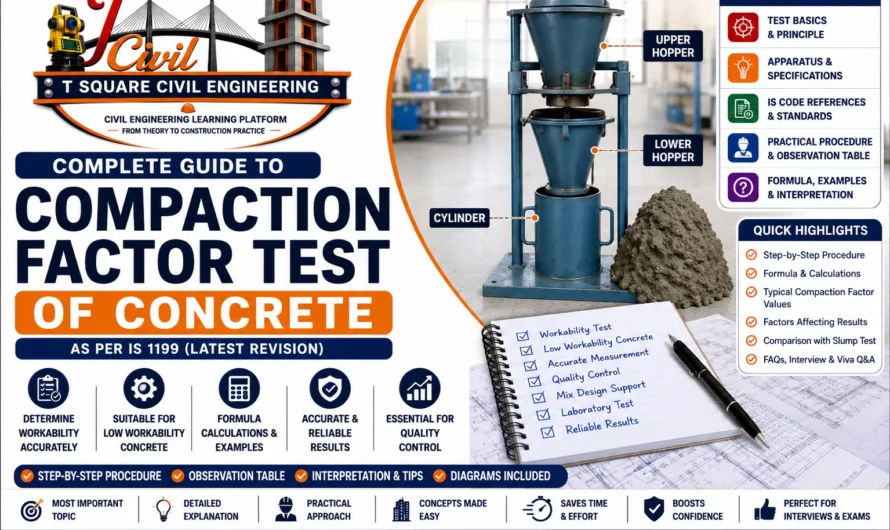
Introduction to the Compaction Factor Test of Concrete The Compaction Factor Test of Concrete is a laboratory test used to determine the workability of fresh …
Civil Engineering Learning Platform: From Theory to Construction Practice
Introduction to the Compaction Factor Test of Concrete The Compaction Factor Test of Concrete is a laboratory test used to determine the workability of fresh …
Introduction Workability of Concrete is one of the most important properties of fresh concrete and plays a significant role in the quality, strength, durability, and …
Reinforcement steel is an important part of reinforced concrete construction. It helps beams, slabs, columns, footings and walls carry the forces acting on them. However, …
Top 50 RCC Interview Questions and Answers | Civil Engineering Interview Guide Introduction If you are preparing for a Civil Engineering interview, understanding Reinforced Cement …
Concrete Cube Casting Procedure involves preparing representative concrete specimens for compressive-strength testing. Reliable results depend on correct sampling, mould preparation, compaction, identification, initial storage and …
Preparing for a civil engineering interview requires more than memorising definitions. Candidates should understand fundamental engineering concepts and be able to explain how those concepts …
Types of Tiles Used in Building Construction: Complete Guide to Ceramic, Vitrified, Porcelain, Single Charge, Double Charge, GVT, PGVT and Other Tiles Tiles are widely …
Learn how to estimate building quantities from drawings using the centre-line, long-wall and element methods. Includes formulas, BOQ format, measurement units, checklist and a residential worked example.
Introduction to Civil Engineering Civil engineering is a vital discipline that focuses on the design, construction, and maintenance of the physical and naturally built environment. …
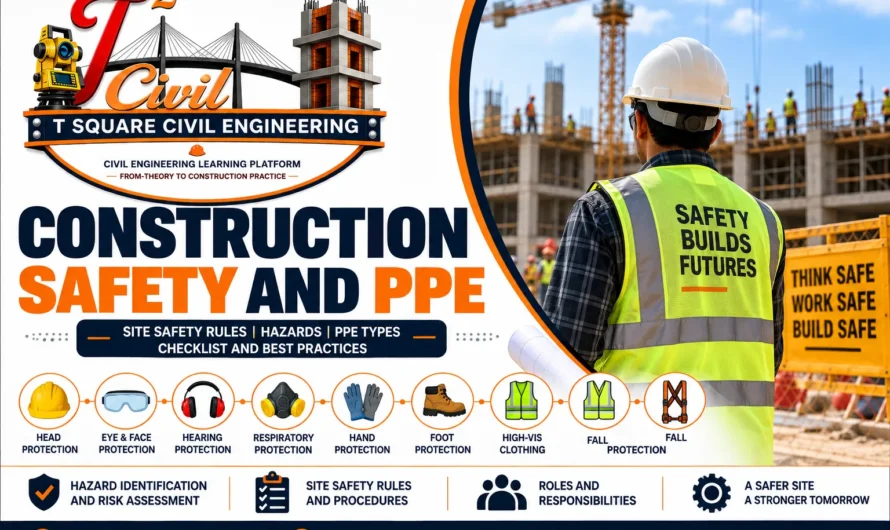
Construction sites are dynamic workplaces where workers, engineers, equipment, materials and temporary structures operate together under continuously changing conditions. Hazards may arise from work at …