Initial and Final Setting Time of Cement: IS Code, Vicat Test, Procedure & Limits
 by
Introduction The initial and final setting time of cement are important physical properties used to understand how cement paste changes from a plastic condition to …

Civil Engineering Learning Platform: From Theory to Construction Practice
Introduction The initial and final setting time of cement are important physical properties used to understand how cement paste changes from a plastic condition to …
Fineness of cement is an important physical property that indicates the degree of subdivision or particle size of cement. It influences the rate of hydration, …
Introduction Standard consistency of cement is the water content required to prepare a cement paste that satisfies the specified penetration condition when tested with a …
Introduction The compressive strength test of cement is one of the most important physical tests used to assess the quality and strength development of hydraulic …
Introduction Specific gravity and water absorption of aggregate are important physical properties used in concrete mix design, aggregate quality assessment and moisture correction during concrete …
The Aggregate Impact Value (AIV) test is used to determine the resistance of coarse aggregate to sudden shock or impact. Aggregates used in concrete, pavements …
The Aggregate Crushing Value (ACV) test determines the resistance of coarse aggregate to crushing under a gradually applied compressive load. For the standard test, aggregate …
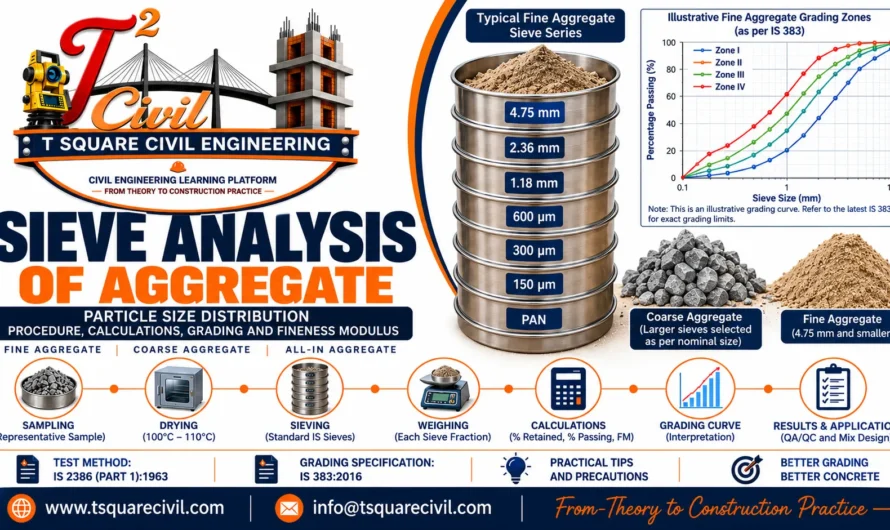
Sieve analysis of aggregate is a laboratory test used to determine the particle-size distribution or grading of fine and coarse aggregate. The test measures the …
The flakiness index test determines the percentage of thin or flaky particles present in coarse aggregate. Particle shape is important because unusually thin particles can …
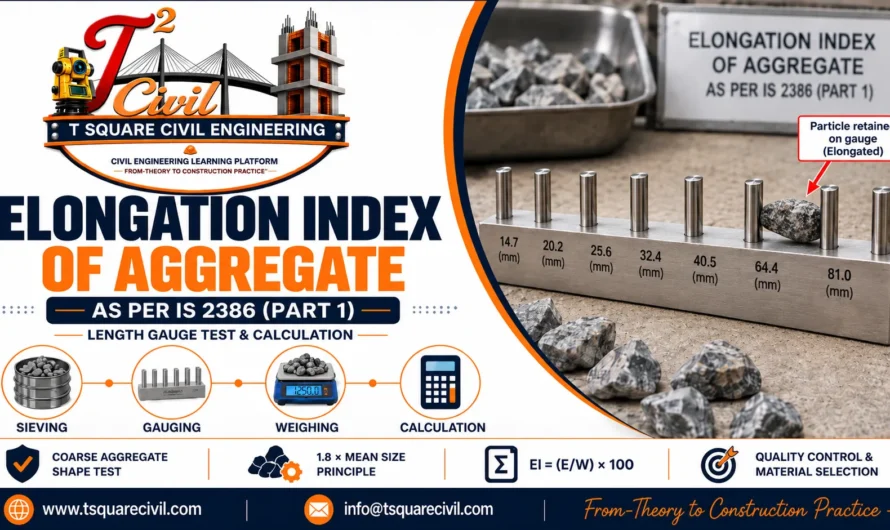
The elongation index of aggregate is an important particle-shape test used to determine the proportion of excessively elongated particles present in coarse aggregate. Particle shape …