
 by
by Concrete mix design often uses more than one coarse aggregate size.
A concrete described as using 20 mm nominal maximum aggregate does not necessarily contain only particles around 20 mm.
In practice, coarse aggregate may be supplied or blended using fractions such as:
- 20 mm aggregate;
- 12.5 mm aggregate;
- 10 mm aggregate; or
- other approved fractions.
The purpose of combining these fractions is to obtain a suitable combined coarse aggregate grading.
A well-graded coarse aggregate system can help improve:
- aggregate packing;
- concrete cohesiveness;
- workability;
- pumpability;
- reduction of excessive voids;
- consistency of concrete production; and
- efficient use of paste.
However, there is no universal rule that every concrete mix should use:
20 mm : 10 mm = 60 : 40
or
20 mm : 10 mm = 50 : 50
or any other fixed ratio.
The correct combination should be established from the actual sieve-analysis results of the available aggregate fractions.
The combined grading should then be checked against the applicable IS 383 grading requirements and verified through concrete trial mixes.
This article explains:
- single-sized and graded coarse aggregate;
- combined coarse aggregate grading;
- IS 383 limits;
- weighted grading calculations;
- 20 mm + 10 mm blending;
- 20 mm + 12.5 mm blending;
- how to determine a suitable blend ratio;
- effect on concrete mix design;
- specific gravity and moisture considerations; and
- practical quality-control checks.
For the complete learning sequence, visit our Concrete Mix Design Hub and Fine and Coarse Aggregate Proportioning in Concrete Mix Design.
Page Contents
What Is Combined Coarse Aggregate Grading?
Combined coarse aggregate grading is the particle-size distribution obtained after two or more coarse aggregate fractions are blended together.
For example:
20 mm fraction + 10 mm fraction
or:
20 mm fraction + 12.5 mm fraction
The final combined aggregate will have its own percentage passing through each sieve.
That combined grading—not the appearance of the individual stockpiles—is what determines whether the final aggregate system satisfies the selected grading requirements.
Why Are Different Coarse Aggregate Sizes Combined?
A single coarse aggregate fraction may contain a relatively narrow range of particle sizes.
Combining different size fractions can help fill the spaces between larger particles.
A suitable combined grading may therefore provide:
- improved particle packing;
- fewer large internal voids;
- improved concrete cohesiveness;
- smoother placing;
- better pumpability;
- reduced tendency toward harshness; and
- more consistent concrete production.
However, more smaller aggregate does not automatically mean better concrete.
Too much smaller coarse aggregate may increase:
- aggregate surface area;
- paste demand;
- water demand;
- pumping resistance; and
- stickiness.
The correct blend must be established from grading and concrete performance.
Single-Sized vs Graded Coarse Aggregate
These terms should not be confused.
Single-Sized Coarse Aggregate
Single-sized aggregate is supplied predominantly within a relatively narrow particle-size range.
Examples include nominal:
- 20 mm;
- 12.5 mm;
- 10 mm.
It is not literally made of particles having one exact diameter.
Each nominal size still has a permitted grading range.
Graded Coarse Aggregate
Graded coarse aggregate contains a broader distribution of coarse aggregate particle sizes.
It may be:
- supplied as graded aggregate from the source; or
- produced by combining two or more single-sized fractions.
The objective is to obtain the specified final grading.
IS 383 Grading for 20 mm Nominal Graded Coarse Aggregate
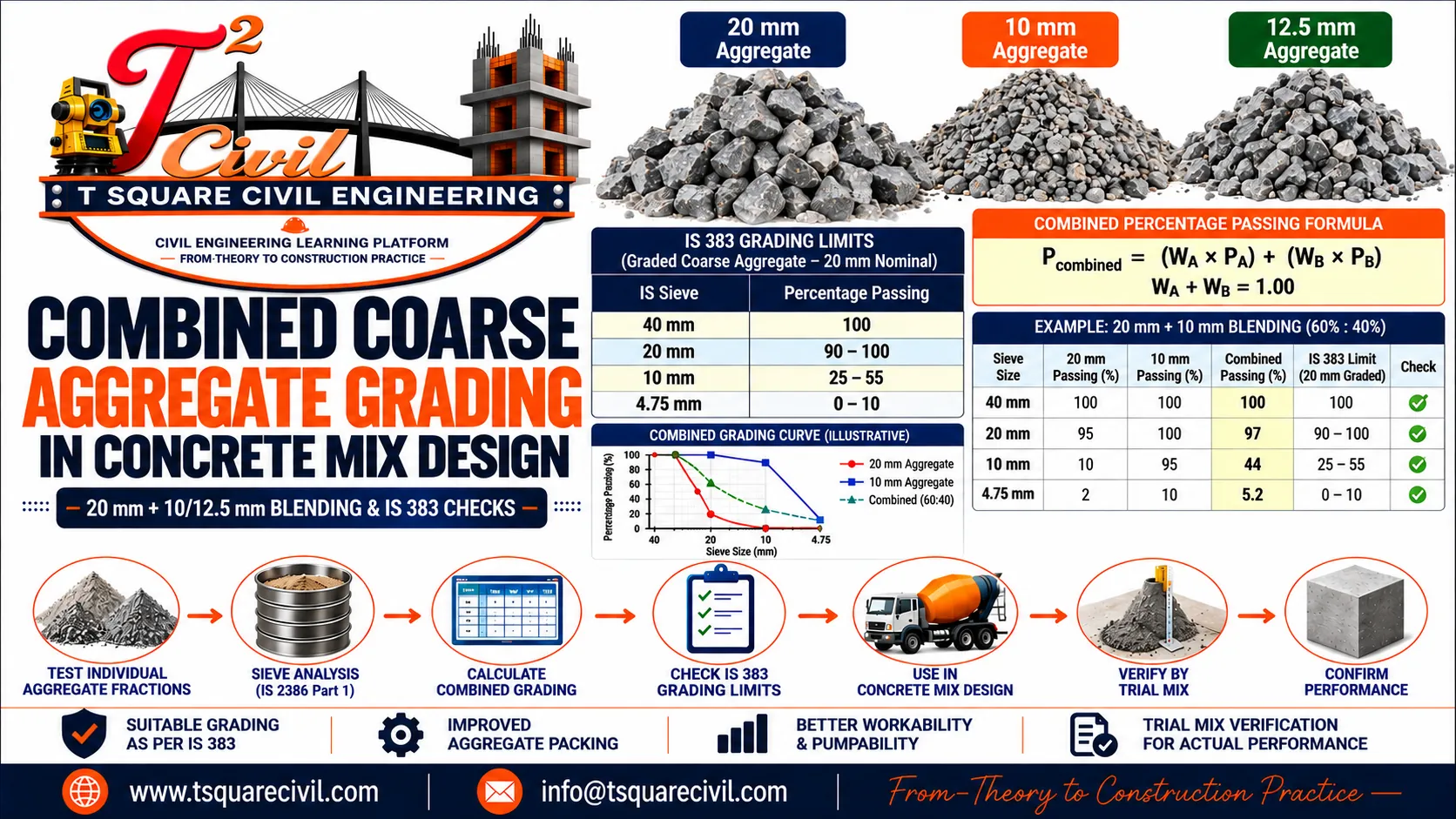
For 20 mm nominal graded coarse aggregate, the key IS 383 grading limits are:
| IS Sieve | Percentage Passing |
|---|---|
| 40 mm | 100 |
| 20 mm | 90–100 |
| 10 mm | 25–55 |
| 4.75 mm | 0–10 |
These values apply to the combined coarse aggregate grading.
Therefore, if 20 mm and 10 mm stockpiles are blended, the final weighted grading should be checked against these limits.
Do Not Assume 20 mm Aggregate Means 100% Retained on 10 mm
This is an important practical point.
A stockpile called:
20 mm aggregate
normally contains a distribution of particle sizes permitted by its grading requirements.
Similarly:
10 mm aggregate
does not consist entirely of particles exactly 10 mm in size.
The actual percentage passing every sieve should be determined by sieve analysis.
Therefore, calculations should use:
actual laboratory test results
rather than idealized particle sizes.
Standard Test for Coarse Aggregate Grading
Aggregate particle-size distribution is determined by sieve analysis.
The general sequence is:
Representative sampling
↓
Sample preparation
↓
Sieve analysis
↓
Mass retained on each sieve
↓
Percentage passing
↓
Check individual fraction grading
↓
Calculate proposed combined grading
↓
Compare with applicable IS 383 limits
For the detailed laboratory test, see our Sieve Analysis / Particle Size Distribution of Aggregate.
Formula for Combined Aggregate Grading
If two aggregates are blended by mass:
Aggregate A proportion:
WA
Aggregate B proportion:
WB
where:
WA + WB = 1.00
and their percentage passing a particular sieve is:
PA and PB
then:
Combined % Passing = (WA × PA) + (WB × PB)
For percentages written directly as percentages:
Combined % Passing = [(A% × PA) + (B% × PB)] ÷ 100
The same calculation must be performed for every relevant sieve.
Example – 20 mm + 10 mm Coarse Aggregate
Suppose laboratory sieve analysis gives:
20 mm Fraction
| Sieve | % Passing |
|---|---|
| 40 mm | 100 |
| 20 mm | 95 |
| 10 mm | 10 |
| 4.75 mm | 2 |
10 mm Fraction
| Sieve | % Passing |
|---|---|
| 40 mm | 100 |
| 20 mm | 100 |
| 10 mm | 95 |
| 4.75 mm | 10 |
Suppose we initially evaluate:
60% of 20 mm aggregate
and:
40% of 10 mm aggregate
The blend proportions are:
WA = 0.60
WB = 0.40
Combined Passing at 40 mm
20 mm fraction:
100% passing
10 mm fraction:
100% passing
Combined:
(0.60 × 100) + (0.40 × 100)
= 60 + 40
= 100%
Combined Passing at 20 mm
Combined:
(0.60 × 95) + (0.40 × 100)
= 57 + 40
= 97%
Combined Passing at 10 mm
Combined:
(0.60 × 10) + (0.40 × 95)
= 6 + 38
= 44%
Combined Passing at 4.75 mm
Combined:
(0.60 × 2) + (0.40 × 10)
= 1.2 + 4.0
= 5.2%
Therefore, the final combined grading is:
| IS Sieve | Combined Passing | IS 383 Graded 20 mm Limit | Check |
|---|---|---|---|
| 40 mm | 100% | 100% | Pass |
| 20 mm | 97% | 90–100% | Pass |
| 10 mm | 44% | 25–55% | Pass |
| 4.75 mm | 5.2% | 0–10% | Pass |
For these illustrative laboratory results, a:
60% 20 mm + 40% 10 mm
blend satisfies the shown graded 20 mm limits.
This does not mean 60:40 is a universal ratio.
Different stockpiles can produce different results.
Why 60:40 Cannot Be Copied to Every Project
Suppose another quarry supplies 20 mm aggregate having:
18% passing the 10 mm sieve
instead of:
10%
and its 10 mm fraction has:
88% passing the 10 mm sieve
instead of:
95%.
The same 60:40 blend would produce a different combined grading.
Therefore, the required blend ratio depends on:
- actual 20 mm grading;
- actual 12.5 or 10 mm grading;
- target combined grading;
- quarry production;
- crusher settings;
- screening efficiency; and
- stockpile variation.
Always calculate from actual test results.
How to Estimate a Suitable Blend Ratio
The combined grading equation can also be rearranged to estimate the proportion required to achieve a selected passing value.
For two fractions:
Pcombined = WA × PA + WB × PB
and:
WA + WB = 1
Suppose the previous aggregates are used.
At the 10 mm sieve:
20 mm fraction passing:
10%
10 mm fraction passing:
95%
Let:
x = proportion of 10 mm aggregate
Therefore:
Proportion of 20 mm aggregate:
1 − x
If a trial target of:
40% passing the 10 mm sieve
is selected:
40 = [10 × (1 − x)] + (95 × x)
40 = 10 − 10x + 95x
40 = 10 + 85x
30 = 85x
x = 0.353 approximately
Therefore:
10 mm fraction ≈ 35.3%
20 mm fraction ≈ 64.7%
This may be used as a starting blend estimate.
However, the result must still be checked at all other sieves.
Do not finalize a blend from the 10 mm sieve alone.
Acceptable Blend Is Controlled by All Sieves
A proposed ratio may satisfy:
10 mm sieve
but fail:
4.75 mm sieve
or another applicable sieve.
Therefore, the correct process is:
Select trial blend → calculate combined passing at every sieve → compare with grading limits → revise ratio if necessary
This can be repeated until a suitable grading is obtained.
A spreadsheet is particularly useful for this calculation.
Example – 20 mm + 12.5 mm Aggregate
Suppose actual sieve-analysis data are:
20 mm Fraction
| Sieve | % Passing |
|---|---|
| 40 mm | 100 |
| 20 mm | 95 |
| 10 mm | 10 |
| 4.75 mm | 2 |
12.5 mm Fraction
| Sieve | % Passing |
|---|---|
| 40 mm | 100 |
| 20 mm | 100 |
| 10 mm | 40 |
| 4.75 mm | 5 |
Suppose the trial blend is:
40% 20 mm
and:
60% 12.5 mm
40 mm Sieve
(0.40 × 100) + (0.60 × 100)
= 100%
20 mm Sieve
(0.40 × 95) + (0.60 × 100)
= 38 + 60
= 98%
10 mm Sieve
(0.40 × 10) + (0.60 × 40)
= 4 + 24
= 28%
4.75 mm Sieve
(0.40 × 2) + (0.60 × 5)
= 0.8 + 3.0
= 3.8%
Therefore:
| IS Sieve | Combined Passing |
|---|---|
| 40 mm | 100% |
| 20 mm | 98% |
| 10 mm | 28% |
| 4.75 mm | 3.8% |
For these illustrative laboratory results, this combination satisfies the shown graded 20 mm requirements.
Again:
40:60 is not a universal 20 mm : 12.5 mm ratio.
It is only the result of the assumed example grading.
Is 12.5 mm Better Than 10 mm for Blending?
Not automatically.
The appropriate smaller fraction depends on:
- actual quarry product;
- available sieves;
- nominal maximum aggregate size;
- reinforcement congestion;
- pump requirements;
- concrete workability;
- combined grading; and
- trial-mix performance.
Both 10 mm and 12.5 mm fractions can be useful where properly proportioned.
Combined Coarse Aggregate vs Nominal Maximum Aggregate Size
Suppose:
20 mm aggregate is blended with 10 mm aggregate.
If the final combined grading conforms to the applicable requirements for:
20 mm nominal graded aggregate
the final coarse aggregate system can still be treated as a:
20 mm nominal maximum aggregate system
The presence of smaller aggregate does not change the nominal maximum size to 10 mm.
The nominal maximum size relates to the grading of the complete aggregate system.
For selection rules, see our Nominal Maximum Aggregate Size in Concrete Mix Design.
Do Not Confuse Internal Coarse Aggregate Blend With Fine/Coarse Aggregate Proportion
This is one of the most important distinctions.
Suppose IS 10262 calculation gives:
Total coarse aggregate = 1,100 kg/m³
That quantity represents the total coarse aggregate requirement.
Now suppose the approved internal coarse aggregate blend is:
60% 20 mm + 40% 10 mm
Then:
20 mm Aggregate
1,100 × 0.60
= 660 kg/m³
10 mm Aggregate
1,100 × 0.40
= 440 kg/m³
Therefore:
Total coarse aggregate:
660 + 440 = 1,100 kg/m³
The 60:40 ratio is an internal coarse aggregate blend.
It is completely different from the IS 10262 ratio between:
fine aggregate and total coarse aggregate.
Fine/Coarse Aggregate Proportion Comes First
A practical calculation sequence is:
Calculate total aggregate volume
↓
Determine fine/coarse aggregate split
↓
Calculate total coarse aggregate quantity
↓
Determine approved internal coarse aggregate blend
↓
Split total CA into individual coarse aggregate fractions
For example:
Total coarse aggregate:
1,100 kg/m³
Approved blend:
20 mm = 60%
10 mm = 40%
Therefore:
20 mm = 660 kg/m³
10 mm = 440 kg/m³
Different Specific Gravities Require Care
If the different coarse aggregate fractions have practically identical specific gravity, splitting the total coarse aggregate mass by the approved grading proportion is straightforward.
However, if their specific gravities differ materially, the absolute-volume calculation should reflect the actual materials.
For a blend defined by mass fractions:
w1, w2, …
and individual specific gravities:
G1, G2, …
an equivalent blend specific gravity can be calculated as:
Gblend = 1 ÷ [(w1/G1) + (w2/G2) + …]
where the mass fractions sum to:
1.00
Example – Combined Specific Gravity
Suppose:
20 mm aggregate:
Mass fraction = 0.60
Specific gravity = 2.70
10 mm aggregate:
Mass fraction = 0.40
Specific gravity = 2.65
Then:
Gblend = 1 ÷ [(0.60/2.70) + (0.40/2.65)]
≈ 2.68
Therefore, the equivalent specific gravity of the blended coarse aggregate is approximately:
2.68
Alternatively, individual aggregate volumes may be calculated separately.
Using actual tested specific gravity is preferable to assuming:
2.65 for every aggregate fraction.
Why Specific Gravity Matters
Concrete mix design is performed on a volume basis.
The aggregate volume is converted to mass using specific gravity.
If the actual specific gravity differs from the value used in the calculation, the:
- aggregate mass;
- absolute volume;
- concrete yield; and
- material proportions
may change.
For the laboratory procedure, see our Specific Gravity and Water Absorption of Aggregate.
Moisture Correction for Different Coarse Aggregate Fractions
Different coarse aggregate stockpiles may have different:
- water absorption;
- moisture content; and
- surface moisture.
For example:
20 mm aggregate absorption:
0.4%
10 mm aggregate absorption:
0.7%
These should not automatically be treated as one identical aggregate moisture condition.
Where required, moisture correction should be performed separately for each fraction.
Then calculate:
- corrected wet aggregate mass; and
- water contribution or absorption
for each stockpile.
For the complete procedure, see our Moisture Correction in Concrete Mix Design.
Combined Grading and Pumped Concrete
Combined coarse aggregate grading can strongly influence pumpability.
A poorly graded coarse aggregate system may create:
- harsh concrete;
- high pumping pressure;
- aggregate interlock;
- unstable flow;
- blockage risk; and
- segregation.
A properly proportioned combination of coarse aggregate sizes can help improve the continuity of the aggregate skeleton.
However, pumpability also depends on:
- fine aggregate;
- mortar content;
- paste volume;
- water content;
- chemical admixture;
- pipeline diameter;
- bends;
- pumping distance; and
- concrete temperature.
Combined grading alone cannot guarantee pumpability.
See our Pumped Concrete Mix Design.
Combined Grading and Aggregate Packing
When different particle sizes are properly combined, smaller coarse particles can occupy part of the space between larger coarse particles.
This can improve aggregate packing.
Improved packing may help reduce excessive void space.
However, maximum theoretical packing should not be the only objective.
Concrete also needs enough:
- mortar;
- paste;
- lubrication;
- workability; and
- cohesiveness
for actual construction.
The optimum grading is therefore a practical balance between packing and concrete performance.
Combined Grading and Water Demand
Better aggregate packing may reduce unnecessary paste demand in some mixes.
However, increasing the proportion of smaller coarse aggregate also increases total aggregate surface area.
Therefore, changing the blend can affect:
- water demand;
- admixture demand;
- workability; and
- pumpability.
There is no universal formula such as:
10% more 10 mm aggregate = X kg less water
or:
X kg more water.
The actual effect should be established by trials.
Combined Grading and Concrete Strength
Combined grading does not directly determine concrete grade.
Concrete strength continues to depend on:
- water-cementitious ratio;
- cementitious materials;
- compaction;
- curing;
- aggregate properties;
- air content; and
- production quality.
However, unsuitable grading may indirectly affect strength through:
- poor compaction;
- excessive voids;
- segregation; or
- excessive water demand.
Combined Grading and Concrete Workability
If the coarse aggregate system contains too much large material, the concrete may become:
- harsh;
- difficult to place;
- difficult to pump; or
- prone to aggregate interlock.
If it contains excessive smaller coarse aggregate, it may become:
- sticky;
- high in surface area;
- higher in mortar demand; or
- more resistant during pumping.
The final blend must therefore be verified in actual concrete.
Trial Mix Verification
After selecting a preliminary combined aggregate ratio, prepare a concrete trial mix.
Check:
- slump or specified workability;
- cohesiveness;
- bleeding;
- segregation;
- finishing;
- fresh concrete density;
- pumpability where applicable;
- compressive strength; and
- overall handling.
A grading combination that looks ideal on paper may still require adjustment after the concrete trial.
See our Concrete Trial Mix Procedure.
Fresh Concrete Density as a Production Check
A change in aggregate grading or aggregate blend can change:
- packing;
- air content;
- total material mass; and
- concrete density.
Fresh density can therefore be useful when comparing:
- approved trial mix; and
- production concrete.
For the complete calculation, see our Fresh Concrete Density and Yield in Concrete Mix Design.
Stockpile Control Is Important
Even after a blend ratio is approved, the grading of each stockpile can change because of:
- crusher wear;
- screen changes;
- quarry variation;
- stockpile segregation;
- loading practices;
- contamination; and
- supplier changes.
Therefore:
Approved ratio + changed stockpile grading ≠ same combined grading
Periodic aggregate testing is important.
Stockpile Segregation
Coarse aggregate can segregate during:
- stockpiling;
- conveyor discharge;
- loading;
- transportation; and
- handling.
Larger particles may roll toward the outer edge or bottom of a stockpile.
A poorly taken sample may therefore not represent the actual aggregate.
Representative sampling is essential before calculating a blend.
Avoid Mixing Ratios by Visual Judgment
Do not decide:
“This looks like too much 20 mm, so add more 10 mm.”
Visual judgment cannot accurately determine combined grading.
The correct process is:
sample → sieve → calculate → blend → verify
Should Blend Ratios Be by Mass or Volume?
Sieve-analysis grading percentages are fundamentally based on mass.
Therefore, aggregate blending for grading calculations is normally performed using mass proportions.
For example:
60% 20 mm + 40% 10 mm by mass
The batching plant should use the approved mass proportions unless the project procedure specifies another properly converted basis.
Do not casually interchange:
mass ratio
and:
volume ratio.
Combined Grading Spreadsheet Method
A simple spreadsheet can contain:
| Sieve | 20 mm Passing | 10 mm Passing | 20 mm Blend % | 10 mm Blend % | Combined Passing | IS Limit |
|---|---|---|---|---|---|---|
| 40 mm | ___ | ___ | ___ | ___ | Formula | ___ |
| 20 mm | ___ | ___ | ___ | ___ | Formula | ___ |
| 10 mm | ___ | ___ | ___ | ___ | Formula | ___ |
| 4.75 mm | ___ | ___ | ___ | ___ | Formula | ___ |
For each row:
Combined Passing = P20 × W20 + P10 × W10
Different blend percentages can then be evaluated quickly.
Example – Comparing Different Blend Ratios
Using the earlier example:
20 mm fraction at 10 mm sieve:
10% passing
10 mm fraction:
95% passing
70:30 Blend
Combined passing:
0.70 × 10 + 0.30 × 95
= 7 + 28.5
= 35.5%
60:40 Blend
= 44%
50:50 Blend
0.50 × 10 + 0.50 × 95
= 52.5%
All three values fall within the:
25–55%
limit at the 10 mm sieve.
However, all other applicable sieves must also be checked.
This demonstrates why several blend ratios may satisfy the grading specification.
The final selection should consider actual concrete performance as well.
What Is the Best 20 mm : 10 mm Ratio?
There is no universal best ratio.
The correct ratio depends on:
- individual aggregate gradings;
- specific gravities;
- water absorption;
- particle shape;
- concrete workability;
- pumping requirement;
- concrete member;
- available aggregate sources; and
- trial-mix results.
Therefore, statements such as:
“Always use 60% 20 mm + 40% 10 mm”
should be avoided.
What Is the Best 20 mm : 12.5 mm Ratio?
The same principle applies.
There is no universal:
50:50
or:
40:60
rule.
Calculate the combined grading from the actual sieve-analysis results.
Then verify the concrete through laboratory and field trials.
Can Three Coarse Aggregate Fractions Be Combined?
Yes.
For three fractions:
A, B and C,
the combined passing is:
Pcombined = WA × PA + WB × PB + WC × PC
where:
WA + WB + WC = 1.00
For example:
- 20 mm;
- 12.5 mm; and
- 10 mm
could be combined if appropriate for the project.
However, additional stockpiles increase batching and quality-control complexity.
Use only the number of aggregate fractions necessary to achieve the required concrete performance.
Combined Coarse Aggregate vs All-in-Aggregate
These terms should also be distinguished.
Combined Coarse Aggregate
Different coarse aggregate fractions are blended while remaining part of the coarse aggregate system.
All-in-Aggregate
All-in-aggregate contains both:
- fine aggregate; and
- coarse aggregate
as one combined material.
IS 383 provides separate grading requirements for all-in-aggregate.
Do not confuse an internal:
20 mm + 10 mm coarse aggregate blend
with an:
all-in-aggregate.
Combined Coarse Aggregate and Absolute Volume
The absolute-volume method determines the total volume available for aggregate after deducting:
- entrapped air;
- cementitious materials;
- water; and
- chemical admixture.
The total aggregate is then separated into:
- fine aggregate; and
- coarse aggregate.
The coarse aggregate portion may then be divided into the approved individual size fractions.
For the full calculation, see our Absolute Volume Method for Concrete Mix Design.
Practical Design Workflow
A recommended workflow is:
Obtain representative samples
↓
Test each coarse aggregate fraction separately
↓
Record percentage passing each relevant sieve
↓
Select trial blend percentages
↓
Calculate combined grading
↓
Check against applicable IS 383 grading
↓
Revise blend if necessary
↓
Determine combined specific gravity
↓
Calculate total coarse aggregate from mix design
↓
Split total coarse aggregate into individual fractions
↓
Apply moisture correction
↓
Prepare concrete trial
↓
Check workability, segregation and cohesiveness
↓
Verify strength
↓
Conduct pumping trial where required
↓
Approve production blend
↓
Monitor stockpile grading during production
Combined Coarse Aggregate Checklist
Before approving the blend, confirm:
- Representative samples obtained
- Each aggregate fraction tested separately
- Sieve-analysis results available
- Blend percentages stated by mass
- Combined grading calculated for every relevant sieve
- Applicable IS 383 grading checked
- Nominal maximum aggregate size confirmed
- Specific gravity of each fraction known
- Water absorption known
- Moisture condition checked
- Total coarse aggregate quantity calculated correctly
- Individual batch masses calculated
- Trial mix completed
- Workability acceptable
- No unacceptable segregation
- Pumpability checked where required
- Strength requirements satisfied
- Production QC procedure established
Common Mistakes
Using a Fixed 60:40 Ratio Everywhere
There is no universal 20 mm : 10 mm aggregate ratio.
Assuming 50:50 Is Automatically Better
The correct ratio depends on actual grading.
Checking Only One Sieve
All applicable grading requirements should be checked.
Using Nominal Aggregate Names Instead of Sieve Results
“20 mm” and “10 mm” are nominal descriptions, not complete gradings.
Confusing Coarse Aggregate Blend With Sand/Coarse Aggregate Ratio
These are separate calculations.
Treating Volume Fraction as Mass Fraction
IS 10262 fine/coarse proportioning uses volume concepts, while internal sieve-blend calculations are normally based on aggregate mass.
Ignoring Specific Gravity Differences
Significant differences affect absolute volume.
Ignoring Moisture Differences
Separate stockpiles may require separate corrections.
Changing Quarry Without Rechecking the Blend
A previous blend ratio may no longer produce the same combined grading.
Assuming Good Grading Guarantees Good Concrete
Concrete must still be verified by trial mixing.
Frequently Asked Questions
What is combined coarse aggregate grading?
It is the particle-size distribution obtained after two or more coarse aggregate fractions are blended together.
Why are 20 mm and 10 mm aggregates combined?
They may be combined to obtain a suitable coarse aggregate grading, improve packing and produce concrete with the required workability and stability.
What is the standard 20 mm to 10 mm aggregate ratio?
There is no universal standard ratio. The ratio should be determined from actual sieve-analysis results and concrete trials.
Is 60:40 a standard aggregate ratio?
No. A 60:40 ratio may work for a particular set of aggregate gradings but should not be applied automatically to every project.
Can 20 mm and 12.5 mm aggregate be combined?
Yes, provided the combined grading and concrete performance satisfy the applicable project requirements.
How is combined grading calculated?
For two aggregates:
Combined % Passing = WA × PA + WB × PB
where W represents mass fraction and P represents percentage passing the sieve.
Should blend ratios be calculated by mass or volume?
Sieve-analysis blending is normally calculated using mass proportions.
What are the graded 20 mm coarse aggregate limits?
The key grading checks include 100% passing 40 mm, 90–100% passing 20 mm, 25–55% passing 10 mm and 0–10% passing 4.75 mm.
Does combined grading determine the total coarse aggregate quantity?
No. Total coarse aggregate quantity is determined through the concrete mix-design calculation. Combined grading determines how that total coarse aggregate may be divided among size fractions.
Can the same blend ratio be used after changing aggregate source?
Not automatically. The new source should be tested and the combined grading recalculated.
Does better grading reduce cement content automatically?
No. Cementitious content is determined from strength, water-cementitious ratio, durability and other design requirements.
Does combined grading improve pumpability?
Suitable grading can support pumpability, but pumpability also depends on mortar content, fine aggregate, paste, admixture, workability and the pumping system.
Do different coarse aggregate fractions require separate moisture correction?
Where their moisture and absorption differ materially, each fraction should be evaluated appropriately.
Can three coarse aggregate sizes be blended?
Yes. The combined percentage passing is calculated using the weighted contribution of all three fractions.
Related Concrete Mix Design Resources
Continue with these T Square Civil resources:
Concrete Mix Design Procedure as per IS 10262:2019
Fine and Coarse Aggregate Proportioning in Concrete Mix Design
Nominal Maximum Aggregate Size in Concrete Mix Design
Fine Aggregate Grading Zones in Concrete Mix Design
Fineness Modulus of Fine Aggregate
Sieve Analysis / Particle Size Distribution of Aggregate
Specific Gravity and Water Absorption of Aggregate
Absolute Volume Method for Concrete Mix Design
Moisture Correction in Concrete Mix Design
Fresh Concrete Density and Yield in Concrete Mix Design
Conclusion
Combined coarse aggregate grading is an important practical part of concrete mix design and production.
The correct aggregate blend should not be selected from a fixed rule such as:
20 mm : 10 mm = 60 : 40
or:
20 mm : 12.5 mm = 50 : 50
Instead:
test each aggregate fraction → calculate the weighted combined grading → check the applicable grading limits → prepare concrete trials → verify performance
For two aggregate fractions:
Combined % Passing = WA × PA + WB × PB
The selected blend is then used to divide the total coarse aggregate quantity obtained from the concrete mix-design calculation.
A well-controlled aggregate blend can help improve packing and concrete consistency, but grading alone does not determine final concrete quality.
The final approved concrete still depends on:
water-cementitious ratio + cementitious materials + fine aggregate + coarse aggregate grading + moisture correction + admixture + workability + compaction + curing + production control
Therefore, combined coarse aggregate grading should be treated as a measured and verified material-design decision, not as a fixed site ratio copied from another project.
Engineering note: Use representative aggregate samples, the latest applicable Indian Standards, approved project specifications and actual trial-mix results when finalizing coarse aggregate combinations for concrete production.